Simple Past Tense:
a Mini – Lesson
presented by – Coleen McGuire
Introduction
 The topic of this lesson is simple past tense. English
language learners (ELLs) need to understand
verb tense and when to apply the appropriate
form of a verb as part of their literacy skills
development. This lesson has been designed for
beginning level, middle school age, English as a
Second Language (ESL) learners.
Learning Objectives:
• Students will understand how to describe a previously occurring action.
• Students will identify the past tense of a verb when presented with the present
tense.
• Students will correctly apply the past tense form of a verb in a sentence.
Materials
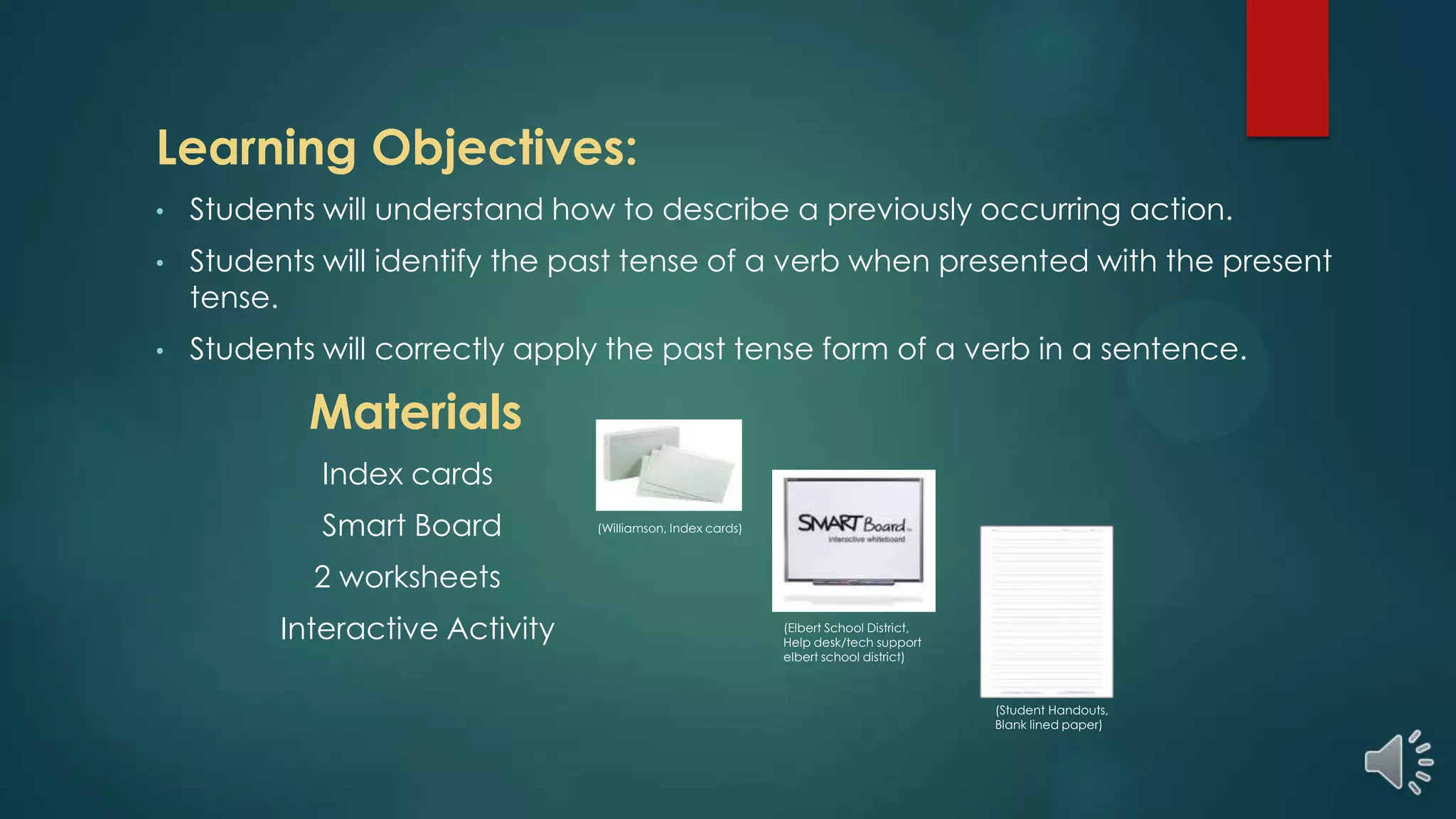
Index cards
Smart Board
2 worksheets
Interactive Activity (Elbert School District,
Help desk/tech support
elbert school district)
(Williamson, Index cards)
(Student Handouts,
Blank lined paper)
Anticipatory Set
 Introduces lesson and assesses prior
knowledge.
On the board, students will be shown pictures of various
actions being performed. Students are to identify
the action and write a sentence describing each
picture. Students will share their answers with the
class.
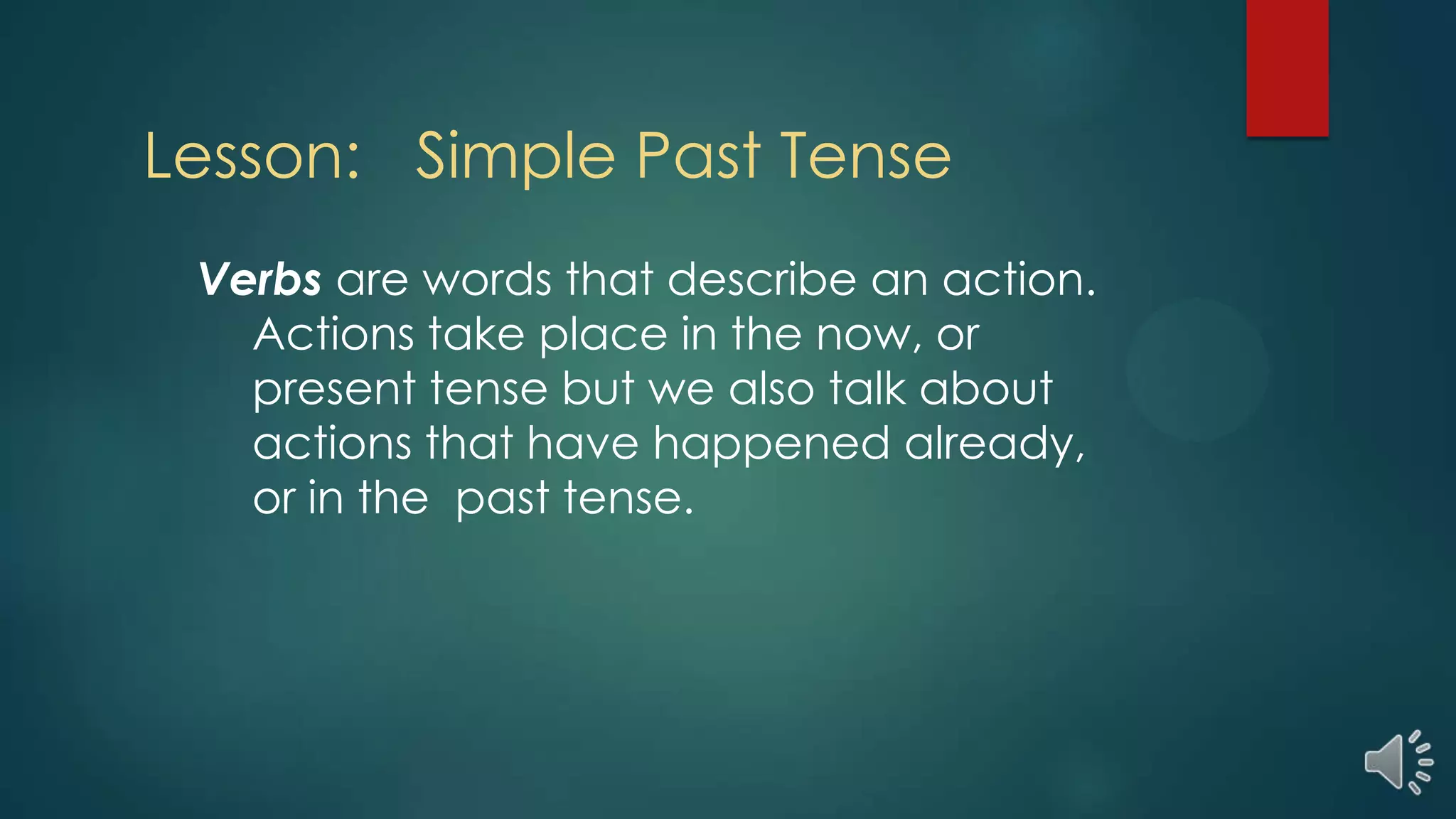
Lesson: Simple Past Tense
Verbs are words that describe an action.
Actions take place in the now, or
present tense but we also talk about
actions that have happened already,
or in the past tense.
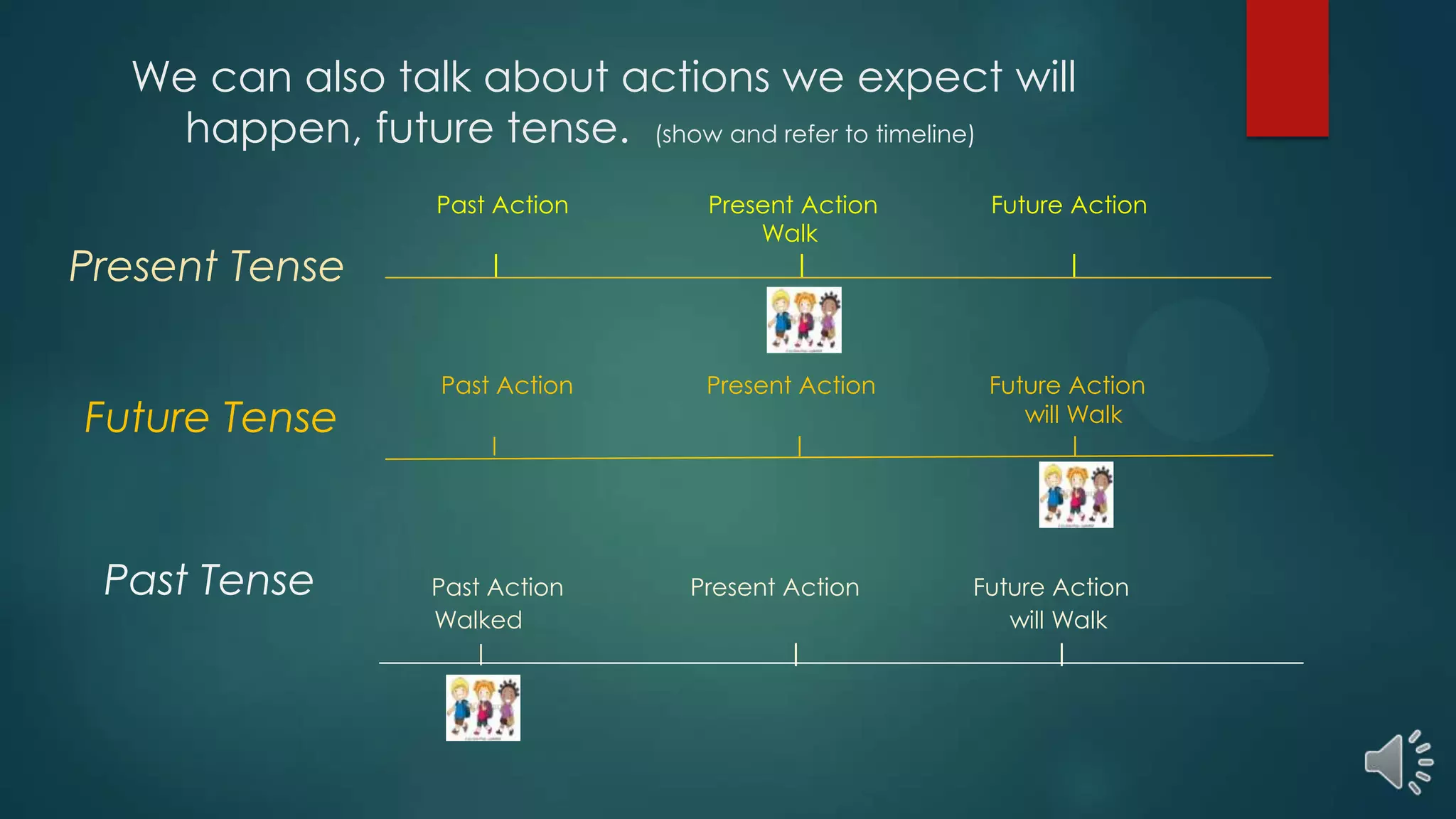
We can also talk about actions we expect will
happen, future tense. (show and refer to timeline)
Past Action Present Action Future Action
Walk
| | |
Past Action Present Action Future Action
will Walk
| | |
Past Action Present Action Future Action
Walked will Walk
| | |
Present Tense
Future Tense
Past Tense
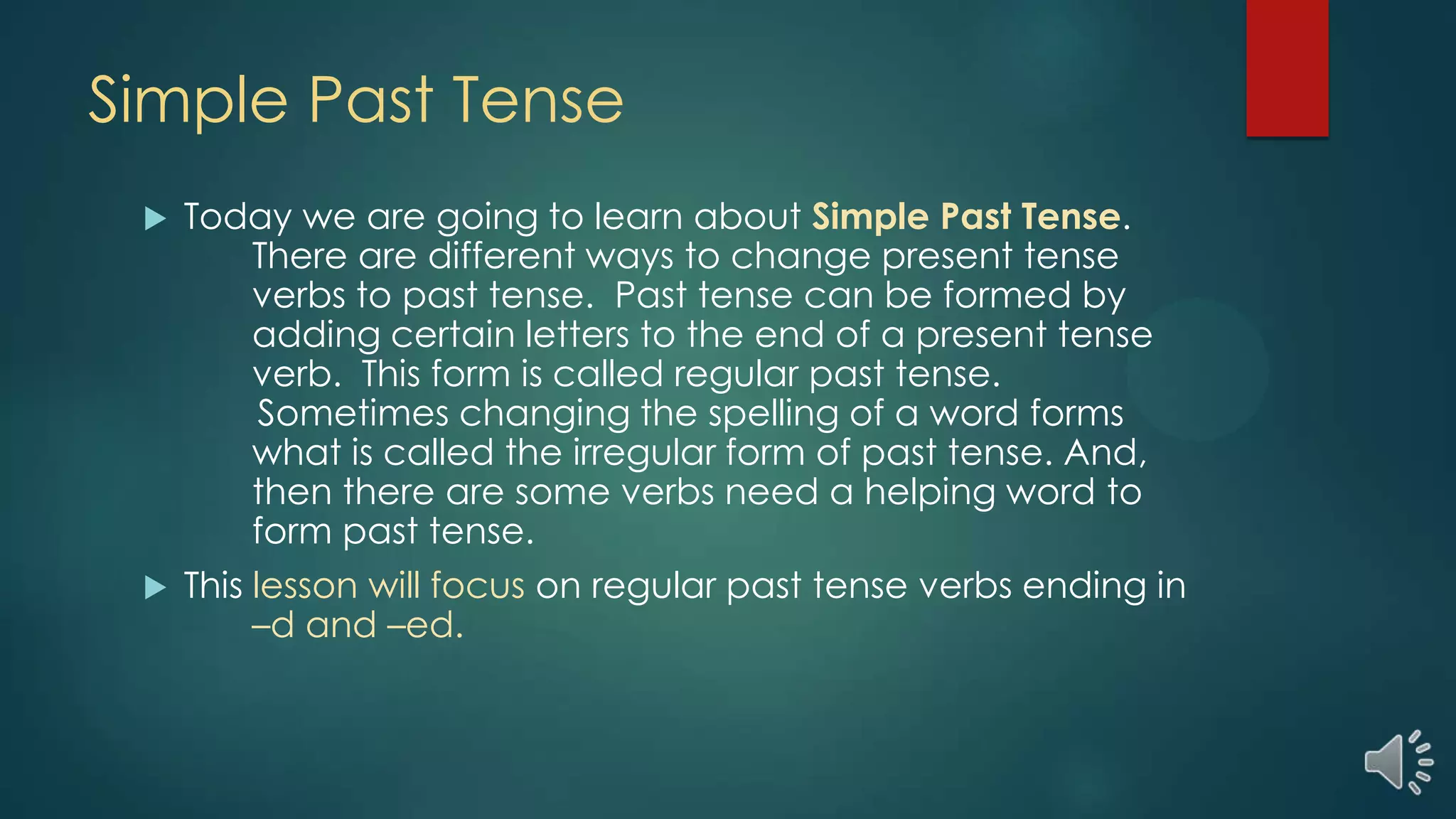
Simple Past Tense
 Today we are going to learn about Simple Past Tense.
There are different ways to change present tense
verbs to past tense. Past tense can be formed by
adding certain letters to the end of a present tense
verb. This form is called regular past tense.
Sometimes changing the spelling of a word forms
what is called the irregular form of past tense. And,
then there are some verbs need a helping word to
form past tense.
 This lesson will focus on regular past tense verbs ending in
–d and –ed.
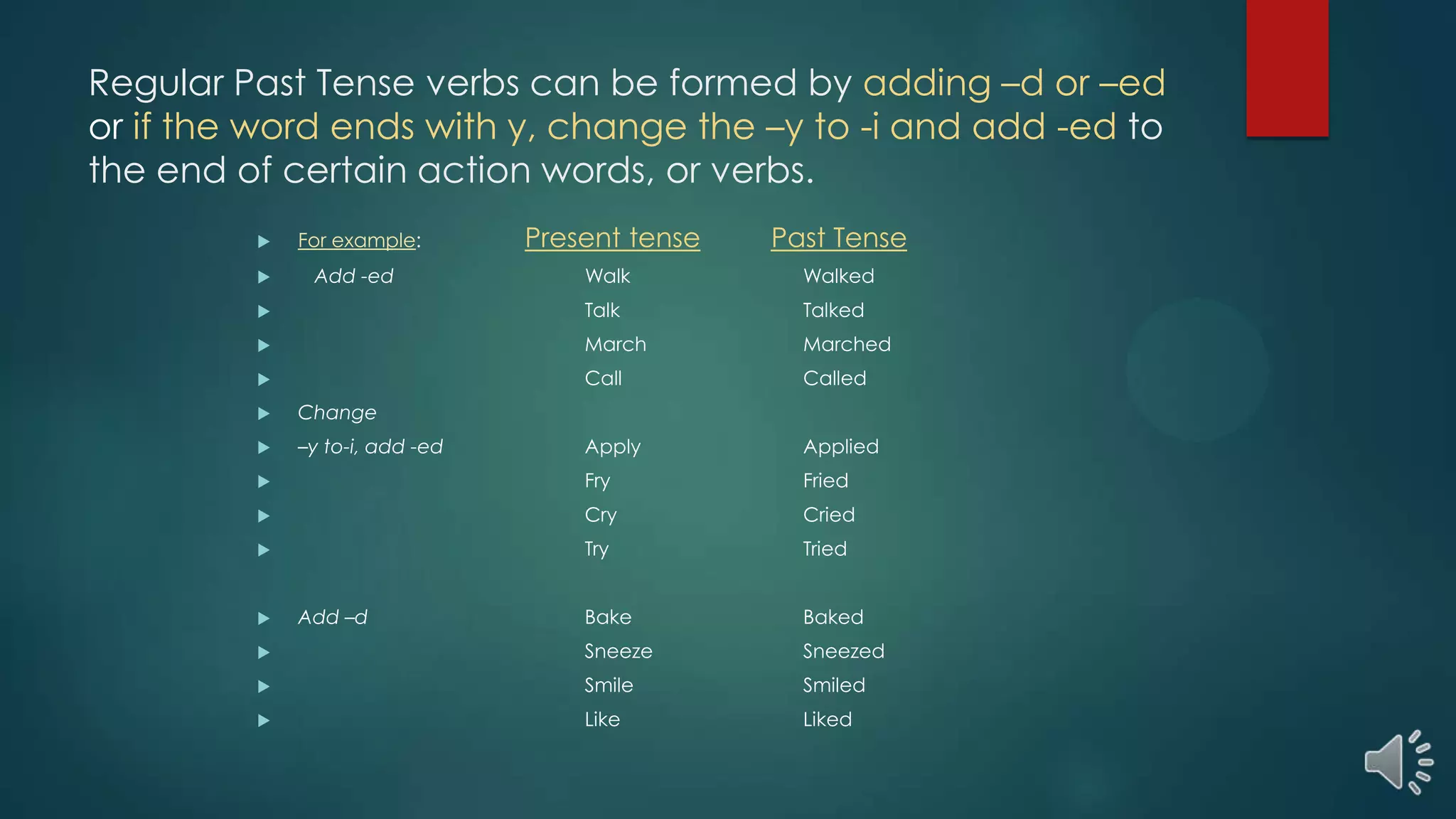
Regular Past Tense verbs can be formed by adding –d or –ed
or if the word ends with y, change the –y to -i and add -ed to
the end of certain action words, or verbs.
 For example: Present tense Past Tense
 Add -ed Walk Walked
 Talk Talked
 March Marched
 Call Called
 Change
 –y to-i, add -ed Apply Applied
 Fry Fried
 Cry Cried
 Try Tried
 Add –d Bake Baked
 Sneeze Sneezed
 Smile Smiled
 Like Liked
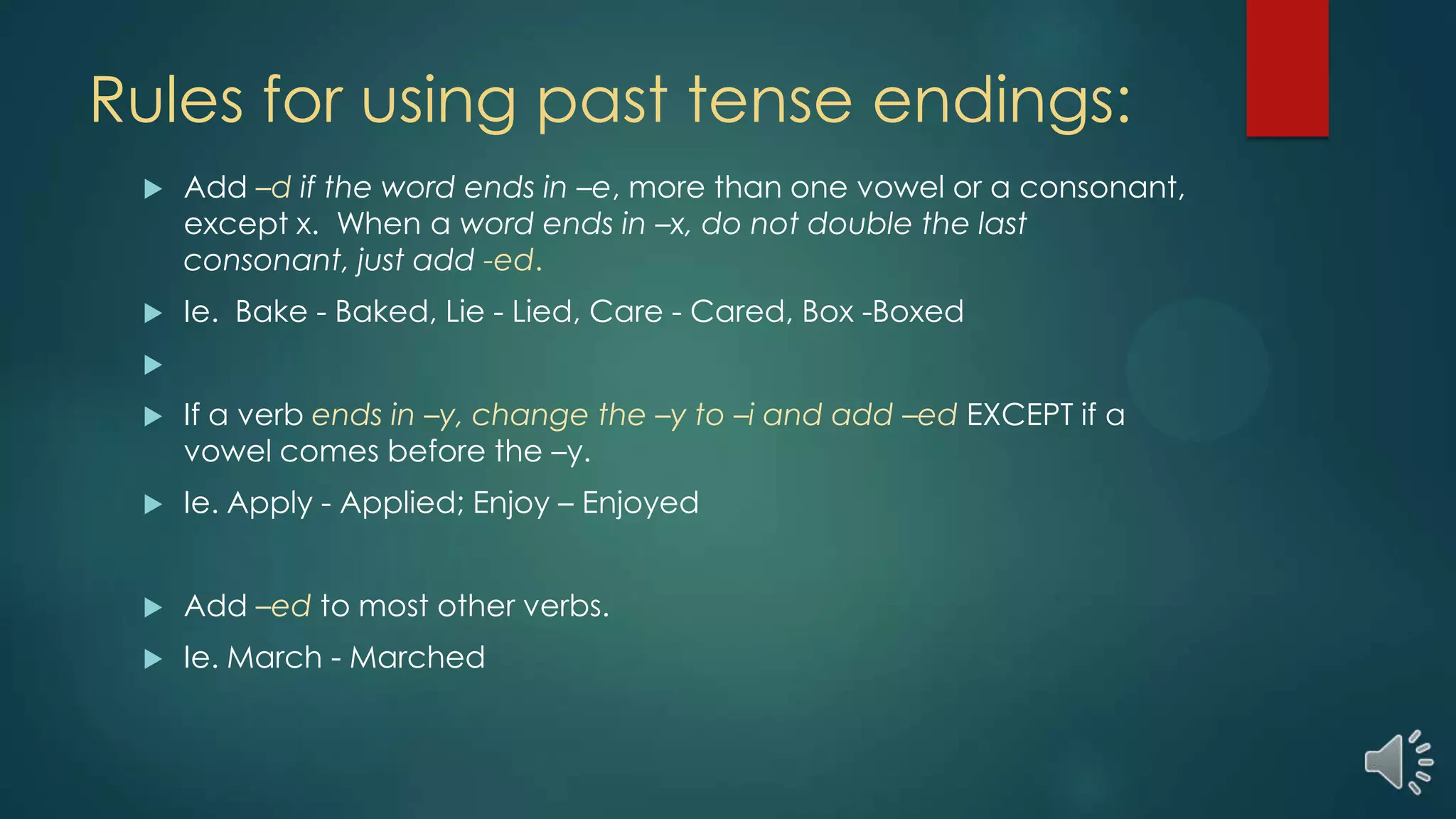
Rules for using past tense endings:
 Add –d if the word ends in –e, more than one vowel or a consonant,
except x. When a word ends in –x, do not double the last
consonant, just add -ed.
 Ie. Bake - Baked, Lie - Lied, Care - Cared, Box -Boxed

 If a verb ends in –y, change the –y to –i and add –ed EXCEPT if a
vowel comes before the –y.
 Ie. Apply - Applied; Enjoy – Enjoyed
 Add –ed to most other verbs.
 Ie. March - Marched
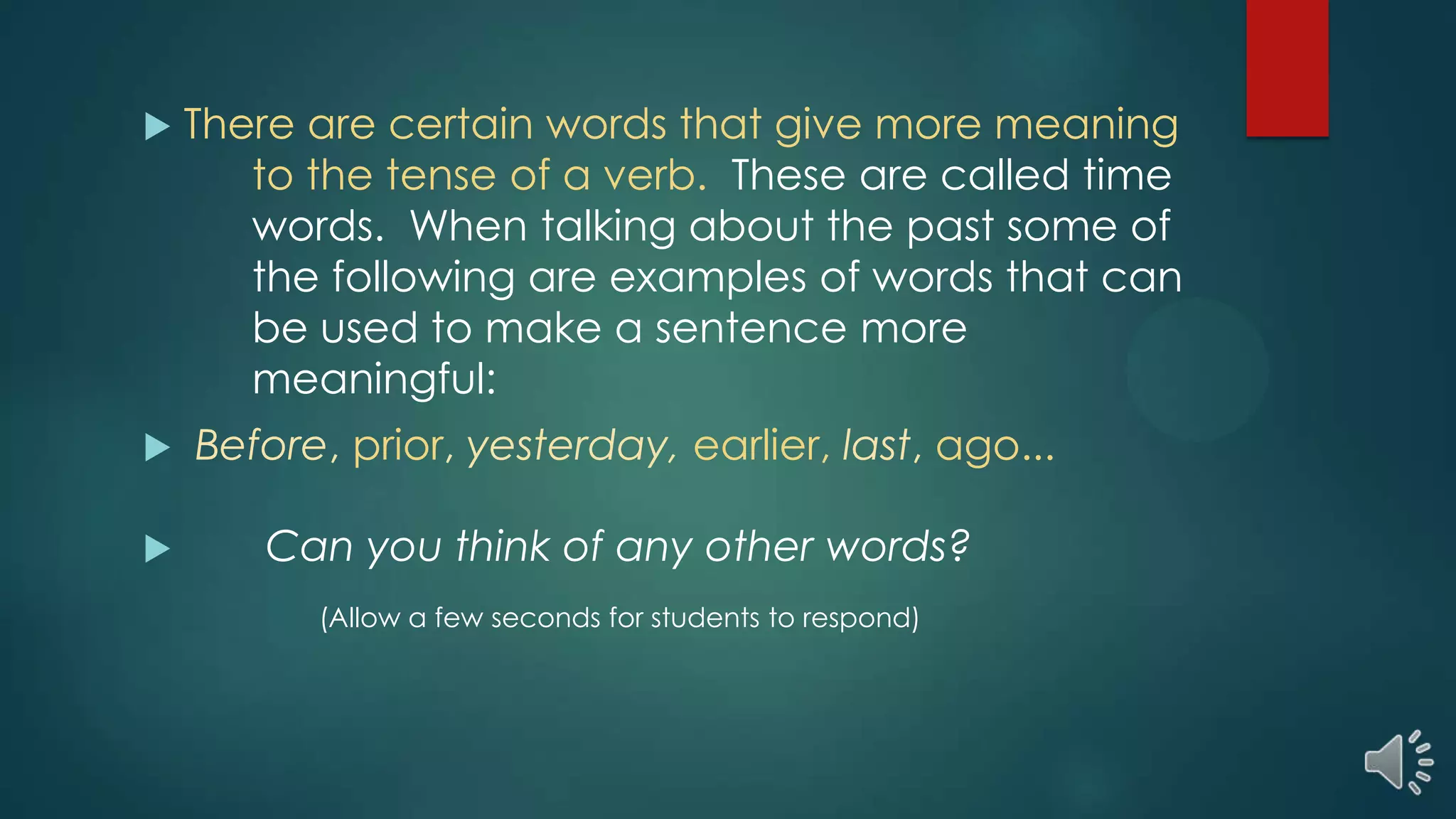
 There are certain words that give more meaning
to the tense of a verb. These are called time
words. When talking about the past some of
the following are examples of words that can
be used to make a sentence more
meaningful:
 Before, prior, yesterday, earlier, last, ago...
 Can you think of any other words?
(Allow a few seconds for students to respond)
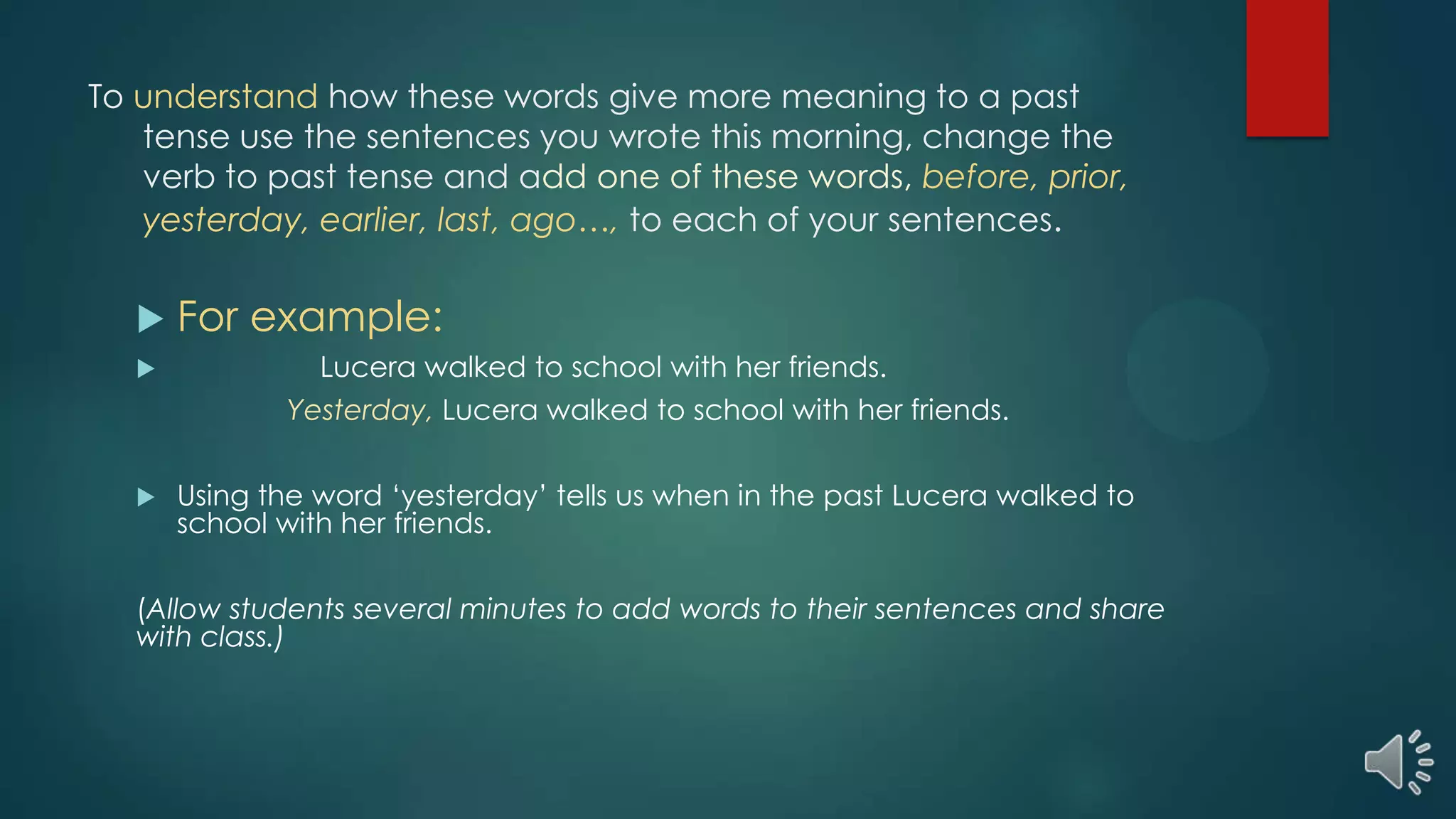
To understand how these words give more meaning to a past
tense use the sentences you wrote this morning, change the
verb to past tense and add one of these words, before, prior,
yesterday, earlier, last, ago…, to each of your sentences.
 For example:
 Lucera walked to school with her friends.
Yesterday, Lucera walked to school with her friends.
 Using the word ‘yesterday’ tells us when in the past Lucera walked to
school with her friends.
(Allow students several minutes to add words to their sentences and share
with class.)
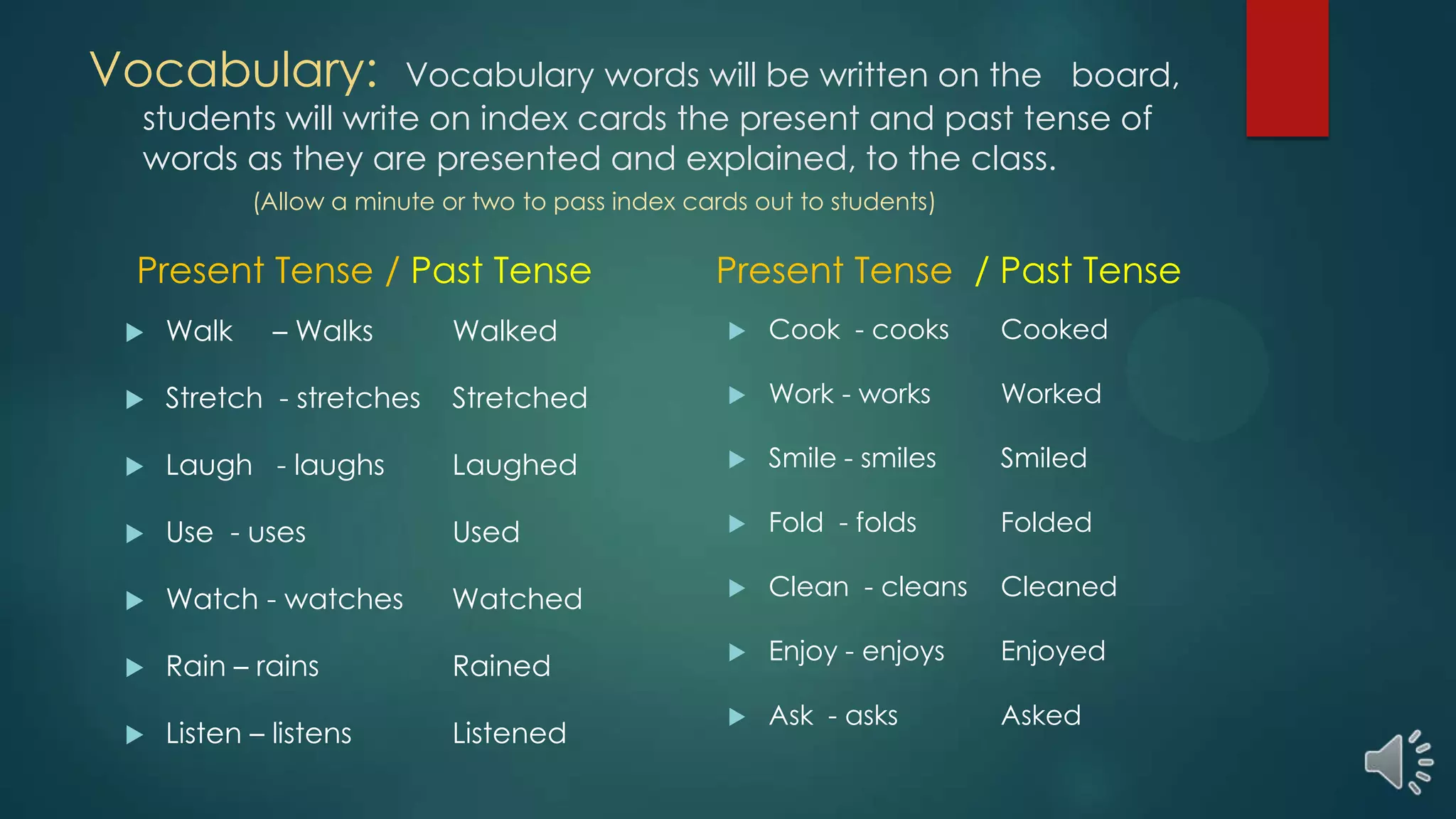
Vocabulary: Vocabulary words will be written on the board,
students will write on index cards the present and past tense of
words as they are presented and explained, to the class.
(Allow a minute or two to pass index cards out to students)
Present Tense / Past Tense
 Walk – Walks Walked
 Stretch - stretches Stretched
 Laugh - laughs Laughed
 Use - uses Used
 Watch - watches Watched
 Rain – rains Rained
 Listen – listens Listened
Present Tense / Past Tense
 Cook - cooks Cooked
 Work - works Worked
 Smile - smiles Smiled
 Fold - folds Folded
 Clean - cleans Cleaned
 Enjoy - enjoys Enjoyed
 Ask - asks Asked
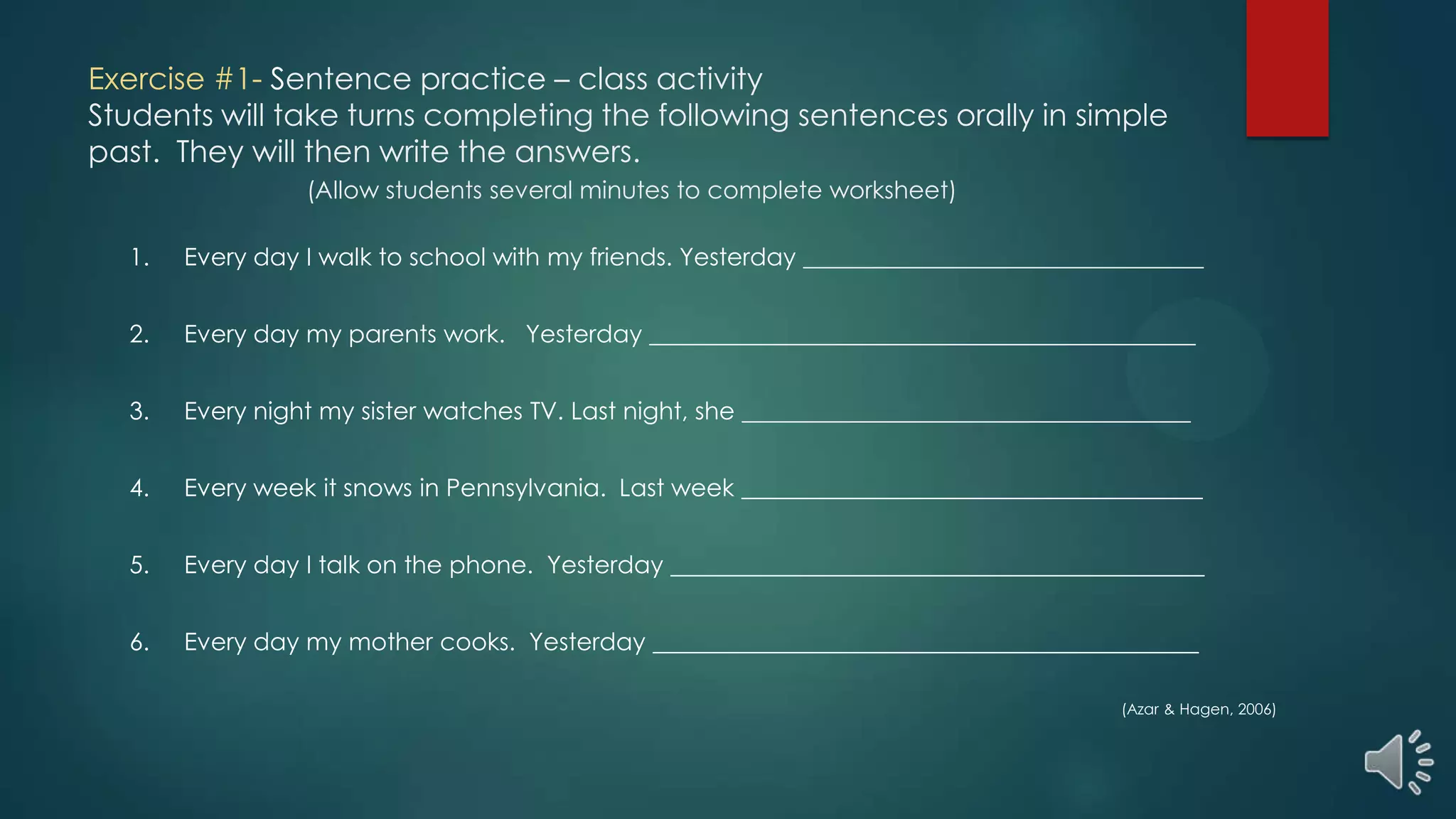
Exercise #1- Sentence practice – class activity
Students will take turns completing the following sentences orally in simple
past. They will then write the answers.
(Allow students several minutes to complete worksheet)
1. Every day I walk to school with my friends. Yesterday _________________________________
2. Every day my parents work. Yesterday _____________________________________________
3. Every night my sister watches TV. Last night, she _____________________________________
4. Every week it snows in Pennsylvania. Last week ______________________________________
5. Every day I talk on the phone. Yesterday ____________________________________________
6. Every day my mother cooks. Yesterday _____________________________________________
(Azar & Hagen, 2006)
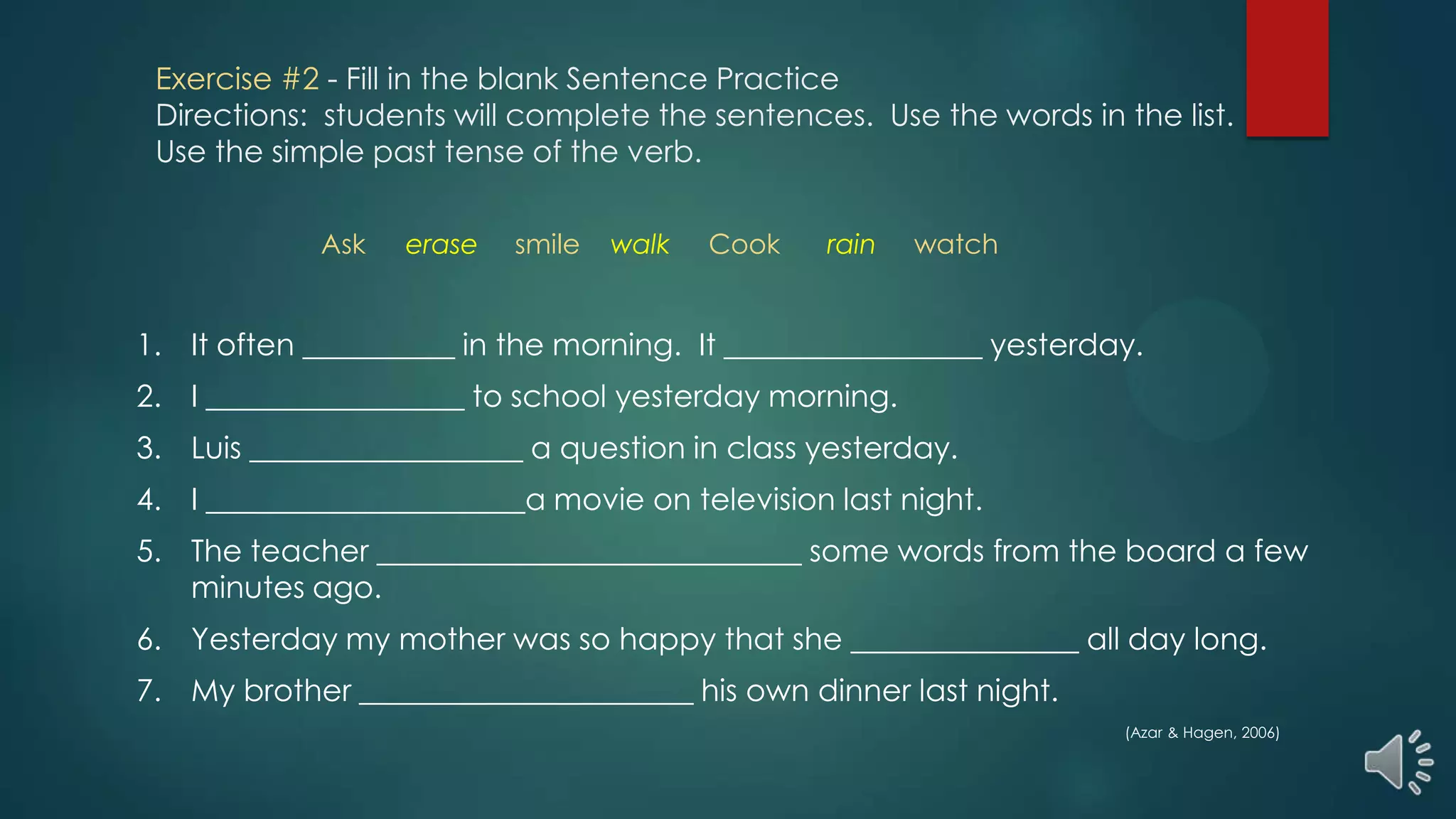
Exercise #2 - Fill in the blank Sentence Practice
Directions: students will complete the sentences. Use the words in the list.
Use the simple past tense of the verb.
1. It often __________ in the morning. It _________________ yesterday.
2. I _________________ to school yesterday morning.
3. Luis __________________ a question in class yesterday.
4. I _____________________a movie on television last night.
5. The teacher ____________________________ some words from the board a few
minutes ago.
6. Yesterday my mother was so happy that she _______________ all day long.
7. My brother ______________________ his own dinner last night.
(Azar & Hagen, 2006)
Ask erase smile walk Cook rain watch
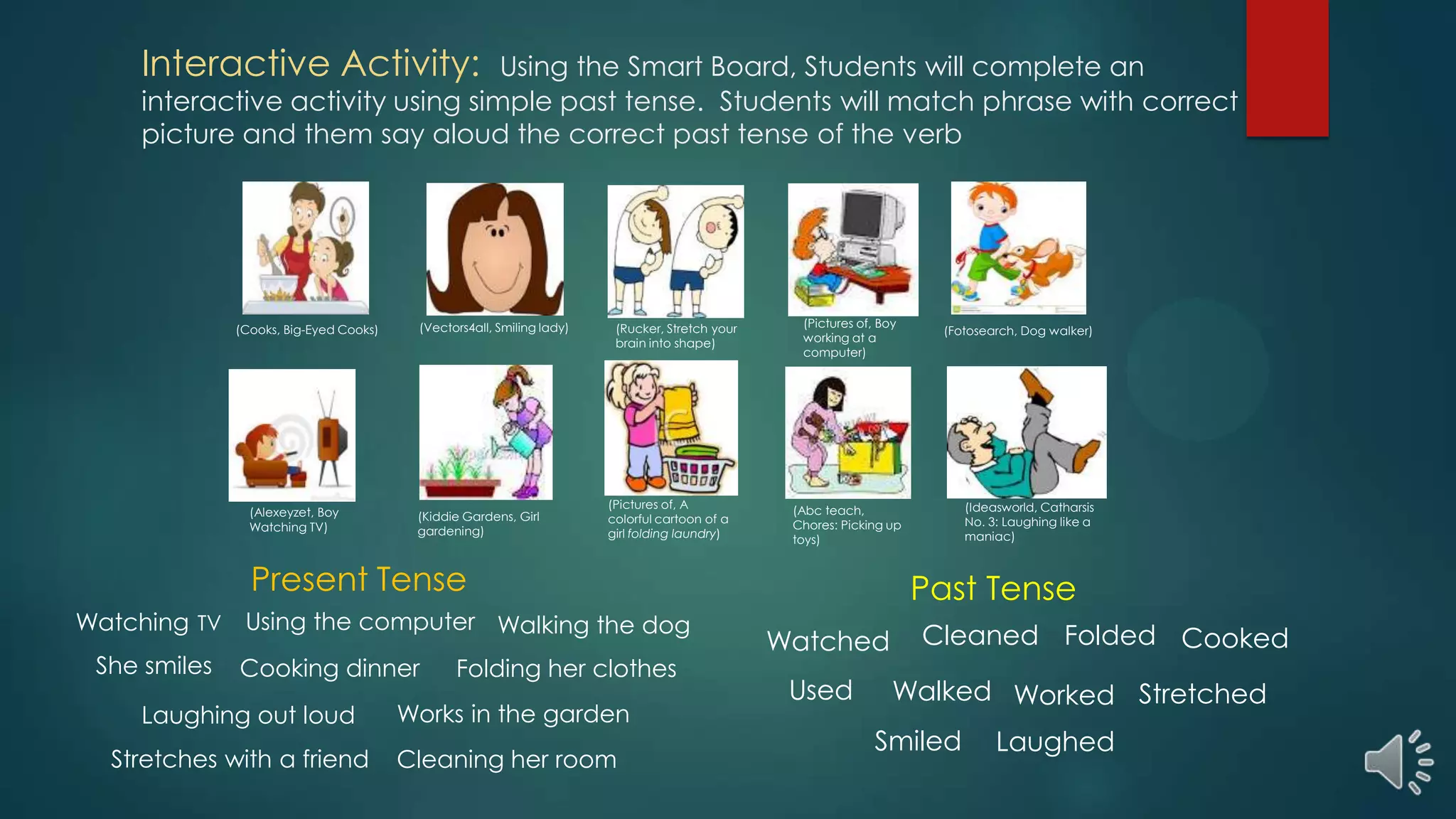
Interactive Activity: Using the Smart Board, Students will complete an
interactive activity using simple past tense. Students will match phrase with correct
picture and them say aloud the correct past tense of the verb
Present Tense Past Tense
Watched Cleaned
Used
Folded
Walked Worked Stretched
Cooked
Smiled Laughed
Watching TV Using the computer Walking the dog
She smiles Cooking dinner Folding her clothes
Laughing out loud Works in the garden
Stretches with a friend Cleaning her room
(Cooks, Big-Eyed Cooks)
(Alexeyzet, Boy
Watching TV)
(Fotosearch, Dog walker)
(Kiddie Gardens, Girl
gardening)
(Pictures of, A
colorful cartoon of a
girl folding laundry)
(Abc teach,
Chores: Picking up
toys)
(Rucker, Stretch your
brain into shape)
(Pictures of, Boy
working at a
computer)
(Ideasworld, Catharsis
No. 3: Laughing like a
maniac)
(Vectors4all, Smiling lady)
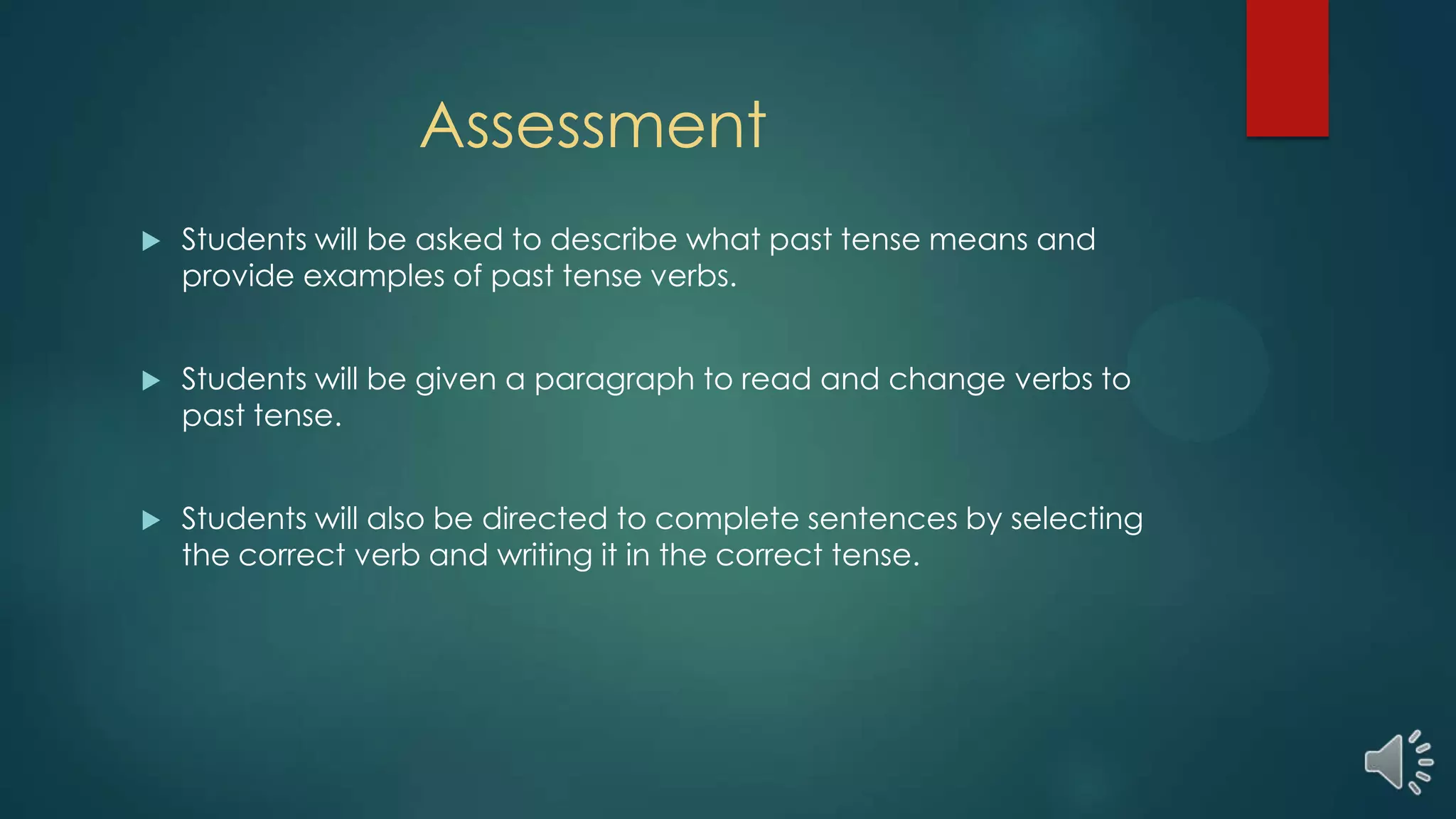
Assessment
 Students will be asked to describe what past tense means and
provide examples of past tense verbs.
 Students will be given a paragraph to read and change verbs to
past tense.
 Students will also be directed to complete sentences by selecting
the correct verb and writing it in the correct tense.
References
Abc teach. (Designer). Chores: Picking up toys [Print Photo]. Retrieved from http://www.abcteach.com/documents/clip-art-kids-chores-picking-up-toys-color-36618
Alexeyzet. (Artist). Boy watching tv [Print Graphic]. Retrieved from http://dreamtime.com
Azar, B., & Hagen, S. (2006). Basic English grammar. (3rd ed., pp. 221-223). White Plains, NY: Pearson Education.
Cooks, B. (Photographer). (2013, January 27). Big-eyed cooks [Print Drawing]. Retrieved from http://bigeyedcooks.com/uncategorized/mamas-big-cooking-part-1-large-casseroles-
and-cooking-for-freezing/attachment/cooking-clipart/
Elbert School District. (Designer). Help desk/tech support elbert school district [Print Photo]. Retrieved from http://www.elbert.k12.ga.us
Fotosearch. (Producer). Dog walker [Print Graphic]. Retrieved from http://www.fotosearch.com/illustration/dog-walker.html
Ideasworld. (Producer). Catharsis No. 3: Laughing like a maniac [Print Photo]. Retrieved from http://www.ideasevolved.com/7-ways-of-dealing-with-failure/
Kiddie Gardens. (Designer). Girl gardening [Print} Graphic]. http://www.kiddiegardens.com/learning_activities.html
Pictures of. (Producer). (2013). A colorful cartoon of a girl folding laundry [Print Graphic]. Retrieved from http://www.picturesof.net/pages/100716-169712-293053.html
Pictures of. (Producer). Boy working at a computer [Print Photo]. Retrieved from http://www.picturesof.net/pages/100415-130694-009042.html
Rucker, K. (Artist). Stretch your brain into shape [Print Graphic]. Retrieved from http://ww2.valdosta.edu/~kfrucker/
Student Handouts. (Photographer). (2014, January 03). Blank lined paper [Print Photo]. Retrieved from http://www.studenthandouts.com
Vectors4all. (Producer). (2013, April 20). Smiling lady [Print Photo]. Retrieved from http://www.vectors4all.net/vectors/smiling-lady-face-clip-art
Williamson, S. (Photographer). (2014, January 06). Index cards [Print Photo]. Retrieved from http://www.husd.org

Mcguire_esl_502 ina_ u09a1_mini-lesson presentation

  • 1.
    Simple Past Tense: aMini – Lesson presented by – Coleen McGuire
  • 2.
    Introduction  The topicof this lesson is simple past tense. English language learners (ELLs) need to understand verb tense and when to apply the appropriate form of a verb as part of their literacy skills development. This lesson has been designed for beginning level, middle school age, English as a Second Language (ESL) learners.
  • 3.
    Learning Objectives: • Studentswill understand how to describe a previously occurring action. • Students will identify the past tense of a verb when presented with the present tense. • Students will correctly apply the past tense form of a verb in a sentence. Materials Index cards Smart Board 2 worksheets Interactive Activity (Elbert School District, Help desk/tech support elbert school district) (Williamson, Index cards) (Student Handouts, Blank lined paper)
  • 4.
    Anticipatory Set  Introduceslesson and assesses prior knowledge. On the board, students will be shown pictures of various actions being performed. Students are to identify the action and write a sentence describing each picture. Students will share their answers with the class.
  • 5.
    Lesson: Simple PastTense Verbs are words that describe an action. Actions take place in the now, or present tense but we also talk about actions that have happened already, or in the past tense.
  • 6.
    We can alsotalk about actions we expect will happen, future tense. (show and refer to timeline) Past Action Present Action Future Action Walk | | | Past Action Present Action Future Action will Walk | | | Past Action Present Action Future Action Walked will Walk | | | Present Tense Future Tense Past Tense
  • 7.
    Simple Past Tense Today we are going to learn about Simple Past Tense. There are different ways to change present tense verbs to past tense. Past tense can be formed by adding certain letters to the end of a present tense verb. This form is called regular past tense. Sometimes changing the spelling of a word forms what is called the irregular form of past tense. And, then there are some verbs need a helping word to form past tense.  This lesson will focus on regular past tense verbs ending in –d and –ed.
  • 8.
    Regular Past Tenseverbs can be formed by adding –d or –ed or if the word ends with y, change the –y to -i and add -ed to the end of certain action words, or verbs.  For example: Present tense Past Tense  Add -ed Walk Walked  Talk Talked  March Marched  Call Called  Change  –y to-i, add -ed Apply Applied  Fry Fried  Cry Cried  Try Tried  Add –d Bake Baked  Sneeze Sneezed  Smile Smiled  Like Liked
  • 9.
    Rules for usingpast tense endings:  Add –d if the word ends in –e, more than one vowel or a consonant, except x. When a word ends in –x, do not double the last consonant, just add -ed.  Ie. Bake - Baked, Lie - Lied, Care - Cared, Box -Boxed   If a verb ends in –y, change the –y to –i and add –ed EXCEPT if a vowel comes before the –y.  Ie. Apply - Applied; Enjoy – Enjoyed  Add –ed to most other verbs.  Ie. March - Marched
  • 10.
     There arecertain words that give more meaning to the tense of a verb. These are called time words. When talking about the past some of the following are examples of words that can be used to make a sentence more meaningful:  Before, prior, yesterday, earlier, last, ago...  Can you think of any other words? (Allow a few seconds for students to respond)
  • 11.
    To understand howthese words give more meaning to a past tense use the sentences you wrote this morning, change the verb to past tense and add one of these words, before, prior, yesterday, earlier, last, ago…, to each of your sentences.  For example:  Lucera walked to school with her friends. Yesterday, Lucera walked to school with her friends.  Using the word ‘yesterday’ tells us when in the past Lucera walked to school with her friends. (Allow students several minutes to add words to their sentences and share with class.)
  • 12.
    Vocabulary: Vocabulary wordswill be written on the board, students will write on index cards the present and past tense of words as they are presented and explained, to the class. (Allow a minute or two to pass index cards out to students) Present Tense / Past Tense  Walk – Walks Walked  Stretch - stretches Stretched  Laugh - laughs Laughed  Use - uses Used  Watch - watches Watched  Rain – rains Rained  Listen – listens Listened Present Tense / Past Tense  Cook - cooks Cooked  Work - works Worked  Smile - smiles Smiled  Fold - folds Folded  Clean - cleans Cleaned  Enjoy - enjoys Enjoyed  Ask - asks Asked
  • 13.
    Exercise #1- Sentencepractice – class activity Students will take turns completing the following sentences orally in simple past. They will then write the answers. (Allow students several minutes to complete worksheet) 1. Every day I walk to school with my friends. Yesterday _________________________________ 2. Every day my parents work. Yesterday _____________________________________________ 3. Every night my sister watches TV. Last night, she _____________________________________ 4. Every week it snows in Pennsylvania. Last week ______________________________________ 5. Every day I talk on the phone. Yesterday ____________________________________________ 6. Every day my mother cooks. Yesterday _____________________________________________ (Azar & Hagen, 2006)
  • 14.
    Exercise #2 -Fill in the blank Sentence Practice Directions: students will complete the sentences. Use the words in the list. Use the simple past tense of the verb. 1. It often __________ in the morning. It _________________ yesterday. 2. I _________________ to school yesterday morning. 3. Luis __________________ a question in class yesterday. 4. I _____________________a movie on television last night. 5. The teacher ____________________________ some words from the board a few minutes ago. 6. Yesterday my mother was so happy that she _______________ all day long. 7. My brother ______________________ his own dinner last night. (Azar & Hagen, 2006) Ask erase smile walk Cook rain watch
  • 15.
    Interactive Activity: Usingthe Smart Board, Students will complete an interactive activity using simple past tense. Students will match phrase with correct picture and them say aloud the correct past tense of the verb Present Tense Past Tense Watched Cleaned Used Folded Walked Worked Stretched Cooked Smiled Laughed Watching TV Using the computer Walking the dog She smiles Cooking dinner Folding her clothes Laughing out loud Works in the garden Stretches with a friend Cleaning her room (Cooks, Big-Eyed Cooks) (Alexeyzet, Boy Watching TV) (Fotosearch, Dog walker) (Kiddie Gardens, Girl gardening) (Pictures of, A colorful cartoon of a girl folding laundry) (Abc teach, Chores: Picking up toys) (Rucker, Stretch your brain into shape) (Pictures of, Boy working at a computer) (Ideasworld, Catharsis No. 3: Laughing like a maniac) (Vectors4all, Smiling lady)
  • 16.
    Assessment  Students willbe asked to describe what past tense means and provide examples of past tense verbs.  Students will be given a paragraph to read and change verbs to past tense.  Students will also be directed to complete sentences by selecting the correct verb and writing it in the correct tense.
  • 17.
    References Abc teach. (Designer).Chores: Picking up toys [Print Photo]. Retrieved from http://www.abcteach.com/documents/clip-art-kids-chores-picking-up-toys-color-36618 Alexeyzet. (Artist). Boy watching tv [Print Graphic]. Retrieved from http://dreamtime.com Azar, B., & Hagen, S. (2006). Basic English grammar. (3rd ed., pp. 221-223). White Plains, NY: Pearson Education. Cooks, B. (Photographer). (2013, January 27). Big-eyed cooks [Print Drawing]. Retrieved from http://bigeyedcooks.com/uncategorized/mamas-big-cooking-part-1-large-casseroles- and-cooking-for-freezing/attachment/cooking-clipart/ Elbert School District. (Designer). Help desk/tech support elbert school district [Print Photo]. Retrieved from http://www.elbert.k12.ga.us Fotosearch. (Producer). Dog walker [Print Graphic]. Retrieved from http://www.fotosearch.com/illustration/dog-walker.html Ideasworld. (Producer). Catharsis No. 3: Laughing like a maniac [Print Photo]. Retrieved from http://www.ideasevolved.com/7-ways-of-dealing-with-failure/ Kiddie Gardens. (Designer). Girl gardening [Print} Graphic]. http://www.kiddiegardens.com/learning_activities.html Pictures of. (Producer). (2013). A colorful cartoon of a girl folding laundry [Print Graphic]. Retrieved from http://www.picturesof.net/pages/100716-169712-293053.html Pictures of. (Producer). Boy working at a computer [Print Photo]. Retrieved from http://www.picturesof.net/pages/100415-130694-009042.html Rucker, K. (Artist). Stretch your brain into shape [Print Graphic]. Retrieved from http://ww2.valdosta.edu/~kfrucker/ Student Handouts. (Photographer). (2014, January 03). Blank lined paper [Print Photo]. Retrieved from http://www.studenthandouts.com Vectors4all. (Producer). (2013, April 20). Smiling lady [Print Photo]. Retrieved from http://www.vectors4all.net/vectors/smiling-lady-face-clip-art Williamson, S. (Photographer). (2014, January 06). Index cards [Print Photo]. Retrieved from http://www.husd.org