UNIVERSITY OF PANAMA
COLLEGE OF HUMANITIES
ENGLISH DEPARTMENT
THE SIMPLE PAST TENSE
BY
PROFESSOR MARISOL ORTEGA DE ALVAREZ
English grammar is a set of rules that describe the structure of the
language. We use grammar all the time when we speak or write. The
study of grammar is necessary for the correct use of the English
language; especially, the written language since the written language
is more formal than the spoken language. The spoken language or
literary dialogue puts up with many grammar mistakes that are part of
a person, or cultural group, or part of the written language of the
author of an article or literary work. Grammar is the structural
foundation of our ability to express ourselves. The more we are aware
of how it works, the more we can monitor the meaning and
effectiveness of the way we and others use language. It can help
foster precision, detect ambiguity, and exploit the richness of
expression available in English. And it can help everyone--not only
teachers of English, but teachers of anything, for all teaching is
ultimately a matter of getting to grips with meaning. (David Crystal, "In
Word and Deed," TES Teacher, April 30, 2004)
Structure:
I, you, he, she, it, we, you, they + VERB (PAST FORM) + Complement
Positive Negative Yes/no
question
Wh-question
He stayed in
Panama.
He didn’t stay in
Panama.
Did he stay in
Panama?
Where did he
stay?
THE SIMPLE PAST TENSE
Note: When the auxiliary did is used in the sentence, the verb goes
back to its base form.
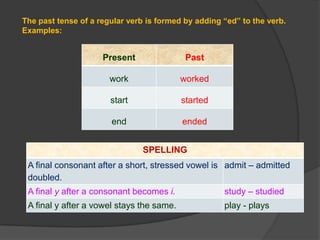
Present Past
work worked
start started
end ended
SPELLING
A final consonant after a short, stressed vowel is
doubled.
admit – admitted
A final y after a consonant becomes i. study – studied
A final y after a vowel stays the same. play - played
The past tense of a regular verb is formed by adding “ed” to the verb.
Examples:
 We use the Simple Past to express the idea that an
action started and finished at a specific time in the
past.
Examples:
I saw a movie yesterday.
He came with his brother.
They studied for two hours.
 The Simple Past can also be used to describe past
facts or generalizations which are no longer true.
Examples:
I didn’t like apples before.
They lived in England two years ago.
He had two houses, but he sold them.
ASSIGNMENT
Order the following sentences using the past tense.
1. It a lot rain
___________________________________
2. My help me mother
________________________________
3. They street cross
___________________________________
4. yesterday they come
_____________________________________
5. stay Bill home
______________________________________
Change the following sentences to questions
beginning with the given question word.
1. The lesson began at 7 o clock. What time ________________?
2. They got home at 9 o clock last night What time ______________?
3. Those books cost four dollars. How much ___________________?
4. They traveled by plane. How _______________________?
5. They met at the restaurant. Where ___________ ?
6. They lived in Panama. Where___________________?
7. She taught us spelling. What _______________?
8. They ate apples for dinner. _________________?
Write down the past tense form of the following words. Mind
the exceptions in spelling.
Have __________________
Sit ____________________
Run ___________________
Stop ___________________
Lie _____________________
End ____________________
Play ___________________
Begin __________________
Agree __________________
Cry ____________________
 We use 'used to' when we want to emphasize that something
happened regularly in the past but no longer happens.
Structure:
 The structure used to + infinitive only exists in the past.
Examples:
I used to play tennis when I was young.
She used to teach physics at the University of Panama.
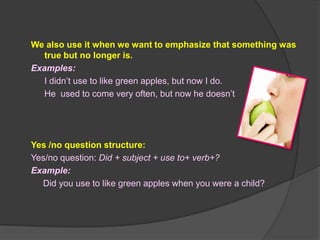
We also use it when we want to emphasize that something was
true but no longer is.
Examples:
I didn’t use to like green apples, but now I do.
He used to come very often, but now he doesn’t
Yes /no question structure:
Yes/no question: Did + subject + use to+ verb+?
Example:
Did you use to like green apples when you were a child?
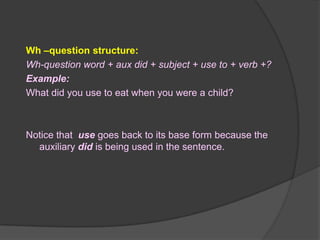
Wh –question structure:
Wh-question word + aux did + subject + use to + verb +?
Example:
What did you use to eat when you were a child?
Notice that use goes back to its base form because the
auxiliary did is being used in the sentence.
Complete the sentences with the appropriate form of
used to and the verb in brackets.
1. It is difficult for Bill to drive in Panama. He ____________________(drive) on
such narrow streets.
2. Gloria didn’t ___________________ (have) a blackberry, but now she does.
3. Computers _________________(be) very expensive. Now the prices are
more reasonable.
4. People from Jamaica __________________ (eat) spicy food. They find our
food tasteless.
5. When Carlos was young, he ________________ (ride) a bicycle to school.
Verb to be – Simple past
Singular Plural
I was We were
You were You were
He was They were
She was
It was
Examples:
 I was a student.
 My husband was happy.
 She was nice.
 You were sick.
 It was a beautiful picture.
 We were wet.
 You were friends.
 The students were in class.
Negative form
Full form Contracted form
I was not I wasn't
You were not You weren't
He was not He wasn't
She was not She wasn't
It was not It wasn't
We were not We weren't
You were not You weren't
Examples:
 Peter wasn't happy.
 Gloria wasn't tall.
 The house wasn't new.
 The house was not clean.
 We weren't early.
 The men were not smart.
 His friends weren't rich.
Question Form
Singular Plural
Was I ______? Were we _____?
Were you ______? Were you ______?
Was he _____?
Were they _____?
Was she _____?
Was it _____?
Examples:
 Was I late?
 Was the book expensive?
 Were Peter and Andres at school?
 Were your sisters singers?
 Were you busy last night?
Complete each sentence with the past tense form of the
verb "be."
 1. Andres and Marisol ______ here last night. (be)
 2. There ______ a good movie on TV last night. (be)
 3. You and I _______ in the classroom this morning.
(be)
 4. She _______ at home yesterday. (be)
 5. They ______ at the store. (be)
 6. The offices ________ closed. (be)
 7. You _______ a good soccer player some years ago.
(be)
Complete each question with the past tense form of
the verb "be."
 1. ________ she here last month?
 2. ________ I helpful?
 3. ________ it a bad car accident?
 4. ________ the store employees friendly?
 5. ________ a doctor available?
 6. ________ we here before?
 7. ________ the man interested in the book?
Complete each sentence using the contracted negative
form of the past tense of the verb "be“ (wasn't / weren't).
 1. He ________ at work on yesterday
 2. It _________ a difficult test.
 3. You _________ in love with her.
 4. I __________ online last night.
 5. The performers __________ very funny.
 6. There __________ any oranges in the bowl.
 7. The leaders of the organization ________
sensible

Simple Past, used to

  • 1.
    UNIVERSITY OF PANAMA COLLEGEOF HUMANITIES ENGLISH DEPARTMENT THE SIMPLE PAST TENSE BY PROFESSOR MARISOL ORTEGA DE ALVAREZ
  • 2.
    English grammar isa set of rules that describe the structure of the language. We use grammar all the time when we speak or write. The study of grammar is necessary for the correct use of the English language; especially, the written language since the written language is more formal than the spoken language. The spoken language or literary dialogue puts up with many grammar mistakes that are part of a person, or cultural group, or part of the written language of the author of an article or literary work. Grammar is the structural foundation of our ability to express ourselves. The more we are aware of how it works, the more we can monitor the meaning and effectiveness of the way we and others use language. It can help foster precision, detect ambiguity, and exploit the richness of expression available in English. And it can help everyone--not only teachers of English, but teachers of anything, for all teaching is ultimately a matter of getting to grips with meaning. (David Crystal, "In Word and Deed," TES Teacher, April 30, 2004)
  • 3.
    Structure: I, you, he,she, it, we, you, they + VERB (PAST FORM) + Complement Positive Negative Yes/no question Wh-question He stayed in Panama. He didn’t stay in Panama. Did he stay in Panama? Where did he stay? THE SIMPLE PAST TENSE Note: When the auxiliary did is used in the sentence, the verb goes back to its base form.
  • 4.
    Present Past work worked startstarted end ended SPELLING A final consonant after a short, stressed vowel is doubled. admit – admitted A final y after a consonant becomes i. study – studied A final y after a vowel stays the same. play - played The past tense of a regular verb is formed by adding “ed” to the verb. Examples:
  • 5.
     We usethe Simple Past to express the idea that an action started and finished at a specific time in the past. Examples: I saw a movie yesterday. He came with his brother. They studied for two hours.  The Simple Past can also be used to describe past facts or generalizations which are no longer true. Examples: I didn’t like apples before. They lived in England two years ago. He had two houses, but he sold them.
  • 6.
    ASSIGNMENT Order the followingsentences using the past tense. 1. It a lot rain ___________________________________ 2. My help me mother ________________________________ 3. They street cross ___________________________________ 4. yesterday they come _____________________________________ 5. stay Bill home ______________________________________
  • 7.
    Change the followingsentences to questions beginning with the given question word. 1. The lesson began at 7 o clock. What time ________________? 2. They got home at 9 o clock last night What time ______________? 3. Those books cost four dollars. How much ___________________? 4. They traveled by plane. How _______________________? 5. They met at the restaurant. Where ___________ ? 6. They lived in Panama. Where___________________? 7. She taught us spelling. What _______________? 8. They ate apples for dinner. _________________?
  • 8.
    Write down thepast tense form of the following words. Mind the exceptions in spelling. Have __________________ Sit ____________________ Run ___________________ Stop ___________________ Lie _____________________ End ____________________ Play ___________________ Begin __________________ Agree __________________ Cry ____________________
  • 9.
     We use'used to' when we want to emphasize that something happened regularly in the past but no longer happens. Structure:  The structure used to + infinitive only exists in the past. Examples: I used to play tennis when I was young. She used to teach physics at the University of Panama.
  • 10.
    We also useit when we want to emphasize that something was true but no longer is. Examples: I didn’t use to like green apples, but now I do. He used to come very often, but now he doesn’t Yes /no question structure: Yes/no question: Did + subject + use to+ verb+? Example: Did you use to like green apples when you were a child?
  • 11.
    Wh –question structure: Wh-questionword + aux did + subject + use to + verb +? Example: What did you use to eat when you were a child? Notice that use goes back to its base form because the auxiliary did is being used in the sentence.
  • 12.
    Complete the sentenceswith the appropriate form of used to and the verb in brackets. 1. It is difficult for Bill to drive in Panama. He ____________________(drive) on such narrow streets. 2. Gloria didn’t ___________________ (have) a blackberry, but now she does. 3. Computers _________________(be) very expensive. Now the prices are more reasonable. 4. People from Jamaica __________________ (eat) spicy food. They find our food tasteless. 5. When Carlos was young, he ________________ (ride) a bicycle to school.
  • 13.
    Verb to be– Simple past Singular Plural I was We were You were You were He was They were She was It was
  • 14.
    Examples:  I wasa student.  My husband was happy.  She was nice.  You were sick.  It was a beautiful picture.  We were wet.  You were friends.  The students were in class.
  • 15.
    Negative form Full formContracted form I was not I wasn't You were not You weren't He was not He wasn't She was not She wasn't It was not It wasn't We were not We weren't You were not You weren't
  • 16.
    Examples:  Peter wasn'thappy.  Gloria wasn't tall.  The house wasn't new.  The house was not clean.  We weren't early.  The men were not smart.  His friends weren't rich.
  • 17.
    Question Form Singular Plural WasI ______? Were we _____? Were you ______? Were you ______? Was he _____? Were they _____? Was she _____? Was it _____?
  • 18.
    Examples:  Was Ilate?  Was the book expensive?  Were Peter and Andres at school?  Were your sisters singers?  Were you busy last night?
  • 19.
    Complete each sentencewith the past tense form of the verb "be."  1. Andres and Marisol ______ here last night. (be)  2. There ______ a good movie on TV last night. (be)  3. You and I _______ in the classroom this morning. (be)  4. She _______ at home yesterday. (be)  5. They ______ at the store. (be)  6. The offices ________ closed. (be)  7. You _______ a good soccer player some years ago. (be)
  • 20.
    Complete each questionwith the past tense form of the verb "be."  1. ________ she here last month?  2. ________ I helpful?  3. ________ it a bad car accident?  4. ________ the store employees friendly?  5. ________ a doctor available?  6. ________ we here before?  7. ________ the man interested in the book?
  • 21.
    Complete each sentenceusing the contracted negative form of the past tense of the verb "be“ (wasn't / weren't).  1. He ________ at work on yesterday  2. It _________ a difficult test.  3. You _________ in love with her.  4. I __________ online last night.  5. The performers __________ very funny.  6. There __________ any oranges in the bowl.  7. The leaders of the organization ________ sensible