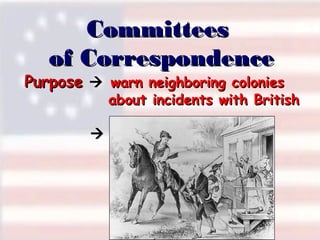
Committees
of Correspondence

Purpose  warn neighboring colonies

about incidents with British


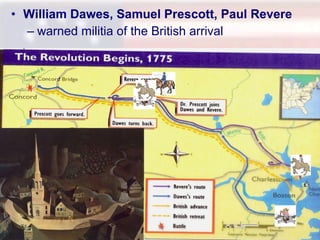
• William Dawes, Samuel Prescott, Paul Revere
– warned militia of the British arrival
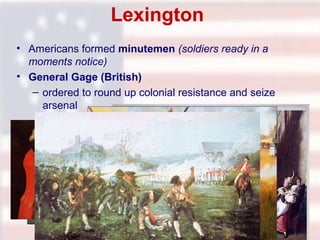
Lexington
• Americans formed minutemen (soldiers ready in a
moments notice)
• General Gage (British)
– ordered to round up colonial resistance and seize
arsenal

The Shot Heard
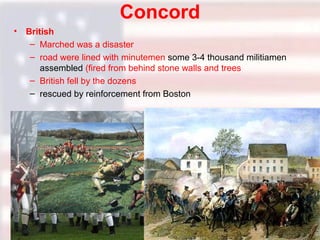
Concord
•

British
– Marched was a disaster
– road were lined with minutemen some 3-4 thousand militiamen
assembled (fired from behind stone walls and trees
– British fell by the dozens
– rescued by reinforcement from Boston
Division
– Loyalist
• Support king (Crown or monarch)

– Patriots
• Support independence

– Radicals
– “I know not what course others may take; but as for me,
give me liberty or give me death” (Patrick Henry)
Advantages
Patriots (Ame.)

British

•

•

•

Advantages (Continental
Army)
– defending homeland
– Know the land
– used hit and run tactics
– supply within reach
– aided by France
Disadvantages
– few soldiers have
experiences
– lack of strong navy

•

Advantages (Redcoats)
– generals and soldiers had
wide experiences
– well-supplied with
ammunition, food, money
– Has a strong navies
disadvantages
– Supplies and
reinforcements takes
months to arrive
– faced with new type of
warfare
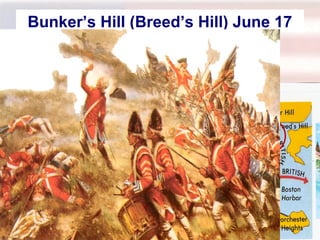
Bunker’s Hill (Breed’s Hill) June 17
• British wontechnical victory

• American
– moral victory
– proved they could
hold own against
better soldiers
•

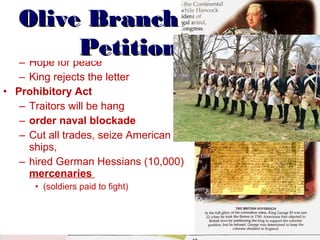
Olive Branch
Letter to King Petition
George III
– Hope for peace

– King rejects the letter
• Prohibitory Act
– Traitors will be hang
– order naval blockade
– Cut all trades, seize American
ships,
– hired German Hessians (10,000)
mercenaries
• (soldiers paid to fight)
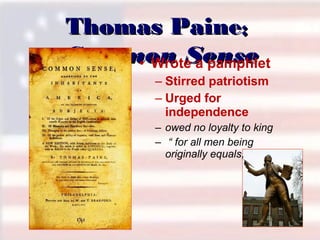
Thomas Paine:
Common Sense
• Wrote a pamphlet
– Stirred patriotism
– Urged for
independence
– owed no loyalty to king
– “ for all men being
originally equals,
•
•

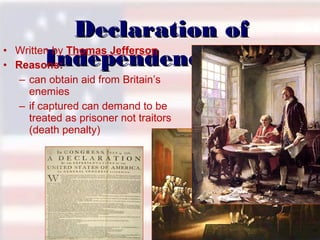
Declaration of
Written by Thomas Jefferson
Independence (1776)
Reasons:
– can obtain aid from Britain’s
enemies
– if captured can demand to be
treated as prisoner not traitors
(death penalty)
Parts of the Declaration:
• preamble– explained the principles behind the act of declaring
independence

• list of all grievances against the king
• conclude with severing ties and becoming independent
– “endowed by their Creator with certain unalienable rights”
“among these are life, liberty and the pursuit of happiness”
– Influence by John Locke- people are the fundamental
source of power “governments derive their just powers
from the consent of the governed”

– July 4, 1776- colonies seized to exist
– America was born
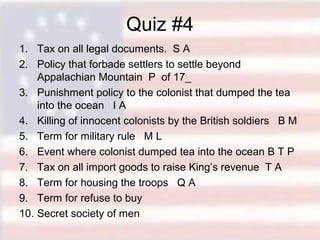
Quiz #4
1. Tax on all legal documents. S A
2. Policy that forbade settlers to settle beyond
Appalachian Mountain P of 17_
3. Punishment policy to the colonist that dumped the tea
into the ocean I A
4. Killing of innocent colonists by the British soldiers B M
5. Term for military rule M L
6. Event where colonist dumped tea into the ocean B T P
7. Tax on all import goods to raise King’s revenue T A
8. Term for housing the troops Q A
9. Term for refuse to buy
10. Secret society of men
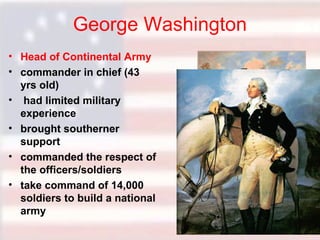
George Washington
• Head of Continental Army
• commander in chief (43
yrs old)
• had limited military
experience
• brought southerner
support
• commanded the respect of
the officers/soldiers
• take command of 14,000
soldiers to build a national
army
Quiz # 5
1. Name the main author of Declaration of Independence
2. Name one reason for writing the Declaration
3. Name the author of Common Sense
4. He said “Give me Liberty or Give me Death.”
5. Name one part of the Declaration of Independence
6. This battle was a moral victory for the Americans
7-8. Name two advantage of the Americans
9-10. Name two advantage of the British
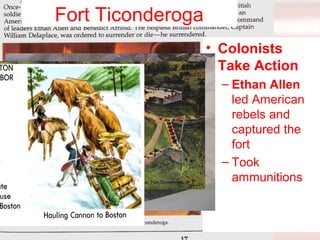
Fort Ticonderoga
• Colonists
Take Action
– Ethan Allen
led American
rebels and
captured the
fort
– Took
ammunitions
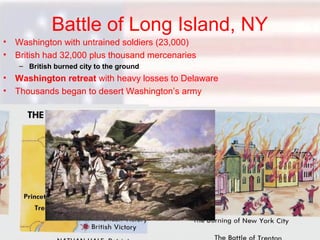
Battle of Long Island, NY
• Washington with untrained soldiers (23,000)
• British had 32,000 plus thousand mercenaries
– British burned city to the ground

• Washington retreat with heavy losses to Delaware
• Thousands began to desert Washington’s army
•
•

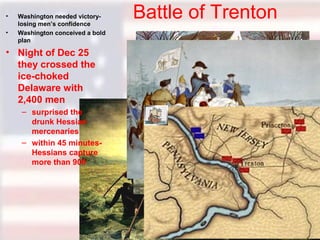
Washington needed victorylosing men’s confidence
Washington conceived a bold
plan

• Night of Dec 25
they crossed the
ice-choked
Delaware with
2,400 men
– surprised the
drunk Hessian
mercenaries
– within 45 minutesHessians capture
more than 900

Battle of Trenton
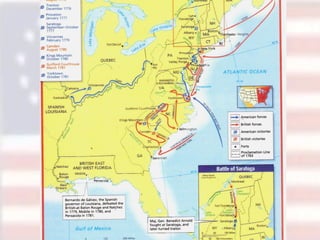
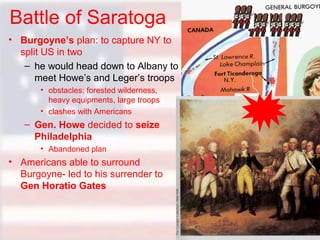
Battle of Saratoga
• Burgoyne’s plan: to capture NY to
split US in two
– he would head down to Albany to
meet Howe’s and Leger’s troops
• obstacles: forested wilderness,
heavy equipments, large troops
• clashes with Americans

– Gen. Howe decided to seize
Philadelphia
• Abandoned plan

• Americans able to surround
Burgoyne- led to his surrender to
Gen Horatio Gates
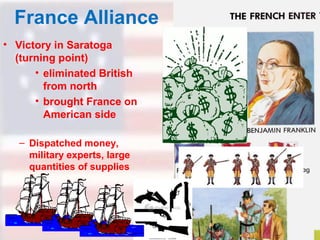
France Alliance
• Victory in Saratoga
(turning point)
• eliminated British
from north
• brought France on
American side
– Dispatched money,
military experts, large
quantities of supplies
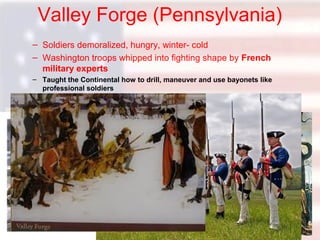
Valley Forge (Pennsylvania)
– Soldiers demoralized, hungry, winter- cold
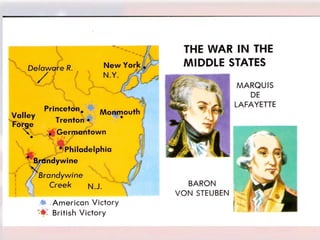
– Washington troops whipped into fighting shape by French
military experts
– Taught the Continental how to drill, maneuver and use bayonets like
professional soldiers
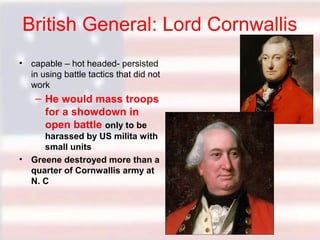
British General: Lord Cornwallis
• capable – hot headed- persisted
in using battle tactics that did not
work

– He would mass troops
for a showdown in
open battle only to be
harassed by US milita with
small units
• Greene destroyed more than a
quarter of Cornwallis army at
N. C
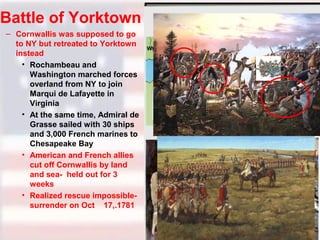
Battle of Yorktown
– Cornwallis was supposed to go
to NY but retreated to Yorktown
instead
• Rochambeau and
Washington marched forces
overland from NY to join
Marqui de Lafayette in
Virginia
• At the same time, Admiral de
Grasse sailed with 30 ships
and 3,000 French marines to
Chesapeake Bay
• American and French allies
cut off Cornwallis by land
and sea- held out for 3
weeks
• Realized rescue impossiblesurrender on Oct 17,.1781
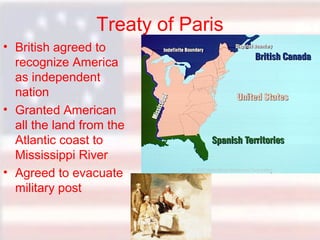
Treaty of Paris
• British agreed to
recognize America
as independent
nation
• Granted American
all the land from the
Atlantic coast to
Mississippi River
• Agreed to evacuate
military post
Road to Revolution
Road to Revolution
Road to Revolution

Road to Revolution

  • 3.
    Committees of Correspondence Purpose warn neighboring colonies about incidents with British 
  • 4.
    • William Dawes,Samuel Prescott, Paul Revere – warned militia of the British arrival
  • 5.
    Lexington • Americans formedminutemen (soldiers ready in a moments notice) • General Gage (British) – ordered to round up colonial resistance and seize arsenal The Shot Heard
  • 6.
    Concord • British – Marched wasa disaster – road were lined with minutemen some 3-4 thousand militiamen assembled (fired from behind stone walls and trees – British fell by the dozens – rescued by reinforcement from Boston
  • 7.
    Division – Loyalist • Supportking (Crown or monarch) – Patriots • Support independence – Radicals – “I know not what course others may take; but as for me, give me liberty or give me death” (Patrick Henry)
  • 8.
    Advantages Patriots (Ame.) British • • • Advantages (Continental Army) –defending homeland – Know the land – used hit and run tactics – supply within reach – aided by France Disadvantages – few soldiers have experiences – lack of strong navy • Advantages (Redcoats) – generals and soldiers had wide experiences – well-supplied with ammunition, food, money – Has a strong navies disadvantages – Supplies and reinforcements takes months to arrive – faced with new type of warfare
  • 9.
    Bunker’s Hill (Breed’sHill) June 17 • British wontechnical victory • American – moral victory – proved they could hold own against better soldiers
  • 10.
    • Olive Branch Letter toKing Petition George III – Hope for peace – King rejects the letter • Prohibitory Act – Traitors will be hang – order naval blockade – Cut all trades, seize American ships, – hired German Hessians (10,000) mercenaries • (soldiers paid to fight)
  • 11.
    Thomas Paine: Common Sense •Wrote a pamphlet – Stirred patriotism – Urged for independence – owed no loyalty to king – “ for all men being originally equals,
  • 12.
    • • Declaration of Written byThomas Jefferson Independence (1776) Reasons: – can obtain aid from Britain’s enemies – if captured can demand to be treated as prisoner not traitors (death penalty)
  • 13.
    Parts of theDeclaration: • preamble– explained the principles behind the act of declaring independence • list of all grievances against the king • conclude with severing ties and becoming independent – “endowed by their Creator with certain unalienable rights” “among these are life, liberty and the pursuit of happiness” – Influence by John Locke- people are the fundamental source of power “governments derive their just powers from the consent of the governed” – July 4, 1776- colonies seized to exist – America was born
  • 14.
    Quiz #4 1. Taxon all legal documents. S A 2. Policy that forbade settlers to settle beyond Appalachian Mountain P of 17_ 3. Punishment policy to the colonist that dumped the tea into the ocean I A 4. Killing of innocent colonists by the British soldiers B M 5. Term for military rule M L 6. Event where colonist dumped tea into the ocean B T P 7. Tax on all import goods to raise King’s revenue T A 8. Term for housing the troops Q A 9. Term for refuse to buy 10. Secret society of men
  • 16.
    George Washington • Headof Continental Army • commander in chief (43 yrs old) • had limited military experience • brought southerner support • commanded the respect of the officers/soldiers • take command of 14,000 soldiers to build a national army
  • 17.
    Quiz # 5 1.Name the main author of Declaration of Independence 2. Name one reason for writing the Declaration 3. Name the author of Common Sense 4. He said “Give me Liberty or Give me Death.” 5. Name one part of the Declaration of Independence 6. This battle was a moral victory for the Americans 7-8. Name two advantage of the Americans 9-10. Name two advantage of the British
  • 19.
    Fort Ticonderoga • Colonists TakeAction – Ethan Allen led American rebels and captured the fort – Took ammunitions
  • 20.
    Battle of LongIsland, NY • Washington with untrained soldiers (23,000) • British had 32,000 plus thousand mercenaries – British burned city to the ground • Washington retreat with heavy losses to Delaware • Thousands began to desert Washington’s army
  • 21.
    • • Washington needed victorylosingmen’s confidence Washington conceived a bold plan • Night of Dec 25 they crossed the ice-choked Delaware with 2,400 men – surprised the drunk Hessian mercenaries – within 45 minutesHessians capture more than 900 Battle of Trenton
  • 22.
    Battle of Saratoga •Burgoyne’s plan: to capture NY to split US in two – he would head down to Albany to meet Howe’s and Leger’s troops • obstacles: forested wilderness, heavy equipments, large troops • clashes with Americans – Gen. Howe decided to seize Philadelphia • Abandoned plan • Americans able to surround Burgoyne- led to his surrender to Gen Horatio Gates
  • 23.
    France Alliance • Victoryin Saratoga (turning point) • eliminated British from north • brought France on American side – Dispatched money, military experts, large quantities of supplies
  • 25.
    Valley Forge (Pennsylvania) –Soldiers demoralized, hungry, winter- cold – Washington troops whipped into fighting shape by French military experts – Taught the Continental how to drill, maneuver and use bayonets like professional soldiers
  • 26.
    British General: LordCornwallis • capable – hot headed- persisted in using battle tactics that did not work – He would mass troops for a showdown in open battle only to be harassed by US milita with small units • Greene destroyed more than a quarter of Cornwallis army at N. C
  • 27.
    Battle of Yorktown –Cornwallis was supposed to go to NY but retreated to Yorktown instead • Rochambeau and Washington marched forces overland from NY to join Marqui de Lafayette in Virginia • At the same time, Admiral de Grasse sailed with 30 ships and 3,000 French marines to Chesapeake Bay • American and French allies cut off Cornwallis by land and sea- held out for 3 weeks • Realized rescue impossiblesurrender on Oct 17,.1781
  • 28.
    Treaty of Paris •British agreed to recognize America as independent nation • Granted American all the land from the Atlantic coast to Mississippi River • Agreed to evacuate military post