WWII BEGINS
    IN EUROPE
•SEPT. 1, 1939, GERMANY
  INVADES POLAND…..
 •THIS BEGINS WWII…
  •GREAT BRITAIN AND
 FRANCE DECLARE WAR
     ON GERMANY!
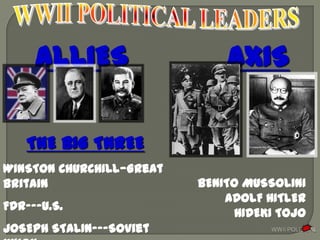
ALLIES                   AXIS

   THE BIG THREE
WINSTON CHURCHILL—Great
Britain                   BENITO MUSSOLINI
                              ADOLF HITLER
FDR---U.S.
                               HIDEKI TOJO
JOSEPH STALIN---Soviet
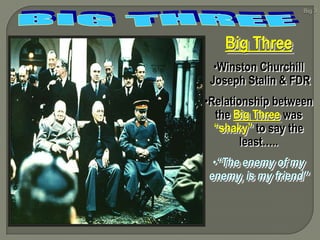
Big Three
  •Winston Churchill
 Joseph Stalin & FDR
•Relationship between
  the Big Three was
  “shaky” to say the
        least…..
 •“The enemy of my
enemy, is my friend”
•GERMAN MILITARY TACTICS OR
         “LIGHTING WAR”
 •The key to blitzkrieg is … SURPRISE!
•It is designed to attack many different
targets with overwhelming numbers so
    as to simply devastate the enemy.
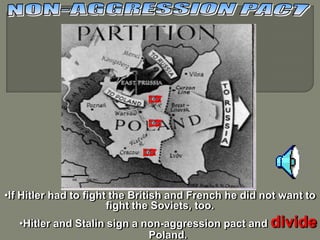
•If Hitler had to fight the British and French he did not want to
                       fight the Soviets, too.
   •Hitler and Stalin sign a non-aggression pact and divide
                              Poland.
•Hitler crushes France in June 1940
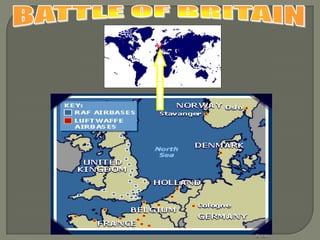
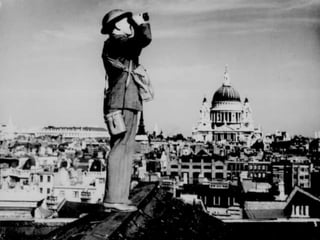
    •Hitler’s last enemy was Great Britain.
     •Hitler wanted to gain air supremacy.
•Battle of Britain, largest air battle ever fought
            in the history of warfare.
 •July to November 1940 and was won by the
  Royal Air Force (RAF or British Air Force).
  •****First major German loss in WWII and
     forced Hitler to change his strategy
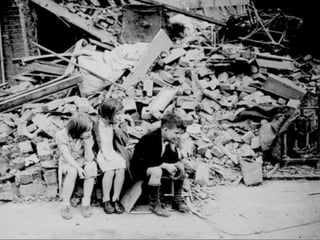
 •British people fought for their country and a
 possible Nazi invasion (Operation Sea Lion).
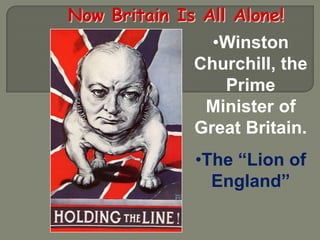
Now Britain Is All Alone!
                •Winston
              Churchill, the
                 Prime
               Minister of
              Great Britain.
              •The “Lion of
                England”
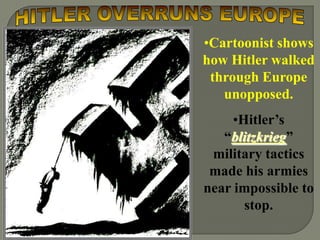
•Cartoonist shows
how Hitler walked
 through Europe
   unopposed.
     •Hitler’s
   “blitzkrieg”
 military tactics
 made his armies
near impossible to
       stop.
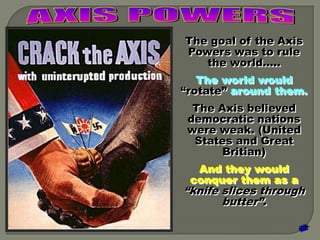
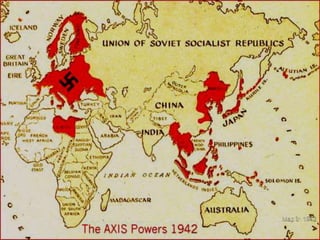
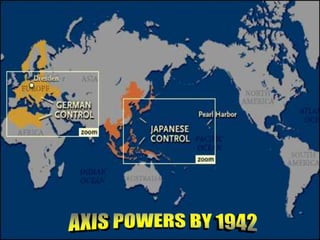
The goal of the Axis
Powers was to rule
   the world…..
   The world would
“rotate” around them.
  The Axis believed
 democratic nations
 were weak. (United
  States and Great
       Britian)
  And they would
 conquer them as a
“knife slices through
       butter”.
• U.S. declares neutrality at onset
• Neutrality Act 1939
  • warring nations buy weapons
     from US if paid cash and carried
     on own ships
• Lend-Lease Act
  • US lend or lease arms to nations
     considered vital to US defense
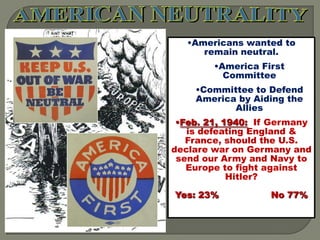
•Americans wanted to
      remain neutral.
        •America First
          Committee
    •Committee to Defend
    America by Aiding the
           Allies
 •Feb. 21, 1940: If Germany
   is defeating England &
   France, should the U.S.
declare war on Germany and
 send our Army and Navy to
   Europe to fight against
            Hitler?

Yes: 23%           No 77%
• Export Control Act
  • FDR power to restrict sale of strategic
     war materials
• FDR threatens to freeze Japanese
    assets in US and reduce amount of
    oil shipped to Japan
• Japan responds
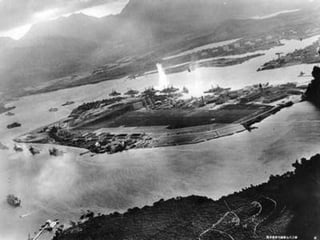
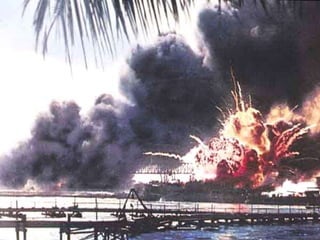
  • attack on Pearl Harbor, Dec. 7, 1941
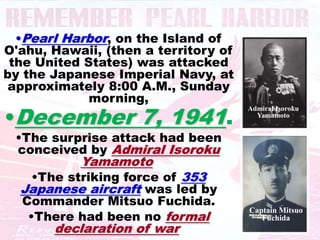
•Pearl Harbor, on the Island of
O'ahu, Hawaii, (then a territory of
 the United States) was attacked
by the Japanese Imperial Navy, at
 approximately 8:00 A.M., Sunday
             morning,
•December 7, 1941.
                                      Admiral Isoroku
                                        Yamamoto


 •The surprise attack had been
 conceived by Admiral Isoroku
           Yamamoto.
    •The striking force of 353
  Japanese aircraft was led by
  Commander Mitsuo Fuchida.
   •There had been no formal
                                      Captain Mitsuo
                                         Fuchida
       declaration of war.
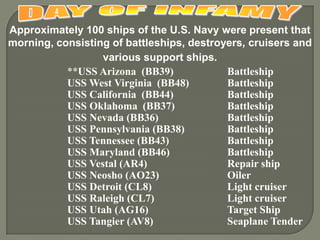
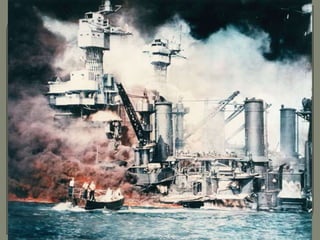
Approximately 100 ships of the U.S. Navy were present that
morning, consisting of battleships, destroyers, cruisers and
                  various support ships.
           **USS Arizona (BB39)            Battleship
           USS West Virginia (BB48)        Battleship
           USS California (BB44)           Battleship
           USS Oklahoma (BB37)             Battleship
           USS Nevada (BB36)               Battleship
           USS Pennsylvania (BB38)         Battleship
           USS Tennessee (BB43)            Battleship
           USS Maryland (BB46)             Battleship
           USS Vestal (AR4)                Repair ship
           USS Neosho (AO23)               Oiler
           USS Detroit (CL8)               Light cruiser
           USS Raleigh (CL7)               Light cruiser
           USS Utah (AG16)                 Target Ship
           USS Tangier (AV8)               Seaplane Tender
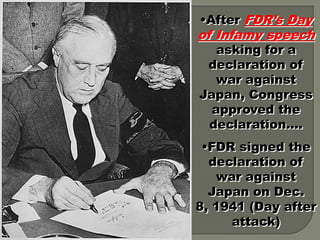
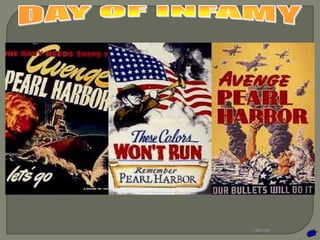
•After FDR’s Day
of Infamy speech
   asking for a
 declaration of
   war against
Japan, Congress
  approved the
 declaration….
 •FDR signed the
  declaration of
   war against
  Japan on Dec.
8, 1941 (Day after
     attack)
• Country challenged to convert to war-time
     production
• cost-plus contracts – company paid cost of
manufacturing plus guaranteed profit
• automobile factories best suited for
     producing war-time equipment
     (jeeps,tanks, artillery, rifles, etc.)
  • produced 1/3 military equipment during war
• the entire nation contributed to efforts
  • rationing of certain products
  • recycling any product that could be used
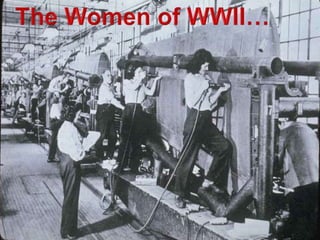
• women went to work in factories

  • Rosie     the Riveter symbolized their
    efforts
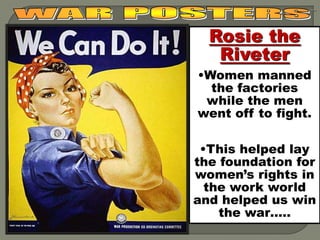
Rosie the
   Riveter
•Women manned
  the factories
 while the men
went off to fight.

 •This helped lay
the foundation for
women’s rights in
  the work world
and helped us win
    the war…..
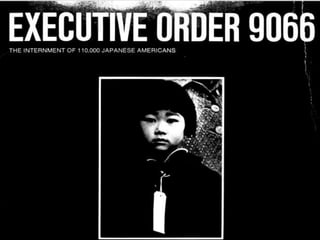
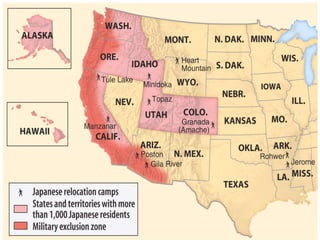
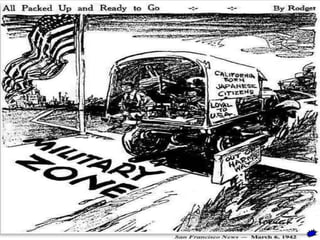
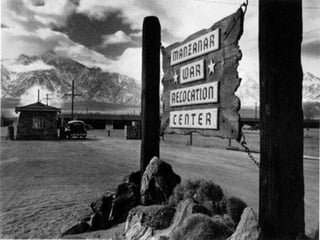
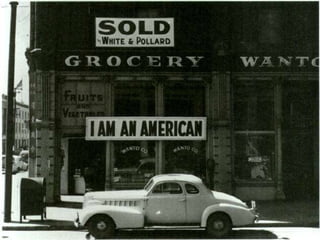
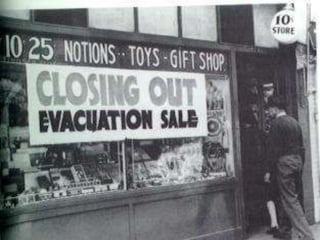
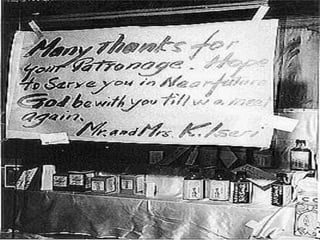
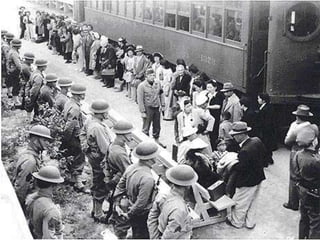
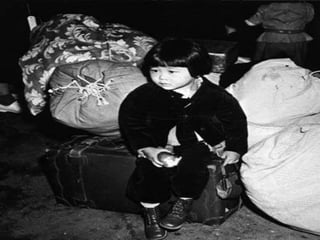
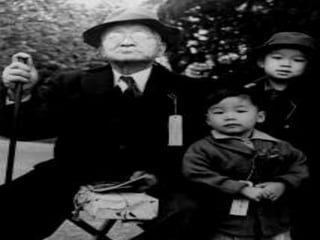
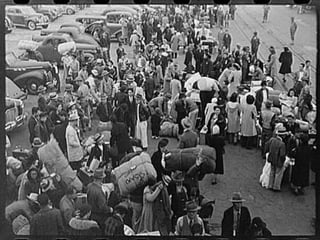
• War Dept. given authority to declare any part of
    U.S. a military zone and remove anyone
    from zone
• West Coast declared military zone
  • all people of Japanese ancestry placed into
     internment camps
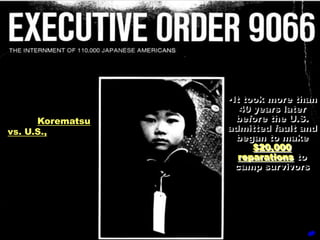
•1944 Supreme       •It took more than
      Court             40 years later
case, Korematsu        before the U.S.
vs. U.S., affirmed   admitted fault and
                       began to make
       the
                           $20,000
constitutionality       reparations to
 of this terrible      camp survivors
       act.
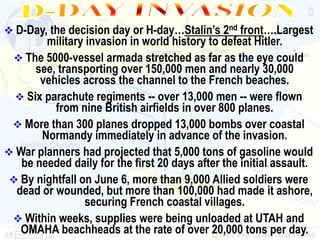
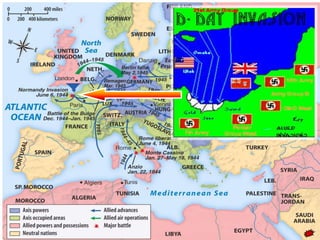
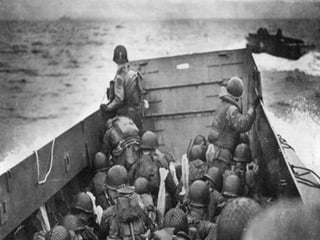
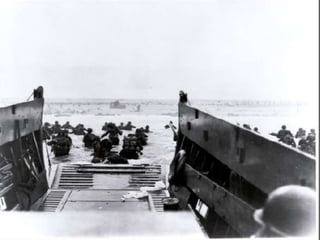
 D-Day, the decision day or H-day…Stalin’s 2nd front….Largest
        military invasion in world history to defeat Hitler.
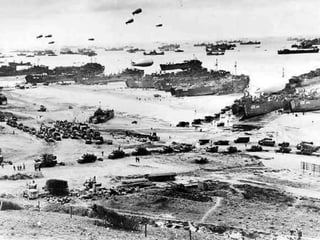
  The 5000-vessel armada stretched as far as the eye could
      see, transporting over 150,000 men and nearly 30,000
       vehicles across the channel to the French beaches.
   Six parachute regiments -- over 13,000 men -- were flown
          from nine British airfields in over 800 planes.
  More than 300 planes dropped 13,000 bombs over coastal
       Normandy immediately in advance of the invasion.
 War planners had projected that 5,000 tons of gasoline would
   be needed daily for the first 20 days after the initial assault.
  By nightfall on June 6, more than 9,000 Allied soldiers were
  dead or wounded, but more than 100,000 had made it ashore,
                 securing French coastal villages.
  Within weeks, supplies were being unloaded at UTAH and
   OMAHA beachheads at the rate of over 20,000 tons per day.
Gen. Eisenhower Gives the Orders for
    D-Day [“Operation Overlord”]


 US General Dwight Eisenhower was chosen by the Big 3 at the
 Tehran Conference (Nov. 28-Dec. 1, 1943) as the Supreme Allied
    Commander and was responsible for the D-Day Invasion.
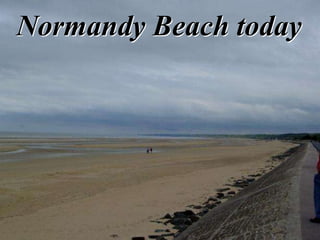
Normandy Beach today
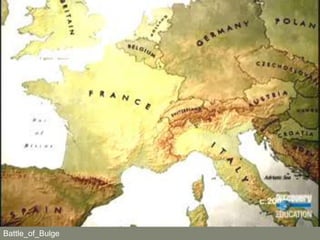
Battle_of_Bulge
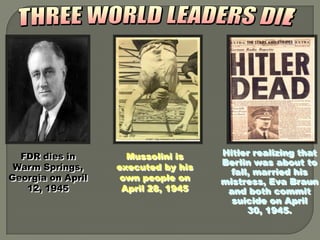
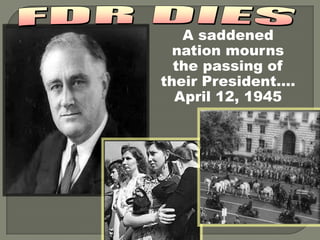
FDR dies in        Mussolini is    Hitler realizing that
                                     Berlin was about to
 Warm Springs,     executed by his
                                       fall, married his
Georgia on April    own people on    mistress, Eva Braun
   12, 1945         April 28, 1945    and both commit
                                       suicide on April
                                           30, 1945.
A saddened
  nation mourns
  the passing of
their President….
  April 12, 1945
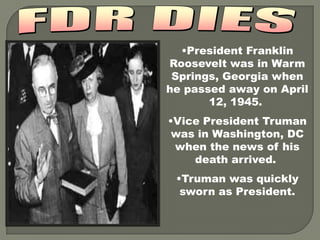
•President Franklin
Roosevelt was in Warm
 Springs, Georgia when
he passed away on April
       12, 1945.
•Vice President Truman
 was in Washington, DC
 when the news of his
    death arrived.
 •Truman was quickly
  sworn as President.
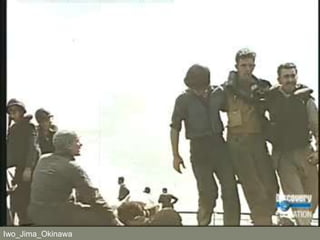
Iwo_Jima_Okinawa
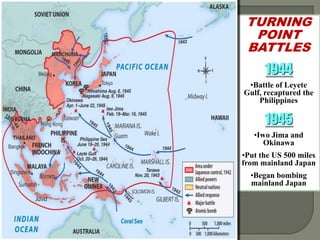
TURNING
  POINT
 BATTLES
      1944
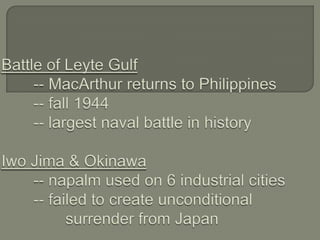
 •Battle of Leyete
Gulf, recaptured the
    Philippines

      1945
   •Iwo Jima and
      Okinawa
•Put the US 500 miles
from mainland Japan
  •Began bombing
  mainland Japan
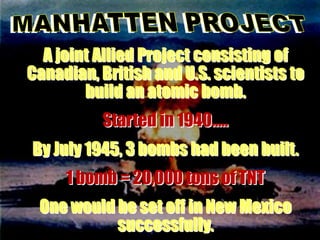
A joint Allied Project consisting of
Canadian, British and U.S. scientists to
        build an atomic bomb.
          Started in 1940…..
By July 1945, 3 bombs had been built.
     1 bomb = 20,000 tons of TNT
 One would be set off in New Mexico
           successfully.
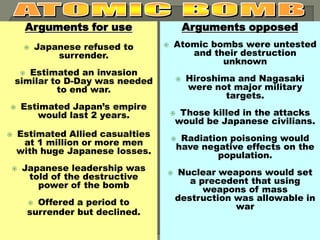
Arguments for use                     Arguments opposed
           Japanese refused to      Atomic bombs were untested
                surrender.               and their destruction
                                               unknown
      Estimated an invasion
    similar to D-Day was needed           Hiroshima and Nagasaki
             to end war.                   were not major military
                                                   targets.
    Estimated Japan’s empire
        would last 2 years.           Those killed in the attacks
                                      would be Japanese civilians.
   Estimated Allied casualties            Radiation poisoning would
     at 1 million or more men         
                                          have negative effects on the
    with huge Japanese losses.                    population.
    Japanese leadership was          Nuclear weapons would set
      told of the destructive     
                                         a precedent that using
        power of the bomb                   weapons of mass
          Offered a period to         destruction was allowable in
        
                                                  war
        surrender but declined.
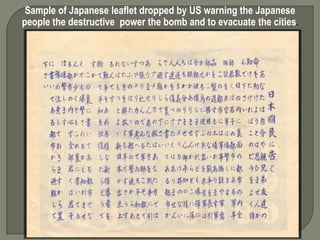
Sample of Japanese leaflet dropped by US warning the Japanese
people the destructive power the bomb and to evacuate the cities.
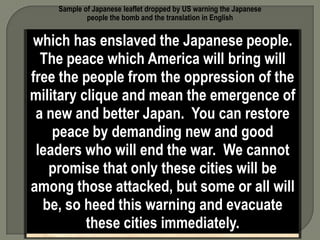
Sample of Japanese leaflet dropped by US warning the Japanese
            people the bomb and the translation in English


which has enslaveddays the military
       In the next few the Japanese people.
  The peace which America will the cities
   installations in some or all of bring will
free the on the photograph will destroyed
 named people from the oppression of the
military clique and mean the cities contain
by American bombs. These emergence of
   military installations and workshops or
 a new and better Japan. You can restore
  factories which produce military goods.
     peace by demanding new and good
  The American Air Force, which does not
wish to injurewill end the war. We cannot
 leaders who innocent people, now gives
    promise that only these cities will be
you warning to evacuate the cities named
among thoseyour lives.but some or notwill
     and save attacked, America is all
     fighting the Japanese people But is
   be, so heed this warning and evacuate
 fighting these cities clique (govt. leaders)
            the military immediately.
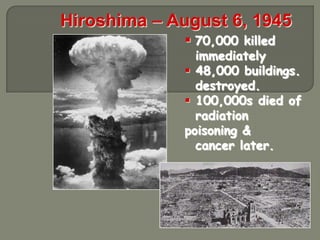
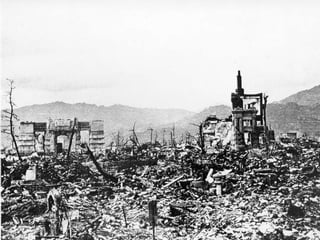
Hiroshima – August 6, 1945
              70,000 killed
               immediately
              48,000 buildings.
               destroyed.
              100,000s died of
               radiation
             poisoning &
               cancer later.
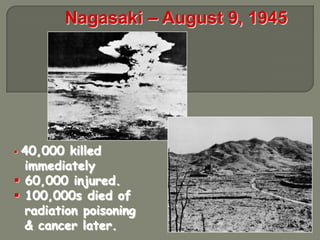
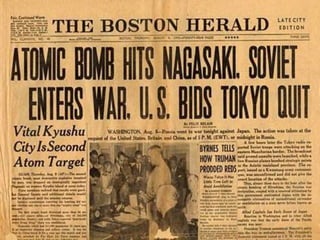
Nagasaki – August 9, 1945


40,000 killed
  immediately
 60,000 injured.
 100,000s died of
  radiation poisoning
  & cancer later.
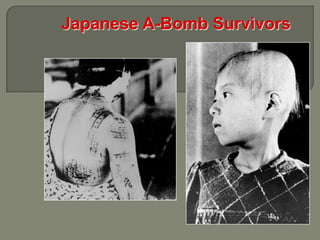
Japanese A-Bomb Survivors
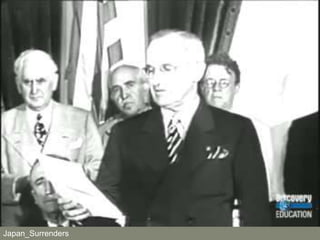
Japan_Surrenders
H wwii pt 2 upload
H wwii pt 2 upload

H wwii pt 2 upload

  • 1.
    WWII BEGINS IN EUROPE •SEPT. 1, 1939, GERMANY INVADES POLAND….. •THIS BEGINS WWII… •GREAT BRITAIN AND FRANCE DECLARE WAR ON GERMANY!
  • 2.
    ALLIES AXIS THE BIG THREE WINSTON CHURCHILL—Great Britain BENITO MUSSOLINI ADOLF HITLER FDR---U.S. HIDEKI TOJO JOSEPH STALIN---Soviet
  • 3.
    Big Three •Winston Churchill Joseph Stalin & FDR •Relationship between the Big Three was “shaky” to say the least….. •“The enemy of my enemy, is my friend”
  • 4.
    •GERMAN MILITARY TACTICSOR “LIGHTING WAR” •The key to blitzkrieg is … SURPRISE! •It is designed to attack many different targets with overwhelming numbers so as to simply devastate the enemy.
  • 5.
    •If Hitler hadto fight the British and French he did not want to fight the Soviets, too. •Hitler and Stalin sign a non-aggression pact and divide Poland.
  • 6.
    •Hitler crushes Francein June 1940 •Hitler’s last enemy was Great Britain. •Hitler wanted to gain air supremacy. •Battle of Britain, largest air battle ever fought in the history of warfare. •July to November 1940 and was won by the Royal Air Force (RAF or British Air Force). •****First major German loss in WWII and forced Hitler to change his strategy •British people fought for their country and a possible Nazi invasion (Operation Sea Lion).
  • 7.
    Now Britain IsAll Alone! •Winston Churchill, the Prime Minister of Great Britain. •The “Lion of England”
  • 11.
    •Cartoonist shows how Hitlerwalked through Europe unopposed. •Hitler’s “blitzkrieg” military tactics made his armies near impossible to stop.
  • 12.
    The goal ofthe Axis Powers was to rule the world….. The world would “rotate” around them. The Axis believed democratic nations were weak. (United States and Great Britian) And they would conquer them as a “knife slices through butter”.
  • 15.
    • U.S. declaresneutrality at onset • Neutrality Act 1939 • warring nations buy weapons from US if paid cash and carried on own ships • Lend-Lease Act • US lend or lease arms to nations considered vital to US defense
  • 16.
    •Americans wanted to remain neutral. •America First Committee •Committee to Defend America by Aiding the Allies •Feb. 21, 1940: If Germany is defeating England & France, should the U.S. declare war on Germany and send our Army and Navy to Europe to fight against Hitler? Yes: 23% No 77%
  • 17.
    • Export ControlAct • FDR power to restrict sale of strategic war materials • FDR threatens to freeze Japanese assets in US and reduce amount of oil shipped to Japan • Japan responds • attack on Pearl Harbor, Dec. 7, 1941
  • 18.
    •Pearl Harbor, onthe Island of O'ahu, Hawaii, (then a territory of the United States) was attacked by the Japanese Imperial Navy, at approximately 8:00 A.M., Sunday morning, •December 7, 1941. Admiral Isoroku Yamamoto •The surprise attack had been conceived by Admiral Isoroku Yamamoto. •The striking force of 353 Japanese aircraft was led by Commander Mitsuo Fuchida. •There had been no formal Captain Mitsuo Fuchida declaration of war.
  • 19.
    Approximately 100 shipsof the U.S. Navy were present that morning, consisting of battleships, destroyers, cruisers and various support ships. **USS Arizona (BB39) Battleship USS West Virginia (BB48) Battleship USS California (BB44) Battleship USS Oklahoma (BB37) Battleship USS Nevada (BB36) Battleship USS Pennsylvania (BB38) Battleship USS Tennessee (BB43) Battleship USS Maryland (BB46) Battleship USS Vestal (AR4) Repair ship USS Neosho (AO23) Oiler USS Detroit (CL8) Light cruiser USS Raleigh (CL7) Light cruiser USS Utah (AG16) Target Ship USS Tangier (AV8) Seaplane Tender
  • 23.
    •After FDR’s Day ofInfamy speech asking for a declaration of war against Japan, Congress approved the declaration…. •FDR signed the declaration of war against Japan on Dec. 8, 1941 (Day after attack)
  • 25.
    • Country challengedto convert to war-time production • cost-plus contracts – company paid cost of manufacturing plus guaranteed profit • automobile factories best suited for producing war-time equipment (jeeps,tanks, artillery, rifles, etc.) • produced 1/3 military equipment during war
  • 26.
    • the entirenation contributed to efforts • rationing of certain products • recycling any product that could be used • women went to work in factories • Rosie the Riveter symbolized their efforts
  • 32.
    Rosie the Riveter •Women manned the factories while the men went off to fight. •This helped lay the foundation for women’s rights in the work world and helped us win the war…..
  • 33.
    • War Dept.given authority to declare any part of U.S. a military zone and remove anyone from zone • West Coast declared military zone • all people of Japanese ancestry placed into internment camps
  • 45.
    •1944 Supreme •It took more than Court 40 years later case, Korematsu before the U.S. vs. U.S., affirmed admitted fault and began to make the $20,000 constitutionality reparations to of this terrible camp survivors act.
  • 53.
     D-Day, thedecision day or H-day…Stalin’s 2nd front….Largest military invasion in world history to defeat Hitler.  The 5000-vessel armada stretched as far as the eye could see, transporting over 150,000 men and nearly 30,000 vehicles across the channel to the French beaches.  Six parachute regiments -- over 13,000 men -- were flown from nine British airfields in over 800 planes.  More than 300 planes dropped 13,000 bombs over coastal Normandy immediately in advance of the invasion.  War planners had projected that 5,000 tons of gasoline would be needed daily for the first 20 days after the initial assault.  By nightfall on June 6, more than 9,000 Allied soldiers were dead or wounded, but more than 100,000 had made it ashore, securing French coastal villages.  Within weeks, supplies were being unloaded at UTAH and OMAHA beachheads at the rate of over 20,000 tons per day.
  • 55.
    Gen. Eisenhower Givesthe Orders for D-Day [“Operation Overlord”] US General Dwight Eisenhower was chosen by the Big 3 at the Tehran Conference (Nov. 28-Dec. 1, 1943) as the Supreme Allied Commander and was responsible for the D-Day Invasion.
  • 60.
  • 62.
  • 64.
    FDR dies in Mussolini is Hitler realizing that Berlin was about to Warm Springs, executed by his fall, married his Georgia on April own people on mistress, Eva Braun 12, 1945 April 28, 1945 and both commit suicide on April 30, 1945.
  • 65.
    A saddened nation mourns the passing of their President…. April 12, 1945
  • 66.
    •President Franklin Roosevelt wasin Warm Springs, Georgia when he passed away on April 12, 1945. •Vice President Truman was in Washington, DC when the news of his death arrived. •Truman was quickly sworn as President.
  • 67.
  • 69.
    TURNING POINT BATTLES 1944 •Battle of Leyete Gulf, recaptured the Philippines 1945 •Iwo Jima and Okinawa •Put the US 500 miles from mainland Japan •Began bombing mainland Japan
  • 71.
    A joint AlliedProject consisting of Canadian, British and U.S. scientists to build an atomic bomb. Started in 1940….. By July 1945, 3 bombs had been built. 1 bomb = 20,000 tons of TNT One would be set off in New Mexico successfully.
  • 72.
    Arguments for use Arguments opposed  Japanese refused to  Atomic bombs were untested surrender. and their destruction unknown  Estimated an invasion similar to D-Day was needed  Hiroshima and Nagasaki to end war. were not major military targets.  Estimated Japan’s empire would last 2 years. Those killed in the attacks would be Japanese civilians.  Estimated Allied casualties Radiation poisoning would at 1 million or more men  have negative effects on the with huge Japanese losses. population.  Japanese leadership was Nuclear weapons would set told of the destructive  a precedent that using power of the bomb weapons of mass Offered a period to destruction was allowable in  war surrender but declined.
  • 73.
    Sample of Japaneseleaflet dropped by US warning the Japanese people the destructive power the bomb and to evacuate the cities.
  • 74.
    Sample of Japaneseleaflet dropped by US warning the Japanese people the bomb and the translation in English which has enslaveddays the military In the next few the Japanese people. The peace which America will the cities installations in some or all of bring will free the on the photograph will destroyed named people from the oppression of the military clique and mean the cities contain by American bombs. These emergence of military installations and workshops or a new and better Japan. You can restore factories which produce military goods. peace by demanding new and good The American Air Force, which does not wish to injurewill end the war. We cannot leaders who innocent people, now gives promise that only these cities will be you warning to evacuate the cities named among thoseyour lives.but some or notwill and save attacked, America is all fighting the Japanese people But is be, so heed this warning and evacuate fighting these cities clique (govt. leaders) the military immediately.
  • 75.
    Hiroshima – August6, 1945  70,000 killed immediately  48,000 buildings. destroyed.  100,000s died of radiation poisoning & cancer later.
  • 76.
    Nagasaki – August9, 1945 40,000 killed immediately  60,000 injured.  100,000s died of radiation poisoning & cancer later.
  • 79.
  • 80.