The American Revolution
       1175-1783
Between 1775 and 1787, Americans
struggled to win a war, make a peace
    and create a sound and stable
 government on both the state and
    the national levels. At first the
 colonies were neither prepared for
nor united behind fighting a war with
              England.
• In fact, the Revolution encompassed two
  struggles--a military conflict with Great Britain
  and a domestic political struggle.
The States United(?)
• Defining Americas War Aim– Second
  Continental Congress
•     --Complete independence? Richard Henry
  Lee draws resolution
•     --Reconciliation? John Dickinson—Olive
  Branch Petition
•
1776
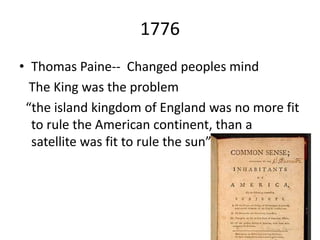
• Thomas Paine-- Changed peoples mind
  The King was the problem
 “the island kingdom of England was no more fit
  to rule the American continent, than a
  satellite was fit to rule the sun”
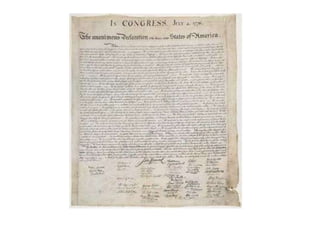
The Declaration of Independence
       1776-Thomas Jefferson
• America’s birth certificate
• John Locke inspired
• Jefferson states all men are equal, unalienable
  rights—governments get their power from the
  consent of the governed, purpose of
  government is to secure the rights of the
  people, people have the right to abolish
  government if government fails to protect
  rights
Divided America
• Loyalists, Patriots and Neutrals
• Articles of Confederation—first gov—loose
  alliance of states—weak central government—
  states not willing to give up power
• Financing the War—very difficult—no power
  to tax
• Created a Continental army-Washington in
  charge
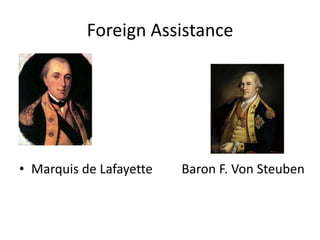
Foreign Assistance


• Marquis de Lafayette   Baron F. Von Steuben
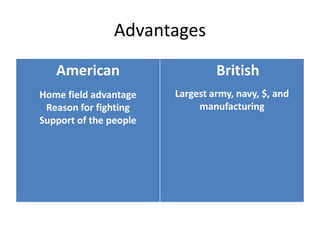
Advantages
   American                      British
Home field advantage    Largest army, navy, $, and
 Reason for fighting         manufacturing
Support of the people
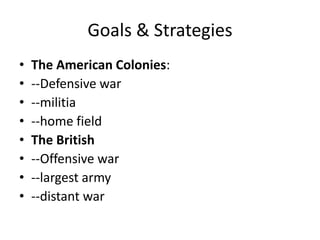
Goals & Strategies
•   The American Colonies:
•   --Defensive war
•   --militia
•   --home field
•   The British
•   --Offensive war
•   --largest army
•   --distant war
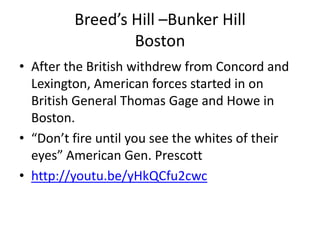
Breed’s Hill –Bunker Hill
                 Boston
• After the British withdrew from Concord and
  Lexington, American forces started in on
  British General Thomas Gage and Howe in
  Boston.
• “Don’t fire until you see the whites of their
  eyes” American Gen. Prescott
• http://youtu.be/yHkQCfu2cwc
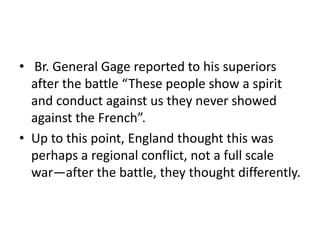
• Br. General Gage reported to his superiors
  after the battle “These people show a spirit
  and conduct against us they never showed
  against the French”.
• Up to this point, England thought this was
  perhaps a regional conflict, not a full scale
  war—after the battle, they thought differently.
The Crisis-Thomas Paine
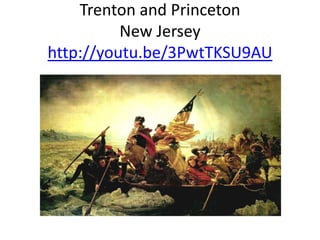
Trenton and Princeton
          New Jersey
http://youtu.be/3PwtTKSU9AU
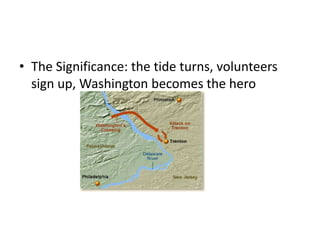
• The Significance: the tide turns, volunteers
  sign up, Washington becomes the hero
Saratoga
• Hero is Benedict Arnold
• French come to our Aid
• http://youtu.be/BXBu2NpB8DI
The Final Phrase: The South
• War was a stalemate—a war of attrition-Britain
  lost in the North East, lost in the Middle
  colonies—now the South
• Strategy: Conquer an area and put Loyalists in
  charge -but they over estimated the loyalty of the
  Loyalists (?)—most were not interested in
  England, they just wanted to get even with
  Patriots—settle old scores—fighting becomes
  vicious (civil war)
• British were constantly harassed by Patriot
  guerrillas—Francis Marion the “Swamp Fox”
The Great Irony
• The British were ready to exploit the
  contradiction of the South
• What Southerners were fighting for was
  freedom, while they enslaved a half million
  blacks
• Page 170
• Racial Manipulation would be used by the
  British to destabilize the South and yet in
  another ironic situation it caused the South to
  be united in opposition to the British
• The Revolutionary theme of Freedom and
  Independence meant, in the South, freedom
  to maintain their Slave system
Gen. Nathaniel Greene
• Remarkable General—knows one doesn’t
  have to win battles in order to win the War.
• The side that wins the hearts and minds of the
  South will prevail.
• Military Strategy: make the British presence so
  unpleasant
• Led the Br. Gen Cornwallis on a 6 month chase
  through the backwoods of the South
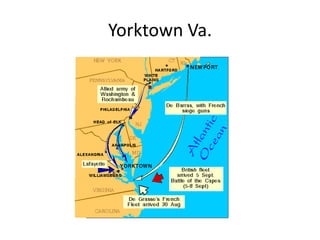
Yorktown Va.
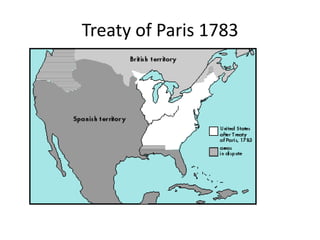
Treaty of Paris 1783
Things to think about
• The American Revolution as a Civil War????
• Patriots vs Loyalists
• Colonists were of British origins now fighting
  to separate themselves from it
Assessing the advantages and
 disadvantages that affected the
outcome in the Revolutionary war.

The american revolution ap

  • 1.
    The American Revolution 1175-1783 Between 1775 and 1787, Americans struggled to win a war, make a peace and create a sound and stable government on both the state and the national levels. At first the colonies were neither prepared for nor united behind fighting a war with England.
  • 2.
    • In fact,the Revolution encompassed two struggles--a military conflict with Great Britain and a domestic political struggle.
  • 3.
    The States United(?) •Defining Americas War Aim– Second Continental Congress • --Complete independence? Richard Henry Lee draws resolution • --Reconciliation? John Dickinson—Olive Branch Petition •
  • 4.
    1776 • Thomas Paine--Changed peoples mind The King was the problem “the island kingdom of England was no more fit to rule the American continent, than a satellite was fit to rule the sun”
  • 5.
    The Declaration ofIndependence 1776-Thomas Jefferson • America’s birth certificate • John Locke inspired • Jefferson states all men are equal, unalienable rights—governments get their power from the consent of the governed, purpose of government is to secure the rights of the people, people have the right to abolish government if government fails to protect rights
  • 7.
    Divided America • Loyalists,Patriots and Neutrals • Articles of Confederation—first gov—loose alliance of states—weak central government— states not willing to give up power • Financing the War—very difficult—no power to tax • Created a Continental army-Washington in charge
  • 8.
    Foreign Assistance • Marquisde Lafayette Baron F. Von Steuben
  • 9.
    Advantages American British Home field advantage Largest army, navy, $, and Reason for fighting manufacturing Support of the people
  • 10.
    Goals & Strategies • The American Colonies: • --Defensive war • --militia • --home field • The British • --Offensive war • --largest army • --distant war
  • 11.
    Breed’s Hill –BunkerHill Boston • After the British withdrew from Concord and Lexington, American forces started in on British General Thomas Gage and Howe in Boston. • “Don’t fire until you see the whites of their eyes” American Gen. Prescott • http://youtu.be/yHkQCfu2cwc
  • 12.
    • Br. GeneralGage reported to his superiors after the battle “These people show a spirit and conduct against us they never showed against the French”. • Up to this point, England thought this was perhaps a regional conflict, not a full scale war—after the battle, they thought differently.
  • 13.
  • 14.
    Trenton and Princeton New Jersey http://youtu.be/3PwtTKSU9AU
  • 15.
    • The Significance:the tide turns, volunteers sign up, Washington becomes the hero
  • 16.
    Saratoga • Hero isBenedict Arnold • French come to our Aid • http://youtu.be/BXBu2NpB8DI
  • 17.
    The Final Phrase:The South • War was a stalemate—a war of attrition-Britain lost in the North East, lost in the Middle colonies—now the South • Strategy: Conquer an area and put Loyalists in charge -but they over estimated the loyalty of the Loyalists (?)—most were not interested in England, they just wanted to get even with Patriots—settle old scores—fighting becomes vicious (civil war) • British were constantly harassed by Patriot guerrillas—Francis Marion the “Swamp Fox”
  • 18.
    The Great Irony •The British were ready to exploit the contradiction of the South • What Southerners were fighting for was freedom, while they enslaved a half million blacks • Page 170 • Racial Manipulation would be used by the British to destabilize the South and yet in another ironic situation it caused the South to be united in opposition to the British
  • 19.
    • The Revolutionarytheme of Freedom and Independence meant, in the South, freedom to maintain their Slave system
  • 20.
    Gen. Nathaniel Greene •Remarkable General—knows one doesn’t have to win battles in order to win the War. • The side that wins the hearts and minds of the South will prevail. • Military Strategy: make the British presence so unpleasant • Led the Br. Gen Cornwallis on a 6 month chase through the backwoods of the South
  • 21.
  • 22.
  • 23.
    Things to thinkabout • The American Revolution as a Civil War????
  • 24.
    • Patriots vsLoyalists • Colonists were of British origins now fighting to separate themselves from it
  • 25.
    Assessing the advantagesand disadvantages that affected the outcome in the Revolutionary war.