BATTLES
AMERICAN
REVOLUTIONRouba Kaziz
Professor: TRACEY RIORDAN
AMERICAN HISTORY 101
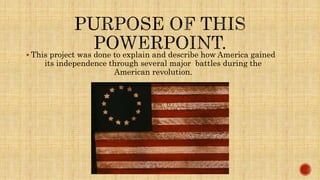
 This project was done to explain and describe how America gained
its independence through several major battles during the
American revolution.
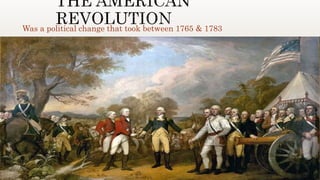
Was a political change that took between 1765 & 1783
WHAT WAS THE AMERICAN
REVOLUTION?
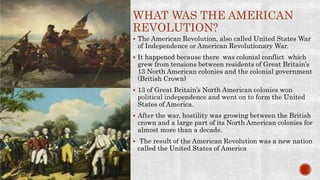
 The American Revolution, also called United States War
of Independence or American Revolutionary War.
 It happened because there was colonial conflict which
grew from tensions between residents of Great Britain’s
13 North American colonies and the colonial government
(British Crown)
 13 of Great Britain’s North American colonies won
political independence and went on to form the United
States of America.
 After the war, hostility was growing between the British
crown and a large part of its North American colonies for
almost more than a decade.
 The result of the American Revolution was a new nation
called the United States of America
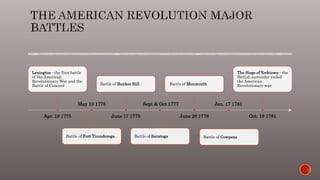
Apr. 19 1775
Lexington - the first battle
of the American
Revolutionary War and the
Battle of Concord
May 10 1775
Battle of Fort Ticonderoga
June 17 1775
Battle of Bunker Hill
Sept & Oct 1777
Battle of Saratoga
June 28 1778
Battle of Monmouth
Jan. 17 1781
Battle of Cowpens
Oct. 19 1781
The Siege of Yorktown - the
British surrender ended
the American
Revolutionary war

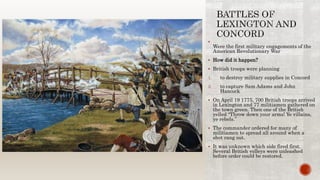
Were the first military engagements of the
American Revolutionary War
 How did it happen?
 British troops were planning
1. to destroy military supplies in Concord
2. to capture Sam Adams and John
Hancock
 On April 19 1775, 700 British troops arrived
in Lexington and 77 militiamen gathered on
the town green. Then one of the British
yelled “Throw down your arms! Ye villains,
ye rebels.”
 The commander ordered for many of
militiamen to spread all around when a
shot rang out.
 It was unknown which side fired first.
Several British volleys were unleashed
before order could be restored.
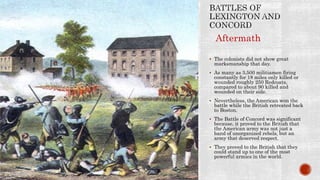
 The colonists did not show great
marksmanship that day.
 As many as 3,500 militiamen firing
constantly for 18 miles only killed or
wounded roughly 250 Redcoats,
compared to about 90 killed and
wounded on their side.
 Nevertheless, the American won the
battle while the British retreated back
to Boston.
 The Battle of Concord was significant
because, it proved to the British that
the American army was not just a
band of unorganized rebels, but an
army that deserved respect.
 They proved to the British that they
could stand up to one of the most
powerful armies in the world.
Aftermath
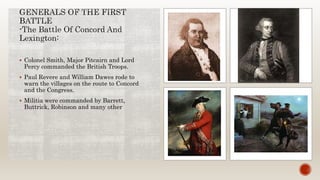
 Colonel Smith, Major Pitcairn and Lord
Percy commanded the British Troops.
 Paul Revere and William Dawes rode to
warn the villages on the route to Concord
and the Congress.
 Militia were commanded by Barrett,
Buttrick, Robinson and many other
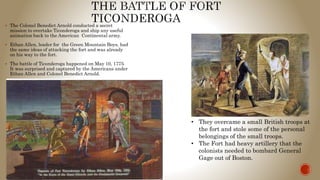
 The Colonel Benedict Arnold conducted a secret
mission to overtake Ticonderoga and ship any useful
animation back to the American Continental army.
 Ethan Allen, leader for the Green Mountain Boys, had
the same ideas of attacking the fort and was already
on his way to the fort.
 The battle of Ticonderoga happened on May 10, 1775.
It was surprised and captured by the Americans under
Ethan Allen and Colonel Benedict Arnold.
• They overcame a small British troops at
the fort and stole some of the personal
belongings of the small troops.
• The Fort had heavy artillery that the
colonists needed to bombard General
Gage out of Boston.
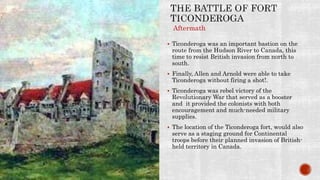
 Ticonderoga was an important bastion on the
route from the Hudson River to Canada, this
time to resist British invasion from north to
south.
 Finally, Allen and Arnold were able to take
Ticonderoga without firing a shot!.
 Ticonderoga was rebel victory of the
Revolutionary War that served as a booster
and it provided the colonists with both
encouragement and much-needed military
supplies.
 The location of the Ticonderoga fort, would also
serve as a staging ground for Continental
troops before their planned invasion of British-
held territory in Canada.
Aftermath
GENERALS AT THE BATTLE OF
FORT TICONDEROGA
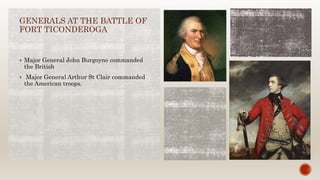
 Major General John Burgoyne commanded
the British
 Major General Arthur St Clair commanded
the American troops.
BACKGROUND
ON FORT
TICONDEROGA
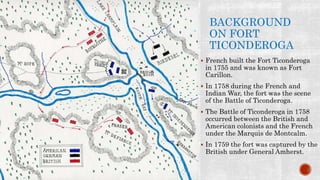
 French built the Fort Ticonderoga
in 1755 and was known as Fort
Carillon.
 In 1758 during the French and
Indian War, the fort was the scene
of the Battle of Ticonderoga.
 The Battle of Ticonderoga in 1758
occurred between the British and
American colonists and the French
under the Marquis de Montcalm.
 In 1759 the fort was captured by the
British under General Amherst.
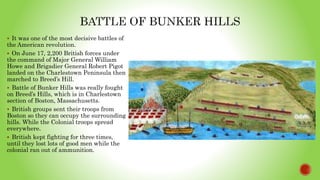
 It was one of the most decisive battles of
the American revolution.
 On June 17, 2,200 British forces under
the command of Major General William
Howe and Brigadier General Robert Pigot
landed on the Charlestown Peninsula then
marched to Breed’s Hill.
 Battle of Bunker Hills was really fought
on Breed’s Hills, which is in Charlestown
section of Boston, Massachusetts.
 British groups sent their troops from
Boston so they can occupy the surrounding
hills. While the Colonial troops spread
everywhere.
 British kept fighting for three times,
until they lost lots of good men while the
colonial ran out of ammunition.
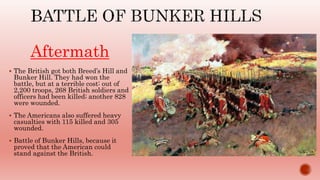
Aftermath
 The British got both Breed’s Hill and
Bunker Hill. They had won the
battle, but at a terrible cost: out of
2,200 troops, 268 British soldiers and
officers had been killed; another 828
were wounded.
 The Americans also suffered heavy
casualties with 115 killed and 305
wounded.
 Battle of Bunker Hills, because it
proved that the American could
stand against the British.
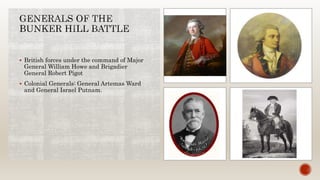
 British forces under the command of Major
General William Howe and Brigadier
General Robert Pigot
 Colonial Generals: General Artemas Ward
and General Israel Putnam.
THE
BATTLE
OF
SARATOGA
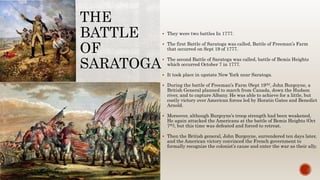
 They were two battles In 1777.
 The first Battle of Saratoga was called, Battle of Freeman’s Farm
that occurred on Sept 19 of 1777.
 The second Battle of Saratoga was called, battle of Bemis Heights
which occurred October 7 in 1777.
 It took place in upstate New York near Saratoga.
 During the battle of Freeman’s Farm (Sept 19th), John Burgoyne, a
British General planned to march from Canada, down the Hudson
river, and to capture Albany. He was able to achieve for a little, but
costly victory over American forces led by Horatio Gates and Benedict
Arnold.
 Moreover, although Burgoyne’s troop strength had been weakened,
He again attacked the Americans at the battle of Bemis Heights (Oct
7th), but this time was defeated and forced to retreat.
 Then the British general, John Burgoyne, surrendered ten days later,
and the American victory convinced the French government to
formally recognize the colonist’s cause and enter the war as their ally.
THE BATTLE OF
SARATOGA
AFTERMATH
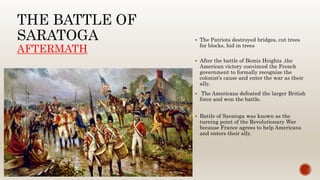
 The Patriots destroyed bridges, cut trees
for blocks, hid in trees
 After the battle of Bemis Heights ,the
American victory convinced the French
government to formally recognize the
colonist’s cause and enter the war as their
ally.
 The Americans defeated the larger British
force and won the battle.
 Battle of Saratoga was known as the
turning point of the Revolutionary War
because France agrees to help Americans
and enters their ally.
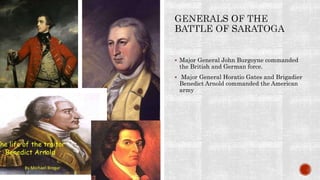
 Major General John Burgoyne commanded
the British and German force.
 Major General Horatio Gates and Brigadier
Benedict Arnold commanded the American
army
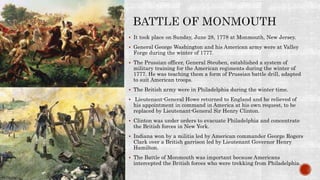
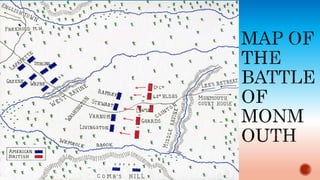
 It took place on Sunday, June 28, 1778 at Monmouth, New Jersey.
 General George Washington and his American army were at Valley
Forge during the winter of 1777.
 The Prussian officer, General Steuben, established a system of
military training for the American regiments during the winter of
1777. He was teaching them a form of Prussian battle drill, adapted
to suit American troops.
 The British army were in Philadelphia during the winter time.
 Lieutenant-General Howe returned to England and he relieved of
his appointment in command in America at his own request, to be
replaced by Lieutenant-General Sir Henry Clinton.
 Clinton was under orders to evacuate Philadelphia and concentrate
the British forces in New York.
 Indiana won by a militia led by American commander George Rogers
Clark over a British garrison led by Lieutenant Governor Henry
Hamilton.
 The Battle of Monmouth was important because Americans
intercepted the British forces who were trekking from Philadelphia.
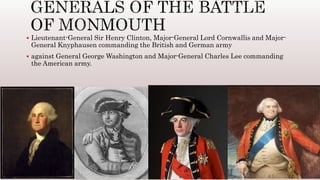
 Lieutenant-General Sir Henry Clinton, Major-General Lord Cornwallis and Major-
General Knyphausen commanding the British and German army
 against General George Washington and Major-General Charles Lee commanding
the American army.
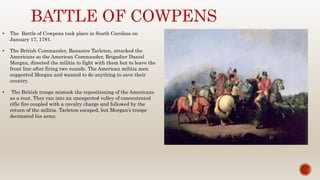
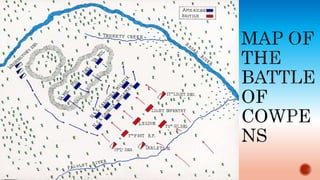
BATTLE OF COWPENS
• The Battle of Cowpens took place in South Carolina on
January 17, 1781.
• The British Commander, Banastre Tarleton, attacked the
Americans so the American Commander, Brigadier Daniel
Morgan, directed the militia to fight with them but to leave the
front line after firing two rounds. The American militia men
supported Morgan and wanted to do anything to save their
country.
• The British troops mistook the repositioning of the Americans
as a rout. They ran into an unexpected volley of concentrated
rifle fire coupled with a cavalry charge and followed by the
return of the militia. Tarleton escaped, but Morgan’s troops
decimated his army.
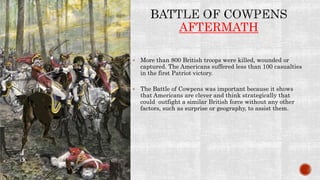
AFTERMATH
• More than 800 British troops were killed, wounded or
captured. The Americans suffered less than 100 casualties
in the first Patriot victory.
• The Battle of Cowpens was important because it shows
that Americans are clever and think strategically that
could outfight a similar British force without any other
factors, such as surprise or geography, to assist them.
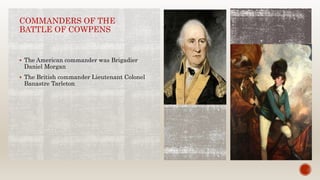
COMMANDERS OF THE
BATTLE OF COWPENS
 The American commander was Brigadier
Daniel Morgan
 The British commander Lieutenant Colonel
Banastre Tarleton
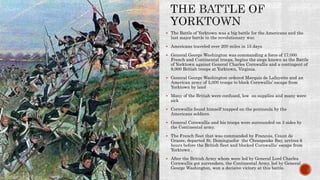
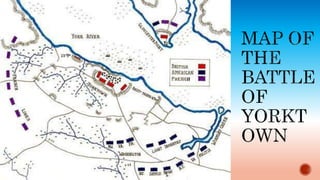
 The Battle of Yorktown was a big battle for the Americans and the
last major battle in the revolutionary war.
 Americans traveled over 200 miles in 15 days
 General George Washington was commanding a force of 17,000
French and Continental troops, begins the siege known as the Battle
of Yorktown against General Charles Cornwallis and a contingent of
9,000 British troops at Yorktown, Virginia.
 General George Washington ordered Marquis de Lafayette and an
American army of 5,000 troops to block Cornwallis’ escape from
Yorktown by land
 Many of the British were confused, low on supplies and many were
sick
 Cornwallis found himself trapped on the peninsula by the
Americans soldiers.
 General Cornwallis and his troops were surrounded on 3 sides by
the Continental army.
 The French fleet that was commanded by Francois, Count de
Grasse, departed St. Dominguefor the Chesapeake Bay, arrives 6
hours before the British fleet and blocked Cornwallis’ escape from
Yorktown .
 After the British Army whom were led by General Lord Charles
Cornwallis got surrenders, the Continental Army, led by General
George Washington, won a decisive victory at this battle.
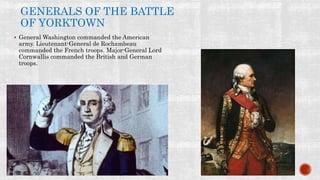
GENERALS OF THE BATTLE
OF YORKTOWN
 General Washington commanded the American
army. Lieutenant-General de Rochambeau
commanded the French troops. Major-General Lord
Cornwallis commanded the British and German
troops.
OUTCOME OF THE
BATTLE
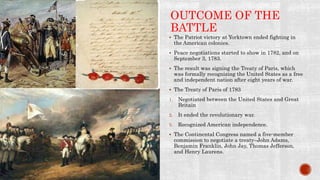
 The Patriot victory at Yorktown ended fighting in
the American colonies.
 Peace negotiations started to show in 1782, and on
September 3, 1783.
 The result was signing the Treaty of Paris, which
was formally recognizing the United States as a free
and independent nation after eight years of war.
 The Treaty of Paris of 1783
1. Negotiated between the United States and Great
Britain
2. It ended the revolutionary war.
3. Recognized American independence.
 The Continental Congress named a five-member
commission to negotiate a treaty–John Adams,
Benjamin Franklin, John Jay, Thomas Jefferson,
and Henry Laurens.
HOW DID
YOUR TOPIC
FIT INTO
THE DAILY
LIFE OF
AMERICA IN
THE ERA
THAT YOU
ARE
COVERING?
 In religious view: Diversity in religion had become a great and
dominant part of England's Thirteen Colonies. The result that the
population of America increased significantly because the colonies
were a patchwork of religiously diverse communities.
 Educational: Upper class children in colonial days got the primary
education such as, reading, writing, simple math, poems, and
prayers. Paper and textbooks were hard to find during the war so
boys and girls recited their lessons until they memorized them. Some
of the most commonly used books were the Bible, a primer, and a
hornbook.
 Musical: Music were a major thing during times of war and is a vital
part of learning about our own social history.
 Work Life: Colonial American people did many different types of jobs.
It varies from industrial laborer in an American city to a slave
working on a southern plantation.
 Economically: The American economy was, dependent on the hard
work of the individuals who lived in America.
 Medically: Health issues had a major impact during the
Revolutionary War. Physicians' knowledge of medical issues was very
basic compared to medical knowledge today. Many of nurses lacked
formal training. Hospitals were very few. They were some health such
as, poor sanitation and hygiene, and contaminated food and water
supplies contributed to the rampant spread of disease in army
barracks.
 The American revolution is unique and
significant because the freedom that we
live today is direct result of the
American revolution.
 Another unique thing is that the
American army was not as heavily
armed as the British counterpart. But
we excelled in the strategic planning
and the knowledge of the battlefields
and the support of the people.
HOW WOULD
YOU HAVE
FELT ABOUT
YOUR TOPIC
IF YOU HAD
BEEN LIVING
DURING THE
ERA YOU ARE
COVERING?
 First of all, I would be among the first participants
on the revolution because I believe that for a country
to be great, first it has to be independent. And
achieving our independence from Great Britain was
the first building stone to our great country.
 I would feel proud of our achievement and at the
same time I would feel heartbroken for those who
depart it us and didn’t get to witness our victory.
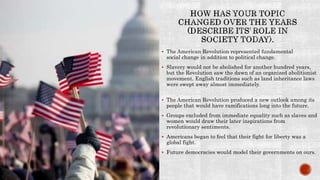
 The American Revolution represented fundamental
social change in addition to political change.
 Slavery would not be abolished for another hundred years,
but the Revolution saw the dawn of an organized abolitionist
movement. English traditions such as land inheritance laws
were swept away almost immediately.
 The American Revolution produced a new outlook among its
people that would have ramifications long into the future.
 Groups excluded from immediate equality such as slaves and
women would draw their later inspirations from
revolutionary sentiments.
 Americans began to feel that their fight for liberty was a
global fight.
 Future democracies would model their governments on ours.
WHAT NEW
INFORMATIO
N DID YOU
LEARN
ABOUT YOUR
TOPIC THAT
YOU DIDN’T
ALREADY
KNOW?
 This project has really helped me
learning about stuff that I did not know
before. I learned about the major
revolutionary war battles in details.
 During my work on this project I came
to realize how intelligent our leaders
were in dealing with unexpected turns
of events for example, they didn't
consider losing one battle a failure,
instead they saw it as a lesson to learn
from it and further improve their
strategy. That approach in my opinion
was imperative to our victory in the
revolution.
 Overall, the American revolution was a
huge success to the United States
because we gained our independence from
Great Britain. Americans had gone
through tragedies. We had gone through
tragedies, made sacrifices, and lost
brothers, sisters and soldiers. Freedom
comes with an expensive price, we have
paid it and that is what makes America
the great country it is today.
WORKS CITED
1. ushistory.org. “Societal Impacts of the American Revolution.” Ushistory.org, Independence Hall Association,
www.ushistory.org/us/12.asp.
2. “Revolutionary War Timeline.” Major Events and Battles of the American Revolution, www.revolutionary-
war.net/revolutionary-war-timeline.html.
3. Hickman, Kennedy. “American Revolution: Capture of Fort Ticonderoga.” ThoughtCo, www.thoughtco.com/capture-
of-fort-ticonderoga-2360180.
4. “The Battle of Bunker Hill.” National Parks Service, U.S. Department of the Interior,
www.nps.gov/nr/twhp/wwwlps/lessons/42bunker/42facts2.htm.
5. History.com Staff. “The Capture of Fort Ticonderoga.” History.com, A&E Television Networks, 2010,
www.history.com/topics/american-revolution/capture-of-fort-ticonderoga.
6. Wallace, Willard M. “American Revolution.” Encyclopædia Britannica, Encyclopædia Britannica, Inc., 21 Feb. 2018,
www.britannica.com/event/American-Revolution.
7. History.com Staff. “Battles of Lexington and Concord.” History.com, A&E Television Networks, 2009,
www.history.com/topics/american-revolution/battles-of-lexington-and-concord.
8. Battle of Saratoga. “Home.” British Battles, www.britishbattles.com/war-of-the-revolution-1775-to-1783/battle-of-
saratoga/
9. “Revolutionary Battles.” Revolutionary Battles ***, www.landofthebrave.info/revolutionary-battles.htm.
10. “Battle of Monmouth.” Battle of Monmouth ***, www.landofthebrave.info/battle-of-monmouth.htm.
FOR
WATCHING!
Rouba

American Revolution. 5PPT Rouba

  • 1.
  • 2.
     This projectwas done to explain and describe how America gained its independence through several major battles during the American revolution.
  • 3.
    Was a politicalchange that took between 1765 & 1783
  • 4.
    WHAT WAS THEAMERICAN REVOLUTION?  The American Revolution, also called United States War of Independence or American Revolutionary War.  It happened because there was colonial conflict which grew from tensions between residents of Great Britain’s 13 North American colonies and the colonial government (British Crown)  13 of Great Britain’s North American colonies won political independence and went on to form the United States of America.  After the war, hostility was growing between the British crown and a large part of its North American colonies for almost more than a decade.  The result of the American Revolution was a new nation called the United States of America
  • 5.
    Apr. 19 1775 Lexington- the first battle of the American Revolutionary War and the Battle of Concord May 10 1775 Battle of Fort Ticonderoga June 17 1775 Battle of Bunker Hill Sept & Oct 1777 Battle of Saratoga June 28 1778 Battle of Monmouth Jan. 17 1781 Battle of Cowpens Oct. 19 1781 The Siege of Yorktown - the British surrender ended the American Revolutionary war
  • 6.
     Were the firstmilitary engagements of the American Revolutionary War  How did it happen?  British troops were planning 1. to destroy military supplies in Concord 2. to capture Sam Adams and John Hancock  On April 19 1775, 700 British troops arrived in Lexington and 77 militiamen gathered on the town green. Then one of the British yelled “Throw down your arms! Ye villains, ye rebels.”  The commander ordered for many of militiamen to spread all around when a shot rang out.  It was unknown which side fired first. Several British volleys were unleashed before order could be restored.
  • 7.
     The colonistsdid not show great marksmanship that day.  As many as 3,500 militiamen firing constantly for 18 miles only killed or wounded roughly 250 Redcoats, compared to about 90 killed and wounded on their side.  Nevertheless, the American won the battle while the British retreated back to Boston.  The Battle of Concord was significant because, it proved to the British that the American army was not just a band of unorganized rebels, but an army that deserved respect.  They proved to the British that they could stand up to one of the most powerful armies in the world. Aftermath
  • 8.
     Colonel Smith,Major Pitcairn and Lord Percy commanded the British Troops.  Paul Revere and William Dawes rode to warn the villages on the route to Concord and the Congress.  Militia were commanded by Barrett, Buttrick, Robinson and many other
  • 9.
     The ColonelBenedict Arnold conducted a secret mission to overtake Ticonderoga and ship any useful animation back to the American Continental army.  Ethan Allen, leader for the Green Mountain Boys, had the same ideas of attacking the fort and was already on his way to the fort.  The battle of Ticonderoga happened on May 10, 1775. It was surprised and captured by the Americans under Ethan Allen and Colonel Benedict Arnold. • They overcame a small British troops at the fort and stole some of the personal belongings of the small troops. • The Fort had heavy artillery that the colonists needed to bombard General Gage out of Boston.
  • 10.
     Ticonderoga wasan important bastion on the route from the Hudson River to Canada, this time to resist British invasion from north to south.  Finally, Allen and Arnold were able to take Ticonderoga without firing a shot!.  Ticonderoga was rebel victory of the Revolutionary War that served as a booster and it provided the colonists with both encouragement and much-needed military supplies.  The location of the Ticonderoga fort, would also serve as a staging ground for Continental troops before their planned invasion of British- held territory in Canada. Aftermath
  • 11.
    GENERALS AT THEBATTLE OF FORT TICONDEROGA  Major General John Burgoyne commanded the British  Major General Arthur St Clair commanded the American troops.
  • 12.
    BACKGROUND ON FORT TICONDEROGA  Frenchbuilt the Fort Ticonderoga in 1755 and was known as Fort Carillon.  In 1758 during the French and Indian War, the fort was the scene of the Battle of Ticonderoga.  The Battle of Ticonderoga in 1758 occurred between the British and American colonists and the French under the Marquis de Montcalm.  In 1759 the fort was captured by the British under General Amherst.
  • 13.
     It wasone of the most decisive battles of the American revolution.  On June 17, 2,200 British forces under the command of Major General William Howe and Brigadier General Robert Pigot landed on the Charlestown Peninsula then marched to Breed’s Hill.  Battle of Bunker Hills was really fought on Breed’s Hills, which is in Charlestown section of Boston, Massachusetts.  British groups sent their troops from Boston so they can occupy the surrounding hills. While the Colonial troops spread everywhere.  British kept fighting for three times, until they lost lots of good men while the colonial ran out of ammunition.
  • 14.
    Aftermath  The Britishgot both Breed’s Hill and Bunker Hill. They had won the battle, but at a terrible cost: out of 2,200 troops, 268 British soldiers and officers had been killed; another 828 were wounded.  The Americans also suffered heavy casualties with 115 killed and 305 wounded.  Battle of Bunker Hills, because it proved that the American could stand against the British.
  • 15.
     British forcesunder the command of Major General William Howe and Brigadier General Robert Pigot  Colonial Generals: General Artemas Ward and General Israel Putnam.
  • 16.
    THE BATTLE OF SARATOGA  They weretwo battles In 1777.  The first Battle of Saratoga was called, Battle of Freeman’s Farm that occurred on Sept 19 of 1777.  The second Battle of Saratoga was called, battle of Bemis Heights which occurred October 7 in 1777.  It took place in upstate New York near Saratoga.  During the battle of Freeman’s Farm (Sept 19th), John Burgoyne, a British General planned to march from Canada, down the Hudson river, and to capture Albany. He was able to achieve for a little, but costly victory over American forces led by Horatio Gates and Benedict Arnold.  Moreover, although Burgoyne’s troop strength had been weakened, He again attacked the Americans at the battle of Bemis Heights (Oct 7th), but this time was defeated and forced to retreat.  Then the British general, John Burgoyne, surrendered ten days later, and the American victory convinced the French government to formally recognize the colonist’s cause and enter the war as their ally.
  • 17.
    THE BATTLE OF SARATOGA AFTERMATH The Patriots destroyed bridges, cut trees for blocks, hid in trees  After the battle of Bemis Heights ,the American victory convinced the French government to formally recognize the colonist’s cause and enter the war as their ally.  The Americans defeated the larger British force and won the battle.  Battle of Saratoga was known as the turning point of the Revolutionary War because France agrees to help Americans and enters their ally.
  • 18.
     Major GeneralJohn Burgoyne commanded the British and German force.  Major General Horatio Gates and Brigadier Benedict Arnold commanded the American army
  • 19.
     It tookplace on Sunday, June 28, 1778 at Monmouth, New Jersey.  General George Washington and his American army were at Valley Forge during the winter of 1777.  The Prussian officer, General Steuben, established a system of military training for the American regiments during the winter of 1777. He was teaching them a form of Prussian battle drill, adapted to suit American troops.  The British army were in Philadelphia during the winter time.  Lieutenant-General Howe returned to England and he relieved of his appointment in command in America at his own request, to be replaced by Lieutenant-General Sir Henry Clinton.  Clinton was under orders to evacuate Philadelphia and concentrate the British forces in New York.  Indiana won by a militia led by American commander George Rogers Clark over a British garrison led by Lieutenant Governor Henry Hamilton.  The Battle of Monmouth was important because Americans intercepted the British forces who were trekking from Philadelphia.
  • 20.
     Lieutenant-General SirHenry Clinton, Major-General Lord Cornwallis and Major- General Knyphausen commanding the British and German army  against General George Washington and Major-General Charles Lee commanding the American army.
  • 22.
    BATTLE OF COWPENS •The Battle of Cowpens took place in South Carolina on January 17, 1781. • The British Commander, Banastre Tarleton, attacked the Americans so the American Commander, Brigadier Daniel Morgan, directed the militia to fight with them but to leave the front line after firing two rounds. The American militia men supported Morgan and wanted to do anything to save their country. • The British troops mistook the repositioning of the Americans as a rout. They ran into an unexpected volley of concentrated rifle fire coupled with a cavalry charge and followed by the return of the militia. Tarleton escaped, but Morgan’s troops decimated his army.
  • 23.
    AFTERMATH • More than800 British troops were killed, wounded or captured. The Americans suffered less than 100 casualties in the first Patriot victory. • The Battle of Cowpens was important because it shows that Americans are clever and think strategically that could outfight a similar British force without any other factors, such as surprise or geography, to assist them.
  • 24.
    COMMANDERS OF THE BATTLEOF COWPENS  The American commander was Brigadier Daniel Morgan  The British commander Lieutenant Colonel Banastre Tarleton
  • 26.
     The Battleof Yorktown was a big battle for the Americans and the last major battle in the revolutionary war.  Americans traveled over 200 miles in 15 days  General George Washington was commanding a force of 17,000 French and Continental troops, begins the siege known as the Battle of Yorktown against General Charles Cornwallis and a contingent of 9,000 British troops at Yorktown, Virginia.  General George Washington ordered Marquis de Lafayette and an American army of 5,000 troops to block Cornwallis’ escape from Yorktown by land  Many of the British were confused, low on supplies and many were sick  Cornwallis found himself trapped on the peninsula by the Americans soldiers.  General Cornwallis and his troops were surrounded on 3 sides by the Continental army.  The French fleet that was commanded by Francois, Count de Grasse, departed St. Dominguefor the Chesapeake Bay, arrives 6 hours before the British fleet and blocked Cornwallis’ escape from Yorktown .  After the British Army whom were led by General Lord Charles Cornwallis got surrenders, the Continental Army, led by General George Washington, won a decisive victory at this battle.
  • 27.
    GENERALS OF THEBATTLE OF YORKTOWN  General Washington commanded the American army. Lieutenant-General de Rochambeau commanded the French troops. Major-General Lord Cornwallis commanded the British and German troops.
  • 28.
    OUTCOME OF THE BATTLE The Patriot victory at Yorktown ended fighting in the American colonies.  Peace negotiations started to show in 1782, and on September 3, 1783.  The result was signing the Treaty of Paris, which was formally recognizing the United States as a free and independent nation after eight years of war.  The Treaty of Paris of 1783 1. Negotiated between the United States and Great Britain 2. It ended the revolutionary war. 3. Recognized American independence.  The Continental Congress named a five-member commission to negotiate a treaty–John Adams, Benjamin Franklin, John Jay, Thomas Jefferson, and Henry Laurens.
  • 30.
    HOW DID YOUR TOPIC FITINTO THE DAILY LIFE OF AMERICA IN THE ERA THAT YOU ARE COVERING?  In religious view: Diversity in religion had become a great and dominant part of England's Thirteen Colonies. The result that the population of America increased significantly because the colonies were a patchwork of religiously diverse communities.  Educational: Upper class children in colonial days got the primary education such as, reading, writing, simple math, poems, and prayers. Paper and textbooks were hard to find during the war so boys and girls recited their lessons until they memorized them. Some of the most commonly used books were the Bible, a primer, and a hornbook.  Musical: Music were a major thing during times of war and is a vital part of learning about our own social history.  Work Life: Colonial American people did many different types of jobs. It varies from industrial laborer in an American city to a slave working on a southern plantation.  Economically: The American economy was, dependent on the hard work of the individuals who lived in America.  Medically: Health issues had a major impact during the Revolutionary War. Physicians' knowledge of medical issues was very basic compared to medical knowledge today. Many of nurses lacked formal training. Hospitals were very few. They were some health such as, poor sanitation and hygiene, and contaminated food and water supplies contributed to the rampant spread of disease in army barracks.
  • 31.
     The Americanrevolution is unique and significant because the freedom that we live today is direct result of the American revolution.  Another unique thing is that the American army was not as heavily armed as the British counterpart. But we excelled in the strategic planning and the knowledge of the battlefields and the support of the people.
  • 32.
    HOW WOULD YOU HAVE FELTABOUT YOUR TOPIC IF YOU HAD BEEN LIVING DURING THE ERA YOU ARE COVERING?  First of all, I would be among the first participants on the revolution because I believe that for a country to be great, first it has to be independent. And achieving our independence from Great Britain was the first building stone to our great country.  I would feel proud of our achievement and at the same time I would feel heartbroken for those who depart it us and didn’t get to witness our victory.
  • 33.
     The AmericanRevolution represented fundamental social change in addition to political change.  Slavery would not be abolished for another hundred years, but the Revolution saw the dawn of an organized abolitionist movement. English traditions such as land inheritance laws were swept away almost immediately.  The American Revolution produced a new outlook among its people that would have ramifications long into the future.  Groups excluded from immediate equality such as slaves and women would draw their later inspirations from revolutionary sentiments.  Americans began to feel that their fight for liberty was a global fight.  Future democracies would model their governments on ours.
  • 34.
    WHAT NEW INFORMATIO N DIDYOU LEARN ABOUT YOUR TOPIC THAT YOU DIDN’T ALREADY KNOW?  This project has really helped me learning about stuff that I did not know before. I learned about the major revolutionary war battles in details.  During my work on this project I came to realize how intelligent our leaders were in dealing with unexpected turns of events for example, they didn't consider losing one battle a failure, instead they saw it as a lesson to learn from it and further improve their strategy. That approach in my opinion was imperative to our victory in the revolution.
  • 35.
     Overall, theAmerican revolution was a huge success to the United States because we gained our independence from Great Britain. Americans had gone through tragedies. We had gone through tragedies, made sacrifices, and lost brothers, sisters and soldiers. Freedom comes with an expensive price, we have paid it and that is what makes America the great country it is today.
  • 36.
    WORKS CITED 1. ushistory.org.“Societal Impacts of the American Revolution.” Ushistory.org, Independence Hall Association, www.ushistory.org/us/12.asp. 2. “Revolutionary War Timeline.” Major Events and Battles of the American Revolution, www.revolutionary- war.net/revolutionary-war-timeline.html. 3. Hickman, Kennedy. “American Revolution: Capture of Fort Ticonderoga.” ThoughtCo, www.thoughtco.com/capture- of-fort-ticonderoga-2360180. 4. “The Battle of Bunker Hill.” National Parks Service, U.S. Department of the Interior, www.nps.gov/nr/twhp/wwwlps/lessons/42bunker/42facts2.htm. 5. History.com Staff. “The Capture of Fort Ticonderoga.” History.com, A&E Television Networks, 2010, www.history.com/topics/american-revolution/capture-of-fort-ticonderoga. 6. Wallace, Willard M. “American Revolution.” Encyclopædia Britannica, Encyclopædia Britannica, Inc., 21 Feb. 2018, www.britannica.com/event/American-Revolution. 7. History.com Staff. “Battles of Lexington and Concord.” History.com, A&E Television Networks, 2009, www.history.com/topics/american-revolution/battles-of-lexington-and-concord. 8. Battle of Saratoga. “Home.” British Battles, www.britishbattles.com/war-of-the-revolution-1775-to-1783/battle-of- saratoga/ 9. “Revolutionary Battles.” Revolutionary Battles ***, www.landofthebrave.info/revolutionary-battles.htm. 10. “Battle of Monmouth.” Battle of Monmouth ***, www.landofthebrave.info/battle-of-monmouth.htm.
  • 37.