The American Revolutionary War
CAUSES OF THE AMERICAN REVOLUTION
Proclamation of 1763 stops colonists from moving west
Parliament taxes the colonies to pay British war debts
Intolerable Acts set up harsh rule in Massachusetts
EFFECTS OF THE AMERICAN REVOLUTION
Colonies declare independence
Britain recognizes United States independence
United States borders extend to Florida
and the Mississippi River
George Washington emerges as a leader
Strengths
and
Weaknesses
The Opposing Sides

One of the Patriots’ greatest advantages
was which of the following?
A.A larger population
B.Mercenaries fighting on their side
C.A stronger navy
D.George Washington as
their military leader
E.Tom Brady
British Strengths…

Population
8 million vs. 2.5 million colonists
Monetary Wealth
Royal Navy
Professional Army
Trained and experienced
50,000 British
30,000 Hessian mercenaries
30,000 American Loyalists
(Tories)
British Weaknesses…
Unrest in Ireland
Government inept and confused,
led by King George III
and Lord North
Lack of desire to
crush American cousins
Whigs cheered American
victories in Parliament
British Weaknesses…

Military Difficulties
Second-rate generals

Inadequate and poor provisions
Need for clear victory,
a draw would be a colonial victory
Armies 3,000 miles from home,
took months to reach the front
Vast colonial territory to conquer
(1,000 x 600 miles)
American Strengths…

Outstanding Leadership
Military – George Washington
Diplomatic – Benjamin Franklin
European Imports
Marquis de Lafayette
Comte de Rochambeau
Francois De Grasse
Thaddeus Kosciusko
Casimir Pulaski
Friedrich von Steuben
American
Strengths…
Colonists fighting
defensively
Self-sustaining
agricultural base
Colonists better marksmen?
Moral advantage
Good cause with
a positive goal
American Weaknesses…
TROUBLES WITH GOVERNMENT:

Colonies were poorly organized and not united for war
Continental Congress debated, took little action,
and exercised little leadership
No written constitution until 1781
Colonies were jealous of Congress and each other
ECONOMIC DIFFICULTIES:
Little metallic currency available
Fearful of taxation
Congress issued virtually worthless currency
American Weaknesses…

MILITARY DIFFICULTIES:
Inadequate firearms, cannons, and gunpowder
(the colonists had enough for each soldier to fire nine shots)

Clothing and shoes scarce
(2,800 men barefoot at Valley Forge)

No Navy
American soldiers numerous but unreliable
The Opposing Sides
Capture of
Fort
Ticonderoga
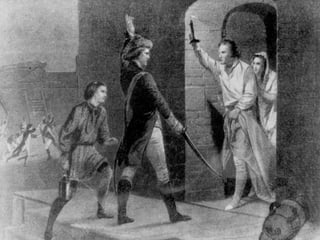
May 10, 1775

Ethan Allen and Benedict Arnold
with the Vermont militia,
the Green Mountain Boys,
captured the mostly abandoned
British fort without a fight
Captured valuable
cannons and gunpowder
Took control of a key route to Canada
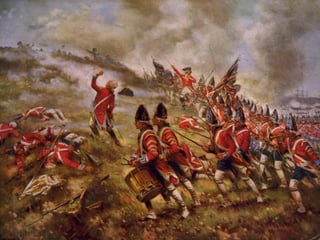
Battle of Bunker Hill
June 17, 1775

Colonel William Prescott led
1,200 militia to
take the high ground over
Boston Harbor
Colonial troops dug in
and prepared defenses
on Breed’s Hill
British General
William Howe attacks:
2,400 redcoats
under his command
British are repelled
after two frontal
assaults
On the third attack,
the militia ran out
of gunpowder,
and the British
took the
position
Losses…
BRITISH
226 killed

COLONISTS
115 killed

(19 officers)

828 wounded

305 wounded

(62 officers)

30 captured
1,054 total casualties

(20 died as POW)

450 total casualties
Although the British won the
Battle of Bunker Hill, they learned
that defeating the Americans on the
battlefield would not be quick or easy
The Death of the American General Warren by John Trumbull
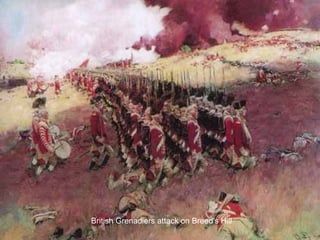
British Grenadiers attack on Breed's Hill
More Military Action

Which of the following shows the correct
chronology?
A. Bunker Hill, Lexington, Ft. Ticonderoga
B. Concord, Yorktown, Lexington

A. A
D.Lexington, Ft. Ticonderoga, Bunker B. B
Hill
C. C
E.Concord, Lexington, Bunker Hill
D. D
C. Yorktown, Lexington, Concord
Early
Battles
Redcoats Leave Boston
March 5, 1776

General Henry Knox and the
Continental Army took the
cannons captured from
Fort Ticonderoga 300 miles
to Dorchester Heights,
overlooking Boston Harbor
General Howe and
the British are forced
to retreat from Boston
to Halifax, Canada
King George III
of Great Britain declared,
"The colonies are in
open and avowed rebellion.
The die is now
cast.
The colonies
must either submit or
triumph."
The King ordered the
blockade of all colonial
ports by the Royal Navy
Attack onCanada

Richard Montgomery captured
Montreal in November, 1775
Benedict Arnold and
Montgomery marched on Quebec:
Poor planning and bad weather
weakened the attack
British reinforcements forced Colonists
to withdraw, leaving Canada to the
British and Montgomery dead
British and Canadians lost 20 men
The American losses were around 500
“The Death of Montgomery” by John Trumbull
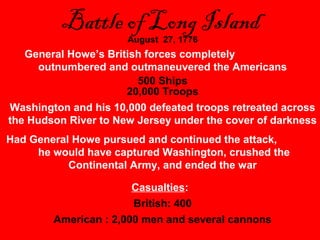
Battle of Long Island
August 27, 1776

General Howe’s British forces completely
outnumbered and outmaneuvered the Americans
500 Ships
20,000 Troops
Washington and his 10,000 defeated troops retreated across
the Hudson River to New Jersey under the cover of darkness
Had General Howe pursued and continued the attack,
he would have captured Washington, crushed the
Continental Army, and ended the war
Casualties:
British: 400
American : 2,000 men and several cannons
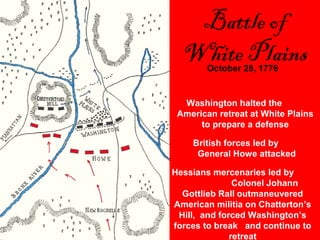
Battle of
White Plains
October 28, 1776

Washington halted the
American retreat at White Plains
to prepare a defense
British forces led by
General Howe attacked
Hessians mercenaries led by
Colonel Johann
Gottlieb Rall outmaneuvered
American militia on Chatterton’s
Hill, and forced Washington’s
forces to break and continue to
retreat
Battle of Fort
Washington
November 16, 1776

British and Hessian forces
outflanked and defeated
the Americans last
position in New York
2,900 Americans were captured
and lost valuable guns,
gunpowder, and cannons
The Continental Army
retreated across New Jersey
into Pennsylvania
British troops crossing the Hudson River  
Molly Pitcher

The only American hero to
emerge from the loss at
Fort Washington was
Margaret “Molly” Corbin.

“Molly Pitcher” was the wife
of a Pennsylvania soldier,
John Corbin, who had gone into
battle at her husband’s side
bringing water to swab cannons
After her husband was killed,
she stepped into his place to
load and fire a cannon,
until she fell wounded.
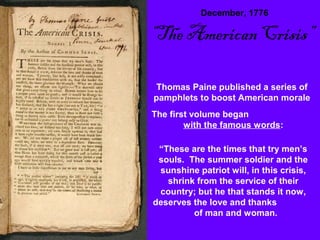
December, 1776

“The American Crisis”
Thomas Paine published a series of
pamphlets to boost American morale
The first volume began
with the famous words:
“These are the times that try men’s
souls. The summer soldier and the
sunshine patriot will, in this crisis,
shrink from the service of their
country; but he that stands it now,
deserves the love and thanks
of man and woman.
Americans
Turn
the
Tide
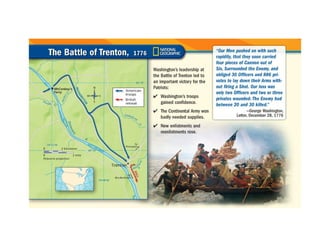
Battle of Trenton
December 26, 1776

Washington’s famous crossing of the Delaware River
2,400 Troops
18 Cannons
The town was defended by
1,200 Hessians with 6 light guns
commanded by the feared Colonel Rall
On the night before the attack, Rall was at dinner when
he was brought information about the American attack
Rall ignored the message,
which was found in his pocket after his death
The American forces attacked
from three directions
The surprised Hessians attempted to form ranks in the town,
but were attacked from the front and rear
Surrounded and mortally
wounded, Rall surrendered
Casualties:
Hessians: 21 killed, 90 wounded, 900 captured
Americans: 4 wounded, 2 possibly froze to death
General George Washington “Crossing the Delaware” at the
Battle of Trenton on Christmas night, 1776 by Emmanuel Leutze 
The surrender to General George Washington of the
dying Hessian commander, Colonel Rall, at the Battle of Trenton
Battle in the Streets of Trenton
General Washington leading the attack at the Battle of Trenton 
Battle of Princeton
January 3, 1777

British Major General Lord Charles Cornwallis
attempted to retake Trenton from the Americans
Washington decided to leave Trenton before
his army was attacked and outnumbered
In the middle of the night, the Americans left fires
burning, and outmaneuvered the British at Princeton
Washington was not able to hold Princeton for long,
and was forced to retreat as his army was outnumbered
General Washington leads the attack at the Battle of Princeton 
Battle of
Brandywine
September 11, 1777

General Howe brought his army
by sea to the Chesapeake
intending to capture Philadelphia
Washington took up defensive
positions at Brandywine Creek,
Pennsylvania to block them
British and Hessian forces
outmaneuvered the Americans
and forced them to retreat,
opening the route to Philadelphia
Battle of
Germantown
October 4, 1777
Washington planned a surprise
attack on British and Hessian
forces encamped at
Germantown, Pennsylvania
The plan was much like the
attack on Trenton, as the
Americans were to attack from
four directions at night
Confusion and heavy fog
led to American forces
breaking and retreating
October 17, 1777

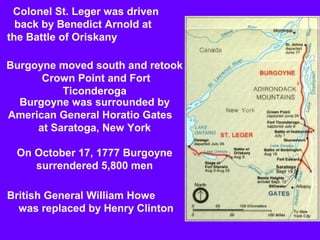
Battle of Saratoga
British planned to cut off the
New England
colonies
at the
Hudson River
Three-Part strategy to attack Albany:
1. General John Burgoyne from the north
2.  Colonel Barry St. Leger from the west
3. General William Howe from the south
General Howe changed his plans and attacked Philadelphia first:
Captures Philadelphia – Continental Congress flees to Baltimore
Howe retires to Philadelphia for comfortable winter quarters
Washington retreats to Valley Forge, Pennsylvania
Betsy Ross sews first “stars and stripes” flag?
Colonel St. Leger was driven
back by Benedict Arnold at
the Battle of Oriskany
Burgoyne moved south and retook
Crown Point and Fort
Ticonderoga
Burgoyne was surrounded by
American General Horatio Gates
at Saratoga, New York
On October 17, 1777 Burgoyne
surrendered 5,800 men
British General William Howe
was replaced by Henry Clinton
Surrender of General Burgoyne at Saratoga by Fauvel 
General John Burgoyne surrenders to General Horatio Gates
French
Alliance
French Alliance
February 6, 1778

Benjamin Franklin was in Paris to
convince King Louis XVI to help
with weapons, supplies, troops,
and strong naval forces
The French, still angry about their defeat
in the French and Indian War,
wanted proof that the Americans
could win before they would help
Saratoga convinced the French
to declare war on Britain
King Louis offered
troops, the French navy, money,
supplies, and a treaty of alliance
The
War Comes
to an
End
Victory at Sea
September 23, 1779

John Paul Jones on the
USS Bon Homme Richard,
attacked a larger British
warship, the HMS Serapis

His ship hit and in flames,
Jones stated,
“I have not yet begun to fight!”
when asked to surrender

American boarding parties defeated
the British and captured the Serapis
in bloody hand-to-hand combat
Battle of Flamborough Head, 23rd September 1779
An American Traitor
Deep in debt, passed over for promotion,
and bitter about not getting enough credit,
Benedict Arnold made a secret deal
to offer to the British the
American fort at West Point
Arnold's scheme was detected
when American forces captured
British Major John André carrying
papers that revealed Arnold's plan
Benedict Arnold escaped to a
British ship and left for England
PLEASE GET OUT
YOUR SPIRAL AND
GET READY FOR
TAKING NOTES
Battle of the
Chesapeake
September 5, 1781

French Admiral
Comte de Grasse defeated
British Admiral Sir Thomas Graves
at the mouth of the
Chesapeake River, Virginia
The victory of the French fleet
prevented the Royal Navy from
resupplying, reinforcing, or
allowing British troops to evacuate
Battle of Yorktown
September 28 – October 19, 1781

British General Charles Cornwallis
marched his army to Yorktown, Virginia
American and French forces surrounded Cornwallis
British forces were low on ammunition and food,
could not be reinforced, resupplied, or evacuated by sea
due to the French naval blockade
Cornwallis was forced to march out of Yorktown and surrender
CASUALTIES:
British: 500 killed, 6,000 captured
American and French: 80 American and 200 French
The British Surrender at Yorktown 19th October 1781
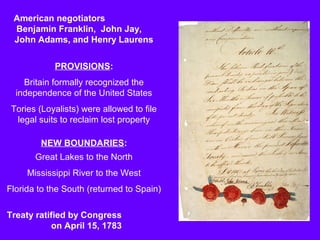
Treaty of Paris
of
1783
American negotiators
Benjamin Franklin, John Jay,
John Adams, and Henry Laurens
PROVISIONS:
Britain formally recognized the
independence of the United States
Tories (Loyalists) were allowed to file
legal suits to reclaim lost property
NEW BOUNDARIES:
Great Lakes to the North
Mississippi River to the West
Florida to the South (returned to Spain)
Treaty ratified by Congress
on April 15, 1783
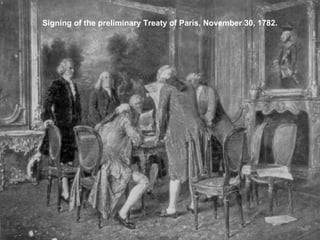
Signing of the preliminary Treaty of Paris, November 30, 1782.
Benjamin West's painting of the delegations at the Treaty of Paris:
John Jay, John Adams, Benjamin Franklin, Henry Laurens, and William Temple Franklin.
The British delegation refused to pose, and the painting was never completed
Review Question 1
Review Question 2
Review Question 3
The End

Chapter 6

  • 1.
  • 2.
    CAUSES OF THEAMERICAN REVOLUTION Proclamation of 1763 stops colonists from moving west Parliament taxes the colonies to pay British war debts Intolerable Acts set up harsh rule in Massachusetts EFFECTS OF THE AMERICAN REVOLUTION Colonies declare independence Britain recognizes United States independence United States borders extend to Florida and the Mississippi River George Washington emerges as a leader
  • 3.
  • 4.
    The Opposing Sides Oneof the Patriots’ greatest advantages was which of the following? A.A larger population B.Mercenaries fighting on their side C.A stronger navy D.George Washington as their military leader E.Tom Brady
  • 5.
    British Strengths… Population 8 millionvs. 2.5 million colonists Monetary Wealth Royal Navy Professional Army Trained and experienced 50,000 British 30,000 Hessian mercenaries 30,000 American Loyalists (Tories)
  • 6.
    British Weaknesses… Unrest inIreland Government inept and confused, led by King George III and Lord North Lack of desire to crush American cousins Whigs cheered American victories in Parliament
  • 7.
    British Weaknesses… Military Difficulties Second-rategenerals Inadequate and poor provisions Need for clear victory, a draw would be a colonial victory Armies 3,000 miles from home, took months to reach the front Vast colonial territory to conquer (1,000 x 600 miles)
  • 8.
    American Strengths… Outstanding Leadership Military– George Washington Diplomatic – Benjamin Franklin European Imports Marquis de Lafayette Comte de Rochambeau Francois De Grasse Thaddeus Kosciusko Casimir Pulaski Friedrich von Steuben
  • 9.
    American Strengths… Colonists fighting defensively Self-sustaining agricultural base Colonistsbetter marksmen? Moral advantage Good cause with a positive goal
  • 10.
    American Weaknesses… TROUBLES WITHGOVERNMENT: Colonies were poorly organized and not united for war Continental Congress debated, took little action, and exercised little leadership No written constitution until 1781 Colonies were jealous of Congress and each other ECONOMIC DIFFICULTIES: Little metallic currency available Fearful of taxation Congress issued virtually worthless currency
  • 11.
    American Weaknesses… MILITARY DIFFICULTIES: Inadequatefirearms, cannons, and gunpowder (the colonists had enough for each soldier to fire nine shots) Clothing and shoes scarce (2,800 men barefoot at Valley Forge) No Navy American soldiers numerous but unreliable
  • 12.
  • 14.
    Capture of Fort Ticonderoga May 10,1775 Ethan Allen and Benedict Arnold with the Vermont militia, the Green Mountain Boys, captured the mostly abandoned British fort without a fight Captured valuable cannons and gunpowder Took control of a key route to Canada
  • 19.
    Battle of BunkerHill June 17, 1775 Colonel William Prescott led 1,200 militia to take the high ground over Boston Harbor Colonial troops dug in and prepared defenses on Breed’s Hill
  • 20.
    British General William Howeattacks: 2,400 redcoats under his command British are repelled after two frontal assaults On the third attack, the militia ran out of gunpowder, and the British took the position
  • 21.
    Losses… BRITISH 226 killed COLONISTS 115 killed (19officers) 828 wounded 305 wounded (62 officers) 30 captured 1,054 total casualties (20 died as POW) 450 total casualties
  • 22.
    Although the Britishwon the Battle of Bunker Hill, they learned that defeating the Americans on the battlefield would not be quick or easy
  • 25.
    The Death ofthe American General Warren by John Trumbull
  • 26.
  • 28.
    More Military Action Whichof the following shows the correct chronology? A. Bunker Hill, Lexington, Ft. Ticonderoga B. Concord, Yorktown, Lexington A. A D.Lexington, Ft. Ticonderoga, Bunker B. B Hill C. C E.Concord, Lexington, Bunker Hill D. D C. Yorktown, Lexington, Concord
  • 29.
  • 32.
    Redcoats Leave Boston March5, 1776 General Henry Knox and the Continental Army took the cannons captured from Fort Ticonderoga 300 miles to Dorchester Heights, overlooking Boston Harbor General Howe and the British are forced to retreat from Boston to Halifax, Canada
  • 36.
    King George III ofGreat Britain declared, "The colonies are in open and avowed rebellion. The die is now cast. The colonies must either submit or triumph." The King ordered the blockade of all colonial ports by the Royal Navy
  • 37.
    Attack onCanada Richard Montgomerycaptured Montreal in November, 1775 Benedict Arnold and Montgomery marched on Quebec: Poor planning and bad weather weakened the attack British reinforcements forced Colonists to withdraw, leaving Canada to the British and Montgomery dead British and Canadians lost 20 men The American losses were around 500
  • 39.
    “The Death ofMontgomery” by John Trumbull
  • 40.
    Battle of LongIsland August 27, 1776 General Howe’s British forces completely outnumbered and outmaneuvered the Americans 500 Ships 20,000 Troops Washington and his 10,000 defeated troops retreated across the Hudson River to New Jersey under the cover of darkness Had General Howe pursued and continued the attack, he would have captured Washington, crushed the Continental Army, and ended the war Casualties: British: 400 American : 2,000 men and several cannons
  • 43.
    Battle of White Plains October28, 1776 Washington halted the American retreat at White Plains to prepare a defense British forces led by General Howe attacked Hessians mercenaries led by Colonel Johann Gottlieb Rall outmaneuvered American militia on Chatterton’s Hill, and forced Washington’s forces to break and continue to retreat
  • 44.
    Battle of Fort Washington November16, 1776 British and Hessian forces outflanked and defeated the Americans last position in New York 2,900 Americans were captured and lost valuable guns, gunpowder, and cannons The Continental Army retreated across New Jersey into Pennsylvania
  • 45.
    British troops crossingthe Hudson River  
  • 46.
    Molly Pitcher The onlyAmerican hero to emerge from the loss at Fort Washington was Margaret “Molly” Corbin. “Molly Pitcher” was the wife of a Pennsylvania soldier, John Corbin, who had gone into battle at her husband’s side bringing water to swab cannons After her husband was killed, she stepped into his place to load and fire a cannon, until she fell wounded.
  • 47.
    December, 1776 “The AmericanCrisis” Thomas Paine published a series of pamphlets to boost American morale The first volume began with the famous words: “These are the times that try men’s souls. The summer soldier and the sunshine patriot will, in this crisis, shrink from the service of their country; but he that stands it now, deserves the love and thanks of man and woman.
  • 48.
  • 49.
    Battle of Trenton December26, 1776 Washington’s famous crossing of the Delaware River 2,400 Troops 18 Cannons The town was defended by 1,200 Hessians with 6 light guns commanded by the feared Colonel Rall On the night before the attack, Rall was at dinner when he was brought information about the American attack Rall ignored the message, which was found in his pocket after his death
  • 50.
    The American forcesattacked from three directions The surprised Hessians attempted to form ranks in the town, but were attacked from the front and rear Surrounded and mortally wounded, Rall surrendered Casualties: Hessians: 21 killed, 90 wounded, 900 captured Americans: 4 wounded, 2 possibly froze to death
  • 51.
    General George Washington“Crossing the Delaware” at the Battle of Trenton on Christmas night, 1776 by Emmanuel Leutze 
  • 54.
    The surrender toGeneral George Washington of the dying Hessian commander, Colonel Rall, at the Battle of Trenton
  • 55.
    Battle in theStreets of Trenton
  • 56.
    General Washington leadingthe attack at the Battle of Trenton 
  • 57.
    Battle of Princeton January3, 1777 British Major General Lord Charles Cornwallis attempted to retake Trenton from the Americans Washington decided to leave Trenton before his army was attacked and outnumbered In the middle of the night, the Americans left fires burning, and outmaneuvered the British at Princeton Washington was not able to hold Princeton for long, and was forced to retreat as his army was outnumbered
  • 59.
    General Washington leadsthe attack at the Battle of Princeton 
  • 60.
    Battle of Brandywine September 11,1777 General Howe brought his army by sea to the Chesapeake intending to capture Philadelphia Washington took up defensive positions at Brandywine Creek, Pennsylvania to block them British and Hessian forces outmaneuvered the Americans and forced them to retreat, opening the route to Philadelphia
  • 61.
    Battle of Germantown October 4,1777 Washington planned a surprise attack on British and Hessian forces encamped at Germantown, Pennsylvania The plan was much like the attack on Trenton, as the Americans were to attack from four directions at night Confusion and heavy fog led to American forces breaking and retreating
  • 62.
    October 17, 1777 Battleof Saratoga British planned to cut off the New England colonies at the Hudson River Three-Part strategy to attack Albany: 1. General John Burgoyne from the north 2.  Colonel Barry St. Leger from the west 3. General William Howe from the south
  • 63.
    General Howe changedhis plans and attacked Philadelphia first: Captures Philadelphia – Continental Congress flees to Baltimore Howe retires to Philadelphia for comfortable winter quarters Washington retreats to Valley Forge, Pennsylvania Betsy Ross sews first “stars and stripes” flag?
  • 64.
    Colonel St. Legerwas driven back by Benedict Arnold at the Battle of Oriskany Burgoyne moved south and retook Crown Point and Fort Ticonderoga Burgoyne was surrounded by American General Horatio Gates at Saratoga, New York On October 17, 1777 Burgoyne surrendered 5,800 men British General William Howe was replaced by Henry Clinton
  • 65.
    Surrender of GeneralBurgoyne at Saratoga by Fauvel 
  • 66.
    General John Burgoynesurrenders to General Horatio Gates
  • 67.
  • 68.
    French Alliance February 6,1778 Benjamin Franklin was in Paris to convince King Louis XVI to help with weapons, supplies, troops, and strong naval forces The French, still angry about their defeat in the French and Indian War, wanted proof that the Americans could win before they would help Saratoga convinced the French to declare war on Britain King Louis offered troops, the French navy, money, supplies, and a treaty of alliance
  • 69.
  • 70.
    Victory at Sea September23, 1779 John Paul Jones on the USS Bon Homme Richard, attacked a larger British warship, the HMS Serapis His ship hit and in flames, Jones stated, “I have not yet begun to fight!” when asked to surrender American boarding parties defeated the British and captured the Serapis in bloody hand-to-hand combat
  • 71.
    Battle of FlamboroughHead, 23rd September 1779
  • 72.
    An American Traitor Deepin debt, passed over for promotion, and bitter about not getting enough credit, Benedict Arnold made a secret deal to offer to the British the American fort at West Point Arnold's scheme was detected when American forces captured British Major John André carrying papers that revealed Arnold's plan Benedict Arnold escaped to a British ship and left for England
  • 73.
    PLEASE GET OUT YOURSPIRAL AND GET READY FOR TAKING NOTES
  • 76.
    Battle of the Chesapeake September5, 1781 French Admiral Comte de Grasse defeated British Admiral Sir Thomas Graves at the mouth of the Chesapeake River, Virginia The victory of the French fleet prevented the Royal Navy from resupplying, reinforcing, or allowing British troops to evacuate
  • 77.
    Battle of Yorktown September28 – October 19, 1781 British General Charles Cornwallis marched his army to Yorktown, Virginia American and French forces surrounded Cornwallis British forces were low on ammunition and food, could not be reinforced, resupplied, or evacuated by sea due to the French naval blockade Cornwallis was forced to march out of Yorktown and surrender CASUALTIES: British: 500 killed, 6,000 captured American and French: 80 American and 200 French
  • 79.
    The British Surrenderat Yorktown 19th October 1781
  • 80.
    The British Surrenderat Yorktown 19th October 1781
  • 81.
  • 82.
    American negotiators Benjamin Franklin,John Jay, John Adams, and Henry Laurens PROVISIONS: Britain formally recognized the independence of the United States Tories (Loyalists) were allowed to file legal suits to reclaim lost property NEW BOUNDARIES: Great Lakes to the North Mississippi River to the West Florida to the South (returned to Spain) Treaty ratified by Congress on April 15, 1783
  • 83.
    Signing of thepreliminary Treaty of Paris, November 30, 1782.
  • 84.
    Benjamin West's paintingof the delegations at the Treaty of Paris: John Jay, John Adams, Benjamin Franklin, Henry Laurens, and William Temple Franklin. The British delegation refused to pose, and the painting was never completed
  • 85.
  • 86.
  • 87.
  • 88.