Basics of Research
Methodology
By Selvan Swaminathan
What is Research
Research is defined as careful consideration of study
regarding a particular concern or problem using scientific
methods.
According to the American sociologist Earl Robert Babbie,
“research is a systematic inquiry to describe, explain,
predict, and control the ‘observed phenomenon’.
Necessity of Psychological
Research
Describe the behaviors
Explain why these behaviors occur
Predict the behaviors
Change a behavior – eg:- Pavlov’s Theory of Classical Conditioning
What is ‘Scientific Method’ in Research
The scientific method is a set of principles and procedures that are used by
researchers to develop questions, collect data, and reach conclusions.
Basic Research Objectives
 ExploratoryStudies – when a researcher has just begun an investigation and wishes to
understand the topicgenerally.
 DescriptiveResearch – Describing, Explaining, and Validating the findings. This method
describe the behavior pattern of sample population.
 ExplanatoryResearch – Explanatoryresearch is research that aims to explain why particular
phenomenawork in the way that they do.
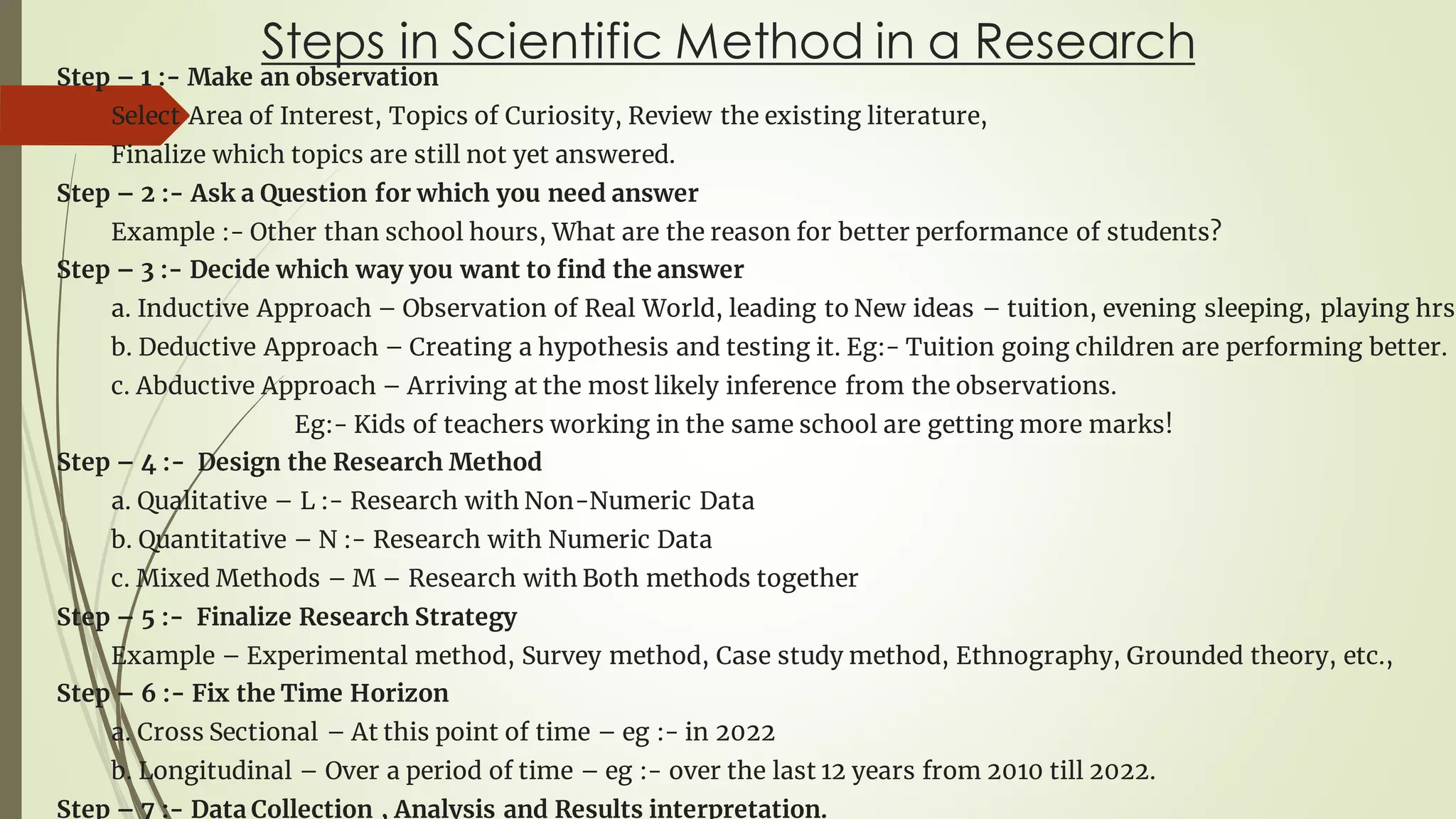
Steps in Scientific Method in a Research
Step – 1 :- Make an observation
Select Area of Interest, Topics of Curiosity, Review the existing literature,
Finalize which topics are still not yet answered.
Step – 2 :- Ask a Question for which you need answer
Example :- Other than school hours, What are the reason for better performance of students?
Step – 3 :- Decide which way you want to find the answer
a. Inductive Approach – Observation of Real World, leading to New ideas – tuition, evening sleeping, playing hrs
b. Deductive Approach – Creating a hypothesis and testing it. Eg:- Tuition going children are performing better.
c. Abductive Approach – Arriving at the most likely inference from the observations.
Eg:- Kids of teachers working in the same school are getting more marks!
Step – 4 :- Design the Research Method
a. Qualitative – L :- Research with Non-Numeric Data
b. Quantitative – N :- Research with Numeric Data
c. Mixed Methods – M – Research with Both methods together
Step – 5 :- Finalize Research Strategy
Example – Experimental method, Survey method, Case study method, Ethnography, Grounded theory, etc.,
Step – 6 :- Fix the Time Horizon
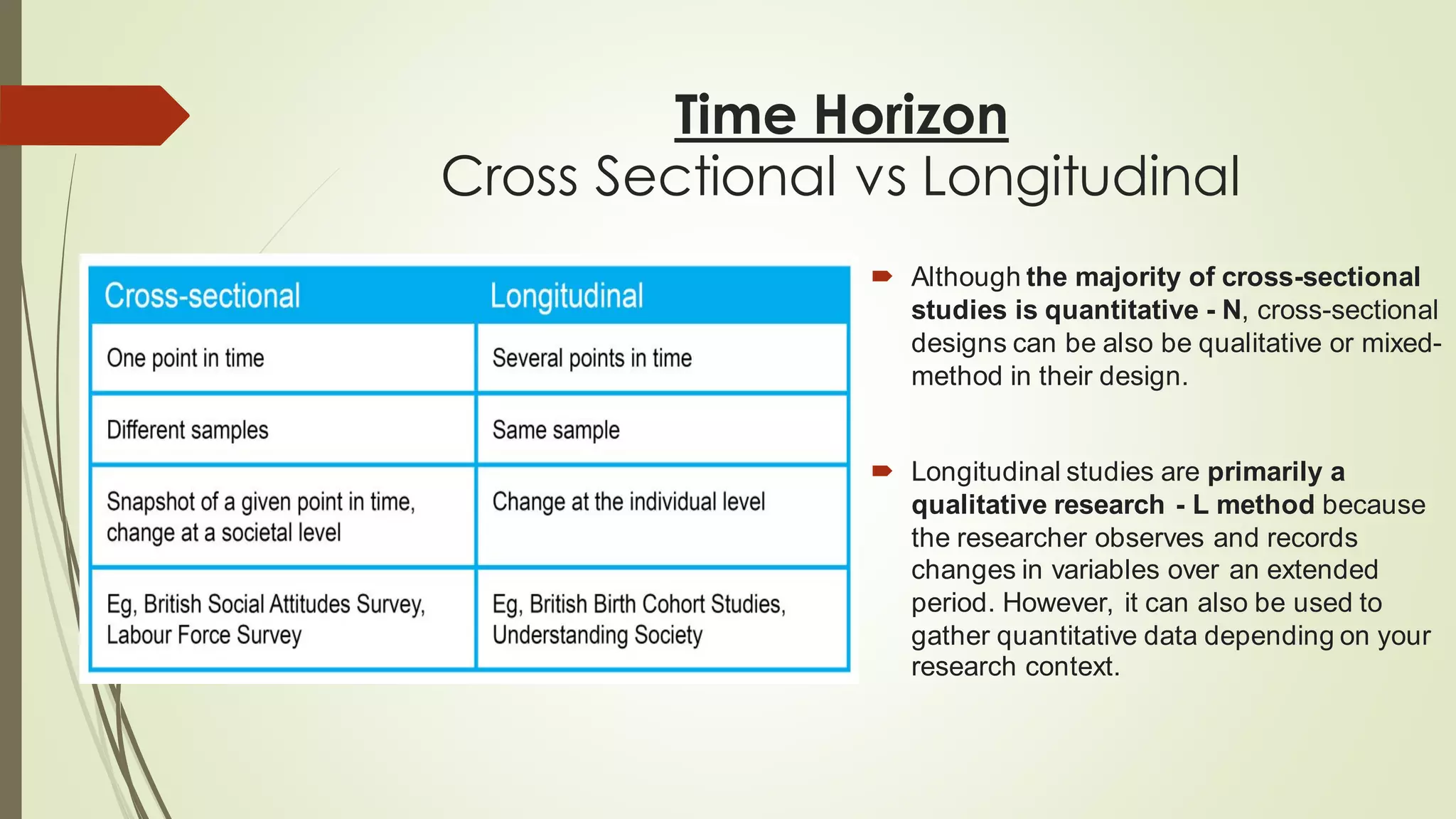
a. Cross Sectional – At this point of time – eg :- in 2022
b. Longitudinal – Over a period of time – eg :- over the last 12 years from 2010 till 2022.
Step – 7 :- Data Collection , Analysis and Results interpretation.
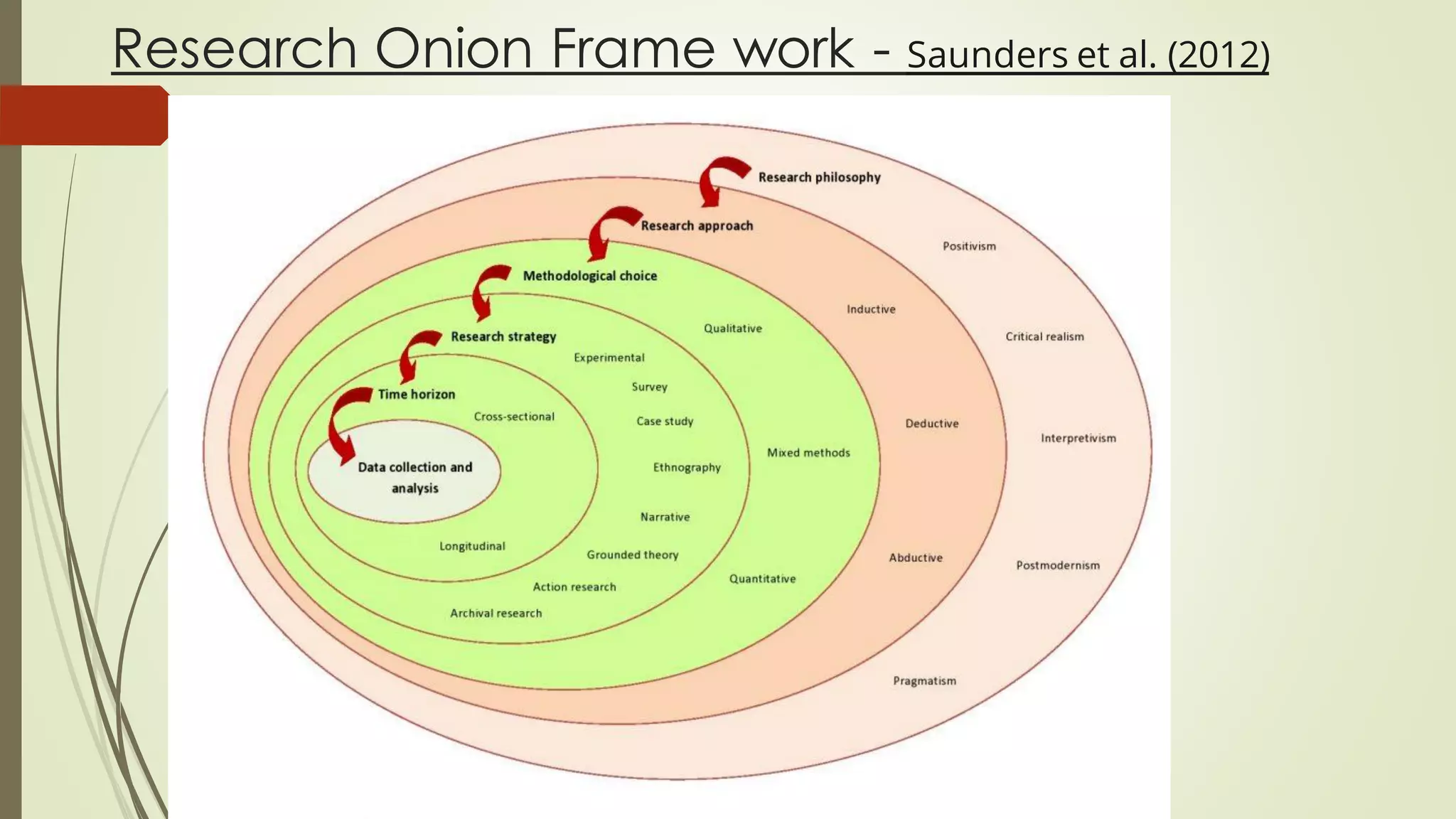
Research Onion Frame work - Saunders et al. (2012)
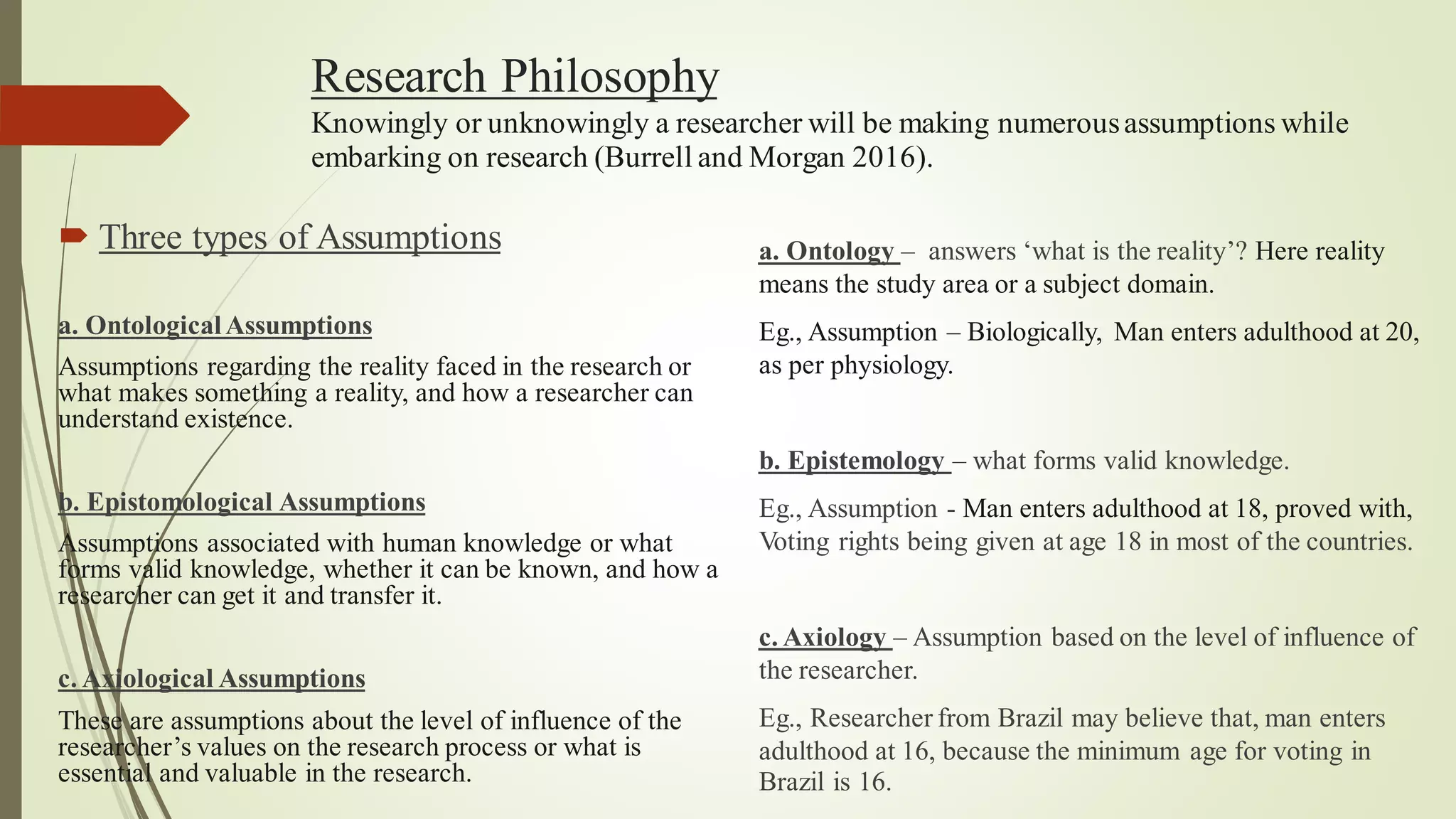
Research Philosophy
Knowingly or unknowingly a researcher will be making numerousassumptions while
embarking on research (Burrell and Morgan 2016).
 Three types of Assumptions
a. OntologicalAssumptions
Assumptions regarding the reality faced in the research or
what makes something a reality, and how a researcher can
understand existence.
b. Epistomological Assumptions
Assumptions associated with human knowledge or what
forms valid knowledge, whether it can be known, and how a
researcher can get it and transfer it.
c. Axiological Assumptions
These are assumptions about the level of influence of the
researcher’s values on the research process or what is
essential and valuable in the research.
a. Ontology – answers ‘what is the reality’? Here reality
means the study area or a subject domain.
Eg., Assumption – Biologically, Man enters adulthood at 20,
as per physiology.
b. Epistemology – what forms valid knowledge.
Eg., Assumption - Man enters adulthood at 18, proved with,
Voting rights being given at age 18 in most of the countries.
c. Axiology – Assumption based on the level of influence of
the researcher.
Eg., Researcher from Brazil may believe that, man enters
adulthood at 16, because the minimum age for voting in
Brazil is 16.
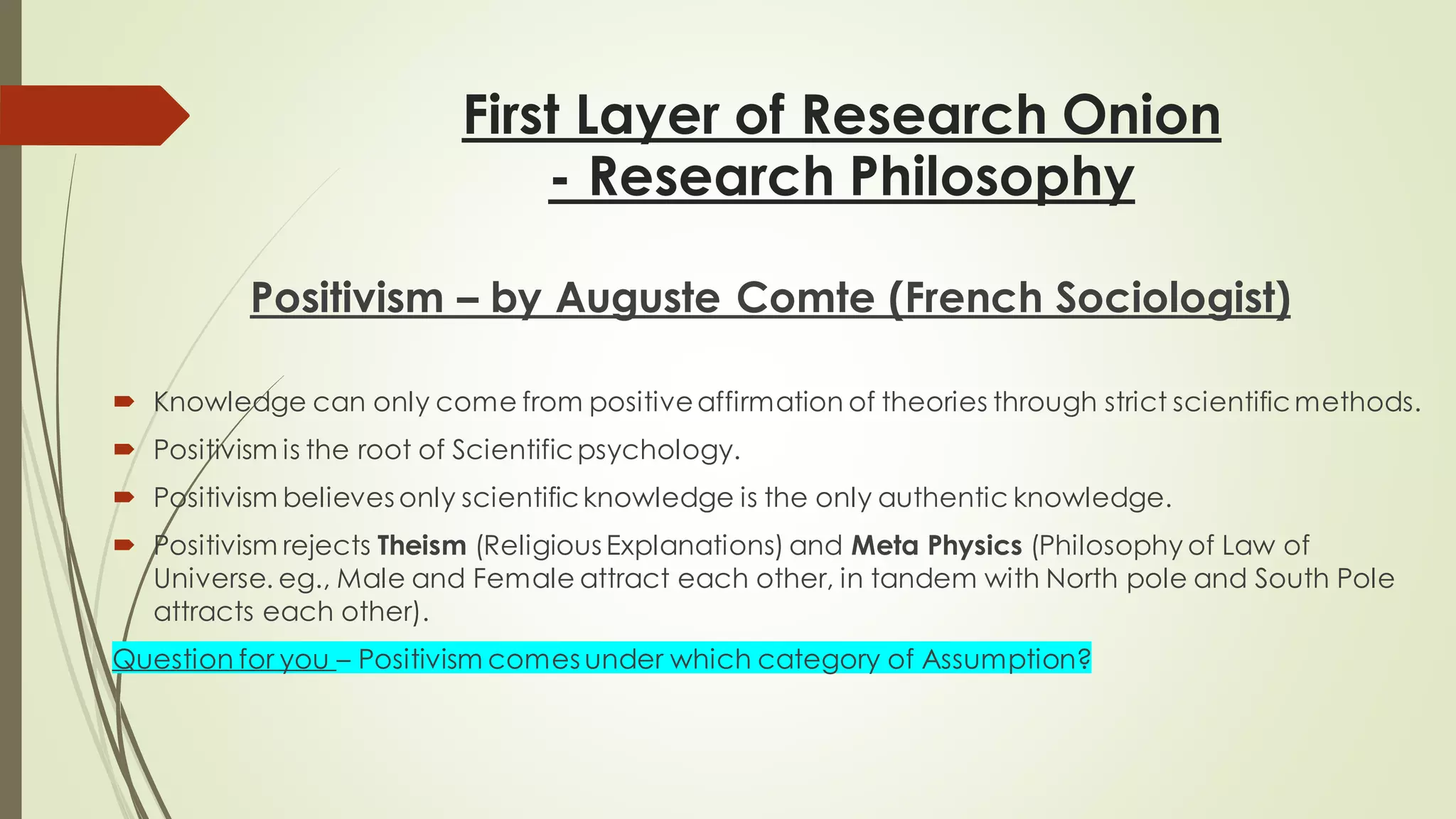
First Layer of Research Onion
- Research Philosophy
Positivism – by Auguste Comte (French Sociologist)
 Knowledge can only come from positiveaffirmation of theories through strict scientificmethods.
 Positivism is the root of Scientificpsychology.
 Positivism believes only scientificknowledge is the only authentic knowledge.
 Positivism rejects Theism (Religious Explanations) and Meta Physics (Philosophy of Law of
Universe. eg., Male and Female attract each other, in tandem with North pole and South Pole
attracts each other).
Question for you – Positivism comes under which category of Assumption?
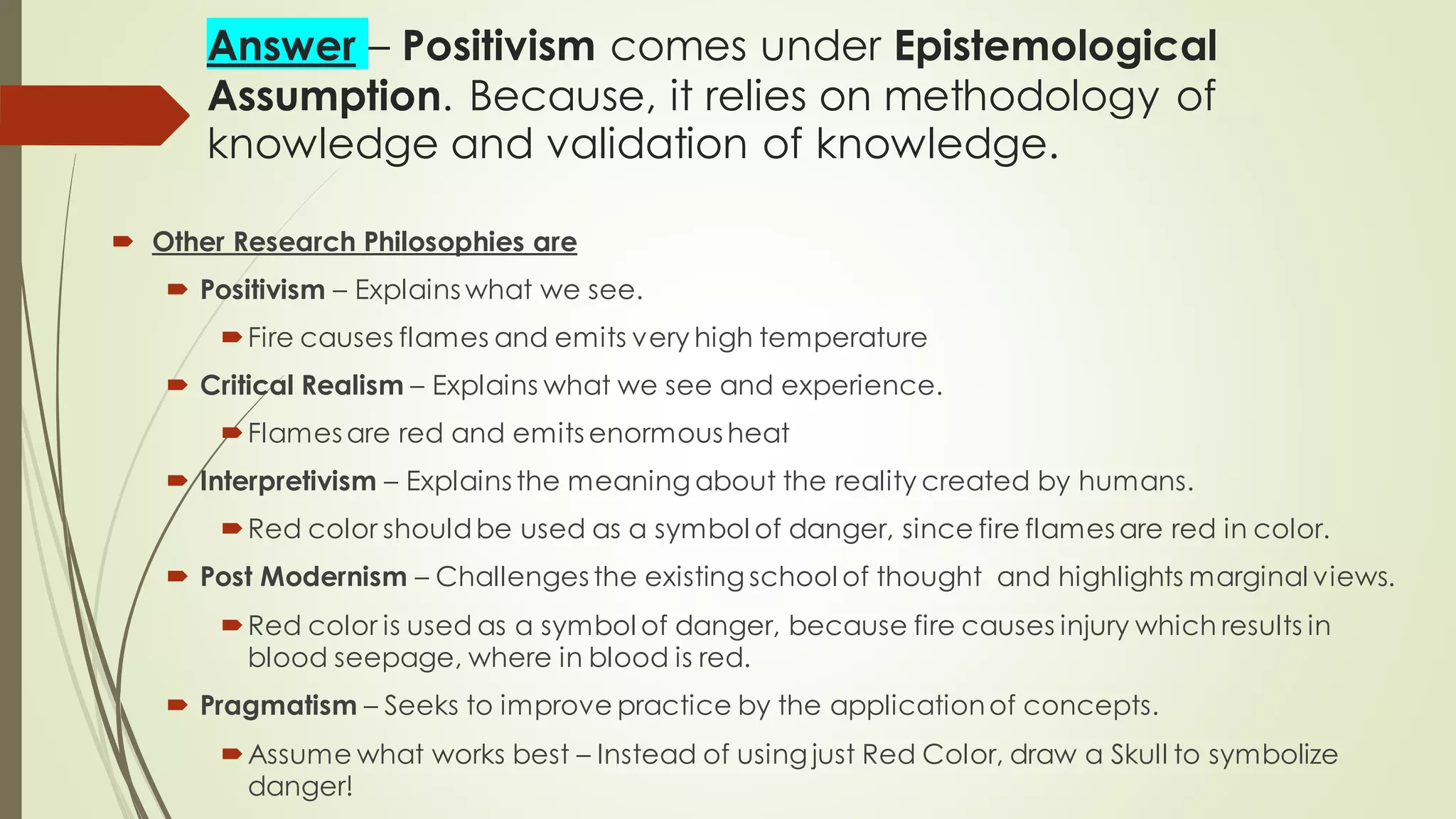
Answer – Positivism comes under Epistemological
Assumption. Because, it relies on methodology of
knowledge and validation of knowledge.
 Other Research Philosophies are
 Positivism – Explains what we see.
Fire causes flames and emits very high temperature
 Critical Realism – Explains what we see and experience.
Flames are red and emits enormous heat
 Interpretivism – Explains the meaning about the reality created by humans.
Red color shouldbe used as a symbol of danger, since fire flames are red in color.
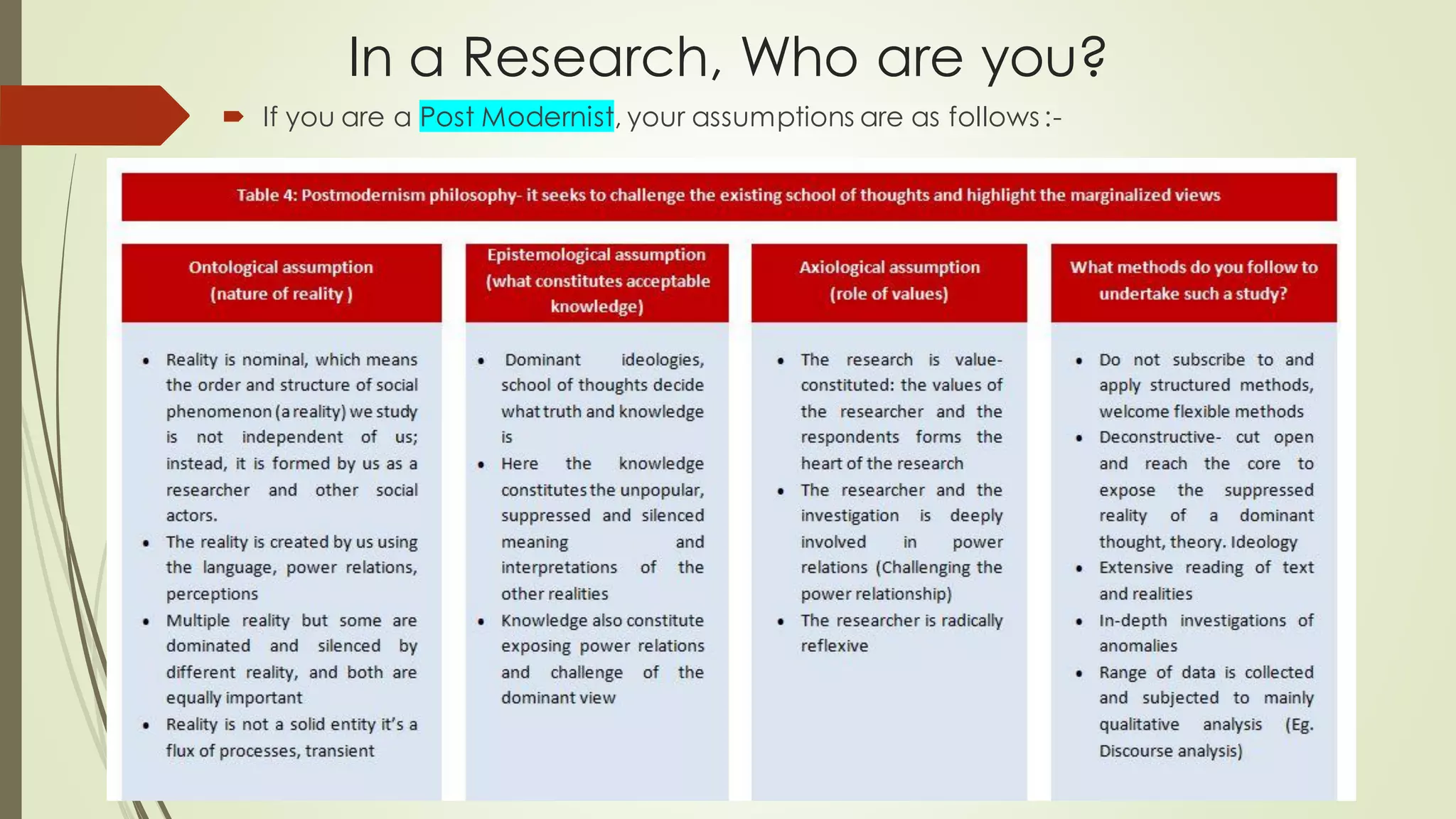
 Post Modernism – Challenges the existing school of thought and highlights marginal views.
Red color is used as a symbol of danger, because fire causes injury which results in
blood seepage, where in blood is red.
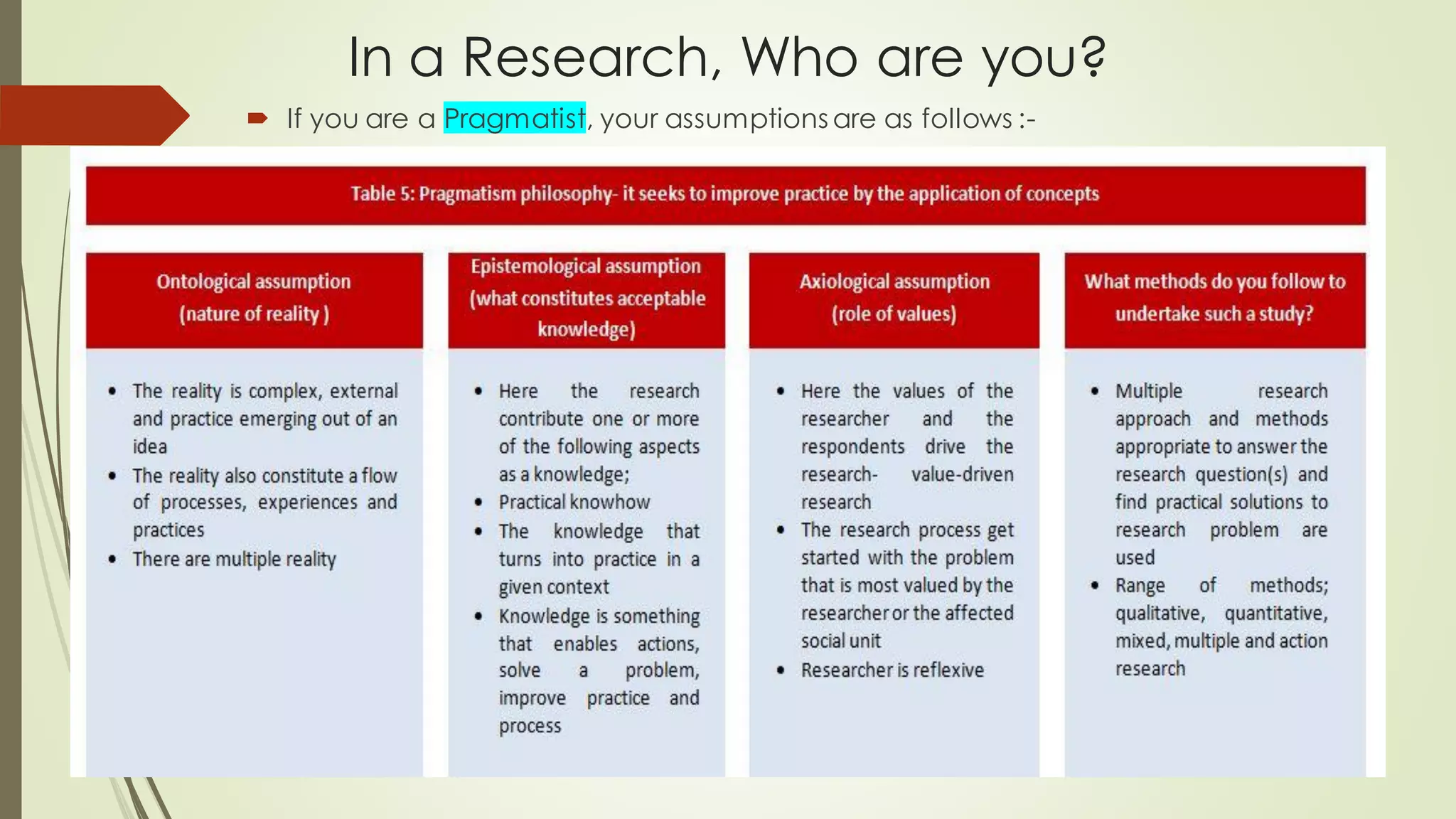
 Pragmatism – Seeks to improve practice by the applicationof concepts.
Assume what works best – Instead of using just Red Color, draw a Skull to symbolize
danger!
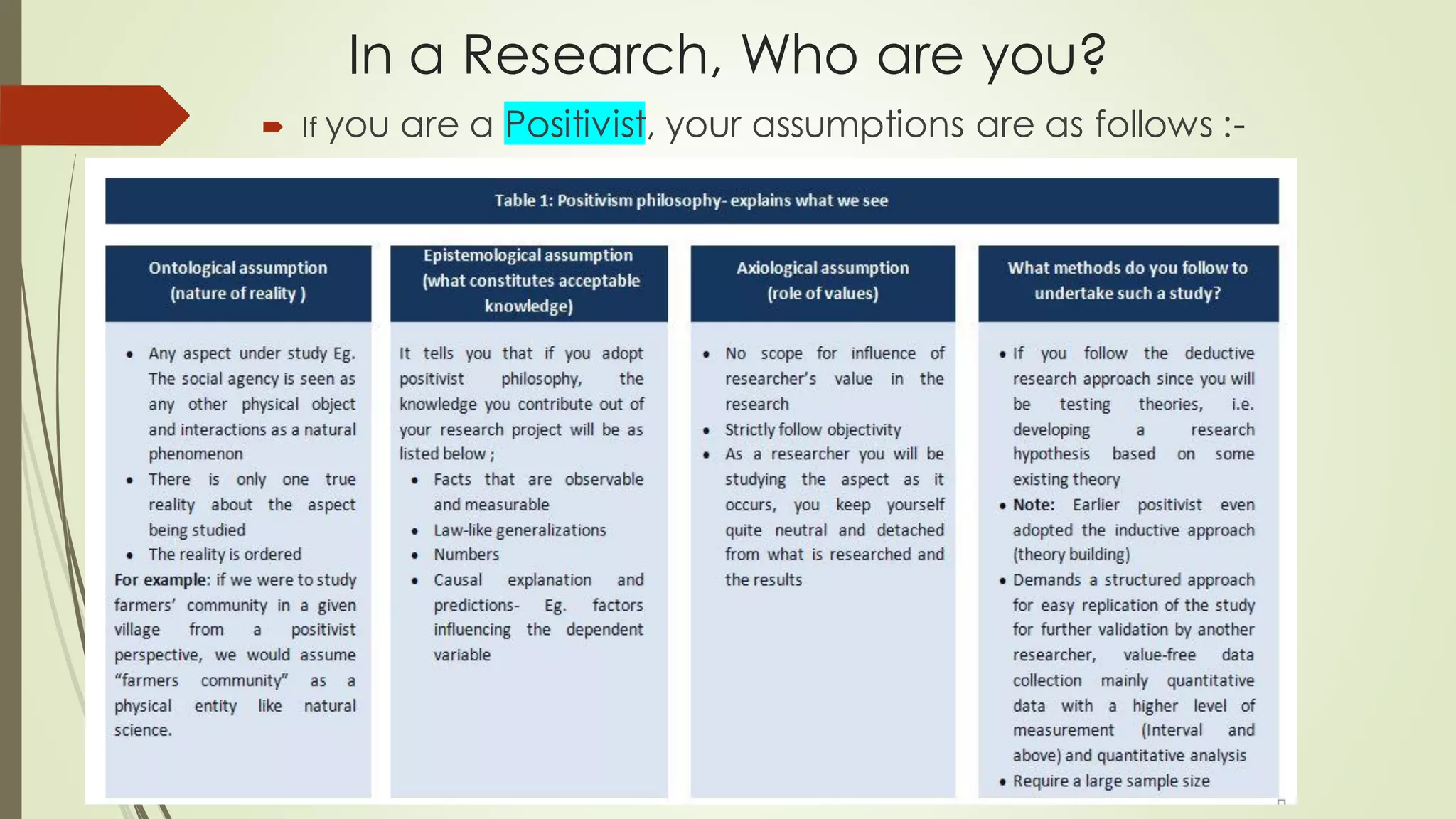
In a Research, Who are you?
 If you are a Positivist, your assumptions are as follows :-
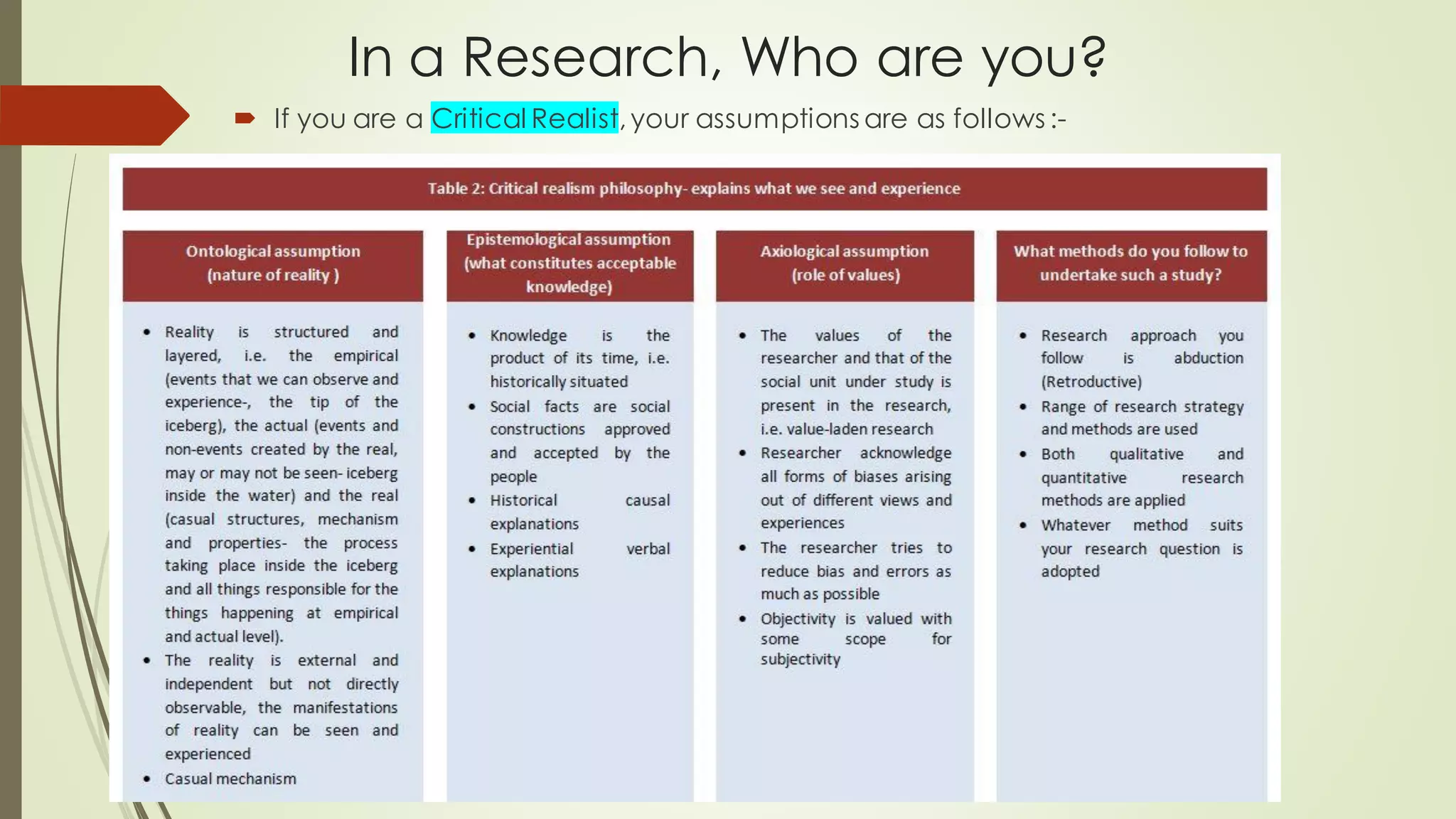
In a Research, Who are you?
 If you are a Critical Realist,your assumptions are as follows :-
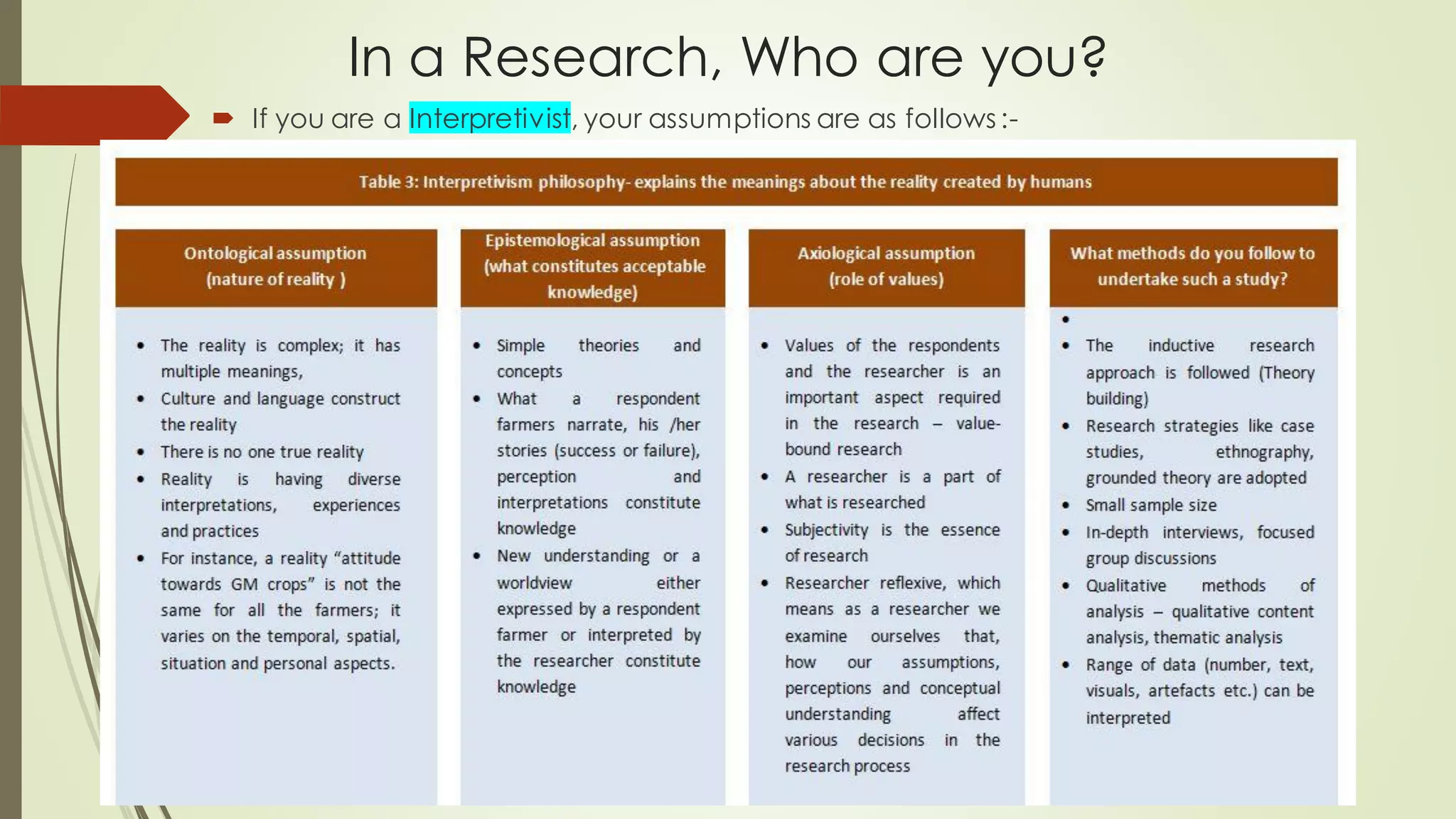
In a Research, Who are you?
 If you are a Interpretivist, your assumptions are as follows :-
In a Research, Who are you?
 If you are a Post Modernist, your assumptions are as follows :-
In a Research, Who are you?
 If you are a Pragmatist, your assumptions are as follows :-
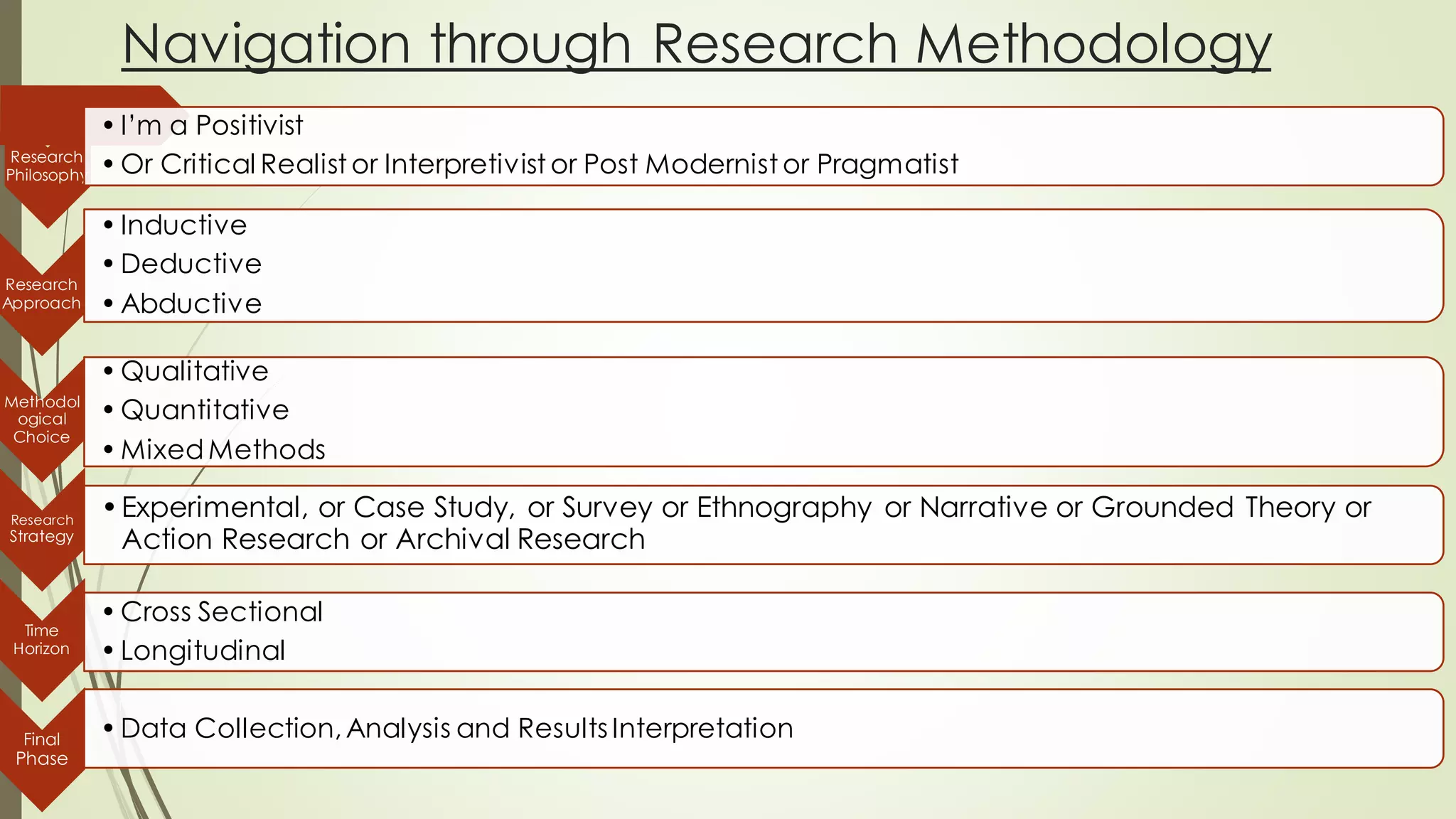
Navigation through Research Methodology
Research
Philosophy
•I’m a Positivist
•Or Critical Realist or Interpretivist or Post Modernist or Pragmatist
Research
Approach
•Inductive
•Deductive
•Abductive
Methodol
ogical
Choice
•Qualitative
•Quantitative
•MixedMethods
Research
Strategy
•Experimental, or Case Study, or Survey or Ethnography or Narrative or Grounded Theory or
Action Research or Archival Research
Time
Horizon
•Cross Sectional
•Longitudinal
Final
Phase
•Data Collection,Analysis and Results Interpretation
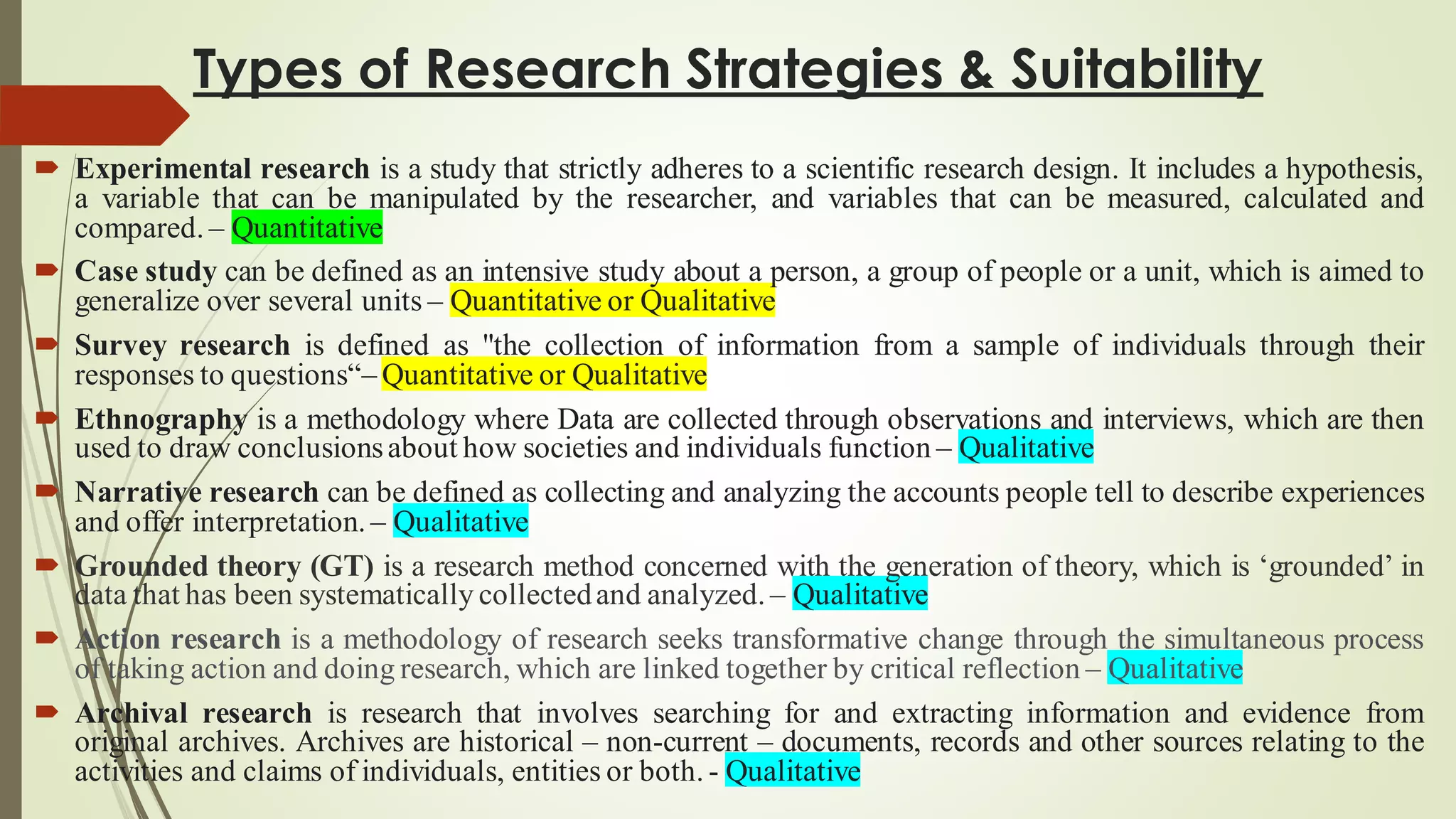
Types of Research Strategies & Suitability
 Experimental research is a study that strictly adheres to a scientific research design. It includes a hypothesis,
a variable that can be manipulated by the researcher, and variables that can be measured, calculated and
compared. – Quantitative
 Case study can be defined as an intensive study about a person, a group of people or a unit, which is aimed to
generalize over several units – Quantitative or Qualitative
 Survey research is defined as "the collection of information from a sample of individuals through their
responses to questions“– Quantitative or Qualitative
 Ethnography is a methodology where Data are collected through observations and interviews, which are then
used to draw conclusionsabout how societies and individuals function – Qualitative
 Narrative research can be defined as collecting and analyzing the accounts people tell to describe experiences
and offer interpretation. – Qualitative
 Grounded theory (GT) is a research method concerned with the generation of theory, which is ‘grounded’ in
data that has been systematically collectedand analyzed. – Qualitative
 Action research is a methodology of research seeks transformative change through the simultaneous process
of taking action and doing research, which are linked together by critical reflection – Qualitative
 Archival research is research that involves searching for and extracting information and evidence from
original archives. Archives are historical – non-current – documents, records and other sources relating to the
activities and claims of individuals, entities or both. - Qualitative
Time Horizon
Cross Sectional vs Longitudinal
 Although the majority of cross-sectional
studies is quantitative - N, cross-sectional
designs can be also be qualitative or mixed-
method in their design.
 Longitudinal studies are primarily a
qualitative research - L method because
the researcher observes and records
changes in variables over an extended
period. However, it can also be used to
gather quantitative data depending on your
research context.
In the next discussion …..
We shall see the concepts of ….
Qualitative Vs Quantitative Research Methodology
Thank you

Basics of Research Methodology Basics...notes1.pdf

  • 1.
  • 2.
    What is Research Researchis defined as careful consideration of study regarding a particular concern or problem using scientific methods. According to the American sociologist Earl Robert Babbie, “research is a systematic inquiry to describe, explain, predict, and control the ‘observed phenomenon’.
  • 3.
    Necessity of Psychological Research Describethe behaviors Explain why these behaviors occur Predict the behaviors Change a behavior – eg:- Pavlov’s Theory of Classical Conditioning
  • 4.
    What is ‘ScientificMethod’ in Research The scientific method is a set of principles and procedures that are used by researchers to develop questions, collect data, and reach conclusions. Basic Research Objectives  ExploratoryStudies – when a researcher has just begun an investigation and wishes to understand the topicgenerally.  DescriptiveResearch – Describing, Explaining, and Validating the findings. This method describe the behavior pattern of sample population.  ExplanatoryResearch – Explanatoryresearch is research that aims to explain why particular phenomenawork in the way that they do.
  • 5.
    Steps in ScientificMethod in a Research Step – 1 :- Make an observation Select Area of Interest, Topics of Curiosity, Review the existing literature, Finalize which topics are still not yet answered. Step – 2 :- Ask a Question for which you need answer Example :- Other than school hours, What are the reason for better performance of students? Step – 3 :- Decide which way you want to find the answer a. Inductive Approach – Observation of Real World, leading to New ideas – tuition, evening sleeping, playing hrs b. Deductive Approach – Creating a hypothesis and testing it. Eg:- Tuition going children are performing better. c. Abductive Approach – Arriving at the most likely inference from the observations. Eg:- Kids of teachers working in the same school are getting more marks! Step – 4 :- Design the Research Method a. Qualitative – L :- Research with Non-Numeric Data b. Quantitative – N :- Research with Numeric Data c. Mixed Methods – M – Research with Both methods together Step – 5 :- Finalize Research Strategy Example – Experimental method, Survey method, Case study method, Ethnography, Grounded theory, etc., Step – 6 :- Fix the Time Horizon a. Cross Sectional – At this point of time – eg :- in 2022 b. Longitudinal – Over a period of time – eg :- over the last 12 years from 2010 till 2022. Step – 7 :- Data Collection , Analysis and Results interpretation.
  • 6.
    Research Onion Framework - Saunders et al. (2012)
  • 7.
    Research Philosophy Knowingly orunknowingly a researcher will be making numerousassumptions while embarking on research (Burrell and Morgan 2016).  Three types of Assumptions a. OntologicalAssumptions Assumptions regarding the reality faced in the research or what makes something a reality, and how a researcher can understand existence. b. Epistomological Assumptions Assumptions associated with human knowledge or what forms valid knowledge, whether it can be known, and how a researcher can get it and transfer it. c. Axiological Assumptions These are assumptions about the level of influence of the researcher’s values on the research process or what is essential and valuable in the research. a. Ontology – answers ‘what is the reality’? Here reality means the study area or a subject domain. Eg., Assumption – Biologically, Man enters adulthood at 20, as per physiology. b. Epistemology – what forms valid knowledge. Eg., Assumption - Man enters adulthood at 18, proved with, Voting rights being given at age 18 in most of the countries. c. Axiology – Assumption based on the level of influence of the researcher. Eg., Researcher from Brazil may believe that, man enters adulthood at 16, because the minimum age for voting in Brazil is 16.
  • 8.
    First Layer ofResearch Onion - Research Philosophy Positivism – by Auguste Comte (French Sociologist)  Knowledge can only come from positiveaffirmation of theories through strict scientificmethods.  Positivism is the root of Scientificpsychology.  Positivism believes only scientificknowledge is the only authentic knowledge.  Positivism rejects Theism (Religious Explanations) and Meta Physics (Philosophy of Law of Universe. eg., Male and Female attract each other, in tandem with North pole and South Pole attracts each other). Question for you – Positivism comes under which category of Assumption?
  • 9.
    Answer – Positivismcomes under Epistemological Assumption. Because, it relies on methodology of knowledge and validation of knowledge.  Other Research Philosophies are  Positivism – Explains what we see. Fire causes flames and emits very high temperature  Critical Realism – Explains what we see and experience. Flames are red and emits enormous heat  Interpretivism – Explains the meaning about the reality created by humans. Red color shouldbe used as a symbol of danger, since fire flames are red in color.  Post Modernism – Challenges the existing school of thought and highlights marginal views. Red color is used as a symbol of danger, because fire causes injury which results in blood seepage, where in blood is red.  Pragmatism – Seeks to improve practice by the applicationof concepts. Assume what works best – Instead of using just Red Color, draw a Skull to symbolize danger!
  • 10.
    In a Research,Who are you?  If you are a Positivist, your assumptions are as follows :-
  • 11.
    In a Research,Who are you?  If you are a Critical Realist,your assumptions are as follows :-
  • 12.
    In a Research,Who are you?  If you are a Interpretivist, your assumptions are as follows :-
  • 13.
    In a Research,Who are you?  If you are a Post Modernist, your assumptions are as follows :-
  • 14.
    In a Research,Who are you?  If you are a Pragmatist, your assumptions are as follows :-
  • 15.
    Navigation through ResearchMethodology Research Philosophy •I’m a Positivist •Or Critical Realist or Interpretivist or Post Modernist or Pragmatist Research Approach •Inductive •Deductive •Abductive Methodol ogical Choice •Qualitative •Quantitative •MixedMethods Research Strategy •Experimental, or Case Study, or Survey or Ethnography or Narrative or Grounded Theory or Action Research or Archival Research Time Horizon •Cross Sectional •Longitudinal Final Phase •Data Collection,Analysis and Results Interpretation
  • 16.
    Types of ResearchStrategies & Suitability  Experimental research is a study that strictly adheres to a scientific research design. It includes a hypothesis, a variable that can be manipulated by the researcher, and variables that can be measured, calculated and compared. – Quantitative  Case study can be defined as an intensive study about a person, a group of people or a unit, which is aimed to generalize over several units – Quantitative or Qualitative  Survey research is defined as "the collection of information from a sample of individuals through their responses to questions“– Quantitative or Qualitative  Ethnography is a methodology where Data are collected through observations and interviews, which are then used to draw conclusionsabout how societies and individuals function – Qualitative  Narrative research can be defined as collecting and analyzing the accounts people tell to describe experiences and offer interpretation. – Qualitative  Grounded theory (GT) is a research method concerned with the generation of theory, which is ‘grounded’ in data that has been systematically collectedand analyzed. – Qualitative  Action research is a methodology of research seeks transformative change through the simultaneous process of taking action and doing research, which are linked together by critical reflection – Qualitative  Archival research is research that involves searching for and extracting information and evidence from original archives. Archives are historical – non-current – documents, records and other sources relating to the activities and claims of individuals, entities or both. - Qualitative
  • 17.
    Time Horizon Cross Sectionalvs Longitudinal  Although the majority of cross-sectional studies is quantitative - N, cross-sectional designs can be also be qualitative or mixed- method in their design.  Longitudinal studies are primarily a qualitative research - L method because the researcher observes and records changes in variables over an extended period. However, it can also be used to gather quantitative data depending on your research context.
  • 18.
    In the nextdiscussion ….. We shall see the concepts of …. Qualitative Vs Quantitative Research Methodology Thank you