Building an in-silico
phenotypic screening
approach with Reaxys
Olivier BARBERAN
Senior Product Manager
Reaxys Medicinal Chemistry
February 2016
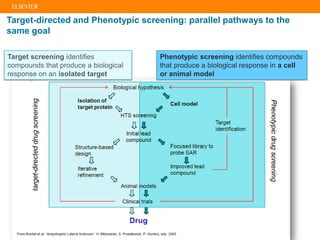
Target-directed and Phenotypic screening: parallel pathways to the
same goal
Phenotypic screening identifies compounds
that produce a biological response in a cell
or animal model
Target screening identifies
compounds that produce a biological
response on an isolated target
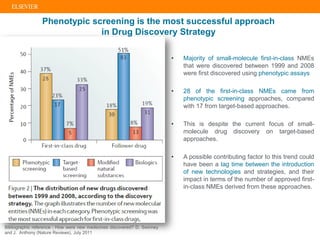
Phenotypic screening is the most successful approach
in Drug Discovery Strategy
• Majority of small-molecule first-in-class NMEs
that were discovered between 1999 and 2008
were first discovered using phenotypic assays
• 28 of the first-in-class NMEs came from
phenotypic screening approaches, compared
with 17 from target-based approaches.
• This is despite the current focus of small-
molecule drug discovery on target-based
approaches.
• A possible contributing factor to this trend could
have been a lag time between the introduction
of new technologies and strategies, and their
impact in terms of the number of approved first-
in-class NMEs derived from these approaches.
Bibliographic reference : How were new medecines discovered? D. Swinney
and J. Anthony (Nature Reviews), July 2011
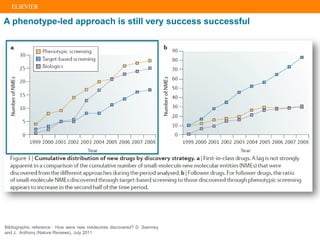
A phenotype-led approach is still very success successful
Bibliographic reference : How were new medecines discovered? D. Swinney
and J. Anthony (Nature Reviews), July 2011
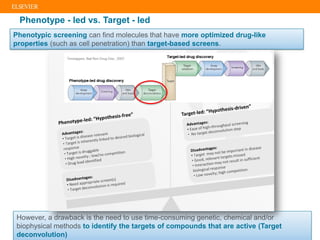
Phenotype - led vs. Target - led
However, a drawback is the need to use time-consuming genetic, chemical and/or
biophysical methods to identify the targets of compounds that are active (Target
deconvolution)
Phenotypic screening can find molecules that have more optimized drug-like
properties (such as cell penetration) than target-based screens.
Why using an in silico Phenotypic screening strategy in drug
discovery
Development of an In Silico Phenotypic screening approach in order to :
2) Building an automated tool in order to establish a target FingerPrint for
disease specific cell lines
1) identify pharmacological targets involved in cell based assay and
understand the molecular mechanisms of action of drugs (MMOA).
7
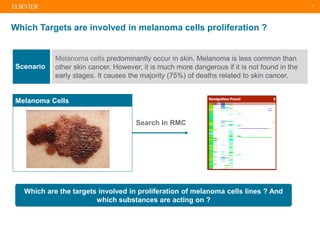
Scenario
Melanoma cells predominantly occur in skin. Melanoma is less common than
other skin cancer. However, it is much more dangerous if it is not found in the
early stages. It causes the majority (75%) of deaths related to skin cancer.
Which are the targets involved in proliferation of melanoma cells lines ? And
which substances are acting on ?
Melanoma Cells
Search In RMC
Which Targets are involved in melanoma cells proliferation ?
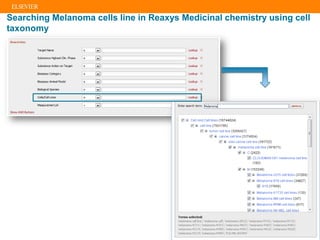
Searching Melanoma cells line in Reaxys Medicinal chemistry using cell
taxonomy
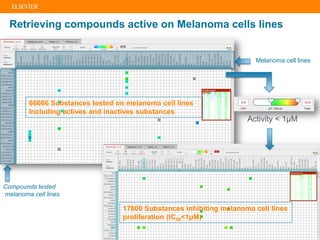
Retrieving compounds active on Melanoma cells lines
66666 Substances tested on melanoma cell lines
Including actives and inactives substances
Activity < 1µM
17600 Substances inhibiting melanoma cell lines
proliferation (IC50<1µM)
Compounds tested
melanoma cell lines
Melanoma cell lines
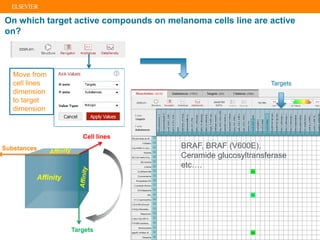
On which target active compounds on melanoma cells line are active
on?
Move from
cell lines
dimension
to target
dimension
BRAF, BRAF (V600E),
Ceramide glucosyltransferase
etc….
Targets
Substances
Cell lines
Targets
Affinity
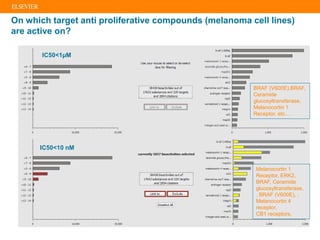
On which target anti proliferative compounds (melanoma cell lines)
are active on?
BRAF (V600E),BRAF,
Ceramide
glucosyltransferase,
Melanocortin 1
Receptor, etc…
IC50<1µM
IC50<10 nM
Melanocortin 1
Receptor, ERK2,
BRAF, Ceramide
glucosyltransferase,
, BRAF (V600E), ,
Melanocortin 4
receptor,
CB1 receptors,
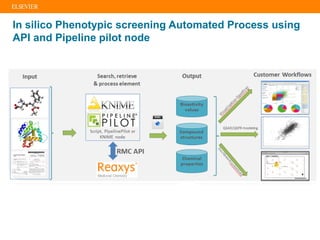
In silico Phenotypic screening Automated Process using
API and Pipeline pilot node
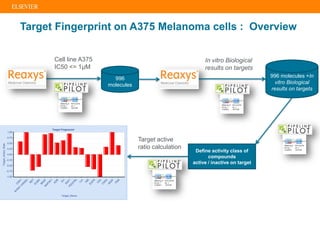
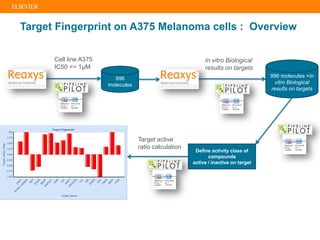
Target Fingerprint on A375 Melanoma cells : Overview
996
molecules
Cell line A375
IC50 <= 1µM
996 molecules +In
vitro Biological
results on targets
In vitro Biological
results on targets
Define activity class of
compounds
active / inactive on target
Target active
ratio calculation
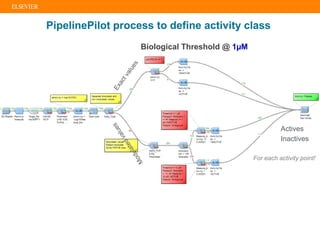
Biological Threshold @ 1µM
Actives
Inactives
For each activity point!
PipelinePilot process to define activity class
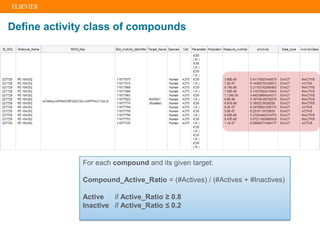
Define activity class of compounds
For each compound and its given target:
Compound_Active_Ratio = (#Actives) / (#Actives + #Inactives)
Active if Active_Ratio ≥ 0.8
Inactive if Active_Ratio ≤ 0.2
Target Fingerprint on A375 Melanoma cells : Overview
996
molecules
Cell line A375
IC50 <= 1µM
996 molecules +In
vitro Biological
results on targets
In vitro Biological
results on targets
Define activity class of
compounds
active / inactive on target
Target active
ratio calculation
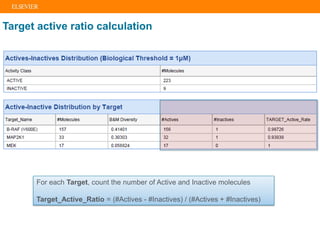
Target active ratio calculation
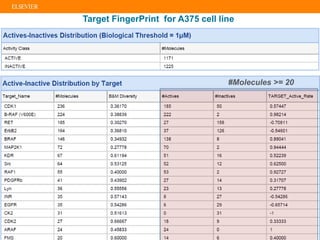
For each Target, count the number of Active and Inactive molecules
Target_Active_Ratio = (#Actives - #Inactives) / (#Actives + #Inactives)
Target FingerPrint for A375 cell line
#Molecules >= 20
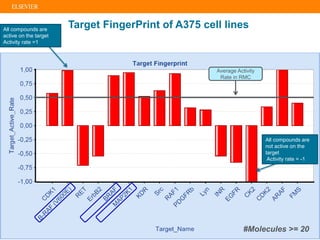
Target FingerPrint of A375 cell lines
#Molecules >= 20
Average Activity
Rate in RMC
All compounds are
active on the target
Activity rate =1
All compounds are
not active on the
target
Activity rate = -1
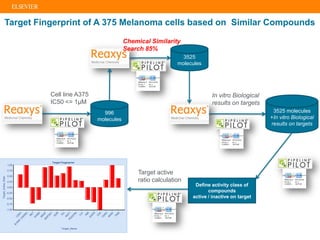
Target Fingerprint of A 375 Melanoma cells based on Similar Compounds
996
molecules
Cell line A375
IC50 <= 1µM
3525 molecules
+In vitro Biological
results on targets
In vitro Biological
results on targets
Define activity class of
compounds
active / inactive on target
Target active
ratio calculation
3525
molecules
Chemical Similarity
Search 85%
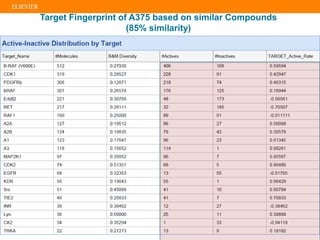
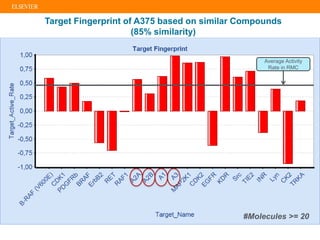
Target Fingerprint of A375 based on similar Compounds
(85% similarity)
Target Fingerprint of A375 based on similar Compounds
(85% similarity)
#Molecules >= 20
Average Activity
Rate in RMC
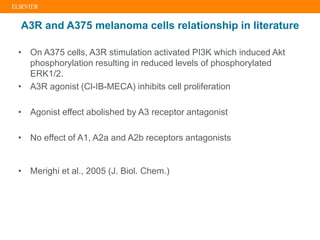
A3R and A375 melanoma cells relationship in literature
• On A375 cells, A3R stimulation activated PI3K which induced Akt
phosphorylation resulting in reduced levels of phosphorylated
ERK1/2.
• A3R agonist (Cl-IB-MECA) inhibits cell proliferation
• Agonist effect abolished by A3 receptor antagonist
• No effect of A1, A2a and A2b receptors antagonists
• Merighi et al., 2005 (J. Biol. Chem.)
Conclusion
Using Reaxys API and Pipeline pilot an automated process was set up to
establish a target FingerPrint for disease specific cell lines.
Reaxys Medicinal chemistry provides High Quality data to identify
pharmacological targets involved in phenotypic screening and understand the
molecular mechanisms of action of drugs (MMOA).

Rmc phenotypic screening

  • 1.
    Building an in-silico phenotypicscreening approach with Reaxys Olivier BARBERAN Senior Product Manager Reaxys Medicinal Chemistry February 2016
  • 2.
    Target-directed and Phenotypicscreening: parallel pathways to the same goal Phenotypic screening identifies compounds that produce a biological response in a cell or animal model Target screening identifies compounds that produce a biological response on an isolated target
  • 3.
    Phenotypic screening isthe most successful approach in Drug Discovery Strategy • Majority of small-molecule first-in-class NMEs that were discovered between 1999 and 2008 were first discovered using phenotypic assays • 28 of the first-in-class NMEs came from phenotypic screening approaches, compared with 17 from target-based approaches. • This is despite the current focus of small- molecule drug discovery on target-based approaches. • A possible contributing factor to this trend could have been a lag time between the introduction of new technologies and strategies, and their impact in terms of the number of approved first- in-class NMEs derived from these approaches. Bibliographic reference : How were new medecines discovered? D. Swinney and J. Anthony (Nature Reviews), July 2011
  • 4.
    A phenotype-led approachis still very success successful Bibliographic reference : How were new medecines discovered? D. Swinney and J. Anthony (Nature Reviews), July 2011
  • 5.
    Phenotype - ledvs. Target - led However, a drawback is the need to use time-consuming genetic, chemical and/or biophysical methods to identify the targets of compounds that are active (Target deconvolution) Phenotypic screening can find molecules that have more optimized drug-like properties (such as cell penetration) than target-based screens.
  • 6.
    Why using anin silico Phenotypic screening strategy in drug discovery Development of an In Silico Phenotypic screening approach in order to : 2) Building an automated tool in order to establish a target FingerPrint for disease specific cell lines 1) identify pharmacological targets involved in cell based assay and understand the molecular mechanisms of action of drugs (MMOA).
  • 7.
    7 Scenario Melanoma cells predominantlyoccur in skin. Melanoma is less common than other skin cancer. However, it is much more dangerous if it is not found in the early stages. It causes the majority (75%) of deaths related to skin cancer. Which are the targets involved in proliferation of melanoma cells lines ? And which substances are acting on ? Melanoma Cells Search In RMC Which Targets are involved in melanoma cells proliferation ?
  • 8.
    Searching Melanoma cellsline in Reaxys Medicinal chemistry using cell taxonomy
  • 9.
    Retrieving compounds activeon Melanoma cells lines 66666 Substances tested on melanoma cell lines Including actives and inactives substances Activity < 1µM 17600 Substances inhibiting melanoma cell lines proliferation (IC50<1µM) Compounds tested melanoma cell lines Melanoma cell lines
  • 10.
    On which targetactive compounds on melanoma cells line are active on? Move from cell lines dimension to target dimension BRAF, BRAF (V600E), Ceramide glucosyltransferase etc…. Targets Substances Cell lines Targets Affinity
  • 11.
    On which targetanti proliferative compounds (melanoma cell lines) are active on? BRAF (V600E),BRAF, Ceramide glucosyltransferase, Melanocortin 1 Receptor, etc… IC50<1µM IC50<10 nM Melanocortin 1 Receptor, ERK2, BRAF, Ceramide glucosyltransferase, , BRAF (V600E), , Melanocortin 4 receptor, CB1 receptors,
  • 12.
    In silico Phenotypicscreening Automated Process using API and Pipeline pilot node
  • 13.
    Target Fingerprint onA375 Melanoma cells : Overview 996 molecules Cell line A375 IC50 <= 1µM 996 molecules +In vitro Biological results on targets In vitro Biological results on targets Define activity class of compounds active / inactive on target Target active ratio calculation
  • 14.
    Biological Threshold @1µM Actives Inactives For each activity point! PipelinePilot process to define activity class
  • 15.
    Define activity classof compounds For each compound and its given target: Compound_Active_Ratio = (#Actives) / (#Actives + #Inactives) Active if Active_Ratio ≥ 0.8 Inactive if Active_Ratio ≤ 0.2
  • 16.
    Target Fingerprint onA375 Melanoma cells : Overview 996 molecules Cell line A375 IC50 <= 1µM 996 molecules +In vitro Biological results on targets In vitro Biological results on targets Define activity class of compounds active / inactive on target Target active ratio calculation
  • 17.
    Target active ratiocalculation For each Target, count the number of Active and Inactive molecules Target_Active_Ratio = (#Actives - #Inactives) / (#Actives + #Inactives)
  • 18.
    Target FingerPrint forA375 cell line #Molecules >= 20
  • 19.
    Target FingerPrint ofA375 cell lines #Molecules >= 20 Average Activity Rate in RMC All compounds are active on the target Activity rate =1 All compounds are not active on the target Activity rate = -1
  • 20.
    Target Fingerprint ofA 375 Melanoma cells based on Similar Compounds 996 molecules Cell line A375 IC50 <= 1µM 3525 molecules +In vitro Biological results on targets In vitro Biological results on targets Define activity class of compounds active / inactive on target Target active ratio calculation 3525 molecules Chemical Similarity Search 85%
  • 21.
    Target Fingerprint ofA375 based on similar Compounds (85% similarity)
  • 22.
    Target Fingerprint ofA375 based on similar Compounds (85% similarity) #Molecules >= 20 Average Activity Rate in RMC
  • 23.
    A3R and A375melanoma cells relationship in literature • On A375 cells, A3R stimulation activated PI3K which induced Akt phosphorylation resulting in reduced levels of phosphorylated ERK1/2. • A3R agonist (Cl-IB-MECA) inhibits cell proliferation • Agonist effect abolished by A3 receptor antagonist • No effect of A1, A2a and A2b receptors antagonists • Merighi et al., 2005 (J. Biol. Chem.)
  • 24.
    Conclusion Using Reaxys APIand Pipeline pilot an automated process was set up to establish a target FingerPrint for disease specific cell lines. Reaxys Medicinal chemistry provides High Quality data to identify pharmacological targets involved in phenotypic screening and understand the molecular mechanisms of action of drugs (MMOA).