Olivier Barberan
Senior Product Manager
New Reaxys Medicinal Chemistry: your lead
optimization solution
Key challenges in drug discovery and Lead
optimization
How NEW Reaxys Medicinal Chemistry supports Hit
to lead and Lead Optimization based with live
examples
Q&A
Summary
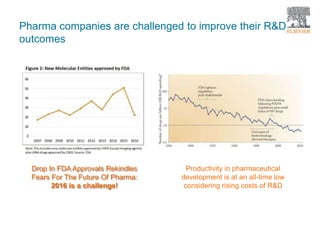
Productivity in pharmaceutical
development is at an all-time low
considering rising costs of R&D
Drop In FDA Approvals Rekindles
Fears For The Future Of Pharma:
2016 is a challenge!
Pharma companies are challenged to improve their R&D
outcomes
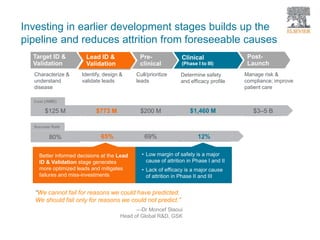
Target ID &
Validation
Lead ID &
Validation
Pre-
clinical
Clinical
(Phase I to III)
Post-
Launch
Characterize &
understand
disease
Identify, design &
validate leads
Cull/prioritize
leads
Determine safety
and efficacy profile
Manage risk &
compliance; improve
patient care
Source: Tufts Center for the study of drug development, Nov 2014
$125 M $773 M $200 M $1,460 M $3–5 B
Cost (/NME)
“We cannot fail for reasons we could have predicted.
We should fail only for reasons we could not predict.”
—Dr Moncef Slaoui
Head of Global R&D, GSK
• Low margin of safety is a major
cause of attrition in Phase I and II
• Lack of efficacy is a major cause
of attrition in Phase II and III
Better informed decisions at the Lead
ID & Validation stage generates
more optimized leads and mitigates
failures and miss-investments
80% 65% 69% 12%
Success Rate
Investing in earlier development stages builds up the
pipeline and reduces attrition from foreseeable causes
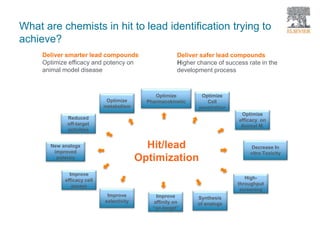
Deliver smarter lead compounds
Optimize efficacy and potency on
animal model disease
Deliver safer lead compounds
Higher chance of success rate in the
development process
High-
throughput
screening
Synthesis
of analogs
Improve
efficacy cell
assays
Improve
selectivity
Improve
affinity on
“on target”
Optimize
metabolism
Optimize
Pharmacokinetic
Optimize
Cell
penetration
New analogs
improved
potency
Reduced
off-target
activities
Optimize
efficacy on
Animal M.
Decrease In
vitro Toxicity
Hit/lead
Optimization
What are chemists in hit to lead identification trying to
achieve?
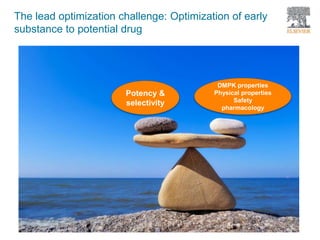
Potency &
selectivity
DMPK properties
Physical properties
Safety
pharmacology
The lead optimization challenge: Optimization of early
substance to potential drug
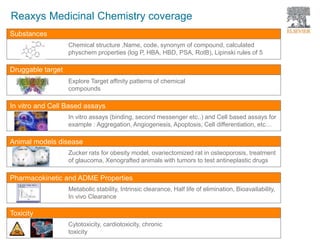
Substances
Chemical structure ,Name, code, synonym of compound, calculated
physchem properties (log P, HBA, HBD, PSA, RotB), Lipinski rules of 5
Druggable target
Explore Target affinity patterns of chemical
compounds
In vitro and Cell Based assays
In vitro assays (binding, second messenger etc..) and Cell based assays for
example : Aggregation, Angiogenesis, Apoptosis, Cell differentiation, etc…
Animal models disease
Zucker rats for obesity model, ovariectomized rat in osteoporosis, treatment
of glaucoma, Xenografted animals with tumors to test antineplastic drugs
Pharmacokinetic and ADME Properties
Metabolic stability, Intrinsic clearance, Half life of elimination, Bioavailability,
In vivo Clearance
Toxicity
Cytotoxicity, cardiotoxicity, chronic
toxicity
Reaxys Medicinal Chemistry coverage
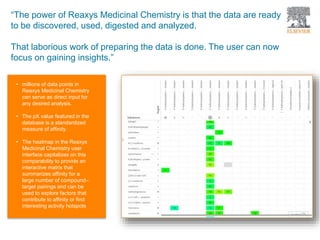
“The power of Reaxys Medicinal Chemistry is that the data are ready
to be discovered, used, digested and analyzed.
That laborious work of preparing the data is done. The user can now
focus on gaining insights.”
• millions of data points in
Reaxys Medicinal Chemistry
can serve as direct input for
any desired analysis.
• The pX value featured in the
database is a standardized
measure of affinity.
• The heatmap in the Reaxys
Medicinal Chemistry user
interface capitalizes on this
comparability to provide an
interactive matrix that
summarizes affinity for a
large number of compound–
target pairings and can be
used to explore factors that
contribute to affinity or find
interesting activity hotspots
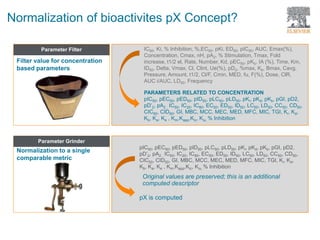
Parameter Filter
Normalization of bioactivites pX Concept?
Parameter Grinder
IC50, Ki, % Inhibition, %,EC50, pKi, ED50, pIC50, AUC, Emax(%),
Concentration, Cmax, nH, pA2, % Stimulation, Tmax, Fold
increase, t1/2 el, Rate, Number, Kd, pEC50, pKb, IA (%), Time, Km,
ID50, Delta, Vmax, Cl, Clint, Ue(%), pD2, %max, Kb, Bmax, Cavg,
Pressure, Amount, t1/2, Cl/F, Cmin, MED, fu, F(%), Dose, ClR,
AUC i/AUC, LD50, Frequency
PARAMETERS RELATED TO CONCENTRATION
pIC50, pEC50, pED50, pID50, pLC50, pLD50, pKi, pKd, pKb, pGI, pD2,
pD’2, pA2 , IC50, IC20, IC80, EC50, ED50, ID50, LC50, LD50, CC50, CD50,
CIC50, CID50, GI, MBC, MCC, MEC, MED, MFC, MIC, TGI, Ki, Kd,
Kb, Ka, Ke , Km,Kapp,Kic, Kiu, % Inhibition
pIC50, pEC50, pED50, pID50, pLC50, pLD50, pKi, pKd, pKb, pGI, pD2,
pD’2, pA2 , IC50, IC20, IC80, EC50, ED50, ID50, LC50, LD50, CC50, CD50,
CIC50, CID50, GI, MBC, MCC, MEC, MED, MFC, MIC, TGI, Ki, Kd,
Kb, Ka, Ke , Km,Kapp,Kic, Kiu, % Inhibition
pX is computed
Filter value for concentration
based parameters
Normalization to a single
comparable metric
Original values are preserved; this is an additional
computed descriptor
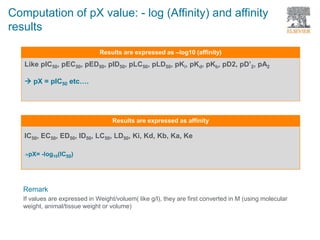
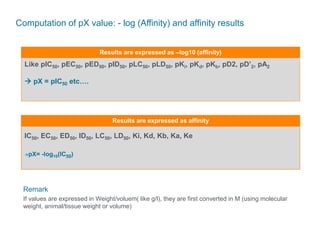
Computation of pX value: - log (Affinity) and affinity
results
Like pIC50, pEC50, pED50, pID50, pLC50, pLD50, pKi, pKd, pKb, pD2, pD’2, pA2
 pX = pIC50 etc….
Remark
If values are expressed in Weight/voluem( like g/l), they are first converted in M (using molecular
weight, animal/tissue weight or volume)
Results are expressed as –log10 (affinity)
IC50, EC50, ED50, ID50, LC50, LD50, Ki, Kd, Kb, Ka, Ke
pX= -log10(IC50)
Results are expressed as affinity
Hit to lead : Virtual screening
Ligand Based virtual Screening – Using Reaxys
Medicinal Chemistry
Objective
• Describe an In Silico Screening approach
using Reaxys Medicinal Chemistry
Case Study on T-Type calcium channels
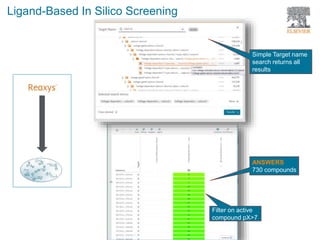
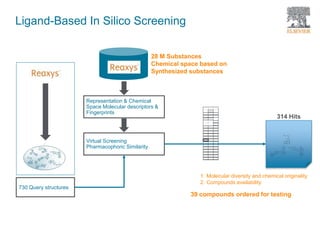
Ligand-Based In Silico Screening
Filter on active
compound pX>7
ANSWERS
730 compounds
Simple Target name
search returns all
results
Ligand-Based In Silico Screening
730 Query structures
Representation & Chemical
Space Molecular descriptors &
Fingerprints
Virtual Screening
Pharmacophoric Similarity
N
O
N
N
N
O
N
N
N
314 Hits
"Drug-like" Filtering
1. Molecular diversity and chemical originality
2. Compounds availability
39 compounds ordered for testing
28 M Substances
Chemical space based on
Synthesized substances
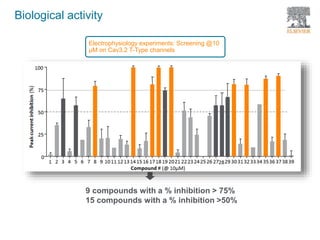
Biological activity
Electrophysiology experiments: Screening @10
µM on Cav3.2 T-Type channels
9 compounds with a % inhibition > 75%
15 compounds with a % inhibition >50%
Lead Optimization
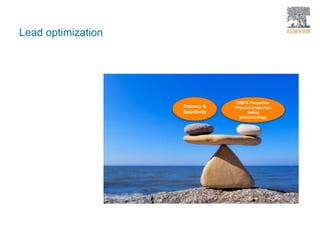
Potency &
Selectivity
DMPK Properties
Physical properties
Safety
pharmacology
Lead optimization
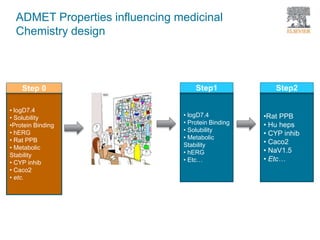
ADMET Properties influencing medicinal
Chemistry design
• logD7.4
• Protein Binding
• Solubility
• Metabolic
Stability
• hERG
• Etc…
Step1
•Rat PPB
• Hu heps
• CYP inhib
• Caco2
• NaV1.5
• Etc…
Step2
• logD7.4
• Solubility
•Protein Binding
• hERG
• Rat PPB
• Metabolic
Stability
• CYP inhib
• Caco2
• etc.
Step 0
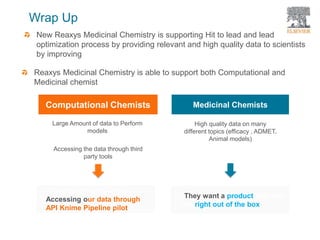
Wrap Up
“They care mostly about
Accessing our data through
API Knime Pipeline pilot”
“They want a product they can
use right out of the box”
New Reaxys Medicinal Chemistry is supporting Hit to lead and lead
optimization process by providing relevant and high quality data to scientists
by improving
Computational Chemists
High quality data on many
different topics (efficacy , ADMET,
Animal models)
Large Amount of data to Perform
models
Medicinal Chemists
Accessing the data through third
party tools
Reaxys Medicinal Chemistry is able to support both Computational and
Medicinal chemist
Q&A
2
1
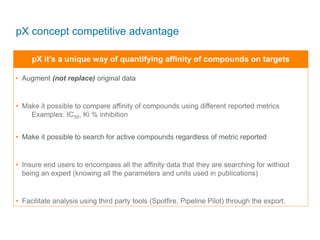
pX concept competitive advantage
• Augment (not replace) original data
• Make it possible to compare affinity of compounds using different reported metrics
Examples: IC50, Ki % inhibition
• Make it possible to search for active compounds regardless of metric reported
• Insure end users to encompass all the affinity data that they are searching for without
being an expert (knowing all the parameters and units used in publications)
• Facilitate analysis using third party tools (Spotfire, Pipeline Pilot) through the export.
pX it’s a unique way of quantifying affinity of compounds on targets
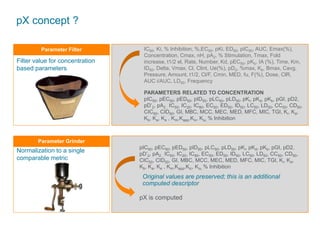
Parameter Filter
22
pX concept ?
Parameter Grinder
IC50, Ki, % Inhibition, %,EC50, pKi, ED50, pIC50, AUC, Emax(%),
Concentration, Cmax, nH, pA2, % Stimulation, Tmax, Fold
increase, t1/2 el, Rate, Number, Kd, pEC50, pKb, IA (%), Time, Km,
ID50, Delta, Vmax, Cl, Clint, Ue(%), pD2, %max, Kb, Bmax, Cavg,
Pressure, Amount, t1/2, Cl/F, Cmin, MED, fu, F(%), Dose, ClR,
AUC i/AUC, LD50, Frequency
PARAMETERS RELATED TO CONCENTRATION
pIC50, pEC50, pED50, pID50, pLC50, pLD50, pKi, pKd, pKb, pGI, pD2,
pD’2, pA2 , IC50, IC20, IC80, EC50, ED50, ID50, LC50, LD50, CC50, CD50,
CIC50, CID50, GI, MBC, MCC, MEC, MED, MFC, MIC, TGI, Ki, Kd,
Kb, Ka, Ke , Km,Kapp,Kic, Kiu, % Inhibition
pIC50, pEC50, pED50, pID50, pLC50, pLD50, pKi, pKd, pKb, pGI, pD2,
pD’2, pA2 , IC50, IC20, IC80, EC50, ED50, ID50, LC50, LD50, CC50, CD50,
CIC50, CID50, GI, MBC, MCC, MEC, MED, MFC, MIC, TGI, Ki, Kd,
Kb, Ka, Ke , Km,Kapp,Kic, Kiu, % Inhibition
pX is computed
Filter value for concentration
based parameters
Normalization to a single
comparable metric
Original values are preserved; this is an additional
computed descriptor
23
Computation of pX value: - log (Affinity) and affinity results
Like pIC50, pEC50, pED50, pID50, pLC50, pLD50, pKi, pKd, pKb, pD2, pD’2, pA2
 pX = pIC50 etc….
Remark
If values are expressed in Weight/voluem( like g/l), they are first converted in M (using molecular
weight, animal/tissue weight or volume)
Results are expressed as –log10 (affinity)
IC50, EC50, ED50, ID50, LC50, LD50, Ki, Kd, Kb, Ka, Ke
pX= -log10(IC50)
Results are expressed as affinity
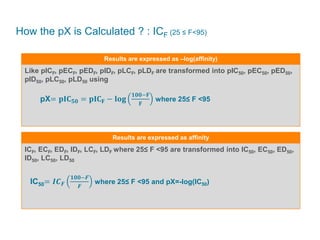
How the pX is Calculated ? : ICF (25 ≤ F<95)
Like pICF, pECF, pEDF, pIDF, pLCF, pLDF are transformed into pIC50, pEC50, pED50,
pID50, pLC50, pLD50 using
Results are expressed as –log(affinity)
ICF, ECF, EDF, IDF, LCF, LDF where 25≤ F <95 are transformed into IC50, EC50, ED50,
ID50, LC50, LD50
Results are expressed as affinity
pX= 𝐩𝐈𝐂 𝟓𝟎 = 𝐩𝐈𝐂 𝐅 − 𝐥𝐨𝐠
𝟏𝟎𝟎−𝐅
𝐅
where 25≤ F <95
IC50= 𝑰𝑪 𝑭
𝟏𝟎𝟎−𝑭
𝑭
where 25≤ F <95 and pX=-log(IC50)
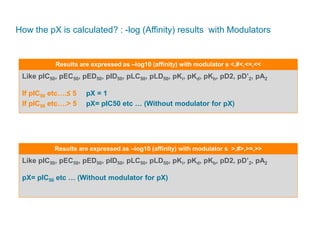
How the pX is calculated? : -log (Affinity) results with Modulators
Like pIC50, pEC50, pED50, pID50, pLC50, pLD50, pKi, pKd, pKb, pD2, pD’2, pA2
If pIC50 etc….≤ 5 pX = 1
If pIC50 etc….> 5 pX= pIC50 etc … (Without modulator for pX)
Results are expressed as –log10 (affinity) with modulator s <,#<,<=,<<
Results are expressed as –log10 (affinity) with modulator s >,#>,>=,>>
Like pIC50, pEC50, pED50, pID50, pLC50, pLD50, pKi, pKd, pKb, pD2, pD’2, pA2
pX= pIC50 etc … (Without modulator for pX)
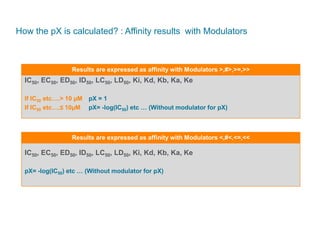
How the pX is calculated? : Affinity results with Modulators
IC50, EC50, ED50, ID50, LC50, LD50, Ki, Kd, Kb, Ka, Ke
If IC50 etc….> 10 µM pX = 1
If IC50 etc….≤ 10µM pX= -log(IC50) etc … (Without modulator for pX)
Results are expressed as affinity with Modulators >,#>,>=,>>
IC50, EC50, ED50, ID50, LC50, LD50, Ki, Kd, Kb, Ka, Ke
pX= -log(IC50) etc … (Without modulator for pX)
Results are expressed as affinity with Modulators <,#<,<=,<<
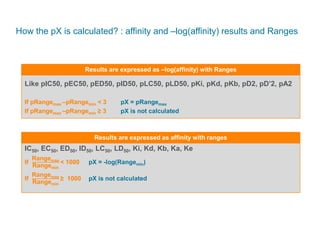
How the pX is calculated? : affinity and –log(affinity) results and Ranges
Like pIC50, pEC50, pED50, pID50, pLC50, pLD50, pKi, pKd, pKb, pD2, pD’2, pA2
If pRangemax –pRangemin < 3 pX = pRangemax
If pRangemax –pRangemin ≥ 3 pX is not calculated
Results are expressed as –log(affinity) with Ranges
IC50, EC50, ED50, ID50, LC50, LD50, Ki, Kd, Kb, Ka, Ke
If
Rangemax
Rangemin
< 1000 pX = -log(Rangemin)
If
Rangemax
Rangemin
≥ 1000 pX is not calculated
Results are expressed as affinity with ranges
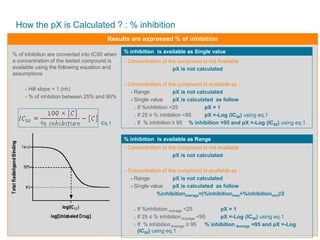
How the pX is Calculated ? : % inhibition
Results are expressed % of inhibition
% of inhibition are converted into IC50 when
a concentration of the tested compound is
available using the following equation and
assumptions
- Hill slope = 1 (nh)
- % of inhbition between 25% and 95%
- Concentration of the compound is not Available
pX is not calculated
- Concentration of the compound is available as :
 Range pX is not calculated
 Single value pX is calculated as follow
o If %inhibition <25 pX = 1
o If 25 ≤ % inhibition <95 pX =-Log (IC50) using eq.1
o If % inhibition ≥ 95 % inhibition =95 and pX =-Log (IC50) using eq.1
% inhibition is available as Single value
- Concentration of the compound is not Available
pX is not calculated
- Concentration of the compound is available as :
 Range pX is not calculated
 Single value pX is calculated as follow
%inhibitionaverage=(%inhibitionmax+%inhibitionmin)/2
o If %inhibition Average <25 pX = 1
o If 25 ≤ % inhibitionAverage <95 pX =-Log (IC50) using eq.1
o If % inhibitionAverage ≥ 95 % inhibition Average =95 and pX =-Log
(IC50) using eq.1
% inhibition is available as Range
Eq.1
How the pX is Calculated ? : Qualitative results
- Not Active (NA)
pX = 1
- @ Active
Concentration of the compound is not Available
pX is not calculated
Concentration of the compound is available
Range pX = -Log [Concentration min]
Single value pX = -Log [Concentration]
Results are expressed as Qualitative

Webinar: New RMC - Your lead_optimization Solution June082017

  • 1.
    Olivier Barberan Senior ProductManager New Reaxys Medicinal Chemistry: your lead optimization solution
  • 2.
    Key challenges indrug discovery and Lead optimization How NEW Reaxys Medicinal Chemistry supports Hit to lead and Lead Optimization based with live examples Q&A Summary
  • 3.
    Productivity in pharmaceutical developmentis at an all-time low considering rising costs of R&D Drop In FDA Approvals Rekindles Fears For The Future Of Pharma: 2016 is a challenge! Pharma companies are challenged to improve their R&D outcomes
  • 4.
    Target ID & Validation LeadID & Validation Pre- clinical Clinical (Phase I to III) Post- Launch Characterize & understand disease Identify, design & validate leads Cull/prioritize leads Determine safety and efficacy profile Manage risk & compliance; improve patient care Source: Tufts Center for the study of drug development, Nov 2014 $125 M $773 M $200 M $1,460 M $3–5 B Cost (/NME) “We cannot fail for reasons we could have predicted. We should fail only for reasons we could not predict.” —Dr Moncef Slaoui Head of Global R&D, GSK • Low margin of safety is a major cause of attrition in Phase I and II • Lack of efficacy is a major cause of attrition in Phase II and III Better informed decisions at the Lead ID & Validation stage generates more optimized leads and mitigates failures and miss-investments 80% 65% 69% 12% Success Rate Investing in earlier development stages builds up the pipeline and reduces attrition from foreseeable causes
  • 5.
    Deliver smarter leadcompounds Optimize efficacy and potency on animal model disease Deliver safer lead compounds Higher chance of success rate in the development process High- throughput screening Synthesis of analogs Improve efficacy cell assays Improve selectivity Improve affinity on “on target” Optimize metabolism Optimize Pharmacokinetic Optimize Cell penetration New analogs improved potency Reduced off-target activities Optimize efficacy on Animal M. Decrease In vitro Toxicity Hit/lead Optimization What are chemists in hit to lead identification trying to achieve?
  • 6.
    Potency & selectivity DMPK properties Physicalproperties Safety pharmacology The lead optimization challenge: Optimization of early substance to potential drug
  • 7.
    Substances Chemical structure ,Name,code, synonym of compound, calculated physchem properties (log P, HBA, HBD, PSA, RotB), Lipinski rules of 5 Druggable target Explore Target affinity patterns of chemical compounds In vitro and Cell Based assays In vitro assays (binding, second messenger etc..) and Cell based assays for example : Aggregation, Angiogenesis, Apoptosis, Cell differentiation, etc… Animal models disease Zucker rats for obesity model, ovariectomized rat in osteoporosis, treatment of glaucoma, Xenografted animals with tumors to test antineplastic drugs Pharmacokinetic and ADME Properties Metabolic stability, Intrinsic clearance, Half life of elimination, Bioavailability, In vivo Clearance Toxicity Cytotoxicity, cardiotoxicity, chronic toxicity Reaxys Medicinal Chemistry coverage
  • 8.
    “The power ofReaxys Medicinal Chemistry is that the data are ready to be discovered, used, digested and analyzed. That laborious work of preparing the data is done. The user can now focus on gaining insights.” • millions of data points in Reaxys Medicinal Chemistry can serve as direct input for any desired analysis. • The pX value featured in the database is a standardized measure of affinity. • The heatmap in the Reaxys Medicinal Chemistry user interface capitalizes on this comparability to provide an interactive matrix that summarizes affinity for a large number of compound– target pairings and can be used to explore factors that contribute to affinity or find interesting activity hotspots
  • 9.
    Parameter Filter Normalization ofbioactivites pX Concept? Parameter Grinder IC50, Ki, % Inhibition, %,EC50, pKi, ED50, pIC50, AUC, Emax(%), Concentration, Cmax, nH, pA2, % Stimulation, Tmax, Fold increase, t1/2 el, Rate, Number, Kd, pEC50, pKb, IA (%), Time, Km, ID50, Delta, Vmax, Cl, Clint, Ue(%), pD2, %max, Kb, Bmax, Cavg, Pressure, Amount, t1/2, Cl/F, Cmin, MED, fu, F(%), Dose, ClR, AUC i/AUC, LD50, Frequency PARAMETERS RELATED TO CONCENTRATION pIC50, pEC50, pED50, pID50, pLC50, pLD50, pKi, pKd, pKb, pGI, pD2, pD’2, pA2 , IC50, IC20, IC80, EC50, ED50, ID50, LC50, LD50, CC50, CD50, CIC50, CID50, GI, MBC, MCC, MEC, MED, MFC, MIC, TGI, Ki, Kd, Kb, Ka, Ke , Km,Kapp,Kic, Kiu, % Inhibition pIC50, pEC50, pED50, pID50, pLC50, pLD50, pKi, pKd, pKb, pGI, pD2, pD’2, pA2 , IC50, IC20, IC80, EC50, ED50, ID50, LC50, LD50, CC50, CD50, CIC50, CID50, GI, MBC, MCC, MEC, MED, MFC, MIC, TGI, Ki, Kd, Kb, Ka, Ke , Km,Kapp,Kic, Kiu, % Inhibition pX is computed Filter value for concentration based parameters Normalization to a single comparable metric Original values are preserved; this is an additional computed descriptor
  • 10.
    Computation of pXvalue: - log (Affinity) and affinity results Like pIC50, pEC50, pED50, pID50, pLC50, pLD50, pKi, pKd, pKb, pD2, pD’2, pA2  pX = pIC50 etc…. Remark If values are expressed in Weight/voluem( like g/l), they are first converted in M (using molecular weight, animal/tissue weight or volume) Results are expressed as –log10 (affinity) IC50, EC50, ED50, ID50, LC50, LD50, Ki, Kd, Kb, Ka, Ke pX= -log10(IC50) Results are expressed as affinity
  • 11.
    Hit to lead: Virtual screening
  • 12.
    Ligand Based virtualScreening – Using Reaxys Medicinal Chemistry Objective • Describe an In Silico Screening approach using Reaxys Medicinal Chemistry Case Study on T-Type calcium channels
  • 13.
    Ligand-Based In SilicoScreening Filter on active compound pX>7 ANSWERS 730 compounds Simple Target name search returns all results
  • 14.
    Ligand-Based In SilicoScreening 730 Query structures Representation & Chemical Space Molecular descriptors & Fingerprints Virtual Screening Pharmacophoric Similarity N O N N N O N N N 314 Hits "Drug-like" Filtering 1. Molecular diversity and chemical originality 2. Compounds availability 39 compounds ordered for testing 28 M Substances Chemical space based on Synthesized substances
  • 15.
    Biological activity Electrophysiology experiments:Screening @10 µM on Cav3.2 T-Type channels 9 compounds with a % inhibition > 75% 15 compounds with a % inhibition >50%
  • 16.
  • 17.
    Potency & Selectivity DMPK Properties Physicalproperties Safety pharmacology Lead optimization
  • 18.
    ADMET Properties influencingmedicinal Chemistry design • logD7.4 • Protein Binding • Solubility • Metabolic Stability • hERG • Etc… Step1 •Rat PPB • Hu heps • CYP inhib • Caco2 • NaV1.5 • Etc… Step2 • logD7.4 • Solubility •Protein Binding • hERG • Rat PPB • Metabolic Stability • CYP inhib • Caco2 • etc. Step 0
  • 19.
    Wrap Up “They caremostly about Accessing our data through API Knime Pipeline pilot” “They want a product they can use right out of the box” New Reaxys Medicinal Chemistry is supporting Hit to lead and lead optimization process by providing relevant and high quality data to scientists by improving Computational Chemists High quality data on many different topics (efficacy , ADMET, Animal models) Large Amount of data to Perform models Medicinal Chemists Accessing the data through third party tools Reaxys Medicinal Chemistry is able to support both Computational and Medicinal chemist
  • 20.
  • 21.
    2 1 pX concept competitiveadvantage • Augment (not replace) original data • Make it possible to compare affinity of compounds using different reported metrics Examples: IC50, Ki % inhibition • Make it possible to search for active compounds regardless of metric reported • Insure end users to encompass all the affinity data that they are searching for without being an expert (knowing all the parameters and units used in publications) • Facilitate analysis using third party tools (Spotfire, Pipeline Pilot) through the export. pX it’s a unique way of quantifying affinity of compounds on targets
  • 22.
    Parameter Filter 22 pX concept? Parameter Grinder IC50, Ki, % Inhibition, %,EC50, pKi, ED50, pIC50, AUC, Emax(%), Concentration, Cmax, nH, pA2, % Stimulation, Tmax, Fold increase, t1/2 el, Rate, Number, Kd, pEC50, pKb, IA (%), Time, Km, ID50, Delta, Vmax, Cl, Clint, Ue(%), pD2, %max, Kb, Bmax, Cavg, Pressure, Amount, t1/2, Cl/F, Cmin, MED, fu, F(%), Dose, ClR, AUC i/AUC, LD50, Frequency PARAMETERS RELATED TO CONCENTRATION pIC50, pEC50, pED50, pID50, pLC50, pLD50, pKi, pKd, pKb, pGI, pD2, pD’2, pA2 , IC50, IC20, IC80, EC50, ED50, ID50, LC50, LD50, CC50, CD50, CIC50, CID50, GI, MBC, MCC, MEC, MED, MFC, MIC, TGI, Ki, Kd, Kb, Ka, Ke , Km,Kapp,Kic, Kiu, % Inhibition pIC50, pEC50, pED50, pID50, pLC50, pLD50, pKi, pKd, pKb, pGI, pD2, pD’2, pA2 , IC50, IC20, IC80, EC50, ED50, ID50, LC50, LD50, CC50, CD50, CIC50, CID50, GI, MBC, MCC, MEC, MED, MFC, MIC, TGI, Ki, Kd, Kb, Ka, Ke , Km,Kapp,Kic, Kiu, % Inhibition pX is computed Filter value for concentration based parameters Normalization to a single comparable metric Original values are preserved; this is an additional computed descriptor
  • 23.
    23 Computation of pXvalue: - log (Affinity) and affinity results Like pIC50, pEC50, pED50, pID50, pLC50, pLD50, pKi, pKd, pKb, pD2, pD’2, pA2  pX = pIC50 etc…. Remark If values are expressed in Weight/voluem( like g/l), they are first converted in M (using molecular weight, animal/tissue weight or volume) Results are expressed as –log10 (affinity) IC50, EC50, ED50, ID50, LC50, LD50, Ki, Kd, Kb, Ka, Ke pX= -log10(IC50) Results are expressed as affinity
  • 24.
    How the pXis Calculated ? : ICF (25 ≤ F<95) Like pICF, pECF, pEDF, pIDF, pLCF, pLDF are transformed into pIC50, pEC50, pED50, pID50, pLC50, pLD50 using Results are expressed as –log(affinity) ICF, ECF, EDF, IDF, LCF, LDF where 25≤ F <95 are transformed into IC50, EC50, ED50, ID50, LC50, LD50 Results are expressed as affinity pX= 𝐩𝐈𝐂 𝟓𝟎 = 𝐩𝐈𝐂 𝐅 − 𝐥𝐨𝐠 𝟏𝟎𝟎−𝐅 𝐅 where 25≤ F <95 IC50= 𝑰𝑪 𝑭 𝟏𝟎𝟎−𝑭 𝑭 where 25≤ F <95 and pX=-log(IC50)
  • 25.
    How the pXis calculated? : -log (Affinity) results with Modulators Like pIC50, pEC50, pED50, pID50, pLC50, pLD50, pKi, pKd, pKb, pD2, pD’2, pA2 If pIC50 etc….≤ 5 pX = 1 If pIC50 etc….> 5 pX= pIC50 etc … (Without modulator for pX) Results are expressed as –log10 (affinity) with modulator s <,#<,<=,<< Results are expressed as –log10 (affinity) with modulator s >,#>,>=,>> Like pIC50, pEC50, pED50, pID50, pLC50, pLD50, pKi, pKd, pKb, pD2, pD’2, pA2 pX= pIC50 etc … (Without modulator for pX)
  • 26.
    How the pXis calculated? : Affinity results with Modulators IC50, EC50, ED50, ID50, LC50, LD50, Ki, Kd, Kb, Ka, Ke If IC50 etc….> 10 µM pX = 1 If IC50 etc….≤ 10µM pX= -log(IC50) etc … (Without modulator for pX) Results are expressed as affinity with Modulators >,#>,>=,>> IC50, EC50, ED50, ID50, LC50, LD50, Ki, Kd, Kb, Ka, Ke pX= -log(IC50) etc … (Without modulator for pX) Results are expressed as affinity with Modulators <,#<,<=,<<
  • 27.
    How the pXis calculated? : affinity and –log(affinity) results and Ranges Like pIC50, pEC50, pED50, pID50, pLC50, pLD50, pKi, pKd, pKb, pD2, pD’2, pA2 If pRangemax –pRangemin < 3 pX = pRangemax If pRangemax –pRangemin ≥ 3 pX is not calculated Results are expressed as –log(affinity) with Ranges IC50, EC50, ED50, ID50, LC50, LD50, Ki, Kd, Kb, Ka, Ke If Rangemax Rangemin < 1000 pX = -log(Rangemin) If Rangemax Rangemin ≥ 1000 pX is not calculated Results are expressed as affinity with ranges
  • 28.
    How the pXis Calculated ? : % inhibition Results are expressed % of inhibition % of inhibition are converted into IC50 when a concentration of the tested compound is available using the following equation and assumptions - Hill slope = 1 (nh) - % of inhbition between 25% and 95% - Concentration of the compound is not Available pX is not calculated - Concentration of the compound is available as :  Range pX is not calculated  Single value pX is calculated as follow o If %inhibition <25 pX = 1 o If 25 ≤ % inhibition <95 pX =-Log (IC50) using eq.1 o If % inhibition ≥ 95 % inhibition =95 and pX =-Log (IC50) using eq.1 % inhibition is available as Single value - Concentration of the compound is not Available pX is not calculated - Concentration of the compound is available as :  Range pX is not calculated  Single value pX is calculated as follow %inhibitionaverage=(%inhibitionmax+%inhibitionmin)/2 o If %inhibition Average <25 pX = 1 o If 25 ≤ % inhibitionAverage <95 pX =-Log (IC50) using eq.1 o If % inhibitionAverage ≥ 95 % inhibition Average =95 and pX =-Log (IC50) using eq.1 % inhibition is available as Range Eq.1
  • 29.
    How the pXis Calculated ? : Qualitative results - Not Active (NA) pX = 1 - @ Active Concentration of the compound is not Available pX is not calculated Concentration of the compound is available Range pX = -Log [Concentration min] Single value pX = -Log [Concentration] Results are expressed as Qualitative

Editor's Notes

  • #4 2016 was a bummer! After years of rising FDA approvals that swelled to an all-time high of 51 new drugs in 2015, they plummeted to 22 last year—a 57% drop—down to a level not seen since 2010 (Fig 1 and 2). What happened? Reversal to the mean? A harbinger of worse things to come? The answer matters because we spend $328 billion a year to buy our medicines in the U.S. ($697 billion worldwide), and the less productive the industry R&D, the more remote the prospect of enjoying affordable great drugs again. What did change, however, were the companies getting the approvals. The outperformers of recent years, GlaxoSmithKline (GSK), Johnson & Johnson and Novartis did not get an approval in 2016 (Fig 4); Neither did Amgen, AstraZeneca, Bayer and Bristol-Myers Squibb (BMS). In all, seven of the 13 historic big pharma companies, which received 14 approvals in 2015, came up empty-handed in 2016. The remaining six companies saw their take grow from 6 to 8. Many of the metrics used to assess drug R&D did not change significantly. Research spending, now at $154 billion, has kept growing, if modestly. The 13 historic big pharma companies received 36% of the approvals vs. 41% in 2015. In both years, the same percentage of drugs (41%) were prized first-in-class therapies targeting novel modes of action. Cancer, infectious diseases, hematology and central nervous systems remained the leading therapeutic areas, garnering 73% of the approvals vs. 71% in 2015. Biological drugs gathered a majority of the approvals for the first time (55% vs. 39% in 2015), extending the trend of recent years. On the regulatory side, a higher percentage of drugs benefited from FDA’s programs to speed their journey to market (Fig 3) as compared to 2015. In short, the class profile of 2016 does not stand out from its predecessor on any metric that might explain the lower approvals.
  • #5 Emphasis why we need to work on the Lead ID and validation to increase th success rate in clinical trials.
  • #20 Medium size pharma are in between consequently they are potentially interested in the two approaches Product out of the box and Content integration. The Strategy to adopt depend on the personas that are involved in the deal Computationnal chemist, Chemoinformaticians etc.. (HT data users) => Data + KNIME/API Chemist medicinal chemist etc…. (LT data users) => UI