IJRET: International Journal of Research in Engineering and Technology eISSN: 2319-1163 | pISSN: 2321-7308
_______________________________________________________________________________________
Volume: 04 Issue: 01 | Jan-2015, Available @ http://www.ijret.org 223
RIVER MONITORING THROUGH WIRELESS SENSOR NETWORK
Trusha R. Wagh1
, A.P.Rao2
1
Student department of E&TC, Jayawantrao Sawant college of Engg, Hadapsar, Pune, 411028, India
2
Faculty department of E&TC, Jayawantrao Sawant college of Engg, Hadapsar, Pune, 411028, India
Abstract
WSN system is the recent and cost effective system for monitoring and controlling the environmental applications. It is also a
demanding task to use efficiently the energy harvesting system (EHS) technology for WSN. The system performs the
measurements using integrated peripherals to process the measured data as well as to co-ordinate the data transport of the WSN
to work. Basically River mote is a case study for designing a low cost hardware system architecture combining low-power mote
and a highly efficient EHS architecture. The main requirement of this system is continuous operation using Energy Harvesting
System. The work includes first the water level monitoring platform using only the ultra-sonic sensor and second the PH balance
to know the toxicity present in water. This system provides a real-time guidance to those industry that depends on regional water
quality conditions like industry, agriculture, aquatic life etc.
Keywords: Energy Harvesting system (EHS), Zig-Bee module, Ultrasonic sensor, Ph sensor, Wireless sensor network
(WSN).
--------------------------------------------------------------------***----------------------------------------------------------------------
1. INTRODUCTION
The earth’s surface consists of 71 % of water in it. Water
plays a very important role for all living being, but due to
growing industries and technical life style the water is
getting polluted by man. The environmental monitoring
system ie the water monitoring system is hence a recent
technology that helps to control water pollution. In previous
days man himself had to check the pollutant contents as well
as the level using handheld devices as shown in fig 1. WSN
ie wireless sensor network thus helps to reduce the physical
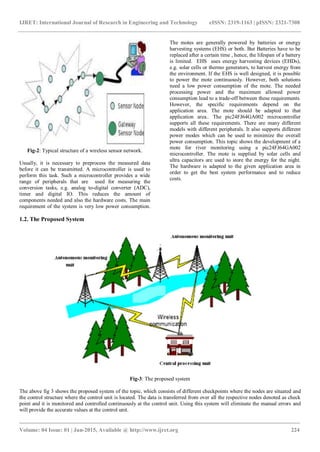
efforts to an automatic sytsem. WSN network typically
consists of a high number of sensor nodes, also called
motes, and of one or few gateway nodes. The gateway node
is connected with a computer to access the data of the WSN.
Each mote collects information about its environment using
the attached sensors. This information is forwarded to
gateway nodes in a multi-hop manner as shown in fig 2.
1.1 Previous System
Fig-1: The Previous Methods for measuring Level and Ph
balance
The proposed system mainly consists of three parts:1) data
monitoring,2) autonomous monitoring unit and 3) central
processing units. The WSN system is thus suitable for the
water bodies such as lakes, rivers, dams etc. The system
explains the auto-monitoring of the water level and pH
value present in an water body. The requirements on a
WSN varies very much, because they are used in many
different application areas, e.g. precision agriculture,
environmental monitoring, structural health monitoring,
industrial applications.
IJRET: International Journal of Research in Engineering and Technology eISSN: 2319-1163 | pISSN: 2321-7308
_______________________________________________________________________________________
Volume: 04 Issue: 01 | Jan-2015, Available @ http://www.ijret.org 224
Fig-2: Typical structure of a wireless sensor network.
Usually, it is necessary to preprocess the measured data
before it can be transmitted. A microcontroller is used to
perform this task. Such a microcontroller provides a wide
range of peripherals that are used for measuring the
conversion tasks, e.g. analog to-digital converter (ADC),
timer and digital IO. This reduces the amount of
components needed and also the hardware costs. The main
requirement of the system is very low power consumption.
The motes are generally powered by batteries or energy
harvesting systems (EHS) or both. But Batteries have to be
replaced after a certain time , hence, the lifespan of a battery
is limited. EHS uses energy harvesting devices (EHDs),
e.g. solar cells or thermo generators, to harvest energy from
the environment. If the EHS is well designed, it is possible
to power the mote continuously. However, both solutions
need a low power consumption of the mote. The needed
processing power and the maximum allowed power
consumption lead to a trade-off between these requirements.
However, the specific requirements depend on the
application area. The mote should be adapted to that
application area.. The pic24FJ64GA002 microcontroller
supports all these requirements. There are many different
models with different peripherals. It also supports different
power modes which can be used to minimize the overall
power consumption. This topic shows the development of a
mote for river monitoring using a pic24FJ64GA002
microcontroller. The mote is supplied by solar cells and
ultra capacitors are used to store the energy for the night.
The hardware is adapted to the given application area in
order to get the best system performance and to reduce
costs.
1.2. The Proposed System
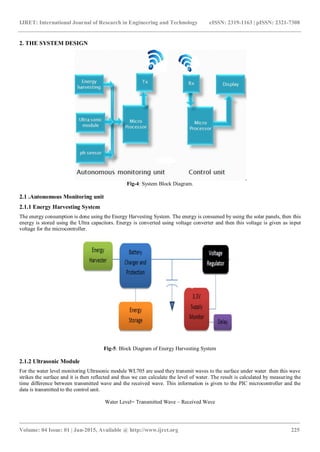
Fig-3: The proposed system
The above fig 3 shows the proposed system of the topic, which consists of different checkpoints where the nodes are situated and
the control structure where the control unit is located. The data is transferred from over all the respective nodes denoted as check
point and it is monitored and controlled continuously at the control unit. Using this system will eliminate the manual errors and
will provide the accurate values at the control unit.
IJRET: International Journal of Research in Engineering and Technology eISSN: 2319-1163 | pISSN: 2321-7308
_______________________________________________________________________________________
Volume: 04 Issue: 01 | Jan-2015, Available @ http://www.ijret.org 225
2. THE SYSTEM DESIGN
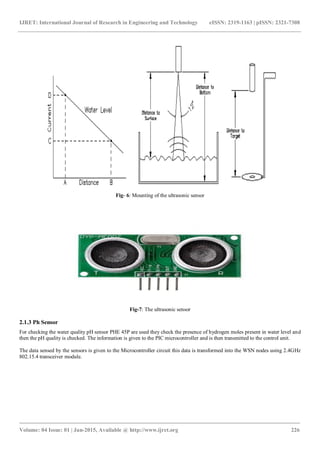
Fig-4: System Block Diagram.
2.1 .Autonomous Monitoring unit
2.1.1 Energy Harvesting System
The energy consumption is done using the Energy Harvesting System. The energy is consumed by using the solar panels, then this
energy is stored using the Ultra capacitors. Energy is converted using voltage converter and then this voltage is given as input
voltage for the microcontroller.
Fig-5: Block Diagram of Energy Harvesting System
2.1.2 Ultrasonic Module
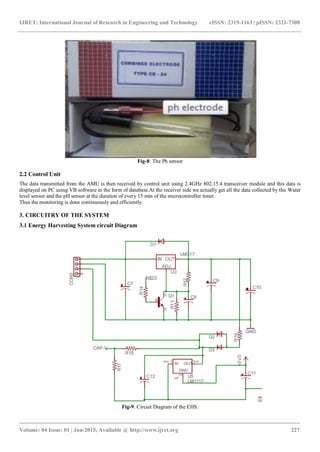
For the water level monitoring Ultrasonic module WL705 are used they transmit waves to the surface under water then this wave
strikes the surface and it is then reflected and thus we can calculate the level of water. The result is calculated by measuring the
time difference between transmitted wave and the received wave. This information is given to the PIC microcontroller and the
data is transmitted to the control unit.
Water Level= Transmitted Wave – Received Wave
IJRET: International Journal of Research in Engineering and Technology eISSN: 2319-1163 | pISSN: 2321-7308
_______________________________________________________________________________________
Volume: 04 Issue: 01 | Jan-2015, Available @ http://www.ijret.org 226
Fig- 6: Mounting of the ultrasonic sensor
Fig-7: The ultrasonic sensor
2.1.3 Ph Sensor
For checking the water quality pH sensor PHE 45P are used they check the presence of hydrogen moles present in water level and
then the pH quality is checked. The information is given to the PIC microcontroller and is then transmitted to the control unit.
The data sensed by the sensors is given to the Microcontroller circuit this data is transformed into the WSN nodes using 2.4GHz
802.15.4 transceiver module.
IJRET: International Journal of Research in Engineering and Technology eISSN: 2319-1163 | pISSN: 2321-7308
_______________________________________________________________________________________
Volume: 04 Issue: 01 | Jan-2015, Available @ http://www.ijret.org 227
Fig-8: The Ph sensor
2.2 Control Unit
The data transmitted from the AMU is then received by control unit using 2.4GHz 802.15.4 transceiver module and this data is
displayed on PC using VB software in the form of database.At the receiver side we actually get all the data collected by the Water
level sensor and the pH sensor at the duration of every 15 min of the microcontroller timer.
Thus the monitoring is done continuously and efficiently.
3. CIRCUITRY OF THE SYSTEM
3.1 Energy Harvesting System circuit Diagram
Fig-9: Circuit Diagram of the EHS.
IJRET: International Journal of Research in Engineering and Technology eISSN: 2319-1163 | pISSN: 2321-7308
_______________________________________________________________________________________
Volume: 04 Issue: 01 | Jan-2015, Available @ http://www.ijret.org 228
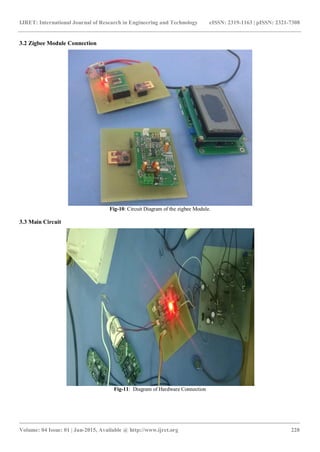
3.2 Zigbee Module Connection
Fig-10: Circuit Diagram of the zigbee Module.
3.3 Main Circuit
Fig-11: Diagram of Hardware Connection
IJRET: International Journal of Research in Engineering and Technology eISSN: 2319-1163 | pISSN: 2321-7308
_______________________________________________________________________________________
Volume: 04 Issue: 01 | Jan-2015, Available @ http://www.ijret.org 229
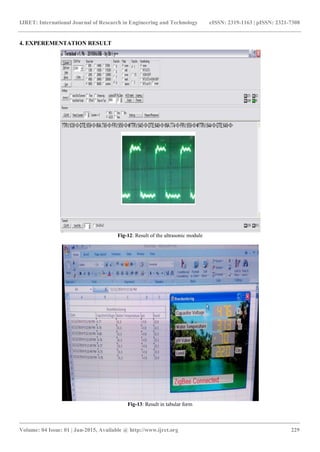
4. EXPEREMENTATION RESULT
Fig-12: Result of the ultrasonic module
Fig-13: Result in tabular form
IJRET: International Journal of Research in Engineering and Technology eISSN: 2319-1163 | pISSN: 2321-7308
_______________________________________________________________________________________
Volume: 04 Issue: 01 | Jan-2015, Available @ http://www.ijret.org 230
Fig-14: Result of the GUI output
5. CONCLUSION
This work demonstrates the adaptability of a mote to a
specific application area using the microcontroller. It shows
low power design techniques. It also demonstrates the
possibility to supply the mote continuously using an energy
harvesting system and battery as the energy storage
elements. This system uses MRF24FJ40MB which uses the
MAC protocol. This system is not limited only for River
monitoring , it can be build on Dams as well to check the
water level. We can thus define the accurate results of pH
balance and water level using this system.
REFERENCES
[1] George T. Karetsos, Theodore Kotsilieris “A mobile
agent enabled wireless sensor network for river
water monitoring” The Fourth International
Conference on Wireless and Mobile
Communications IEEE pp 346-351, 2008.
[2] Peng Jiang , Hongbo Xia , Zhiye He and Zheming
Wang “Design of a Water Environment Monitoring
System Based on Wireless Sensor Networks”
Sensors, vol.9, pp-6411-6434, 2009.
[3] Jo Ueyama ,Danny Hughes, Ka Lok Man ,Sheng-
Uei Guan “Applying a Multi-Paradigm Approach
to Implementing Wireless Sensor Network Based
River Monitoring” First ACIS International
Symposium on Cryptography, and Network Security
vol. 978-0-7695-4332-1/10 pp. 187-191, 2010.
[4] Philipp Maria Glatz, Leander Bernd Hörmann,
Christian Steger, Reinhold Weiss “Designing
Perpetual Energy Harvesting Systems explained
with River Mote: A Wireless Sensor Network
Platform for River Monitoring” EJSE Special
Issue: Wireless Sensor Networks and Practical
Applications pp. 55-65,2010.
[5] Abdulrahman Alkandari, Meshal alnasheet,
Yousef Alabduljader , Samer M. Moein “Wireless
Sensor Network (WSN) for Water Monitoring
System: Case Study of Kuwait Beaches” The
Society of Digital Information and Wireless
Communications, pp. 709-717 2011.
[6] Sabuj Das Gupta, Islam Md. Shahinur, Akond
Anisul Haque, Amin Ruhul, Sudip Majumder “
Design and Implementation of Water Depth
Measurement and Object Detection Model Using
Ultrasonic Signal System” International Journal of
IJRET: International Journal of Research in Engineering and Technology eISSN: 2319-1163 | pISSN: 2321-7308
_______________________________________________________________________________________
Volume: 04 Issue: 01 | Jan-2015, Available @ http://www.ijret.org 231
Engineering Research and Development Volume 4,
Issue 3), PP. 62-69, October 2012.
[7] Leander B. H¨ormann, Philipp M. Glatz, Christian
Steger, Reinhold Weiss “A Wireless Sensor Node
For River Monitoring Using Msp430 R And Energy
Harvesting” 2011 .
[8] Panom Petchjatuporn, Wiwat Kiranon, Anatawat
Kunakorn “A Solar-powered Battery Charger with
Neural Network Maximum Power Point Tracking
Implemented on a Low-Cost PIC-microcontroller”
Faculty of Engineering, Mahanakorn University of
Technology vol. 2394-525-778-185-8 2012.
[9] Lívia C. Degrossi, Guilherme G. do Amaral,
Eduardo S. M. deVasconcelos “Using Wireless
Sensor Networks in the Sensor Web for Flood
Monitoring in Brazil” Proceedings of the 10th
International ISCRAM Conference – Baden-Baden,
Germany, pp 458-462 2013.
BIOGRAPHIES
Trusha R Wagh, pursuing M.E in
Electronics engineering(Digital Systems)
from Jaywantrao Sawant College of
Engineering, Pune, Maharashtra. India.
Dr A.P.Rao, Professor at Electronics and
Telecommunication Department at
Jaywantrao Sawant College of engineering
Pune, Maharashtra. India

River monitoring through wireless sensor network

  • 1.
    IJRET: International Journalof Research in Engineering and Technology eISSN: 2319-1163 | pISSN: 2321-7308 _______________________________________________________________________________________ Volume: 04 Issue: 01 | Jan-2015, Available @ http://www.ijret.org 223 RIVER MONITORING THROUGH WIRELESS SENSOR NETWORK Trusha R. Wagh1 , A.P.Rao2 1 Student department of E&TC, Jayawantrao Sawant college of Engg, Hadapsar, Pune, 411028, India 2 Faculty department of E&TC, Jayawantrao Sawant college of Engg, Hadapsar, Pune, 411028, India Abstract WSN system is the recent and cost effective system for monitoring and controlling the environmental applications. It is also a demanding task to use efficiently the energy harvesting system (EHS) technology for WSN. The system performs the measurements using integrated peripherals to process the measured data as well as to co-ordinate the data transport of the WSN to work. Basically River mote is a case study for designing a low cost hardware system architecture combining low-power mote and a highly efficient EHS architecture. The main requirement of this system is continuous operation using Energy Harvesting System. The work includes first the water level monitoring platform using only the ultra-sonic sensor and second the PH balance to know the toxicity present in water. This system provides a real-time guidance to those industry that depends on regional water quality conditions like industry, agriculture, aquatic life etc. Keywords: Energy Harvesting system (EHS), Zig-Bee module, Ultrasonic sensor, Ph sensor, Wireless sensor network (WSN). --------------------------------------------------------------------***---------------------------------------------------------------------- 1. INTRODUCTION The earth’s surface consists of 71 % of water in it. Water plays a very important role for all living being, but due to growing industries and technical life style the water is getting polluted by man. The environmental monitoring system ie the water monitoring system is hence a recent technology that helps to control water pollution. In previous days man himself had to check the pollutant contents as well as the level using handheld devices as shown in fig 1. WSN ie wireless sensor network thus helps to reduce the physical efforts to an automatic sytsem. WSN network typically consists of a high number of sensor nodes, also called motes, and of one or few gateway nodes. The gateway node is connected with a computer to access the data of the WSN. Each mote collects information about its environment using the attached sensors. This information is forwarded to gateway nodes in a multi-hop manner as shown in fig 2. 1.1 Previous System Fig-1: The Previous Methods for measuring Level and Ph balance The proposed system mainly consists of three parts:1) data monitoring,2) autonomous monitoring unit and 3) central processing units. The WSN system is thus suitable for the water bodies such as lakes, rivers, dams etc. The system explains the auto-monitoring of the water level and pH value present in an water body. The requirements on a WSN varies very much, because they are used in many different application areas, e.g. precision agriculture, environmental monitoring, structural health monitoring, industrial applications.
  • 2.
    IJRET: International Journalof Research in Engineering and Technology eISSN: 2319-1163 | pISSN: 2321-7308 _______________________________________________________________________________________ Volume: 04 Issue: 01 | Jan-2015, Available @ http://www.ijret.org 224 Fig-2: Typical structure of a wireless sensor network. Usually, it is necessary to preprocess the measured data before it can be transmitted. A microcontroller is used to perform this task. Such a microcontroller provides a wide range of peripherals that are used for measuring the conversion tasks, e.g. analog to-digital converter (ADC), timer and digital IO. This reduces the amount of components needed and also the hardware costs. The main requirement of the system is very low power consumption. The motes are generally powered by batteries or energy harvesting systems (EHS) or both. But Batteries have to be replaced after a certain time , hence, the lifespan of a battery is limited. EHS uses energy harvesting devices (EHDs), e.g. solar cells or thermo generators, to harvest energy from the environment. If the EHS is well designed, it is possible to power the mote continuously. However, both solutions need a low power consumption of the mote. The needed processing power and the maximum allowed power consumption lead to a trade-off between these requirements. However, the specific requirements depend on the application area. The mote should be adapted to that application area.. The pic24FJ64GA002 microcontroller supports all these requirements. There are many different models with different peripherals. It also supports different power modes which can be used to minimize the overall power consumption. This topic shows the development of a mote for river monitoring using a pic24FJ64GA002 microcontroller. The mote is supplied by solar cells and ultra capacitors are used to store the energy for the night. The hardware is adapted to the given application area in order to get the best system performance and to reduce costs. 1.2. The Proposed System Fig-3: The proposed system The above fig 3 shows the proposed system of the topic, which consists of different checkpoints where the nodes are situated and the control structure where the control unit is located. The data is transferred from over all the respective nodes denoted as check point and it is monitored and controlled continuously at the control unit. Using this system will eliminate the manual errors and will provide the accurate values at the control unit.
  • 3.
    IJRET: International Journalof Research in Engineering and Technology eISSN: 2319-1163 | pISSN: 2321-7308 _______________________________________________________________________________________ Volume: 04 Issue: 01 | Jan-2015, Available @ http://www.ijret.org 225 2. THE SYSTEM DESIGN Fig-4: System Block Diagram. 2.1 .Autonomous Monitoring unit 2.1.1 Energy Harvesting System The energy consumption is done using the Energy Harvesting System. The energy is consumed by using the solar panels, then this energy is stored using the Ultra capacitors. Energy is converted using voltage converter and then this voltage is given as input voltage for the microcontroller. Fig-5: Block Diagram of Energy Harvesting System 2.1.2 Ultrasonic Module For the water level monitoring Ultrasonic module WL705 are used they transmit waves to the surface under water then this wave strikes the surface and it is then reflected and thus we can calculate the level of water. The result is calculated by measuring the time difference between transmitted wave and the received wave. This information is given to the PIC microcontroller and the data is transmitted to the control unit. Water Level= Transmitted Wave – Received Wave
  • 4.
    IJRET: International Journalof Research in Engineering and Technology eISSN: 2319-1163 | pISSN: 2321-7308 _______________________________________________________________________________________ Volume: 04 Issue: 01 | Jan-2015, Available @ http://www.ijret.org 226 Fig- 6: Mounting of the ultrasonic sensor Fig-7: The ultrasonic sensor 2.1.3 Ph Sensor For checking the water quality pH sensor PHE 45P are used they check the presence of hydrogen moles present in water level and then the pH quality is checked. The information is given to the PIC microcontroller and is then transmitted to the control unit. The data sensed by the sensors is given to the Microcontroller circuit this data is transformed into the WSN nodes using 2.4GHz 802.15.4 transceiver module.
  • 5.
    IJRET: International Journalof Research in Engineering and Technology eISSN: 2319-1163 | pISSN: 2321-7308 _______________________________________________________________________________________ Volume: 04 Issue: 01 | Jan-2015, Available @ http://www.ijret.org 227 Fig-8: The Ph sensor 2.2 Control Unit The data transmitted from the AMU is then received by control unit using 2.4GHz 802.15.4 transceiver module and this data is displayed on PC using VB software in the form of database.At the receiver side we actually get all the data collected by the Water level sensor and the pH sensor at the duration of every 15 min of the microcontroller timer. Thus the monitoring is done continuously and efficiently. 3. CIRCUITRY OF THE SYSTEM 3.1 Energy Harvesting System circuit Diagram Fig-9: Circuit Diagram of the EHS.
  • 6.
    IJRET: International Journalof Research in Engineering and Technology eISSN: 2319-1163 | pISSN: 2321-7308 _______________________________________________________________________________________ Volume: 04 Issue: 01 | Jan-2015, Available @ http://www.ijret.org 228 3.2 Zigbee Module Connection Fig-10: Circuit Diagram of the zigbee Module. 3.3 Main Circuit Fig-11: Diagram of Hardware Connection
  • 7.
    IJRET: International Journalof Research in Engineering and Technology eISSN: 2319-1163 | pISSN: 2321-7308 _______________________________________________________________________________________ Volume: 04 Issue: 01 | Jan-2015, Available @ http://www.ijret.org 229 4. EXPEREMENTATION RESULT Fig-12: Result of the ultrasonic module Fig-13: Result in tabular form
  • 8.
    IJRET: International Journalof Research in Engineering and Technology eISSN: 2319-1163 | pISSN: 2321-7308 _______________________________________________________________________________________ Volume: 04 Issue: 01 | Jan-2015, Available @ http://www.ijret.org 230 Fig-14: Result of the GUI output 5. CONCLUSION This work demonstrates the adaptability of a mote to a specific application area using the microcontroller. It shows low power design techniques. It also demonstrates the possibility to supply the mote continuously using an energy harvesting system and battery as the energy storage elements. This system uses MRF24FJ40MB which uses the MAC protocol. This system is not limited only for River monitoring , it can be build on Dams as well to check the water level. We can thus define the accurate results of pH balance and water level using this system. REFERENCES [1] George T. Karetsos, Theodore Kotsilieris “A mobile agent enabled wireless sensor network for river water monitoring” The Fourth International Conference on Wireless and Mobile Communications IEEE pp 346-351, 2008. [2] Peng Jiang , Hongbo Xia , Zhiye He and Zheming Wang “Design of a Water Environment Monitoring System Based on Wireless Sensor Networks” Sensors, vol.9, pp-6411-6434, 2009. [3] Jo Ueyama ,Danny Hughes, Ka Lok Man ,Sheng- Uei Guan “Applying a Multi-Paradigm Approach to Implementing Wireless Sensor Network Based River Monitoring” First ACIS International Symposium on Cryptography, and Network Security vol. 978-0-7695-4332-1/10 pp. 187-191, 2010. [4] Philipp Maria Glatz, Leander Bernd Hörmann, Christian Steger, Reinhold Weiss “Designing Perpetual Energy Harvesting Systems explained with River Mote: A Wireless Sensor Network Platform for River Monitoring” EJSE Special Issue: Wireless Sensor Networks and Practical Applications pp. 55-65,2010. [5] Abdulrahman Alkandari, Meshal alnasheet, Yousef Alabduljader , Samer M. Moein “Wireless Sensor Network (WSN) for Water Monitoring System: Case Study of Kuwait Beaches” The Society of Digital Information and Wireless Communications, pp. 709-717 2011. [6] Sabuj Das Gupta, Islam Md. Shahinur, Akond Anisul Haque, Amin Ruhul, Sudip Majumder “ Design and Implementation of Water Depth Measurement and Object Detection Model Using Ultrasonic Signal System” International Journal of
  • 9.
    IJRET: International Journalof Research in Engineering and Technology eISSN: 2319-1163 | pISSN: 2321-7308 _______________________________________________________________________________________ Volume: 04 Issue: 01 | Jan-2015, Available @ http://www.ijret.org 231 Engineering Research and Development Volume 4, Issue 3), PP. 62-69, October 2012. [7] Leander B. H¨ormann, Philipp M. Glatz, Christian Steger, Reinhold Weiss “A Wireless Sensor Node For River Monitoring Using Msp430 R And Energy Harvesting” 2011 . [8] Panom Petchjatuporn, Wiwat Kiranon, Anatawat Kunakorn “A Solar-powered Battery Charger with Neural Network Maximum Power Point Tracking Implemented on a Low-Cost PIC-microcontroller” Faculty of Engineering, Mahanakorn University of Technology vol. 2394-525-778-185-8 2012. [9] Lívia C. Degrossi, Guilherme G. do Amaral, Eduardo S. M. deVasconcelos “Using Wireless Sensor Networks in the Sensor Web for Flood Monitoring in Brazil” Proceedings of the 10th International ISCRAM Conference – Baden-Baden, Germany, pp 458-462 2013. BIOGRAPHIES Trusha R Wagh, pursuing M.E in Electronics engineering(Digital Systems) from Jaywantrao Sawant College of Engineering, Pune, Maharashtra. India. Dr A.P.Rao, Professor at Electronics and Telecommunication Department at Jaywantrao Sawant College of engineering Pune, Maharashtra. India