International Research Journal of Engineering and Technology (IRJET) e-ISSN: 2395 -0056
Volume: 04 Issue: 03 | Mar -2017 www.irjet.net p-ISSN: 2395-0072
© 2017, IRJET | Impact Factor value: 5.181 | ISO 9001:2008 Certified Journal | Page 2442
Power Consumption Alert System
D.Aswini1, N.Nisari2, Nivetha3, B.Vaishnavi4
1Assistant Professor, Computer Science and Engineering, Kumaraguru College of Technology, Tamil Nadu, India
2, 3, 4UG Students, Computer Science and Engineering, Kumaraguru College of Technology, Tamil Nadu, India
----------------------------------------------------------------------------***---------------------------------------------------------------------------
Abstract - Nowadays, people are unaware of the cost of
energy consumed by various appliances. This project aims to
design a circuit which helps the consumer in takingcareofthe
electrical energy consumption and the extra charges incurred
due to minor changes in slab categories, even though these
changes are small they affect the consumer’s bill severely. To
make the consumer aware and to control the excess power
consumption, this paper introduces, a “POWER
CONSUMPTION ALERT SYSTEM”. Thissystemwill intimate the
consumer about his /her usage rate. It will display the total
units of power consumed and how many units has been left
with, in order to be in a minimum slab rate being for a period
of time. In this way, the consumer can be made aware of the
power consumed and can hence make the consumer use the
power accordingly. Daily usage is updated to the consumer
periodically through a mobile application and also in a
webpage which generates a report aswell. Oncethemaximum
threshold value is reached, power is cut off with a prior
notification to the consumer. It notonlybenefitstheconsumer,
it also benefits the government as it is capable of reducing the
power consumption and subsequently can reduce the unusual
power usage.
KeyWords: ARDUINO UNO, Optocoupler, Energy
meter, GSM, ESP8266, Thingspeak.
1. INTRODUCTION
Electrical energy is universally accepted as an
essential commodity for human beings. Energy is the
prime mover of economic growth and is vital to the
sustenance of modern economy. Future economic growth
crucially depends on the long-term availability of energy
from its sources.
The IOT based “POWER CONSUMPTION ALERT
SYSTEM” mainly aims at the middle class and the lower
middle class family to bring their electricity bill down with
the help of the power consumption alert system. Energy
meters being deployed at homes are used for reading the
power that is being consumed. Each consumer may fix a
customized threshold value (unit/cost). If the value
reaches above the threshold, the power is cut off with a
prior notification to the consumer. The graph or the
amount of electricity consumed can be visualized with the
help of a mobile application/website where the report is
given to the user periodically.
This system can be installed at any place where the
energy consumption should be regularly monitored and
controlled. The consumers can fix their own threshold
budget values and can be easily customized based on their
requirements.
POWER CONSUMPTION ALERT SYSTEM is used to
continuously monitor the meter reading and give
weekly/monthly/daily information about the number of
units consumed along with its cost to the consumer. Major
components used in this project are ARDUINO Board, GSM
module, ESP 8266, energy meter circuit, andload. ARDUINO
is a credit card sized minicomputer and acts as a fast
processor system. It is the central unit of this project and is
connected to GSM, ESP 8266, and energy meter through
various ports. The overall operation of the proposed system
is discussed in the following sections.
2. LITERATURE SURVEY
Previous Literatures1, 2, 3, 4, 5 andresearchwork done
by scholars in this domain have been reviewed. Difficulties
that were faced by them are presented here.
A communicationbetweentheenergymeterandthe
EB officer [7] through a wireless medium is used for making
longer distance communication easier with reduced cost.
A wireless sensor and actuator network [8] can be
used for monitoring the energyuseofelectrical appliancesin
a home environment. The four pull-down options used are
CSM, Monitor, Node, and Display that helps the consumer to
monitor the usage of electricity.
The prepaid electricity meter uses a prepaid card
that communicates with the user and the prepaid meter.For
each unit of power consumed, the cost is deducted from the
prepaid card .Once the prepaid card is out of balance, the
load of the consumer is disconnected from the utility supply
by the contactor. The user can recharge the card remotely
through mobile communicationbasedoncustomerrequests.
International Research Journal of Engineering and Technology (IRJET) e-ISSN: 2395 -0056
Volume: 04 Issue: 03 | Mar -2017 www.irjet.net p-ISSN: 2395-0072
© 2017, IRJET | Impact Factor value: 5.181 | ISO 9001:2008 Certified Journal | Page 2443
3. SYSTEM ANALYSIS
The variousliteraturestudiesthatweredonehelped
in developing a new technique for controlling and
monitoring the power consumption.
3.1. Issues in the existing system
i. No cost reduction mechanism
In the existing electrical system, there is no control
over the cost exerted towards electricity and the daily
consumption is not known. As a result of this, the slab rates
are doubled and this leads to a high bill amount. A power cut
off is the only solution for the cost reduction.
ii. Electricity usage is not monitored
There is no awareness for the electricity usage in
our day to day life. Only a total consumption can be
measured in this system. Slab rate changes cannot be
determined and measured in the existing energy meters.
Only the Bi-monthly consumption is determined.
iii. Energy consumption is not notified
User is not notified regarding the usage of current.
Even if the user consumes higher units of current,thereisno
notification message or alert given which is a major
disadvantage. If the user is notified in prior about the
electricity usage the consumption can be reduced which in
turn will drastically reduce the price as well.
3.2. Proposed System
This project is aimed to design a circuit which helps
the consumer to monitor the electrical energy consumption
and protect him/her from the extra charges incurred due to
minor changes in slab categories, since even small changes
can affect the bill at a high rate. In this project, electricity
usage is updated periodically that is read from the energy
meter and then sent to ARDUINO. The energy values once
taken from the energy meter are digitized and processed
with the help of a micro controller. The micro controllerthat
we use here is ARDUINO. The cost value for the
corresponding energy value isdeterminedandthethreshold
cost value is fixed for which the consumption level increase
is notified to the user. Daily consumption cost will be
updated to the user through SMS and graph will be
generated in an online application on a daily, weekly and
monthly basis. The problem of overload can also be
monitored. When the circuit is overloaded, the difference in
consumption is also analyzed. This deviation from the
normal value is notified to customer to prevent tripping of
the breakers or blowing of fuses.
4. SYSTEM DESCRIPTION
The proposed system is described with the help of an
architecture diagram and its module description.
4.1. Hardware Requirements
4.1.1. Energy meter
An electricity meter is a device that measures the
amount of electric energy consumed by a residence,
business, or any electrically powered device. There are two
types of meters - electromechanical andelectronic.Themost
commonly used electricity meter is the electromechanical
induction watt-hour meter.Theelectromechanical induction
meter operates by counting the revolutions of a non-
magnetic but electrically conductive metal disc.Thespeedof
rotation of the disc is proportional to the power passing
through the meter. The number of revolutions is thus
proportional to the energy consumed. Electronic meters
display the energy used on an LCD or an LED display.
Electronic meters can also recordparametersoftheloadand
supply instantaneous and maximum rate of usage demands,
voltages, power factor and reactive power used etc. The
energy meter that is used is a single phase (AC), KWH, static
energy meter .It has four LED indications which indicate
phase, reversed current, earthed load and watt-hour. Its
operating voltage range is between 140V-300V.
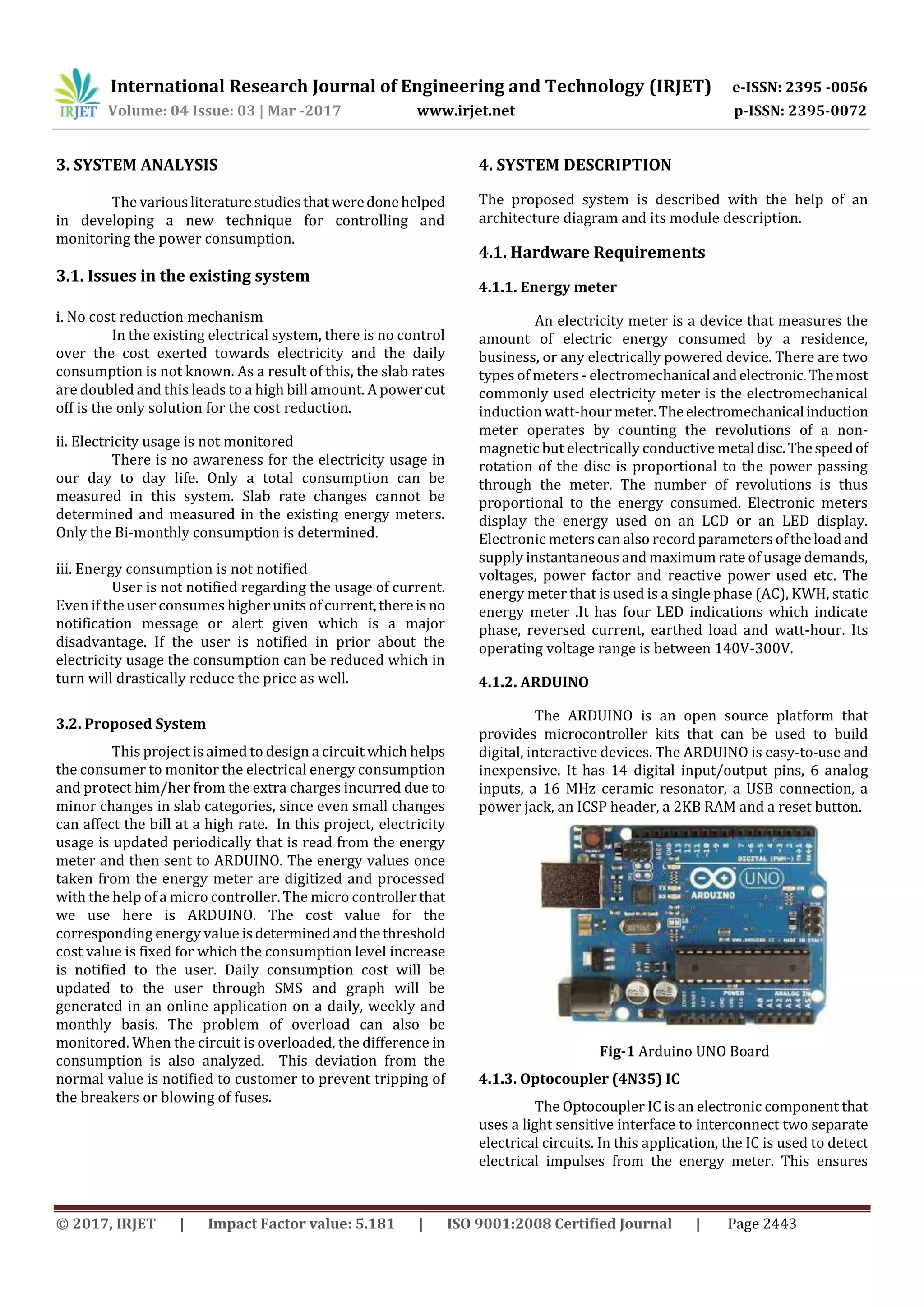
4.1.2. ARDUINO
The ARDUINO is an open source platform that
provides microcontroller kits that can be used to build
digital, interactive devices. The ARDUINO is easy-to-use and
inexpensive. It has 14 digital input/output pins, 6 analog
inputs, a 16 MHz ceramic resonator, a USB connection, a
power jack, an ICSP header, a 2KB RAM and a reset button.
Fig-1 Arduino UNO Board
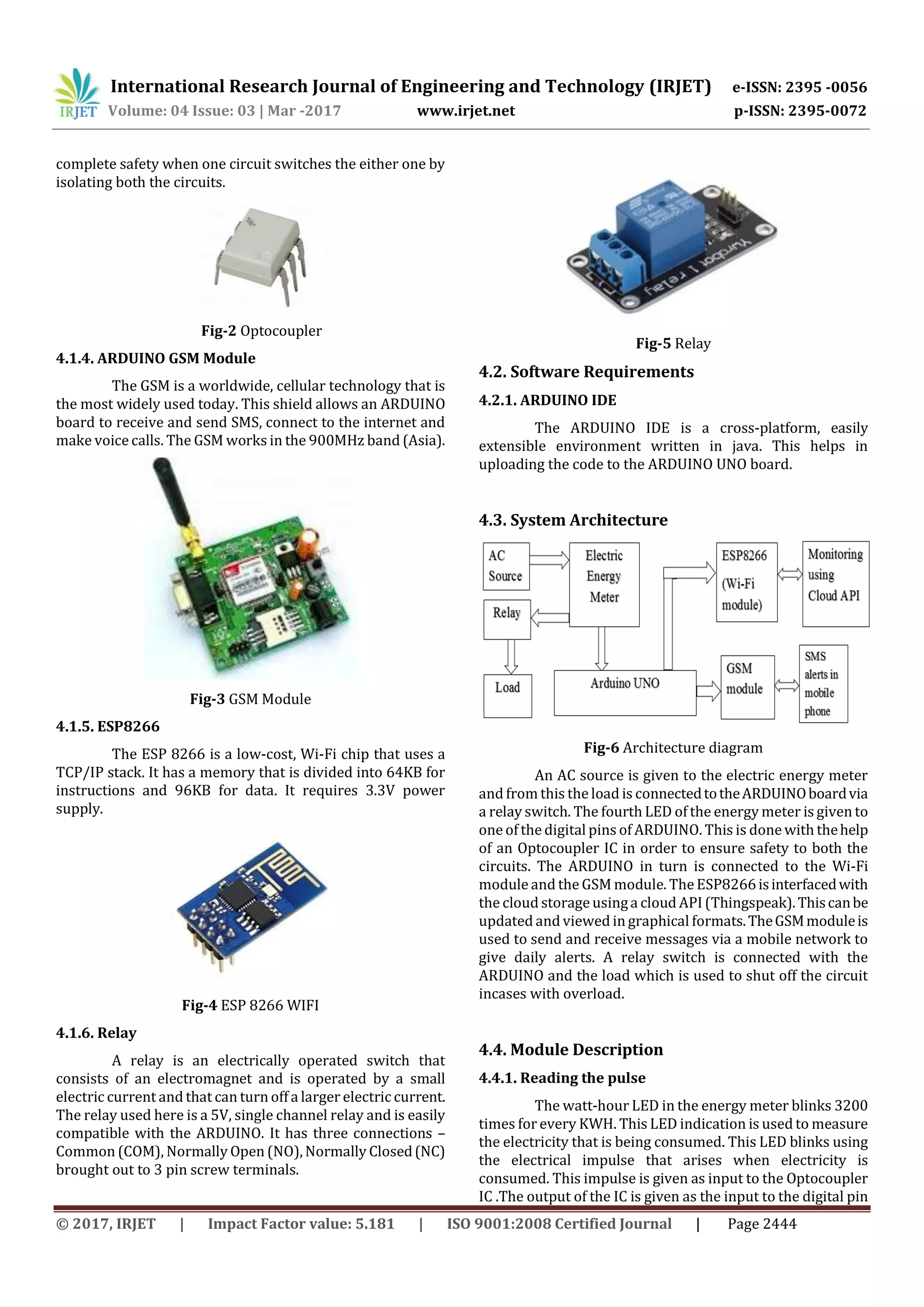
4.1.3. Optocoupler (4N35) IC
The Optocoupler IC is an electronic component that
uses a light sensitive interface to interconnect two separate
electrical circuits. In this application, the IC is used to detect
electrical impulses from the energy meter. This ensures
International Research Journal of Engineering and Technology (IRJET) e-ISSN: 2395 -0056
Volume: 04 Issue: 03 | Mar -2017 www.irjet.net p-ISSN: 2395-0072
© 2017, IRJET | Impact Factor value: 5.181 | ISO 9001:2008 Certified Journal | Page 2444
complete safety when one circuit switches the either one by
isolating both the circuits.
Fig-2 Optocoupler
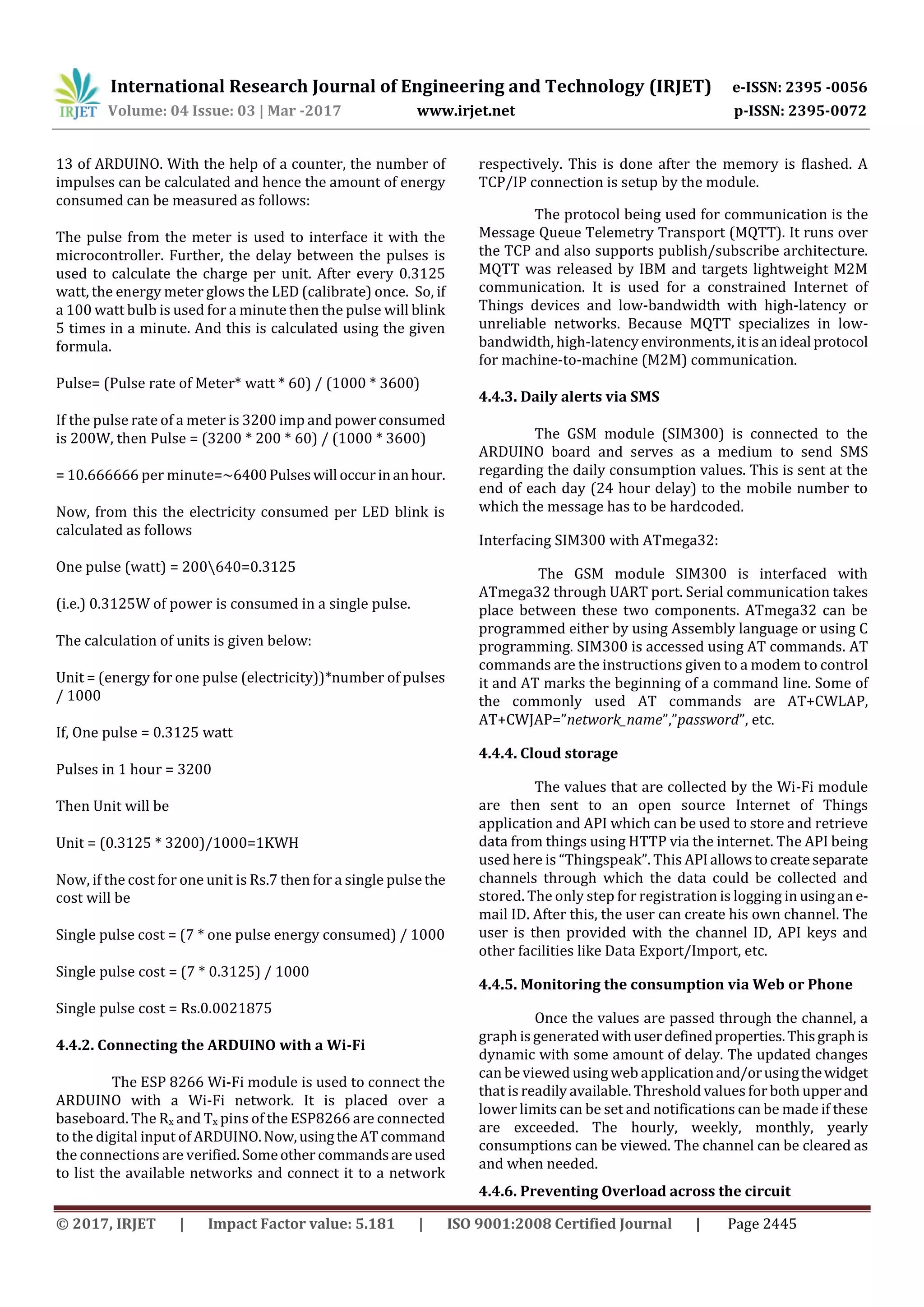
4.1.4. ARDUINO GSM Module
The GSM is a worldwide, cellular technology that is
the most widely used today. This shield allows an ARDUINO
board to receive and send SMS, connect to the internet and
make voice calls. The GSM works in the 900MHz band (Asia).
Fig-3 GSM Module
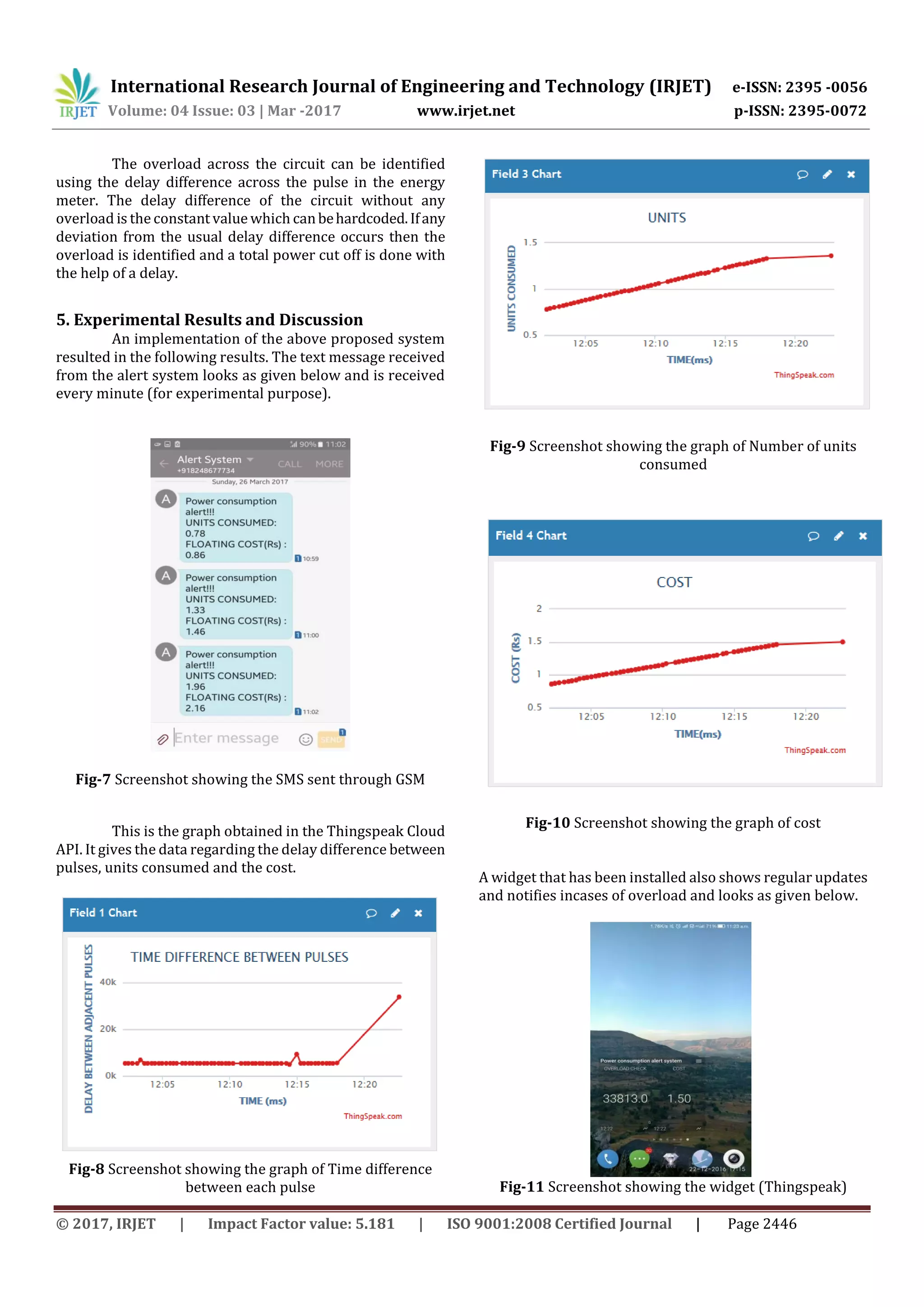
4.1.5. ESP8266
The ESP 8266 is a low-cost, Wi-Fi chip that uses a
TCP/IP stack. It has a memory that is divided into 64KB for
instructions and 96KB for data. It requires 3.3V power
supply.
Fig-4 ESP 8266 WIFI
4.1.6. Relay
A relay is an electrically operated switch that
consists of an electromagnet and is operated by a small
electric current and that can turn off a larger electric current.
The relay used here is a 5V, single channel relay and is easily
compatible with the ARDUINO. It has three connections –
Common (COM), Normally Open (NO),Normally Closed(NC)
brought out to 3 pin screw terminals.
Fig-5 Relay
4.2. Software Requirements
4.2.1. ARDUINO IDE
The ARDUINO IDE is a cross-platform, easily
extensible environment written in java. This helps in
uploading the code to the ARDUINO UNO board.
4.3. System Architecture
Fig-6 Architecture diagram
An AC source is given to the electric energy meter
and from this the load is connectedtotheARDUINOboardvia
a relay switch. The fourth LED of the energy meter is given to
one of the digital pins of ARDUINO. This is done with thehelp
of an Optocoupler IC in order to ensure safety to both the
circuits. The ARDUINO in turn is connected to the Wi-Fi
module and the GSM module. The ESP8266isinterfacedwith
the cloud storage usinga cloud API (Thingspeak).Thiscanbe
updated and viewed in graphical formats.TheGSMmoduleis
used to send and receive messages via a mobile network to
give daily alerts. A relay switch is connected with the
ARDUINO and the load which is used to shut off the circuit
incases with overload.
4.4. Module Description
4.4.1. Reading the pulse
The watt-hour LED in the energy meter blinks 3200
times forevery KWH. This LED indication is used to measure
the electricity that is being consumed. This LED blinks using
the electrical impulse that arises when electricity is
consumed. This impulse is given as input to the Optocoupler
IC .The output of the IC is given as the input to the digital pin
International Research Journal of Engineering and Technology (IRJET) e-ISSN: 2395 -0056
Volume: 04 Issue: 03 | Mar -2017 www.irjet.net p-ISSN: 2395-0072
© 2017, IRJET | Impact Factor value: 5.181 | ISO 9001:2008 Certified Journal | Page 2445
13 of ARDUINO. With the help of a counter, the number of
impulses can be calculated and hence the amount of energy
consumed can be measured as follows:
The pulse from the meter is used to interface it with the
microcontroller. Further, the delay between the pulses is
used to calculate the charge per unit. After every 0.3125
watt, the energy meter glows the LED (calibrate) once. So, if
a 100 watt bulb is used for a minute then the pulse will blink
5 times in a minute. And this is calculated using the given
formula.
Pulse= (Pulse rate of Meter* watt * 60) / (1000 * 3600)
If the pulse rate of a meter is 3200 imp and powerconsumed
is 200W, then Pulse = (3200 * 200 * 60) / (1000 * 3600)
= 10.666666 per minute=~6400Pulseswill occurinanhour.
Now, from this the electricity consumed per LED blink is
calculated as follows
One pulse (watt) = 200640=0.3125
(i.e.) 0.3125W of power is consumed in a single pulse.
The calculation of units is given below:
Unit = (energy for one pulse (electricity))*number of pulses
/ 1000
If, One pulse = 0.3125 watt
Pulses in 1 hour = 3200
Then Unit will be
Unit = (0.3125 * 3200)/1000=1KWH
Now, if the cost for one unit is Rs.7 then for a single pulsethe
cost will be
Single pulse cost = (7 * one pulse energy consumed) / 1000
Single pulse cost = (7 * 0.3125) / 1000
Single pulse cost = Rs.0.0021875
4.4.2. Connecting the ARDUINO with a Wi-Fi
The ESP 8266 Wi-Fi module is used to connect the
ARDUINO with a Wi-Fi network. It is placed over a
baseboard. The Rx and Tx pins of the ESP8266 are connected
to the digital input of ARDUINO.Now,usingtheATcommand
the connections are verified. Someother commandsareused
to list the available networks and connect it to a network
respectively. This is done after the memory is flashed. A
TCP/IP connection is setup by the module.
The protocol being used for communication is the
Message Queue Telemetry Transport (MQTT). It runs over
the TCP and also supports publish/subscribe architecture.
MQTT was released by IBM and targets lightweight M2M
communication. It is used for a constrained Internet of
Things devices and low-bandwidth with high-latency or
unreliable networks. Because MQTT specializes in low-
bandwidth, high-latencyenvironments,itisanideal protocol
for machine-to-machine (M2M) communication.
4.4.3. Daily alerts via SMS
The GSM module (SIM300) is connected to the
ARDUINO board and serves as a medium to send SMS
regarding the daily consumption values. This is sent at the
end of each day (24 hour delay) to the mobile number to
which the message has to be hardcoded.
Interfacing SIM300 with ATmega32:
The GSM module SIM300 is interfaced with
ATmega32 through UART port. Serial communication takes
place between these two components. ATmega32 can be
programmed either by using Assembly language or using C
programming. SIM300 is accessed using AT commands. AT
commands are the instructions given to a modem to control
it and AT marks the beginning of a command line. Some of
the commonly used AT commands are AT+CWLAP,
AT+CWJAP=”network_name”,”password”, etc.
4.4.4. Cloud storage
The values that are collected by the Wi-Fi module
are then sent to an open source Internet of Things
application and API which can be used to store and retrieve
data from things using HTTP via the internet. The API being
used here is “Thingspeak”. This APIallowstocreateseparate
channels through which the data could be collected and
stored. The only step for registration is logging in usingan e-
mail ID. After this, the user can create his own channel. The
user is then provided with the channel ID, API keys and
other facilities like Data Export/Import, etc.
4.4.5. Monitoring the consumption via Web or Phone
Once the values are passed through the channel, a
graph is generated withuserdefinedproperties.Thisgraphis
dynamic with some amount of delay. The updated changes
can be viewed using web applicationand/orusingthewidget
that is readily available. Threshold values forboth upperand
lower limits can be set and notifications can be made if these
are exceeded. The hourly, weekly, monthly, yearly
consumptions can be viewed. The channel can be cleared as
and when needed.
4.4.6. Preventing Overload across the circuit
International Research Journal of Engineering and Technology (IRJET) e-ISSN: 2395 -0056
Volume: 04 Issue: 03 | Mar -2017 www.irjet.net p-ISSN: 2395-0072
© 2017, IRJET | Impact Factor value: 5.181 | ISO 9001:2008 Certified Journal | Page 2446
The overload across the circuit can be identified
using the delay difference across the pulse in the energy
meter. The delay difference of the circuit without any
overload is the constant value which canbehardcoded.Ifany
deviation from the usual delay difference occurs then the
overload is identified and a total power cut off is done with
the help of a delay.
5. Experimental Results and Discussion
An implementation of the above proposed system
resulted in the following results. The text message received
from the alert system looks as given below and is received
every minute (for experimental purpose).
Fig-7 Screenshot showing the SMS sent through GSM
This is the graph obtained in the Thingspeak Cloud
API. It gives the data regarding the delay difference between
pulses, units consumed and the cost.
Fig-8 Screenshot showing the graph of Time difference
between each pulse
Fig-9 Screenshot showing the graph of Number of units
consumed
Fig-10 Screenshot showing the graph of cost
A widget that has been installed also shows regular updates
and notifies incases of overload and looks as given below.
Fig-11 Screenshot showing the widget (Thingspeak)
International Research Journal of Engineering and Technology (IRJET) e-ISSN: 2395 -0056
Volume: 04 Issue: 03 | Mar -2017 www.irjet.net p-ISSN: 2395-0072
© 2017, IRJET | Impact Factor value: 5.181 | ISO 9001:2008 Certified Journal | Page 2447
6. CONCLUSIONS
Thus, the Power Consumption Alert System is used to alert
the user regarding his everyday consumption of electricity.
This helps in saving electricity and also keeping the
electricity bills under limits. A small moduleconsistingof the
ARDUINO board, ESP8266 and GSM can be installed with
energy meter to make the electricity consumption smarter.
REFERENCES
[1] Changliang Xia, Member, IEEE, Xin Gu, Tingna Shi, and
Yan Yan, “Neutral-Point Potential Balancing of Three-
Level Inverters in Direct-Driven Wind Energy
Conversion System” IEEE TRANSACTIONS ON ENERGY
CONVERSION, VOL. 26, NO. 1, MARCH 2011.
[2] Vijay Chand Ganti, Bhim Singh, Fellow,IEEE,ShivKumar
Aggarwal, and Tara Chandra Kandpal,” DFIG-Based
Wind Power Conversion With Grid Power Leveling for
Reduced Gusts” IEEE TRANSACTIONS ON
SUSTAINABLE ENERGY, VOL. 3, NO. 1, JANUARY 2012.
[3] Jiabing Hu, Member, IEEE, HailiangXu,StudentMember,
IEEE, and Yikang He, Senior Member, IEEE Coordinated
Control of DFIG’s RSC and GSC.
[4] Under Generalized Unbalanced and Distorted Grid
Voltage Conditions”, IEEE TRANSACTIONS ON
INDUSTRIAL ELECTRONICS, VOL. 60, NO. 7, JULY 2013.
[5] Yipeng Song, Student Member, IEEE, and Heng Nian,
Member, IEEE “Modularized Control Strategy and
Performance Analysis of DFIG System Under
Unbalanced and Harmonic Grid Voltage” IEEE
TRANSACTIONSON POWER ELECTRONICS,VOL.30,NO.
9, SEPTEMBER 2015.
[6] Muhamad Zahim Sujod, Member, IEEE, Istvan Erlich,
Senior Member, IEEE, and Stephan IEEE
TRANSACTIONSON ENERGYCONVERSION,VOL.28,NO.
3, SEPTEMBER 2013.
[7] B.S.Sathish Dr.P.Thirusakthimurugan and R.Narmadha
“INTERNATIONAL JOURNAL OF ADVANCEDRESEARCH
IN COMPUTER ENGINEERING & TECHNOLOGY
(IJARCET)”AnAdvancedPowerManagementUsingGSM
Module Volume 3 Issue 4, April 2014 1101 ISSN: 2278 –
1323.
[8] Edwin Chobot, Daniel Newby “INTERNATIONAL
JOURNAL OF EMBEDDED SYSTEMS AND
APPLICATIONS” Design and Implementation of a
Wireless Sensor and Actuator Network for Energy
Measurement and Control at Home vol. 3, no. 1, March
2013.
[9] Amit Jain, Mohnish Bagree“INTERNATIONAL JOURNAL
OF ENGINEERING, SCIENCE AND TECHNOLOGY” A
prepaid meter using mobilecommunicationVol.3,No.3,
2011, pp. 160-166.

Power Consumption Alert System

  • 1.
    International Research Journalof Engineering and Technology (IRJET) e-ISSN: 2395 -0056 Volume: 04 Issue: 03 | Mar -2017 www.irjet.net p-ISSN: 2395-0072 © 2017, IRJET | Impact Factor value: 5.181 | ISO 9001:2008 Certified Journal | Page 2442 Power Consumption Alert System D.Aswini1, N.Nisari2, Nivetha3, B.Vaishnavi4 1Assistant Professor, Computer Science and Engineering, Kumaraguru College of Technology, Tamil Nadu, India 2, 3, 4UG Students, Computer Science and Engineering, Kumaraguru College of Technology, Tamil Nadu, India ----------------------------------------------------------------------------***--------------------------------------------------------------------------- Abstract - Nowadays, people are unaware of the cost of energy consumed by various appliances. This project aims to design a circuit which helps the consumer in takingcareofthe electrical energy consumption and the extra charges incurred due to minor changes in slab categories, even though these changes are small they affect the consumer’s bill severely. To make the consumer aware and to control the excess power consumption, this paper introduces, a “POWER CONSUMPTION ALERT SYSTEM”. Thissystemwill intimate the consumer about his /her usage rate. It will display the total units of power consumed and how many units has been left with, in order to be in a minimum slab rate being for a period of time. In this way, the consumer can be made aware of the power consumed and can hence make the consumer use the power accordingly. Daily usage is updated to the consumer periodically through a mobile application and also in a webpage which generates a report aswell. Oncethemaximum threshold value is reached, power is cut off with a prior notification to the consumer. It notonlybenefitstheconsumer, it also benefits the government as it is capable of reducing the power consumption and subsequently can reduce the unusual power usage. KeyWords: ARDUINO UNO, Optocoupler, Energy meter, GSM, ESP8266, Thingspeak. 1. INTRODUCTION Electrical energy is universally accepted as an essential commodity for human beings. Energy is the prime mover of economic growth and is vital to the sustenance of modern economy. Future economic growth crucially depends on the long-term availability of energy from its sources. The IOT based “POWER CONSUMPTION ALERT SYSTEM” mainly aims at the middle class and the lower middle class family to bring their electricity bill down with the help of the power consumption alert system. Energy meters being deployed at homes are used for reading the power that is being consumed. Each consumer may fix a customized threshold value (unit/cost). If the value reaches above the threshold, the power is cut off with a prior notification to the consumer. The graph or the amount of electricity consumed can be visualized with the help of a mobile application/website where the report is given to the user periodically. This system can be installed at any place where the energy consumption should be regularly monitored and controlled. The consumers can fix their own threshold budget values and can be easily customized based on their requirements. POWER CONSUMPTION ALERT SYSTEM is used to continuously monitor the meter reading and give weekly/monthly/daily information about the number of units consumed along with its cost to the consumer. Major components used in this project are ARDUINO Board, GSM module, ESP 8266, energy meter circuit, andload. ARDUINO is a credit card sized minicomputer and acts as a fast processor system. It is the central unit of this project and is connected to GSM, ESP 8266, and energy meter through various ports. The overall operation of the proposed system is discussed in the following sections. 2. LITERATURE SURVEY Previous Literatures1, 2, 3, 4, 5 andresearchwork done by scholars in this domain have been reviewed. Difficulties that were faced by them are presented here. A communicationbetweentheenergymeterandthe EB officer [7] through a wireless medium is used for making longer distance communication easier with reduced cost. A wireless sensor and actuator network [8] can be used for monitoring the energyuseofelectrical appliancesin a home environment. The four pull-down options used are CSM, Monitor, Node, and Display that helps the consumer to monitor the usage of electricity. The prepaid electricity meter uses a prepaid card that communicates with the user and the prepaid meter.For each unit of power consumed, the cost is deducted from the prepaid card .Once the prepaid card is out of balance, the load of the consumer is disconnected from the utility supply by the contactor. The user can recharge the card remotely through mobile communicationbasedoncustomerrequests.
  • 2.
    International Research Journalof Engineering and Technology (IRJET) e-ISSN: 2395 -0056 Volume: 04 Issue: 03 | Mar -2017 www.irjet.net p-ISSN: 2395-0072 © 2017, IRJET | Impact Factor value: 5.181 | ISO 9001:2008 Certified Journal | Page 2443 3. SYSTEM ANALYSIS The variousliteraturestudiesthatweredonehelped in developing a new technique for controlling and monitoring the power consumption. 3.1. Issues in the existing system i. No cost reduction mechanism In the existing electrical system, there is no control over the cost exerted towards electricity and the daily consumption is not known. As a result of this, the slab rates are doubled and this leads to a high bill amount. A power cut off is the only solution for the cost reduction. ii. Electricity usage is not monitored There is no awareness for the electricity usage in our day to day life. Only a total consumption can be measured in this system. Slab rate changes cannot be determined and measured in the existing energy meters. Only the Bi-monthly consumption is determined. iii. Energy consumption is not notified User is not notified regarding the usage of current. Even if the user consumes higher units of current,thereisno notification message or alert given which is a major disadvantage. If the user is notified in prior about the electricity usage the consumption can be reduced which in turn will drastically reduce the price as well. 3.2. Proposed System This project is aimed to design a circuit which helps the consumer to monitor the electrical energy consumption and protect him/her from the extra charges incurred due to minor changes in slab categories, since even small changes can affect the bill at a high rate. In this project, electricity usage is updated periodically that is read from the energy meter and then sent to ARDUINO. The energy values once taken from the energy meter are digitized and processed with the help of a micro controller. The micro controllerthat we use here is ARDUINO. The cost value for the corresponding energy value isdeterminedandthethreshold cost value is fixed for which the consumption level increase is notified to the user. Daily consumption cost will be updated to the user through SMS and graph will be generated in an online application on a daily, weekly and monthly basis. The problem of overload can also be monitored. When the circuit is overloaded, the difference in consumption is also analyzed. This deviation from the normal value is notified to customer to prevent tripping of the breakers or blowing of fuses. 4. SYSTEM DESCRIPTION The proposed system is described with the help of an architecture diagram and its module description. 4.1. Hardware Requirements 4.1.1. Energy meter An electricity meter is a device that measures the amount of electric energy consumed by a residence, business, or any electrically powered device. There are two types of meters - electromechanical andelectronic.Themost commonly used electricity meter is the electromechanical induction watt-hour meter.Theelectromechanical induction meter operates by counting the revolutions of a non- magnetic but electrically conductive metal disc.Thespeedof rotation of the disc is proportional to the power passing through the meter. The number of revolutions is thus proportional to the energy consumed. Electronic meters display the energy used on an LCD or an LED display. Electronic meters can also recordparametersoftheloadand supply instantaneous and maximum rate of usage demands, voltages, power factor and reactive power used etc. The energy meter that is used is a single phase (AC), KWH, static energy meter .It has four LED indications which indicate phase, reversed current, earthed load and watt-hour. Its operating voltage range is between 140V-300V. 4.1.2. ARDUINO The ARDUINO is an open source platform that provides microcontroller kits that can be used to build digital, interactive devices. The ARDUINO is easy-to-use and inexpensive. It has 14 digital input/output pins, 6 analog inputs, a 16 MHz ceramic resonator, a USB connection, a power jack, an ICSP header, a 2KB RAM and a reset button. Fig-1 Arduino UNO Board 4.1.3. Optocoupler (4N35) IC The Optocoupler IC is an electronic component that uses a light sensitive interface to interconnect two separate electrical circuits. In this application, the IC is used to detect electrical impulses from the energy meter. This ensures
  • 3.
    International Research Journalof Engineering and Technology (IRJET) e-ISSN: 2395 -0056 Volume: 04 Issue: 03 | Mar -2017 www.irjet.net p-ISSN: 2395-0072 © 2017, IRJET | Impact Factor value: 5.181 | ISO 9001:2008 Certified Journal | Page 2444 complete safety when one circuit switches the either one by isolating both the circuits. Fig-2 Optocoupler 4.1.4. ARDUINO GSM Module The GSM is a worldwide, cellular technology that is the most widely used today. This shield allows an ARDUINO board to receive and send SMS, connect to the internet and make voice calls. The GSM works in the 900MHz band (Asia). Fig-3 GSM Module 4.1.5. ESP8266 The ESP 8266 is a low-cost, Wi-Fi chip that uses a TCP/IP stack. It has a memory that is divided into 64KB for instructions and 96KB for data. It requires 3.3V power supply. Fig-4 ESP 8266 WIFI 4.1.6. Relay A relay is an electrically operated switch that consists of an electromagnet and is operated by a small electric current and that can turn off a larger electric current. The relay used here is a 5V, single channel relay and is easily compatible with the ARDUINO. It has three connections – Common (COM), Normally Open (NO),Normally Closed(NC) brought out to 3 pin screw terminals. Fig-5 Relay 4.2. Software Requirements 4.2.1. ARDUINO IDE The ARDUINO IDE is a cross-platform, easily extensible environment written in java. This helps in uploading the code to the ARDUINO UNO board. 4.3. System Architecture Fig-6 Architecture diagram An AC source is given to the electric energy meter and from this the load is connectedtotheARDUINOboardvia a relay switch. The fourth LED of the energy meter is given to one of the digital pins of ARDUINO. This is done with thehelp of an Optocoupler IC in order to ensure safety to both the circuits. The ARDUINO in turn is connected to the Wi-Fi module and the GSM module. The ESP8266isinterfacedwith the cloud storage usinga cloud API (Thingspeak).Thiscanbe updated and viewed in graphical formats.TheGSMmoduleis used to send and receive messages via a mobile network to give daily alerts. A relay switch is connected with the ARDUINO and the load which is used to shut off the circuit incases with overload. 4.4. Module Description 4.4.1. Reading the pulse The watt-hour LED in the energy meter blinks 3200 times forevery KWH. This LED indication is used to measure the electricity that is being consumed. This LED blinks using the electrical impulse that arises when electricity is consumed. This impulse is given as input to the Optocoupler IC .The output of the IC is given as the input to the digital pin
  • 4.
    International Research Journalof Engineering and Technology (IRJET) e-ISSN: 2395 -0056 Volume: 04 Issue: 03 | Mar -2017 www.irjet.net p-ISSN: 2395-0072 © 2017, IRJET | Impact Factor value: 5.181 | ISO 9001:2008 Certified Journal | Page 2445 13 of ARDUINO. With the help of a counter, the number of impulses can be calculated and hence the amount of energy consumed can be measured as follows: The pulse from the meter is used to interface it with the microcontroller. Further, the delay between the pulses is used to calculate the charge per unit. After every 0.3125 watt, the energy meter glows the LED (calibrate) once. So, if a 100 watt bulb is used for a minute then the pulse will blink 5 times in a minute. And this is calculated using the given formula. Pulse= (Pulse rate of Meter* watt * 60) / (1000 * 3600) If the pulse rate of a meter is 3200 imp and powerconsumed is 200W, then Pulse = (3200 * 200 * 60) / (1000 * 3600) = 10.666666 per minute=~6400Pulseswill occurinanhour. Now, from this the electricity consumed per LED blink is calculated as follows One pulse (watt) = 200640=0.3125 (i.e.) 0.3125W of power is consumed in a single pulse. The calculation of units is given below: Unit = (energy for one pulse (electricity))*number of pulses / 1000 If, One pulse = 0.3125 watt Pulses in 1 hour = 3200 Then Unit will be Unit = (0.3125 * 3200)/1000=1KWH Now, if the cost for one unit is Rs.7 then for a single pulsethe cost will be Single pulse cost = (7 * one pulse energy consumed) / 1000 Single pulse cost = (7 * 0.3125) / 1000 Single pulse cost = Rs.0.0021875 4.4.2. Connecting the ARDUINO with a Wi-Fi The ESP 8266 Wi-Fi module is used to connect the ARDUINO with a Wi-Fi network. It is placed over a baseboard. The Rx and Tx pins of the ESP8266 are connected to the digital input of ARDUINO.Now,usingtheATcommand the connections are verified. Someother commandsareused to list the available networks and connect it to a network respectively. This is done after the memory is flashed. A TCP/IP connection is setup by the module. The protocol being used for communication is the Message Queue Telemetry Transport (MQTT). It runs over the TCP and also supports publish/subscribe architecture. MQTT was released by IBM and targets lightweight M2M communication. It is used for a constrained Internet of Things devices and low-bandwidth with high-latency or unreliable networks. Because MQTT specializes in low- bandwidth, high-latencyenvironments,itisanideal protocol for machine-to-machine (M2M) communication. 4.4.3. Daily alerts via SMS The GSM module (SIM300) is connected to the ARDUINO board and serves as a medium to send SMS regarding the daily consumption values. This is sent at the end of each day (24 hour delay) to the mobile number to which the message has to be hardcoded. Interfacing SIM300 with ATmega32: The GSM module SIM300 is interfaced with ATmega32 through UART port. Serial communication takes place between these two components. ATmega32 can be programmed either by using Assembly language or using C programming. SIM300 is accessed using AT commands. AT commands are the instructions given to a modem to control it and AT marks the beginning of a command line. Some of the commonly used AT commands are AT+CWLAP, AT+CWJAP=”network_name”,”password”, etc. 4.4.4. Cloud storage The values that are collected by the Wi-Fi module are then sent to an open source Internet of Things application and API which can be used to store and retrieve data from things using HTTP via the internet. The API being used here is “Thingspeak”. This APIallowstocreateseparate channels through which the data could be collected and stored. The only step for registration is logging in usingan e- mail ID. After this, the user can create his own channel. The user is then provided with the channel ID, API keys and other facilities like Data Export/Import, etc. 4.4.5. Monitoring the consumption via Web or Phone Once the values are passed through the channel, a graph is generated withuserdefinedproperties.Thisgraphis dynamic with some amount of delay. The updated changes can be viewed using web applicationand/orusingthewidget that is readily available. Threshold values forboth upperand lower limits can be set and notifications can be made if these are exceeded. The hourly, weekly, monthly, yearly consumptions can be viewed. The channel can be cleared as and when needed. 4.4.6. Preventing Overload across the circuit
  • 5.
    International Research Journalof Engineering and Technology (IRJET) e-ISSN: 2395 -0056 Volume: 04 Issue: 03 | Mar -2017 www.irjet.net p-ISSN: 2395-0072 © 2017, IRJET | Impact Factor value: 5.181 | ISO 9001:2008 Certified Journal | Page 2446 The overload across the circuit can be identified using the delay difference across the pulse in the energy meter. The delay difference of the circuit without any overload is the constant value which canbehardcoded.Ifany deviation from the usual delay difference occurs then the overload is identified and a total power cut off is done with the help of a delay. 5. Experimental Results and Discussion An implementation of the above proposed system resulted in the following results. The text message received from the alert system looks as given below and is received every minute (for experimental purpose). Fig-7 Screenshot showing the SMS sent through GSM This is the graph obtained in the Thingspeak Cloud API. It gives the data regarding the delay difference between pulses, units consumed and the cost. Fig-8 Screenshot showing the graph of Time difference between each pulse Fig-9 Screenshot showing the graph of Number of units consumed Fig-10 Screenshot showing the graph of cost A widget that has been installed also shows regular updates and notifies incases of overload and looks as given below. Fig-11 Screenshot showing the widget (Thingspeak)
  • 6.
    International Research Journalof Engineering and Technology (IRJET) e-ISSN: 2395 -0056 Volume: 04 Issue: 03 | Mar -2017 www.irjet.net p-ISSN: 2395-0072 © 2017, IRJET | Impact Factor value: 5.181 | ISO 9001:2008 Certified Journal | Page 2447 6. CONCLUSIONS Thus, the Power Consumption Alert System is used to alert the user regarding his everyday consumption of electricity. This helps in saving electricity and also keeping the electricity bills under limits. A small moduleconsistingof the ARDUINO board, ESP8266 and GSM can be installed with energy meter to make the electricity consumption smarter. REFERENCES [1] Changliang Xia, Member, IEEE, Xin Gu, Tingna Shi, and Yan Yan, “Neutral-Point Potential Balancing of Three- Level Inverters in Direct-Driven Wind Energy Conversion System” IEEE TRANSACTIONS ON ENERGY CONVERSION, VOL. 26, NO. 1, MARCH 2011. [2] Vijay Chand Ganti, Bhim Singh, Fellow,IEEE,ShivKumar Aggarwal, and Tara Chandra Kandpal,” DFIG-Based Wind Power Conversion With Grid Power Leveling for Reduced Gusts” IEEE TRANSACTIONS ON SUSTAINABLE ENERGY, VOL. 3, NO. 1, JANUARY 2012. [3] Jiabing Hu, Member, IEEE, HailiangXu,StudentMember, IEEE, and Yikang He, Senior Member, IEEE Coordinated Control of DFIG’s RSC and GSC. [4] Under Generalized Unbalanced and Distorted Grid Voltage Conditions”, IEEE TRANSACTIONS ON INDUSTRIAL ELECTRONICS, VOL. 60, NO. 7, JULY 2013. [5] Yipeng Song, Student Member, IEEE, and Heng Nian, Member, IEEE “Modularized Control Strategy and Performance Analysis of DFIG System Under Unbalanced and Harmonic Grid Voltage” IEEE TRANSACTIONSON POWER ELECTRONICS,VOL.30,NO. 9, SEPTEMBER 2015. [6] Muhamad Zahim Sujod, Member, IEEE, Istvan Erlich, Senior Member, IEEE, and Stephan IEEE TRANSACTIONSON ENERGYCONVERSION,VOL.28,NO. 3, SEPTEMBER 2013. [7] B.S.Sathish Dr.P.Thirusakthimurugan and R.Narmadha “INTERNATIONAL JOURNAL OF ADVANCEDRESEARCH IN COMPUTER ENGINEERING & TECHNOLOGY (IJARCET)”AnAdvancedPowerManagementUsingGSM Module Volume 3 Issue 4, April 2014 1101 ISSN: 2278 – 1323. [8] Edwin Chobot, Daniel Newby “INTERNATIONAL JOURNAL OF EMBEDDED SYSTEMS AND APPLICATIONS” Design and Implementation of a Wireless Sensor and Actuator Network for Energy Measurement and Control at Home vol. 3, no. 1, March 2013. [9] Amit Jain, Mohnish Bagree“INTERNATIONAL JOURNAL OF ENGINEERING, SCIENCE AND TECHNOLOGY” A prepaid meter using mobilecommunicationVol.3,No.3, 2011, pp. 160-166.