Vulnerability Assessment
What Is Vulnerability Assessment?
 First step any security protection plan begins with assessment of
vulnerabilities
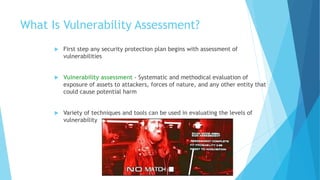
 Vulnerability assessment - Systematic and methodical evaluation of
exposure of assets to attackers, forces of nature, and any other entity that
could cause potential harm
 Variety of techniques and tools can be used in evaluating the levels of
vulnerability
Elements of Vulnerability Assessment
 Asset Identification - Process of inventorying items with economic value
 Identify what needs to be protected
 After an inventory of the assets has been its important to determine each item’s relative value.
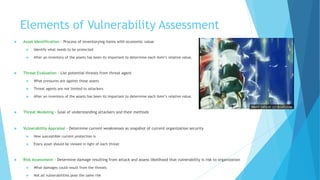
 Threat Evaluation - List potential threats from threat agent
 What pressures are against those assets
 Threat agents are not limited to attackers
 After an inventory of the assets has been its important to determine each item’s relative value.
 Threat Modeling - Goal of understanding attackers and their methods
 Vulnerability Appraisal - Determine current weaknesses as snapshot of current organization security
 How susceptible current protection is
 Every asset should be viewed in light of each threat
 Risk Assessment - Determine damage resulting from attack and assess likelihood that vulnerability is risk to organization
 What damages could result from the threats
 Not all vulnerabilities pose the same risk
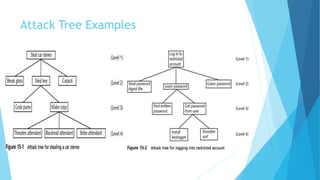
Attack Tree Examples
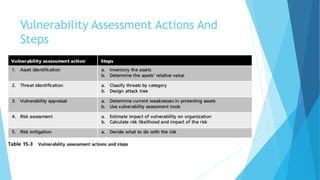
Vulnerability Assessment Actions And
Steps
Assessment Techniques
 Baseline Reporting - Comparison of present state of system to its baseline
 Baseline - Imaginary line by which an element is measured or compared; can be seen as standard
 IT baseline is checklist against which systems can be evaluated and audited for security posture
 Outlines major security considerations for system and becomes the starting point for solid security
 Deviations include not only technical issues but also management and operational issues
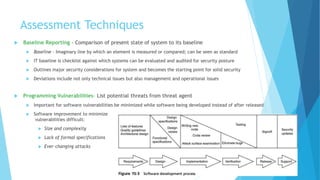
 Programming Vulnerabilities- List potential threats from threat agent
 Important for software vulnerabilities be minimized while software being developed instead of after released
 Software improvement to minimize
vulnerabilities difficult:
 Size and complexity
 Lack of formal specifications
 Ever-changing attacks
Assessment Tools
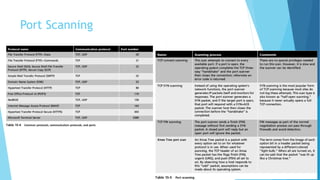
 Port scanners - Software can be used to search system for port vulnerabilities
 Banner grabbing tools – Software used to intentionally gather message that service
transmits when another program connects to it.
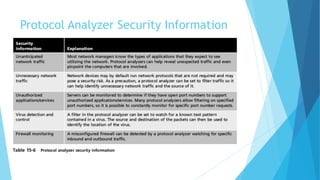
 Protocol analyzers - Hardware or software that captures packets to decode and analyze
contents
 Vulnerability scanners - Automated software searches a system for known security
weaknesses
 Honeypots and honeynets - Goal is to trick attackers into revealing their techniques
 Tools can likewise used by attackers to uncover vulnerabilities to be exploited
Port Scanning
Protocol Analyzer Security Information
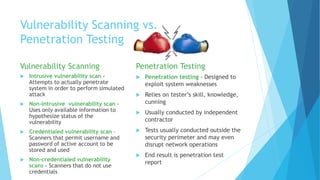
Vulnerability Scanning vs.
Penetration Testing
Vulnerability Scanning
 Intrusive vulnerability scan -
Attempts to actually penetrate
system in order to perform simulated
attack
 Non-intrusive vulnerability scan -
Uses only available information to
hypothesize status of the
vulnerability
 Credentialed vulnerability scan –
Scanners that permit username and
password of active account to be
stored and used
 Non-credentialed vulnerability
scans - Scanners that do not use
credentials
Penetration Testing
 Penetration testing - Designed to
exploit system weaknesses
 Relies on tester’s skill, knowledge,
cunning
 Usually conducted by independent
contractor
 Tests usually conducted outside the
security perimeter and may even
disrupt network operations
 End result is penetration test
report
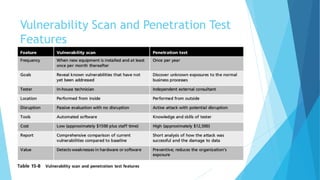
Vulnerability Scan and Penetration Test
Features
Third-Party Integration
 Increasing number of organizations use third-party vendors to create partnerships
 Third-party integration - Risk of combining systems and data with outside
entities, continues to grow
 Question: How will entities combine their services without compromising their
existing security defenses?
 Question: What happens if privacy policy of one of the partners is less restrictive
than that of the other partner?
 Data considerations - Who owns data generated through the partnership and how
data protected?
 Inoperability agreements
 Service Level Agreement (SLA) - Service contract between a vendor and a client
 Blanket Purchase Agreement (BPA) - Prearranged purchase or sale agreement between
a government agency and a business
 Memorandum of Understanding (MOU) - Describes agreement between two or more
parties
 Interconnection Security Agreement (ISA) - Agreement intended to minimize security
risks for data transmitted across a network
Mitigating and Deterring Attacks
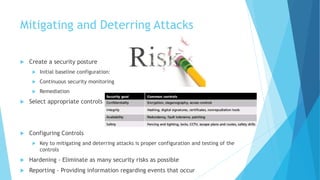
 Create a security posture
 Initial baseline configuration:
 Continuous security monitoring
 Remediation
 Select appropriate controls
 Configuring Controls
 Key to mitigating and deterring attacks is proper configuration and testing of the
controls
 Hardening - Eliminate as many security risks as possible
 Reporting - Providing information regarding events that occur
Checkpoint
 Vulnerability assessment
 Methodical evaluation of exposure of assets to risk
 Five steps in an assessment
 Risk describes likelihood that threat agent will exploit a vulnerability
 Several techniques can be used in a vulnerability assessment
 Port scanners, protocol analyzers, honeypots are used as assessment tools
 Vulnerability scan searches system for known security weakness and reports findings
 Penetration testing designed to exploit any discovered system weaknesses
 Tester may have various levels of system knowledge
 Standard techniques used to mitigate and deter attacks
 Healthy security posture
 Proper configuration of controls
 Hardening and reporting

Vulnerability Assessment

  • 1.
  • 2.
    What Is VulnerabilityAssessment?  First step any security protection plan begins with assessment of vulnerabilities  Vulnerability assessment - Systematic and methodical evaluation of exposure of assets to attackers, forces of nature, and any other entity that could cause potential harm  Variety of techniques and tools can be used in evaluating the levels of vulnerability
  • 3.
    Elements of VulnerabilityAssessment  Asset Identification - Process of inventorying items with economic value  Identify what needs to be protected  After an inventory of the assets has been its important to determine each item’s relative value.  Threat Evaluation - List potential threats from threat agent  What pressures are against those assets  Threat agents are not limited to attackers  After an inventory of the assets has been its important to determine each item’s relative value.  Threat Modeling - Goal of understanding attackers and their methods  Vulnerability Appraisal - Determine current weaknesses as snapshot of current organization security  How susceptible current protection is  Every asset should be viewed in light of each threat  Risk Assessment - Determine damage resulting from attack and assess likelihood that vulnerability is risk to organization  What damages could result from the threats  Not all vulnerabilities pose the same risk
  • 4.
  • 5.
  • 6.
    Assessment Techniques  BaselineReporting - Comparison of present state of system to its baseline  Baseline - Imaginary line by which an element is measured or compared; can be seen as standard  IT baseline is checklist against which systems can be evaluated and audited for security posture  Outlines major security considerations for system and becomes the starting point for solid security  Deviations include not only technical issues but also management and operational issues  Programming Vulnerabilities- List potential threats from threat agent  Important for software vulnerabilities be minimized while software being developed instead of after released  Software improvement to minimize vulnerabilities difficult:  Size and complexity  Lack of formal specifications  Ever-changing attacks
  • 7.
    Assessment Tools  Portscanners - Software can be used to search system for port vulnerabilities  Banner grabbing tools – Software used to intentionally gather message that service transmits when another program connects to it.  Protocol analyzers - Hardware or software that captures packets to decode and analyze contents  Vulnerability scanners - Automated software searches a system for known security weaknesses  Honeypots and honeynets - Goal is to trick attackers into revealing their techniques  Tools can likewise used by attackers to uncover vulnerabilities to be exploited
  • 8.
  • 9.
  • 10.
    Vulnerability Scanning vs. PenetrationTesting Vulnerability Scanning  Intrusive vulnerability scan - Attempts to actually penetrate system in order to perform simulated attack  Non-intrusive vulnerability scan - Uses only available information to hypothesize status of the vulnerability  Credentialed vulnerability scan – Scanners that permit username and password of active account to be stored and used  Non-credentialed vulnerability scans - Scanners that do not use credentials Penetration Testing  Penetration testing - Designed to exploit system weaknesses  Relies on tester’s skill, knowledge, cunning  Usually conducted by independent contractor  Tests usually conducted outside the security perimeter and may even disrupt network operations  End result is penetration test report
  • 11.
    Vulnerability Scan andPenetration Test Features
  • 12.
    Third-Party Integration  Increasingnumber of organizations use third-party vendors to create partnerships  Third-party integration - Risk of combining systems and data with outside entities, continues to grow  Question: How will entities combine their services without compromising their existing security defenses?  Question: What happens if privacy policy of one of the partners is less restrictive than that of the other partner?  Data considerations - Who owns data generated through the partnership and how data protected?  Inoperability agreements  Service Level Agreement (SLA) - Service contract between a vendor and a client  Blanket Purchase Agreement (BPA) - Prearranged purchase or sale agreement between a government agency and a business  Memorandum of Understanding (MOU) - Describes agreement between two or more parties  Interconnection Security Agreement (ISA) - Agreement intended to minimize security risks for data transmitted across a network
  • 13.
    Mitigating and DeterringAttacks  Create a security posture  Initial baseline configuration:  Continuous security monitoring  Remediation  Select appropriate controls  Configuring Controls  Key to mitigating and deterring attacks is proper configuration and testing of the controls  Hardening - Eliminate as many security risks as possible  Reporting - Providing information regarding events that occur
  • 14.
    Checkpoint  Vulnerability assessment Methodical evaluation of exposure of assets to risk  Five steps in an assessment  Risk describes likelihood that threat agent will exploit a vulnerability  Several techniques can be used in a vulnerability assessment  Port scanners, protocol analyzers, honeypots are used as assessment tools  Vulnerability scan searches system for known security weakness and reports findings  Penetration testing designed to exploit any discovered system weaknesses  Tester may have various levels of system knowledge  Standard techniques used to mitigate and deter attacks  Healthy security posture  Proper configuration of controls  Hardening and reporting