LECTURE 2: INTRODUCTION TO INFORMATION SYSTEMS RISK MANAGEMENT
2.1 INTRODUCTION
• The fundamental precept of information security is to support the mission of the
organization.
• All organizations are exposed to uncertainties, some of which impact the
organization in a negative manner.
• In order to support the organization, IT security professionals must be able to help
their organizations’ management understand and manage these uncertainties.
• Managing uncertainties is not an easy task. Limited resources and an ever-changing
landscape of threats and vulnerabilities make completely mitigating all risks
impossible.
• Therefore, IT security professionals must have a toolset to assist them in sharing a
commonly understood view with IT and business managers concerning the potential
impact of various IT security related threats to the mission. This toolset needs to be
consistent, repeatable, cost-effective and reduce risks to a reasonable level.
1
2.2 RISK AND RISK MANAGEMENT
• Risk: The potential harm that may arise from some current process or from some
future event.
❖ IT security risk is the harm to a process or the related information resulting from
some purposeful or accidental event that negatively impacts the process or the
related information.
❖ Risk is a function of the likelihood of a given threat-source’s exercising a
particular potential vulnerability, and the resulting impact of that adverse event
on the organization.
• Risk Management: Risk management is the process of identifying vulnerabilities and
threats to the information resources used by an organization in achieving business
objectives, and deciding what countermeasures, if any, to take in reducing risk to an
acceptable level, based on the value of the information resource to the organization.
❖ Risk management involves understanding and responding to factors that may lead
to a failure in the confidentiality, integrity or availability of an information system.
2
2.2 THREATS
• Threat: The potential for a threat source to exercise (accidentally trigger or
intentionally exploit) a specific vulnerability.
• Threat-Source: Either intent and method targeted at the intentional exploitation of a
vulnerability or a situation and method that may accidentally trigger a vulnerability.
• The threat is merely the potential for the exercise of a particular vulnerability.
Threats in themselves are not actions. Threats must be coupled with threat-sources
to become dangerous.
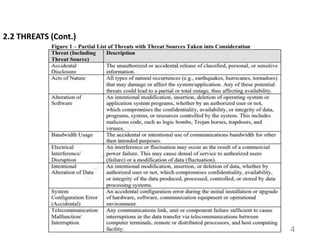
• It is often expedient to incorporate threat sources into threats. The list in the
following table shows some (but not all) of the possible threats to information
systems.
3
2.2 THREATS (Cont.)
4
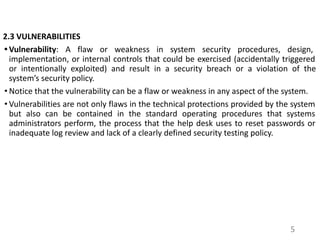
2.3 VULNERABILITIES
• Vulnerability: A flaw or weakness in system security procedures, design,
implementation, or internal controls that could be exercised (accidentally triggered
or intentionally exploited) and result in a security breach or a violation of the
system’s security policy.
• Notice that the vulnerability can be a flaw or weakness in any aspect of the system.
• Vulnerabilities are not only flaws in the technical protections provided by the system
but also can be contained in the standard operating procedures that systems
administrators perform, the process that the help desk uses to reset passwords or
inadequate log review and lack of a clearly defined security testing policy.
5
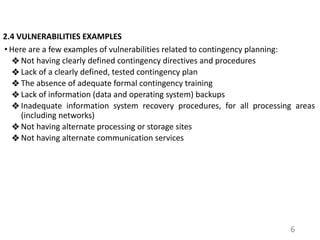
2.4 VULNERABILITIES EXAMPLES
• Here are a few examples of vulnerabilities related to contingency planning:
❖ Not having clearly defined contingency directives and procedures
❖ Lack of a clearly defined, tested contingency plan
❖ The absence of adequate formal contingency training
❖ Lack of information (data and operating system) backups
❖ Inadequate information system recovery procedures, for all processing areas
(including networks)
❖ Not having alternate processing or storage sites
❖ Not having alternate communication services
6
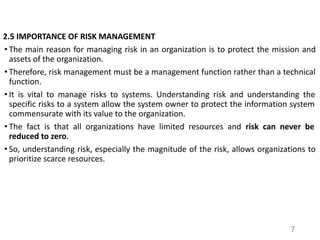
2.5 IMPORTANCE OF RISK MANAGEMENT
• The main reason for managing risk in an organization is to protect the mission and
assets of the organization.
• Therefore, risk management must be a management function rather than a technical
function.
• It is vital to manage risks to systems. Understanding risk and understanding the
specific risks to a system allow the system owner to protect the information system
commensurate with its value to the organization.
• The fact is that all organizations have limited resources and risk can never be
reduced to zero.
• So, understanding risk, especially the magnitude of the risk, allows organizations to
prioritize scarce resources.
7
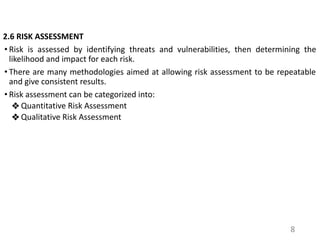
2.6 RISK ASSESSMENT
• Risk is assessed by identifying threats and vulnerabilities, then determining the
likelihood and impact for each risk.
• There are many methodologies aimed at allowing risk assessment to be repeatable
and give consistent results.
• Risk assessment can be categorized into:
❖ Quantitative Risk Assessment
❖ Qualitative Risk Assessment
8
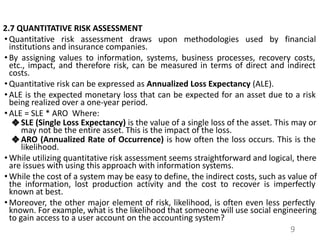
2.7 QUANTITATIVE RISK ASSESSMENT
• Quantitative risk assessment draws upon methodologies used by financial
institutions and insurance companies.
• By assigning values to information, systems, business processes, recovery costs,
etc., impact, and therefore risk, can be measured in terms of direct and indirect
costs.
• Quantitative risk can be expressed as Annualized Loss Expectancy (ALE).
• ALE is the expected monetary loss that can be expected for an asset due to a risk
being realized over a one-year period.
• ALE = SLE * ARO Where:
❖ SLE (Single Loss Expectancy) is the value of a single loss of the asset. This may or
may not be the entire asset. This is the impact of the loss.
❖ ARO (Annualized Rate of Occurrence) is how often the loss occurs. This is the
likelihood.
• While utilizing quantitative risk assessment seems straightforward and logical, there
are issues with using this approach with information systems.
• While the cost of a system may be easy to define, the indirect costs, such as value of
the information, lost production activity and the cost to recover is imperfectly
known at best.
• Moreover, the other major element of risk, likelihood, is often even less perfectly
known. For example, what is the likelihood that someone will use social engineering
to gain access to a user account on the accounting system?
9
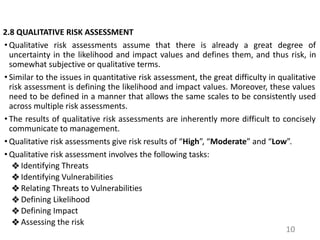
2.8 QUALITATIVE RISK ASSESSMENT
• Qualitative risk assessments assume that there is already a great degree of
uncertainty in the likelihood and impact values and defines them, and thus risk, in
somewhat subjective or qualitative terms.
• Similar to the issues in quantitative risk assessment, the great difficulty in qualitative
risk assessment is defining the likelihood and impact values. Moreover, these values
need to be defined in a manner that allows the same scales to be consistently used
across multiple risk assessments.
• The results of qualitative risk assessments are inherently more difficult to concisely
communicate to management.
• Qualitative risk assessments give risk results of “High”, “Moderate” and “Low”.
• Qualitative risk assessment involves the following tasks:
❖ Identifying Threats
❖ Identifying Vulnerabilities
❖ Relating Threats to Vulnerabilities
❖ Defining Likelihood
❖ Defining Impact
❖ Assessing the risk
10
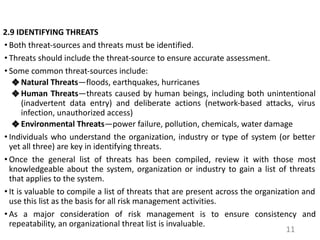
2.9 IDENTIFYING THREATS
• Both threat-sources and threats must be identified.
• Threats should include the threat-source to ensure accurate assessment.
• Some common threat-sources include:
❖ Natural Threats—floods, earthquakes, hurricanes
❖ Human Threats—threats caused by human beings, including both unintentional
(inadvertent data entry) and deliberate actions (network-based attacks, virus
infection, unauthorized access)
❖ Environmental Threats—power failure, pollution, chemicals, water damage
• Individuals who understand the organization, industry or type of system (or better
yet all three) are key in identifying threats.
• Once the general list of threats has been compiled, review it with those most
knowledgeable about the system, organization or industry to gain a list of threats
that applies to the system.
• It is valuable to compile a list of threats that are present across the organization and
use this list as the basis for all risk management activities.
• As a major consideration of risk management is to ensure consistency and
repeatability, an organizational threat list is invaluable.
11
2.10 IDENTIFYING VULNERABILITIES
• Vulnerabilities can be identified by numerous means. Different risk management
schemes offer different methodologies for identifying vulnerabilities.
• In general, start with commonly available vulnerability lists or control areas.
• Then, working with the system owners or other individuals with knowledge of the
system or organization, start to identify the vulnerabilities that apply to the system.
• Specific vulnerabilities can be found by reviewing vendor web sites and public
vulnerability archives, such as Common Vulnerabilities and Exposures (CVE
-http://cve.mitre.org) or the National Vulnerability Database (NVD -
http://nvd.nist.gov).
• If they exist, previous risk assessments and audit reports are the best place to start.
12
2.10 IDENTIFYING VULNERABILITIES (Cont.)
• Additionally, while the following tools and techniques are typically used to evaluate
the effectiveness of controls, they can also be used to identify vulnerabilities:
❖ Vulnerability Scanners – Software that can examine an operating system, network
application or code for known flaws by comparing the system (or system
responses to known stimuli) to a database of flaw signatures.
❖ Penetration Testing (Ethical Hacking) – An attempt by human security analysts to
exercise threats against the system. This includes operational vulnerabilities, such
as social engineering.
❖ Audit of Operational and Management Controls – A thorough review of
operational and management controls by comparing the current documentation
to best practices (such as ISO 17799) and by comparing actual practices against
current documented processes.
• It is invaluable to have a base list of vulnerabilities that are always considered during
every risk assessment in the organization.
• This practice ensures at least a minimum level of consistency between risk
assessments.
• Moreover, vulnerabilities discovered during past assessments of the system should
be included in all future assessments. Doing this allows management to understand
that past risk management activities have been effective.
13
2.11 RELATING THREATS TO VULNERABILITIES
• One of the main activities in the risk management process is to relate a threat to a
vulnerability. This is often called threat-vulnerability (T-V) pairing.
• Not every threat-action/threat can be exercised against every vulnerability.
• For instance, a threat of “flood” obviously applies to a vulnerability of “lack of
contingency planning”, but not to a vulnerability of “failure to change default
authenticators.”
• Developing the T-V pair list is accomplished by reviewing the vulnerability list and
pairing a vulnerability with every threat that applies, then by reviewing the threat list
and ensuring that all the vulnerabilities that that threat-action/threat can act against
have been identified.
14
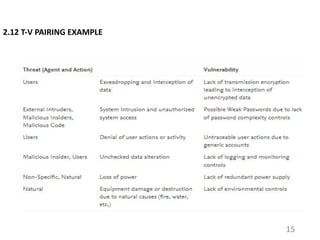
2.12 T-V PAIRING EXAMPLE
15
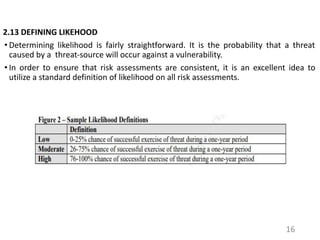
2.13 DEFINING LIKEHOOD
• Determining likelihood is fairly straightforward. It is the probability that a threat
caused by a threat-source will occur against a vulnerability.
• In order to ensure that risk assessments are consistent, it is an excellent idea to
utilize a standard definition of likelihood on all risk assessments.
16
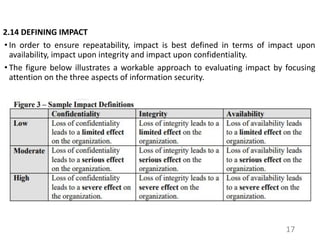
2.14 DEFINING IMPACT
• In order to ensure repeatability, impact is best defined in terms of impact upon
availability, impact upon integrity and impact upon confidentiality.
• The figure below illustrates a workable approach to evaluating impact by focusing
attention on the three aspects of information security.
17
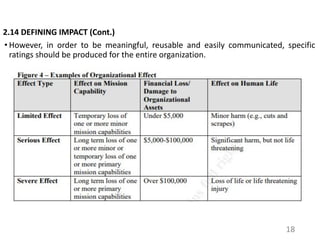
2.14 DEFINING IMPACT (Cont.)
• However, in order to be meaningful, reusable and easily communicated, specific
ratings should be produced for the entire organization.
18
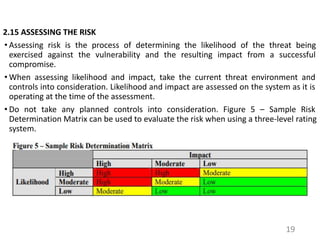
2.15 ASSESSING THE RISK
• Assessing risk is the process of determining the likelihood of the threat being
exercised against the vulnerability and the resulting impact from a successful
compromise.
• When assessing likelihood and impact, take the current threat environment and
controls into consideration. Likelihood and impact are assessed on the system as it is
operating at the time of the assessment.
• Do not take any planned controls into consideration. Figure 5 – Sample Risk
Determination Matrix can be used to evaluate the risk when using a three-level rating
system.
19
2.16 RISK MANAGEMENT
• Recall that the purpose of assessing risk is to assist management in determining
where to direct resources.
• There are four basic strategies for managing risk:
❖ Mitigation
❖ Transference
❖ Acceptance
❖ Avoidance
• For each risk in the risk assessment report, a risk management strategy must be
devised that reduces the risk to an acceptable level for an acceptable cost.
• For each risk management strategy, the cost associated with the strategy and the
basic steps for achieving the strategy (known as the Plan Of Action & Milestones or
POAM) must also be determined.
20
2.17 RISK MITIGATION
• Mitigation is the most considered risk management strategy.
• Mitigation involves fixing the flaw or providing some type of compensatory control to
reduce the likelihood or impact associated with the flaw.
• A common mitigation for a technical security flaw is to install a patch provided by the
vendor.
• Sometimes the process of determining mitigation strategies is called control analysis.
21
2.18 RISK TRANSFERENCE
• Transference is the process of allowing another party to accept the risk on your
behalf.
• This is not widely done for IT systems, but everyone does it all the time in their
personal lives.
• For instance, Car insurance is a way to transfer risk.
• In these cases, risk is transferred from the individual to a pool of insurance holders,
including the insurance company.
• Note that this does not decrease the likelihood or fix any flaws, but it does reduce
the overall impact (primarily financial) on the organization.
22
2.19 RISK ACCEPTANCE
• Acceptance is the practice of simply allowing the system to operate with a known
risk.
• Many low risks are simply accepted.
• Risks that have an extremely high cost to mitigate are also often accepted.
• Beware of high risks being accepted by management. Ensure that this strategy is in
writing and accepted by the manager(s) making the decision.
• Typically, business managers, not IT security personnel, are the ones authorized to
accept risk on behalf of an organization.
23
2.20 RISK AVOIDANCE
• Avoidance is the practice of removing the vulnerable aspect of the system or even
the system itself.
• For instance, during a risk assessment, a website was uncovered that let vendors
view their invoices, using a vendor ID embedded in the HTML file name as the
identification and no authentication or authorization per vendor.
• When notified about the web pages and the risk to the organization, management
decided to remove the web pages and provide vendor invoices via another
mechanism.
• In this case, the risk was avoided by removing the vulnerable web pages.
24
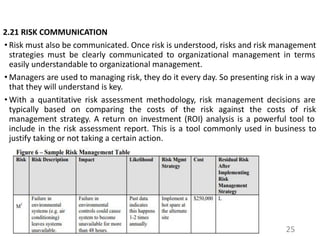
2.21 RISK COMMUNICATION
• Risk must also be communicated. Once risk is understood, risks and risk management
strategies must be clearly communicated to organizational management in terms
easily understandable to organizational management.
• Managers are used to managing risk, they do it every day. So presenting risk in a way
that they will understand is key.
• With a quantitative risk assessment methodology, risk management decisions are
typically based on comparing the costs of the risk against the costs of risk
management strategy. A return on investment (ROI) analysis is a powerful tool to
include in the risk assessment report. This is a tool commonly used in business to
justify taking or not taking a certain action.
25
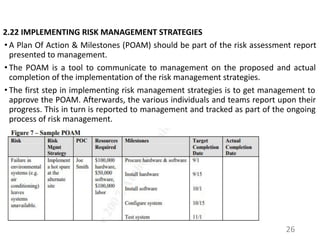
2.22 IMPLEMENTING RISK MANAGEMENT STRATEGIES
• A Plan Of Action & Milestones (POAM) should be part of the risk assessment report
presented to management.
• The POAM is a tool to communicate to management on the proposed and actual
completion of the implementation of the risk management strategies.
• The first step in implementing risk management strategies is to get management to
approve the POAM. Afterwards, the various individuals and teams report upon their
progress. This in turn is reported to management and tracked as part of the ongoing
process of risk management.
26
LECTURE 1 TUTORIAL QUESTIONS
1. Briefly define each the following terms: risk, threat, threat-source, vulnerability,
impact and likehood.
2. What does the term threat-vulnerability (T-V) pair mean?
3. What is risk assessment?
4. What is risk management?
5. What are the two categories of risk assessment?
6. What are two good examples of a complex password?
7. Describe the tasks involved in qualitative risk assessment?
8. Describe the strategies of managing risks?
9. Explain why risk needs to be communicated to the management?
10. What is Plan Of Action & Milestones (POAM) ?
27

IS-Risk-Management-Lecture-2.pdf

  • 1.
    LECTURE 2: INTRODUCTIONTO INFORMATION SYSTEMS RISK MANAGEMENT 2.1 INTRODUCTION • The fundamental precept of information security is to support the mission of the organization. • All organizations are exposed to uncertainties, some of which impact the organization in a negative manner. • In order to support the organization, IT security professionals must be able to help their organizations’ management understand and manage these uncertainties. • Managing uncertainties is not an easy task. Limited resources and an ever-changing landscape of threats and vulnerabilities make completely mitigating all risks impossible. • Therefore, IT security professionals must have a toolset to assist them in sharing a commonly understood view with IT and business managers concerning the potential impact of various IT security related threats to the mission. This toolset needs to be consistent, repeatable, cost-effective and reduce risks to a reasonable level. 1
  • 2.
    2.2 RISK ANDRISK MANAGEMENT • Risk: The potential harm that may arise from some current process or from some future event. ❖ IT security risk is the harm to a process or the related information resulting from some purposeful or accidental event that negatively impacts the process or the related information. ❖ Risk is a function of the likelihood of a given threat-source’s exercising a particular potential vulnerability, and the resulting impact of that adverse event on the organization. • Risk Management: Risk management is the process of identifying vulnerabilities and threats to the information resources used by an organization in achieving business objectives, and deciding what countermeasures, if any, to take in reducing risk to an acceptable level, based on the value of the information resource to the organization. ❖ Risk management involves understanding and responding to factors that may lead to a failure in the confidentiality, integrity or availability of an information system. 2
  • 3.
    2.2 THREATS • Threat:The potential for a threat source to exercise (accidentally trigger or intentionally exploit) a specific vulnerability. • Threat-Source: Either intent and method targeted at the intentional exploitation of a vulnerability or a situation and method that may accidentally trigger a vulnerability. • The threat is merely the potential for the exercise of a particular vulnerability. Threats in themselves are not actions. Threats must be coupled with threat-sources to become dangerous. • It is often expedient to incorporate threat sources into threats. The list in the following table shows some (but not all) of the possible threats to information systems. 3
  • 4.
  • 5.
    2.3 VULNERABILITIES • Vulnerability:A flaw or weakness in system security procedures, design, implementation, or internal controls that could be exercised (accidentally triggered or intentionally exploited) and result in a security breach or a violation of the system’s security policy. • Notice that the vulnerability can be a flaw or weakness in any aspect of the system. • Vulnerabilities are not only flaws in the technical protections provided by the system but also can be contained in the standard operating procedures that systems administrators perform, the process that the help desk uses to reset passwords or inadequate log review and lack of a clearly defined security testing policy. 5
  • 6.
    2.4 VULNERABILITIES EXAMPLES •Here are a few examples of vulnerabilities related to contingency planning: ❖ Not having clearly defined contingency directives and procedures ❖ Lack of a clearly defined, tested contingency plan ❖ The absence of adequate formal contingency training ❖ Lack of information (data and operating system) backups ❖ Inadequate information system recovery procedures, for all processing areas (including networks) ❖ Not having alternate processing or storage sites ❖ Not having alternate communication services 6
  • 7.
    2.5 IMPORTANCE OFRISK MANAGEMENT • The main reason for managing risk in an organization is to protect the mission and assets of the organization. • Therefore, risk management must be a management function rather than a technical function. • It is vital to manage risks to systems. Understanding risk and understanding the specific risks to a system allow the system owner to protect the information system commensurate with its value to the organization. • The fact is that all organizations have limited resources and risk can never be reduced to zero. • So, understanding risk, especially the magnitude of the risk, allows organizations to prioritize scarce resources. 7
  • 8.
    2.6 RISK ASSESSMENT •Risk is assessed by identifying threats and vulnerabilities, then determining the likelihood and impact for each risk. • There are many methodologies aimed at allowing risk assessment to be repeatable and give consistent results. • Risk assessment can be categorized into: ❖ Quantitative Risk Assessment ❖ Qualitative Risk Assessment 8
  • 9.
    2.7 QUANTITATIVE RISKASSESSMENT • Quantitative risk assessment draws upon methodologies used by financial institutions and insurance companies. • By assigning values to information, systems, business processes, recovery costs, etc., impact, and therefore risk, can be measured in terms of direct and indirect costs. • Quantitative risk can be expressed as Annualized Loss Expectancy (ALE). • ALE is the expected monetary loss that can be expected for an asset due to a risk being realized over a one-year period. • ALE = SLE * ARO Where: ❖ SLE (Single Loss Expectancy) is the value of a single loss of the asset. This may or may not be the entire asset. This is the impact of the loss. ❖ ARO (Annualized Rate of Occurrence) is how often the loss occurs. This is the likelihood. • While utilizing quantitative risk assessment seems straightforward and logical, there are issues with using this approach with information systems. • While the cost of a system may be easy to define, the indirect costs, such as value of the information, lost production activity and the cost to recover is imperfectly known at best. • Moreover, the other major element of risk, likelihood, is often even less perfectly known. For example, what is the likelihood that someone will use social engineering to gain access to a user account on the accounting system? 9
  • 10.
    2.8 QUALITATIVE RISKASSESSMENT • Qualitative risk assessments assume that there is already a great degree of uncertainty in the likelihood and impact values and defines them, and thus risk, in somewhat subjective or qualitative terms. • Similar to the issues in quantitative risk assessment, the great difficulty in qualitative risk assessment is defining the likelihood and impact values. Moreover, these values need to be defined in a manner that allows the same scales to be consistently used across multiple risk assessments. • The results of qualitative risk assessments are inherently more difficult to concisely communicate to management. • Qualitative risk assessments give risk results of “High”, “Moderate” and “Low”. • Qualitative risk assessment involves the following tasks: ❖ Identifying Threats ❖ Identifying Vulnerabilities ❖ Relating Threats to Vulnerabilities ❖ Defining Likelihood ❖ Defining Impact ❖ Assessing the risk 10
  • 11.
    2.9 IDENTIFYING THREATS •Both threat-sources and threats must be identified. • Threats should include the threat-source to ensure accurate assessment. • Some common threat-sources include: ❖ Natural Threats—floods, earthquakes, hurricanes ❖ Human Threats—threats caused by human beings, including both unintentional (inadvertent data entry) and deliberate actions (network-based attacks, virus infection, unauthorized access) ❖ Environmental Threats—power failure, pollution, chemicals, water damage • Individuals who understand the organization, industry or type of system (or better yet all three) are key in identifying threats. • Once the general list of threats has been compiled, review it with those most knowledgeable about the system, organization or industry to gain a list of threats that applies to the system. • It is valuable to compile a list of threats that are present across the organization and use this list as the basis for all risk management activities. • As a major consideration of risk management is to ensure consistency and repeatability, an organizational threat list is invaluable. 11
  • 12.
    2.10 IDENTIFYING VULNERABILITIES •Vulnerabilities can be identified by numerous means. Different risk management schemes offer different methodologies for identifying vulnerabilities. • In general, start with commonly available vulnerability lists or control areas. • Then, working with the system owners or other individuals with knowledge of the system or organization, start to identify the vulnerabilities that apply to the system. • Specific vulnerabilities can be found by reviewing vendor web sites and public vulnerability archives, such as Common Vulnerabilities and Exposures (CVE -http://cve.mitre.org) or the National Vulnerability Database (NVD - http://nvd.nist.gov). • If they exist, previous risk assessments and audit reports are the best place to start. 12
  • 13.
    2.10 IDENTIFYING VULNERABILITIES(Cont.) • Additionally, while the following tools and techniques are typically used to evaluate the effectiveness of controls, they can also be used to identify vulnerabilities: ❖ Vulnerability Scanners – Software that can examine an operating system, network application or code for known flaws by comparing the system (or system responses to known stimuli) to a database of flaw signatures. ❖ Penetration Testing (Ethical Hacking) – An attempt by human security analysts to exercise threats against the system. This includes operational vulnerabilities, such as social engineering. ❖ Audit of Operational and Management Controls – A thorough review of operational and management controls by comparing the current documentation to best practices (such as ISO 17799) and by comparing actual practices against current documented processes. • It is invaluable to have a base list of vulnerabilities that are always considered during every risk assessment in the organization. • This practice ensures at least a minimum level of consistency between risk assessments. • Moreover, vulnerabilities discovered during past assessments of the system should be included in all future assessments. Doing this allows management to understand that past risk management activities have been effective. 13
  • 14.
    2.11 RELATING THREATSTO VULNERABILITIES • One of the main activities in the risk management process is to relate a threat to a vulnerability. This is often called threat-vulnerability (T-V) pairing. • Not every threat-action/threat can be exercised against every vulnerability. • For instance, a threat of “flood” obviously applies to a vulnerability of “lack of contingency planning”, but not to a vulnerability of “failure to change default authenticators.” • Developing the T-V pair list is accomplished by reviewing the vulnerability list and pairing a vulnerability with every threat that applies, then by reviewing the threat list and ensuring that all the vulnerabilities that that threat-action/threat can act against have been identified. 14
  • 15.
    2.12 T-V PAIRINGEXAMPLE 15
  • 16.
    2.13 DEFINING LIKEHOOD •Determining likelihood is fairly straightforward. It is the probability that a threat caused by a threat-source will occur against a vulnerability. • In order to ensure that risk assessments are consistent, it is an excellent idea to utilize a standard definition of likelihood on all risk assessments. 16
  • 17.
    2.14 DEFINING IMPACT •In order to ensure repeatability, impact is best defined in terms of impact upon availability, impact upon integrity and impact upon confidentiality. • The figure below illustrates a workable approach to evaluating impact by focusing attention on the three aspects of information security. 17
  • 18.
    2.14 DEFINING IMPACT(Cont.) • However, in order to be meaningful, reusable and easily communicated, specific ratings should be produced for the entire organization. 18
  • 19.
    2.15 ASSESSING THERISK • Assessing risk is the process of determining the likelihood of the threat being exercised against the vulnerability and the resulting impact from a successful compromise. • When assessing likelihood and impact, take the current threat environment and controls into consideration. Likelihood and impact are assessed on the system as it is operating at the time of the assessment. • Do not take any planned controls into consideration. Figure 5 – Sample Risk Determination Matrix can be used to evaluate the risk when using a three-level rating system. 19
  • 20.
    2.16 RISK MANAGEMENT •Recall that the purpose of assessing risk is to assist management in determining where to direct resources. • There are four basic strategies for managing risk: ❖ Mitigation ❖ Transference ❖ Acceptance ❖ Avoidance • For each risk in the risk assessment report, a risk management strategy must be devised that reduces the risk to an acceptable level for an acceptable cost. • For each risk management strategy, the cost associated with the strategy and the basic steps for achieving the strategy (known as the Plan Of Action & Milestones or POAM) must also be determined. 20
  • 21.
    2.17 RISK MITIGATION •Mitigation is the most considered risk management strategy. • Mitigation involves fixing the flaw or providing some type of compensatory control to reduce the likelihood or impact associated with the flaw. • A common mitigation for a technical security flaw is to install a patch provided by the vendor. • Sometimes the process of determining mitigation strategies is called control analysis. 21
  • 22.
    2.18 RISK TRANSFERENCE •Transference is the process of allowing another party to accept the risk on your behalf. • This is not widely done for IT systems, but everyone does it all the time in their personal lives. • For instance, Car insurance is a way to transfer risk. • In these cases, risk is transferred from the individual to a pool of insurance holders, including the insurance company. • Note that this does not decrease the likelihood or fix any flaws, but it does reduce the overall impact (primarily financial) on the organization. 22
  • 23.
    2.19 RISK ACCEPTANCE •Acceptance is the practice of simply allowing the system to operate with a known risk. • Many low risks are simply accepted. • Risks that have an extremely high cost to mitigate are also often accepted. • Beware of high risks being accepted by management. Ensure that this strategy is in writing and accepted by the manager(s) making the decision. • Typically, business managers, not IT security personnel, are the ones authorized to accept risk on behalf of an organization. 23
  • 24.
    2.20 RISK AVOIDANCE •Avoidance is the practice of removing the vulnerable aspect of the system or even the system itself. • For instance, during a risk assessment, a website was uncovered that let vendors view their invoices, using a vendor ID embedded in the HTML file name as the identification and no authentication or authorization per vendor. • When notified about the web pages and the risk to the organization, management decided to remove the web pages and provide vendor invoices via another mechanism. • In this case, the risk was avoided by removing the vulnerable web pages. 24
  • 25.
    2.21 RISK COMMUNICATION •Risk must also be communicated. Once risk is understood, risks and risk management strategies must be clearly communicated to organizational management in terms easily understandable to organizational management. • Managers are used to managing risk, they do it every day. So presenting risk in a way that they will understand is key. • With a quantitative risk assessment methodology, risk management decisions are typically based on comparing the costs of the risk against the costs of risk management strategy. A return on investment (ROI) analysis is a powerful tool to include in the risk assessment report. This is a tool commonly used in business to justify taking or not taking a certain action. 25
  • 26.
    2.22 IMPLEMENTING RISKMANAGEMENT STRATEGIES • A Plan Of Action & Milestones (POAM) should be part of the risk assessment report presented to management. • The POAM is a tool to communicate to management on the proposed and actual completion of the implementation of the risk management strategies. • The first step in implementing risk management strategies is to get management to approve the POAM. Afterwards, the various individuals and teams report upon their progress. This in turn is reported to management and tracked as part of the ongoing process of risk management. 26
  • 27.
    LECTURE 1 TUTORIALQUESTIONS 1. Briefly define each the following terms: risk, threat, threat-source, vulnerability, impact and likehood. 2. What does the term threat-vulnerability (T-V) pair mean? 3. What is risk assessment? 4. What is risk management? 5. What are the two categories of risk assessment? 6. What are two good examples of a complex password? 7. Describe the tasks involved in qualitative risk assessment? 8. Describe the strategies of managing risks? 9. Explain why risk needs to be communicated to the management? 10. What is Plan Of Action & Milestones (POAM) ? 27