Operational Risk Management
Developed as part of the National
Emergency Services Curriculum Project
RISK_MGT.PPT

Last Revised: 10 June 2003

1
OVERVIEW
•
•
•
•
•
•

Why ORM?
What is ORM - The Essentials
The Integration Imperative
USAF ORM Maturation
ORM Leadership Opportunity
ORM Applied

RISK_MGT.PPT

Last Revised: 10 June 2003

2
Why ORM?

To Ensure Necessary Risks are Taken

• ORM:
• Is an important tool for training realism
• Provides potential to expand capabilities
• Assures necessary risk taking to enhance
superiority

RISK_MGT.PPT

Last Revised: 10 June 2003

3
What is Operational Risk
Management?
• Natural evolution from traditional risk
management
• Systematic decision-making tool that
balances risk cost & benefits

RISK_MGT.PPT

Last Revised: 10 June 2003

4
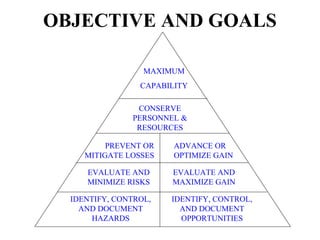
OBJECTIVE AND GOALS
MAXIMUM
CAPABILITY
CONSERVE
PERSONNEL &
RESOURCES
PREVENT OR
MITIGATE LOSSES

ADVANCE OR
OPTIMIZE GAIN

EVALUATE AND
MINIMIZE RISKS

EVALUATE AND
MAXIMIZE GAIN

IDENTIFY, CONTROL,
AND DOCUMENT
HAZARDS

IDENTIFY, CONTROL,
AND DOCUMENT
OPPORTUNITIES
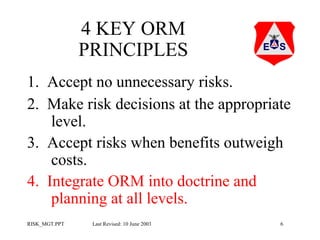
4 KEY ORM
PRINCIPLES
1. Accept no unnecessary risks.
2. Make risk decisions at the appropriate
level.
3. Accept risks when benefits outweigh
costs.
4. Integrate ORM into doctrine and
planning at all levels.
RISK_MGT.PPT

Last Revised: 10 June 2003

6
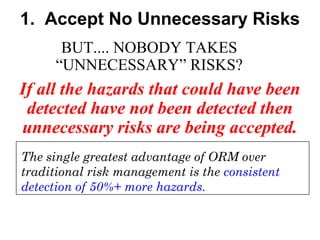
1. Accept No Unnecessary Risks
BUT.... NOBODY TAKES
“UNNECESSARY” RISKS?

If all the hazards that could have been
detected have not been detected then
unnecessary risks are being accepted.
The single greatest advantage of ORM over
traditional risk management is the consistent
detection of 50%+ more hazards.
2. Make Risk Decisions at the
Appropriate Level
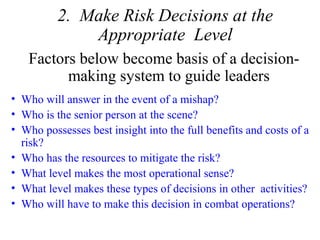
Factors below become basis of a decisionmaking system to guide leaders
• Who will answer in the event of a mishap?
• Who is the senior person at the scene?
• Who possesses best insight into the full benefits and costs of a
risk?
• Who has the resources to mitigate the risk?
• What level makes the most operational sense?
• What level makes these types of decisions in other activities?
• Who will have to make this decision in combat operations?
3. Accept Risks When Benefits
Outweigh Costs.
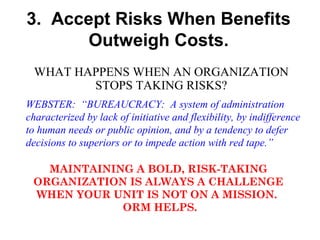
WHAT HAPPENS WHEN AN ORGANIZATION
STOPS TAKING RISKS?
WEBSTER: “BUREAUCRACY: A system of administration
characterized by lack of initiative and flexibility, by indifference
to human needs or public opinion, and by a tendency to defer
decisions to superiors or to impede action with red tape.”
MAINTAINING A BOLD, RISK-TAKING
ORGANIZATION IS ALWAYS A CHALLENGE
WHEN YOUR UNIT IS NOT ON A MISSION.
ORM HELPS.
4. Integrate ORM Into Doctrine and
Planning At All Levels.
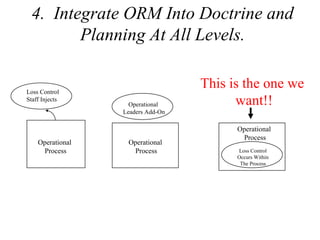
Loss Control
Staff Injects

Operational
Process

Operational
Leaders Add-On

Operational
Process

This is the one we
want!!
Operational
Process
Loss Control
Occurs Within
The Process
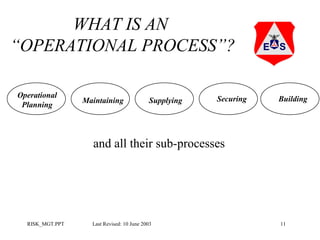
WHAT IS AN
“OPERATIONAL PROCESS”?
Operational
Planning

Maintaining

Supplying

Securing

Building

and all their sub-processes

RISK_MGT.PPT

Last Revised: 10 June 2003

11
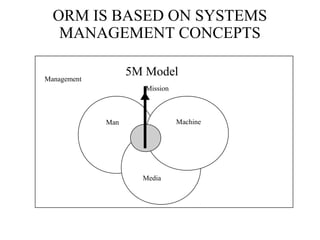
ORM IS BASED ON SYSTEMS
MANAGEMENT CONCEPTS
5M Model

Management

Mission

Machine

Man

Media
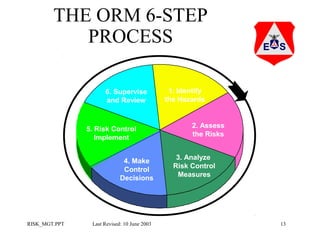
THE ORM 6-STEP
PROCESS
6. Supervise
and Review

5. Risk Control
Implement
4. Make
Control
Decisions

RISK_MGT.PPT

Last Revised: 10 June 2003

1. Identify
the Hazards

2. Assess
the Risks
3. Analyze
Risk Control
Measures

13
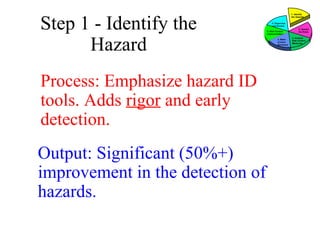
Step 1 - Identify the
Hazard
Process: Emphasize hazard ID
tools. Adds rigor and early
detection.
Output: Significant (50%+)
improvement in the detection of
hazards.

1. Identify
the Hazards
6. Supervise
and Review
5. Risk Control
Implementation
4. Make
Control
Decisions

2. Assess
the Risks
3. Analyze
Risk Control
Measures
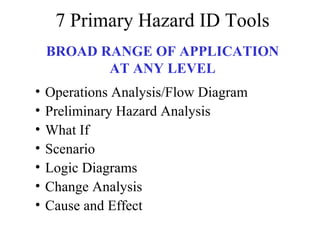
7 Primary Hazard ID Tools
BROAD RANGE OF APPLICATION
AT ANY LEVEL
•
•
•
•
•
•
•

Operations Analysis/Flow Diagram
Preliminary Hazard Analysis
What If
Scenario
Logic Diagrams
Change Analysis
Cause and Effect
Specialized and Advanced
Hazard ID Tools
• Specialized tools accomplish specific ORM
objectives.
Map analysis, interface analysis, mission
protection tools, training realism, opportunity
assessment

• Advanced tools are used by specialists and
professionals to add depth to ORM
applications
RISK_MGT.PPT

Last Revised: 10 June 2003

16
EXAMPLE:
THE DRIVE TO WORK
WHAT IF ANALYSIS
What if the car catches fire.
•What if a carjack is attempted.
•What if I have to take an unknown detour.
•What if I run out of gas.
•What if another car rear ends me.
•

RISK_MGT.PPT

Last Revised: 10 June 2003

17
6. Supervise
and Review

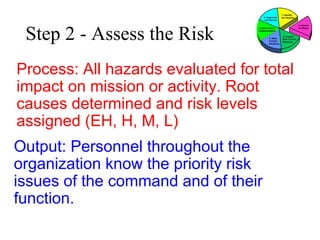
Step 2 - Assess the Risk

1. Identify
the Hazards
2. Assess
the Risks

5. Risk Control
Implementation
4. Make
Control
Decisions

3. Analyze
Risk Control
Measures

Process: All hazards evaluated for total
impact on mission or activity. Root
causes determined and risk levels
assigned (EH, H, M, L)
Output: Personnel throughout the
organization know the priority risk
issues of the command and of their
function.
THE ASSESSMENT TOOLS ADD
OBJECTIVITY TO THE
EVALUATION OF RISK
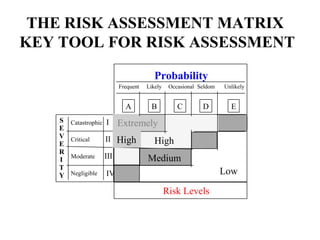
• Risk assessment matrix: Requires
specific evaluations of severity,
probability, and when necessary,
exposure
• Totem pole: Induces the
prioritization of risk issues across
functions and across the organization
THE RISK ASSESSMENT MATRIX
KEY TOOL FOR RISK ASSESSMENT
Probability
Frequent

A
S
E
V
E
R
I
T
Y

Likely

B

Catastrophic

I
II

High

Moderate

III

C

D

Unlikely

E

Extremely

Critical

Occasional Seldom

Negligible

High
Medium
Low

IV

Risk Levels
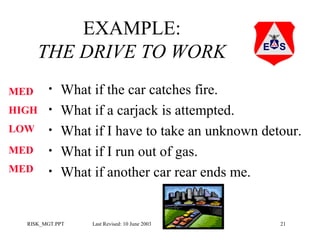
EXAMPLE:
THE DRIVE TO WORK
MED

•

HIGH

•

LOW

•

MED

•

MED

•

What if the car catches fire.
What if a carjack is attempted.
What if I have to take an unknown detour.
What if I run out of gas.
What if another car rear ends me.

RISK_MGT.PPT

Last Revised: 10 June 2003

21
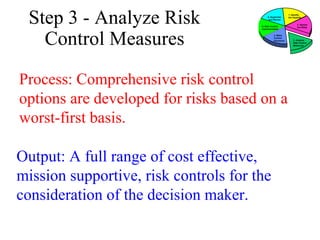
Step 3 - Analyze Risk
Control Measures

6. Supervise
and Review
5. Risk Control
Implementation
4. Make
Control
Decisions

Process: Comprehensive risk control
options are developed for risks based on a
worst-first basis.
Output: A full range of cost effective,
mission supportive, risk controls for the
consideration of the decision maker.

1. Identify
the Hazards
2. Assess
the Risks

3. Analyze
Risk Control
Measures
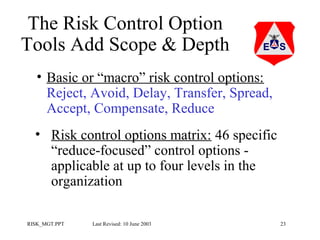
The Risk Control Option
Tools Add Scope & Depth
• Basic or “macro” risk control options:
Reject, Avoid, Delay, Transfer, Spread,
Accept, Compensate, Reduce
• Risk control options matrix: 46 specific
“reduce-focused” control options applicable at up to four levels in the
organization
RISK_MGT.PPT

Last Revised: 10 June 2003

23
EXAMPLE:
THE DRIVE TO WORK
What if the car catches fire

MEDIUM

Macro options:
• Transfer - Insurance
• Reduce (use Control Options Matrix) •
•
•
•

Engineer gas tank
Drive defensively
Focused maintenance
Emergency response plan & equipment

RISK_MGT.PPT

Last Revised: 10 June 2003

24
Step 4 - Make Control
Decisions

6. Supervise
and Review
5. Risk Control
Implementation

4. Make
Control
Decisions

1. Identify
the Hazards
2. Assess
the Risks
3. Analyze
Risk Control
Measures

Process: A decision-making system gets risk
decisions to the right person, at the right
time, with the right support.
Output: Personnel know their decisionmaking authority and limitations and take
necessary risks.
ORM Uses Proven
Decision-making Tools
• Decision-making systems get the decision to the
right person, at the right time, with the right
support
• Basic cost benefit and return on investment
analysis assure maximum benefit for the risk
control $
• Decision-making matrices and other modern
decision-making tools improve decision quality
• The leader question list induces better staff inputs
RISK_MGT.PPT

Last Revised: 10 June 2003

26
ESTABLISHING A DECISION
MAKING GUIDELINE
EXAMPLE
RISK LEVEL
Extremely High
High
Medium
Low

DECISION LEVEL
Wing Commander or specifically
authorized designee
Group Commander or
specifically authorized designee
Flight leader, or senior leader on
the scene
Any person in a leadership
position
EXAMPLE:
THE DRIVE TO WORK
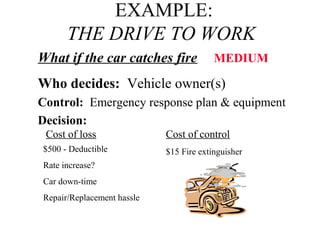
What if the car catches fire

MEDIUM

Who decides: Vehicle owner(s)
Control: Emergency response plan & equipment
Decision:
Cost of loss

Cost of control

$500 - Deductible

$15 Fire extinguisher

Rate increase?
Car down-time
Repair/Replacement hassle
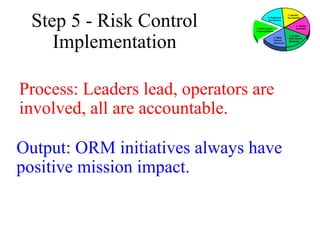
Step 5 - Risk Control
Implementation

6. Supervise
and Review

1. Identify
the Hazards

2. Assess
the Risks

5. Risk Control
Implementation
4. Make
Control
Decisions

Process: Leaders lead, operators are
involved, all are accountable.
Output: ORM initiatives always have
positive mission impact.

3. Analyze
Risk Control
Measures
ORM Implementation Tools &
Guidelines Help Controls Click
with Operators
• The involvement continuum guides the high
degree of operator input to ORM actions
• The leader involvement actions list and the
leader opportunity job aid help assure effective
leader influence
• The motivation model makes application of
modern behavior management techniques easier
RISK_MGT.PPT

Last Revised: 10 June 2003

30
EXAMPLE:
THE DRIVE TO WORK
What if the car catches fire MEDIUM
• Transfer - Insurance
OPR: Dad
• Reduce •
•
•
•

Engineer gas tank
OPR: Ford
Drive defensively
OPR: Driver
Focused maintenance
OPR: Dad
Emergency response plan & equipment OPR:
Team Mom & Dad

RISK_MGT.PPT

Last Revised: 10 June 2003

31
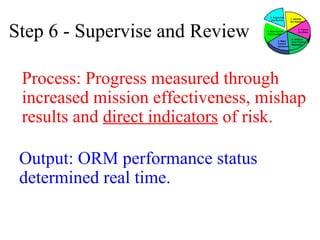
Step 6 - Supervise and Review

6. Supervise
and Review

5. Risk Control
Implementation
4. Make
Control
Decisions

1. Identify
the Hazards
2. Assess
the Risks
3. Analyze
Risk Control
Measures

Process: Progress measured through
increased mission effectiveness, mishap
results and direct indicators of risk.
Output: ORM performance status
determined real time.
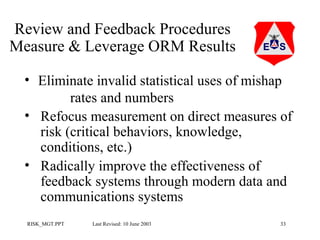
Review and Feedback Procedures
Measure & Leverage ORM Results
• Eliminate invalid statistical uses of mishap
rates and numbers
• Refocus measurement on direct measures of
risk (critical behaviors, knowledge,
conditions, etc.)
• Radically improve the effectiveness of
feedback systems through modern data and
communications systems
RISK_MGT.PPT

Last Revised: 10 June 2003

33
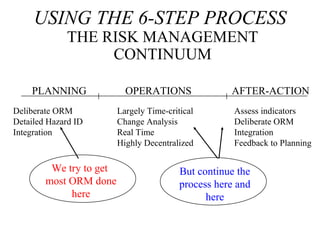
USING THE 6-STEP PROCESS
THE RISK MANAGEMENT
CONTINUUM

PLANNING
Deliberate ORM
Detailed Hazard ID
Integration

We try to get
most ORM done
here

OPERATIONS

AFTER-ACTION

Largely Time-critical
Change Analysis
Real Time
Highly Decentralized

Assess indicators
Deliberate ORM
Integration
Feedback to Planning

But continue the
process here and
here
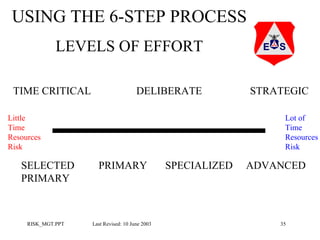
USING THE 6-STEP PROCESS
LEVELS OF EFFORT
TIME CRITICAL

DELIBERATE

Little
Time
Resources
Risk

SELECTED
PRIMARY

RISK_MGT.PPT

STRATEGIC
Lot of
Time
Resources
Risk

PRIMARY

Last Revised: 10 June 2003

SPECIALIZED

ADVANCED

35
Integrating the ORM Process
Overview
• Why integration is critical?
• 12 Strategies for ORM
integration.
• The importance of pace.
WHY INTEGRATION IS
CRITICAL?
Integration:
•
•
•
•
•
•

Forces balancing of loss control and other mission
needs
Captures more of the knowledge and experience of large
numbers of operators
Reduces the number and diversity of references needed
to do the job right
Eliminates redundancy and gaps between loss control
functions
Strengthens accountability
Reduces costs and workloads (in plans, materiel
development cycles, etc.)

RISK_MGT.PPT

Last Revised: 10 June 2003

37
THE TWELVE STRATEGIES
FOR
PROGRAM INTEGRATION
1.
2.
3.
4.
5.
6.

Accountability
Teaming
Partnership
Integrate in Training
Risk Decision Points
Organization &
Policy Structure

RISK_MGT.PPT

Last Revised: 10 June 2003

7. Employee Activities
8. Process Integration
9. Direct Change
10. Gain a Champion
11. Integrate in Strategic
Planning
12. Integrate into
Measurement
38
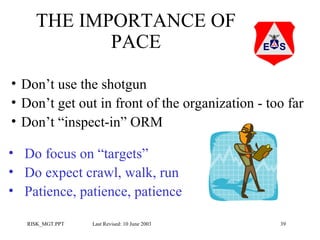
THE IMPORTANCE OF
PACE
• Don’t use the shotgun
• Don’t get out in front of the organization - too far
• Don’t “inspect-in” ORM
• Do focus on “targets”
• Do expect crawl, walk, run
• Patience, patience, patience
RISK_MGT.PPT

Last Revised: 10 June 2003

39
USAF ORM
MATURATION
• Vision
• USAF

Approach
• Background
• Strategy

RISK_MGT.PPT

Last Revised: 10 June 2003

40
VISION
Macro: Every Leader, Member, & Employee Manages
Risk in All They Do... On- & Off-Duty
Micro:
On-Duty
- Every Organization Manages Normal
Operational Risk Profile
- Unique Operations Identified &
Assessed
Off-Duty
- Every Individual Applies Risk
Management Process to Activities
RISK_MGT.PPT

Last Revised: 10 June 2003

41
CAP APPROACH

• Top-Down Approach
• Strong Senior Leader Backing
• Decentralized Implementation
• Moderate Implementation Tempo
• Safety Lead Role for CrossFunctional Implementation
RISK_MGT.PPT

Last Revised: 10 June 2003

42
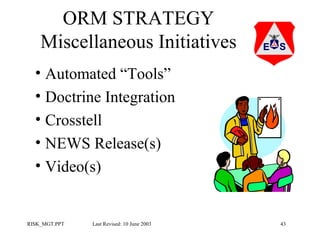
ORM STRATEGY
Miscellaneous Initiatives
• Automated “Tools”
• Doctrine Integration
• Crosstell
• NEWS Release(s)
• Video(s)

RISK_MGT.PPT

Last Revised: 10 June 2003

43
The leader’s role will be
a decisive factor in the
success or failure of
ORM
RISK_MGT.PPT

Last Revised: 10 June 2003

44
ORM Leadership
Opportunities
1. Commit to Breakthrough Improvement
Objectives: Put improvement of risk performance
(control-opportunity) on a competitive level with other
important mission concerns.

2. Set Goals & Objectives
Objectives: Establish periodic ORM performance
and programmatic goals.
RISK_MGT.PPT

Last Revised: 10 June 2003

45
ORM Leadership
Opportunities Continued
3. Set a Personal Example
Objectives: To assure credibility of the ORM
process through personal behavior.

4. Build an Aggressive Opportunity
Mindset in the Organization
Objectives: Create an organization as conscious
of the opportunity aspects of ORM as it is the risk
reduction
RISK_MGT.PPT

Last Revised: 10 June 2003

46
ORM Leadership
Opportunities Continued
5. Induce Loss Control Community
Functional Integration
Objectives: Build increasing cooperation and
integration of the loss control community

6. Establish an ORM Management Structure
Objectives: Provide the necessary leadership and
staff resources to adequately guide the ORM process
RISK_MGT.PPT

Last Revised: 10 June 2003

47
ORM Leadership
Opportunities Continued
7. Resource ORM Activities
Objectives: Allocate resources to ORM (controlopportunity) at a level it can competitively justify

8. Heat Shield Subordinates
Objectives: Protect subordinates who have taken
prudent, mission supportive risks, but experienced
severe losses, from negative consequences.
RISK_MGT.PPT

Last Revised: 10 June 2003

48
ORM Leadership
Opportunities Continued
9. Detect & Correct Gambling
Objectives: Develop an organization in
which risk “gambling” is deterred even
when the gambler “wins”.

10. Use the Power of Question
Objectives: Use pointed ORM questions
to induce ORM activity and culture change.
RISK_MGT.PPT

Last Revised: 10 June 2003

49
ORM Leadership
Opportunities Continued
11. Regularly Monitor ORM Progress
Objectives: Periodically assess a set of data
that effectively monitors organization ORM
status

12. Exploit the ORM Value of Major
Mishap Reviews

Objectives: Consistently induce
consideration of the ORM implications of
mishaps
RISK_MGT.PPT

Last Revised: 10 June 2003

50
QUESTIONS?
THINK SAFETY

RISK_MGT.PPT

Last Revised: 10 June 2003

51

Risk management

  • 1.
    Operational Risk Management Developedas part of the National Emergency Services Curriculum Project RISK_MGT.PPT Last Revised: 10 June 2003 1
  • 2.
    OVERVIEW • • • • • • Why ORM? What isORM - The Essentials The Integration Imperative USAF ORM Maturation ORM Leadership Opportunity ORM Applied RISK_MGT.PPT Last Revised: 10 June 2003 2
  • 3.
    Why ORM? To EnsureNecessary Risks are Taken • ORM: • Is an important tool for training realism • Provides potential to expand capabilities • Assures necessary risk taking to enhance superiority RISK_MGT.PPT Last Revised: 10 June 2003 3
  • 4.
    What is OperationalRisk Management? • Natural evolution from traditional risk management • Systematic decision-making tool that balances risk cost & benefits RISK_MGT.PPT Last Revised: 10 June 2003 4
  • 5.
    OBJECTIVE AND GOALS MAXIMUM CAPABILITY CONSERVE PERSONNEL& RESOURCES PREVENT OR MITIGATE LOSSES ADVANCE OR OPTIMIZE GAIN EVALUATE AND MINIMIZE RISKS EVALUATE AND MAXIMIZE GAIN IDENTIFY, CONTROL, AND DOCUMENT HAZARDS IDENTIFY, CONTROL, AND DOCUMENT OPPORTUNITIES
  • 6.
    4 KEY ORM PRINCIPLES 1.Accept no unnecessary risks. 2. Make risk decisions at the appropriate level. 3. Accept risks when benefits outweigh costs. 4. Integrate ORM into doctrine and planning at all levels. RISK_MGT.PPT Last Revised: 10 June 2003 6
  • 7.
    1. Accept NoUnnecessary Risks BUT.... NOBODY TAKES “UNNECESSARY” RISKS? If all the hazards that could have been detected have not been detected then unnecessary risks are being accepted. The single greatest advantage of ORM over traditional risk management is the consistent detection of 50%+ more hazards.
  • 8.
    2. Make RiskDecisions at the Appropriate Level Factors below become basis of a decisionmaking system to guide leaders • Who will answer in the event of a mishap? • Who is the senior person at the scene? • Who possesses best insight into the full benefits and costs of a risk? • Who has the resources to mitigate the risk? • What level makes the most operational sense? • What level makes these types of decisions in other activities? • Who will have to make this decision in combat operations?
  • 9.
    3. Accept RisksWhen Benefits Outweigh Costs. WHAT HAPPENS WHEN AN ORGANIZATION STOPS TAKING RISKS? WEBSTER: “BUREAUCRACY: A system of administration characterized by lack of initiative and flexibility, by indifference to human needs or public opinion, and by a tendency to defer decisions to superiors or to impede action with red tape.” MAINTAINING A BOLD, RISK-TAKING ORGANIZATION IS ALWAYS A CHALLENGE WHEN YOUR UNIT IS NOT ON A MISSION. ORM HELPS.
  • 10.
    4. Integrate ORMInto Doctrine and Planning At All Levels. Loss Control Staff Injects Operational Process Operational Leaders Add-On Operational Process This is the one we want!! Operational Process Loss Control Occurs Within The Process
  • 11.
    WHAT IS AN “OPERATIONALPROCESS”? Operational Planning Maintaining Supplying Securing Building and all their sub-processes RISK_MGT.PPT Last Revised: 10 June 2003 11
  • 12.
    ORM IS BASEDON SYSTEMS MANAGEMENT CONCEPTS 5M Model Management Mission Machine Man Media
  • 13.
    THE ORM 6-STEP PROCESS 6.Supervise and Review 5. Risk Control Implement 4. Make Control Decisions RISK_MGT.PPT Last Revised: 10 June 2003 1. Identify the Hazards 2. Assess the Risks 3. Analyze Risk Control Measures 13
  • 14.
    Step 1 -Identify the Hazard Process: Emphasize hazard ID tools. Adds rigor and early detection. Output: Significant (50%+) improvement in the detection of hazards. 1. Identify the Hazards 6. Supervise and Review 5. Risk Control Implementation 4. Make Control Decisions 2. Assess the Risks 3. Analyze Risk Control Measures
  • 15.
    7 Primary HazardID Tools BROAD RANGE OF APPLICATION AT ANY LEVEL • • • • • • • Operations Analysis/Flow Diagram Preliminary Hazard Analysis What If Scenario Logic Diagrams Change Analysis Cause and Effect
  • 16.
    Specialized and Advanced HazardID Tools • Specialized tools accomplish specific ORM objectives. Map analysis, interface analysis, mission protection tools, training realism, opportunity assessment • Advanced tools are used by specialists and professionals to add depth to ORM applications RISK_MGT.PPT Last Revised: 10 June 2003 16
  • 17.
    EXAMPLE: THE DRIVE TOWORK WHAT IF ANALYSIS What if the car catches fire. •What if a carjack is attempted. •What if I have to take an unknown detour. •What if I run out of gas. •What if another car rear ends me. • RISK_MGT.PPT Last Revised: 10 June 2003 17
  • 18.
    6. Supervise and Review Step2 - Assess the Risk 1. Identify the Hazards 2. Assess the Risks 5. Risk Control Implementation 4. Make Control Decisions 3. Analyze Risk Control Measures Process: All hazards evaluated for total impact on mission or activity. Root causes determined and risk levels assigned (EH, H, M, L) Output: Personnel throughout the organization know the priority risk issues of the command and of their function.
  • 19.
    THE ASSESSMENT TOOLSADD OBJECTIVITY TO THE EVALUATION OF RISK • Risk assessment matrix: Requires specific evaluations of severity, probability, and when necessary, exposure • Totem pole: Induces the prioritization of risk issues across functions and across the organization
  • 20.
    THE RISK ASSESSMENTMATRIX KEY TOOL FOR RISK ASSESSMENT Probability Frequent A S E V E R I T Y Likely B Catastrophic I II High Moderate III C D Unlikely E Extremely Critical Occasional Seldom Negligible High Medium Low IV Risk Levels
  • 21.
    EXAMPLE: THE DRIVE TOWORK MED • HIGH • LOW • MED • MED • What if the car catches fire. What if a carjack is attempted. What if I have to take an unknown detour. What if I run out of gas. What if another car rear ends me. RISK_MGT.PPT Last Revised: 10 June 2003 21
  • 22.
    Step 3 -Analyze Risk Control Measures 6. Supervise and Review 5. Risk Control Implementation 4. Make Control Decisions Process: Comprehensive risk control options are developed for risks based on a worst-first basis. Output: A full range of cost effective, mission supportive, risk controls for the consideration of the decision maker. 1. Identify the Hazards 2. Assess the Risks 3. Analyze Risk Control Measures
  • 23.
    The Risk ControlOption Tools Add Scope & Depth • Basic or “macro” risk control options: Reject, Avoid, Delay, Transfer, Spread, Accept, Compensate, Reduce • Risk control options matrix: 46 specific “reduce-focused” control options applicable at up to four levels in the organization RISK_MGT.PPT Last Revised: 10 June 2003 23
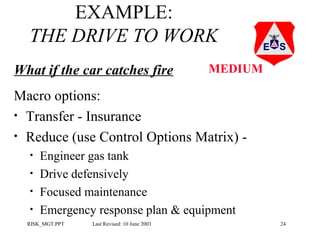
  • 24.
    EXAMPLE: THE DRIVE TOWORK What if the car catches fire MEDIUM Macro options: • Transfer - Insurance • Reduce (use Control Options Matrix) • • • • Engineer gas tank Drive defensively Focused maintenance Emergency response plan & equipment RISK_MGT.PPT Last Revised: 10 June 2003 24
  • 25.
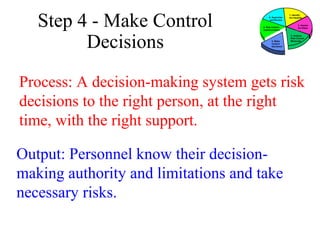
    Step 4 -Make Control Decisions 6. Supervise and Review 5. Risk Control Implementation 4. Make Control Decisions 1. Identify the Hazards 2. Assess the Risks 3. Analyze Risk Control Measures Process: A decision-making system gets risk decisions to the right person, at the right time, with the right support. Output: Personnel know their decisionmaking authority and limitations and take necessary risks.
  • 26.
    ORM Uses Proven Decision-makingTools • Decision-making systems get the decision to the right person, at the right time, with the right support • Basic cost benefit and return on investment analysis assure maximum benefit for the risk control $ • Decision-making matrices and other modern decision-making tools improve decision quality • The leader question list induces better staff inputs RISK_MGT.PPT Last Revised: 10 June 2003 26
  • 27.
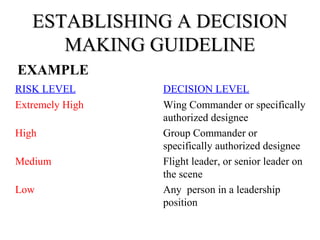
    ESTABLISHING A DECISION MAKINGGUIDELINE EXAMPLE RISK LEVEL Extremely High High Medium Low DECISION LEVEL Wing Commander or specifically authorized designee Group Commander or specifically authorized designee Flight leader, or senior leader on the scene Any person in a leadership position
  • 28.
    EXAMPLE: THE DRIVE TOWORK What if the car catches fire MEDIUM Who decides: Vehicle owner(s) Control: Emergency response plan & equipment Decision: Cost of loss Cost of control $500 - Deductible $15 Fire extinguisher Rate increase? Car down-time Repair/Replacement hassle
  • 29.
    Step 5 -Risk Control Implementation 6. Supervise and Review 1. Identify the Hazards 2. Assess the Risks 5. Risk Control Implementation 4. Make Control Decisions Process: Leaders lead, operators are involved, all are accountable. Output: ORM initiatives always have positive mission impact. 3. Analyze Risk Control Measures
  • 30.
    ORM Implementation Tools& Guidelines Help Controls Click with Operators • The involvement continuum guides the high degree of operator input to ORM actions • The leader involvement actions list and the leader opportunity job aid help assure effective leader influence • The motivation model makes application of modern behavior management techniques easier RISK_MGT.PPT Last Revised: 10 June 2003 30
  • 31.
    EXAMPLE: THE DRIVE TOWORK What if the car catches fire MEDIUM • Transfer - Insurance OPR: Dad • Reduce • • • • Engineer gas tank OPR: Ford Drive defensively OPR: Driver Focused maintenance OPR: Dad Emergency response plan & equipment OPR: Team Mom & Dad RISK_MGT.PPT Last Revised: 10 June 2003 31
  • 32.
    Step 6 -Supervise and Review 6. Supervise and Review 5. Risk Control Implementation 4. Make Control Decisions 1. Identify the Hazards 2. Assess the Risks 3. Analyze Risk Control Measures Process: Progress measured through increased mission effectiveness, mishap results and direct indicators of risk. Output: ORM performance status determined real time.
  • 33.
    Review and FeedbackProcedures Measure & Leverage ORM Results • Eliminate invalid statistical uses of mishap rates and numbers • Refocus measurement on direct measures of risk (critical behaviors, knowledge, conditions, etc.) • Radically improve the effectiveness of feedback systems through modern data and communications systems RISK_MGT.PPT Last Revised: 10 June 2003 33
  • 34.
    USING THE 6-STEPPROCESS THE RISK MANAGEMENT CONTINUUM PLANNING Deliberate ORM Detailed Hazard ID Integration We try to get most ORM done here OPERATIONS AFTER-ACTION Largely Time-critical Change Analysis Real Time Highly Decentralized Assess indicators Deliberate ORM Integration Feedback to Planning But continue the process here and here
  • 35.
    USING THE 6-STEPPROCESS LEVELS OF EFFORT TIME CRITICAL DELIBERATE Little Time Resources Risk SELECTED PRIMARY RISK_MGT.PPT STRATEGIC Lot of Time Resources Risk PRIMARY Last Revised: 10 June 2003 SPECIALIZED ADVANCED 35
  • 36.
    Integrating the ORMProcess Overview • Why integration is critical? • 12 Strategies for ORM integration. • The importance of pace.
  • 37.
    WHY INTEGRATION IS CRITICAL? Integration: • • • • • • Forcesbalancing of loss control and other mission needs Captures more of the knowledge and experience of large numbers of operators Reduces the number and diversity of references needed to do the job right Eliminates redundancy and gaps between loss control functions Strengthens accountability Reduces costs and workloads (in plans, materiel development cycles, etc.) RISK_MGT.PPT Last Revised: 10 June 2003 37
  • 38.
    THE TWELVE STRATEGIES FOR PROGRAMINTEGRATION 1. 2. 3. 4. 5. 6. Accountability Teaming Partnership Integrate in Training Risk Decision Points Organization & Policy Structure RISK_MGT.PPT Last Revised: 10 June 2003 7. Employee Activities 8. Process Integration 9. Direct Change 10. Gain a Champion 11. Integrate in Strategic Planning 12. Integrate into Measurement 38
  • 39.
    THE IMPORTANCE OF PACE •Don’t use the shotgun • Don’t get out in front of the organization - too far • Don’t “inspect-in” ORM • Do focus on “targets” • Do expect crawl, walk, run • Patience, patience, patience RISK_MGT.PPT Last Revised: 10 June 2003 39
  • 40.
    USAF ORM MATURATION • Vision •USAF Approach • Background • Strategy RISK_MGT.PPT Last Revised: 10 June 2003 40
  • 41.
    VISION Macro: Every Leader,Member, & Employee Manages Risk in All They Do... On- & Off-Duty Micro: On-Duty - Every Organization Manages Normal Operational Risk Profile - Unique Operations Identified & Assessed Off-Duty - Every Individual Applies Risk Management Process to Activities RISK_MGT.PPT Last Revised: 10 June 2003 41
  • 42.
    CAP APPROACH • Top-DownApproach • Strong Senior Leader Backing • Decentralized Implementation • Moderate Implementation Tempo • Safety Lead Role for CrossFunctional Implementation RISK_MGT.PPT Last Revised: 10 June 2003 42
  • 43.
    ORM STRATEGY Miscellaneous Initiatives •Automated “Tools” • Doctrine Integration • Crosstell • NEWS Release(s) • Video(s) RISK_MGT.PPT Last Revised: 10 June 2003 43
  • 44.
    The leader’s rolewill be a decisive factor in the success or failure of ORM RISK_MGT.PPT Last Revised: 10 June 2003 44
  • 45.
    ORM Leadership Opportunities 1. Committo Breakthrough Improvement Objectives: Put improvement of risk performance (control-opportunity) on a competitive level with other important mission concerns. 2. Set Goals & Objectives Objectives: Establish periodic ORM performance and programmatic goals. RISK_MGT.PPT Last Revised: 10 June 2003 45
  • 46.
    ORM Leadership Opportunities Continued 3.Set a Personal Example Objectives: To assure credibility of the ORM process through personal behavior. 4. Build an Aggressive Opportunity Mindset in the Organization Objectives: Create an organization as conscious of the opportunity aspects of ORM as it is the risk reduction RISK_MGT.PPT Last Revised: 10 June 2003 46
  • 47.
    ORM Leadership Opportunities Continued 5.Induce Loss Control Community Functional Integration Objectives: Build increasing cooperation and integration of the loss control community 6. Establish an ORM Management Structure Objectives: Provide the necessary leadership and staff resources to adequately guide the ORM process RISK_MGT.PPT Last Revised: 10 June 2003 47
  • 48.
    ORM Leadership Opportunities Continued 7.Resource ORM Activities Objectives: Allocate resources to ORM (controlopportunity) at a level it can competitively justify 8. Heat Shield Subordinates Objectives: Protect subordinates who have taken prudent, mission supportive risks, but experienced severe losses, from negative consequences. RISK_MGT.PPT Last Revised: 10 June 2003 48
  • 49.
    ORM Leadership Opportunities Continued 9.Detect & Correct Gambling Objectives: Develop an organization in which risk “gambling” is deterred even when the gambler “wins”. 10. Use the Power of Question Objectives: Use pointed ORM questions to induce ORM activity and culture change. RISK_MGT.PPT Last Revised: 10 June 2003 49
  • 50.
    ORM Leadership Opportunities Continued 11.Regularly Monitor ORM Progress Objectives: Periodically assess a set of data that effectively monitors organization ORM status 12. Exploit the ORM Value of Major Mishap Reviews Objectives: Consistently induce consideration of the ORM implications of mishaps RISK_MGT.PPT Last Revised: 10 June 2003 50
  • 51.

Editor's Notes

  • #6 KEY POINTS: * Understanding the pyramid: - Left side is risk reduction. - Right side is opportunity-risk. * ORM will significantly alter the traditional distribution of effort. More impact on the right side, more emphasis on prevent (performance) rather than simply compliance. STUDENT NOTES: _______________________________________________________________________________________________________________________________________________________________________________________________________________________________________________________________________________________________________________________________________________________________________________________________________________________________________________________________________________________________________________________________________________________________________________________ ______________________________________________________________________________________________________________________________
  • #7 KEY POINTS: * By understanding these key ideas, you understand the basis of ORM. STUDENT NOTES: _______________________________________________________________________________________________________________________________________________________________________________________________________________________________________________________________________________________________________________________________________________________________________________________________________________________________________________________________________________________________________________________________________________________________________________________ ______________________________________________________________________________________________________________________________ ___________________________________________________________________________________________________________________________________________________________________________________________________________________________________________________________________________________________________________________________
  • #9 KEY POINTS: * In our discussion of step four - Make Control Decisions, we will outline the procedures for building effective risk control decisions systems in your organization. These systems resolve these various factors into a consistent routine process. STUDENT NOTES: _______________________________________________________________________________________________________________________________________________________________________________________________________________________________________________________________________________________________________________________________________________________________________________________________________________________________________________________________________________________________________________________________________________________________________________________ ______________________________________________________________________________________________________________________________ ______________________________________________________________________________________________________________________________
  • #10 KEY POINTS: * In the late 1960’s, the USAF failed to take the risks associated with realistic air-to-air combat. As a result, the kill ratio with the NV Air Force reached nearly 1 to 1. The risks were taken when Red Flag was developed. - Result: The kill ratio quickly increased to a favorable 10 to 1 or more. ORM can assure that we never make a similar mistake. STUDENT NOTES: _______________________________________________________________________________________________________________________________________________________________________________________________________________________________________________________________________________________________________________________________________________________________________________________________________________________________________________________________________________________________________________________________________________________________________________________ ______________________________________________________________________________________________________________________________ _______________________________________________________________
  • #13 KEY POINTS: * ORM is a systems based concept. This means that ORM users understand that operational mistakes and errors have their origin in the design of the system (man, machine, media, management) and that mission success depends on overall system effectiveness. * We will refer to this model at several points in the six step process. It is a key concept of ORM. STUDENT NOTES: _______________________________________________________________________________________________________________________________________________________________________________________________________________________________________________________________________________________________________________________________________________________________________________________________________________________________________________________________________________________________________________________________________________________________________________________ ______________________________________________________________________________________________________________________________
  • #14 KEY POINTS: * This model illustrates the overall process. STUDENT NOTES: _______________________________________________________________________________________________________________________________________________________________________________________________________________________________________________________________________________________________________________________________________________________________________________________________________________________________________________________________________________________________________________________________________________________________________________________ ______________________________________________________________________________________________________________________________ ___________________________________________________________________________________________________________________________________________________________________________________________________________________________________________________________________________________________________________________________
  • #35 NOTES: _______________________________________________________________________________________________________________________________________________________________________________________________________________________________________________________________________________________________________________________________________________________________________________________________________________________________________________________________________________________________________________________________________________________________________________________ ______________________________________________________________________________________________________________________________ ____________________________________________________________________________________________________________________________________________________________________________________________________________________________________________________________
  • #36 STUDENT NOTES: ___________________________________________________________________________________________________________________________________________________________________________________________________________________________________________________________________________________________________________________________________________________________________________________________________________________________________________________________________________________________________________________________________________________________________________________________________________________________________________________________________________________________________________________________________________________________________________________________________________________________________________________________________________________________________________________________________________________________________________________________________________________________________________________________________________________________________________________________________________________________________________________________________________________________________________________________________________________________________________________________________________________________________________
  • #37 We’ll cover system safety. Notice the similarities to ORM. It is in fact the predecessor of ORM - many of the gurus of ORM got their start in system safety. AFMC has identified it’s system safety guys as the point men for ORM Why we need it - mishaps, cost vs. benefit, If we keep doing what we’ve been doing we’ll keep getting what we’ve got. There will be some burps in the statistics but overall things won’t change much. A little how it works - again similar in many ways to ORM Where are we going? What are the obstacles in our path? Summary Very briefly - how do you use it?
  • #38 KEY POINTS: * It is these characteristics that are key to the potential of ORM to reduce risk levels up to 90% below current levels. STUDENT NOTES: _______________________________________________________________________________________________________________________________________________________________________________________________________________________________________________________________________________________________________________________________________________________________________________________________________________________________________________________________________________________________________________________________________________________________________________________ ______________________________________________________________________________________________________________________________ ____________________________________________________________________________________________________________________________________________________________________________________________________________________________________________________________
  • #39 STUDENT NOTES: _______________________________________________________________________________________________________________________________________________________________________________________________________________________________________________________________________________________________________________________________________________________________________________________________________________________________________________________________________________________________________________________________________________________________________________________ ______________________________________________________________________________________________________________________________ _______________________________________________________________________________________________________________________________________________________________________________________________________________________________________________________________________________________________________________________________________________________________________________________________________________________________________________________________________________________________________________________________________________________________________________________
  • #41 Notes:__________________________________________________________________________________________________________________________________________________________________________________________________________________________________________________________________________________________________________________________________________________________________________________________________________________________
  • #43 Notes:__________________________________________________________________________________________________________________________________________________________________________________________________________________________________________________________________________________________________________________________________________________________________________________________________________________________