PRESENTATION
ON
ENTERPRISE RISK
MANAGEMENT
By CA AMIT PANDIT
AT WIRC, ICAI - MUMBAI
8-8-2015
Defining risk…
2
A probability or threat of damage, injury, liability, loss, or any other negative
occurrence that is caused by external or internal vulnerabilities, and that may
be avoided through preemptive action.
- www. businessdictionary.com
The chance that an investment's actual return will be different than expected. Risk
includes the possibility of losing some or all of the original investment. Different
versions of risk are usually measured by calculating the standard deviation of
the historical returns or average returns of a specific investment. A high standard
deviation indicates a high degree of risk.
-www.investopedia.com
Defining risk…
3
“A risk is a situation that an event,
action, or non-action could
adversely affect an organization’s
ability to achieve its business
objectives.”
Risk is Deviation from what is expected /
budgeted
4
How Do You See Risk
• You are given a bet
• Toss a coin
• Heads you get Rs 50 lakhs
• Tails you have to pay Rs 50 lakhs
• Will you take the bet?
5
6
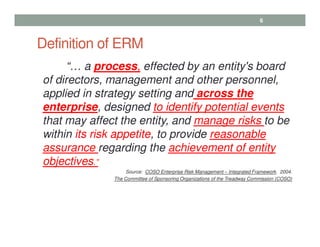
Definition of ERM
“… a process, effected by an entity's board
of directors, management and other personnel,
applied in strategy setting and across the
enterprise, designed to identify potential events
that may affect the entity, and manage risks to be
within its risk appetite, to provide reasonable
assurance regarding the achievement of entity
objectives.”
Source: COSO Enterprise Risk Management – Integrated Framework. 2004.
The Committee of Sponsoring Organizations of the Treadway Commission (COSO)
ERM Roles & Responsibilities
• Management
• The Board of Directors
• Top Management (CXOs, HODs etc)
• Internal auditors
Evolution of Risk Management
• Safety and hazard management
• Process controls – Quality Controls
• Operations Risk Management
• Financial Risk Management
• Enterprise Risk Management – Integrated Framework
8
9
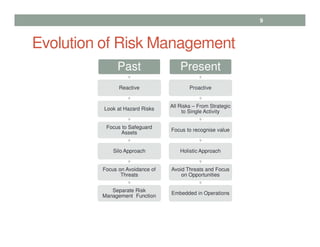
Evolution of Risk Management
Past
Reactive
Look at Hazard Risks
Focus to Safeguard
Assets
Silo Approach
Focus on Avoidance of
Threats
Separate Risk
Management Function
Present
Proactive
All Risks – From Strategic
to Single Activity
Focus to recognise value
Holistic Approach
Avoid Threats and Focus
on Opportunities
Embedded in Operations
Evolution of Risk Management – The
JugglingAct Just Got Tougher
• Regulation
• Globalization
• Multi-Location operations
• Currencies – fx rates
• Interest rates
• Financial markets
• E-commerce
10
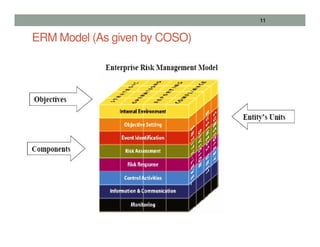
ERM Model (As given by COSO)
11
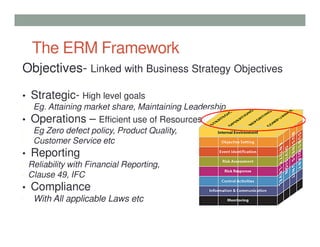
The ERM Framework
Objectives- Linked with Business Strategy Objectives
• Strategic- High level goals
- Eg. Attaining market share, Maintaining Leadership
• Operations – Efficient use of Resources
- Eg Zero defect policy, Product Quality,
- Customer Service etc
• Reporting
- Reliability with Financial Reporting,
- Clause 49, IFC
• Compliance
- With All applicable Laws etc
• Develop a portfolio view
- Entity level
- Business unit level
- Subsidiary/Division
The ERM Framework
All Components are
Interelated
The ERM Framework
Internal Environment
• Tone at the Top- Board
• Control Framework
• Establishes the entity’s risk culture.
• Risk Philosophy & Risk Appetite
• Integrity & Ethical values
• Commitment to Compliance
• Considers all other aspects of how the
organization’s actions may affect its risk culture.
• Egs: Enron, Worldcom, Satyam
• Egs: Infosys, Walt Disney
Objective Setting
• Strategic Planning- How does business
achieve its objectives
• Define risk appetite.
• Risk tolerance.
• Costs Involved
• Assignment of responsibilities to
organizational elements and leaders (linkage)
Event Identification
• Events that impact achievement of Objectives
• Identify external & Internal Events.
• Economic Events
• Natural Disasters
• Political Events
• Technological Changes
• Personnel Issues
• Process Deficiencies
• Distinguish Risks and Opportunities.
• Understand how these events would influence
the company risk.
• Identify List of Potential Risks
• Sit with each HOD to list things which can go
wrong
Source: Business Risk Assessment. 1998 – The Institute of Internal Auditors
Control It
Share or
Transfer It
Diversify or
Avoid It
Risk
Management
Process
Level
Activity
Level
Entity Level
Risk
Monitoring
Identification
Measurement
Prioritization
Risk
Assessment
Risk Analysis
Risk Assessment
• Assess risks from
- Likelihood (Probability of Occurrence)
- Impact
• Risk assessment methodologies.
• Assess risk (Inherent & Residual) .
Likelihood Of Risk
Level Likelihood Definition
Certain
>90%
There is Certainty that Risk will occur
Likely
65-90%
It is Highly likely that Risk will occur
Moderate
35-65%
Possible Chance that Risk may occur
Unlikely
10-35%
It is Unlikely that Risk may occur
Rare
<10%
There is an extremely remote chance that Risk may occur
20
21
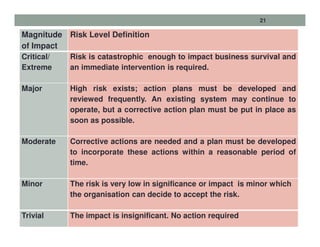
Magnitude
of Impact
Risk Level Definition
Critical/
Extreme
Risk is catastrophic enough to impact business survival and
an immediate intervention is required.
Major High risk exists; action plans must be developed and
reviewed frequently. An existing system may continue to
operate, but a corrective action plan must be put in place as
soon as possible.
Moderate Corrective actions are needed and a plan must be developed
to incorporate these actions within a reasonable period of
time.
Minor The risk is very low in significance or impact is minor which
the organisation can decide to accept the risk.
Trivial The impact is insignificant. No action required
Risk Score = Probability of Occurrence (Likelihood) x Value of Impact
Value
of
Impact
Critical
(5)
Treatable Risk
(5)
Treatable Risk
(10)
Significant Risk
(15)
Significant Risk
(20)
Significant Risk
(25)
Major
(4)
Acceptable Risk
(4)
Treatable Risk
(8)
Treatable Risk
(12)
Significant Risk
(16)
Significant Risk
(20)
Moderate
(3)
Acceptable Risk
(3)
Treatable Risk
(6)
Treatable Risk
(9)
Treatable Risk
(12)
Significant Risk
(15)
Minor
(2)
Acceptable Risk
(2)
Acceptable
Risk (4)
Treatable Risk
(6)
Treatable Risk
(8)
Treatable Risk
(10)
Trivial
(1)
Acceptable Risk
(1)
Acceptable
Risk (2)
Acceptable Risk
(3)
Acceptable Risk
(4)
Treatable Risk
(5)
Rare (1) Unlikely (2) Moderate(3) Likely (4) Certain (5)
Probability of Occurrence
22
Risks Matrix
Risk Response
• Evaluate Response options
• Risk Avoidance
• Risk Treatment (eg improving the internal
control system)
• Risk transfer (Buying insurance)
• Risk Acceptance- (Monitoring)
• Risk Exploitation take advantage of the
opportunities presented
• Residual Risk- Unmitigated Part of Risk
Control Activities
• Preventive
• Detective
• Manual
• Automated
• Entity Level
• Process Level
• Application Level
INHERENT
RISK
RESIDUAL
RISK
• Dashboard of risks and related responses
(visual status of where key risks stand relative to risk
tolerances)
• Flowcharts of processes with key controls noted
• Narratives of business objectives linked to operational
risks and responses
• List of key risks to be monitored or used
• Management understanding of key business risk
responsibility and communication of assignments
Information & Communication
Monitoring
• Collect and display information
• Perform analysis
- Risks are being properly addressed
- Controls are working to mitigate risks
Internal Control
A strong system of internal
control is essential to effective
enterprise risk management.
Internal Auditors
• Do not have primary responsibility for ERM
implementation or maintenance.
• Can Assist management in the process by:
- Monitoring
- Evaluating
- Examining
- Reporting
- Recommending improvements
29
Email: pandit.amit.ca@gmail.com
Hand Phone: +919820127898

ppt erm.pdf

  • 1.
    PRESENTATION ON ENTERPRISE RISK MANAGEMENT By CAAMIT PANDIT AT WIRC, ICAI - MUMBAI 8-8-2015
  • 2.
    Defining risk… 2 A probabilityor threat of damage, injury, liability, loss, or any other negative occurrence that is caused by external or internal vulnerabilities, and that may be avoided through preemptive action. - www. businessdictionary.com The chance that an investment's actual return will be different than expected. Risk includes the possibility of losing some or all of the original investment. Different versions of risk are usually measured by calculating the standard deviation of the historical returns or average returns of a specific investment. A high standard deviation indicates a high degree of risk. -www.investopedia.com
  • 3.
    Defining risk… 3 “A riskis a situation that an event, action, or non-action could adversely affect an organization’s ability to achieve its business objectives.”
  • 4.
    Risk is Deviationfrom what is expected / budgeted 4
  • 5.
    How Do YouSee Risk • You are given a bet • Toss a coin • Heads you get Rs 50 lakhs • Tails you have to pay Rs 50 lakhs • Will you take the bet? 5
  • 6.
    6 Definition of ERM “…a process, effected by an entity's board of directors, management and other personnel, applied in strategy setting and across the enterprise, designed to identify potential events that may affect the entity, and manage risks to be within its risk appetite, to provide reasonable assurance regarding the achievement of entity objectives.” Source: COSO Enterprise Risk Management – Integrated Framework. 2004. The Committee of Sponsoring Organizations of the Treadway Commission (COSO)
  • 7.
    ERM Roles &Responsibilities • Management • The Board of Directors • Top Management (CXOs, HODs etc) • Internal auditors
  • 8.
    Evolution of RiskManagement • Safety and hazard management • Process controls – Quality Controls • Operations Risk Management • Financial Risk Management • Enterprise Risk Management – Integrated Framework 8
  • 9.
    9 Evolution of RiskManagement Past Reactive Look at Hazard Risks Focus to Safeguard Assets Silo Approach Focus on Avoidance of Threats Separate Risk Management Function Present Proactive All Risks – From Strategic to Single Activity Focus to recognise value Holistic Approach Avoid Threats and Focus on Opportunities Embedded in Operations
  • 10.
    Evolution of RiskManagement – The JugglingAct Just Got Tougher • Regulation • Globalization • Multi-Location operations • Currencies – fx rates • Interest rates • Financial markets • E-commerce 10
  • 11.
    ERM Model (Asgiven by COSO) 11
  • 12.
    The ERM Framework Objectives-Linked with Business Strategy Objectives • Strategic- High level goals - Eg. Attaining market share, Maintaining Leadership • Operations – Efficient use of Resources - Eg Zero defect policy, Product Quality, - Customer Service etc • Reporting - Reliability with Financial Reporting, - Clause 49, IFC • Compliance - With All applicable Laws etc
  • 13.
    • Develop aportfolio view - Entity level - Business unit level - Subsidiary/Division The ERM Framework
  • 14.
  • 15.
    Internal Environment • Toneat the Top- Board • Control Framework • Establishes the entity’s risk culture. • Risk Philosophy & Risk Appetite • Integrity & Ethical values • Commitment to Compliance • Considers all other aspects of how the organization’s actions may affect its risk culture. • Egs: Enron, Worldcom, Satyam • Egs: Infosys, Walt Disney
  • 16.
    Objective Setting • StrategicPlanning- How does business achieve its objectives • Define risk appetite. • Risk tolerance. • Costs Involved • Assignment of responsibilities to organizational elements and leaders (linkage)
  • 17.
    Event Identification • Eventsthat impact achievement of Objectives • Identify external & Internal Events. • Economic Events • Natural Disasters • Political Events • Technological Changes • Personnel Issues • Process Deficiencies • Distinguish Risks and Opportunities. • Understand how these events would influence the company risk. • Identify List of Potential Risks • Sit with each HOD to list things which can go wrong
  • 18.
    Source: Business RiskAssessment. 1998 – The Institute of Internal Auditors Control It Share or Transfer It Diversify or Avoid It Risk Management Process Level Activity Level Entity Level Risk Monitoring Identification Measurement Prioritization Risk Assessment Risk Analysis
  • 19.
    Risk Assessment • Assessrisks from - Likelihood (Probability of Occurrence) - Impact • Risk assessment methodologies. • Assess risk (Inherent & Residual) .
  • 20.
    Likelihood Of Risk LevelLikelihood Definition Certain >90% There is Certainty that Risk will occur Likely 65-90% It is Highly likely that Risk will occur Moderate 35-65% Possible Chance that Risk may occur Unlikely 10-35% It is Unlikely that Risk may occur Rare <10% There is an extremely remote chance that Risk may occur 20
  • 21.
    21 Magnitude of Impact Risk LevelDefinition Critical/ Extreme Risk is catastrophic enough to impact business survival and an immediate intervention is required. Major High risk exists; action plans must be developed and reviewed frequently. An existing system may continue to operate, but a corrective action plan must be put in place as soon as possible. Moderate Corrective actions are needed and a plan must be developed to incorporate these actions within a reasonable period of time. Minor The risk is very low in significance or impact is minor which the organisation can decide to accept the risk. Trivial The impact is insignificant. No action required
  • 22.
    Risk Score =Probability of Occurrence (Likelihood) x Value of Impact Value of Impact Critical (5) Treatable Risk (5) Treatable Risk (10) Significant Risk (15) Significant Risk (20) Significant Risk (25) Major (4) Acceptable Risk (4) Treatable Risk (8) Treatable Risk (12) Significant Risk (16) Significant Risk (20) Moderate (3) Acceptable Risk (3) Treatable Risk (6) Treatable Risk (9) Treatable Risk (12) Significant Risk (15) Minor (2) Acceptable Risk (2) Acceptable Risk (4) Treatable Risk (6) Treatable Risk (8) Treatable Risk (10) Trivial (1) Acceptable Risk (1) Acceptable Risk (2) Acceptable Risk (3) Acceptable Risk (4) Treatable Risk (5) Rare (1) Unlikely (2) Moderate(3) Likely (4) Certain (5) Probability of Occurrence 22 Risks Matrix
  • 23.
    Risk Response • EvaluateResponse options • Risk Avoidance • Risk Treatment (eg improving the internal control system) • Risk transfer (Buying insurance) • Risk Acceptance- (Monitoring) • Risk Exploitation take advantage of the opportunities presented • Residual Risk- Unmitigated Part of Risk
  • 24.
    Control Activities • Preventive •Detective • Manual • Automated • Entity Level • Process Level • Application Level INHERENT RISK RESIDUAL RISK
  • 25.
    • Dashboard ofrisks and related responses (visual status of where key risks stand relative to risk tolerances) • Flowcharts of processes with key controls noted • Narratives of business objectives linked to operational risks and responses • List of key risks to be monitored or used • Management understanding of key business risk responsibility and communication of assignments Information & Communication
  • 26.
    Monitoring • Collect anddisplay information • Perform analysis - Risks are being properly addressed - Controls are working to mitigate risks
  • 27.
    Internal Control A strongsystem of internal control is essential to effective enterprise risk management.
  • 28.
    Internal Auditors • Donot have primary responsibility for ERM implementation or maintenance. • Can Assist management in the process by: - Monitoring - Evaluating - Examining - Reporting - Recommending improvements
  • 29.