1
HEMP
Hazard and Effects
Management Program
Objective:Objective:
After this session you will be able to:
• Understand How to Manage Hazards and their Effects
• Understand your role and responsibility in the HEMP process
• Have clear understanding of how Hazards and Effects
Management (HEMP) fits into the HSE Control Framework
• Understand the 6 Practical Steps for completing a HEMP review
• Have enough knowledge to discuss HEMP and ask the right
questions
After this session you will be able to:
• Understand How to Manage Hazards and their Effects
• Understand your role and responsibility in the HEMP process
• Have clear understanding of how Hazards and Effects
Management (HEMP) fits into the HSE Control Framework
• Understand the 6 Practical Steps for completing a HEMP review
• Have enough knowledge to discuss HEMP and ask the right
questions
HEMP
Hazard and Effects Management Program
3
• The HEMP is at the heart of our HSE
Management Systems. It’s where the planning
turns into action.
• HSE Risk Management relies primarily on
HEMP and it’s associated tools.
What is a HEMP?
• All our activities have the potential to harm people and the environment or
cause damage to assets, financial loss, and to adversely impact on reputation.
• To manage these risks, we use a Hazard and Effects Management Process
(HEMP)
• A HEMP is a structured approach to identifying and managing the hazards and
potential effects of these activities.
• The overall objective is to reduce risks to As Low As Reasonably Practicable
(ALARP).
• A HEMP evaluation can be detailed e.g. an HSE Case for a high-risk activity such
as Road Transport
• ... or a relatively short e.g. For a single task in a mechanical workshop such as
changing a tyre.
4
HEMP
Hazard and Effects Management Program
5
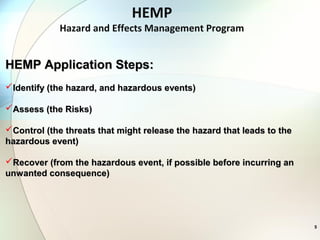
HEMP Application Steps:HEMP Application Steps:
Identify (the hazard, and hazardous events)Identify (the hazard, and hazardous events)
Assess (the Risks)Assess (the Risks)
Control (the threats that might release the hazard that leads to theControl (the threats that might release the hazard that leads to the
hazardous event)hazardous event)
Recover (from the hazardous event, if possible before incurring anRecover (from the hazardous event, if possible before incurring an
unwanted consequence)unwanted consequence)
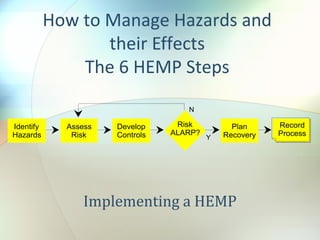
How to Manage Hazards and
their Effects
The 6 HEMP Steps
Implementing a HEMP
Identify
Hazards
Assess
Risk
Develop
Controls
Risk
ALARP?
Plan
Recovery
N
Y
Record
Process
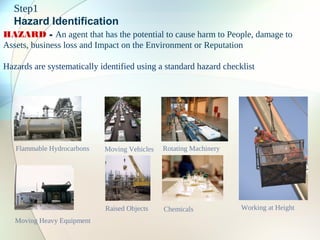
Moving Heavy Equipment
Working at Height
Flammable Hydrocarbons
Raised Objects
HAZARD - An agent that has the potential to cause harm to People, damage to
Assets, business loss and Impact on the Environment or Reputation
Hazards are systematically identified using a standard hazard checklist
Rotating MachineryMoving Vehicles
Chemicals
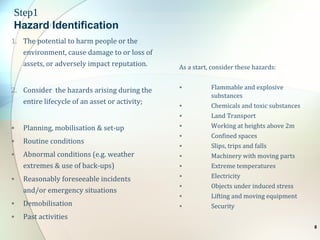
Step1
Hazard Identification
1. The potential to harm people or the
environment, cause damage to or loss of
assets, or adversely impact reputation.
2. Consider the hazards arising during the
entire lifecycle of an asset or activity;
• Planning, mobilisation & set-up
• Routine conditions
• Abnormal conditions (e.g. weather
extremes & use of back-ups)
• Reasonably foreseeable incidents
and/or emergency situations
• Demobilisation
• Past activities
As a start, consider these hazards:
• Flammable and explosive
substances
• Chemicals and toxic substances
• Land Transport
• Working at heights above 2m
• Confined spaces
• Slips, trips and falls
• Machinery with moving parts
• Extreme temperatures
• Electricity
• Objects under induced stress
• Lifting and moving equipment
• Security
8
Step1
Hazard Identification
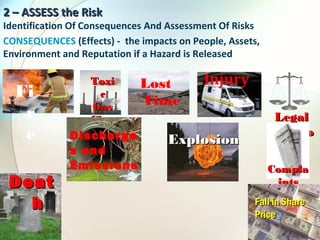
CONSEQUENCES (Effects) - the impacts on People, Assets,
Environment and Reputation if a Hazard is Released
2 – ASSESS the Risk2 – ASSESS the Risk
Identification Of Consequences And Assessment Of Risks
LegalLegal
ActioActio
nn
Fi
r
e
ToxiToxi
cc
GasGas
ClouClou
dd
Lost
Time
Injury
DeatDeat
hh
Discharge
s and
Emissions
ExplosionExplosion
ComplaCompla
intsints
Fall in ShareFall in Share
PricePrice
2 – ASSESS the Risk
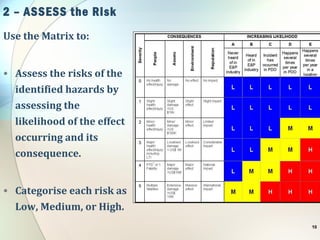
Use the Matrix to:
• Assess the risks of the
identified hazards by
assessing the
likelihood of the effect
occurring and its
consequence.
• Categorise each risk as
Low, Medium, or High.
10
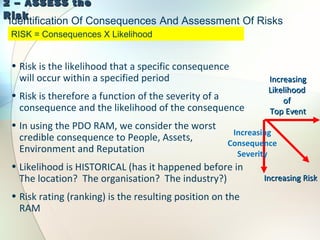
2 – ASSESS the
Risk
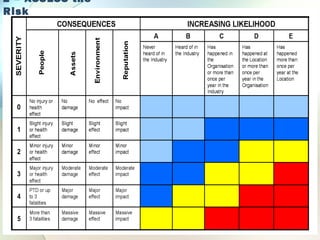
• Risk is the likelihood that a specific consequence
will occur within a specified period
• Risk is therefore a function of the severity of a
consequence and the likelihood of the consequence
• In using the PDO RAM, we consider the worst
credible consequence to People, Assets,
Environment and Reputation
• Likelihood is HISTORICAL (has it happened before in
The location? The organisation? The industry?)
• Risk rating (ranking) is the resulting position on the
RAM
RISK = Consequences X Likelihood
IncreasingIncreasing
LikelihoodLikelihood
ofof
Top EventTop Event
Increasing RiskIncreasing Risk
Identification Of Consequences And Assessment Of Risks
2 – ASSESS the2 – ASSESS the
RiskRisk
Increasing
Consequence
Severity
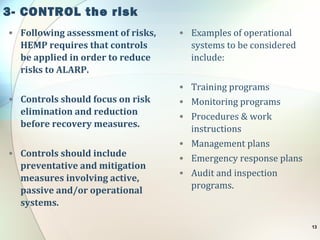
3- CONTROL the risk
• Following assessment of risks,
HEMP requires that controls
be applied in order to reduce
risks to ALARP.
• Controls should focus on risk
elimination and reduction
before recovery measures.
• Controls should include
preventative and mitigation
measures involving active,
passive and/or operational
systems.
• Examples of operational
systems to be considered
include:
• Training programs
• Monitoring programs
• Procedures & work
instructions
• Management plans
• Emergency response plans
• Audit and inspection
programs.
13
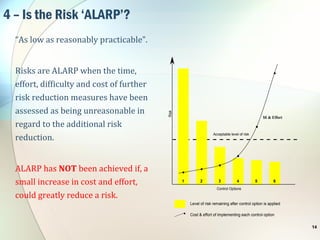
4 – Is the Risk ‘ALARP’?
“As low as reasonably practicable”.
Risks are ALARP when the time,
effort, difficulty and cost of further
risk reduction measures have been
assessed as being unreasonable in
regard to the additional risk
reduction.
ALARP has NOT been achieved if, a
small increase in cost and effort,
could greatly reduce a risk.
14
Acceptable level of risk
61 2 3 4 5
Level of risk remaining after control option is applied
Cost & effort of implementing each control option
Control Options
Risk
$$ & Effort
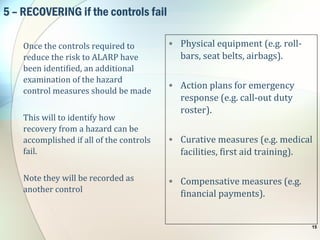
5 – RECOVERING if the controls fail
Once the controls required to
reduce the risk to ALARP have
been identified, an additional
examination of the hazard
control measures should be made
This will to identify how
recovery from a hazard can be
accomplished if all of the controls
fail.
Note they will be recorded as
another control
• Physical equipment (e.g. roll-
bars, seat belts, airbags).
• Action plans for emergency
response (e.g. call-out duty
roster).
• Curative measures (e.g. medical
facilities, first aid training).
• Compensative measures (e.g.
financial payments).
15
16
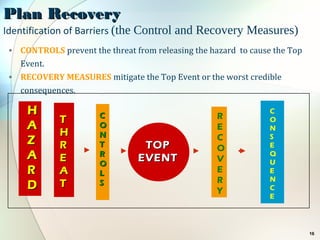
Plan RecoveryPlan Recovery
Identification of Barriers (the Control and Recovery Measures)
• CONTROLS prevent the threat from releasing the hazard to cause the Top
Event.
• RECOVERY MEASURES mitigate the Top Event or the worst credible
consequences.
TT
HH
RR
EE
AA
TT
HH
AA
ZZ
AA
RR
DD
TOPTOP
EVENTEVENT
C
O
N
S
E
Q
U
E
N
C
E
R
E
C
O
V
E
R
Y
CC
OO
NN
TT
RR
OO
LL
SS
17
LoadLoad
PlanPlan
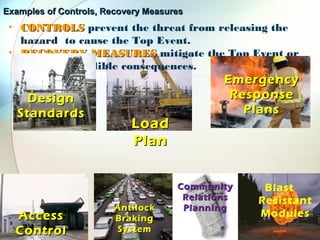
Examples of Controls, Recovery MeasuresExamples of Controls, Recovery Measures
• CONTROLSCONTROLS prevent the threat from releasing the
hazard to cause the Top Event.
• RECOVERY MEASURESRECOVERY MEASURES mitigate the Top Event or
the worst credible consequences.
DesignDesign
StandardsStandards
EmergencyEmergency
ResponseResponse
PlansPlans
Blast
Resistant
ModulesAccessAccess
ControlControl
AntilockAntilock
BrakingBraking
SystemSystem
CommunityCommunity
RelationsRelations
PlanningPlanning
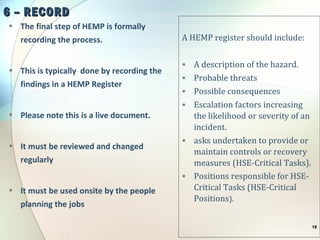
6 – RECORD6 – RECORD
• The final step of HEMP is formally
recording the process.
• This is typically done by recording the
findings in a HEMP Register
• Please note this is a live document.
• It must be reviewed and changed
regularly
• It must be used onsite by the people
planning the jobs
A HEMP register should include:
• A description of the hazard.
• Probable threats
• Possible consequences
• Escalation factors increasing
the likelihood or severity of an
incident.
• asks undertaken to provide or
maintain controls or recovery
measures (HSE-Critical Tasks).
• Positions responsible for HSE-
Critical Tasks (HSE-Critical
Positions).
18
19
Exercise
1. Imagine you are the owner
of the Nairobi Zoo, and you
have the opportunity to
acquire a lion for your zoo.
2. Up until now you have only
had sheep and rabbits in
your zoo.
3. Identify the Hazard, Top
event and Consequence,
RAM your Consequence
4. What can go wrong and
how can you prevent this
from happening?
5. What happens if the Lion
Gets out? What do you do?
20
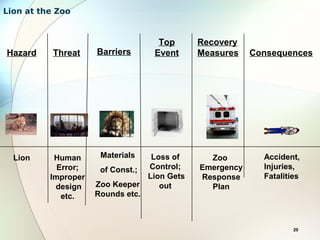
Hazard Threat Barriers
Top
Event
Recovery
Measures Consequences
Lion Human
Error;
Improper
design
etc.
Loss of
Control;
Lion Gets
out
Zoo
Emergency
Response
Plan
Accident,
Injuries,
Fatalities
Lion at the Zoo
Materials
of Const.;
Zoo Keeper
Rounds etc.
21
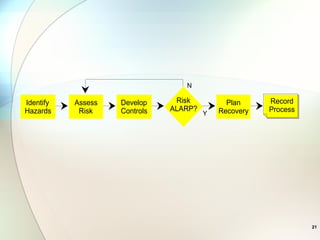
Identify
Hazards
Assess
Risk
Develop
Controls
Risk
ALARP?
Plan
Recovery
N
Y
Record
Process
22

Hemp final

  • 1.
  • 2.
    Objective:Objective: After this sessionyou will be able to: • Understand How to Manage Hazards and their Effects • Understand your role and responsibility in the HEMP process • Have clear understanding of how Hazards and Effects Management (HEMP) fits into the HSE Control Framework • Understand the 6 Practical Steps for completing a HEMP review • Have enough knowledge to discuss HEMP and ask the right questions After this session you will be able to: • Understand How to Manage Hazards and their Effects • Understand your role and responsibility in the HEMP process • Have clear understanding of how Hazards and Effects Management (HEMP) fits into the HSE Control Framework • Understand the 6 Practical Steps for completing a HEMP review • Have enough knowledge to discuss HEMP and ask the right questions
  • 3.
    HEMP Hazard and EffectsManagement Program 3 • The HEMP is at the heart of our HSE Management Systems. It’s where the planning turns into action. • HSE Risk Management relies primarily on HEMP and it’s associated tools.
  • 4.
    What is aHEMP? • All our activities have the potential to harm people and the environment or cause damage to assets, financial loss, and to adversely impact on reputation. • To manage these risks, we use a Hazard and Effects Management Process (HEMP) • A HEMP is a structured approach to identifying and managing the hazards and potential effects of these activities. • The overall objective is to reduce risks to As Low As Reasonably Practicable (ALARP). • A HEMP evaluation can be detailed e.g. an HSE Case for a high-risk activity such as Road Transport • ... or a relatively short e.g. For a single task in a mechanical workshop such as changing a tyre. 4
  • 5.
    HEMP Hazard and EffectsManagement Program 5 HEMP Application Steps:HEMP Application Steps: Identify (the hazard, and hazardous events)Identify (the hazard, and hazardous events) Assess (the Risks)Assess (the Risks) Control (the threats that might release the hazard that leads to theControl (the threats that might release the hazard that leads to the hazardous event)hazardous event) Recover (from the hazardous event, if possible before incurring anRecover (from the hazardous event, if possible before incurring an unwanted consequence)unwanted consequence)
  • 6.
    How to ManageHazards and their Effects The 6 HEMP Steps Implementing a HEMP Identify Hazards Assess Risk Develop Controls Risk ALARP? Plan Recovery N Y Record Process
  • 7.
    Moving Heavy Equipment Workingat Height Flammable Hydrocarbons Raised Objects HAZARD - An agent that has the potential to cause harm to People, damage to Assets, business loss and Impact on the Environment or Reputation Hazards are systematically identified using a standard hazard checklist Rotating MachineryMoving Vehicles Chemicals Step1 Hazard Identification
  • 8.
    1. The potentialto harm people or the environment, cause damage to or loss of assets, or adversely impact reputation. 2. Consider the hazards arising during the entire lifecycle of an asset or activity; • Planning, mobilisation & set-up • Routine conditions • Abnormal conditions (e.g. weather extremes & use of back-ups) • Reasonably foreseeable incidents and/or emergency situations • Demobilisation • Past activities As a start, consider these hazards: • Flammable and explosive substances • Chemicals and toxic substances • Land Transport • Working at heights above 2m • Confined spaces • Slips, trips and falls • Machinery with moving parts • Extreme temperatures • Electricity • Objects under induced stress • Lifting and moving equipment • Security 8 Step1 Hazard Identification
  • 9.
    CONSEQUENCES (Effects) -the impacts on People, Assets, Environment and Reputation if a Hazard is Released 2 – ASSESS the Risk2 – ASSESS the Risk Identification Of Consequences And Assessment Of Risks LegalLegal ActioActio nn Fi r e ToxiToxi cc GasGas ClouClou dd Lost Time Injury DeatDeat hh Discharge s and Emissions ExplosionExplosion ComplaCompla intsints Fall in ShareFall in Share PricePrice
  • 10.
    2 – ASSESSthe Risk Use the Matrix to: • Assess the risks of the identified hazards by assessing the likelihood of the effect occurring and its consequence. • Categorise each risk as Low, Medium, or High. 10
  • 11.
    2 – ASSESSthe Risk
  • 12.
    • Risk isthe likelihood that a specific consequence will occur within a specified period • Risk is therefore a function of the severity of a consequence and the likelihood of the consequence • In using the PDO RAM, we consider the worst credible consequence to People, Assets, Environment and Reputation • Likelihood is HISTORICAL (has it happened before in The location? The organisation? The industry?) • Risk rating (ranking) is the resulting position on the RAM RISK = Consequences X Likelihood IncreasingIncreasing LikelihoodLikelihood ofof Top EventTop Event Increasing RiskIncreasing Risk Identification Of Consequences And Assessment Of Risks 2 – ASSESS the2 – ASSESS the RiskRisk Increasing Consequence Severity
  • 13.
    3- CONTROL therisk • Following assessment of risks, HEMP requires that controls be applied in order to reduce risks to ALARP. • Controls should focus on risk elimination and reduction before recovery measures. • Controls should include preventative and mitigation measures involving active, passive and/or operational systems. • Examples of operational systems to be considered include: • Training programs • Monitoring programs • Procedures & work instructions • Management plans • Emergency response plans • Audit and inspection programs. 13
  • 14.
    4 – Isthe Risk ‘ALARP’? “As low as reasonably practicable”. Risks are ALARP when the time, effort, difficulty and cost of further risk reduction measures have been assessed as being unreasonable in regard to the additional risk reduction. ALARP has NOT been achieved if, a small increase in cost and effort, could greatly reduce a risk. 14 Acceptable level of risk 61 2 3 4 5 Level of risk remaining after control option is applied Cost & effort of implementing each control option Control Options Risk $$ & Effort
  • 15.
    5 – RECOVERINGif the controls fail Once the controls required to reduce the risk to ALARP have been identified, an additional examination of the hazard control measures should be made This will to identify how recovery from a hazard can be accomplished if all of the controls fail. Note they will be recorded as another control • Physical equipment (e.g. roll- bars, seat belts, airbags). • Action plans for emergency response (e.g. call-out duty roster). • Curative measures (e.g. medical facilities, first aid training). • Compensative measures (e.g. financial payments). 15
  • 16.
    16 Plan RecoveryPlan Recovery Identificationof Barriers (the Control and Recovery Measures) • CONTROLS prevent the threat from releasing the hazard to cause the Top Event. • RECOVERY MEASURES mitigate the Top Event or the worst credible consequences. TT HH RR EE AA TT HH AA ZZ AA RR DD TOPTOP EVENTEVENT C O N S E Q U E N C E R E C O V E R Y CC OO NN TT RR OO LL SS
  • 17.
    17 LoadLoad PlanPlan Examples of Controls,Recovery MeasuresExamples of Controls, Recovery Measures • CONTROLSCONTROLS prevent the threat from releasing the hazard to cause the Top Event. • RECOVERY MEASURESRECOVERY MEASURES mitigate the Top Event or the worst credible consequences. DesignDesign StandardsStandards EmergencyEmergency ResponseResponse PlansPlans Blast Resistant ModulesAccessAccess ControlControl AntilockAntilock BrakingBraking SystemSystem CommunityCommunity RelationsRelations PlanningPlanning
  • 18.
    6 – RECORD6– RECORD • The final step of HEMP is formally recording the process. • This is typically done by recording the findings in a HEMP Register • Please note this is a live document. • It must be reviewed and changed regularly • It must be used onsite by the people planning the jobs A HEMP register should include: • A description of the hazard. • Probable threats • Possible consequences • Escalation factors increasing the likelihood or severity of an incident. • asks undertaken to provide or maintain controls or recovery measures (HSE-Critical Tasks). • Positions responsible for HSE- Critical Tasks (HSE-Critical Positions). 18
  • 19.
    19 Exercise 1. Imagine youare the owner of the Nairobi Zoo, and you have the opportunity to acquire a lion for your zoo. 2. Up until now you have only had sheep and rabbits in your zoo. 3. Identify the Hazard, Top event and Consequence, RAM your Consequence 4. What can go wrong and how can you prevent this from happening? 5. What happens if the Lion Gets out? What do you do?
  • 20.
    20 Hazard Threat Barriers Top Event Recovery MeasuresConsequences Lion Human Error; Improper design etc. Loss of Control; Lion Gets out Zoo Emergency Response Plan Accident, Injuries, Fatalities Lion at the Zoo Materials of Const.; Zoo Keeper Rounds etc.
  • 21.
  • 22.