GENERAL	
  OVERVIEW	
  OF	
  
DEEPWATER	
  RISER	
  DESIGN	
  
Alberto	
  Alvino	
  
Overview	
  
Introduc>on	
  
Riser	
  Types	
  
Main	
  Selec>on	
  Factors	
  
Design	
  Procedure	
  
Dynamic	
  Example	
  of	
  Riser	
  Modeling	
  
Summary	
  
INTRODUCTION	
  
Introduc>on	
  
•  What	
  is	
  Riser?	
  A	
  riser	
  is	
  a	
  pipe	
  that	
  connects	
  
and	
  surface	
  facility	
  to	
  a	
  subsea	
  system	
  
•  What	
  is	
  Deepwater?	
  Above	
  1000L	
  depth	
  
•  What	
  is	
  Riser	
  Design?	
  It	
  means	
  to	
  achieve	
  the	
  
func>onal	
  requirements	


RISER	
  TYPES	
  
Riser	
  Types	
  
•  Material	
  Type:	
  Steel,	
  Flexible,	
  Titanium	
  and	
  
Composite	
  
•  BOP	
  (X-­‐Tree)	
  LocaDon:	
  Subsea	
  and	
  Surface	
  
(Dry	
  and	
  Wet)	
  
•  ConfiguraDon	
  Type:	
  SCR,	
  SLWR,	
  Hybrid	
  Riser,	
  
TTR	
  
•  FuncDonal	
  Type:	
  Drilling,	
  Produc>on,	
  
Injec>on,	
  Export,	
  Comple>on/Workover	
  
Material	
  Type:	
  Steel	
  Pipe	
  
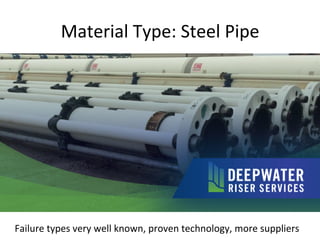
Failure	
  types	
  very	
  well	
  known,	
  proven	
  technology,	
  more	
  suppliers	
  
Material	
  Type:	
  Unbonded	
  Flexible	
  
Pipe	
  
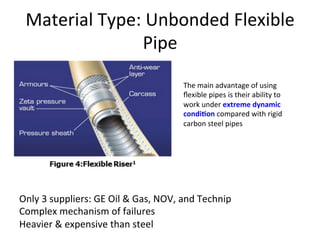
The	
  main	
  advantage	
  of	
  using	
  
flexible	
  pipes	
  is	
  their	
  ability	
  to	
  
work	
  under	
  extreme	
  dynamic	
  
condiDon	
  compared	
  with	
  rigid	
  
carbon	
  steel	
  pipes	
  
Only	
  3	
  suppliers:	
  GE	
  Oil	
  &	
  Gas,	
  NOV,	
  and	
  Technip	
  
Complex	
  mechanism	
  of	
  failures	
  
Heavier	
  &	
  expensive	
  than	
  steel	
  
Material	
  Type:	
  Titanium	
  
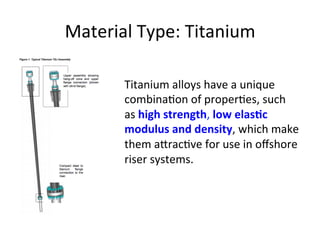
Titanium	
  alloys	
  have	
  a	
  unique	
  
combina>on	
  of	
  proper>es,	
  such	
  
as	
  high	
  strength,	
  low	
  elasDc	
  
modulus	
  and	
  density,	
  which	
  make	
  
them	
  a[rac>ve	
  for	
  use	
  in	
  offshore	
  
riser	
  systems.	
  
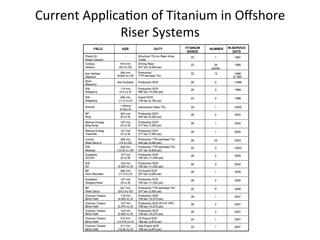
Current	
  Applica>on	
  of	
  Titanium	
  in	
  Offshore	
  
Riser	
  Systems	
  
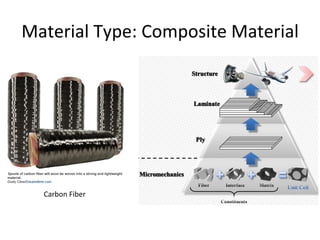
Material	
  Type:	
  Composite	
  Material	
  
Carbon	
  Fiber	
  
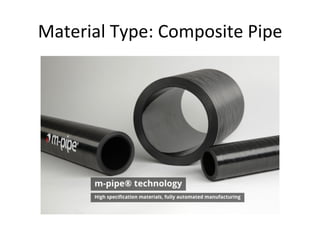
Material	
  Type:	
  Composite	
  Pipe	
  
Material	
  Type:	
  Composite	
  Material	
  
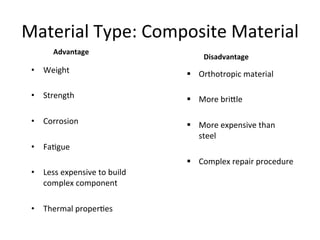
•  Weight	
  
•  Strength	
  
•  Corrosion	
  
•  Fa>gue	
  
•  Less	
  expensive	
  to	
  build	
  
complex	
  component	
  
•  Thermal	
  proper>es	
  
§  Orthotropic	
  material	
  
§  More	
  bri[le	
  
§  More	
  expensive	
  than	
  
steel	
  
§  Complex	
  repair	
  procedure	
  
Advantage	
  
Disadvantage	
  
Surface	
  x	
  Subsea	
  BOP	
  
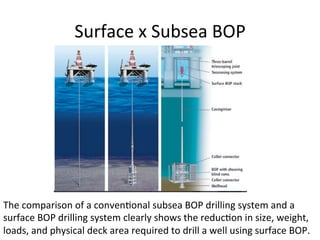
The	
  comparison	
  of	
  a	
  conven>onal	
  subsea	
  BOP	
  drilling	
  system	
  and	
  a	
  
surface	
  BOP	
  drilling	
  system	
  clearly	
  shows	
  the	
  reduc>on	
  in	
  size,	
  weight,	
  
loads,	
  and	
  physical	
  deck	
  area	
  required	
  to	
  drill	
  a	
  well	
  using	
  surface	
  BOP.	
  
Surface	
  x	
  Subsea	
  BOP	
  
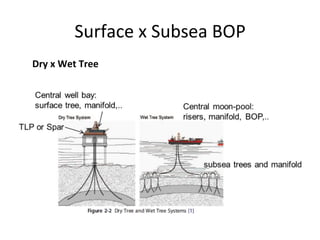
Dry	
  x	
  Wet	
  Tree	
  
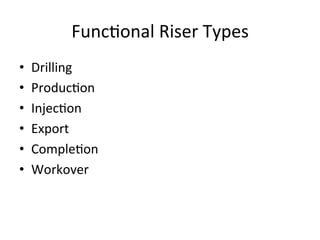
Func>onal	
  Riser	
  Types	
  
•  Drilling	
  
•  Produc>on	
  
•  Injec>on	
  
•  Export	
  
•  Comple>on	
  
•  Workover	
  
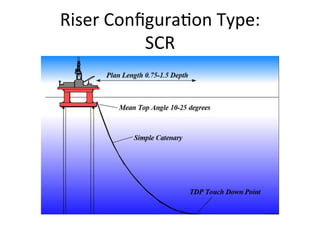
Riser	
  Configura>on	
  Type:	
  
SCR	
  
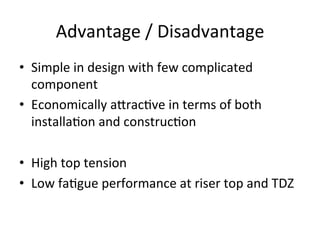
Advantage	
  /	
  Disadvantage	
  
•  Simple	
  in	
  design	
  with	
  few	
  complicated	
  
component	
  
•  Economically	
  a[rac>ve	
  in	
  terms	
  of	
  both	
  
installa>on	
  and	
  construc>on	
  
•  High	
  top	
  tension	
  
•  Low	
  fa>gue	
  performance	
  at	
  riser	
  top	
  and	
  TDZ	
  
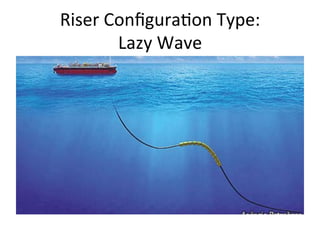
Riser	
  Configura>on	
  Type:	
  
Lazy	
  Wave	
  	
  
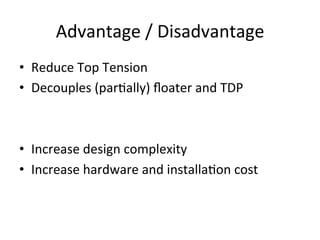
Advantage	
  /	
  Disadvantage	
  
•  Reduce	
  Top	
  Tension	
  
•  Decouples	
  (par>ally)	
  floater	
  and	
  TDP	
  
•  Increase	
  design	
  complexity	
  
•  Increase	
  hardware	
  and	
  installa>on	
  cost	
  
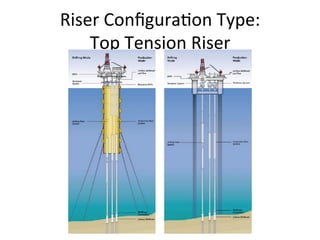
Riser	
  Configura>on	
  Type:	
  
Top	
  Tension	
  Riser	
  
Advantage	
  /	
  Disadvantage	
  
•  Field	
  proven	
  
•  Efficient	
  drilling	
  
•  Fast	
  access	
  to	
  wellbore	
  
•  Riser	
  weight	
  
•  Interference	
  problem	
  
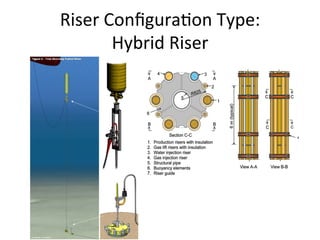
Riser	
  Configura>on	
  Type:	
  
Hybrid	
  Riser	
  
Advantage	
  /	
  Disadvantage	
  
•  Pre-­‐installable	
  
•  Low	
  vessel	
  payload	
  
•  Decoupled	
  from	
  vessel	
  mo>on	
  
•  Increased	
  design	
  complexity	
  
•  High	
  CAPEX	
  compared	
  to	
  other	
  riser	
  types	
  
•  Interference	
  issues	
  
MAIN	
  SELECTION	
  FACTORS	
  
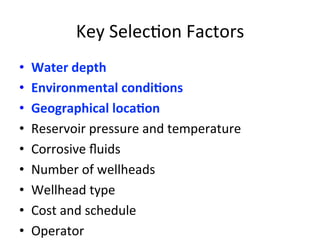
Key	
  Selec>on	
  Factors	
  
•  Water	
  depth	
  
•  Environmental	
  condiDons	
  
•  Geographical	
  locaDon	
  
•  Reservoir	
  pressure	
  and	
  temperature	
  
•  Corrosive	
  fluids	
  
•  Number	
  of	
  wellheads	
  
•  Wellhead	
  type	
  
•  Cost	
  and	
  schedule	
  
•  Operator	
  
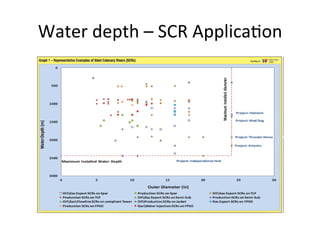
Water	
  depth	
  –	
  SCR	
  Applica>on	
  
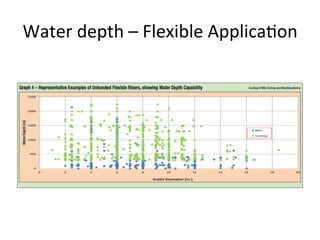
Water	
  depth	
  –	
  Flexible	
  Applica>on	
  
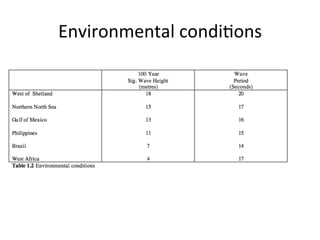
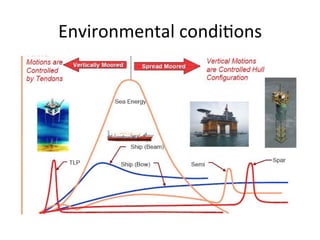
Environmental	
  condi>ons	
  
Environmental	
  condi>ons	
  
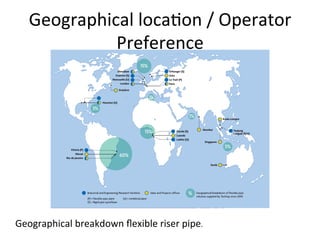
Geographical	
  loca>on	
  /	
  Operator	
  
Preference	
  
Geographical	
  breakdown	
  flexible	
  riser	
  pipe.	
  
DESIGN	
  PROCEDURE	
  
Overview	
  
•  Pre-­‐FEED	
  
§  Determine	
  technically	
  feasible	
  riser	
  solu>ons	
  
§  Determine	
  cost	
  comparison	
  between	
  riser	
  solu>ons	
  
§  Iden>fy	
  risks	
  associated	
  with	
  riser	
  system	
  
§  Concept	
  selec>on	
  
Overview	
  
•  FEED	
  
§  Further	
  develop	
  selected	
  concept	
  (or	
  concepts)	
  to	
  enable	
  
Operator	
  to	
  commence	
  the	
  Execu>on	
  Phase	
  with	
  high	
  
degree	
  of	
  confidence	
  and	
  low	
  level	
  of	
  risk	
  
§  Develop	
  documenta>on	
  to	
  enable	
  an	
  ITT	
  (invita>on	
  to	
  
tender)	
  package	
  to	
  be	
  issued	
  to	
  Execu>on	
  Phase	
  
contractors	
  
•  Detail	
  Design	
  
§  Detailed	
  design	
  of	
  the	
  riser	
  system	
  to	
  enable	
  fabrica>on	
  
and	
  installa>on	
  
Design	
  Procedure:	
  Design	
  Basis	
  
•  Required	
  informaDon:	
  Riser	
  pipe	
  proper>es,	
  
riser	
  system	
  data	
  (flex	
  joint,	
  bending	
  s>ffener,	
  
buoyancy	
  modules,	
  etc.),	
  wellhead	
  data,	
  
subsea	
  equipment	
  (BOP,	
  LMRP,	
  Lower	
  flex	
  
joint),	
  water	
  depth,	
  environmental	
  condi>on,	
  
conductor	
  data,	
  soil	
  proper>es,	
  vessel	
  data,	
  
fa>gue	
  details,	
  hydrodynamic	
  proper>es,	
  
pressure,	
  temperature,	
  etc.	
  
Design	
  Procedure:	
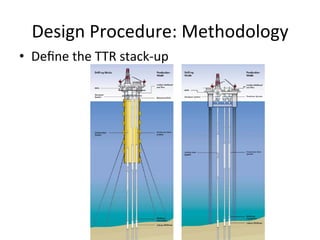
  Methodology	
  
•  Define	
  the	
  TTR	
  stack-­‐up	


Design	
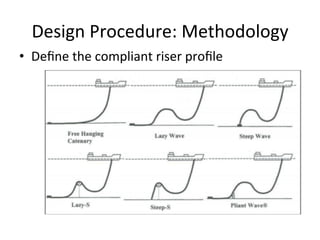
  Procedure:	
  Methodology	
  
•  Define	
  the	
  compliant	
  riser	
  profile	


Modeling	
  Considera>ons	
  
•  Built	
  the	
  FE	
  global	
  model;	
  
•  Most	
  components	
  can	
  be	
  modeled	
  as	
  pipe	
  
elements	
  with	
  the	
  key	
  proper>es	
  defined:	
  
– Bending	
  s>ffness	
  
– Axial	
  s>ffness	
  
– Mass	
  
– Drag	
  diameter	
  
– Buoyancy	
  diameter	
  
Commercial	
  SoLware	
  
•  Riser	
  Global	
  FEA:	
  	
  
•  Flexcom	
  
•  Orcaflex	
  
•  DeepRiser	
  
•  Ansys	
  
•  Abaqus	
  
•  Riser	
  VIV	
  soLware	
  
•  Shear	
  7	
  
•  VIVA	
  
•  VIVANA	
  
Global	
  FE	
  Model	
  
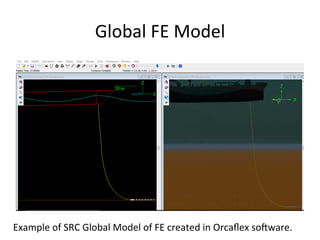
Example	
  of	
  SRC	
  Global	
  Model	
  of	
  FE	
  created	
  in	
  Orcaflex	
  soLware.	
  
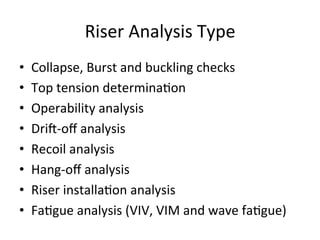
Riser	
  Analysis	
  Type	
  
•  Collapse,	
  Burst	
  and	
  buckling	
  checks	
  
•  Top	
  tension	
  determina>on	
  
•  Operability	
  analysis	
  
•  DriL-­‐off	
  analysis	
  
•  Recoil	
  analysis	
  
•  Hang-­‐off	
  analysis	
  
•  Riser	
  installa>on	
  analysis	
  
•  Fa>gue	
  analysis	
  (VIV,	
  VIM	
  and	
  wave	
  fa>gue)	
  
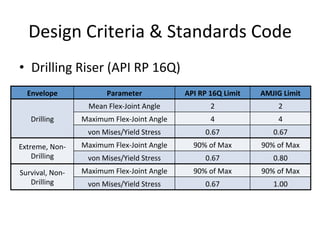
Design	
  Criteria	
  &	
  Standards	
  Code	
  
•  Drilling	
  Riser	
  (API	
  RP	
  16Q)	
  
Envelope	
   Parameter	
   API	
  RP	
  16Q	
  Limit	
   AMJIG	
  Limit	
  
Drilling	
  
Mean	
  Flex-­‐Joint	
  Angle	
   2	
   2	
  
Maximum	
  Flex-­‐Joint	
  Angle	
   4	
   4	
  
von	
  Mises/Yield	
  Stress	
   0.67	
   0.67	
  
Extreme,	
  Non-­‐
Drilling	
  
Maximum	
  Flex-­‐Joint	
  Angle	
   90%	
  of	
  Max	
   90%	
  of	
  Max	
  
von	
  Mises/Yield	
  Stress	
   0.67	
   0.80	
  
Survival,	
  Non-­‐
Drilling	
  
Maximum	
  Flex-­‐Joint	
  Angle	
   90%	
  of	
  Max	
   90%	
  of	
  Max	
  
von	
  Mises/Yield	
  Stress	
   0.67	
   1.00	
  
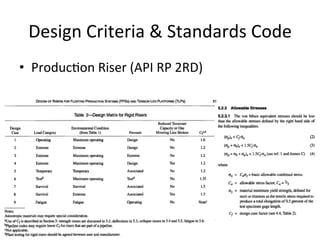
Design	
  Criteria	
  &	
  Standards	
  Code	
  
•  Produc>on	
  Riser	
  (API	
  RP	
  2RD)	
  
DYNAMIC	
  EXAMPLE	
  OF	
  RISER	
  
MODELING	


SOME	
  EXAMPLES	
  
Flexcom	
  Models	


h[ps://www.woodgroup.com/what-­‐we-­‐do/view-­‐by-­‐products-­‐
and-­‐services/digital-­‐solu>ons/flexcom	


Deep	
  Riser	
  Models	


h[ps://www.woodgroup.com/what-­‐we-­‐do/view-­‐by-­‐products-­‐
and-­‐services/digital-­‐solu>ons/riser	


Orcaflex	
  Models	


h[ps://www.orcina.com/SoLwareProducts/OrcaFlex/Examples/
index.php	


SUMMARY	
  
Summary	
  
•  There	
  are	
  diverse	
  riser	
  types	
  
•  Riser	
  design	
  is	
  complex	
  task	
  that	
  involve	
  
several	
  itera>on	
  analysis,	
  involving	
  inter-­‐
discipline	
  itera>on;	
  
•  Some	
  >me,	
  technical	
  factor	
  are	
  overpassed	
  by	
  
not	
  technical	
  factor;	
  

Riser Design Overview

  • 1.
    GENERAL  OVERVIEW  OF   DEEPWATER  RISER  DESIGN   Alberto  Alvino  
  • 3.
    Overview   Introduc>on   Riser  Types   Main  Selec>on  Factors   Design  Procedure   Dynamic  Example  of  Riser  Modeling   Summary  
  • 4.
  • 5.
    Introduc>on   •  What  is  Riser?  A  riser  is  a  pipe  that  connects   and  surface  facility  to  a  subsea  system   •  What  is  Deepwater?  Above  1000L  depth   •  What  is  Riser  Design?  It  means  to  achieve  the   func>onal  requirements      
  • 6.
  • 7.
    Riser  Types   • Material  Type:  Steel,  Flexible,  Titanium  and   Composite   •  BOP  (X-­‐Tree)  LocaDon:  Subsea  and  Surface   (Dry  and  Wet)   •  ConfiguraDon  Type:  SCR,  SLWR,  Hybrid  Riser,   TTR   •  FuncDonal  Type:  Drilling,  Produc>on,   Injec>on,  Export,  Comple>on/Workover  
  • 8.
    Material  Type:  Steel  Pipe   Failure  types  very  well  known,  proven  technology,  more  suppliers  
  • 9.
    Material  Type:  Unbonded  Flexible   Pipe   The  main  advantage  of  using   flexible  pipes  is  their  ability  to   work  under  extreme  dynamic   condiDon  compared  with  rigid   carbon  steel  pipes   Only  3  suppliers:  GE  Oil  &  Gas,  NOV,  and  Technip   Complex  mechanism  of  failures   Heavier  &  expensive  than  steel  
  • 10.
    Material  Type:  Titanium   Titanium  alloys  have  a  unique   combina>on  of  proper>es,  such   as  high  strength,  low  elasDc   modulus  and  density,  which  make   them  a[rac>ve  for  use  in  offshore   riser  systems.  
  • 11.
    Current  Applica>on  of  Titanium  in  Offshore   Riser  Systems  
  • 12.
    Material  Type:  Composite  Material   Carbon  Fiber  
  • 13.
  • 14.
    Material  Type:  Composite  Material   •  Weight   •  Strength   •  Corrosion   •  Fa>gue   •  Less  expensive  to  build   complex  component   •  Thermal  proper>es   §  Orthotropic  material   §  More  bri[le   §  More  expensive  than   steel   §  Complex  repair  procedure   Advantage   Disadvantage  
  • 15.
    Surface  x  Subsea  BOP   The  comparison  of  a  conven>onal  subsea  BOP  drilling  system  and  a   surface  BOP  drilling  system  clearly  shows  the  reduc>on  in  size,  weight,   loads,  and  physical  deck  area  required  to  drill  a  well  using  surface  BOP.  
  • 16.
    Surface  x  Subsea  BOP   Dry  x  Wet  Tree  
  • 17.
    Func>onal  Riser  Types   •  Drilling   •  Produc>on   •  Injec>on   •  Export   •  Comple>on   •  Workover  
  • 18.
  • 19.
    Advantage  /  Disadvantage   •  Simple  in  design  with  few  complicated   component   •  Economically  a[rac>ve  in  terms  of  both   installa>on  and  construc>on   •  High  top  tension   •  Low  fa>gue  performance  at  riser  top  and  TDZ  
  • 20.
    Riser  Configura>on  Type:   Lazy  Wave    
  • 21.
    Advantage  /  Disadvantage   •  Reduce  Top  Tension   •  Decouples  (par>ally)  floater  and  TDP   •  Increase  design  complexity   •  Increase  hardware  and  installa>on  cost  
  • 22.
    Riser  Configura>on  Type:   Top  Tension  Riser  
  • 23.
    Advantage  /  Disadvantage   •  Field  proven   •  Efficient  drilling   •  Fast  access  to  wellbore   •  Riser  weight   •  Interference  problem  
  • 24.
    Riser  Configura>on  Type:   Hybrid  Riser  
  • 25.
    Advantage  /  Disadvantage   •  Pre-­‐installable   •  Low  vessel  payload   •  Decoupled  from  vessel  mo>on   •  Increased  design  complexity   •  High  CAPEX  compared  to  other  riser  types   •  Interference  issues  
  • 26.
  • 27.
    Key  Selec>on  Factors   •  Water  depth   •  Environmental  condiDons   •  Geographical  locaDon   •  Reservoir  pressure  and  temperature   •  Corrosive  fluids   •  Number  of  wellheads   •  Wellhead  type   •  Cost  and  schedule   •  Operator  
  • 28.
    Water  depth  –  SCR  Applica>on  
  • 29.
    Water  depth  –  Flexible  Applica>on  
  • 30.
  • 31.
  • 32.
    Geographical  loca>on  /  Operator   Preference   Geographical  breakdown  flexible  riser  pipe.  
  • 33.
  • 34.
    Overview   •  Pre-­‐FEED   §  Determine  technically  feasible  riser  solu>ons   §  Determine  cost  comparison  between  riser  solu>ons   §  Iden>fy  risks  associated  with  riser  system   §  Concept  selec>on  
  • 35.
    Overview   •  FEED   §  Further  develop  selected  concept  (or  concepts)  to  enable   Operator  to  commence  the  Execu>on  Phase  with  high   degree  of  confidence  and  low  level  of  risk   §  Develop  documenta>on  to  enable  an  ITT  (invita>on  to   tender)  package  to  be  issued  to  Execu>on  Phase   contractors   •  Detail  Design   §  Detailed  design  of  the  riser  system  to  enable  fabrica>on   and  installa>on  
  • 36.
    Design  Procedure:  Design  Basis   •  Required  informaDon:  Riser  pipe  proper>es,   riser  system  data  (flex  joint,  bending  s>ffener,   buoyancy  modules,  etc.),  wellhead  data,   subsea  equipment  (BOP,  LMRP,  Lower  flex   joint),  water  depth,  environmental  condi>on,   conductor  data,  soil  proper>es,  vessel  data,   fa>gue  details,  hydrodynamic  proper>es,   pressure,  temperature,  etc.  
  • 37.
    Design  Procedure:  Methodology   •  Define  the  TTR  stack-­‐up      
  • 38.
    Design  Procedure:  Methodology   •  Define  the  compliant  riser  profile      
  • 39.
    Modeling  Considera>ons   • Built  the  FE  global  model;   •  Most  components  can  be  modeled  as  pipe   elements  with  the  key  proper>es  defined:   – Bending  s>ffness   – Axial  s>ffness   – Mass   – Drag  diameter   – Buoyancy  diameter  
  • 40.
    Commercial  SoLware   • Riser  Global  FEA:     •  Flexcom   •  Orcaflex   •  DeepRiser   •  Ansys   •  Abaqus   •  Riser  VIV  soLware   •  Shear  7   •  VIVA   •  VIVANA  
  • 41.
    Global  FE  Model   Example  of  SRC  Global  Model  of  FE  created  in  Orcaflex  soLware.  
  • 42.
    Riser  Analysis  Type   •  Collapse,  Burst  and  buckling  checks   •  Top  tension  determina>on   •  Operability  analysis   •  DriL-­‐off  analysis   •  Recoil  analysis   •  Hang-­‐off  analysis   •  Riser  installa>on  analysis   •  Fa>gue  analysis  (VIV,  VIM  and  wave  fa>gue)  
  • 43.
    Design  Criteria  &  Standards  Code   •  Drilling  Riser  (API  RP  16Q)   Envelope   Parameter   API  RP  16Q  Limit   AMJIG  Limit   Drilling   Mean  Flex-­‐Joint  Angle   2   2   Maximum  Flex-­‐Joint  Angle   4   4   von  Mises/Yield  Stress   0.67   0.67   Extreme,  Non-­‐ Drilling   Maximum  Flex-­‐Joint  Angle   90%  of  Max   90%  of  Max   von  Mises/Yield  Stress   0.67   0.80   Survival,  Non-­‐ Drilling   Maximum  Flex-­‐Joint  Angle   90%  of  Max   90%  of  Max   von  Mises/Yield  Stress   0.67   1.00  
  • 44.
    Design  Criteria  &  Standards  Code   •  Produc>on  Riser  (API  RP  2RD)  
  • 45.
    DYNAMIC  EXAMPLE  OF  RISER   MODELING    
  • 46.
    SOME  EXAMPLES   Flexcom  Models     h[ps://www.woodgroup.com/what-­‐we-­‐do/view-­‐by-­‐products-­‐ and-­‐services/digital-­‐solu>ons/flexcom     Deep  Riser  Models     h[ps://www.woodgroup.com/what-­‐we-­‐do/view-­‐by-­‐products-­‐ and-­‐services/digital-­‐solu>ons/riser     Orcaflex  Models     h[ps://www.orcina.com/SoLwareProducts/OrcaFlex/Examples/ index.php    
  • 47.
  • 48.
    Summary   •  There  are  diverse  riser  types   •  Riser  design  is  complex  task  that  involve   several  itera>on  analysis,  involving  inter-­‐ discipline  itera>on;   •  Some  >me,  technical  factor  are  overpassed  by   not  technical  factor;