Ulnar Nerve
Dr. AGP
• Musician's Nerve (C8, T1)
• Ulnar nerve is a terminal branch of the medial cord
of the brachial plexus. It contains mainly fibers from
the anterior rami of spinal nerves C8 and T1, but
may sometimes carry C7 fibers as well.
COURSE AND BRANCHES
In Arm-No Branches
• From the medial cord, the ulnar nerve passes
distally through the axilla, medial to the axillary
artery. It descends on the medial aspect of the arm,
medial to the brachial artery and the biceps brachii
muscle. In the mid-portion of the arm, the nerve
pierces the medial intermuscular septum to enter
the posterior compartment.
• Here, the nerve runs anterior to the medial head of
triceps muscle and in 70-80% of people, this nerve
passes under the arcade of Struthers-a thin,
aponeurotic band, that extends from the medial
head of triceps to the medial intermuscular
septum.
In Elbow
• The ulnar nerve then passes between the medial
epicondyle and olecranon in the groove for ulnar
nerve to enter the anterior compartment of the
forearm. Posterior to the medial epicondyle, the
ulnar nerve is subcutaneous and easily palpable. It
is commonly referred to as the "funny bone" in this
region.
• Sensory Branch to Elbow Joint
• Motor Branch to FCU
In Forearm
• Ulnar nerve continues into the anterior
compartment of the forearm by passing between
the humeral and ulnar heads of the of flexor carpi
ulnaris.
• The ulnar nerve descends on the medial aspect of
the forearm, over the flexor digitorum profundus
muscle and deep to the flexor carpi ulnaris muscle.
Close to the wrist, the nerve emerges lateral to
flexor carpi ulnaris with the accompanying ulnar
artery, which lies lateral to it.
• Both structures run superficial to the flexor
retinaculum (transverse carpal ligament) to enter
the hand just lateral to the pisiform bone and are
only covered by fascia and skin.
Motor Branches
• Branches to FCU
• Branches to medial half of FDP RF, LF
• Sensory Branches
• Palmar Cutaneous Branch
• Dorsal Cutaneous Branch
In Wrist
• At the wrist, the ulnar nerve and artery enter the
hand by coursing through the Guyon’s canal (ulnar
canal), a groove between the pisiform and the hook
of the hamate, bridged by the palmar carpal
ligament.
Superficial Branch
• superficial branch of the ulnar nerve supplies
sensory innervation to the anterior aspect of the
ulnar 1½ digits (little finger and half of the ring
finger) and medial palmar skin.
• Additionally, it provides motor innervation to the
palmaris brevis muscle in the hypothenar region of
the hand. It arises from the ulnar nerve just distal
to the pisiform bone and often divides into two
palmar digital nerves.
Deep Branch
• Deep branch of the ulnar nerve emerges from the
same region of the nerve as the superficial branch.
It courses between the muscles of the hypothenar
region into the deep aspect of the palm, along side
the deep palmar branch of the ulnar artery. This
nerve provides motor innervation to the vast
majority of hand muscles.
• 4 Dorsal Interossei
• 3 Palmar Interossei
• 3 Hypothenar Muscle
• 2 Lumbricals 3rd and 4th
• 2 Heads of adductor pollicis
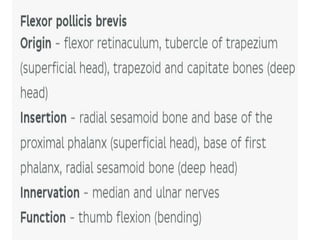
• 1 Deep head of Flexor pollicis brevis
Blood Supply
• Superior ulnar collateral artery
• Inferior ulnar collateral artery
• Posterio ulnar recurrent artery
Cubital Tunnel
• Roof-FCU, Fascia and Osborne Ligament
• Floor -Posterior and Transverse band
• Walls- Medial epicondyle and Olecranon
• OL-Triangular connective tissue joining proximal
ulnar and humeral heads of FCU
Guyons Canal
Roof-Superfiscial palmar carpal ligament
Floor-Flexor retinaculum and Hypothenar muscles
Medial- Pisiform, Pisohamate ligament more
proximally
Lateral- Hook of Hamate
Content-UN, UA
INTRINSIC MUSCLES OF
HAND
• Intrinsic muscle groups consist of smaller muscles
solely located within the various hand osseofascial
compartments within the anatomic confines of the
wrist (proximally) and phalanges (distally). The
intrinsics are important for various hand functions,
such as pinch and grip strength.
• Thenar Muscles
• Hypothenar muscles
• Lumbricals
• Dorsal and Palmar Interossei
• Palmaris brevis- Small superficial muscle
Thenar Muscles
• The thenar muscles are four in total; they are
evident and easy to palpate on the radial side of
the palmar surface of the hand, at the base of the
thumb.
• They form the ‘ball’ or ‘fleshy’ part of the thumb
known as the thenar eminence,
• Abductor pollicis brevis,
• Adductor pollicis,
• Flexor pollicis brevis
• Opponens pollicis.
Hypothenar muscles
• Palmar surface of the hand, the thenar eminence
has a corresponding, ‘fleshy’ region on the ulnar
side of the hand. It is easily palpated and visible at
the base of the little finger. This region is called the
hypothenar eminence
Consists of the three hypothenar muscles:
abductor digiti minimi,
flexor digiti minimi,
opponens digiti minimi
This group of muscles are expert movers of the little
finger they abduct, flex, and bring it towards the
thumb to facilitate opposition.
Lumbricals
• The lumbrical muscles, which get their name due to
their worm-like appearance (lumbricidae - Latin =
earthworm), are four short intrinsic muscles of the
hand located between the metacarpal bones, deep
to the palmar fascia.
• Origin
• The first lumbrical arises from the radial side and
palmar surface of the tendon of the index finger.
• The second lumbrical arises from the radial side
and palmar surface of the tendon of the middle
finger.
• The third lumbrical arises from the ulnar side of the
middle finger rendon and the radial side of ring
finger tendon.
• The fourth lumbrical arises from the ulnar side of
the ring finger tendon and the radial side of the
little finger tendon
• Insertion
• Lateral sides if Extensor expansion of IF, MF, RF, LF
Dorsal Interossei
• Dorsal interossei are bipennate (feather-like)
muscles found in the dorsal compartment of the
hand. The prefix bi- means that they arise by two
heads which converge to attach onto a central
tendon, which gives them a shape of a feather. The
dorsal interossei consist of four muscles numbered
1–4 from the lateral to the medial side.
• 1st dorsal interosseous muscle: this muscle is the
largest and strongest of the dorsal interossei and is
sometimes referred to as abductor indicis. It arises
from the adjacent surfaces of the 1st and 2nd
metacarpal bones. The muscle fibers converge
distally into a tendon which inserts on the radial
side of the base of the 2nd proximal phalanx and its
dorsal digital expansion.
• 2nd dorsal interosseous muscle: arises from the
adjacent surfaces of the 2nd and 3rd metacarpal
bones. Like the 1st muscle, the muscle fibers of the
2nd dorsal interosseous converge distally into a
tendon which inserts on the radial side of the base
of the 3nd proximal phalanx and its dorsal digital
expansion.
• 3rd dorsal interosseous muscle: arises from the
adjacent surfaces of the 3rd and 4th metacarpal
bones. Unlike the 1st and 2nd, the tendon of the
3rd dorsal interosseous inserts on the ulnar side of
the base of the 3nd proximal phalanx and its dorsal
digital expansion.
• 4th dorsal interosseous muscle: arises from the
adjacent surfaces of the 4th and 5th metacarpal
bones. The tendon of the 4th dorsal interosseous
also inserts on the ulnar side like the 3rd
interosseous, attaching on the base of the 4nd
proximal phalanx and its dorsal digital expansion.
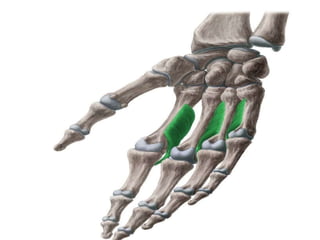
Palmar Interossei
• Palmar interossei are short unipennate intrinsic
muscles of the hand. They lie on the palmar surface
of the hand and along with the dorsal interossei
muscles occupy the spaces between the
metacarpal bones.
• 1st palmar interosseous: arises from the entire
length of the 2nd metacarpal bone and is inserted
into the ipsilateral extensor expansion of the index
finger.
• 2nd palmar interosseous: arises from the radial
side of the 4th metacarpal bone, and inserts
together with the third lumbrical into the radial
base of proximal phalanx of ring finger and on its
extensor expansion.
• 3rd palmar interosseous: arises from the radial
side of the 5th metacarpal bone, and inserts with
the fourth lumbrical into the base of the proximal
phalanx of the little finger and on its extensor
expansion.
Ulnar Nerve.pptx
Ulnar Nerve.pptx

Ulnar Nerve.pptx

  • 1.
  • 2.
    • Musician's Nerve(C8, T1) • Ulnar nerve is a terminal branch of the medial cord of the brachial plexus. It contains mainly fibers from the anterior rami of spinal nerves C8 and T1, but may sometimes carry C7 fibers as well.
  • 3.
  • 6.
  • 8.
    • From themedial cord, the ulnar nerve passes distally through the axilla, medial to the axillary artery. It descends on the medial aspect of the arm, medial to the brachial artery and the biceps brachii muscle. In the mid-portion of the arm, the nerve pierces the medial intermuscular septum to enter the posterior compartment.
  • 9.
    • Here, thenerve runs anterior to the medial head of triceps muscle and in 70-80% of people, this nerve passes under the arcade of Struthers-a thin, aponeurotic band, that extends from the medial head of triceps to the medial intermuscular septum.
  • 10.
    In Elbow • Theulnar nerve then passes between the medial epicondyle and olecranon in the groove for ulnar nerve to enter the anterior compartment of the forearm. Posterior to the medial epicondyle, the ulnar nerve is subcutaneous and easily palpable. It is commonly referred to as the "funny bone" in this region.
  • 11.
    • Sensory Branchto Elbow Joint • Motor Branch to FCU
  • 13.
  • 15.
    • Ulnar nervecontinues into the anterior compartment of the forearm by passing between the humeral and ulnar heads of the of flexor carpi ulnaris.
  • 16.
    • The ulnarnerve descends on the medial aspect of the forearm, over the flexor digitorum profundus muscle and deep to the flexor carpi ulnaris muscle. Close to the wrist, the nerve emerges lateral to flexor carpi ulnaris with the accompanying ulnar artery, which lies lateral to it.
  • 17.
    • Both structuresrun superficial to the flexor retinaculum (transverse carpal ligament) to enter the hand just lateral to the pisiform bone and are only covered by fascia and skin.
  • 18.
    Motor Branches • Branchesto FCU • Branches to medial half of FDP RF, LF • Sensory Branches • Palmar Cutaneous Branch • Dorsal Cutaneous Branch
  • 19.
    In Wrist • Atthe wrist, the ulnar nerve and artery enter the hand by coursing through the Guyon’s canal (ulnar canal), a groove between the pisiform and the hook of the hamate, bridged by the palmar carpal ligament.
  • 22.
    Superficial Branch • superficialbranch of the ulnar nerve supplies sensory innervation to the anterior aspect of the ulnar 1½ digits (little finger and half of the ring finger) and medial palmar skin.
  • 23.
    • Additionally, itprovides motor innervation to the palmaris brevis muscle in the hypothenar region of the hand. It arises from the ulnar nerve just distal to the pisiform bone and often divides into two palmar digital nerves.
  • 24.
  • 25.
    • Deep branchof the ulnar nerve emerges from the same region of the nerve as the superficial branch. It courses between the muscles of the hypothenar region into the deep aspect of the palm, along side the deep palmar branch of the ulnar artery. This nerve provides motor innervation to the vast majority of hand muscles.
  • 26.
    • 4 DorsalInterossei • 3 Palmar Interossei • 3 Hypothenar Muscle • 2 Lumbricals 3rd and 4th • 2 Heads of adductor pollicis • 1 Deep head of Flexor pollicis brevis
  • 27.
    Blood Supply • Superiorulnar collateral artery • Inferior ulnar collateral artery • Posterio ulnar recurrent artery
  • 28.
    Cubital Tunnel • Roof-FCU,Fascia and Osborne Ligament • Floor -Posterior and Transverse band • Walls- Medial epicondyle and Olecranon • OL-Triangular connective tissue joining proximal ulnar and humeral heads of FCU
  • 29.
    Guyons Canal Roof-Superfiscial palmarcarpal ligament Floor-Flexor retinaculum and Hypothenar muscles Medial- Pisiform, Pisohamate ligament more proximally Lateral- Hook of Hamate Content-UN, UA
  • 31.
  • 32.
    • Intrinsic musclegroups consist of smaller muscles solely located within the various hand osseofascial compartments within the anatomic confines of the wrist (proximally) and phalanges (distally). The intrinsics are important for various hand functions, such as pinch and grip strength.
  • 33.
    • Thenar Muscles •Hypothenar muscles • Lumbricals • Dorsal and Palmar Interossei • Palmaris brevis- Small superficial muscle
  • 34.
  • 39.
    • The thenarmuscles are four in total; they are evident and easy to palpate on the radial side of the palmar surface of the hand, at the base of the thumb. • They form the ‘ball’ or ‘fleshy’ part of the thumb known as the thenar eminence,
  • 40.
    • Abductor pollicisbrevis, • Adductor pollicis, • Flexor pollicis brevis • Opponens pollicis.
  • 45.
  • 47.
    • Palmar surfaceof the hand, the thenar eminence has a corresponding, ‘fleshy’ region on the ulnar side of the hand. It is easily palpated and visible at the base of the little finger. This region is called the hypothenar eminence
  • 48.
    Consists of thethree hypothenar muscles: abductor digiti minimi, flexor digiti minimi, opponens digiti minimi This group of muscles are expert movers of the little finger they abduct, flex, and bring it towards the thumb to facilitate opposition.
  • 53.
  • 56.
    • The lumbricalmuscles, which get their name due to their worm-like appearance (lumbricidae - Latin = earthworm), are four short intrinsic muscles of the hand located between the metacarpal bones, deep to the palmar fascia.
  • 59.
    • Origin • Thefirst lumbrical arises from the radial side and palmar surface of the tendon of the index finger. • The second lumbrical arises from the radial side and palmar surface of the tendon of the middle finger.
  • 60.
    • The thirdlumbrical arises from the ulnar side of the middle finger rendon and the radial side of ring finger tendon. • The fourth lumbrical arises from the ulnar side of the ring finger tendon and the radial side of the little finger tendon
  • 61.
    • Insertion • Lateralsides if Extensor expansion of IF, MF, RF, LF
  • 62.
  • 66.
    • Dorsal interosseiare bipennate (feather-like) muscles found in the dorsal compartment of the hand. The prefix bi- means that they arise by two heads which converge to attach onto a central tendon, which gives them a shape of a feather. The dorsal interossei consist of four muscles numbered 1–4 from the lateral to the medial side.
  • 67.
    • 1st dorsalinterosseous muscle: this muscle is the largest and strongest of the dorsal interossei and is sometimes referred to as abductor indicis. It arises from the adjacent surfaces of the 1st and 2nd metacarpal bones. The muscle fibers converge distally into a tendon which inserts on the radial side of the base of the 2nd proximal phalanx and its dorsal digital expansion.
  • 68.
    • 2nd dorsalinterosseous muscle: arises from the adjacent surfaces of the 2nd and 3rd metacarpal bones. Like the 1st muscle, the muscle fibers of the 2nd dorsal interosseous converge distally into a tendon which inserts on the radial side of the base of the 3nd proximal phalanx and its dorsal digital expansion.
  • 69.
    • 3rd dorsalinterosseous muscle: arises from the adjacent surfaces of the 3rd and 4th metacarpal bones. Unlike the 1st and 2nd, the tendon of the 3rd dorsal interosseous inserts on the ulnar side of the base of the 3nd proximal phalanx and its dorsal digital expansion.
  • 70.
    • 4th dorsalinterosseous muscle: arises from the adjacent surfaces of the 4th and 5th metacarpal bones. The tendon of the 4th dorsal interosseous also inserts on the ulnar side like the 3rd interosseous, attaching on the base of the 4nd proximal phalanx and its dorsal digital expansion.
  • 71.
  • 72.
    • Palmar interosseiare short unipennate intrinsic muscles of the hand. They lie on the palmar surface of the hand and along with the dorsal interossei muscles occupy the spaces between the metacarpal bones.
  • 76.
    • 1st palmarinterosseous: arises from the entire length of the 2nd metacarpal bone and is inserted into the ipsilateral extensor expansion of the index finger.
  • 77.
    • 2nd palmarinterosseous: arises from the radial side of the 4th metacarpal bone, and inserts together with the third lumbrical into the radial base of proximal phalanx of ring finger and on its extensor expansion.
  • 78.
    • 3rd palmarinterosseous: arises from the radial side of the 5th metacarpal bone, and inserts with the fourth lumbrical into the base of the proximal phalanx of the little finger and on its extensor expansion.