ENTANGLEMENT
HAZARDS -SCALP
AVULSION INJURIES AND
REPLANT
Dr. Akshai George Paul
Department of Plastic Surgery
Introduction
• Scalp avulsion injuries are infrequent industrial
/domestic injuries when the scalp hair gets
accidently caught between fan blades/industrial
machines etc.
• The injury is devastating and often life threatening.
• Microvascular scalp replantation is the gold
standard treatment for such injuries .
• Here I describe our experience with the 2 cases of
microvascular scalp replantations done in our unit.
Methods
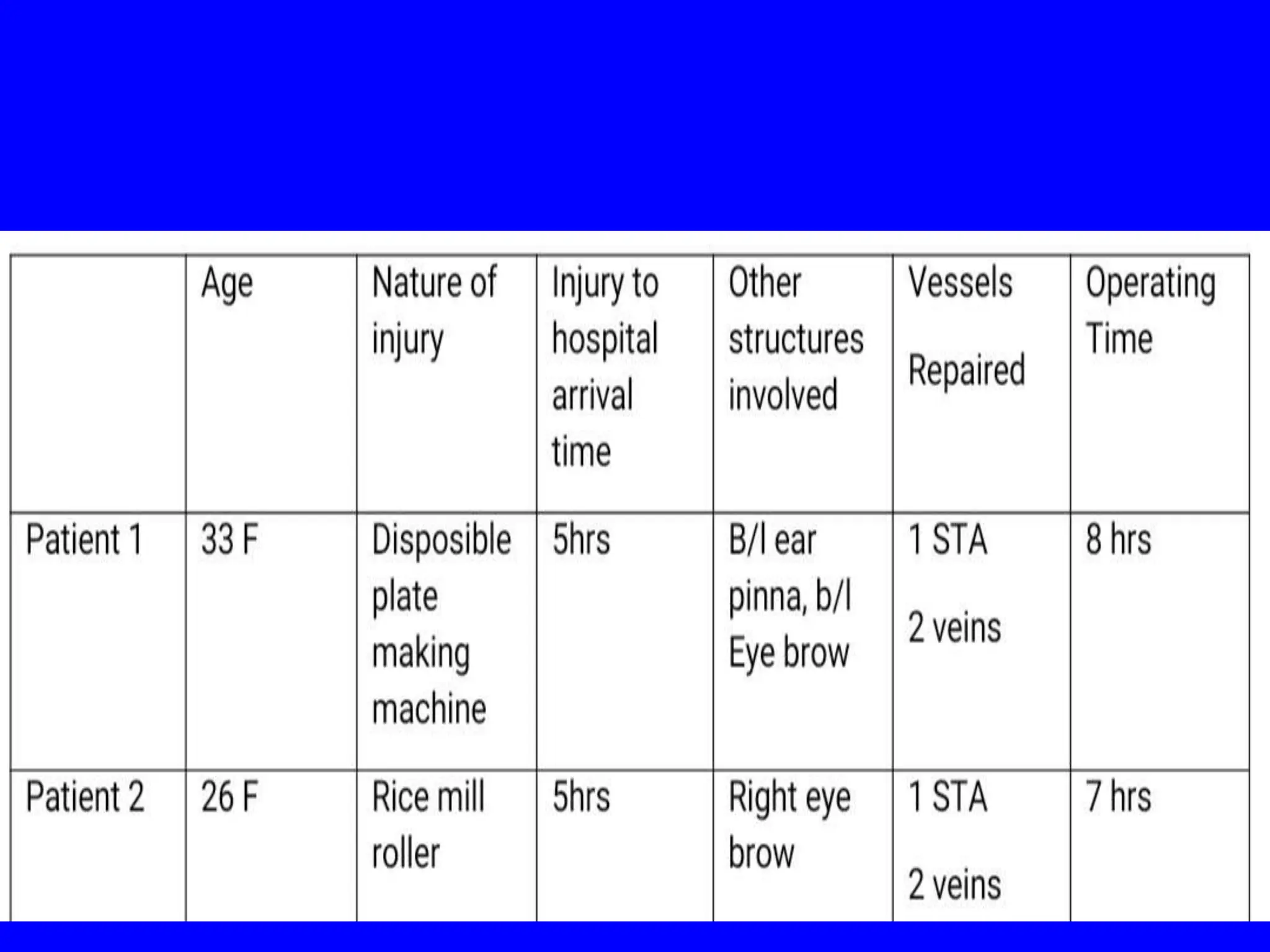
• 2 female patients were operated. One case was a
total scalp avulsion and the other was partial
avulsion. Unilateral superficial temporal vessels
were used for anastomosis . Scalp survival was
based on one artery and 2 veins.No vein grafts
used. No nerve repair was performed
Results
• For the first case which was a total scalp avulsion,
the replant was successful, but after a week’s time,
there was segmental necrosis over the scalp and
posterior neck region .The residual areas were
debrided and split skin grafting was done.
• The second case which was a partial avulsion was
successfully replanted also have few spotty necrotic
areas which was Grafted after demarcation.
Conclusion
• Scalp avulsions are a rare entity which is often
bewildering to the patient and bystanders,and a
challenging task for a reconstructive surgeon. But a
good result with restoration of a hair bearing scalp
can be extremely satisfying for both the surgeon
and patient .
• No other reconstructive surgeries can be as ideal as
a successful microvascular replantation of the scalp
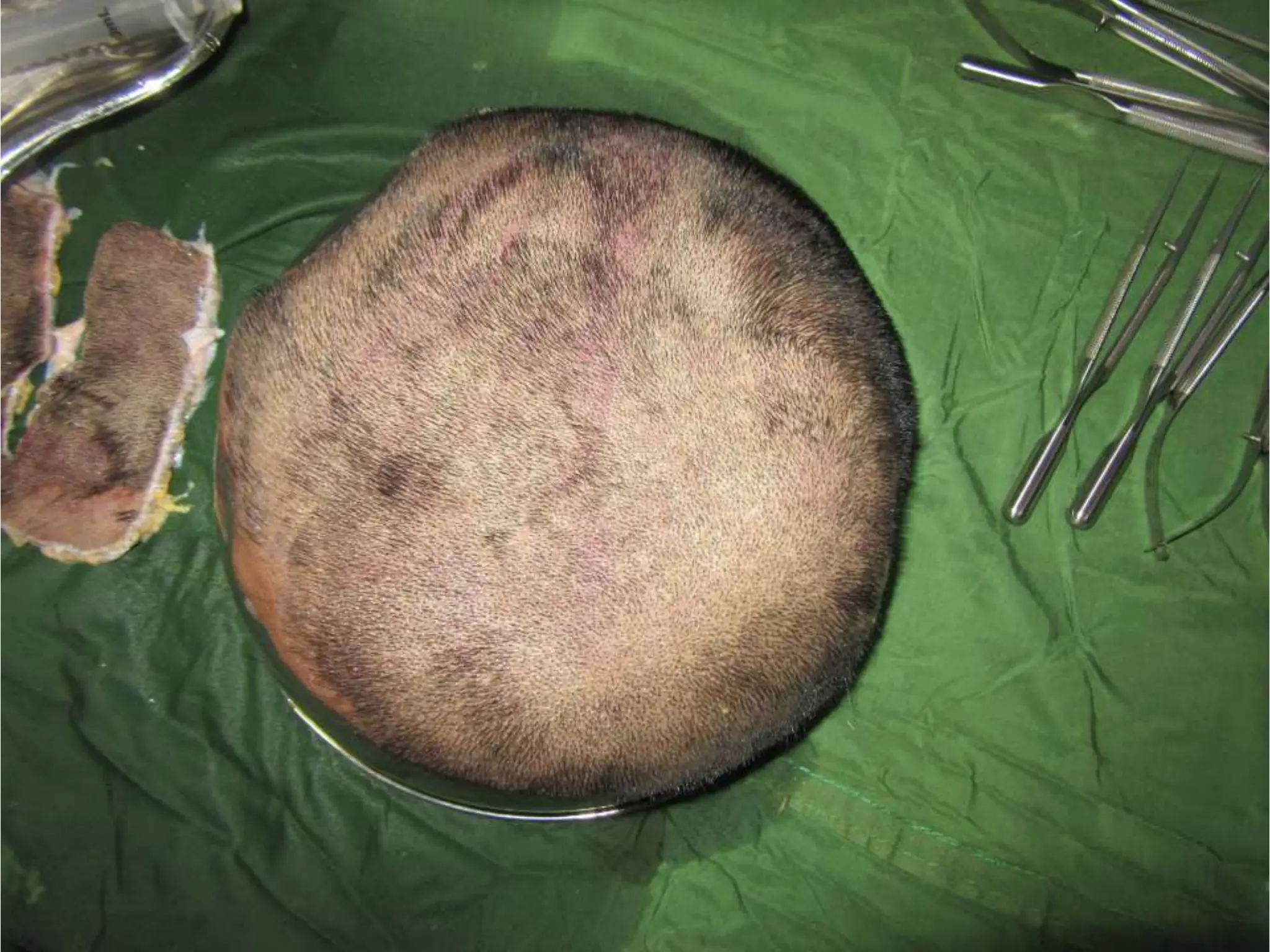
Patient 1
33-year old female who presented 5
hours after injury with complete scalp
avulsion due to entanglement of hair in
disposible plate making motorized
machine.
At Arrival
Line of avulsion:–both eyebrows,
root of nose, both ears, occipital
area, Neck area.
Trimming of hairs and Washing with
normal saline, manual picking of
visible debris was done.
Left superficial temporal artery and vein
accompanying and right side vein also
done using Nylon 10–0 under
microscope and general anesthesia by
single team.
No neural repair was done.
POST OP D1
First dressing was done on day 2 and
discoloration of the posterior part and b/l ear
was noted.
Multiple debridement of necrosed area was
done and SSG for occipital region done and
sensations are almost normal now.
She had Satisfactory hair growth after 1 yr
The approximate blood loss was 1000
mL, postoperative hemoglobin recorded
low,blood transfusion was done.
Temperature, skin color were used for
clinical monitoring. Low-molecular
weight heparin + dextran was given in
postoperative period for 5 days.
POST OP D3
POST OP D10
DEBRIDEMENT + SSG
Pod5
After 10 months
Patient 2
26 -year old female who presented 5 hours after
injury with partial scalp avulsion due to
entanglement of hair in rice mill roller
AT ARRAIVAL
Line of avulsion:–
At Right eyebrow, partially below left
eye brow and separate peice of left
temporal region
Trimming of hairs and Washing with
normal saline, manual picking of visible
debris was done.
Right superficial temporal artery and vein
accompanying and left side vein also done using
Nylon 10–0 under microscope and general
anesthesia by single team.
No neural repair was done.
The approximate blood loss was 800 mL,
postoperative hemoglobin recorded low,blood
transfusion was done.
Temperature, skin color were used for clinical
monitoring.
Low-molecular weight heparin + dextran was given in
postoperative period for 5 days.
First dressing was done on day 1 and No
discoloration seen.In 3 weeks post
procedure, slight discoloration of
occipital area seen.
Post OP D1
After 3 Weeks
• Then she developed Patchy Necrotic areas over the
occipital area and Temporal area
• Underwent debridement and then SSG after
demarcation
• On OPD follow up
ENTANGLEMENT INJURIES .pptx

ENTANGLEMENT INJURIES .pptx

  • 1.
    ENTANGLEMENT HAZARDS -SCALP AVULSION INJURIESAND REPLANT Dr. Akshai George Paul Department of Plastic Surgery
  • 3.
    Introduction • Scalp avulsioninjuries are infrequent industrial /domestic injuries when the scalp hair gets accidently caught between fan blades/industrial machines etc. • The injury is devastating and often life threatening. • Microvascular scalp replantation is the gold standard treatment for such injuries .
  • 6.
    • Here Idescribe our experience with the 2 cases of microvascular scalp replantations done in our unit.
  • 7.
    Methods • 2 femalepatients were operated. One case was a total scalp avulsion and the other was partial avulsion. Unilateral superficial temporal vessels were used for anastomosis . Scalp survival was based on one artery and 2 veins.No vein grafts used. No nerve repair was performed
  • 9.
    Results • For thefirst case which was a total scalp avulsion, the replant was successful, but after a week’s time, there was segmental necrosis over the scalp and posterior neck region .The residual areas were debrided and split skin grafting was done.
  • 10.
    • The secondcase which was a partial avulsion was successfully replanted also have few spotty necrotic areas which was Grafted after demarcation.
  • 11.
    Conclusion • Scalp avulsionsare a rare entity which is often bewildering to the patient and bystanders,and a challenging task for a reconstructive surgeon. But a good result with restoration of a hair bearing scalp can be extremely satisfying for both the surgeon and patient . • No other reconstructive surgeries can be as ideal as a successful microvascular replantation of the scalp
  • 12.
    Patient 1 33-year oldfemale who presented 5 hours after injury with complete scalp avulsion due to entanglement of hair in disposible plate making motorized machine.
  • 13.
  • 14.
    Line of avulsion:–botheyebrows, root of nose, both ears, occipital area, Neck area.
  • 16.
    Trimming of hairsand Washing with normal saline, manual picking of visible debris was done.
  • 18.
    Left superficial temporalartery and vein accompanying and right side vein also done using Nylon 10–0 under microscope and general anesthesia by single team. No neural repair was done.
  • 19.
  • 20.
    First dressing wasdone on day 2 and discoloration of the posterior part and b/l ear was noted. Multiple debridement of necrosed area was done and SSG for occipital region done and sensations are almost normal now. She had Satisfactory hair growth after 1 yr
  • 21.
    The approximate bloodloss was 1000 mL, postoperative hemoglobin recorded low,blood transfusion was done. Temperature, skin color were used for clinical monitoring. Low-molecular weight heparin + dextran was given in postoperative period for 5 days.
  • 22.
  • 23.
  • 24.
  • 25.
  • 26.
    Patient 2 26 -yearold female who presented 5 hours after injury with partial scalp avulsion due to entanglement of hair in rice mill roller
  • 27.
  • 29.
    Line of avulsion:– AtRight eyebrow, partially below left eye brow and separate peice of left temporal region
  • 31.
    Trimming of hairsand Washing with normal saline, manual picking of visible debris was done.
  • 32.
    Right superficial temporalartery and vein accompanying and left side vein also done using Nylon 10–0 under microscope and general anesthesia by single team. No neural repair was done.
  • 34.
    The approximate bloodloss was 800 mL, postoperative hemoglobin recorded low,blood transfusion was done. Temperature, skin color were used for clinical monitoring. Low-molecular weight heparin + dextran was given in postoperative period for 5 days.
  • 37.
    First dressing wasdone on day 1 and No discoloration seen.In 3 weeks post procedure, slight discoloration of occipital area seen.
  • 38.
  • 40.
  • 42.
    • Then shedeveloped Patchy Necrotic areas over the occipital area and Temporal area • Underwent debridement and then SSG after demarcation • On OPD follow up