Welcome To MY Presentation
Presented By
- Sudeb das
- ID: 2014-2-55-023
- Department of ECE
RFID
Radio Frequency Identification
CONTENTS
 What is RFID ?
 How Does RFID Work
 RFID Hardware
 Applications of RFID
What is RFID?




Radio Frequency Identification
The use of radio frequency readers and
tags to identify real objects.
New frontier in the field of information
technology
One form of Automatic Identification
Barcode VS RFID
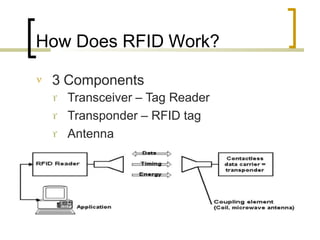
How Does RFID Work?
 3 Components



Transceiver – Tag Reader
Transponder – RFID tag
Antenna
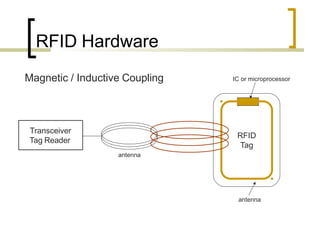
RFID Hardware
Magnetic / Inductive Coupling
Transceiver
Tag Reader
antenna
RFID
Tag
IC or microprocessor
antenna
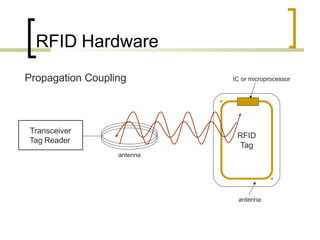
RFID Hardware
Propagation Coupling
Transceiver
Tag Reader
antenna
RFID
Tag
IC or microprocessor
antenna
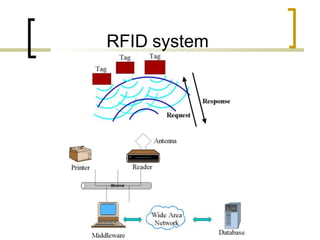
RFID system
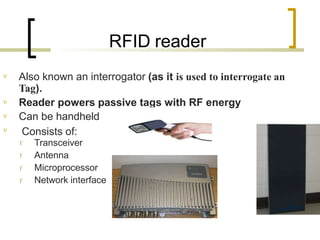
RFID reader




Also known an interrogator (as it is used to interrogate an
Tag).
Reader powers passive tags with RF energy
Can be handheld
Consists of:




Transceiver
Antenna
Microprocessor
Network interface
RFID tags


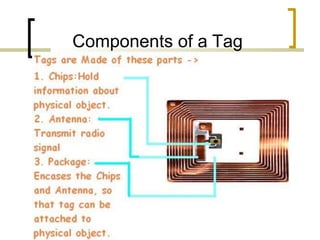
Tag is a device used to transmit
information such as a serial number to
the reader in a contact less manner
Classified as :



Passive – energy from reader
Active - battery
Semi-passive – battery and energy from
reader
Components of a Tag
Real Tags
Frequency Ranges
 Low – 100-500 kHz
 short range, low data rate, cost, & power
 Intermediate – 10-16 MHz
 medium range and data rate
 High – 850-950 MHz & 2.4-5.8GHz


large range, high cost, high data rate
needs line of sight
Frequencies of operation
 Low frequency



30-300 kHz
Tags need to be closer to the reader
Poor discrimination
 High frequency/radio frequency



3-30 MHz
Tags can be read from relatively greater
distances
Tags can hold more information
 Ultra high frequency/microwave



>300 MHz
Longest range
More interference
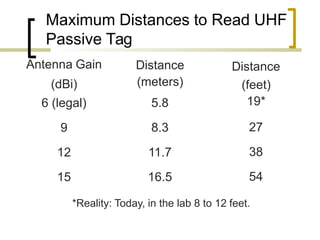
UHF passive tag
Maximum Distances to Read UHF
Passive Tag
Antenna Gain
(dBi)
6 (legal)
9
12
15
Distance
(meters)
5.8
8.3
11.7
16.5
Distance
(feet)
19*
27
38
54
*Reality: Today, in the lab 8 to 12 feet.
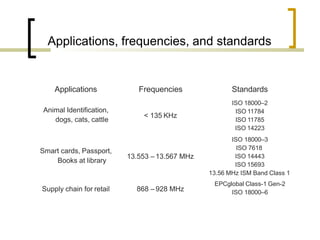
Applications, frequencies, and standards
Applications Frequencies
Animal Identification,
dogs, cats, cattle
< 135 KHz
Smart cards, Passport,
Books at library
13.553 – 13.567 MHz
Supply chain for retail 868 – 928 MHz
Standards
ISO 18000–2
ISO 11784
ISO 11785
ISO 14223
ISO 18000–3
ISO 7618
ISO 14443
ISO 15693
13.56 MHz ISM Band Class 1
EPCglobal Class-1 Gen-2
ISO 18000–6
Multiple Tags?



What happens when multiple tags are
in range of the transceiver?
All the tags will be excited at the same
time.
Makes it very difficult to distinguish
between the tags.
General Applications used in our
Day-to-Day Life



Keyless entry
Electronic Product Code (EPC)
Proximity cards
General Applications
 Payment tokens


Contact-less credit cards
Automatic toll-payment


Euro banknotes
Passports
General Applications


Libraries
Security device
 Bookstores
Current Applications






Livestock Tagging
Wild Animal Tracking
Electronic Article Surveillance (EAS)
Automated Toll Collection
Animal Husbandry
Vehicle Anti-Theft
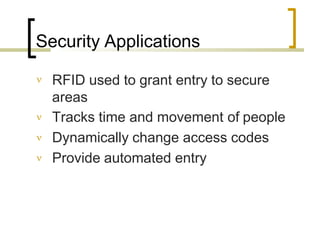
Security Applications




RFID used to grant entry to secure
areas
Tracks time and movement of people
Dynamically change access codes
Provide automated entry
Conclusion




RFID has many potential uses
Likely to play a key technological role
Perceptions of privacy and security
vary
Privacy and security concerns must be
addressed
THANKS FOR
SHOWING INTEREST
…

radio-frequency identification (RFID)