Selecting RFID Tags Sean Watson WS Packaging Group - Automated Systems
WS Packaging $400+ Million Printing and Packaging 1500+ employees Since 1966 19 locations in North America RFID Since 2004 Automatic Application Tags and Tag encoding UHF, HF Recent Joint Venture with ASK (Secure Contactless Technologies)
RFID Basics What is RFID?  How Does It Work? Physics of an RFID System Tag Standards Components of an RFID System Mandates and Applications.
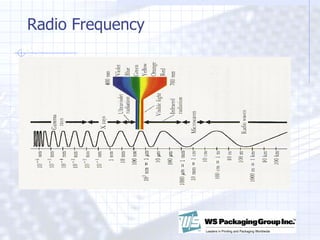
Radio Frequency
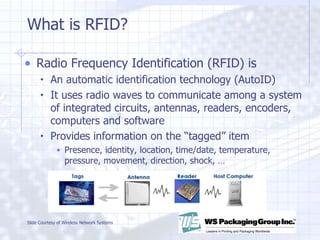
What is RFID? Radio Frequency Identification (RFID) is An automatic identification technology (AutoID)  It uses radio waves to communicate among a system of integrated circuits, antennas, readers, encoders, computers and software Provides information on the “tagged” item Presence, identity, location, time/date, temperature, pressure, movement, direction, shock, …  Slide Courtesy of Wireless Network Systems
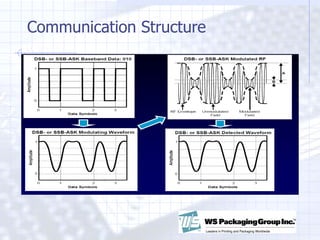
Communication Structure
Interrogator/Reader What is a reader? An RFID reader is a device that emits a radio signal that reads tags placed on items. What does a reader do? As the tag is passed through the reader’s/interrogator’s antenna field, the tag is awakened and transmits its encoded data.  This data is received by the reader and passed on to the network for processing
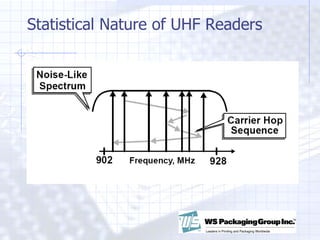
Statistical Nature of UHF Readers
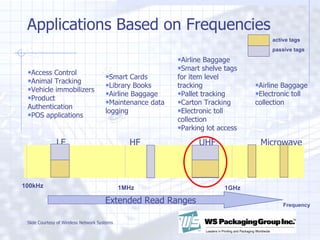
Applications Based on Frequencies Frequency 100kHz 1MHz 1GHz Extended Read Ranges Slide Courtesy of Wireless Network Systems Airline Baggage Electronic toll collection Airline Baggage Smart shelve tags for item level tracking Pallet tracking Carton Tracking Electronic toll collection Parking lot access Smart Cards Library Books Airline Baggage Maintenance data logging Access Control Animal Tracking Vehicle immobilizers Product Authentication POS applications Microwave UHF HF LF active tags passive tags
Begin at the Beginning When Considering RFID Identify where money is saved and Earned Elimination of waste, returns, mistakes Improve the customer expereince Determine what is to be tagged at which point to save/earn money Determine What Data should be on the tag Determine all read-write points and conditions After doing the above search for hardware and tags that MEET YOUR APPLICATION NEEDS!
Selecting the Right Reader Consider your options/environment Mobile reader located on a cart, tray or forklift that can be moved throughout your plant Hand-held reader used for scanning one box or pallet at-a-time. Fixed location reader located at entry/exit points in your building
Associated Costs (Readers) Initial purchase price – Hardware Installation and Maintenance Testing the readers performance and Range Review Industry Studies and seek client references
Selecting a tag Define your application needs.  What is tagged What information is stored in the tag, what is stored in a separate data base. How does the information get into the tag.  Where and how is the information collected and used.  Who collects (interoperability needs) Is there a security issue with cloned tags Determine Costs/ROI UHF tags <15 cents Readers 500-3000 dollars HF tags <40 cents Readers 30-500 dollars LF or active tags $1 and up.
What is tagged.  Different RFID frequencies behave differently.  UHF  Distances up to 21 feet Fast read of many tags Near field works in or near liquid. HF  Shorter range (3 feet)  Better around water and metal. LF  Longer range Can be embedded in animals.
Chip Protocols have different strengths UHF Standards Retail Supply Chain Gen II, EPC Data Standards (Identity, 256 to 512 bits) HF Standards ISO 15693 (Identity,1000 bits) ISO 14443 (Identity,Value up to 2000 bits) EPC HF (Identity) Customs TTF Standards (Read Only Identity) Secure Tags (Processor tags, applications on tag, up to 10K)
EPC Data Standards General Identifier (GID) Serialized Global Trade Identification Number (SGTIN) (Used for case and Wal*Mart Pallets) Serial Shipping Container Code (SSCC) (Target Pallets) Serial Global Location Number (SGLN) Global Returnable Asset Identifier (GRAI) Global Individual Asset Identifier (GIAI) DOD Construct
Antennas Antennas transmit the RF energy field, from the readers, that energize the RFID tags and labels.  Antennas also received the encoded data from the tags for the reader to process. Antennas may differ depending on the frequency, application, environmental requirements
Types of UHF antennae Near Field 1 inch range, ok near water Combination tags Both near field and far field properties. Mini Dipole 6-10 feet range, orientation sensitive, adequate for most case applications Enhanced Dipole 10-16 feet, less sensitive to reader antenna alignment and detuning but still directional. Used cases (difficult materials) and pallets Omni 21 feet or more. Orientation insensitive. Generally used in pallet applications.
Customer may mandate types. Mandates EPC UHF Wal*Mart DOD HF ISO 14443 Mass Transit E-Pedigree Pharma
Other Tag Selection Criteria Performance for specific read environment. Hand held readers. Environmental Detuning factors. Tagged item detuning factors. Yields in encoding devices. Printers. Applicators. Application Specific needs Many tags in field at the same time (tend to UHF). High speed processing. Security needs.
Middleware Software component that Bridges the physical device layer with the Business process management layer (ERP)
Pilot Project -  Assess Evaluate Design impliment
Assess Understand how industry regulations effect your application Impact on operation and organizational processes. Wal-mart initiative E-pedegree
Evaluate Compliance Solutions There is no one size fits ll in this business Select an RFID tag supplier, Systems Integrator, and Middleware provider with expertise in their respective fields to help you with your unique requirements
Design your Solution What is the impact of RFID on your infrastructure? RFID will impact IT, Inventory Management, Procurement, Customer Support, and Logistics. RFID will almost certainly require a modification of the above processes to maximize its value.
Implement and  Monitor Plan on tweaking your systems as you go. RFID will provide a wealth of new data that you can use to refine operations, optomize production and enhance sales and marketing. Depending on your industry you could find unexpected ROI sooner than you expect.
Questions ? Now is a good time to ask.

Selectingtags Final

  • 1.
    Selecting RFID TagsSean Watson WS Packaging Group - Automated Systems
  • 2.
    WS Packaging $400+Million Printing and Packaging 1500+ employees Since 1966 19 locations in North America RFID Since 2004 Automatic Application Tags and Tag encoding UHF, HF Recent Joint Venture with ASK (Secure Contactless Technologies)
  • 3.
    RFID Basics Whatis RFID? How Does It Work? Physics of an RFID System Tag Standards Components of an RFID System Mandates and Applications.
  • 4.
  • 5.
    What is RFID?Radio Frequency Identification (RFID) is An automatic identification technology (AutoID) It uses radio waves to communicate among a system of integrated circuits, antennas, readers, encoders, computers and software Provides information on the “tagged” item Presence, identity, location, time/date, temperature, pressure, movement, direction, shock, … Slide Courtesy of Wireless Network Systems
  • 6.
  • 7.
    Interrogator/Reader What isa reader? An RFID reader is a device that emits a radio signal that reads tags placed on items. What does a reader do? As the tag is passed through the reader’s/interrogator’s antenna field, the tag is awakened and transmits its encoded data. This data is received by the reader and passed on to the network for processing
  • 8.
  • 9.
    Applications Based onFrequencies Frequency 100kHz 1MHz 1GHz Extended Read Ranges Slide Courtesy of Wireless Network Systems Airline Baggage Electronic toll collection Airline Baggage Smart shelve tags for item level tracking Pallet tracking Carton Tracking Electronic toll collection Parking lot access Smart Cards Library Books Airline Baggage Maintenance data logging Access Control Animal Tracking Vehicle immobilizers Product Authentication POS applications Microwave UHF HF LF active tags passive tags
  • 10.
    Begin at theBeginning When Considering RFID Identify where money is saved and Earned Elimination of waste, returns, mistakes Improve the customer expereince Determine what is to be tagged at which point to save/earn money Determine What Data should be on the tag Determine all read-write points and conditions After doing the above search for hardware and tags that MEET YOUR APPLICATION NEEDS!
  • 11.
    Selecting the RightReader Consider your options/environment Mobile reader located on a cart, tray or forklift that can be moved throughout your plant Hand-held reader used for scanning one box or pallet at-a-time. Fixed location reader located at entry/exit points in your building
  • 12.
    Associated Costs (Readers)Initial purchase price – Hardware Installation and Maintenance Testing the readers performance and Range Review Industry Studies and seek client references
  • 13.
    Selecting a tagDefine your application needs. What is tagged What information is stored in the tag, what is stored in a separate data base. How does the information get into the tag. Where and how is the information collected and used. Who collects (interoperability needs) Is there a security issue with cloned tags Determine Costs/ROI UHF tags <15 cents Readers 500-3000 dollars HF tags <40 cents Readers 30-500 dollars LF or active tags $1 and up.
  • 14.
    What is tagged. Different RFID frequencies behave differently. UHF Distances up to 21 feet Fast read of many tags Near field works in or near liquid. HF Shorter range (3 feet) Better around water and metal. LF Longer range Can be embedded in animals.
  • 15.
    Chip Protocols havedifferent strengths UHF Standards Retail Supply Chain Gen II, EPC Data Standards (Identity, 256 to 512 bits) HF Standards ISO 15693 (Identity,1000 bits) ISO 14443 (Identity,Value up to 2000 bits) EPC HF (Identity) Customs TTF Standards (Read Only Identity) Secure Tags (Processor tags, applications on tag, up to 10K)
  • 16.
    EPC Data StandardsGeneral Identifier (GID) Serialized Global Trade Identification Number (SGTIN) (Used for case and Wal*Mart Pallets) Serial Shipping Container Code (SSCC) (Target Pallets) Serial Global Location Number (SGLN) Global Returnable Asset Identifier (GRAI) Global Individual Asset Identifier (GIAI) DOD Construct
  • 17.
    Antennas Antennas transmitthe RF energy field, from the readers, that energize the RFID tags and labels. Antennas also received the encoded data from the tags for the reader to process. Antennas may differ depending on the frequency, application, environmental requirements
  • 18.
    Types of UHFantennae Near Field 1 inch range, ok near water Combination tags Both near field and far field properties. Mini Dipole 6-10 feet range, orientation sensitive, adequate for most case applications Enhanced Dipole 10-16 feet, less sensitive to reader antenna alignment and detuning but still directional. Used cases (difficult materials) and pallets Omni 21 feet or more. Orientation insensitive. Generally used in pallet applications.
  • 19.
    Customer may mandatetypes. Mandates EPC UHF Wal*Mart DOD HF ISO 14443 Mass Transit E-Pedigree Pharma
  • 20.
    Other Tag SelectionCriteria Performance for specific read environment. Hand held readers. Environmental Detuning factors. Tagged item detuning factors. Yields in encoding devices. Printers. Applicators. Application Specific needs Many tags in field at the same time (tend to UHF). High speed processing. Security needs.
  • 21.
    Middleware Software componentthat Bridges the physical device layer with the Business process management layer (ERP)
  • 22.
    Pilot Project - Assess Evaluate Design impliment
  • 23.
    Assess Understand howindustry regulations effect your application Impact on operation and organizational processes. Wal-mart initiative E-pedegree
  • 24.
    Evaluate Compliance SolutionsThere is no one size fits ll in this business Select an RFID tag supplier, Systems Integrator, and Middleware provider with expertise in their respective fields to help you with your unique requirements
  • 25.
    Design your SolutionWhat is the impact of RFID on your infrastructure? RFID will impact IT, Inventory Management, Procurement, Customer Support, and Logistics. RFID will almost certainly require a modification of the above processes to maximize its value.
  • 26.
    Implement and Monitor Plan on tweaking your systems as you go. RFID will provide a wealth of new data that you can use to refine operations, optomize production and enhance sales and marketing. Depending on your industry you could find unexpected ROI sooner than you expect.
  • 27.
    Questions ? Nowis a good time to ask.