1
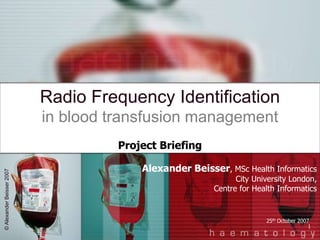
Radio Frequency Identification
in blood transfusion management
Alexander Beisser, MSc Health Informatics
City University London,
Centre for Health Informatics
25th October 2007
Project Briefing
©AlexanderBeisser2007
2
The project briefing
 About this study
 About Barcodes
 About RFID
3
About this study
 Alexander Beisser
 Works for ICT Shared Services at Newham University
Hospital Trust
 Dissertation for Master of Science in Health
Informatics
 City University London
 Course accredited by NHS Connecting for Health
4
About this study
The main question
Can the emerging Radio Frequency Identification
technology help to make blood transfusion safer,
more reliable and allow better tracking of (used)
blood products within a secondary care setting like
Newham University Hospital Trust in accordance
with the requirements of the National Patient Safety
Agency and SHOT1 initiatives?
1Serious Hazards of Transfusion, Manchester, UK
5
About this study
The aim of project
Audit and analysis of technology available to
enhance safety in the transfusion process in a
secondary care setting.
 Barcode versus Radio Frequency technology
 Investigation into the possibility to use RFID technology
to improve safety in transfusion medicine in accordance
to NPSA Right patient – right blood initiative.
6
About this study
Motivation for study
Safety of blood transfusions :
 609 cases reported to SHOT1 in 2005 (out of more than
3.6 million transfusions)
 37% of transfusion related errors occur in hospital
transfusion laboratory environment
 Most common error is IBCT (485 cases = 79%)
 1358 near miss incidences
 SHOT recommendations
 Right patient – right blood initiative of NPSA
 And others
1Serious Hazards of Transfusion, Manchester, UK
7
About this study
Audit to be performed to see if:
 Can RFID technology be added to barcode system?
 Can semi-active / active be used to automatically
interrogate and audits blood products for blood products
condition
 Has RFID technology the potential to reduce IBCT error
rate?
 How can RFID improve safety by automatic authentication
of
 Patient
 Clinician / nurse
 Blood product
8
About this study
The focus points in project
 In blood banks
 Monitoring of blood products condition
 At patient bedside
 Correct blood for correct patient
 Patient identification
 Patient condition monitoring
(temperature, etc.)
 Audit of blood products used in
transfusion
9
About Barcode Technology
 Machine readable representation of information
 Use of dark ink on light background to create high / low reflectance to
represent converted 1s and 0s
 Information is read by optical barcode readers (barcode scanner) using
a laser beam
 Developed in 1948, first commercial use in 1966, success in 1980’s
 Barcodes are nowadays commonly used to capture ID Data to identify
products, goods or other items
 Examples: Supermarket checkouts, sample identification in pathology (or
other healthcare) environment
Typical Linear Barcode
as it can be found
on everyday products
2 dimensional barcode
as it can be found
i.e. in a pathology setting
Barcode reader
(cordless version)
10
About Barcode Technology
Advantages of Barcodes
 Virtually free (≈ £0.003 per code for linear
barcodes)
 Widely used within retail and supply chain industry
 Used within healthcare settings
 Easy implementation
 Well-formed and established international and
European standards
 Users are well aware of technology
 Easy to use and therefore lower training costs
 Can be used across industry and country borders
11
About Barcode Technology
Disadvantages of Barcodes (I)
 Line of sight required to read barcode
 Only one barcode can be read at a time
 Reading speed lower than RFID
 Reading of label can be difficult when label is
curved or crumbling
 Dust and dirt influence readability of code
12
About Barcode Technology
Disadvantages of Barcodes (II)
 Label can crumble when exposed to water (i.e.
when patient is taking a shower)
 Limited amount of data can be stored on label
 No additional data can be written or stored on
label except a unique number
 New label is required when data format / structure
changes or multiple barcodes are needed
 A connection to a database is required
13
About RFID Technology
 Automatic identification method
 First used in 1939 by Royal Air Force to distinguish between
enemy and allied aircrafts
 Storage of information on electronic tags
 Data is retrieved by RFID readers (interrogators) from a distance
that can be greater then with barcodes
 Widely used in retail and supply chain sectors
 Healthcare industry shows more interest in emerging RFID
solutions for healthcare settings
 Technology consist of
Antenna incorporated
into RFID tag
Electronic RFID tag RFID reader
(here attached to a PDA)
14
About RFID Technology
Different types of tags
 3 different types of RFID tags available
 Passive
 Semi-active
 Active
15
About RFID Technology
The advantages of RFID
 Contact-free authentication
 Out of sight authentication
 Read and write to tags
 Store data on tags
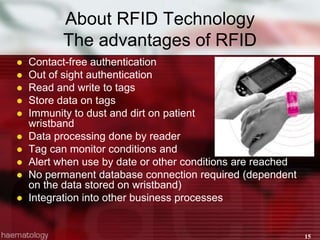
 Immunity to dust and dirt on patient
wristband
 Data processing done by reader
 Tag can monitor conditions and
 Alert when use by date or other conditions are reached
 No permanent database connection required (dependent
on the data stored on wristband)
 Integration into other business processes
16
About RFID Technology
The challenges for using RFID
 Costs of tags
 Cost of infrastructure
 Interference with other medical equipment
 Standardisation still in progress
 Data privacy
 Acceptability by patients and staff
 Not yet widely used within the NHS
 Process re-engineering could be required
 No out-of-box solution available
17
About RFID Technology
RFID technology in healthcare (I)
RFID projects and systems within healthcare
environments:
 America:
 Massachusetts General Hospital: Blood product tagging
 Jacoby Medical Center NY: Blood product tagging
 Shelby County Regional MC: Patient tracking in surgery
 European Union:
 Saarbruecken Clinic: Patient identification and blood product
tagging
 United Kingdom:
 Portsmouth NHS Trust: Blood sample & testing monitoring
 Birmingham Heartlands Hospital: Patient and equipment
tracking in surgery
 Wirral Hospital NHS Trust: Patient tracking
18
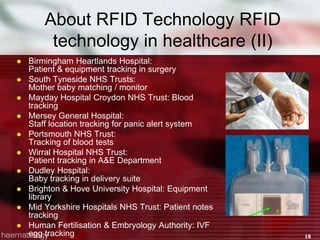
About RFID Technology RFID
technology in healthcare (II)
 Birmingham Heartlands Hospital:
Patient & equipment tracking in surgery
 South Tyneside NHS Trusts:
Mother baby matching / monitor
 Mayday Hospital Croydon NHS Trust: Blood
tracking
 Mersey General Hospital:
Staff location tracking for panic alert system
 Portsmouth NHS Trust:
Tracking of blood tests
 Wirral Hospital NHS Trust:
Patient tracking in A&E Department
 Dudley Hospital:
Baby tracking in delivery suite
 Brighton & Hove University Hospital: Equipment
library
 Mid Yorkshire Hospitals NHS Trust: Patient notes
tracking
 Human Fertilisation & Embryology Authority: IVF
egg tracking
19
The questionnaire
A short note about the questionnaire:
 Anonymous questionnaire
 Contains open answer and rating questions
 To answer rating questions
circle the scale at the appropriate point.
20
Thank you
Thank you very much for your attention.
Please feel free to contact me if you have
any further questions.
Alex Beisser MSc, BSc, CISA, ITIL
alex428uk@yahoo.com
about.me/alex428uk
uk.linkedin.com/in/beissera/

RFID in Blood Transfusion Project Briefing

  • 1.
    1 Radio Frequency Identification inblood transfusion management Alexander Beisser, MSc Health Informatics City University London, Centre for Health Informatics 25th October 2007 Project Briefing ©AlexanderBeisser2007
  • 2.
    2 The project briefing About this study  About Barcodes  About RFID
  • 3.
    3 About this study Alexander Beisser  Works for ICT Shared Services at Newham University Hospital Trust  Dissertation for Master of Science in Health Informatics  City University London  Course accredited by NHS Connecting for Health
  • 4.
    4 About this study Themain question Can the emerging Radio Frequency Identification technology help to make blood transfusion safer, more reliable and allow better tracking of (used) blood products within a secondary care setting like Newham University Hospital Trust in accordance with the requirements of the National Patient Safety Agency and SHOT1 initiatives? 1Serious Hazards of Transfusion, Manchester, UK
  • 5.
    5 About this study Theaim of project Audit and analysis of technology available to enhance safety in the transfusion process in a secondary care setting.  Barcode versus Radio Frequency technology  Investigation into the possibility to use RFID technology to improve safety in transfusion medicine in accordance to NPSA Right patient – right blood initiative.
  • 6.
    6 About this study Motivationfor study Safety of blood transfusions :  609 cases reported to SHOT1 in 2005 (out of more than 3.6 million transfusions)  37% of transfusion related errors occur in hospital transfusion laboratory environment  Most common error is IBCT (485 cases = 79%)  1358 near miss incidences  SHOT recommendations  Right patient – right blood initiative of NPSA  And others 1Serious Hazards of Transfusion, Manchester, UK
  • 7.
    7 About this study Auditto be performed to see if:  Can RFID technology be added to barcode system?  Can semi-active / active be used to automatically interrogate and audits blood products for blood products condition  Has RFID technology the potential to reduce IBCT error rate?  How can RFID improve safety by automatic authentication of  Patient  Clinician / nurse  Blood product
  • 8.
    8 About this study Thefocus points in project  In blood banks  Monitoring of blood products condition  At patient bedside  Correct blood for correct patient  Patient identification  Patient condition monitoring (temperature, etc.)  Audit of blood products used in transfusion
  • 9.
    9 About Barcode Technology Machine readable representation of information  Use of dark ink on light background to create high / low reflectance to represent converted 1s and 0s  Information is read by optical barcode readers (barcode scanner) using a laser beam  Developed in 1948, first commercial use in 1966, success in 1980’s  Barcodes are nowadays commonly used to capture ID Data to identify products, goods or other items  Examples: Supermarket checkouts, sample identification in pathology (or other healthcare) environment Typical Linear Barcode as it can be found on everyday products 2 dimensional barcode as it can be found i.e. in a pathology setting Barcode reader (cordless version)
  • 10.
    10 About Barcode Technology Advantagesof Barcodes  Virtually free (≈ £0.003 per code for linear barcodes)  Widely used within retail and supply chain industry  Used within healthcare settings  Easy implementation  Well-formed and established international and European standards  Users are well aware of technology  Easy to use and therefore lower training costs  Can be used across industry and country borders
  • 11.
    11 About Barcode Technology Disadvantagesof Barcodes (I)  Line of sight required to read barcode  Only one barcode can be read at a time  Reading speed lower than RFID  Reading of label can be difficult when label is curved or crumbling  Dust and dirt influence readability of code
  • 12.
    12 About Barcode Technology Disadvantagesof Barcodes (II)  Label can crumble when exposed to water (i.e. when patient is taking a shower)  Limited amount of data can be stored on label  No additional data can be written or stored on label except a unique number  New label is required when data format / structure changes or multiple barcodes are needed  A connection to a database is required
  • 13.
    13 About RFID Technology Automatic identification method  First used in 1939 by Royal Air Force to distinguish between enemy and allied aircrafts  Storage of information on electronic tags  Data is retrieved by RFID readers (interrogators) from a distance that can be greater then with barcodes  Widely used in retail and supply chain sectors  Healthcare industry shows more interest in emerging RFID solutions for healthcare settings  Technology consist of Antenna incorporated into RFID tag Electronic RFID tag RFID reader (here attached to a PDA)
  • 14.
    14 About RFID Technology Differenttypes of tags  3 different types of RFID tags available  Passive  Semi-active  Active
  • 15.
    15 About RFID Technology Theadvantages of RFID  Contact-free authentication  Out of sight authentication  Read and write to tags  Store data on tags  Immunity to dust and dirt on patient wristband  Data processing done by reader  Tag can monitor conditions and  Alert when use by date or other conditions are reached  No permanent database connection required (dependent on the data stored on wristband)  Integration into other business processes
  • 16.
    16 About RFID Technology Thechallenges for using RFID  Costs of tags  Cost of infrastructure  Interference with other medical equipment  Standardisation still in progress  Data privacy  Acceptability by patients and staff  Not yet widely used within the NHS  Process re-engineering could be required  No out-of-box solution available
  • 17.
    17 About RFID Technology RFIDtechnology in healthcare (I) RFID projects and systems within healthcare environments:  America:  Massachusetts General Hospital: Blood product tagging  Jacoby Medical Center NY: Blood product tagging  Shelby County Regional MC: Patient tracking in surgery  European Union:  Saarbruecken Clinic: Patient identification and blood product tagging  United Kingdom:  Portsmouth NHS Trust: Blood sample & testing monitoring  Birmingham Heartlands Hospital: Patient and equipment tracking in surgery  Wirral Hospital NHS Trust: Patient tracking
  • 18.
    18 About RFID TechnologyRFID technology in healthcare (II)  Birmingham Heartlands Hospital: Patient & equipment tracking in surgery  South Tyneside NHS Trusts: Mother baby matching / monitor  Mayday Hospital Croydon NHS Trust: Blood tracking  Mersey General Hospital: Staff location tracking for panic alert system  Portsmouth NHS Trust: Tracking of blood tests  Wirral Hospital NHS Trust: Patient tracking in A&E Department  Dudley Hospital: Baby tracking in delivery suite  Brighton & Hove University Hospital: Equipment library  Mid Yorkshire Hospitals NHS Trust: Patient notes tracking  Human Fertilisation & Embryology Authority: IVF egg tracking
  • 19.
    19 The questionnaire A shortnote about the questionnaire:  Anonymous questionnaire  Contains open answer and rating questions  To answer rating questions circle the scale at the appropriate point.
  • 20.
    20 Thank you Thank youvery much for your attention. Please feel free to contact me if you have any further questions. Alex Beisser MSc, BSc, CISA, ITIL alex428uk@yahoo.com about.me/alex428uk uk.linkedin.com/in/beissera/