Presented by:
A1Group
Retailing- Definition
 According to Philip Kotler “retailing includes all
the activities involved in selling goods or
Services directly to final consumers for personal ,
Non business use”.
 “Every sale of Goods and Services to final
consumer” – Food products, apparel, movie
tickets; services from hair cutting to e-ticketing.
 A retailer or retail store is any business enterprise
whose sale volume comes primarily from
retailing”.
 A retailer may be defined, as a ‘ dealer or trader
who sells goods in small quantities’.
 Any Organization Selling to final consumer
is retailing , whether they are
 A Manufacturer
 A Wholesaler
 A Retailer
International Retail: At a Glance
 One of the world’s largest industry
exceeding US $ 9 trillion
 47 Global Fortune 500 companies &
25 Asia's Top 200 companies are
retailers
 Dominated by developed countries.
 US, EU & Japan constitutes 80% of
world retail sales
 Biggest player in India, Pantaloon’s
total group sales is about equal to 2
Wal-Mart super centers annual
revenues
38%
27%
13%
8%
3% 2% 9%
USA EU Japan China
India Russia Others
Retail Landscape in India
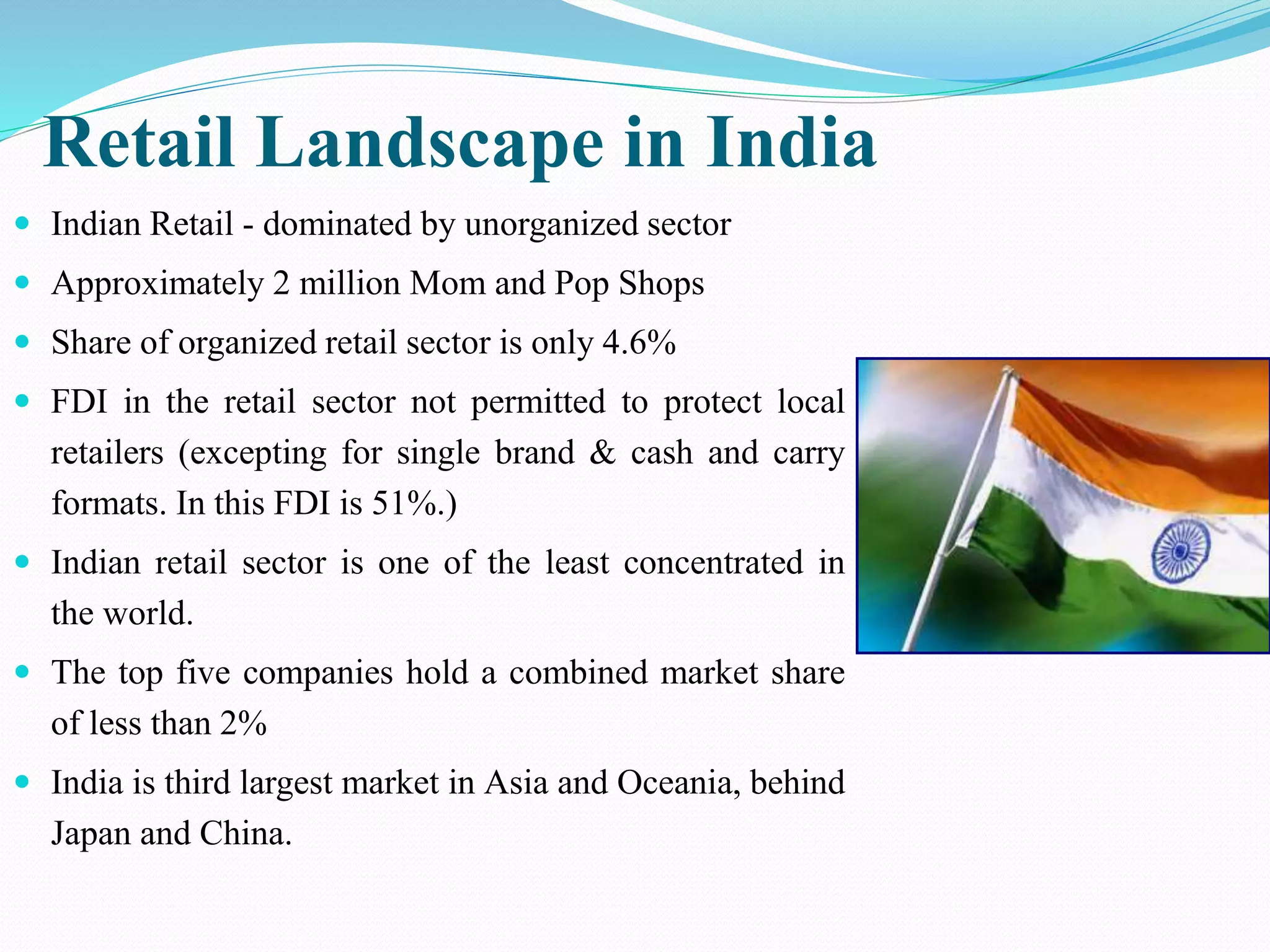
 Indian Retail - dominated by unorganized sector
 Approximately 2 million Mom and Pop Shops
 Share of organized retail sector is only 4.6%
 FDI in the retail sector not permitted to protect local
retailers (excepting for single brand & cash and carry
formats. In this FDI is 51%.)
 Indian retail sector is one of the least concentrated in
the world.
 The top five companies hold a combined market share
of less than 2%
 India is third largest market in Asia and Oceania, behind
Japan and China.
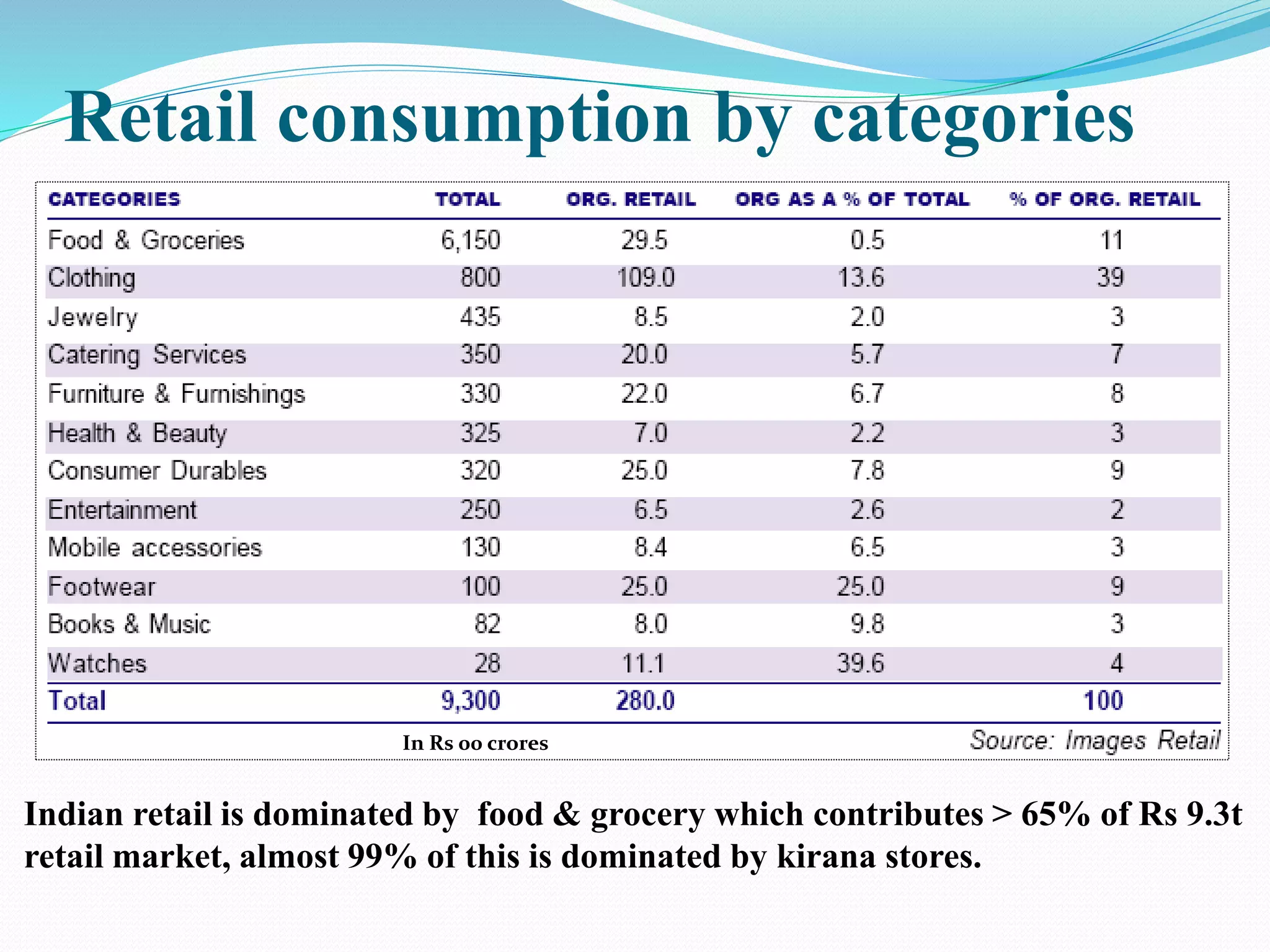
Retail consumption by categories
Indian retail is dominated by food & grocery which contributes > 65% of Rs 9.3t
retail market, almost 99% of this is dominated by kirana stores.
In Rs 00 crores
Global Players
 Highly evolved US market has Wal-Mart taking only 8% market share
 UK market has Tesco with only 13.4% market share
 China market still does not have a clear leader
USA =US$ 2,350 Bn UK=US$ 406 Bn China = US$ 313 Bn
Big players retail in India
 Future group- Big bazaar, Food bazaar, Pantaloons etc.
 Reliance retail- marks & spencer
 RPG group- spencer
 Bharti-walmart
 Tata Tesco- star bazaar
Small players retail in India
 Parsvnath retail
 Vishal mega mart retail
 Shoppers’ stop
SWOT analysis
Strengths
 Emerging retail formats like malls, hyper/supermarkets
and specialty stores
 Indian consumers have high disposable incomes
 Large number of earning young population.
 Growth of real-estate and Improvement in infrastructure.
 Huge agricultural sector offering an abundance of raw
materials.
Weaknesses
 Demographic differences
 Presence of a significant number of strong and well-
established players
 Relatively small domestic market limits growth opportunities
 High real-estate and distribution cost are the obstacles for
growth of retail in India
Opportunities
 Increasing awareness of consumers about products and services
 Changing consumers’ requirements and lifestyles
 Innovation for new product development
 Private label sector has been boosted by economic downturn
Threats
 Economic slowdown is having an adverse effect on
consumer spending.
 Rigid government policies and regulations restrict the
entry of new players.
 Price competition among retailers puts downwards
pressure on margins.
 Entry of International players in Indian markets consumes
the share of Indian retailers
FDI
 Foreign direct investment (FDI)
 FDI refers to capital inflows from abroad that is
invested in or to enhance the production capacity of
the economy
 It usually involves participation in management, joint-
venture, transfer of technology and expertise
FDI policy with regard to India
 FDI up to 100% for cash and carry wholesale trading
and export trading allowed under the automatic route
 FDI up to 51 % with prior Government approval (i.e.
FIPB) for retail trade of ‘Single Brand’ products
 FDI is not permitted in Multi Brand Retailing in India
Global players – Eye on India
Global players plans to have their presence
in India
Wal- Mart has already signed a JV with
Bharti Enterprises to set up stores
Tesco has a service center in Bangalore.
Metro AG has cash & carry stores .
The Govt. of India currently allows a
foreign player to enter the market in JV
with an Indian partner
More global luxury brands to enter India.
Retailing: Facts and Trends
 Internet Retailing is Huge
 Recession is hurting the high end
 Category killers usually dominate either on price,
selection, store appearance or, better yet, all three
ONLINE RETAILING
 A type of electronic commerce used for business-to-
consumer (B2C) transactions and mail order,
are forms of non-shop retailing.
 Divided in to 2 parts:
1. B2C
2. B2B
B2C
Business that sells products or provides services to
end-user consumers.
Business-to-consumer activity exists both online
and offline, the acronym B2C has primarily been
used to describe the online variety.
B2B
 Business-to-business (B2B) describes commerce
transactions between businesses, such as between
a manufacturer and a wholesaler, or between a wholesaler
and a retailer.
 While almost any B2C product or service could also be a
B2B product, very few B2B products or services will be
used by consumers.
Customers
 Online customers must have access to the internet
and a valid method of payment in order to
complete a transaction.
 Generally, higher levels of education, occupation
of the head of the household and income
correspond to more favorable perceptions of
shopping online.
 Increased exposure to technology also increases
the probability of developing favorable attitudes
towards new shopping channels.
Payment
•Billing to mobile
phones and landlines
•Cash on delivery
•Cheque
•Debit card
•Electronic money
•Gift cards
•Postal money order
•Wire transfer
•Invoice
Challenges
 Automatic approval is not allowed for foreign investment in
retail.
 Regulations restricting real estate purchases, and cumbersome
local laws.
 Taxation, which favour’s small retail businesses.
 Absence of developed supply chain and integrated IT
management.
 Lack of trained work force.
 Low skill level for retailing management.
 Lack of Retailing Courses and study options
 Intrinsic complexity of retailing – rapid price changes, constant
threat of product obsolescence and low margins.
CONTRIBUTION TO INDIAN
GROWTH
 Retailing in India is one of the pillars of its
economy and accounts for 14 to 15 percent of its
GDP.
 The Indian retail market is estimated to be US$
450 billion and one of the top five retail markets in
the world by economic value.
 India is one of the fastest growing retail market in
the world, with 1.2 billion people.
EMPLOYMENT GENERATION
 India's retail and logistics industry employs
about 40 million Indians (3.3% of Indian
population).
 Company’s coming in after FDI will create 10
mn jobs subsequently.

Retail sector in India

  • 1.
  • 2.
    Retailing- Definition  Accordingto Philip Kotler “retailing includes all the activities involved in selling goods or Services directly to final consumers for personal , Non business use”.  “Every sale of Goods and Services to final consumer” – Food products, apparel, movie tickets; services from hair cutting to e-ticketing.
  • 3.
     A retaileror retail store is any business enterprise whose sale volume comes primarily from retailing”.  A retailer may be defined, as a ‘ dealer or trader who sells goods in small quantities’.  Any Organization Selling to final consumer is retailing , whether they are  A Manufacturer  A Wholesaler  A Retailer
  • 4.
    International Retail: Ata Glance  One of the world’s largest industry exceeding US $ 9 trillion  47 Global Fortune 500 companies & 25 Asia's Top 200 companies are retailers  Dominated by developed countries.  US, EU & Japan constitutes 80% of world retail sales  Biggest player in India, Pantaloon’s total group sales is about equal to 2 Wal-Mart super centers annual revenues 38% 27% 13% 8% 3% 2% 9% USA EU Japan China India Russia Others
  • 5.
    Retail Landscape inIndia  Indian Retail - dominated by unorganized sector  Approximately 2 million Mom and Pop Shops  Share of organized retail sector is only 4.6%  FDI in the retail sector not permitted to protect local retailers (excepting for single brand & cash and carry formats. In this FDI is 51%.)  Indian retail sector is one of the least concentrated in the world.  The top five companies hold a combined market share of less than 2%  India is third largest market in Asia and Oceania, behind Japan and China.
  • 6.
    Retail consumption bycategories Indian retail is dominated by food & grocery which contributes > 65% of Rs 9.3t retail market, almost 99% of this is dominated by kirana stores. In Rs 00 crores
  • 7.
    Global Players  Highlyevolved US market has Wal-Mart taking only 8% market share  UK market has Tesco with only 13.4% market share  China market still does not have a clear leader USA =US$ 2,350 Bn UK=US$ 406 Bn China = US$ 313 Bn
  • 8.
    Big players retailin India  Future group- Big bazaar, Food bazaar, Pantaloons etc.  Reliance retail- marks & spencer  RPG group- spencer  Bharti-walmart  Tata Tesco- star bazaar
  • 9.
    Small players retailin India  Parsvnath retail  Vishal mega mart retail  Shoppers’ stop
  • 10.
    SWOT analysis Strengths  Emergingretail formats like malls, hyper/supermarkets and specialty stores  Indian consumers have high disposable incomes  Large number of earning young population.  Growth of real-estate and Improvement in infrastructure.  Huge agricultural sector offering an abundance of raw materials.
  • 11.
    Weaknesses  Demographic differences Presence of a significant number of strong and well- established players  Relatively small domestic market limits growth opportunities  High real-estate and distribution cost are the obstacles for growth of retail in India
  • 12.
    Opportunities  Increasing awarenessof consumers about products and services  Changing consumers’ requirements and lifestyles  Innovation for new product development  Private label sector has been boosted by economic downturn
  • 13.
    Threats  Economic slowdownis having an adverse effect on consumer spending.  Rigid government policies and regulations restrict the entry of new players.  Price competition among retailers puts downwards pressure on margins.  Entry of International players in Indian markets consumes the share of Indian retailers
  • 14.
    FDI  Foreign directinvestment (FDI)  FDI refers to capital inflows from abroad that is invested in or to enhance the production capacity of the economy  It usually involves participation in management, joint- venture, transfer of technology and expertise
  • 15.
    FDI policy withregard to India  FDI up to 100% for cash and carry wholesale trading and export trading allowed under the automatic route  FDI up to 51 % with prior Government approval (i.e. FIPB) for retail trade of ‘Single Brand’ products  FDI is not permitted in Multi Brand Retailing in India
  • 16.
    Global players –Eye on India Global players plans to have their presence in India Wal- Mart has already signed a JV with Bharti Enterprises to set up stores Tesco has a service center in Bangalore. Metro AG has cash & carry stores . The Govt. of India currently allows a foreign player to enter the market in JV with an Indian partner More global luxury brands to enter India.
  • 17.
    Retailing: Facts andTrends  Internet Retailing is Huge  Recession is hurting the high end  Category killers usually dominate either on price, selection, store appearance or, better yet, all three
  • 18.
    ONLINE RETAILING  Atype of electronic commerce used for business-to- consumer (B2C) transactions and mail order, are forms of non-shop retailing.  Divided in to 2 parts: 1. B2C 2. B2B
  • 19.
    B2C Business that sellsproducts or provides services to end-user consumers. Business-to-consumer activity exists both online and offline, the acronym B2C has primarily been used to describe the online variety.
  • 20.
    B2B  Business-to-business (B2B)describes commerce transactions between businesses, such as between a manufacturer and a wholesaler, or between a wholesaler and a retailer.  While almost any B2C product or service could also be a B2B product, very few B2B products or services will be used by consumers.
  • 21.
    Customers  Online customersmust have access to the internet and a valid method of payment in order to complete a transaction.  Generally, higher levels of education, occupation of the head of the household and income correspond to more favorable perceptions of shopping online.  Increased exposure to technology also increases the probability of developing favorable attitudes towards new shopping channels.
  • 22.
    Payment •Billing to mobile phonesand landlines •Cash on delivery •Cheque •Debit card •Electronic money •Gift cards •Postal money order •Wire transfer •Invoice
  • 23.
    Challenges  Automatic approvalis not allowed for foreign investment in retail.  Regulations restricting real estate purchases, and cumbersome local laws.  Taxation, which favour’s small retail businesses.  Absence of developed supply chain and integrated IT management.  Lack of trained work force.  Low skill level for retailing management.  Lack of Retailing Courses and study options  Intrinsic complexity of retailing – rapid price changes, constant threat of product obsolescence and low margins.
  • 24.
    CONTRIBUTION TO INDIAN GROWTH Retailing in India is one of the pillars of its economy and accounts for 14 to 15 percent of its GDP.  The Indian retail market is estimated to be US$ 450 billion and one of the top five retail markets in the world by economic value.  India is one of the fastest growing retail market in the world, with 1.2 billion people.
  • 25.
    EMPLOYMENT GENERATION  India'sretail and logistics industry employs about 40 million Indians (3.3% of Indian population).  Company’s coming in after FDI will create 10 mn jobs subsequently.