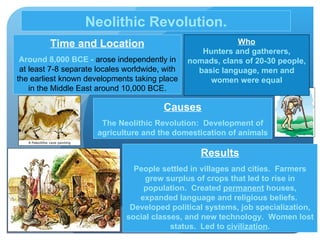
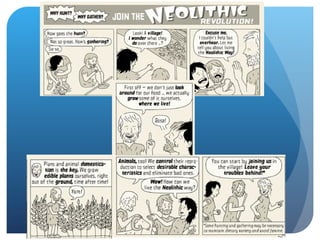



Neolithic Revolution. Time and Location Around 8,000 BCE -  arose independently in at least 7-8 separate locales worldwide, with the earliest known developments taking place in the Middle East around 10,000 BCE. Causes The Neolithic Revolution:  Development of agriculture and the domestication of animals Results People settled in villages and cities.  Farmers grew surplus of crops that led to rise in population.  Created  permanent  houses, expanded language and religious beliefs.  Developed political systems, job specialization, social classes, and new technology.  Women lost status.  Led to  civilization . Who Hunters and gatherers, nomads, clans of 20-30 people, basic language, men and women were equal
 
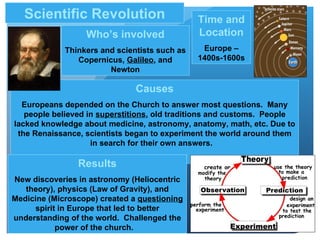
Scientific Revolution Causes Europeans depended on the Church to answer most questions.  Many people believed in  superstitions , old traditions and customs.  People lacked knowledge about medicine, astronomy, anatomy, math, etc. Due to the Renaissance, scientists began to experiment the world around them in search for their own answers.  Who’s involved Thinkers and scientists such as Copernicus,  Galileo , and Newton Results New discoveries in astronomy (Heliocentric theory), physics (Law of Gravity), and Medicine (Microscope) created a  questioning  spirit in Europe that led to better understanding of the world.  Challenged the power of the church.  Time and Location Europe – 1400s-1600s
Scientific Revolution
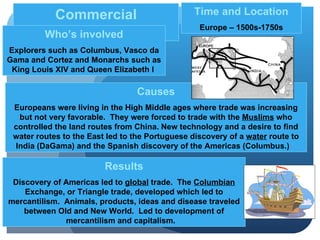
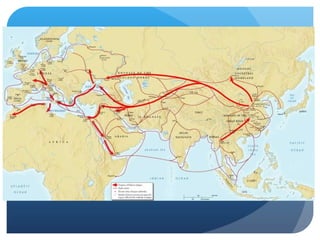
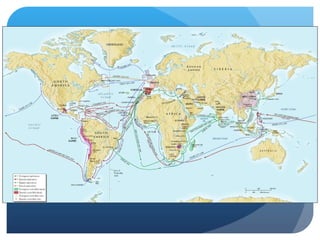
Commercial Revolution Causes Europeans were living in the High Middle ages where trade was increasing but not very favorable.  They were forced to trade with the  Muslims  who controlled the land routes from China. New technology and a desire to find water routes to the East led to the Portuguese discovery of a  water  route to India (DaGama) and the Spanish discovery of the Americas (Columbus.)  Results Discovery of Americas led to  global  trade.  The  Columbian  Exchange, or Triangle trade, developed which led to mercantilism.  Animals, products, ideas and disease traveled between Old and New World.  Led to development of mercantilism and capitalism.  Who’s involved Explorers such as Columbus, Vasco da Gama and Cortez and Monarchs such as King Louis XIV and Queen Elizabeth I  Time and Location Europe – 1500s-1750s
 
 
Exploration
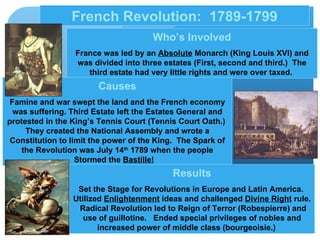
French Revolution:  1789-1799 Who’s Involved France was led by an  Absolute  Monarch (King Louis XVI) and was divided into three estates (First, second and third.)  The third estate had very little rights and were over taxed.  Causes Famine and war swept the land and the French economy was suffering. Third Estate left the Estates General and protested in the King’s Tennis Court (Tennis Court Oath.)  They created the National Assembly and wrote a Constitution to limit the power of the King.  The Spark of the Revolution was July 14 th  1789 when the people Stormed the  Bastille!   Results Set the Stage for Revolutions in Europe and Latin America.  Utilized  Enlightenment  ideas and challenged  Divine Right  rule.  Radical Revolution led to Reign of Terror (Robespierre) and use of guillotine.  Ended special privileges of nobles and increased power of middle class (bourgeoisie.)
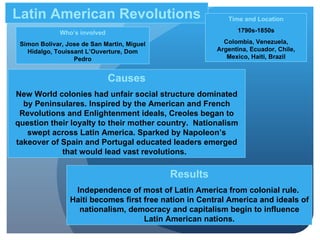
Latin American Revolutions Causes New World colonies had unfair social structure dominated by Peninsulares. Inspired by the American and French Revolutions and Enlightenment ideals, Creoles began to question their loyalty to their mother country.  Nationalism swept across Latin America. Sparked by Napoleon’s takeover of Spain and Portugal educated leaders emerged that would lead vast revolutions.  Results Independence of most of Latin America from colonial rule.  Haiti becomes first free nation in Central America and ideals of nationalism, democracy and capitalism begin to influence Latin American nations. Who’s involved Simon Bolivar, Jose de San Martin, Miguel Hidalgo, Touissant L’Ouverture, Dom Pedro Time and Location 1790s-1850s Colombia, Venezuela, Argentina, Ecuador, Chile, Mexico, Haiti, Brazil
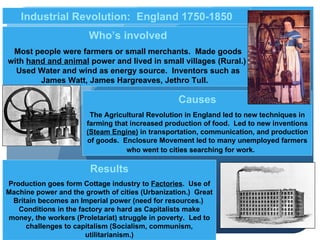
Industrial Revolution:  England 1750-1850 Who’s involved Most people were farmers or small merchants.  Made goods with  hand and animal  power and lived in small villages (Rural.)  Used Water and wind as energy source.  Inventors such as James Watt, James Hargreaves, Jethro Tull.  Causes The Agricultural Revolution in England led to new techniques in farming that increased production of food.  Led to new inventions  (Steam Engine)  in transportation, communication, and production of goods.  Enclosure Movement led to many unemployed farmers who went to cities searching for work.   Results Production goes form Cottage industry to  Factories .  Use of Machine power and the growth of cities (Urbanization.)  Great Britain becomes an Imperial power (need for resources.)  Conditions in the factory are hard as Capitalists make money, the workers (Proletariat) struggle in poverty.  Led to challenges to capitalism (Socialism, communism, utilitarianism.)
Industrial Revolution
Russian Revolution Causes Poor economic conditions, corrupt and weak leadership, harsh treatment of the people, and rigid social structure led to rising peasant concerns.  Spark was WWI – led to March and November Revolutions.  Results Vladimir Lenin and the Bolsheviks took over the government and formed the first communist nation based on the ideas of Karl Marx.  Lenin created a classless society, redistributed land and exited WWI.  His slogan was “Peace, Bread, Land.” Who’s involved Czar Nicholas II, Rasputin, Vladimir Lenin Time and Location 1917 Russia

Revolutions

  • 1.
    Neolithic Revolution. Timeand Location Around 8,000 BCE - arose independently in at least 7-8 separate locales worldwide, with the earliest known developments taking place in the Middle East around 10,000 BCE. Causes The Neolithic Revolution: Development of agriculture and the domestication of animals Results People settled in villages and cities. Farmers grew surplus of crops that led to rise in population. Created permanent houses, expanded language and religious beliefs. Developed political systems, job specialization, social classes, and new technology. Women lost status. Led to civilization . Who Hunters and gatherers, nomads, clans of 20-30 people, basic language, men and women were equal
  • 2.
  • 3.
    Scientific Revolution CausesEuropeans depended on the Church to answer most questions. Many people believed in superstitions , old traditions and customs. People lacked knowledge about medicine, astronomy, anatomy, math, etc. Due to the Renaissance, scientists began to experiment the world around them in search for their own answers. Who’s involved Thinkers and scientists such as Copernicus, Galileo , and Newton Results New discoveries in astronomy (Heliocentric theory), physics (Law of Gravity), and Medicine (Microscope) created a questioning spirit in Europe that led to better understanding of the world. Challenged the power of the church. Time and Location Europe – 1400s-1600s
  • 4.
  • 5.
    Commercial Revolution CausesEuropeans were living in the High Middle ages where trade was increasing but not very favorable. They were forced to trade with the Muslims who controlled the land routes from China. New technology and a desire to find water routes to the East led to the Portuguese discovery of a water route to India (DaGama) and the Spanish discovery of the Americas (Columbus.) Results Discovery of Americas led to global trade. The Columbian Exchange, or Triangle trade, developed which led to mercantilism. Animals, products, ideas and disease traveled between Old and New World. Led to development of mercantilism and capitalism. Who’s involved Explorers such as Columbus, Vasco da Gama and Cortez and Monarchs such as King Louis XIV and Queen Elizabeth I Time and Location Europe – 1500s-1750s
  • 6.
  • 7.
  • 8.
  • 9.
    French Revolution: 1789-1799 Who’s Involved France was led by an Absolute Monarch (King Louis XVI) and was divided into three estates (First, second and third.) The third estate had very little rights and were over taxed. Causes Famine and war swept the land and the French economy was suffering. Third Estate left the Estates General and protested in the King’s Tennis Court (Tennis Court Oath.) They created the National Assembly and wrote a Constitution to limit the power of the King. The Spark of the Revolution was July 14 th 1789 when the people Stormed the Bastille! Results Set the Stage for Revolutions in Europe and Latin America. Utilized Enlightenment ideas and challenged Divine Right rule. Radical Revolution led to Reign of Terror (Robespierre) and use of guillotine. Ended special privileges of nobles and increased power of middle class (bourgeoisie.)
  • 10.
    Latin American RevolutionsCauses New World colonies had unfair social structure dominated by Peninsulares. Inspired by the American and French Revolutions and Enlightenment ideals, Creoles began to question their loyalty to their mother country. Nationalism swept across Latin America. Sparked by Napoleon’s takeover of Spain and Portugal educated leaders emerged that would lead vast revolutions. Results Independence of most of Latin America from colonial rule. Haiti becomes first free nation in Central America and ideals of nationalism, democracy and capitalism begin to influence Latin American nations. Who’s involved Simon Bolivar, Jose de San Martin, Miguel Hidalgo, Touissant L’Ouverture, Dom Pedro Time and Location 1790s-1850s Colombia, Venezuela, Argentina, Ecuador, Chile, Mexico, Haiti, Brazil
  • 11.
    Industrial Revolution: England 1750-1850 Who’s involved Most people were farmers or small merchants. Made goods with hand and animal power and lived in small villages (Rural.) Used Water and wind as energy source. Inventors such as James Watt, James Hargreaves, Jethro Tull. Causes The Agricultural Revolution in England led to new techniques in farming that increased production of food. Led to new inventions (Steam Engine) in transportation, communication, and production of goods. Enclosure Movement led to many unemployed farmers who went to cities searching for work. Results Production goes form Cottage industry to Factories . Use of Machine power and the growth of cities (Urbanization.) Great Britain becomes an Imperial power (need for resources.) Conditions in the factory are hard as Capitalists make money, the workers (Proletariat) struggle in poverty. Led to challenges to capitalism (Socialism, communism, utilitarianism.)
  • 12.
  • 13.
    Russian Revolution CausesPoor economic conditions, corrupt and weak leadership, harsh treatment of the people, and rigid social structure led to rising peasant concerns. Spark was WWI – led to March and November Revolutions. Results Vladimir Lenin and the Bolsheviks took over the government and formed the first communist nation based on the ideas of Karl Marx. Lenin created a classless society, redistributed land and exited WWI. His slogan was “Peace, Bread, Land.” Who’s involved Czar Nicholas II, Rasputin, Vladimir Lenin Time and Location 1917 Russia