1837 - 1901

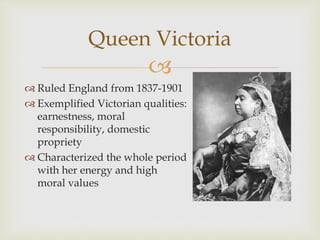
 Ruled England from 1837-1901
 Exemplified Victorian qualities:
earnestness, moral
responsibility, domestic
propriety
 Characterized the whole period
with her energy and high
moral values
Queen Victoria

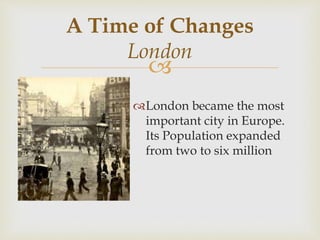
London became the most
important city in Europe.
Its Population expanded
from two to six million
A Time of Changes
London

 The poor lived in slums, horrible quarters
characterized by squalor, disease and crime. The
atmosphere was polluted and that caused a
disastrous effect especially on children’s health
 Law and order were among the major problems of
the urban environment. The Prime Minister Sir
Robert Peel founded the Metropolitan Police, known
as “bobbies” from the name of their founder.
Urban habitat

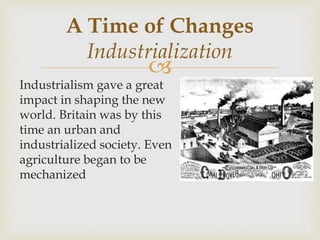
Industrialism gave a great
impact in shaping the new
world. Britain was by this
time an urban and
industrialized society. Even
agriculture began to be
mechanized
A Time of Changes
Industrialization

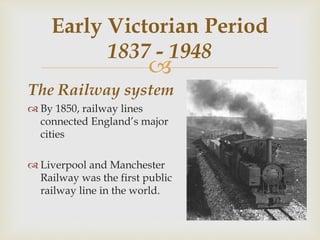
The Railway system
 By 1850, railway lines
connected England’s major
cities
 Liverpool and Manchester
Railway was the first public
railway line in the world.
Early Victorian Period
1837 - 1948

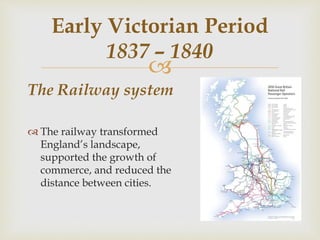
The Railway system
 The railway transformed
England’s landscape,
supported the growth of
commerce, and reduced the
distance between cities.
Early Victorian Period
1837 – 1840

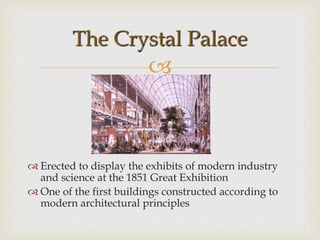
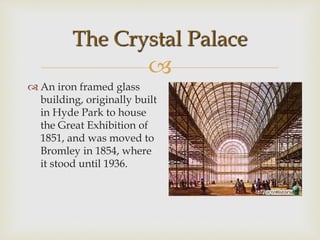
 Erected to display the exhibits of modern industry
and science at the 1851 Great Exhibition
 One of the first buildings constructed according to
modern architectural principles
The Crystal Palace

 An iron framed glass
building, originally built
in Hyde Park to house
the Great Exhibition of
1851, and was moved to
Bromley in 1854, where
it stood until 1936.
The Crystal Palace

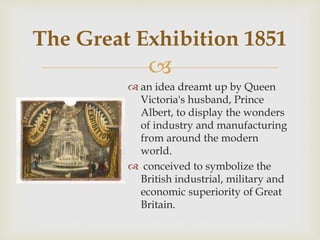
 an idea dreamt up by Queen
Victoria's husband, Prince
Albert, to display the wonders
of industry and manufacturing
from around the modern
world.
 conceived to symbolize the
British industrial, military and
economic superiority of Great
Britain.
The Great Exhibition 1851

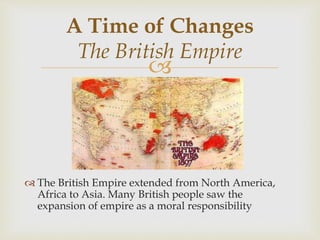
 The British Empire extended from North America,
Africa to Asia. Many British people saw the
expansion of empire as a moral responsibility
A Time of Changes
The British Empire

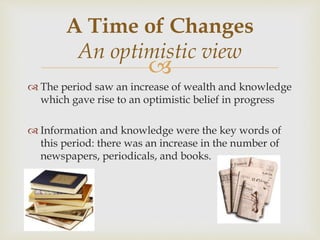
 The period saw an increase of wealth and knowledge
which gave rise to an optimistic belief in progress
 Information and knowledge were the key words of
this period: there was an increase in the number of
newspapers, periodicals, and books.
A Time of Changes
An optimistic view

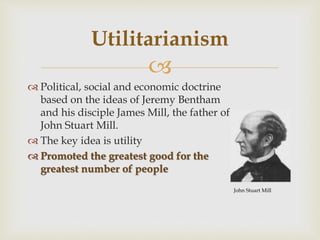
 Political, social and economic doctrine
based on the ideas of Jeremy Bentham
and his disciple James Mill, the father of
John Stuart Mill.
 The key idea is utility
 Promoted the greatest good for the
greatest number of people
Utilitarianism
John Stuart Mill

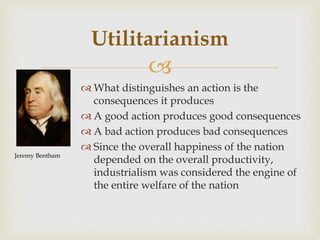
 What distinguishes an action is the
consequences it produces
 A good action produces good consequences
 A bad action produces bad consequences
 Since the overall happiness of the nation
depended on the overall productivity,
industrialism was considered the engine of
the entire welfare of the nation
Utilitarianism
Jeremy Bentham

 Utilitarianism required rationality and mathematical
approach in every aspect of life
 There was a stupendous amount of importance
given to 'facts'.
 Negated the concept of 'fancy', imagination and
human emotions depriving people of enjoying they
personal qualities
Utilitarianism

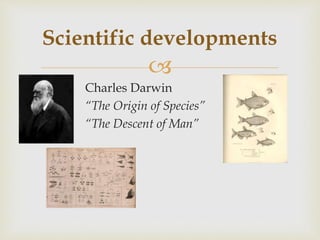
Charles Darwin
“The Origin of Species”
“The Descent of Man”
Scientific developments

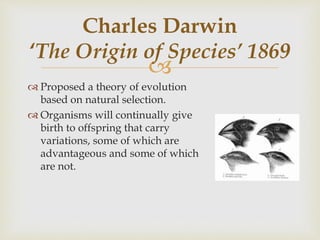
 Proposed a theory of evolution
based on natural selection.
 Organisms will continually give
birth to offspring that carry
variations, some of which are
advantageous and some of which
are not.
Charles Darwin
‘The Origin of Species’ 1869

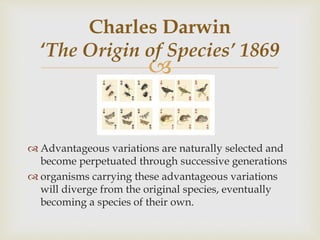
 Advantageous variations are naturally selected and
become perpetuated through successive generations
 organisms carrying these advantageous variations
will diverge from the original species, eventually
becoming a species of their own.
Charles Darwin
‘The Origin of Species’ 1869

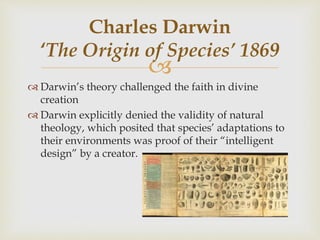
 Darwin’s theory challenged the faith in divine
creation
 Darwin explicitly denied the validity of natural
theology, which posited that species’ adaptations to
their environments was proof of their “intelligent
design” by a creator.
Charles Darwin
‘The Origin of Species’ 1869

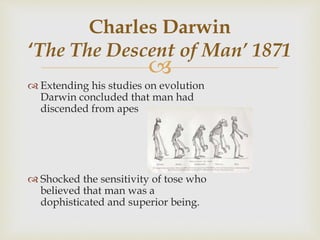
 Extending his studies on evolution
Darwin concluded that man had
discended from apes
 Shocked the sensitivity of tose who
believed that man was a
dophisticated and superior being.
Charles Darwin
‘The The Descent of Man’ 1871

 Darwin’s influence is far from limited to science. His
work has influenced a wide range of topics including
political and economic thinking.
 Natural selection was often used to reinforce existing
ideas and prejudices considering some men
Charles Darwin
‘The The Descent of Man’ 1871

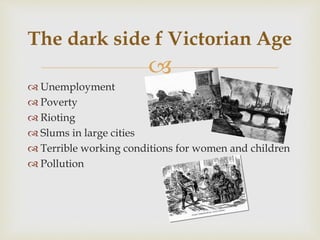
 Unemployment
 Poverty
 Rioting
 Slums in large cities
 Terrible working conditions for women and children
 Pollution
The dark side f Victorian Age

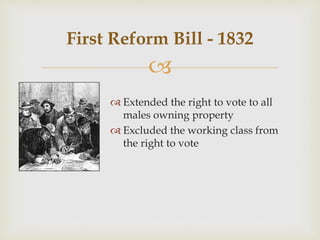
 Extended the right to vote to all
males owning property
 Excluded the working class from
the right to vote
First Reform Bill - 1832

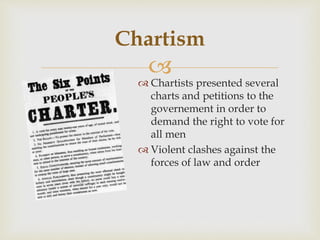
 Chartists presented several
charts and petitions to the
governement in order to
demand the right to vote for
all men
 Violent clashes against the
forces of law and order
Chartism

 Gave the right to vote to alla male workers –
labourers, farmers and miners.
 It was only in 1918 that all men regardless their
occupation, would have theright to vote (men over
21 and women over 30)
The third Reform Bill - 1884

 In 1833 the Factory Act limited the working hours of
children
 Children aged 11–18 should work a maximum of 12
hours per day
 Children aged 9–11 a maximum of eight hours, and
children under the age of nine should no longer be
permitted to work
 This act, however, only applied to the textile
industry
Victorian Reforms

 In 1842 a law was passed to ban women and children
working in mines
 In 1847 the Ten Hours’ Act limited the working
hours, for adult workers too, to ten a day
 In 1870 the Education Act established the right of all
children to schooling
 The 1880 Act obliged all children between the ages of
5 and 10 to attend school
 In 1891 education becomes free for every child
Victorian Reforms

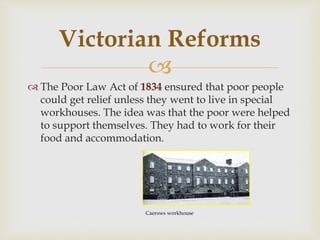
 The Poor Law Act of 1834 ensured that poor people
could get relief unless they went to live in special
workhouses. The idea was that the poor were helped
to support themselves. They had to work for their
food and accommodation.
Victorian Reforms
Caersws workhouse
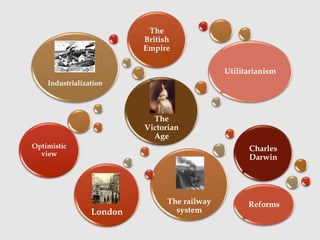
The
Victorian
Age
Industrialization
The railway
system
The
British
Empire
London
Optimistic
view
Utilitarianism
Charles
Darwin
Reforms

Victorian Age

  • 1.
  • 2.
      Ruled Englandfrom 1837-1901  Exemplified Victorian qualities: earnestness, moral responsibility, domestic propriety  Characterized the whole period with her energy and high moral values Queen Victoria
  • 3.
     London became themost important city in Europe. Its Population expanded from two to six million A Time of Changes London
  • 4.
      The poorlived in slums, horrible quarters characterized by squalor, disease and crime. The atmosphere was polluted and that caused a disastrous effect especially on children’s health  Law and order were among the major problems of the urban environment. The Prime Minister Sir Robert Peel founded the Metropolitan Police, known as “bobbies” from the name of their founder. Urban habitat
  • 5.
     Industrialism gave agreat impact in shaping the new world. Britain was by this time an urban and industrialized society. Even agriculture began to be mechanized A Time of Changes Industrialization
  • 6.
     The Railway system By 1850, railway lines connected England’s major cities  Liverpool and Manchester Railway was the first public railway line in the world. Early Victorian Period 1837 - 1948
  • 7.
     The Railway system The railway transformed England’s landscape, supported the growth of commerce, and reduced the distance between cities. Early Victorian Period 1837 – 1840
  • 8.
      Erected todisplay the exhibits of modern industry and science at the 1851 Great Exhibition  One of the first buildings constructed according to modern architectural principles The Crystal Palace
  • 9.
      An ironframed glass building, originally built in Hyde Park to house the Great Exhibition of 1851, and was moved to Bromley in 1854, where it stood until 1936. The Crystal Palace
  • 10.
      an ideadreamt up by Queen Victoria's husband, Prince Albert, to display the wonders of industry and manufacturing from around the modern world.  conceived to symbolize the British industrial, military and economic superiority of Great Britain. The Great Exhibition 1851
  • 11.
      The BritishEmpire extended from North America, Africa to Asia. Many British people saw the expansion of empire as a moral responsibility A Time of Changes The British Empire
  • 12.
      The periodsaw an increase of wealth and knowledge which gave rise to an optimistic belief in progress  Information and knowledge were the key words of this period: there was an increase in the number of newspapers, periodicals, and books. A Time of Changes An optimistic view
  • 13.
      Political, socialand economic doctrine based on the ideas of Jeremy Bentham and his disciple James Mill, the father of John Stuart Mill.  The key idea is utility  Promoted the greatest good for the greatest number of people Utilitarianism John Stuart Mill
  • 14.
      What distinguishesan action is the consequences it produces  A good action produces good consequences  A bad action produces bad consequences  Since the overall happiness of the nation depended on the overall productivity, industrialism was considered the engine of the entire welfare of the nation Utilitarianism Jeremy Bentham
  • 15.
      Utilitarianism requiredrationality and mathematical approach in every aspect of life  There was a stupendous amount of importance given to 'facts'.  Negated the concept of 'fancy', imagination and human emotions depriving people of enjoying they personal qualities Utilitarianism
  • 16.
     Charles Darwin “The Originof Species” “The Descent of Man” Scientific developments
  • 17.
      Proposed atheory of evolution based on natural selection.  Organisms will continually give birth to offspring that carry variations, some of which are advantageous and some of which are not. Charles Darwin ‘The Origin of Species’ 1869
  • 18.
      Advantageous variationsare naturally selected and become perpetuated through successive generations  organisms carrying these advantageous variations will diverge from the original species, eventually becoming a species of their own. Charles Darwin ‘The Origin of Species’ 1869
  • 19.
      Darwin’s theorychallenged the faith in divine creation  Darwin explicitly denied the validity of natural theology, which posited that species’ adaptations to their environments was proof of their “intelligent design” by a creator. Charles Darwin ‘The Origin of Species’ 1869
  • 20.
      Extending hisstudies on evolution Darwin concluded that man had discended from apes  Shocked the sensitivity of tose who believed that man was a dophisticated and superior being. Charles Darwin ‘The The Descent of Man’ 1871
  • 21.
      Darwin’s influenceis far from limited to science. His work has influenced a wide range of topics including political and economic thinking.  Natural selection was often used to reinforce existing ideas and prejudices considering some men Charles Darwin ‘The The Descent of Man’ 1871
  • 22.
      Unemployment  Poverty Rioting  Slums in large cities  Terrible working conditions for women and children  Pollution The dark side f Victorian Age
  • 23.
      Extended theright to vote to all males owning property  Excluded the working class from the right to vote First Reform Bill - 1832
  • 24.
      Chartists presentedseveral charts and petitions to the governement in order to demand the right to vote for all men  Violent clashes against the forces of law and order Chartism
  • 25.
      Gave theright to vote to alla male workers – labourers, farmers and miners.  It was only in 1918 that all men regardless their occupation, would have theright to vote (men over 21 and women over 30) The third Reform Bill - 1884
  • 26.
      In 1833the Factory Act limited the working hours of children  Children aged 11–18 should work a maximum of 12 hours per day  Children aged 9–11 a maximum of eight hours, and children under the age of nine should no longer be permitted to work  This act, however, only applied to the textile industry Victorian Reforms
  • 27.
      In 1842a law was passed to ban women and children working in mines  In 1847 the Ten Hours’ Act limited the working hours, for adult workers too, to ten a day  In 1870 the Education Act established the right of all children to schooling  The 1880 Act obliged all children between the ages of 5 and 10 to attend school  In 1891 education becomes free for every child Victorian Reforms
  • 28.
      The PoorLaw Act of 1834 ensured that poor people could get relief unless they went to live in special workhouses. The idea was that the poor were helped to support themselves. They had to work for their food and accommodation. Victorian Reforms Caersws workhouse
  • 29.