Palaces, Prosperity, and
Revolutions
Weeks 11-12
Overview
• c. 1670 – 1815
• Political Use of Space
• 18th Century Culture
• The American
Revolution
• The French Revolution
• Napoleon
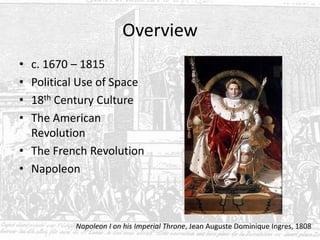
Napoleon I on his Imperial Throne, Jean Auguste Dominique Ingres, 1808
Space and Splendor
• Political use of space
• Importance of the
Monarch
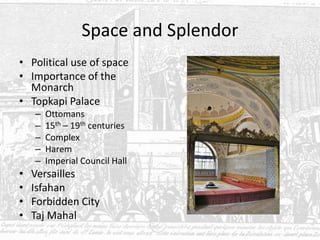
• Topkapi Palace
– Ottomans
– 15th – 19th centuries
– Complex
– Harem
– Imperial Council Hall
• Versailles
• Isfahan
• Forbidden City
• Taj Mahal
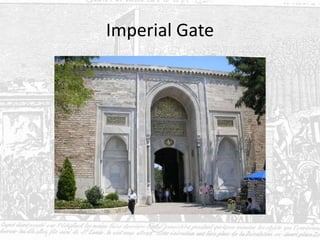
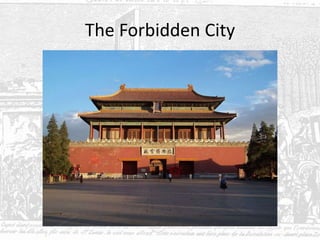
Imperial Gate
The Forbidden City
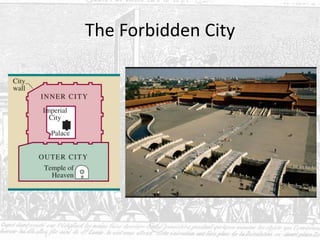
The Forbidden City
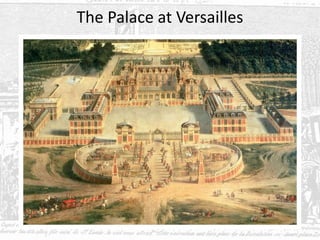
The Palace at Versailles
p446
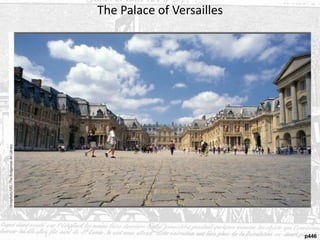
The Palace of Versailles
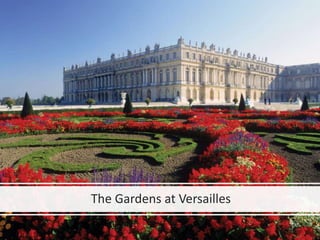
The Gardens at Versailles
p448
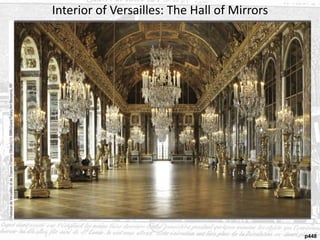
Interior of Versailles: The Hall of Mirrors
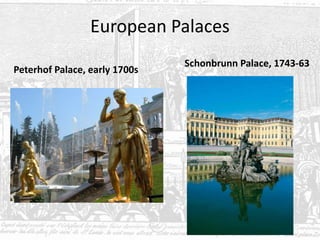
European Palaces
Peterhof Palace, early 1700s
Schonbrunn Palace, 1743-63
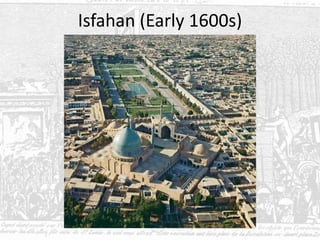
Isfahan (Early 1600s)
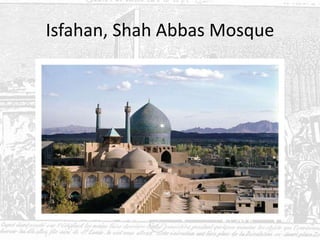
Isfahan, Shah Abbas Mosque
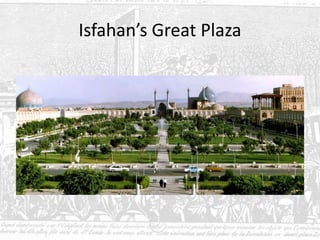
Isfahan’s Great Plaza
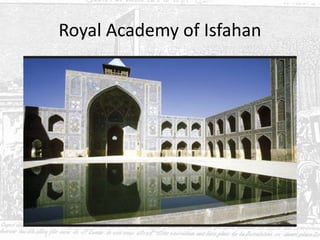
Royal Academy of Isfahan
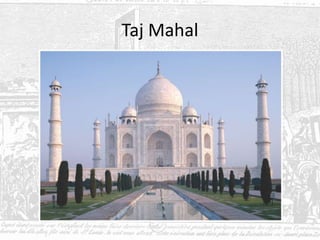
Taj Mahal
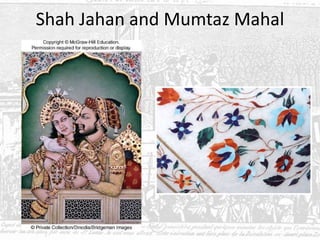
Shah Jahan and Mumtaz Mahal
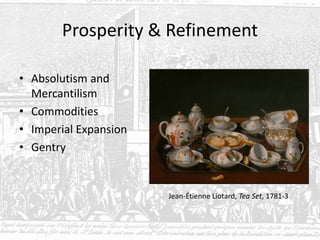
Prosperity & Refinement
• Absolutism and
Mercantilism
• Commodities
• Imperial Expansion
• Gentry
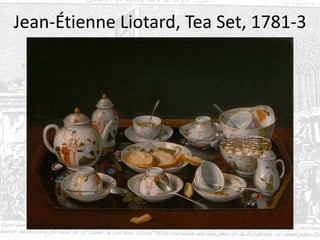
Jean-Étienne Liotard, Tea Set, 1781-3
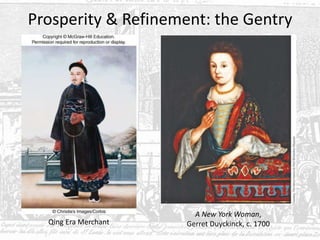
Prosperity & Refinement: the Gentry
Qing Era Merchant
A New York Woman,
Gerret Duyckinck, c. 1700
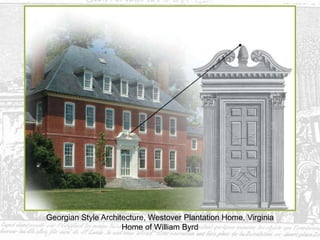
Georgian Style Architecture, Westover Plantation Home, Virginia
Home of William Byrd
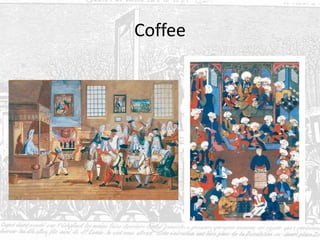
Coffee
Jean-Étienne Liotard, Tea Set, 1781-3
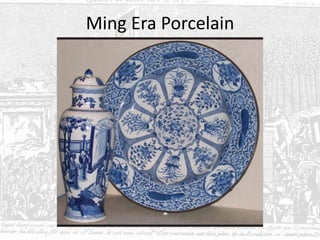
Ming Era Porcelain
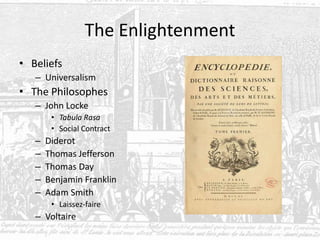
The Enlightenment
• Beliefs
– Universalism
• The Philosophes
– John Locke
• Tabula Rasa
• Social Contract
– Diderot
– Thomas Jefferson
– Thomas Day
– Benjamin Franklin
– Adam Smith
• Laissez-faire
– Voltaire
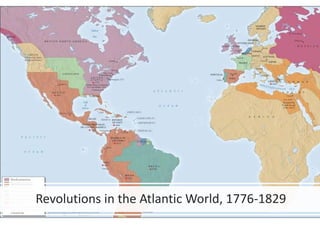
Revolutions in the Atlantic World, 1776-1829
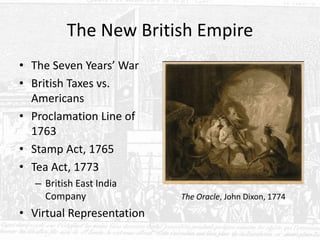
The New British Empire
• The Seven Years’ War
• British Taxes vs.
Americans
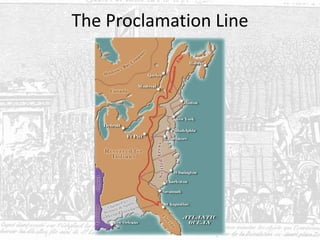
• Proclamation Line of
1763
• Stamp Act, 1765
• Tea Act, 1773
– British East India
Company
• Virtual Representation
The Oracle, John Dixon, 1774
The Proclamation Line
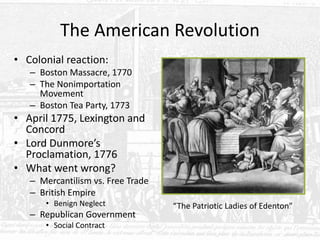
The American Revolution
• Colonial reaction:
– Boston Massacre, 1770
– The Nonimportation
Movement
– Boston Tea Party, 1773
• April 1775, Lexington and
Concord
• Lord Dunmore’s
Proclamation, 1776
• What went wrong?
– Mercantilism vs. Free Trade
– British Empire
• Benign Neglect
– Republican Government
• Social Contract
“The Patriotic Ladies of Edenton”
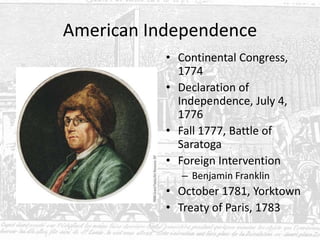
American Independence
• Continental Congress,
1774
• Declaration of
Independence, July 4,
1776
• Fall 1777, Battle of
Saratoga
• Foreign Intervention
– Benjamin Franklin
• October 1781, Yorktown
• Treaty of Paris, 1783
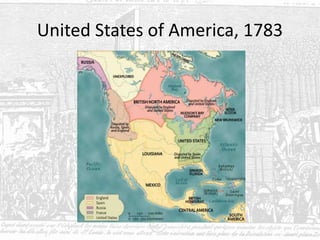
United States of America, 1783
The American Constitution
• Articles of
Confederation
• Shays’ Rebellion, 1786
– Paper currency & Bonds
• Constitutional
Convention, 1787
– Popular sovereignty
– Republican government
– Free trade
– Free markets
– Free labor
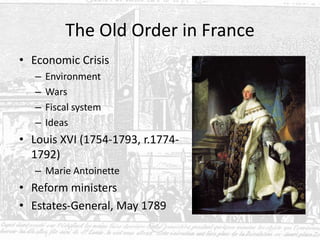
The Old Order in France
• Economic Crisis
– Environment
– Wars
– Fiscal system
– Ideas
• Louis XVI (1754-1793, r.1774-
1792)
– Marie Antoinette
• Reform ministers
• Estates-General, May 1789
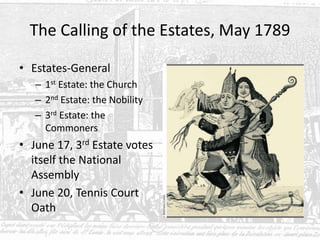
The Calling of the Estates, May 1789
• Estates-General
– 1st Estate: the Church
– 2nd Estate: the Nobility
– 3rd Estate: the
Commoners
• June 17, 3rd Estate votes
itself the National
Assembly
• June 20, Tennis Court
Oath
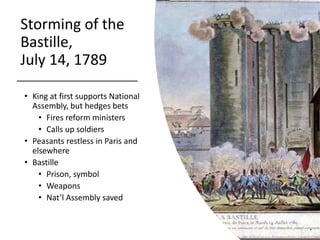
Storming of the
Bastille,
July 14, 1789
• King at first supports National
Assembly, but hedges bets
• Fires reform ministers
• Calls up soldiers
• Peasants restless in Paris and
elsewhere
• Bastille
• Prison, symbol
• Weapons
• Nat’l Assembly saved
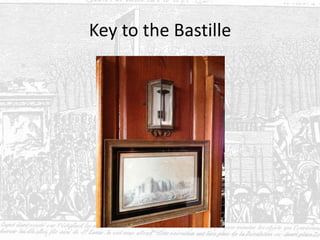
Key to the Bastille
Timeline of the Revolution
• June 1789 – Sept 1791, National Assembly
• Oct 1791 – Sept 1792, Legislative Assembly
• Sept 1792 – July 1794, National Convention
– April 1793 – July 1794, Committee of Public Safety
• Aug 1794 – Oct 1795, Thermidorian Reaction
• Oct 1795 – Nov 1799, The Directory
• Napoleon
– Nov 1799, Consulate/Triumvirate, “First Consul”
– 1802, Consul for life
– 1804, Emperor
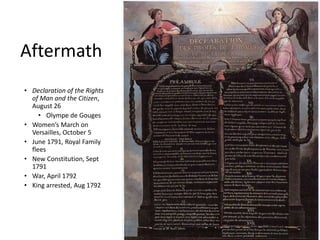
Aftermath
• Declaration of the Rights
of Man and the Citizen,
August 26
• Olympe de Gouges
• Women’s March on
Versailles, October 5
• June 1791, Royal Family
flees
• New Constitution, Sept
1791
• War, April 1792
• King arrested, Aug 1792
The French Republic
• Jacobins
• Louis XIV
• Maximilien Robespierre
(1758-1794)
• Committee of Public Safety
• The Reign of Terror, 1793-
1794
• Guillotine: 10,000s killed
– 26 killed/day in Paris,
officially
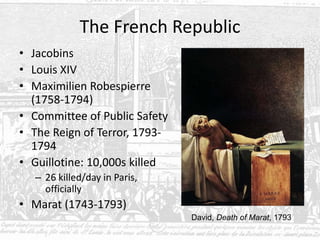
• Marat (1743-1793)
David, Death of Marat, 1793
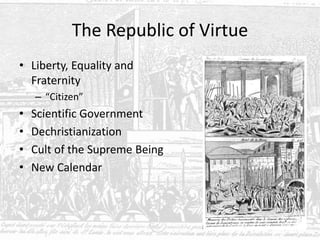
The Republic of Virtue
• Liberty, Equality and
Fraternity
– “Citizen”
• Scientific Government
• Dechristianization
• Cult of the Supreme Being
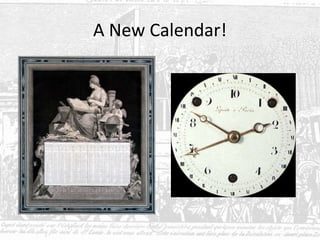
• New Calendar
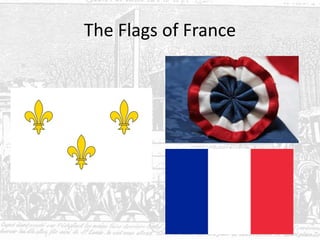
The Flags of France
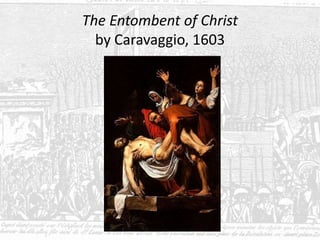
The Entombent of Christ
by Caravaggio, 1603
A New Calendar!
Rise of Napoleon
• Robespierre arrested, July
27, 1794
• France’s Revolutionary
Army
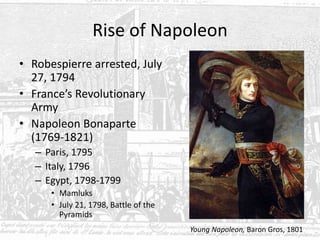
• Napoleon Bonaparte
(1769-1821)
– Paris, 1795
– Italy, 1796
– Egypt, 1798-1799
• Mamluks
• July 21, 1798, Battle of the
Pyramids
Young Napoleon, Baron Gros, 1801
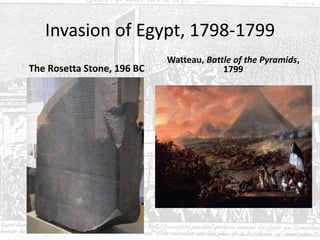
Invasion of Egypt, 1798-1799
The Rosetta Stone, 196 BC
Watteau, Battle of the Pyramids,
1799
Napoleon’s Reign
• 1804, Emperor
• Accomplishments
– Pope
– Napoleonic Code
– Grand Army
• 1812, Invasion of Russia
• 1814, Exiled to Elba
• 1815, Battle of
Waterloo
• Final exile to St. Helena
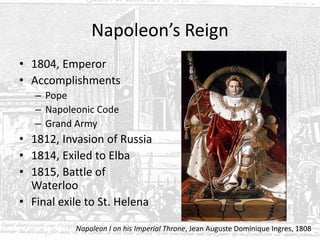
Napoleon I on his Imperial Throne, Jean Auguste Dominique Ingres, 1808
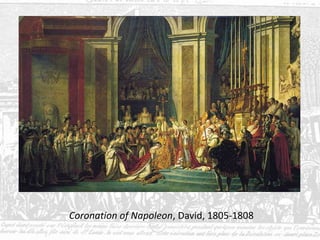
Coronation of Napoleon, David, 1805-1808
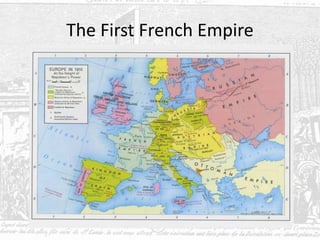
The First French Empire
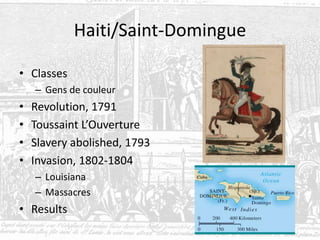
Haiti/Saint-Domingue
• Classes
– Gens de couleur
• Revolution, 1791
• Toussaint L’Ouverture
• Slavery abolished, 1793
• Invasion, 1802-1804
– Louisiana
– Massacres
• Results
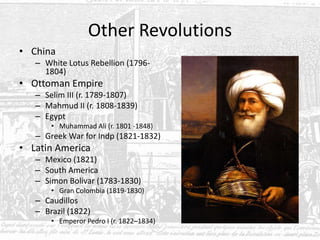
Other Revolutions
• China
– White Lotus Rebellion (1796-
1804)
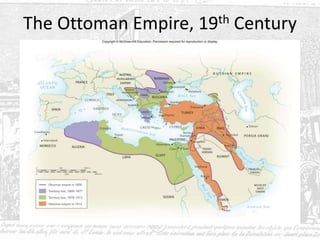
• Ottoman Empire
– Selim III (r. 1789-1807)
– Mahmud II (r. 1808-1839)
– Egypt
• Muhammad Ali (r. 1801 -1848)
– Greek War for Indp (1821-1832)
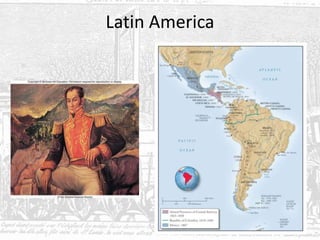
• Latin America
– Mexico (1821)
– South America
– Simon Bolivar (1783-1830)
• Gran Colombia (1819-1830)
– Caudillos
– Brazil (1822)
• Emperor Pedro I (r. 1822–1834)
The Ottoman Empire, 19th Century
Latin America
Intro to the Industrial Revolution
• “A process by which new methods of
production and new sources of power enabled
a given worker to produce an ever greater
quantity of goods and through which a largely
agricultural society transformed itself into one
composed primarily of producers of
manufactured goods and providers of
services.”
– Walter Arnstein
• Importance
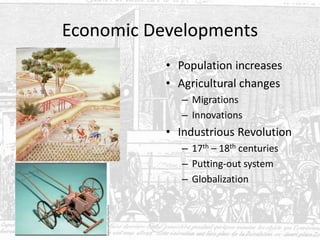
Economic Developments
• Population increases
• Agricultural changes
– Migrations
– Innovations
• Industrious Revolution
– 17th – 18th centuries
– Putting-out system
– Globalization
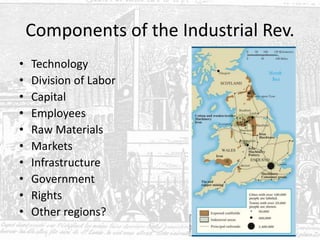
Components of the Industrial Rev.
• Technology
• Division of Labor
• Capital
• Employees
• Raw Materials
• Markets
• Infrastructure
• Government
• Rights
• Other regions?
What was produced in the
Industrial Revolution?
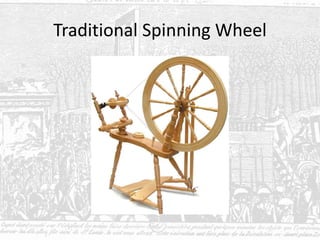
Traditional Spinning Wheel
Textile Factories
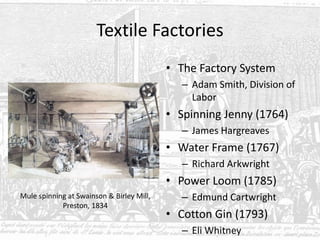
• The Factory System
– Adam Smith, Division of
Labor
• Spinning Jenny (1764)
– James Hargreaves
• Water Frame (1767)
– Richard Arkwright
• Power Loom (1785)
– Edmund Cartwright
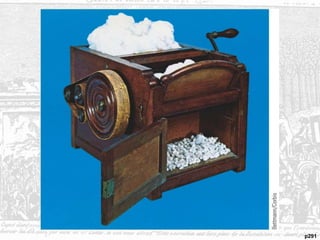
• Cotton Gin (1793)
– Eli Whitney
Mule spinning at Swainson & Birley Mill,
Preston, 1834
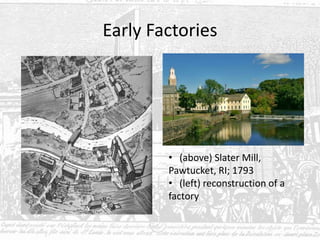
Early Factories
• (above) Slater Mill,
Pawtucket, RI; 1793
• (left) reconstruction of a
factory
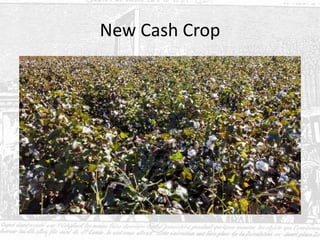
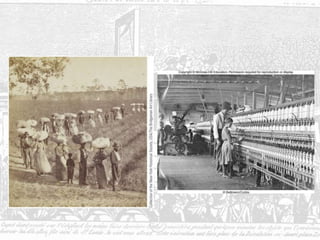
New Cash Crop
p291
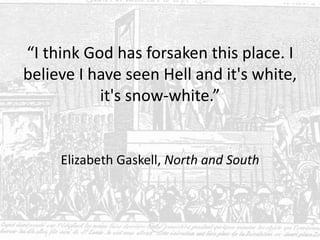
“I think God has forsaken this place. I
believe I have seen Hell and it's white,
it's snow-white.”
Elizabeth Gaskell, North and South
Industrial Society
• Developments
– Coke, 1709
– James Watt, 1765
– 1st steam powered train, 1815
• Limited-Liability Joint-Stock
Company
• Bourgeoisie/Middle Class
• Working Class
– Free Labor
– Regulated Day
– Discipline
• Reform
– Luddites
– Unions
– British Mines Act, 1842
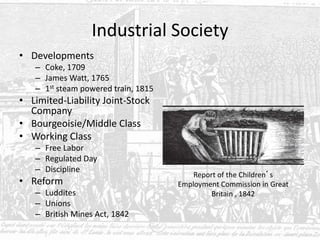
Report of the Children’s
Employment Commission in Great
Britain , 1842
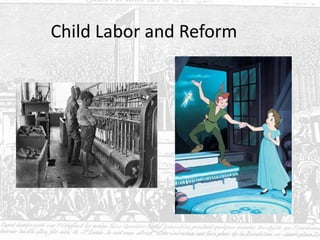
Child Labor and Reform

Week 11 (Revolutions)

  • 1.
  • 2.
    Overview • c. 1670– 1815 • Political Use of Space • 18th Century Culture • The American Revolution • The French Revolution • Napoleon Napoleon I on his Imperial Throne, Jean Auguste Dominique Ingres, 1808
  • 3.
    Space and Splendor •Political use of space • Importance of the Monarch • Topkapi Palace – Ottomans – 15th – 19th centuries – Complex – Harem – Imperial Council Hall • Versailles • Isfahan • Forbidden City • Taj Mahal
  • 4.
  • 5.
  • 6.
  • 7.
    The Palace atVersailles
  • 8.
  • 9.
    The Gardens atVersailles
  • 10.
    p448 Interior of Versailles:The Hall of Mirrors
  • 11.
    European Palaces Peterhof Palace,early 1700s Schonbrunn Palace, 1743-63
  • 12.
  • 13.
  • 14.
  • 15.
  • 16.
  • 17.
    Shah Jahan andMumtaz Mahal
  • 18.
    Prosperity & Refinement •Absolutism and Mercantilism • Commodities • Imperial Expansion • Gentry Jean-Étienne Liotard, Tea Set, 1781-3
  • 19.
    Prosperity & Refinement:the Gentry Qing Era Merchant A New York Woman, Gerret Duyckinck, c. 1700
  • 20.
    Georgian Style Architecture,Westover Plantation Home, Virginia Home of William Byrd
  • 21.
  • 22.
  • 23.
  • 24.
    The Enlightenment • Beliefs –Universalism • The Philosophes – John Locke • Tabula Rasa • Social Contract – Diderot – Thomas Jefferson – Thomas Day – Benjamin Franklin – Adam Smith • Laissez-faire – Voltaire
  • 25.
    Revolutions in theAtlantic World, 1776-1829
  • 26.
    The New BritishEmpire • The Seven Years’ War • British Taxes vs. Americans • Proclamation Line of 1763 • Stamp Act, 1765 • Tea Act, 1773 – British East India Company • Virtual Representation The Oracle, John Dixon, 1774
  • 27.
  • 28.
    The American Revolution •Colonial reaction: – Boston Massacre, 1770 – The Nonimportation Movement – Boston Tea Party, 1773 • April 1775, Lexington and Concord • Lord Dunmore’s Proclamation, 1776 • What went wrong? – Mercantilism vs. Free Trade – British Empire • Benign Neglect – Republican Government • Social Contract “The Patriotic Ladies of Edenton”
  • 29.
    American Independence • ContinentalCongress, 1774 • Declaration of Independence, July 4, 1776 • Fall 1777, Battle of Saratoga • Foreign Intervention – Benjamin Franklin • October 1781, Yorktown • Treaty of Paris, 1783
  • 30.
    United States ofAmerica, 1783
  • 31.
    The American Constitution •Articles of Confederation • Shays’ Rebellion, 1786 – Paper currency & Bonds • Constitutional Convention, 1787 – Popular sovereignty – Republican government – Free trade – Free markets – Free labor
  • 32.
    The Old Orderin France • Economic Crisis – Environment – Wars – Fiscal system – Ideas • Louis XVI (1754-1793, r.1774- 1792) – Marie Antoinette • Reform ministers • Estates-General, May 1789
  • 33.
    The Calling ofthe Estates, May 1789 • Estates-General – 1st Estate: the Church – 2nd Estate: the Nobility – 3rd Estate: the Commoners • June 17, 3rd Estate votes itself the National Assembly • June 20, Tennis Court Oath
  • 34.
    Storming of the Bastille, July14, 1789 • King at first supports National Assembly, but hedges bets • Fires reform ministers • Calls up soldiers • Peasants restless in Paris and elsewhere • Bastille • Prison, symbol • Weapons • Nat’l Assembly saved
  • 35.
    Key to theBastille
  • 36.
    Timeline of theRevolution • June 1789 – Sept 1791, National Assembly • Oct 1791 – Sept 1792, Legislative Assembly • Sept 1792 – July 1794, National Convention – April 1793 – July 1794, Committee of Public Safety • Aug 1794 – Oct 1795, Thermidorian Reaction • Oct 1795 – Nov 1799, The Directory • Napoleon – Nov 1799, Consulate/Triumvirate, “First Consul” – 1802, Consul for life – 1804, Emperor
  • 37.
    Aftermath • Declaration ofthe Rights of Man and the Citizen, August 26 • Olympe de Gouges • Women’s March on Versailles, October 5 • June 1791, Royal Family flees • New Constitution, Sept 1791 • War, April 1792 • King arrested, Aug 1792
  • 38.
    The French Republic •Jacobins • Louis XIV • Maximilien Robespierre (1758-1794) • Committee of Public Safety • The Reign of Terror, 1793- 1794 • Guillotine: 10,000s killed – 26 killed/day in Paris, officially • Marat (1743-1793) David, Death of Marat, 1793
  • 39.
    The Republic ofVirtue • Liberty, Equality and Fraternity – “Citizen” • Scientific Government • Dechristianization • Cult of the Supreme Being • New Calendar
  • 40.
  • 41.
    The Entombent ofChrist by Caravaggio, 1603
  • 42.
  • 43.
    Rise of Napoleon •Robespierre arrested, July 27, 1794 • France’s Revolutionary Army • Napoleon Bonaparte (1769-1821) – Paris, 1795 – Italy, 1796 – Egypt, 1798-1799 • Mamluks • July 21, 1798, Battle of the Pyramids Young Napoleon, Baron Gros, 1801
  • 44.
    Invasion of Egypt,1798-1799 The Rosetta Stone, 196 BC Watteau, Battle of the Pyramids, 1799
  • 45.
    Napoleon’s Reign • 1804,Emperor • Accomplishments – Pope – Napoleonic Code – Grand Army • 1812, Invasion of Russia • 1814, Exiled to Elba • 1815, Battle of Waterloo • Final exile to St. Helena Napoleon I on his Imperial Throne, Jean Auguste Dominique Ingres, 1808
  • 46.
    Coronation of Napoleon,David, 1805-1808
  • 47.
  • 48.
    Haiti/Saint-Domingue • Classes – Gensde couleur • Revolution, 1791 • Toussaint L’Ouverture • Slavery abolished, 1793 • Invasion, 1802-1804 – Louisiana – Massacres • Results
  • 49.
    Other Revolutions • China –White Lotus Rebellion (1796- 1804) • Ottoman Empire – Selim III (r. 1789-1807) – Mahmud II (r. 1808-1839) – Egypt • Muhammad Ali (r. 1801 -1848) – Greek War for Indp (1821-1832) • Latin America – Mexico (1821) – South America – Simon Bolivar (1783-1830) • Gran Colombia (1819-1830) – Caudillos – Brazil (1822) • Emperor Pedro I (r. 1822–1834)
  • 50.
    The Ottoman Empire,19th Century
  • 51.
  • 52.
    Intro to theIndustrial Revolution • “A process by which new methods of production and new sources of power enabled a given worker to produce an ever greater quantity of goods and through which a largely agricultural society transformed itself into one composed primarily of producers of manufactured goods and providers of services.” – Walter Arnstein • Importance
  • 53.
    Economic Developments • Populationincreases • Agricultural changes – Migrations – Innovations • Industrious Revolution – 17th – 18th centuries – Putting-out system – Globalization
  • 54.
    Components of theIndustrial Rev. • Technology • Division of Labor • Capital • Employees • Raw Materials • Markets • Infrastructure • Government • Rights • Other regions?
  • 55.
    What was producedin the Industrial Revolution?
  • 56.
  • 57.
    Textile Factories • TheFactory System – Adam Smith, Division of Labor • Spinning Jenny (1764) – James Hargreaves • Water Frame (1767) – Richard Arkwright • Power Loom (1785) – Edmund Cartwright • Cotton Gin (1793) – Eli Whitney Mule spinning at Swainson & Birley Mill, Preston, 1834
  • 58.
    Early Factories • (above)Slater Mill, Pawtucket, RI; 1793 • (left) reconstruction of a factory
  • 59.
  • 60.
  • 61.
    “I think Godhas forsaken this place. I believe I have seen Hell and it's white, it's snow-white.” Elizabeth Gaskell, North and South
  • 63.
    Industrial Society • Developments –Coke, 1709 – James Watt, 1765 – 1st steam powered train, 1815 • Limited-Liability Joint-Stock Company • Bourgeoisie/Middle Class • Working Class – Free Labor – Regulated Day – Discipline • Reform – Luddites – Unions – British Mines Act, 1842 Report of the Children’s Employment Commission in Great Britain , 1842
  • 64.

Editor's Notes

  • #9 The Palace of Versailles. Louis XIV spent untold sums of money on the construction of a new palace at Versailles. As is evident in this exterior view, the palace was enormous, being more than a quarter of a mile long. In addition to being the royal residence, it also housed the members of the king’s government and served as home for thousands of French nobles. As the largest royal residence in Europe, Versailles impressed foreigners and became a source of envy for other rulers.
  • #11 Interior of Versailles: The Hall of Mirrors. Pictured here is the exquisite Hall of Mirrors at Versailles. Located on the second floor, the hall overlooks the park below. Three hundred and fifty-seven mirrors were placed on the wall opposite the windows to create an illusion of even greater width. Careful planning went into every detail of the interior decoration. Even the doorknobs were specially designed to reflect the magnificence of Versailles. This photo shows the Hall of Mirrors after the restoration work that was completed in June 2007, a project that took three years, cost 12 million euros (more than $16 million), and included the restoration of the Bohemian crystal chandeliers.
  • #61 The Growth in Cotton Production and Consumption Whitney’s gin (left) made possible the mass cultivation of upland, or short-stable, cotton, which was unprofitable to raise when its seeds had to be laboriously removed by hand. As cotton production pushed farther south and west, taking slavery with it, it provisioned a growing northern textile industry. Calico, or patterned cotton cloth, was hand produced by wood-block printing with colored dyes, as shown here at right. The availability of plentiful, cheap cloth vastly expanded women’s wardrobes.