Limitations of first law of
thermodynamics
Sohaib Siddique butt
University of Gujrat
Email:sohaibbutt448506@gmail.com
What will I discuss ??
 First law of thermodynamics
 First limitations of first law of thermodynamics.
 Second limitation of first law of thermodynamics.
 Third limitations of first law of thermodynamics
First law of thermodynamics
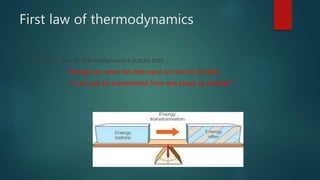
The First law of thermodynamics states that :-
“Energy can never be destroyed nor can be formed,
it can just be transformed from one phase to another.”
FIRST LIMITATION
 Limitation:-First law does not help to predict whether the
certain process is possible or not.
 Reason:-It does not specify that heat cannot flow from
low temperature body to a high temperature body.
 The first law does not indicate whether heat can flow from
a cold end to a hot end or not. For example: we cannot
extract heat from the ice by cooling it to a low
temperature. Some external work has to be done
SECOND LIMITATION
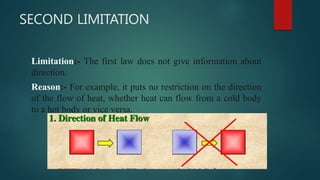
Limitation:- The first law does not give information about
direction.
Reason:- For example, it puts no restriction on the direction
of the flow of heat, whether heat can flow from a cold body
to a hot body or vice versa.
THIRD LIMITATION
Limitation:- It does not provide and specify sufficient
condition for the process to take place.
Reason:- This Law is silent about its % of conversion of
energy from one form to another form. Work can be
converted into equivalent amount of heat but heat cannot
be converted into equivalent amount of work.
Practically it is not possible to convert the heat
energy into an equivalent amount of work.
Solution
 To overcome this limitations, another law is needed which
is known as second law of thermodynamics.
 The second law of thermodynamics helps us to predict
whether the reaction is feasible or not and also tell the
direction of the flow of heat.
SECOND LAW of thermodynamics
 The entropy of an isolated system consisting of two
regions of space, isolated from one another, each in
thermodynamic equilibrium in itself, but not in
equilibrium with each other, will, when the isolation
that separates the two regions is broken, so that the
two regions become able to exchange matter or energy,
tend to increase over time, approaching a maximum
value when the jointly communicating system reaches
thermodynamic equilibrium
Simple:-
 In a simple manner, the second law states "energy systems have a
tendency to increase their entropy rather than decrease it." This can
also be stated as "heat can spontaneously flow from a higher
temperature region to a lower-temperature region, but not the other
way around." Heat can appear to flow from cold to hot, for example,
when a warm object is cooled in a refrigerator, but the transfer of
energy is still from hot to cold. The heat from the object warms the
surrounding air, which in turn heats and expands the refrigerant. The
refrigerant is then compressed, expending electrical energy. The
entropy of an isolated macroscopic system never decreases.
However, a microscopic system may exhibit fluctuations of entropy
opposite to that stated by the Second Law
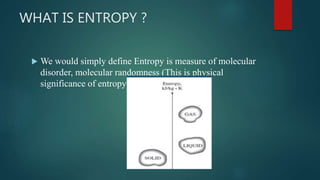
WHAT IS ENTROPY ?
 We would simply define Entropy is measure of molecular
disorder, molecular randomness (This is physical
significance of entropy)
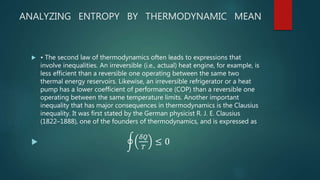
ANALYZING ENTROPY BY THERMODYNAMIC MEAN
 • The second law of thermodynamics often leads to expressions that
involve inequalities. An irreversible (i.e., actual) heat engine, for example, is
less efficient than a reversible one operating between the same two
thermal energy reservoirs. Likewise, an irreversible refrigerator or a heat
pump has a lower coefficient of performance (COP) than a reversible one
operating between the same temperature limits. Another important
inequality that has major consequences in thermodynamics is the Clausius
inequality. It was first stated by the German physicist R. J. E. Clausius
(1822–1888), one of the founders of thermodynamics, and is expressed as

𝛿𝑄
𝑇
≤ 0
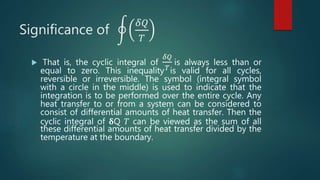
Significance of
𝛿𝑄
𝑇
 That is, the cyclic integral of
𝛿𝑄
𝑇
is always less than or
equal to zero. This inequality is valid for all cycles,
reversible or irreversible. The symbol (integral symbol
with a circle in the middle) is used to indicate that the
integration is to be performed over the entire cycle. Any
heat transfer to or from a system can be considered to
consist of differential amounts of heat transfer. Then the
cyclic integral of 𝛅Q 𝑇 can be viewed as the sum of all
these differential amounts of heat transfer divided by the
temperature at the boundary.
Entropy and the Second Law
The entropy of an isolated system never decreases; spontaneous (irreversible)
processes always increase entropy.
All the consequences of the second law of thermodynamics follow from the
treatment of entropy as a measure of disorder.
Making engines that would convert mechanical energy entirely to work would
require entropy to decrease in isolated system – can’t happen.
Many familiar processes increase entropy – shuffling cards, breaking eggs,
and so on.
We never see these processes spontaneously happening in reverse – a movie
played backwards looks silly. This directionality is referred to as the arrow of
time
What is Reversible Process?
 The process in which the system and surroundings can be restored to the
initial state from the final state without producing any changes in the
thermodynamics properties of the universe is called a reversible process. In
the figure below, let us suppose that the system has undergone a change
from state A to state B. If the system can be restored from state B to state
A, and there is no change in the universe, then the process is said to be a
reversible process. The reversible process can be reversed completely and
there is no trace left to show that the system had undergone
thermodynamic change.
Conditions:-
 Thus there are two important conditions for the
reversible process to occur.
 Firstly, the process should occur in infinitesimally
small time and
 secondly all of the initial and final state of the system
should be in equilibrium with each other.
Example of Reversible Process
 A nice example of a reversible process from real life would be
focusing a beam of parallel light rays with a lens[1]
 . How is this reversible?
 Well, it’s always possible to put a second lens after the focusing lens
and collimate the diverging rays so that they’re parallel again. If we
were to watch this happen in time-reversed manner, we wouldn’t be
able to tell it apart from the forward time version of the experiment.
Continued……
 A very simple example can be of two metal jars A and B which are at a
thermal equilibrium and are in contact with each other. Now when we heat
jar A slightly, heat starts to flow from Jar A to Jar B. This is the direction of
this process. Now this process can be reversed just by cooling Jar A
slightly. When Jar A is cooled, heat flows from Jar B to Jar A till thermal
equilibrium is reached
What is Irreversible Process?
1) In the irreversible process the initial state of the system and surroundings
cannot be restored from the final state.
2) During the irreversible process the various states of the system on the path
of change from initial state to final state are not in equilibrium with each
other.
3) During the irreversible process the entropy of the system increases
decisively and it cannot be reduced back to its initial value.
4) The phenomenon of a system undergoing irreversible process is called as
irreversibility.
Exampes of Irreversible Process
 A hot cup of tea left on its own to cool down.
 An egg falling on the floor and cracking open, spilling its contents in the
process.
 Basically, anything whose time-reversed version cannot
happen spontaneously is irreversible. A cup of tea, when left alone, will
never get heated up all by itself. Similarly, a broken egg will never
reassemble itself.
Continued……
 For example, when we are driving the car uphill, it consumes a lot of fuel
and this fuel is not returned when we are driving down hill. Many factors
contribute in making any process irreversible. The most common of these
are
1) Friction
2) Unrestrained expansion of a fluid
3) Heat transfer through a finite temperature difference
4) Mixing of two different substances.
Heat Engines
Heating – the transfer of energy to a system by thermal contact with a
reservoir.
Work – the transfer of energy to a system by a change in the external
parameters (V, el.-mag. and grav. fields, etc.).
The main question we want to address: what are the limitations imposed
by thermodynamic on the performance of heat engines?
A heat engine – any device that is capable of
converting thermal energy (heating) into mechanical
energy (work). We will consider an important class of
such devices whose operation is cyclic.
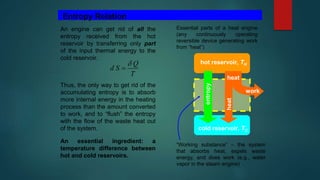
Entropy Relation
entropy
heat
work
heat
hot reservoir, TH
cold reservoir, TC
Thus, the only way to get rid of the
accumulating entropy is to absorb
more internal energy in the heating
process than the amount converted
to work, and to “flush” the entropy
with the flow of the waste heat out
of the system.
An engine can get rid of all the
entropy received from the hot
reservoir by transferring only part
of the input thermal energy to the
cold reservoir.
“Working substance” – the system
that absorbs heat, expels waste
energy, and does work (e.g., water
vapor in the steam engine)
T
Q
Sd


Essential parts of a heat engine
(any continuously operating
reversible device generating work
from “heat”)
An essential ingredient: a
temperature difference between
hot and cold reservoirs.
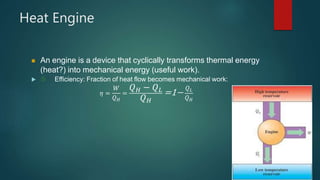
Heat Engine
 An engine is a device that cyclically transforms thermal energy
(heat?) into mechanical energy (useful work).
  Efficiency: Fraction of heat flow becomes mechanical work:
𝜂 =
𝑊
𝑄 𝐻
=
𝑄 𝐻 − 𝑄 𝐿
𝑄 𝐻
=1−
𝑄 𝐿
𝑄 𝐻
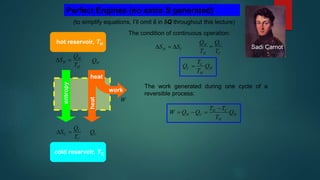
Perfect Engines (no extra S generated)
H
H
H
T
Q
S 
C
C
C
T
Q
S 
HQ
CQ
W
entropy
heat
workheat
hot reservoir, TH
cold reservoir, TC
The condition of continuous operation:
CH SS 
C
C
H
H
T
Q
T
Q

H
H
C
C Q
T
T
Q 
The work generated during one cycle of a
reversible process:
H
H
CH
CH Q
T
TT
QQW


Sadi Carnot
(to simplify equations, I’ll omit  in Q throughout this lecture)
Introduction to Reverse Heat Engine
 The engine is the devise that produces the work by absorbing heat from
the high temperature reservoir or source and releasing the remaining heat
to the low temperature reservoir or sink. One of the earliest cycles for the
heat engine was proposed by Sadi Carnot. The Carnot cycle comprises of
two reversible isothermal processes and two reversible adiabatic processes.
Since all the processes in Carnot cycle are considered to be reversible,
whole cycle is also considered to be reversible. If all the processes of the
Carnot cycle are reversed, what we get is a machine which is called as
reversed heat engine.
Continued…….
 As the name suggests the reversed heat engine works exactly opposite to
the heat engine. The heat engine produces work by absorbing heat from
the source and liberating some heat to the sink. The reversed heat engine
absorbs the work and transfers heat from the sink to the source. That
means that the reversed heat engine absorbs work and transfers heat from
low temperature reservoir to high temperature reservoir.
Continued….
 The natural tendency of the heat is to flow from the high temperature
reservoir to the low temperature reservoir. The concept of reversed heat
engine clearly shows that to transfer heat from the low temperature
reservoir to the high temperature reservoir external work must be
performed on the system. The reversed heat engine comprises of all the
processes that the Carnot heat engine has, but they operate in a reverse
manner.
Important Point
 The reversed heat engine concept bolsters the findings made
by Clausiusabout second law of thermodynamics. His statement for second
law of thermodynamics says, “It is impossible to construct a device which,
operating in a cycle, will produce no effect other than the transfer of heat
from a colder to a hotter body." This means that when the devise transfers
heat from low temperature to high temperature reservoir, it cannot do so
without producing any other effect. This any other effect is absorbing the
work. The heat will not flow spontaneously form low temperature to high
temperature reservoir; some external work has to be done on it.

Thermodynamics

  • 1.
    Limitations of firstlaw of thermodynamics Sohaib Siddique butt University of Gujrat Email:sohaibbutt448506@gmail.com
  • 2.
    What will Idiscuss ??  First law of thermodynamics  First limitations of first law of thermodynamics.  Second limitation of first law of thermodynamics.  Third limitations of first law of thermodynamics
  • 3.
    First law ofthermodynamics The First law of thermodynamics states that :- “Energy can never be destroyed nor can be formed, it can just be transformed from one phase to another.”
  • 4.
    FIRST LIMITATION  Limitation:-Firstlaw does not help to predict whether the certain process is possible or not.  Reason:-It does not specify that heat cannot flow from low temperature body to a high temperature body.  The first law does not indicate whether heat can flow from a cold end to a hot end or not. For example: we cannot extract heat from the ice by cooling it to a low temperature. Some external work has to be done
  • 5.
    SECOND LIMITATION Limitation:- Thefirst law does not give information about direction. Reason:- For example, it puts no restriction on the direction of the flow of heat, whether heat can flow from a cold body to a hot body or vice versa.
  • 6.
    THIRD LIMITATION Limitation:- Itdoes not provide and specify sufficient condition for the process to take place. Reason:- This Law is silent about its % of conversion of energy from one form to another form. Work can be converted into equivalent amount of heat but heat cannot be converted into equivalent amount of work. Practically it is not possible to convert the heat energy into an equivalent amount of work.
  • 7.
    Solution  To overcomethis limitations, another law is needed which is known as second law of thermodynamics.  The second law of thermodynamics helps us to predict whether the reaction is feasible or not and also tell the direction of the flow of heat.
  • 8.
    SECOND LAW ofthermodynamics  The entropy of an isolated system consisting of two regions of space, isolated from one another, each in thermodynamic equilibrium in itself, but not in equilibrium with each other, will, when the isolation that separates the two regions is broken, so that the two regions become able to exchange matter or energy, tend to increase over time, approaching a maximum value when the jointly communicating system reaches thermodynamic equilibrium
  • 9.
    Simple:-  In asimple manner, the second law states "energy systems have a tendency to increase their entropy rather than decrease it." This can also be stated as "heat can spontaneously flow from a higher temperature region to a lower-temperature region, but not the other way around." Heat can appear to flow from cold to hot, for example, when a warm object is cooled in a refrigerator, but the transfer of energy is still from hot to cold. The heat from the object warms the surrounding air, which in turn heats and expands the refrigerant. The refrigerant is then compressed, expending electrical energy. The entropy of an isolated macroscopic system never decreases. However, a microscopic system may exhibit fluctuations of entropy opposite to that stated by the Second Law
  • 11.
    WHAT IS ENTROPY?  We would simply define Entropy is measure of molecular disorder, molecular randomness (This is physical significance of entropy)
  • 12.
    ANALYZING ENTROPY BYTHERMODYNAMIC MEAN  • The second law of thermodynamics often leads to expressions that involve inequalities. An irreversible (i.e., actual) heat engine, for example, is less efficient than a reversible one operating between the same two thermal energy reservoirs. Likewise, an irreversible refrigerator or a heat pump has a lower coefficient of performance (COP) than a reversible one operating between the same temperature limits. Another important inequality that has major consequences in thermodynamics is the Clausius inequality. It was first stated by the German physicist R. J. E. Clausius (1822–1888), one of the founders of thermodynamics, and is expressed as  𝛿𝑄 𝑇 ≤ 0
  • 13.
    Significance of 𝛿𝑄 𝑇  Thatis, the cyclic integral of 𝛿𝑄 𝑇 is always less than or equal to zero. This inequality is valid for all cycles, reversible or irreversible. The symbol (integral symbol with a circle in the middle) is used to indicate that the integration is to be performed over the entire cycle. Any heat transfer to or from a system can be considered to consist of differential amounts of heat transfer. Then the cyclic integral of 𝛅Q 𝑇 can be viewed as the sum of all these differential amounts of heat transfer divided by the temperature at the boundary.
  • 14.
    Entropy and theSecond Law The entropy of an isolated system never decreases; spontaneous (irreversible) processes always increase entropy. All the consequences of the second law of thermodynamics follow from the treatment of entropy as a measure of disorder. Making engines that would convert mechanical energy entirely to work would require entropy to decrease in isolated system – can’t happen. Many familiar processes increase entropy – shuffling cards, breaking eggs, and so on. We never see these processes spontaneously happening in reverse – a movie played backwards looks silly. This directionality is referred to as the arrow of time
  • 15.
    What is ReversibleProcess?  The process in which the system and surroundings can be restored to the initial state from the final state without producing any changes in the thermodynamics properties of the universe is called a reversible process. In the figure below, let us suppose that the system has undergone a change from state A to state B. If the system can be restored from state B to state A, and there is no change in the universe, then the process is said to be a reversible process. The reversible process can be reversed completely and there is no trace left to show that the system had undergone thermodynamic change.
  • 16.
    Conditions:-  Thus thereare two important conditions for the reversible process to occur.  Firstly, the process should occur in infinitesimally small time and  secondly all of the initial and final state of the system should be in equilibrium with each other.
  • 17.
    Example of ReversibleProcess  A nice example of a reversible process from real life would be focusing a beam of parallel light rays with a lens[1]  . How is this reversible?  Well, it’s always possible to put a second lens after the focusing lens and collimate the diverging rays so that they’re parallel again. If we were to watch this happen in time-reversed manner, we wouldn’t be able to tell it apart from the forward time version of the experiment.
  • 18.
    Continued……  A verysimple example can be of two metal jars A and B which are at a thermal equilibrium and are in contact with each other. Now when we heat jar A slightly, heat starts to flow from Jar A to Jar B. This is the direction of this process. Now this process can be reversed just by cooling Jar A slightly. When Jar A is cooled, heat flows from Jar B to Jar A till thermal equilibrium is reached
  • 19.
    What is IrreversibleProcess? 1) In the irreversible process the initial state of the system and surroundings cannot be restored from the final state. 2) During the irreversible process the various states of the system on the path of change from initial state to final state are not in equilibrium with each other. 3) During the irreversible process the entropy of the system increases decisively and it cannot be reduced back to its initial value. 4) The phenomenon of a system undergoing irreversible process is called as irreversibility.
  • 20.
    Exampes of IrreversibleProcess  A hot cup of tea left on its own to cool down.  An egg falling on the floor and cracking open, spilling its contents in the process.  Basically, anything whose time-reversed version cannot happen spontaneously is irreversible. A cup of tea, when left alone, will never get heated up all by itself. Similarly, a broken egg will never reassemble itself.
  • 21.
    Continued……  For example,when we are driving the car uphill, it consumes a lot of fuel and this fuel is not returned when we are driving down hill. Many factors contribute in making any process irreversible. The most common of these are 1) Friction 2) Unrestrained expansion of a fluid 3) Heat transfer through a finite temperature difference 4) Mixing of two different substances.
  • 22.
    Heat Engines Heating –the transfer of energy to a system by thermal contact with a reservoir. Work – the transfer of energy to a system by a change in the external parameters (V, el.-mag. and grav. fields, etc.). The main question we want to address: what are the limitations imposed by thermodynamic on the performance of heat engines? A heat engine – any device that is capable of converting thermal energy (heating) into mechanical energy (work). We will consider an important class of such devices whose operation is cyclic.
  • 23.
    Entropy Relation entropy heat work heat hot reservoir,TH cold reservoir, TC Thus, the only way to get rid of the accumulating entropy is to absorb more internal energy in the heating process than the amount converted to work, and to “flush” the entropy with the flow of the waste heat out of the system. An engine can get rid of all the entropy received from the hot reservoir by transferring only part of the input thermal energy to the cold reservoir. “Working substance” – the system that absorbs heat, expels waste energy, and does work (e.g., water vapor in the steam engine) T Q Sd   Essential parts of a heat engine (any continuously operating reversible device generating work from “heat”) An essential ingredient: a temperature difference between hot and cold reservoirs.
  • 24.
    Heat Engine  Anengine is a device that cyclically transforms thermal energy (heat?) into mechanical energy (useful work).   Efficiency: Fraction of heat flow becomes mechanical work: 𝜂 = 𝑊 𝑄 𝐻 = 𝑄 𝐻 − 𝑄 𝐿 𝑄 𝐻 =1− 𝑄 𝐿 𝑄 𝐻
  • 25.
    Perfect Engines (noextra S generated) H H H T Q S  C C C T Q S  HQ CQ W entropy heat workheat hot reservoir, TH cold reservoir, TC The condition of continuous operation: CH SS  C C H H T Q T Q  H H C C Q T T Q  The work generated during one cycle of a reversible process: H H CH CH Q T TT QQW   Sadi Carnot (to simplify equations, I’ll omit  in Q throughout this lecture)
  • 26.
    Introduction to ReverseHeat Engine  The engine is the devise that produces the work by absorbing heat from the high temperature reservoir or source and releasing the remaining heat to the low temperature reservoir or sink. One of the earliest cycles for the heat engine was proposed by Sadi Carnot. The Carnot cycle comprises of two reversible isothermal processes and two reversible adiabatic processes. Since all the processes in Carnot cycle are considered to be reversible, whole cycle is also considered to be reversible. If all the processes of the Carnot cycle are reversed, what we get is a machine which is called as reversed heat engine.
  • 27.
    Continued…….  As thename suggests the reversed heat engine works exactly opposite to the heat engine. The heat engine produces work by absorbing heat from the source and liberating some heat to the sink. The reversed heat engine absorbs the work and transfers heat from the sink to the source. That means that the reversed heat engine absorbs work and transfers heat from low temperature reservoir to high temperature reservoir.
  • 28.
    Continued….  The naturaltendency of the heat is to flow from the high temperature reservoir to the low temperature reservoir. The concept of reversed heat engine clearly shows that to transfer heat from the low temperature reservoir to the high temperature reservoir external work must be performed on the system. The reversed heat engine comprises of all the processes that the Carnot heat engine has, but they operate in a reverse manner.
  • 29.
    Important Point  Thereversed heat engine concept bolsters the findings made by Clausiusabout second law of thermodynamics. His statement for second law of thermodynamics says, “It is impossible to construct a device which, operating in a cycle, will produce no effect other than the transfer of heat from a colder to a hotter body." This means that when the devise transfers heat from low temperature to high temperature reservoir, it cannot do so without producing any other effect. This any other effect is absorbing the work. The heat will not flow spontaneously form low temperature to high temperature reservoir; some external work has to be done on it.