Architecture Reconstruction and
  Analysis of Medical Device
  Software                 Blood Pressure
                           Monitor


                                                     CARA Software


Fraunhofer                                                                           US FDA
Dharmalingam Ganesan                                                            Raoul Jetley
Mikael Lindvall                                                                  Paul Jones
Rance Cleaveland                                                                   Yi Zhang
          © 2011 Fraunhofer USA, Inc. Center for Experimental Software Engineering
Context
• FDA reviews 510k pre-market submissions for safety of
  medical devices
   – Hazard analysis, arch. docs, and test results are reviewed, but
     not source code
   – (may) review code if failures are reported in field


• Submitted arch. docs are typically “too abstract” – not
  easy to analyze for safety

• What (as-built) architectural viewpoints are needed for
  safety and assurance cases?


                © 2011 Fraunhofer USA, Inc. Center for Experimental Software Engineering
Software analysis needs at FDA
• Basic needs: identify unsafe constructs (enough)
• Safety “requires” good engineering
   – What is the as-built architecture of the software?
   – Is the architecture based on good engineering?
       • Good modular structure? Good separation of concerns?

• Safety “requires” extensive testing
   – Was the medical device software tested enough? (can’t answer)
       • Easy to test unit-by-unit?
       • Easy to verify using static analysis tools (SATs)?

• Developed a method to address these questions
   – Discovers static and runtime structures from code
   – These structures are abstract, yet concrete and precise


                                     © 2011 Fraunhofer USA, Inc.
                             Center for Experimental Software Engineering
Brief overview of the method
•   Premise: As-built architecture is inspired and influenced by external entities
     – (e.g., libraries, COTS software) used by the software
     – Grounded on analysis of more than 2 dozen industrial systems

•   A knowledge base (KB) of keywords (e.g., “taskSpawn”, “msgQSend”) support the
    discovery of architectural structures hidden in source code

•   Code relations (e.g., call, import) are extracted and then a suite of architectural
    structures is discovered from different viewpoints using the KB

•   Discovered runtime structures cover different viewpoints including:
     –   Partition of modules into tasks, Task Spawn, Inter-task communication and synchronization


•   Discovered structures are used to reason about testability and safety issues

•   Architecture reconstruction algorithms are formalized using relational operators (e.g.,
    transitive closure, composition) for task-oriented architectures – see the paper


                       © 2011 Fraunhofer USA, Inc. Center for Experimental Software Engineering
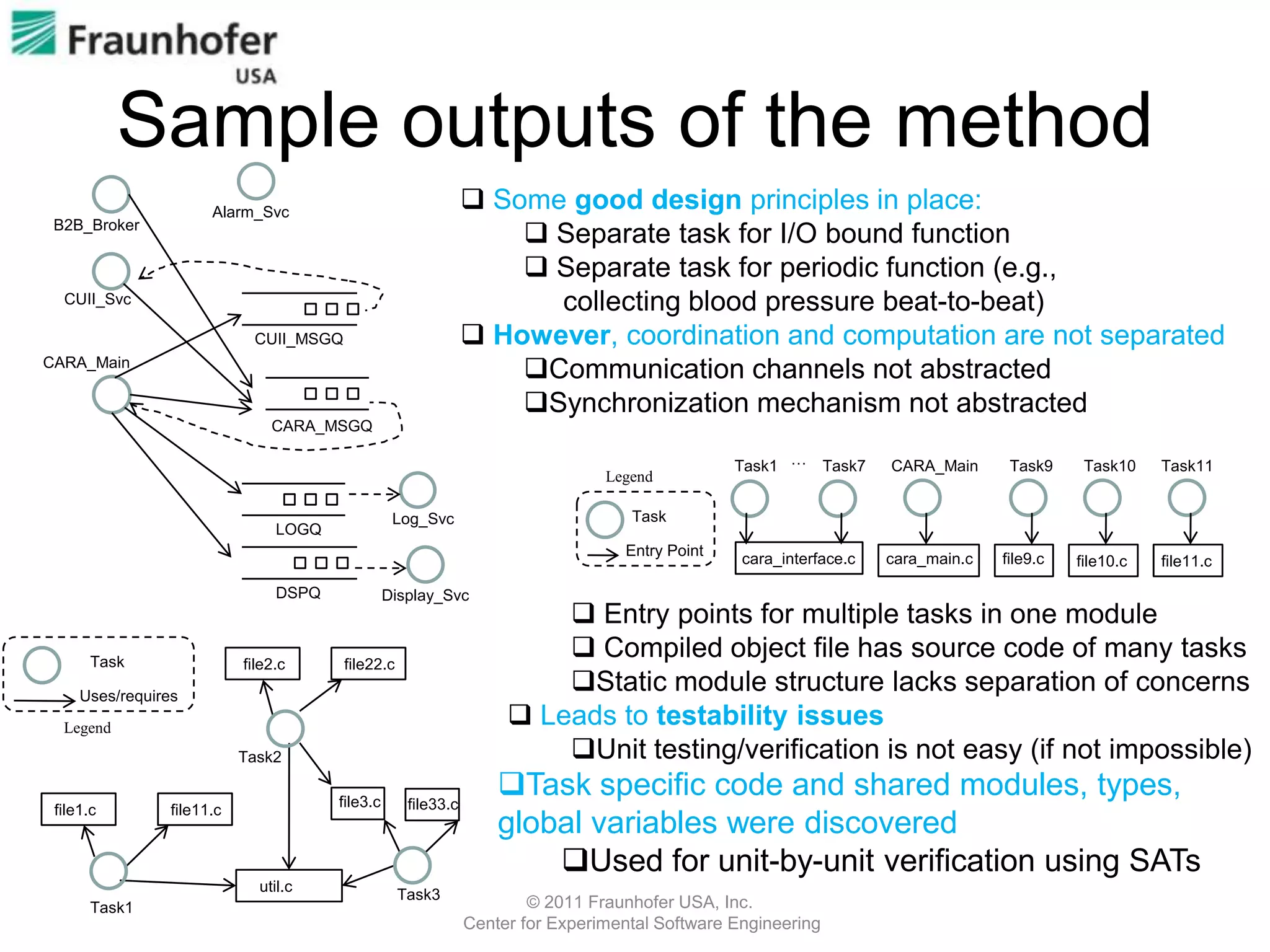
Sample outputs of the method
                       Alarm_Svc
                                                                 Some good design principles in place:
 B2B_Broker
                                                                     Separate task for I/O bound function
                                                                     Separate task for periodic function (e.g.,
  CUII_Svc                                                            collecting blood pressure beat-to-beat)
                             CUII_MSGQ                           However, coordination and computation are not separated
CARA_Main
                                                                    Communication channels not abstracted
                                                                    Synchronization mechanism not abstracted
                                CARA_MSGQ

                                                                                                 Task1 …       Task7   CARA_Main      Task9     Task10    Task11
                                                                                 Legend

                                                   Log_Svc                          Task
                                 LOGQ
                                                                                   Entry Point
                                                                                                  cara_interface.c     cara_main.c   file9.c   file10.c   file11.c

                                 DSPQ             Display_Svc
                                                                          Entry points for multiple tasks in one module
       Task                 file2.c      file22.c
                                                                          Compiled object file has source code of many tasks
     Uses/requires
                                                                         Static module structure lacks separation of concerns
  Legend
                                                                      Leads to testability issues
                            Task2                                        Unit testing/verification is not easy (if not impossible)
                                        file3.c      file33.c
                                                                    Task specific code and shared modules, types,
 file1.c         file11.c
                                                                    global variables were discovered
                                                                        Used for unit-by-unit verification using SATs
                              util.c
                                                    Task3
       Task1                                                            © 2011 Fraunhofer USA, Inc.
                                                                Center for Experimental Software Engineering
Closing remarks
• Need as-built architecture to configure SATs and interpret their
  detailed output
• Some issues with SATs
   – Wrongly reported several entry functions as dead
   – OS functions for messaging not taken care properly
• SATs are useful but cannot be used right out of the bat
• Analysis of as-built architecture offers complementary design insights
  for safety analysis

• Future Work:
    – Link safety requirements to discovered structures for an assurance case
    – Evolve the catalog of structures for testability and safety
    – Discover behavioral models for verification of safety properties


                                      © 2011 Fraunhofer USA, Inc.
                              Center for Experimental Software Engineering

Reverse Architecting of a Medical Device Software

  • 1.
    Architecture Reconstruction and Analysis of Medical Device Software Blood Pressure Monitor CARA Software Fraunhofer US FDA Dharmalingam Ganesan Raoul Jetley Mikael Lindvall Paul Jones Rance Cleaveland Yi Zhang © 2011 Fraunhofer USA, Inc. Center for Experimental Software Engineering
  • 2.
    Context • FDA reviews510k pre-market submissions for safety of medical devices – Hazard analysis, arch. docs, and test results are reviewed, but not source code – (may) review code if failures are reported in field • Submitted arch. docs are typically “too abstract” – not easy to analyze for safety • What (as-built) architectural viewpoints are needed for safety and assurance cases? © 2011 Fraunhofer USA, Inc. Center for Experimental Software Engineering
  • 3.
    Software analysis needsat FDA • Basic needs: identify unsafe constructs (enough) • Safety “requires” good engineering – What is the as-built architecture of the software? – Is the architecture based on good engineering? • Good modular structure? Good separation of concerns? • Safety “requires” extensive testing – Was the medical device software tested enough? (can’t answer) • Easy to test unit-by-unit? • Easy to verify using static analysis tools (SATs)? • Developed a method to address these questions – Discovers static and runtime structures from code – These structures are abstract, yet concrete and precise © 2011 Fraunhofer USA, Inc. Center for Experimental Software Engineering
  • 4.
    Brief overview ofthe method • Premise: As-built architecture is inspired and influenced by external entities – (e.g., libraries, COTS software) used by the software – Grounded on analysis of more than 2 dozen industrial systems • A knowledge base (KB) of keywords (e.g., “taskSpawn”, “msgQSend”) support the discovery of architectural structures hidden in source code • Code relations (e.g., call, import) are extracted and then a suite of architectural structures is discovered from different viewpoints using the KB • Discovered runtime structures cover different viewpoints including: – Partition of modules into tasks, Task Spawn, Inter-task communication and synchronization • Discovered structures are used to reason about testability and safety issues • Architecture reconstruction algorithms are formalized using relational operators (e.g., transitive closure, composition) for task-oriented architectures – see the paper © 2011 Fraunhofer USA, Inc. Center for Experimental Software Engineering
  • 5.
    Sample outputs ofthe method Alarm_Svc  Some good design principles in place: B2B_Broker  Separate task for I/O bound function  Separate task for periodic function (e.g., CUII_Svc collecting blood pressure beat-to-beat) CUII_MSGQ  However, coordination and computation are not separated CARA_Main Communication channels not abstracted Synchronization mechanism not abstracted CARA_MSGQ Task1 … Task7 CARA_Main Task9 Task10 Task11 Legend Log_Svc Task LOGQ Entry Point cara_interface.c cara_main.c file9.c file10.c file11.c DSPQ Display_Svc  Entry points for multiple tasks in one module Task file2.c file22.c  Compiled object file has source code of many tasks Uses/requires Static module structure lacks separation of concerns Legend  Leads to testability issues Task2 Unit testing/verification is not easy (if not impossible) file3.c file33.c Task specific code and shared modules, types, file1.c file11.c global variables were discovered Used for unit-by-unit verification using SATs util.c Task3 Task1 © 2011 Fraunhofer USA, Inc. Center for Experimental Software Engineering
  • 6.
    Closing remarks • Needas-built architecture to configure SATs and interpret their detailed output • Some issues with SATs – Wrongly reported several entry functions as dead – OS functions for messaging not taken care properly • SATs are useful but cannot be used right out of the bat • Analysis of as-built architecture offers complementary design insights for safety analysis • Future Work: – Link safety requirements to discovered structures for an assurance case – Evolve the catalog of structures for testability and safety – Discover behavioral models for verification of safety properties © 2011 Fraunhofer USA, Inc. Center for Experimental Software Engineering