Software Testing

    CSE 492
    Lesson 9
Testing Overview


   Pressman 17: Micro view
   Pressman 18: Macro view
   Techniques for Testing (How?)
   Motivation for Testing (Why?)
   Challenges of Testing
     Fiascos, War Stories, Lessons Learned
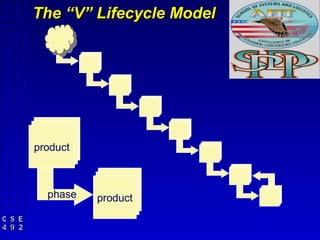
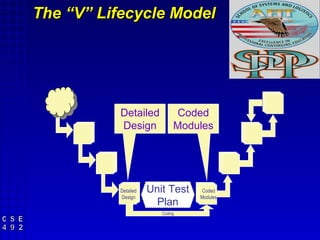
The “V” Lifecycle Model


product


  phase   product
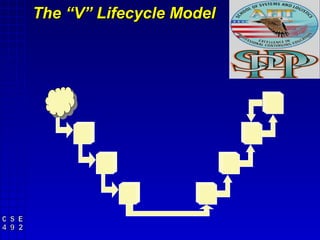
The “V” Lifecycle Model


           Detailed           Coded
           Design             Modules


           Detailed   Unit Test    Coded
           Design                 Modules
                        Plan
                         Coding
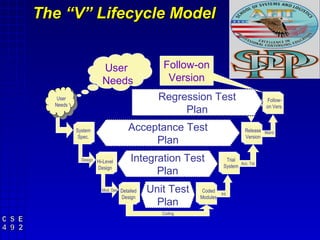
The “V” Lifecycle Model


                     User                    Follow-on
                     Needs                    Version
   User                                     Regression Test                         Follow-
  Needs
                                                 Plan                               on Vers.


          System                  Acceptance Test                         Release Maint.
           Spec.                                                          Version
                                       Plan
            Design Hi-Level        Integration Test              Trial
                                                                       Acc. Tst.
                                                                System
                   Design
                                         Plan
                     Mod. Des. Detailed   Unit Test    Coded
                                                              Int.
                               Design                 Modules
                                            Plan
                                             Coding
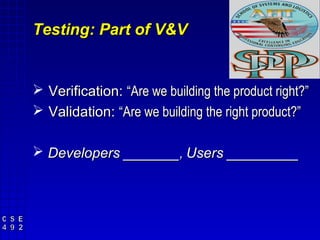
Testing: Part of V&V


 Verification: “Are we building the product right?”
 Validation: “Are we building the right product?”

 Developers _______, Users _________
Types of Testing


 Black Box
 Glass Box
 Integration & Validation Testing
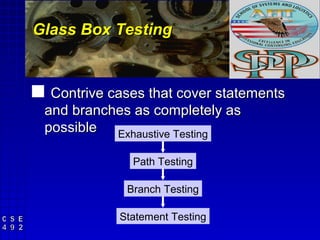
Glass Box Testing


 Contrive cases that cover statements
 and branches as completely as
 possible Exhaustive Testing

               Path Testing

              Branch Testing

             Statement Testing
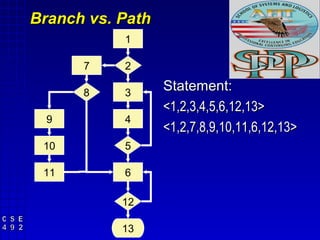
Branch vs. Path
           1

      7    2

      8    3
                  Statement:
                  <1,2,3,4,5,6,12,13>
  9        4
                  <1,2,7,8,9,10,11,6,12,13>
 10        5

 11        6

           12

           13
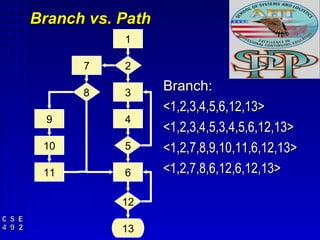
Branch vs. Path
           1

      7    2

      8    3
                  Branch:
                  <1,2,3,4,5,6,12,13>
  9        4
                  <1,2,3,4,5,3,4,5,6,12,13>
 10        5      <1,2,7,8,9,10,11,6,12,13>
 11        6      <1,2,7,8,6,12,6,12,13>

           12

           13
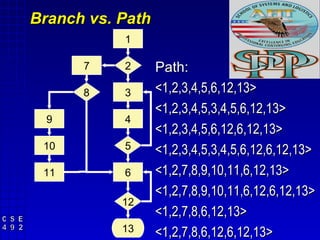
Branch vs. Path
           1

      7    2      Path:
      8    3      <1,2,3,4,5,6,12,13>
                  <1,2,3,4,5,3,4,5,6,12,13>
  9        4
                  <1,2,3,4,5,6,12,6,12,13>
 10        5      <1,2,3,4,5,3,4,5,6,12,6,12,13>
 11        6      <1,2,7,8,9,10,11,6,12,13>
                  <1,2,7,8,9,10,11,6,12,6,12,13>
           12
                  <1,2,7,8,6,12,13>
           13     <1,2,7,8,6,12,6,12,13>
Black Box Testing


 Focus is on functional requirements,
 not inside code
 Make sure system functions as
 intended with expected input
 Make sure system does not do
 anything “bad” with unexpected input
 Best chance of success--plan early!
Special Challenges


 Hard-to-simulate stimuli
 Real-time, asynchronous systems
 Cross-platform systems



Tricky Cases


   Unexpected Input
   Divide by Zero
   Floating Point Arithmetic (esp. “if x = y then…”)



A Quote…
“Suppose a programmer is asked
to test a module he has written.
Testing has been described as a
process of executing a product with the intention
of finding faults. Testing is thus a destructive
process. [But] the programmer will not ordinarily
wish to destroy his work. If the fundamental
attitude is the usual protective one, chances of
highlighting faults is lower than if the major
motivation were truly destructive.” [Schach 99]
Schach continued…
“After a programmer has been
constructive and built a module,
testing requires the programmer
perform a destructive act, and attempt to destroy
the very thing he has created.” [Schach 99]
My theory…
Programmers handle the foreseen
and the well-understood rather
competently; errors often occur
in unforeseen circumstances, poorly understood
requirements and designs, and hard-to-test
situations.
The Bermuda Triangle
Pressman Problem 17.1


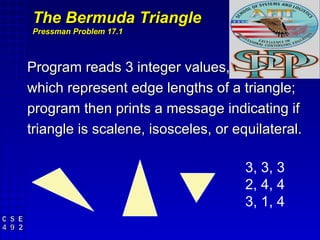
Program reads 3 integer values,
which represent edge lengths of a triangle;
program then prints a message indicating if
triangle is scalene, isosceles, or equilateral.

                                     3, 3, 3
                                     2, 4, 4
                                     3, 1, 4
The Bermuda Triangle
Pressman Problem 17.1
The Bermuda Triangle
Revisited


New Requirement:
  Check for (and report) Right Triangles
The Bermuda Triangle
Revisited


Program must check:
  a^2 + b^2 = c^2
  a+b>c
Long leg is hypotenuse

Pseudocode:
 for x in 1..3 loop
    get input[x]
 end loop;
 c := longest (input[x]: x = 1,2,3)
 a, b := {other two sides}
The Bermuda Triangle
Revisited


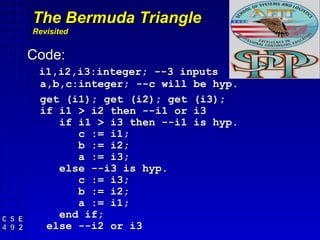
Code:
 i1,i2,i3:integer; --3 inputs
 a,b,c:integer; --c will be hyp.
 get (i1); get (i2); get (i3);
 if i1 > i2 then --i1 or i3
    if i1 > i3 then --i1 is hyp.
       c := i1;
       b := i2;
       a := i3;
    else --i3 is hyp.
       c := i3;
       b := i2;
       a := i1;
    end if;
  else --i2 or i3
The Bermuda Triangle
Revisited


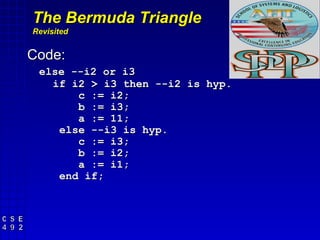
Code:
 else --i2 or i3
   if i2 > i3 then --i2 is hyp.
       c := i2;
       b := i3;
       a := 11;
    else --i3 is hyp.
       c := i3;
       b := i2;
       a := i1;
    end if;
The Bermuda Triangle
Revisited


New Requirement:
  Accept floating point input
The Bermuda Triangle
Revisited


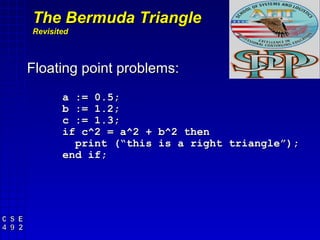
Floating point problems:
       a := 0.5;
       b := 1.2;
       c := 1.3;
       if c^2 = a^2 + b^2 then
         print (“this is a right triangle”);
       end if;
Linking Global Points


 One file: LAT/LON + Radius
 Second file: LAT/LONs
 Goal: If Point in File2 resides inside
  Area in File1, create link
Other “War Stories”


 Therac Machine
 F-15 Air-to-Air Missile Firing
 Processor Enhancement
 600 ± 10 ms
Other Forms of Testing


 STRESS
   Test the system at max load conditions
 Recovery
   Test the system over max load conditions
 Performance
   Ensure system meets timing requirements
 Regression
   “All of the above” after a system modification
Conclusions
 Testing is a science
   statement vs. path
 Testing is an art
   seeing the unforeseen
 Good testing is difficult to perform
   stubs and drivers during integration
   simulating real-world conditions
 Solution?
   Well-planned & rigorous testing program--
   not an ad hoc, haphazard one

Software testing ari force institute of tech.

  • 1.
    Software Testing CSE 492 Lesson 9
  • 2.
    Testing Overview  Pressman 17: Micro view  Pressman 18: Macro view  Techniques for Testing (How?)  Motivation for Testing (Why?)  Challenges of Testing  Fiascos, War Stories, Lessons Learned
  • 3.
    The “V” LifecycleModel product phase product
  • 4.
  • 5.
    The “V” LifecycleModel Detailed Coded Design Modules Detailed Unit Test Coded Design Modules Plan Coding
  • 6.
    The “V” LifecycleModel User Follow-on Needs Version User Regression Test Follow- Needs Plan on Vers. System Acceptance Test Release Maint. Spec. Version Plan Design Hi-Level Integration Test Trial Acc. Tst. System Design Plan Mod. Des. Detailed Unit Test Coded Int. Design Modules Plan Coding
  • 7.
    Testing: Part ofV&V  Verification: “Are we building the product right?”  Validation: “Are we building the right product?”  Developers _______, Users _________
  • 8.
    Types of Testing Black Box  Glass Box  Integration & Validation Testing
  • 9.
    Glass Box Testing Contrive cases that cover statements and branches as completely as possible Exhaustive Testing Path Testing Branch Testing Statement Testing
  • 10.
    Branch vs. Path 1 7 2 8 3 Statement: <1,2,3,4,5,6,12,13> 9 4 <1,2,7,8,9,10,11,6,12,13> 10 5 11 6 12 13
  • 11.
    Branch vs. Path 1 7 2 8 3 Branch: <1,2,3,4,5,6,12,13> 9 4 <1,2,3,4,5,3,4,5,6,12,13> 10 5 <1,2,7,8,9,10,11,6,12,13> 11 6 <1,2,7,8,6,12,6,12,13> 12 13
  • 12.
    Branch vs. Path 1 7 2 Path: 8 3 <1,2,3,4,5,6,12,13> <1,2,3,4,5,3,4,5,6,12,13> 9 4 <1,2,3,4,5,6,12,6,12,13> 10 5 <1,2,3,4,5,3,4,5,6,12,6,12,13> 11 6 <1,2,7,8,9,10,11,6,12,13> <1,2,7,8,9,10,11,6,12,6,12,13> 12 <1,2,7,8,6,12,13> 13 <1,2,7,8,6,12,6,12,13>
  • 13.
    Black Box Testing Focus is on functional requirements, not inside code  Make sure system functions as intended with expected input  Make sure system does not do anything “bad” with unexpected input  Best chance of success--plan early!
  • 14.
    Special Challenges  Hard-to-simulatestimuli  Real-time, asynchronous systems  Cross-platform systems   
  • 15.
    Tricky Cases  Unexpected Input  Divide by Zero  Floating Point Arithmetic (esp. “if x = y then…”)   
  • 16.
    A Quote… “Suppose aprogrammer is asked to test a module he has written. Testing has been described as a process of executing a product with the intention of finding faults. Testing is thus a destructive process. [But] the programmer will not ordinarily wish to destroy his work. If the fundamental attitude is the usual protective one, chances of highlighting faults is lower than if the major motivation were truly destructive.” [Schach 99]
  • 17.
    Schach continued… “After aprogrammer has been constructive and built a module, testing requires the programmer perform a destructive act, and attempt to destroy the very thing he has created.” [Schach 99]
  • 18.
    My theory… Programmers handlethe foreseen and the well-understood rather competently; errors often occur in unforeseen circumstances, poorly understood requirements and designs, and hard-to-test situations.
  • 19.
    The Bermuda Triangle PressmanProblem 17.1 Program reads 3 integer values, which represent edge lengths of a triangle; program then prints a message indicating if triangle is scalene, isosceles, or equilateral. 3, 3, 3 2, 4, 4 3, 1, 4
  • 20.
  • 21.
    The Bermuda Triangle Revisited NewRequirement: Check for (and report) Right Triangles
  • 22.
    The Bermuda Triangle Revisited Programmust check: a^2 + b^2 = c^2 a+b>c Long leg is hypotenuse Pseudocode: for x in 1..3 loop get input[x] end loop; c := longest (input[x]: x = 1,2,3) a, b := {other two sides}
  • 23.
    The Bermuda Triangle Revisited Code: i1,i2,i3:integer; --3 inputs a,b,c:integer; --c will be hyp. get (i1); get (i2); get (i3); if i1 > i2 then --i1 or i3 if i1 > i3 then --i1 is hyp. c := i1; b := i2; a := i3; else --i3 is hyp. c := i3; b := i2; a := i1; end if; else --i2 or i3
  • 24.
    The Bermuda Triangle Revisited Code: else --i2 or i3 if i2 > i3 then --i2 is hyp. c := i2; b := i3; a := 11; else --i3 is hyp. c := i3; b := i2; a := i1; end if;
  • 25.
    The Bermuda Triangle Revisited NewRequirement: Accept floating point input
  • 26.
    The Bermuda Triangle Revisited Floatingpoint problems: a := 0.5; b := 1.2; c := 1.3; if c^2 = a^2 + b^2 then print (“this is a right triangle”); end if;
  • 27.
    Linking Global Points One file: LAT/LON + Radius  Second file: LAT/LONs  Goal: If Point in File2 resides inside Area in File1, create link
  • 28.
    Other “War Stories” Therac Machine  F-15 Air-to-Air Missile Firing  Processor Enhancement  600 ± 10 ms
  • 29.
    Other Forms ofTesting  STRESS  Test the system at max load conditions  Recovery  Test the system over max load conditions  Performance  Ensure system meets timing requirements  Regression  “All of the above” after a system modification
  • 30.
    Conclusions  Testing isa science  statement vs. path  Testing is an art  seeing the unforeseen  Good testing is difficult to perform  stubs and drivers during integration  simulating real-world conditions  Solution?  Well-planned & rigorous testing program-- not an ad hoc, haphazard one