Presented by
Goutamabhat
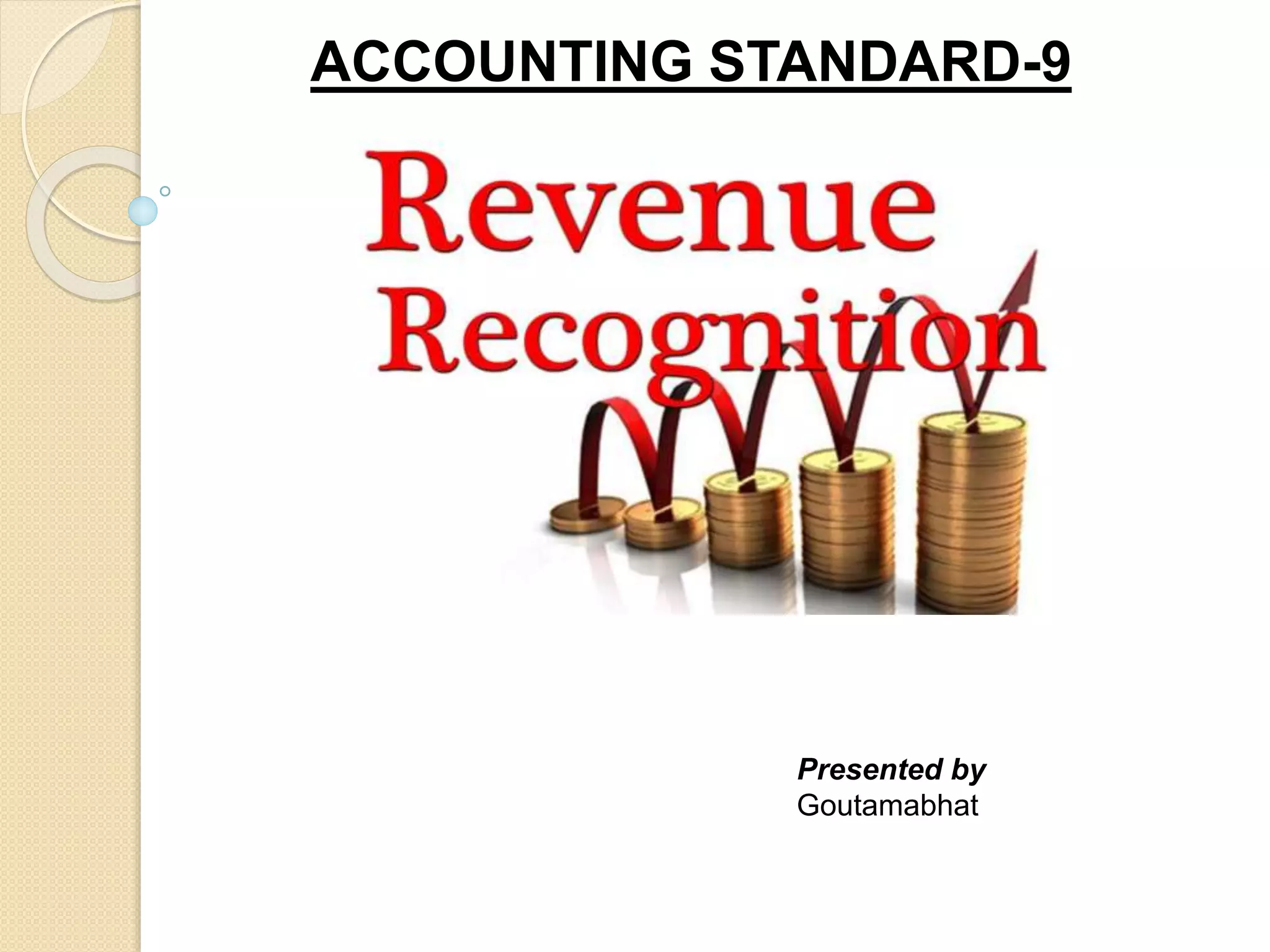
ACCOUNTING STANDARD-9
REVENUE:
It is the gross inflow of cash, receivables or other consideration arising in the course of
ordinary activities of an enterprise from the
1. Sale of goods
2. Rendering of services
3. Use of enterprise resources by others, yielding interest, royalties and dividends
RECOGNITION:
Recording of the monetary effects of a business transaction into books of accounts
or financial statements
MEASURING OF REVENUE:
Charges made to clients or customers for goods supplied and services rendered
Charges and rewards arising from use of resources by others
Relationship between revenue recognition , the
matching concept and the accrual concept
The matching principle directs a company to report an expense in
the same period as the related revenues. It is associated with the
accrual method of accounting
The matching principle accrual cncept(revenues and expenses
are recorded as they are incurred, no matter when cash is
received)
With the revenue recognition principle(revenue should be
recognised when they are earned no matter when cash is
received
Principles
Revenue recognition principle provides that revenue is
recognized:
•When it is earned
•When it is realizes or realizable
•Earned –when earning proocess is substantially complete
•Realized-when goods and services are exchanged for cash
•Realizable-assets received are convertible into known amount
of cash
Primary criteria
•Persuasive evidence for an arrangement
•Delivery has occurred or services have been rendered
•The sellers price to the buyer is fixed or determinable
•Collectability is reasonabally assured
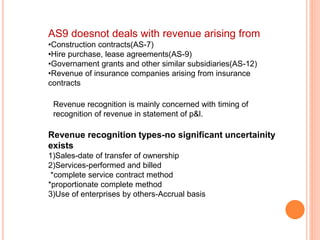
AS9 doesnot deals with revenue arising from
•Construction contracts(AS-7)
•Hire purchase, lease agreements(AS-9)
•Governament grants and other similar subsidiaries(AS-12)
•Revenue of insurance companies arising from insurance
contracts
Revenue recognition is mainly concerned with timing of
recognition of revenue in statement of p&l.
Revenue recognition types-no significant uncertainity
exists
1)Sales-date of transfer of ownership
2)Services-performed and billed
*complete service contract method
*proportionate complete method
3)Use of enterprises by others-Accrual basis
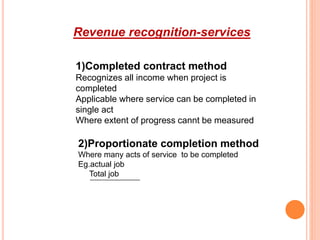
1)Completed contract method
Recognizes all income when project is
completed
Applicable where service can be completed in
single act
Where extent of progress cannt be measured
2)Proportionate completion method
Where many acts of service to be completed
Eg.actual job
Total job
Revenue recognition-services
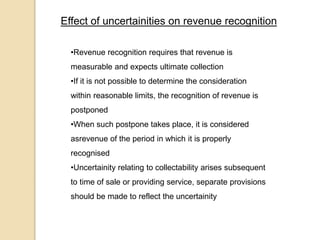
Effect of uncertainities on revenue recognition
•Revenue recognition requires that revenue is
measurable and expects ultimate collection
•If it is not possible to determine the consideration
within reasonable limits, the recognition of revenue is
postponed
•When such postpone takes place, it is considered
asrevenue of the period in which it is properly
recognised
•Uncertainity relating to collectability arises subsequent
to time of sale or providing service, separate provisions
should be made to reflect the uncertainity
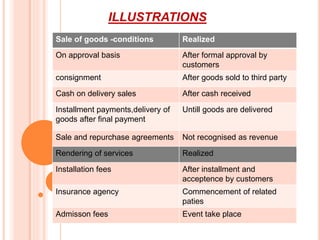
Sale of goods -conditions Realized
On approval basis After formal approval by
customers
consignment After goods sold to third party
Cash on delivery sales After cash received
Installment payments,delivery of
goods after final payment
Untill goods are delivered
Sale and repurchase agreements Not recognised as revenue
Rendering of services Realized
Installation fees After installment and
acceptence by customers
Insurance agency Commencement of related
paties
Admisson fees Event take place
ILLUSTRATIONS
conclusion:
Revenue recognition principle is a cornestore of accrual
accounting together with the matching principle. They both
determine the accounting period, in which revenues and
expenses are recognized, in contrast to cash accounting
where revenues are recognized when cash is received no
matter when goods are sold or services are rendered
References:
•www.icai.org
•www.mca.gov.in
•www.quora.com
Revenue recognition  AS-9

Revenue recognition AS-9

  • 1.
  • 2.
    REVENUE: It is thegross inflow of cash, receivables or other consideration arising in the course of ordinary activities of an enterprise from the 1. Sale of goods 2. Rendering of services 3. Use of enterprise resources by others, yielding interest, royalties and dividends RECOGNITION: Recording of the monetary effects of a business transaction into books of accounts or financial statements MEASURING OF REVENUE: Charges made to clients or customers for goods supplied and services rendered Charges and rewards arising from use of resources by others
  • 3.
    Relationship between revenuerecognition , the matching concept and the accrual concept The matching principle directs a company to report an expense in the same period as the related revenues. It is associated with the accrual method of accounting The matching principle accrual cncept(revenues and expenses are recorded as they are incurred, no matter when cash is received) With the revenue recognition principle(revenue should be recognised when they are earned no matter when cash is received
  • 4.
    Principles Revenue recognition principleprovides that revenue is recognized: •When it is earned •When it is realizes or realizable •Earned –when earning proocess is substantially complete •Realized-when goods and services are exchanged for cash •Realizable-assets received are convertible into known amount of cash Primary criteria •Persuasive evidence for an arrangement •Delivery has occurred or services have been rendered •The sellers price to the buyer is fixed or determinable •Collectability is reasonabally assured
  • 5.
    AS9 doesnot dealswith revenue arising from •Construction contracts(AS-7) •Hire purchase, lease agreements(AS-9) •Governament grants and other similar subsidiaries(AS-12) •Revenue of insurance companies arising from insurance contracts Revenue recognition is mainly concerned with timing of recognition of revenue in statement of p&l. Revenue recognition types-no significant uncertainity exists 1)Sales-date of transfer of ownership 2)Services-performed and billed *complete service contract method *proportionate complete method 3)Use of enterprises by others-Accrual basis
  • 6.
    1)Completed contract method Recognizesall income when project is completed Applicable where service can be completed in single act Where extent of progress cannt be measured 2)Proportionate completion method Where many acts of service to be completed Eg.actual job Total job Revenue recognition-services
  • 7.
    Effect of uncertainitieson revenue recognition •Revenue recognition requires that revenue is measurable and expects ultimate collection •If it is not possible to determine the consideration within reasonable limits, the recognition of revenue is postponed •When such postpone takes place, it is considered asrevenue of the period in which it is properly recognised •Uncertainity relating to collectability arises subsequent to time of sale or providing service, separate provisions should be made to reflect the uncertainity
  • 8.
    Sale of goods-conditions Realized On approval basis After formal approval by customers consignment After goods sold to third party Cash on delivery sales After cash received Installment payments,delivery of goods after final payment Untill goods are delivered Sale and repurchase agreements Not recognised as revenue Rendering of services Realized Installation fees After installment and acceptence by customers Insurance agency Commencement of related paties Admisson fees Event take place ILLUSTRATIONS
  • 9.
    conclusion: Revenue recognition principleis a cornestore of accrual accounting together with the matching principle. They both determine the accounting period, in which revenues and expenses are recognized, in contrast to cash accounting where revenues are recognized when cash is received no matter when goods are sold or services are rendered References: •www.icai.org •www.mca.gov.in •www.quora.com