Revealing the
      Gaps:
BPML utilisation
 in South Africa
  John Hill, Lisa F Seymour,
       Lunga Silandela
    Information Systems
   University of Cape Town
Revealing the Gaps:
BPML utilisation in South Africa
• BPMLs
• Modelling Tools
• BPML Limitations
• Purpose
• Limitations & Findings
• Conclusion
• Moving Forward
Modelling & BPMLs
• This ability to model business processes formally
                                                         Transition


                                                           Action
  is a fundamental part of BPM (business process
  management)                                            Transition


• Many business process modelling languages              Transition


  (BPMLs) and models have been developed such            <No op...


  as UML AD, Flow Charting, EPC, Petri Nets,             Transition

  BPMN etc.
• Yet BPML's differ in that they describe or             Final state


  highlight perspectives differently or to a different
  degree [4].
Modelling Tools
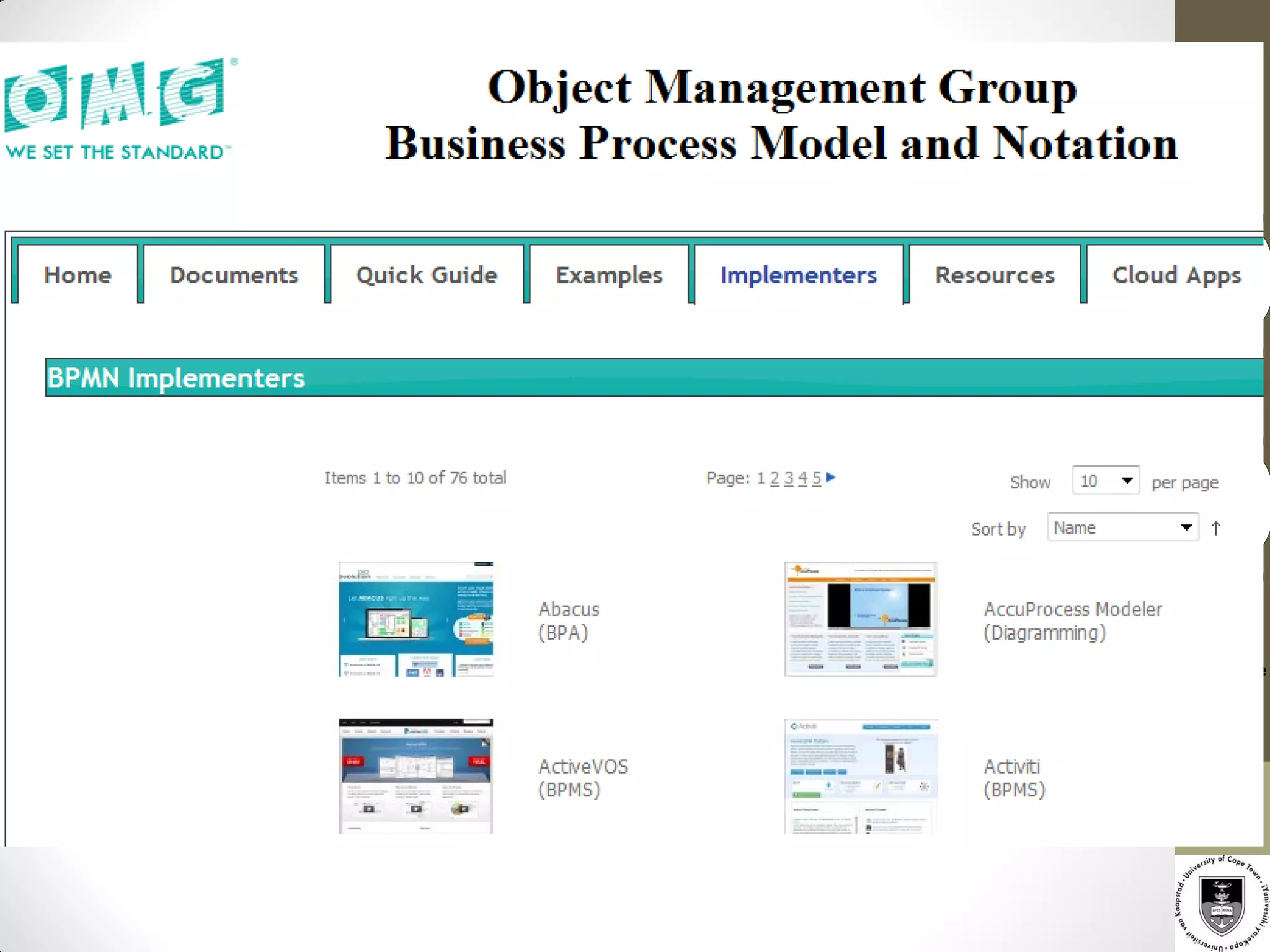
• A wide range of free/inexpensive tools are available (Aris Express,    Transition

  Visio, Oryx, etc.) [15] but often lack the support and functionality     Action
  required for in depth, enterprise wide deployment [16]
                                                                         Transition


                                                                         Transition


                                                                         <No op...


                                                                         Transition


                                                                         Final state


                                                           Recker [12]
Many Tools many BPMLs
                                       Transition

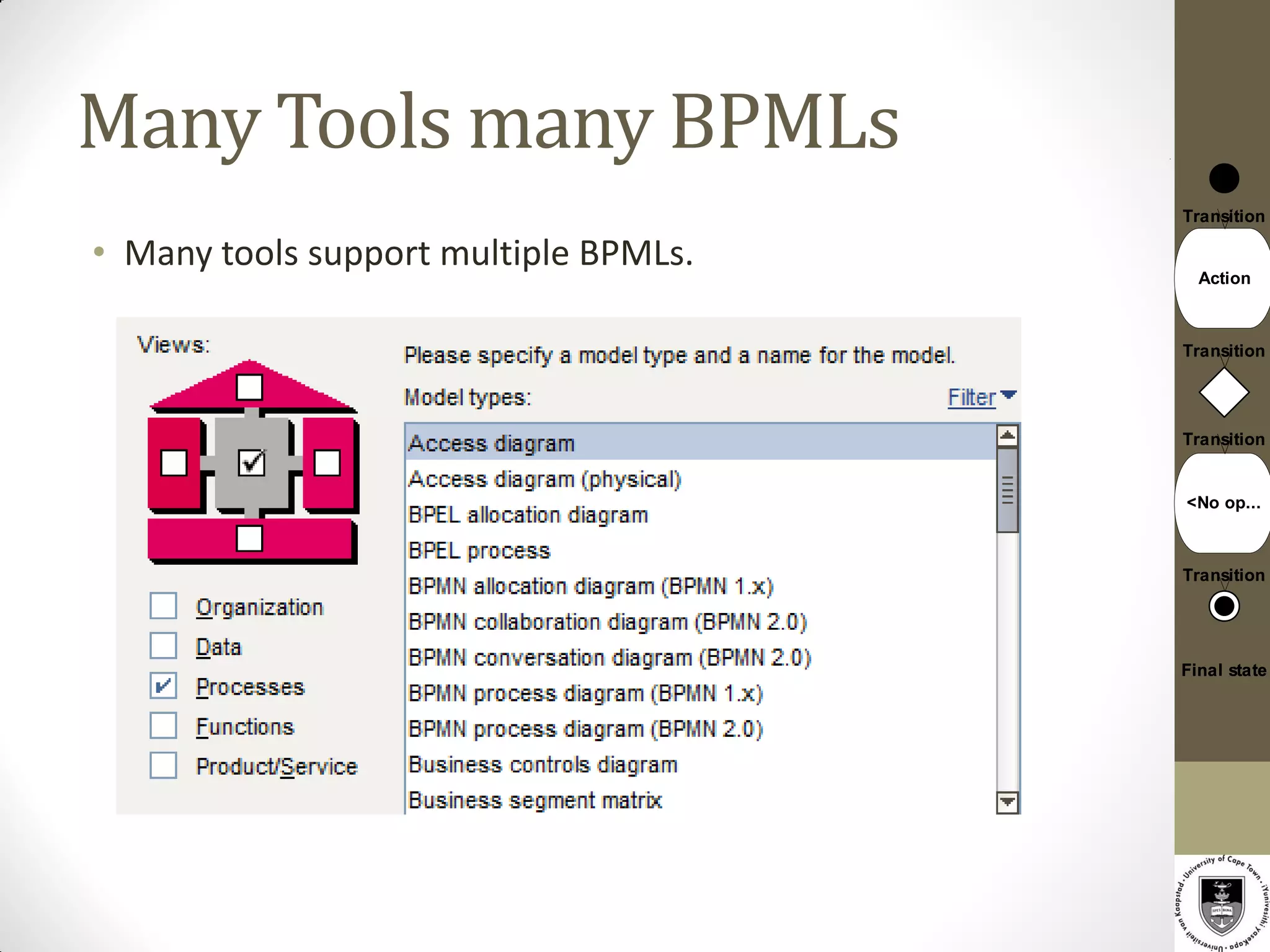
• Many tools support multiple BPMLs.     Action


                                       Transition


                                       Transition


                                       <No op...


                                       Transition


                                       Final state
Transition


  Action


Transition


Transition


<No op...


Transition


Final state
BPML Limitations
                                                       Transition

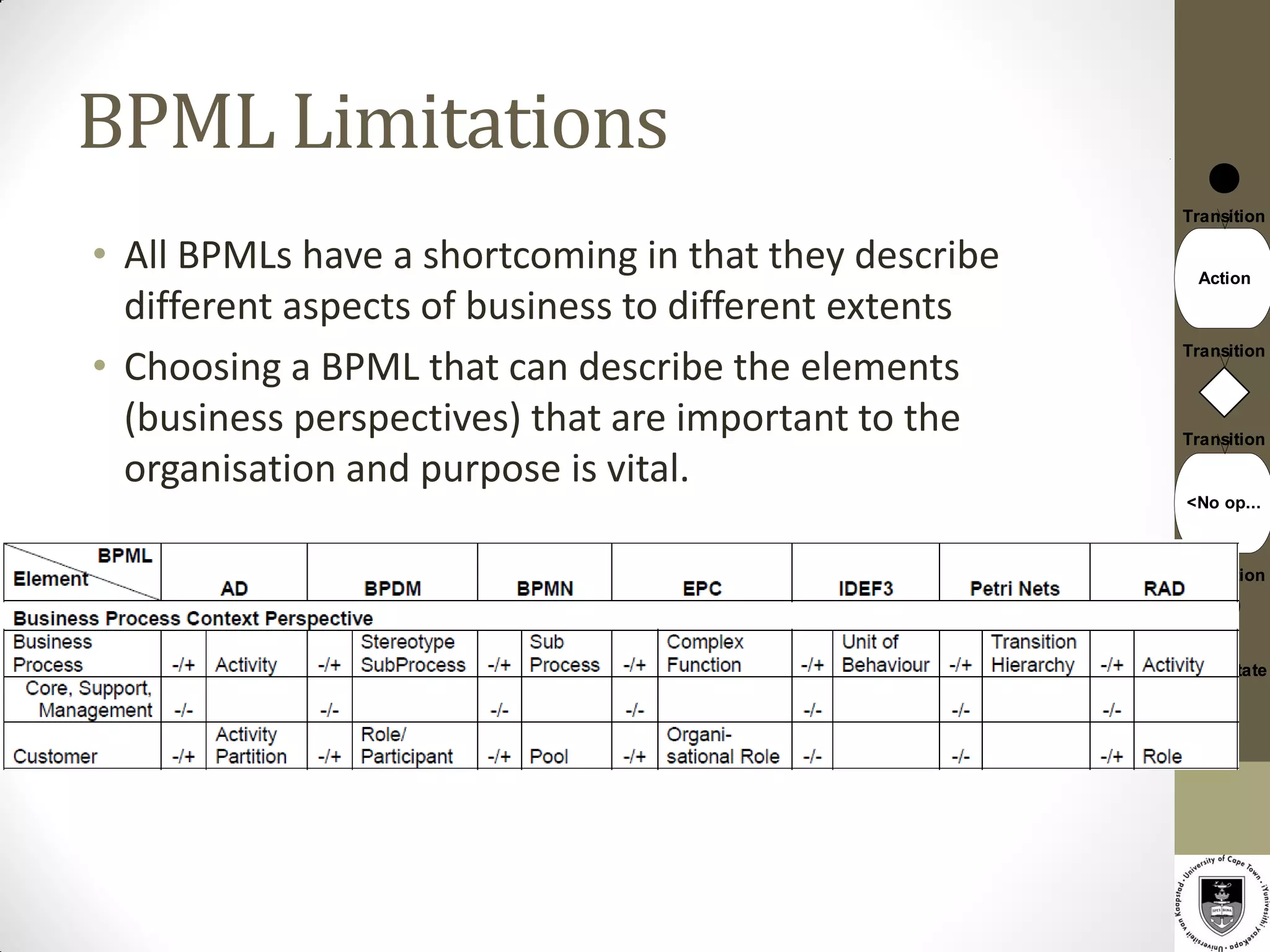
• All BPMLs have a shortcoming in that they describe     Action

  different aspects of business to different extents
• Choosing a BPML that can describe the elements
                                                       Transition


  (business perspectives) that are important to the    Transition

  organisation and purpose is vital.
                                                       <No op...


                                                       Transition


                                                       Final state
Purpose: “Reveal the Gaps”
                                                              Transition

Usage gap: The gap between the elements that can be             Action

  modelled by an organisation’s chosen BPML and the
  elements that are actually modelled by individuals within   Transition


  that organisation.
                                                              Transition

Expectation gap: The gap between the elements that an
                                                              <No op...
  organisation expects its BPML to model and the
  elements which the BPML can actually model.                 Transition


Needs gap: The number of elements that can’t be modelled
  by an organisation’s chosen BPML but are wanted to be       Final state


  modeled
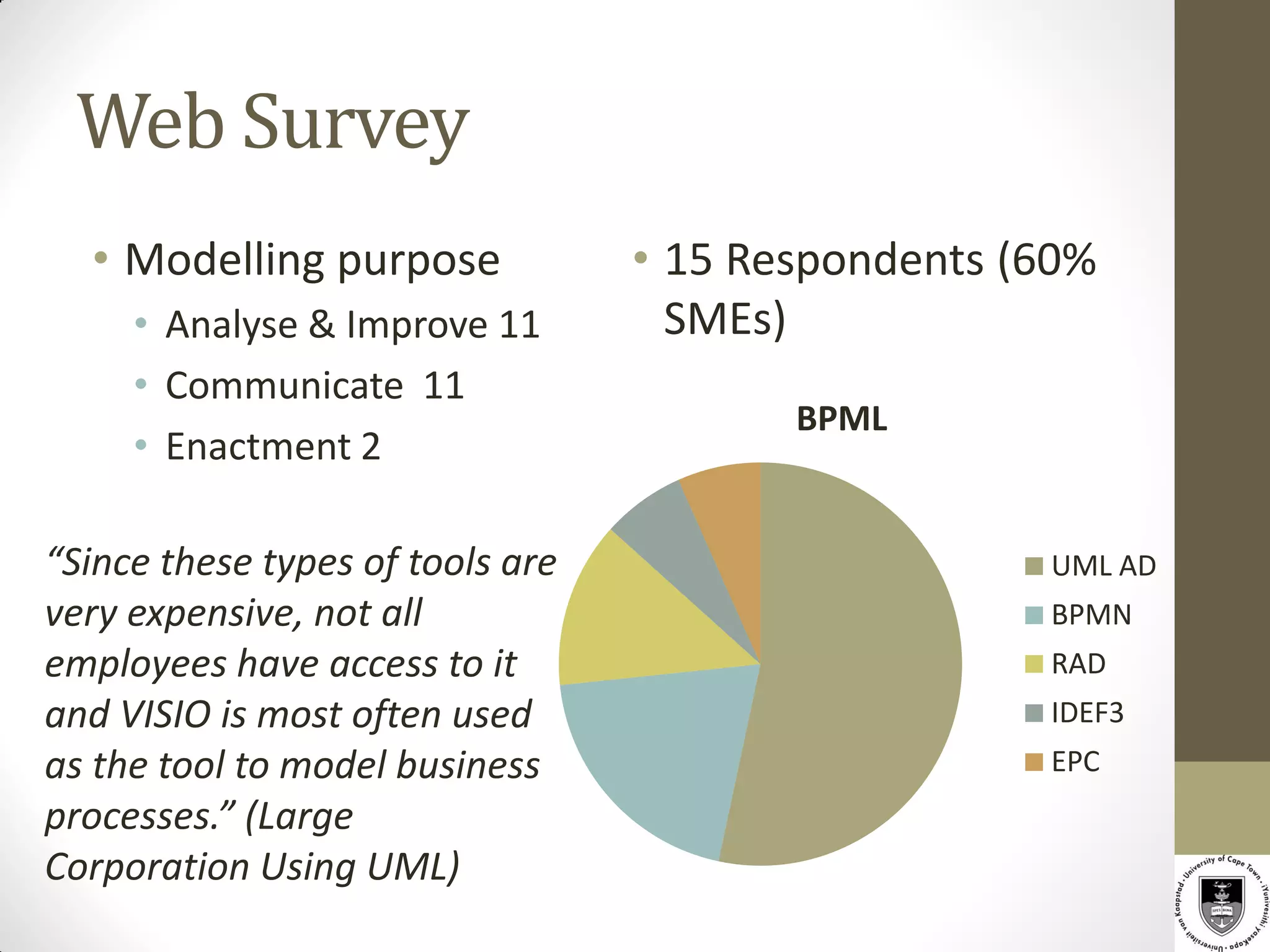
Web Survey
  • Modelling purpose             • 15 Respondents (60%
     • Analyse & Improve 11         SMEs)
     • Communicate 11
                                         BPML
     • Enactment 2

“Since these types of tools are                     UML AD
very expensive, not all                             BPMN
employees have access to it                         RAD
and VISIO is most often used                        IDEF3
as the tool to model business                       EPC
processes.” (Large
Corporation Using UML)
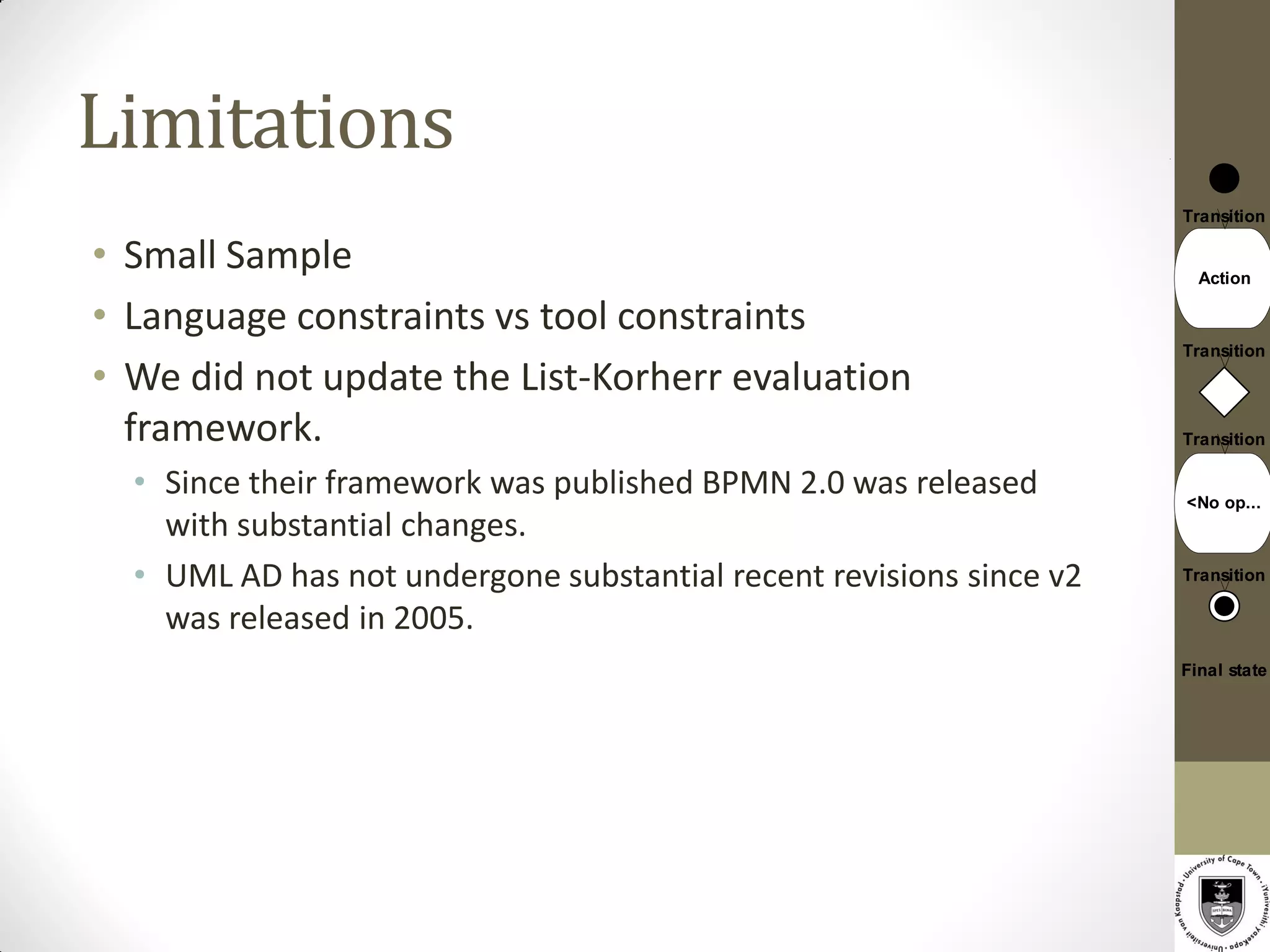
Limitations
                                                                     Transition

• Small Sample                                                         Action

• Language constraints vs tool constraints
                                                                     Transition
• We did not update the List-Korherr evaluation
  framework.                                                         Transition

  • Since their framework was published BPMN 2.0 was released        <No op...
    with substantial changes.
  • UML AD has not undergone substantial recent revisions since v2   Transition

    was released in 2005.
                                                                     Final state
A Usage Gap exists
                                                                    Transition

• The different BPMLs can model between 14 and 32 relevant            Action
  constructs (elements).
• Yet, on average the usage percentage of the sample was 49%.       Transition


• This suggests that almost half the elements that organisations’
                                                                    Transition
  BPMLs can model aren’t being utilised.
• Supports literature [16]                                          <No op...


                                                                    Transition


                                                                    Final state
An Expectation Gap exists
• We found a lack of understanding with regard to what elements       Transition


  BPMLs can actually model.                                             Action


• The potential implication of this lack of understanding is the
                                                                      Transition
  implementation of the wrong or unsuitable BPML within an
  organisation.                                                       Transition

• zur Muehlen & Recker [16] suggest that a lack of training in BPML
                                                                      <No op...
  tool utilisation is to blame for this “expectation gap”
                                                                      Transition


                                                                      Final state
A Needs Gap exists
• Organisations still require the ability to model more elements      Transition


  than what their BPMLs can model.                                      Action


• This could be either :
                                                                      Transition
  • a general inability of BPMLs to model certain elements,
  • the implementation of unsuitable BPMLs                            Transition

  • or a lack of understanding regarding what elements a given BPML
                                                                      <No op...
    can model
• It has been suggested that a post BPML implementation “needs        Transition


  gap” arises from a misunderstanding of the non-functional
  requirements of a BPML [23].                                        Final state
SMEs vs Large organisations
                                                    Transition


• SMEs utilise BPMLs in the same (or similar) way     Action

  that larger organisations utilise BPMLs           Transition

• No association between company size and:
   • Unused elements
                                                    Transition


                                                    <No op...

   • Incorrect expectations
                                                    Transition

   • Needs
                                                    Final state
Conclusion
                                                               Transition

• Brings into question the general suitability of the use of     Action

  BPMLs in particular, UML AD being employed in South
  African organisations to model processes                     Transition


• South African organisations currently fail to utilise        Transition

  Business Process Modelling Languages effectively.
                                                               <No op...
• A combination of lack of understanding and
  shortcomings of BPMLs appear to drive this                   Transition


  ineffectiveness.
                                                               Final state
Moving Forward
• This evaluation framework for examination of BPML
                                                                    Transition


  utilisation within organisations has the potential to be scaled     Action


  up once updated.
                                                                    Transition

• Why do the gaps exist?
  • Are the gaps as a result of misrepresentation by vendors of a   Transition

    BPML’s modelling capability?
                                                                    <No op...
  • Are the gaps as a result of poor/incomplete understanding by
    the organisations implementing a BPML?                          Transition


• Organisations need to realise the full potential of effective
  BPML utilisation                                                  Final state
Transition


Thank you !
                Action


              Transition


              Transition


              <No op...


Discussion    Transition


              Final state

Revealing the gaps A study of Business Process Modelling Language utilisation in South African organisations

  • 1.
    Revealing the Gaps: BPML utilisation in South Africa John Hill, Lisa F Seymour, Lunga Silandela Information Systems University of Cape Town
  • 2.
    Revealing the Gaps: BPMLutilisation in South Africa • BPMLs • Modelling Tools • BPML Limitations • Purpose • Limitations & Findings • Conclusion • Moving Forward
  • 3.
    Modelling & BPMLs •This ability to model business processes formally Transition Action is a fundamental part of BPM (business process management) Transition • Many business process modelling languages Transition (BPMLs) and models have been developed such <No op... as UML AD, Flow Charting, EPC, Petri Nets, Transition BPMN etc. • Yet BPML's differ in that they describe or Final state highlight perspectives differently or to a different degree [4].
  • 4.
    Modelling Tools • Awide range of free/inexpensive tools are available (Aris Express, Transition Visio, Oryx, etc.) [15] but often lack the support and functionality Action required for in depth, enterprise wide deployment [16] Transition Transition <No op... Transition Final state Recker [12]
  • 5.
    Many Tools manyBPMLs Transition • Many tools support multiple BPMLs. Action Transition Transition <No op... Transition Final state
  • 6.
    Transition Action Transition Transition <Noop... Transition Final state
  • 7.
    BPML Limitations Transition • All BPMLs have a shortcoming in that they describe Action different aspects of business to different extents • Choosing a BPML that can describe the elements Transition (business perspectives) that are important to the Transition organisation and purpose is vital. <No op... Transition Final state
  • 8.
    Purpose: “Reveal theGaps” Transition Usage gap: The gap between the elements that can be Action modelled by an organisation’s chosen BPML and the elements that are actually modelled by individuals within Transition that organisation. Transition Expectation gap: The gap between the elements that an <No op... organisation expects its BPML to model and the elements which the BPML can actually model. Transition Needs gap: The number of elements that can’t be modelled by an organisation’s chosen BPML but are wanted to be Final state modeled
  • 9.
    Web Survey • Modelling purpose • 15 Respondents (60% • Analyse & Improve 11 SMEs) • Communicate 11 BPML • Enactment 2 “Since these types of tools are UML AD very expensive, not all BPMN employees have access to it RAD and VISIO is most often used IDEF3 as the tool to model business EPC processes.” (Large Corporation Using UML)
  • 10.
    Limitations Transition • Small Sample Action • Language constraints vs tool constraints Transition • We did not update the List-Korherr evaluation framework. Transition • Since their framework was published BPMN 2.0 was released <No op... with substantial changes. • UML AD has not undergone substantial recent revisions since v2 Transition was released in 2005. Final state
  • 11.
    A Usage Gapexists Transition • The different BPMLs can model between 14 and 32 relevant Action constructs (elements). • Yet, on average the usage percentage of the sample was 49%. Transition • This suggests that almost half the elements that organisations’ Transition BPMLs can model aren’t being utilised. • Supports literature [16] <No op... Transition Final state
  • 12.
    An Expectation Gapexists • We found a lack of understanding with regard to what elements Transition BPMLs can actually model. Action • The potential implication of this lack of understanding is the Transition implementation of the wrong or unsuitable BPML within an organisation. Transition • zur Muehlen & Recker [16] suggest that a lack of training in BPML <No op... tool utilisation is to blame for this “expectation gap” Transition Final state
  • 13.
    A Needs Gapexists • Organisations still require the ability to model more elements Transition than what their BPMLs can model. Action • This could be either : Transition • a general inability of BPMLs to model certain elements, • the implementation of unsuitable BPMLs Transition • or a lack of understanding regarding what elements a given BPML <No op... can model • It has been suggested that a post BPML implementation “needs Transition gap” arises from a misunderstanding of the non-functional requirements of a BPML [23]. Final state
  • 14.
    SMEs vs Largeorganisations Transition • SMEs utilise BPMLs in the same (or similar) way Action that larger organisations utilise BPMLs Transition • No association between company size and: • Unused elements Transition <No op... • Incorrect expectations Transition • Needs Final state
  • 15.
    Conclusion Transition • Brings into question the general suitability of the use of Action BPMLs in particular, UML AD being employed in South African organisations to model processes Transition • South African organisations currently fail to utilise Transition Business Process Modelling Languages effectively. <No op... • A combination of lack of understanding and shortcomings of BPMLs appear to drive this Transition ineffectiveness. Final state
  • 16.
    Moving Forward • Thisevaluation framework for examination of BPML Transition utilisation within organisations has the potential to be scaled Action up once updated. Transition • Why do the gaps exist? • Are the gaps as a result of misrepresentation by vendors of a Transition BPML’s modelling capability? <No op... • Are the gaps as a result of poor/incomplete understanding by the organisations implementing a BPML? Transition • Organisations need to realise the full potential of effective BPML utilisation Final state
  • 17.
    Transition Thank you ! Action Transition Transition <No op... Discussion Transition Final state