User perceptions, motivations and implications on
ERP usage: An Indian Higher Education Context

       Jyoti M. Bhat, Bhavya Shroff & Rajendra K. Bandi

             Indian Institute of Management,
                       Bangalore, India

                      CONFENIS -2012
Agenda

 • Study ERP implementation from user perspectives
 • Case study of ERP implementation in an Indian higher
   education institution.
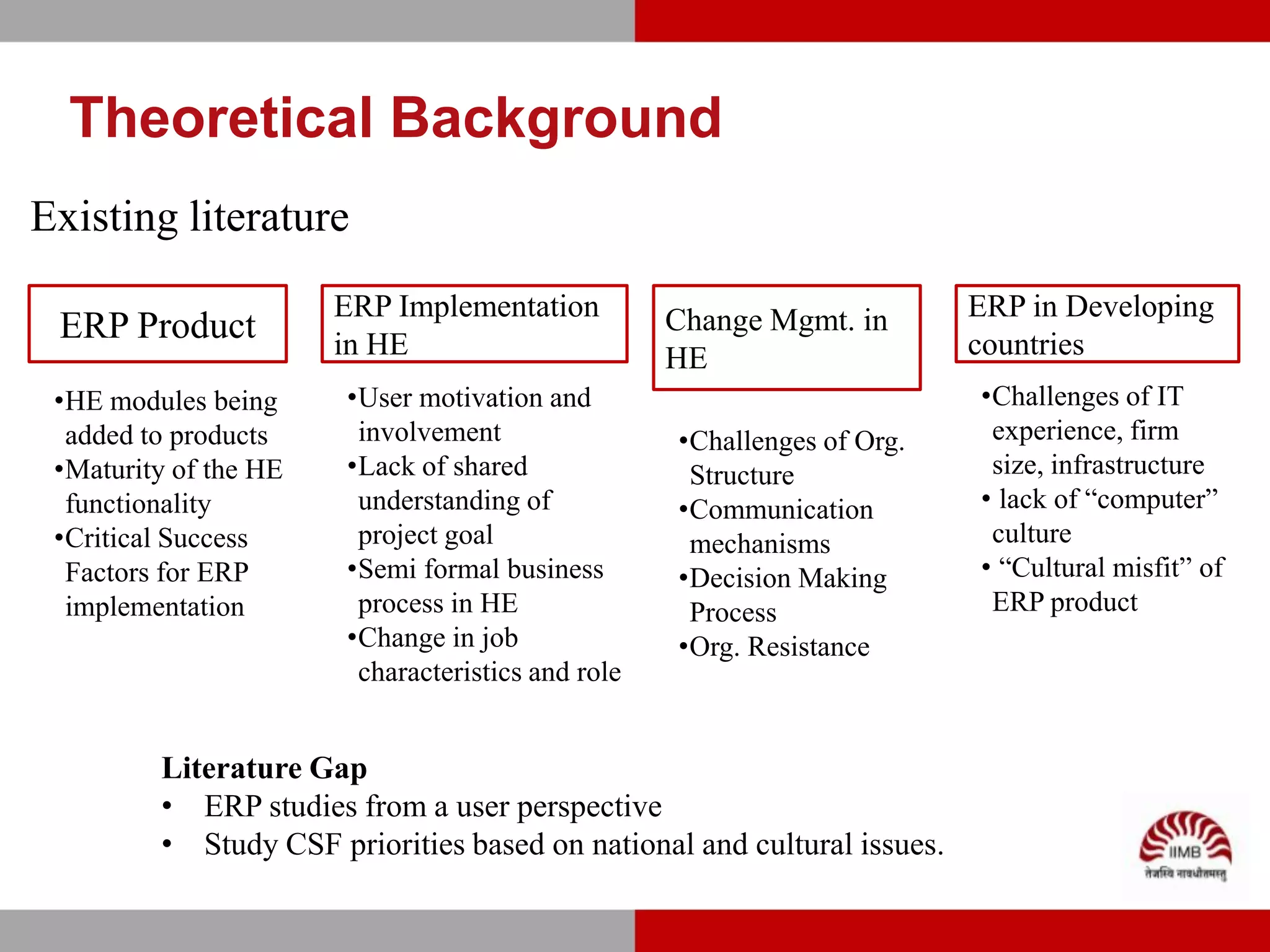
Theoretical Background
Existing literature
                       ERP Implementation          Change Mgmt. in       ERP in Developing
 ERP Product           in HE                                             countries
                                                   HE
 •HE modules being     •User motivation and                              •Challenges of IT
  added to products     involvement                •Challenges of Org.    experience, firm
 •Maturity of the HE   •Lack of shared              Structure             size, infrastructure
  functionality         understanding of           •Communication        • lack of “computer”
 •Critical Success      project goal                mechanisms            culture
  Factors for ERP      •Semi formal business       •Decision Making      • “Cultural misfit” of
  implementation        process in HE               Process               ERP product
                       •Change in job              •Org. Resistance
                        characteristics and role


         Literature Gap
         • ERP studies from a user perspective
         • Study CSF priorities based on national and cultural issues.
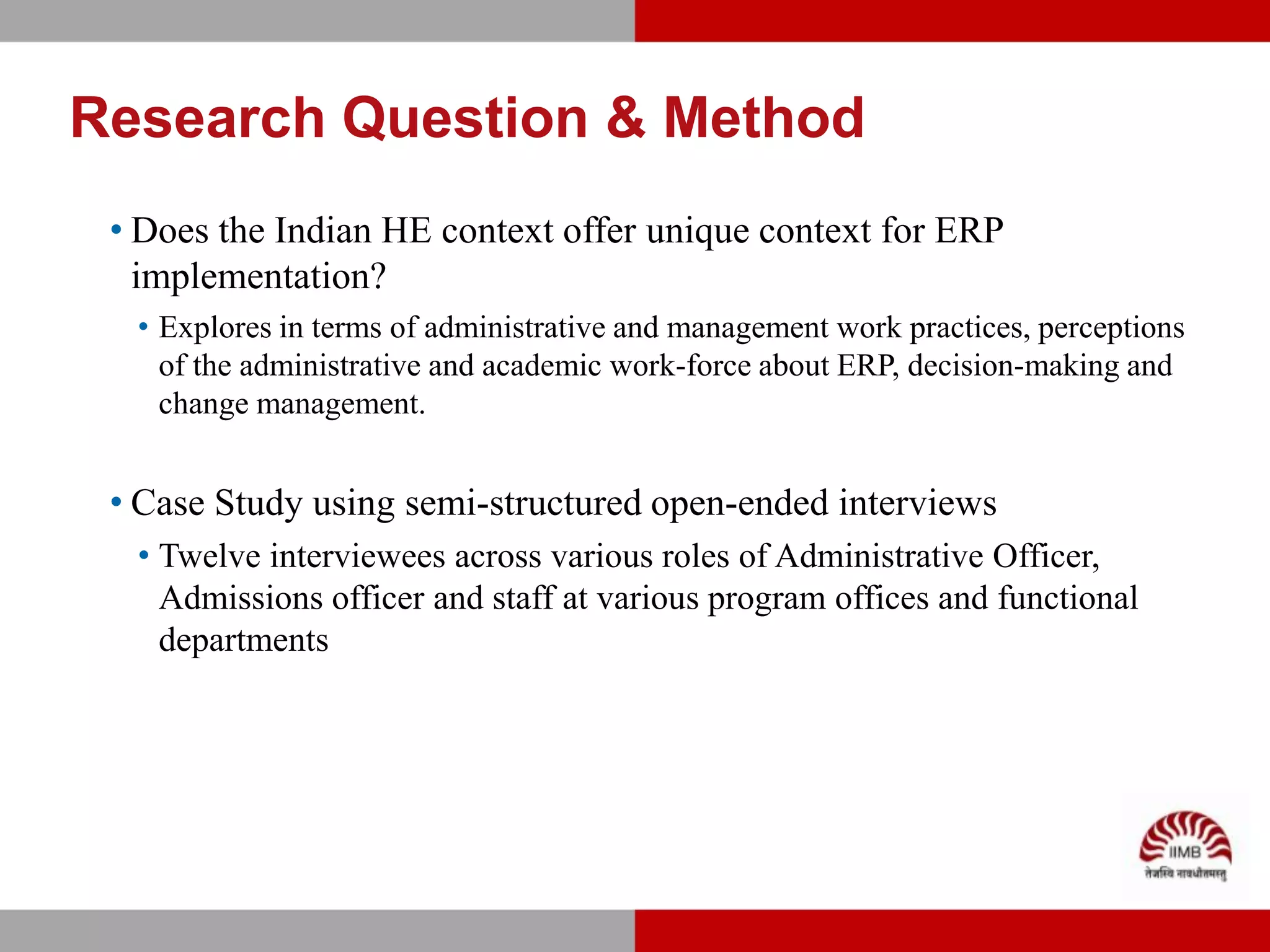
Research Question & Method
 • Does the Indian HE context offer unique context for ERP
   implementation?
  • Explores in terms of administrative and management work practices, perceptions
    of the administrative and academic work-force about ERP, decision-making and
    change management.


 • Case Study using semi-structured open-ended interviews
  • Twelve interviewees across various roles of Administrative Officer,
    Admissions officer and staff at various program offices and functional
    departments
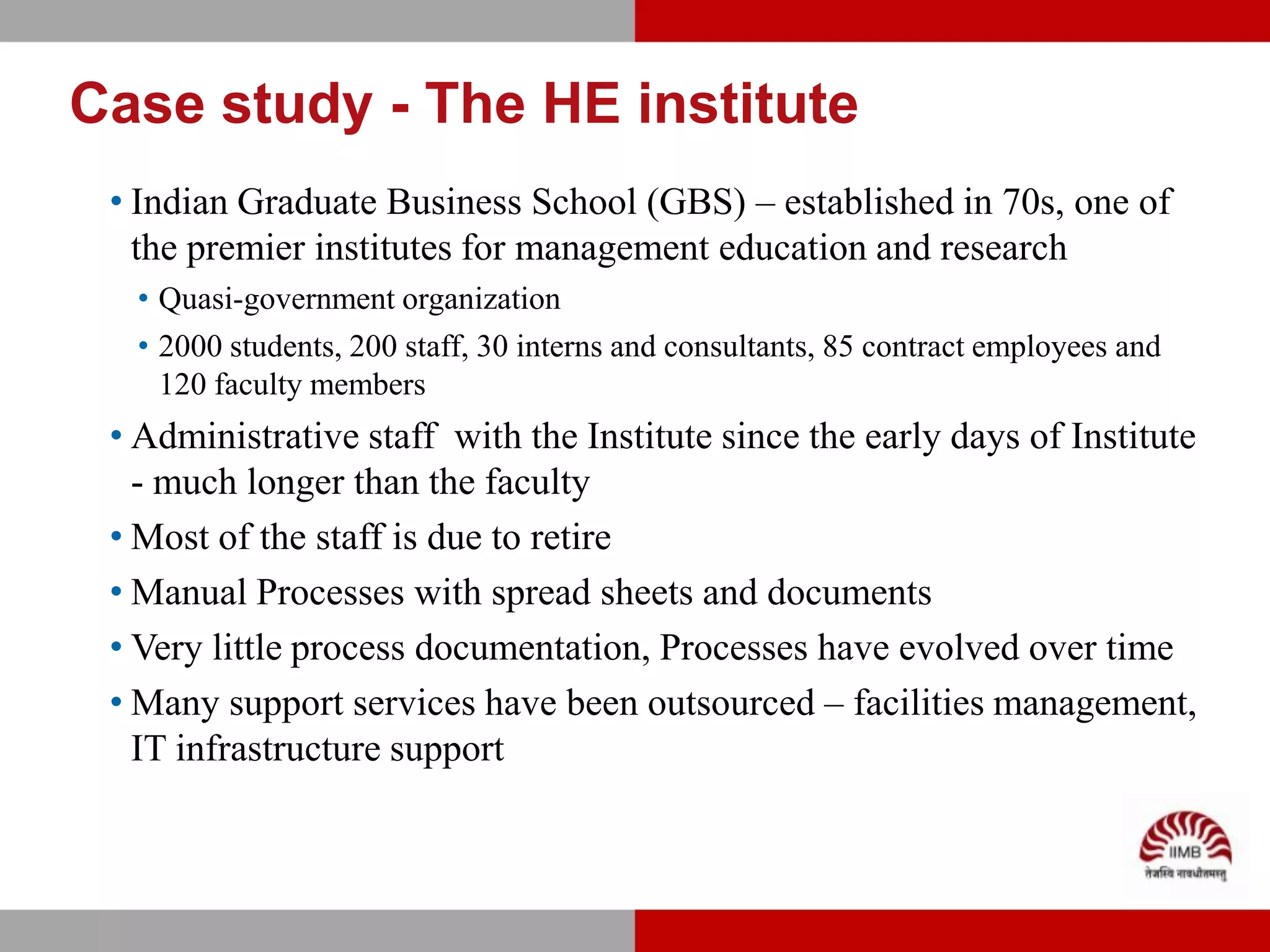
Case study - The HE institute
 • Indian Graduate Business School (GBS) – established in 70s, one of
   the premier institutes for management education and research
  • Quasi-government organization
  • 2000 students, 200 staff, 30 interns and consultants, 85 contract employees and
    120 faculty members
 • Administrative staff with the Institute since the early days of Institute
   - much longer than the faculty
 • Most of the staff is due to retire
 • Manual Processes with spread sheets and documents
 • Very little process documentation, Processes have evolved over time
 • Many support services have been outsourced – facilities management,
   IT infrastructure support
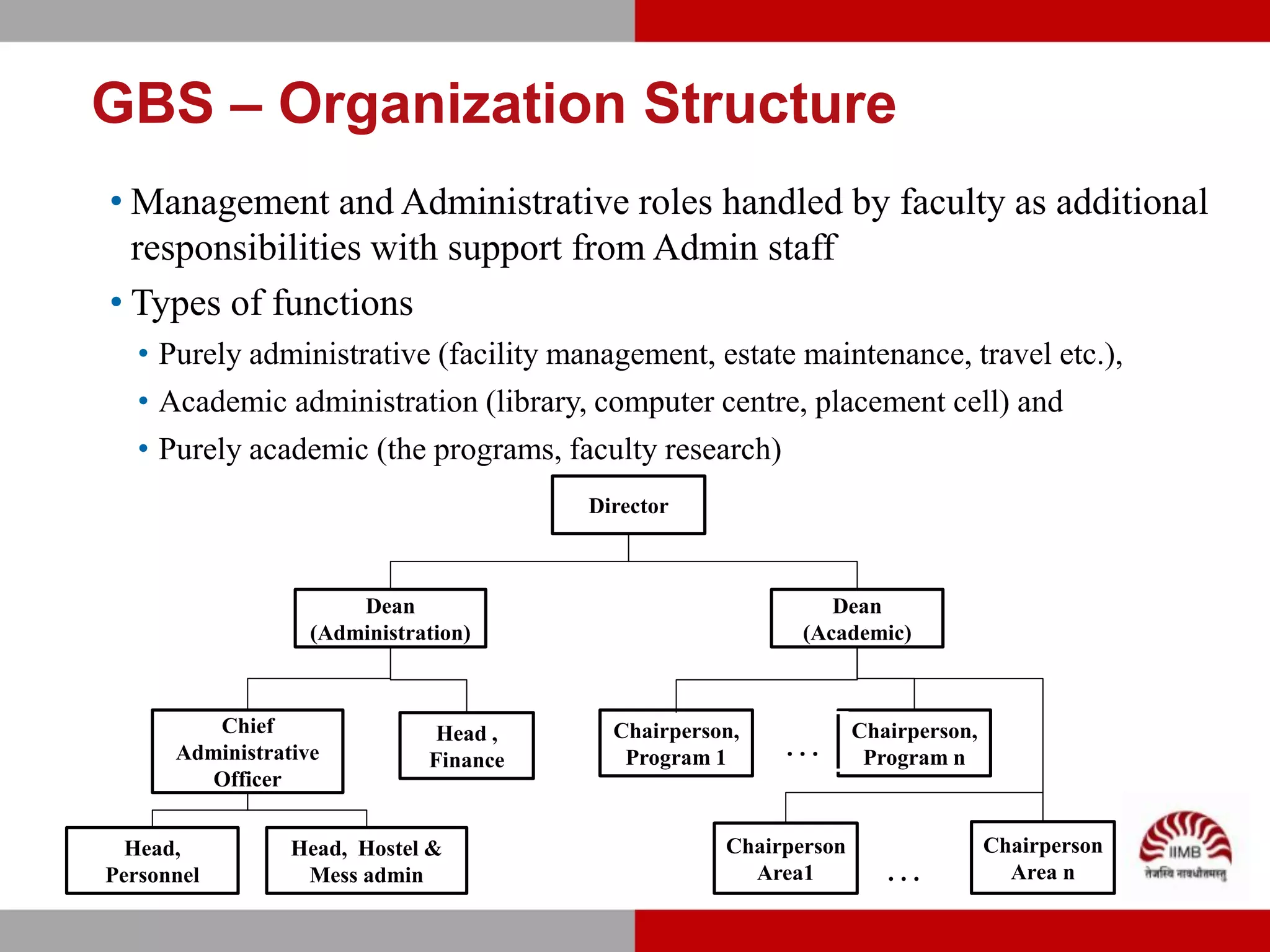
GBS – Organization Structure
• Management and Administrative roles handled by faculty as additional
  responsibilities with support from Admin staff
• Types of functions
   • Purely administrative (facility management, estate maintenance, travel etc.),
   • Academic administration (library, computer centre, placement cell) and
   • Purely academic (the programs, faculty research)
                                        Director


                       Dean                                   Dean
                   (Administration)                        (Academic)


         Chief
      Administrative
                               Head ,
                              Finance
                                          Chairperson,
                                           Program 1     …        Chairperson,
                                                                   Program n
         Officer


  Head,          Head, Hostel &                     Chairperson                  Chairperson
Personnel         Mess admin                          Area1          ….            Area n
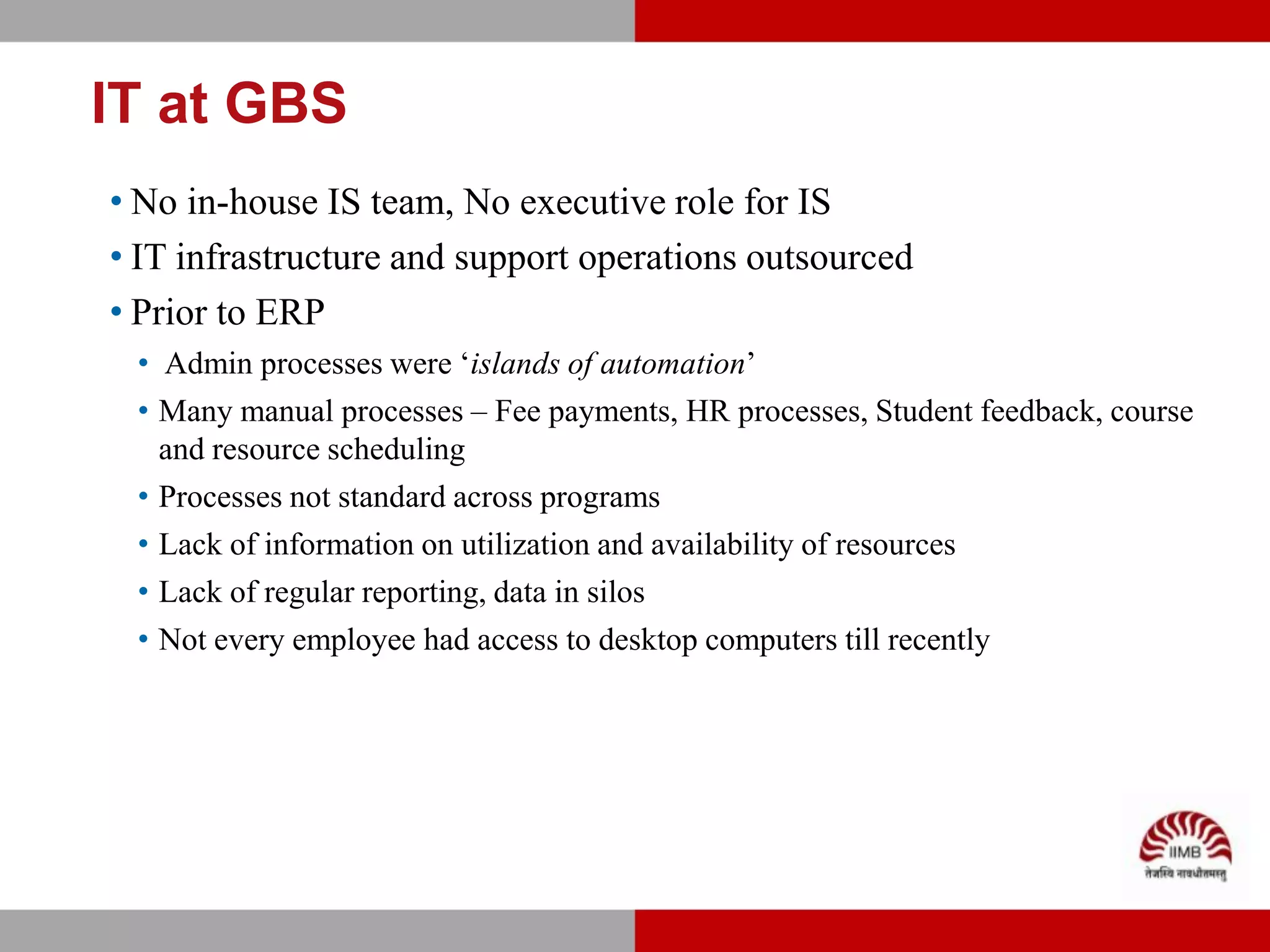
IT at GBS
• No in-house IS team, No executive role for IS
• IT infrastructure and support operations outsourced
• Prior to ERP
 • Admin processes were ‘islands of automation’
 • Many manual processes – Fee payments, HR processes, Student feedback, course
   and resource scheduling
 • Processes not standard across programs
 • Lack of information on utilization and availability of resources
 • Lack of regular reporting, data in silos
 • Not every employee had access to desktop computers till recently
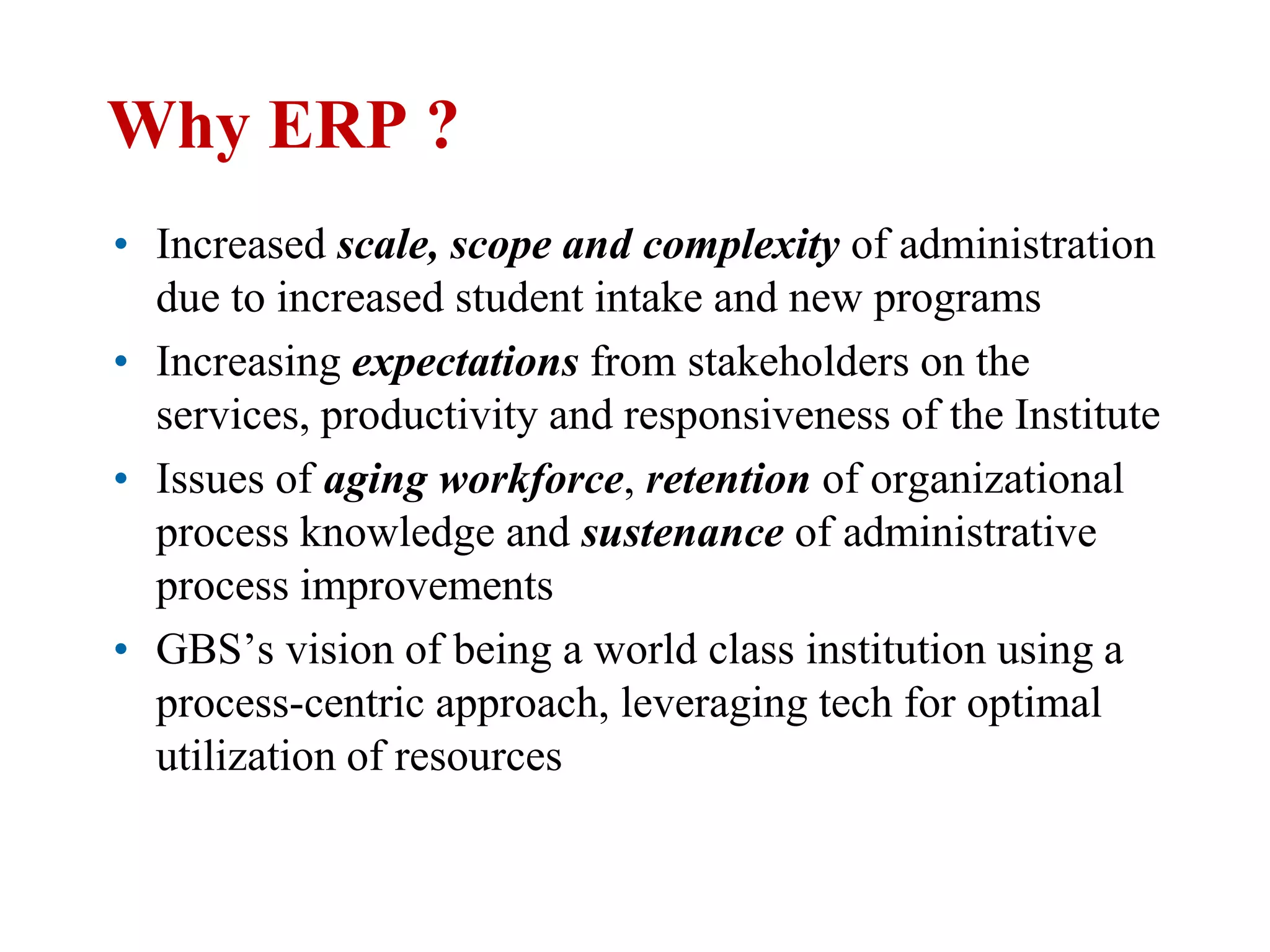
Why ERP ?
• Increased scale, scope and complexity of administration
  due to increased student intake and new programs
• Increasing expectations from stakeholders on the
  services, productivity and responsiveness of the Institute
• Issues of aging workforce, retention of organizational
  process knowledge and sustenance of administrative
  process improvements
• GBS’s vision of being a world class institution using a
  process-centric approach, leveraging tech for optimal
  utilization of resources
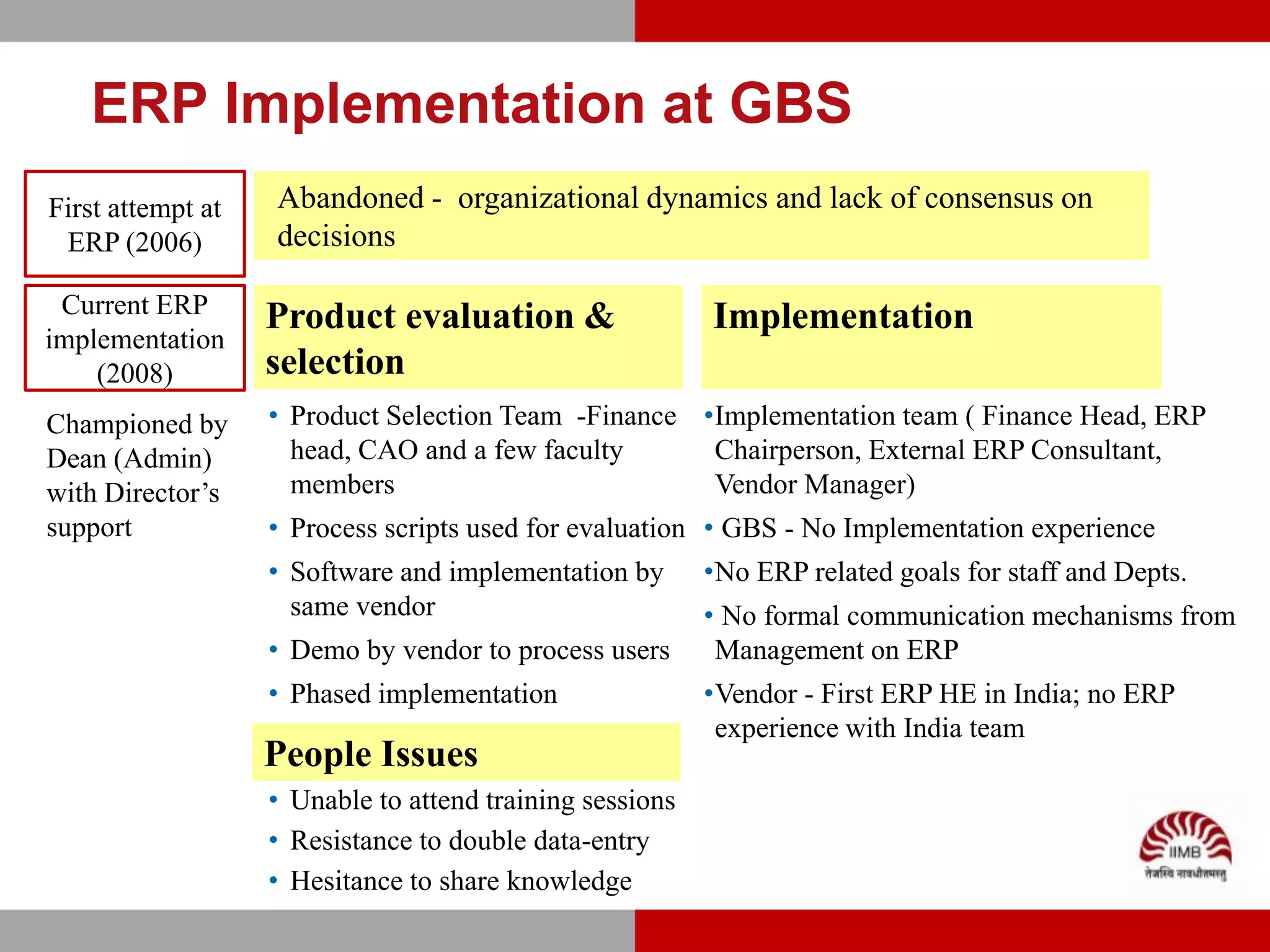
ERP Implementation at GBS
First attempt at   Abandoned - organizational dynamics and lack of consensus on
 ERP (2006)        decisions

 Current ERP       Product evaluation &                   Implementation
implementation
    (2008)         selection
Championed by      • Product Selection Team -Finance •Implementation team ( Finance Head, ERP
Dean (Admin)         head, CAO and a few faculty      Chairperson, External ERP Consultant,
with Director’s      members                          Vendor Manager)
support            • Process scripts used for evaluation • GBS - No Implementation experience
                   • Software and implementation by       •No ERP related goals for staff and Depts.
                     same vendor                          • No formal communication mechanisms from
                   • Demo by vendor to process users       Management on ERP
                   • Phased implementation                •Vendor - First ERP HE in India; no ERP
                                                           experience with India team
                   People Issues
                   • Unable to attend training sessions
                   • Resistance to double data-entry
                   • Hesitance to share knowledge
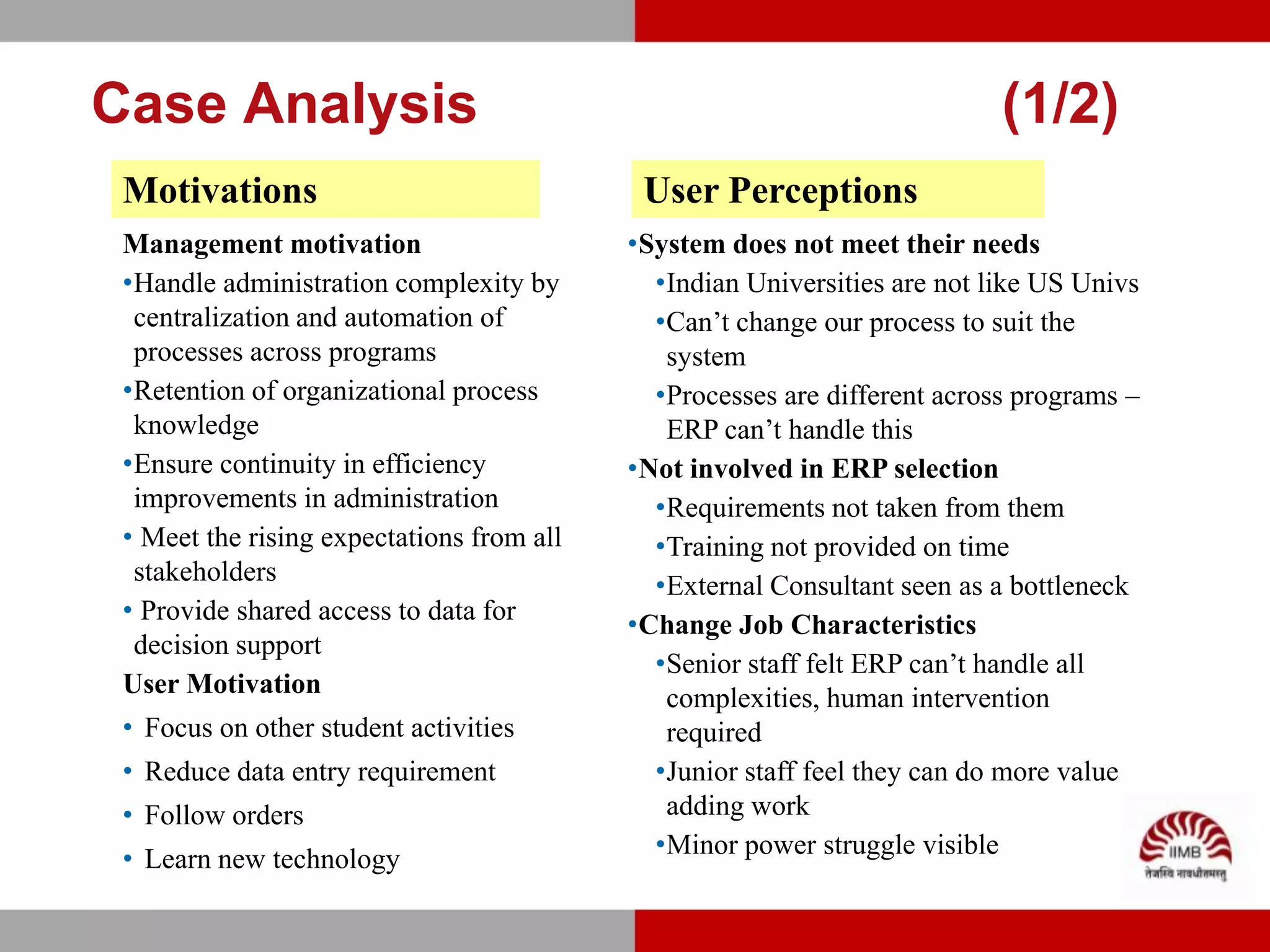
Case Analysis                                                              (1/2)
 Motivations                                User Perceptions
 Management motivation                     •System does not meet their needs
 •Handle administration complexity by        •Indian Universities are not like US Univs
  centralization and automation of           •Can’t change our process to suit the
  processes across programs                   system
 •Retention of organizational process        •Processes are different across programs –
  knowledge                                   ERP can’t handle this
 •Ensure continuity in efficiency          •Not involved in ERP selection
  improvements in administration             •Requirements not taken from them
 • Meet the rising expectations from all     •Training not provided on time
  stakeholders                               •External Consultant seen as a bottleneck
 • Provide shared access to data for       •Change Job Characteristics
  decision support
                                             •Senior staff felt ERP can’t handle all
 User Motivation
                                              complexities, human intervention
 • Focus on other student activities          required
 • Reduce data entry requirement             •Junior staff feel they can do more value
 • Follow orders                              adding work
                                             •Minor power struggle visible
 • Learn new technology
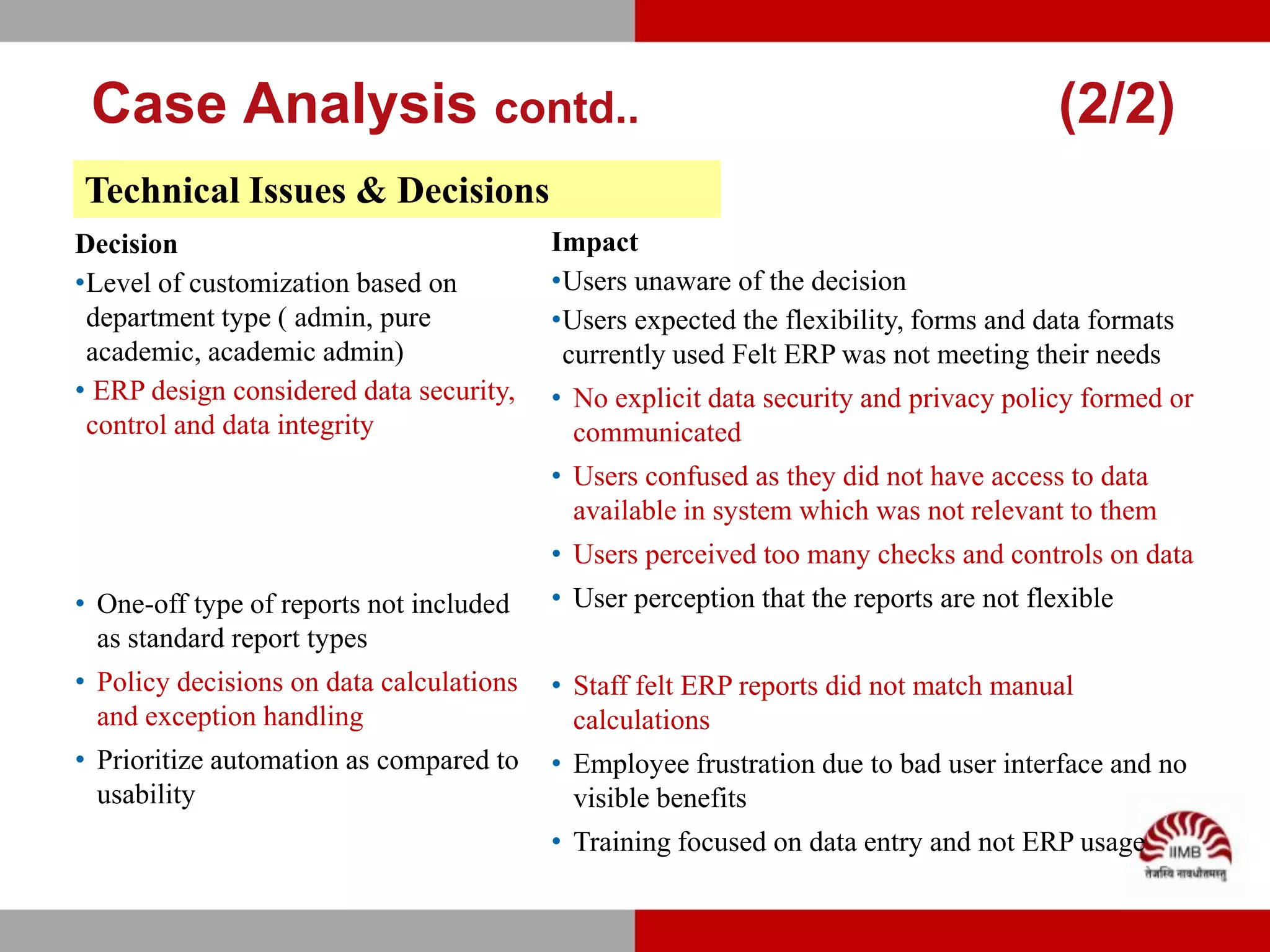
Case Analysis contd..                                                                 (2/2)
Technical Issues & Decisions
Decision                                  Impact
•Level of customization based on          •Users unaware of the decision
 department type ( admin, pure            •Users expected the flexibility, forms and data formats
 academic, academic admin)                 currently used Felt ERP was not meeting their needs
• ERP design considered data security,    • No explicit data security and privacy policy formed or
 control and data integrity                 communicated
                                          • Users confused as they did not have access to data
                                            available in system which was not relevant to them
                                          • Users perceived too many checks and controls on data
• One-off type of reports not included    • User perception that the reports are not flexible
  as standard report types
• Policy decisions on data calculations   • Staff felt ERP reports did not match manual
  and exception handling                    calculations
• Prioritize automation as compared to    • Employee frustration due to bad user interface and no
  usability                                 visible benefits
                                          • Training focused on data entry and not ERP usage
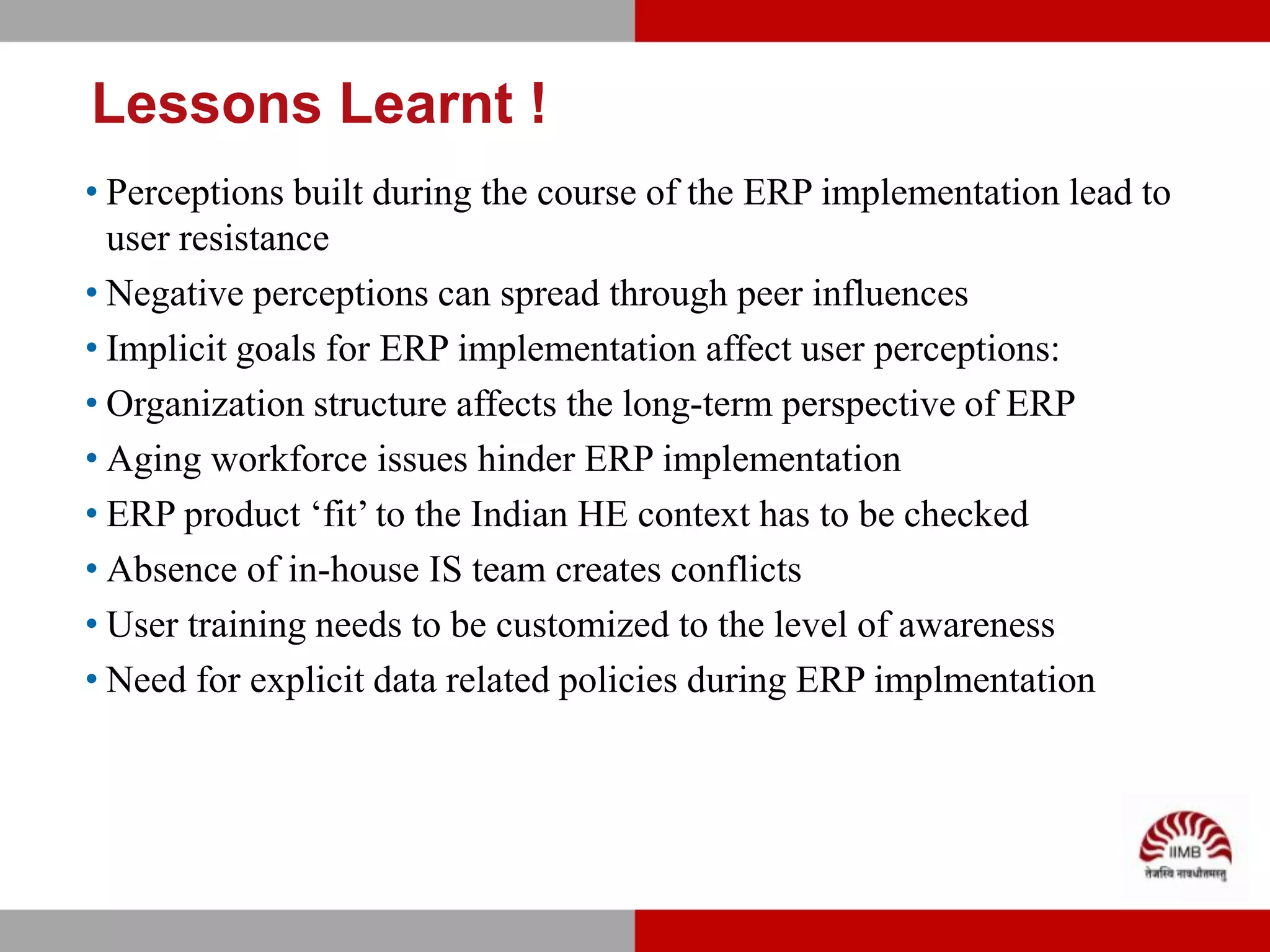
Lessons Learnt !
• Perceptions built during the course of the ERP implementation lead to
  user resistance
• Negative perceptions can spread through peer influences
• Implicit goals for ERP implementation affect user perceptions:
• Organization structure affects the long-term perspective of ERP
• Aging workforce issues hinder ERP implementation
• ERP product ‘fit’ to the Indian HE context has to be checked
• Absence of in-house IS team creates conflicts
• User training needs to be customized to the level of awareness
• Need for explicit data related policies during ERP implmentation
Key References
• Abugabah, A., Sanzogni, L.: Enterprise Resource Planning (ERP) System in Higher
  Education: A literature Review and Implications, World Academy of Science,
  Engineering and Technology, vol 71. (2010)

• Gyampah, K. A.: ERP implementation factors A comparison of managerial and end-user
  perspectives. Business Process Management Journal, vol 10, iss 2, pp. 171-183. (2004)

• Hong, K..K., Kim, Y.G.: The critical success factors for ERP implementation: an
  organizational fit perspective. Information & Management, vol 40, pp. 25–40. (2002)

• Huang,Z.,Palvia,P.: ERP implementation issues in advanced and developing countries.
  Business Process Management Journal, vol. 7, iss. 3, pp. 276 – 284 (2001)

• Lechtchinskaia, L.,Uffen, J.,Breitner, M.H.: "Critical Success Factors for Adoption of
  Integrated Information Systems in Higher Education Institutions – A Meta-Analysis”
  AMCIS 2011 Proceedings. (2011)

• Von Hellens L., Nielsen S., Beekhuyzen J.: Qualitative case studies on implementation of
  enterprise wide systems. Hershey PA: Idea Group. (2005)
Thank You!


       Dr. Rajendra K. Bandi
       rbandi@iimb.ernet.in

   Indian Institute of Management Bangalore
Bannerghatta Road, Bangalore – 560 076, INDIA

            www.iimb.ernet.in

User perceptions, motivations and implications on ERP usage: An Indian Higher Education Context

  • 1.
    User perceptions, motivationsand implications on ERP usage: An Indian Higher Education Context Jyoti M. Bhat, Bhavya Shroff & Rajendra K. Bandi Indian Institute of Management, Bangalore, India CONFENIS -2012
  • 2.
    Agenda • StudyERP implementation from user perspectives • Case study of ERP implementation in an Indian higher education institution.
  • 3.
    Theoretical Background Existing literature ERP Implementation Change Mgmt. in ERP in Developing ERP Product in HE countries HE •HE modules being •User motivation and •Challenges of IT added to products involvement •Challenges of Org. experience, firm •Maturity of the HE •Lack of shared Structure size, infrastructure functionality understanding of •Communication • lack of “computer” •Critical Success project goal mechanisms culture Factors for ERP •Semi formal business •Decision Making • “Cultural misfit” of implementation process in HE Process ERP product •Change in job •Org. Resistance characteristics and role Literature Gap • ERP studies from a user perspective • Study CSF priorities based on national and cultural issues.
  • 4.
    Research Question &Method • Does the Indian HE context offer unique context for ERP implementation? • Explores in terms of administrative and management work practices, perceptions of the administrative and academic work-force about ERP, decision-making and change management. • Case Study using semi-structured open-ended interviews • Twelve interviewees across various roles of Administrative Officer, Admissions officer and staff at various program offices and functional departments
  • 5.
    Case study -The HE institute • Indian Graduate Business School (GBS) – established in 70s, one of the premier institutes for management education and research • Quasi-government organization • 2000 students, 200 staff, 30 interns and consultants, 85 contract employees and 120 faculty members • Administrative staff with the Institute since the early days of Institute - much longer than the faculty • Most of the staff is due to retire • Manual Processes with spread sheets and documents • Very little process documentation, Processes have evolved over time • Many support services have been outsourced – facilities management, IT infrastructure support
  • 6.
    GBS – OrganizationStructure • Management and Administrative roles handled by faculty as additional responsibilities with support from Admin staff • Types of functions • Purely administrative (facility management, estate maintenance, travel etc.), • Academic administration (library, computer centre, placement cell) and • Purely academic (the programs, faculty research) Director Dean Dean (Administration) (Academic) Chief Administrative Head , Finance Chairperson, Program 1 … Chairperson, Program n Officer Head, Head, Hostel & Chairperson Chairperson Personnel Mess admin Area1 …. Area n
  • 7.
    IT at GBS •No in-house IS team, No executive role for IS • IT infrastructure and support operations outsourced • Prior to ERP • Admin processes were ‘islands of automation’ • Many manual processes – Fee payments, HR processes, Student feedback, course and resource scheduling • Processes not standard across programs • Lack of information on utilization and availability of resources • Lack of regular reporting, data in silos • Not every employee had access to desktop computers till recently
  • 8.
    Why ERP ? •Increased scale, scope and complexity of administration due to increased student intake and new programs • Increasing expectations from stakeholders on the services, productivity and responsiveness of the Institute • Issues of aging workforce, retention of organizational process knowledge and sustenance of administrative process improvements • GBS’s vision of being a world class institution using a process-centric approach, leveraging tech for optimal utilization of resources
  • 9.
    ERP Implementation atGBS First attempt at Abandoned - organizational dynamics and lack of consensus on ERP (2006) decisions Current ERP Product evaluation & Implementation implementation (2008) selection Championed by • Product Selection Team -Finance •Implementation team ( Finance Head, ERP Dean (Admin) head, CAO and a few faculty Chairperson, External ERP Consultant, with Director’s members Vendor Manager) support • Process scripts used for evaluation • GBS - No Implementation experience • Software and implementation by •No ERP related goals for staff and Depts. same vendor • No formal communication mechanisms from • Demo by vendor to process users Management on ERP • Phased implementation •Vendor - First ERP HE in India; no ERP experience with India team People Issues • Unable to attend training sessions • Resistance to double data-entry • Hesitance to share knowledge
  • 10.
    Case Analysis (1/2) Motivations User Perceptions Management motivation •System does not meet their needs •Handle administration complexity by •Indian Universities are not like US Univs centralization and automation of •Can’t change our process to suit the processes across programs system •Retention of organizational process •Processes are different across programs – knowledge ERP can’t handle this •Ensure continuity in efficiency •Not involved in ERP selection improvements in administration •Requirements not taken from them • Meet the rising expectations from all •Training not provided on time stakeholders •External Consultant seen as a bottleneck • Provide shared access to data for •Change Job Characteristics decision support •Senior staff felt ERP can’t handle all User Motivation complexities, human intervention • Focus on other student activities required • Reduce data entry requirement •Junior staff feel they can do more value • Follow orders adding work •Minor power struggle visible • Learn new technology
  • 11.
    Case Analysis contd.. (2/2) Technical Issues & Decisions Decision Impact •Level of customization based on •Users unaware of the decision department type ( admin, pure •Users expected the flexibility, forms and data formats academic, academic admin) currently used Felt ERP was not meeting their needs • ERP design considered data security, • No explicit data security and privacy policy formed or control and data integrity communicated • Users confused as they did not have access to data available in system which was not relevant to them • Users perceived too many checks and controls on data • One-off type of reports not included • User perception that the reports are not flexible as standard report types • Policy decisions on data calculations • Staff felt ERP reports did not match manual and exception handling calculations • Prioritize automation as compared to • Employee frustration due to bad user interface and no usability visible benefits • Training focused on data entry and not ERP usage
  • 12.
    Lessons Learnt ! •Perceptions built during the course of the ERP implementation lead to user resistance • Negative perceptions can spread through peer influences • Implicit goals for ERP implementation affect user perceptions: • Organization structure affects the long-term perspective of ERP • Aging workforce issues hinder ERP implementation • ERP product ‘fit’ to the Indian HE context has to be checked • Absence of in-house IS team creates conflicts • User training needs to be customized to the level of awareness • Need for explicit data related policies during ERP implmentation
  • 13.
    Key References • Abugabah,A., Sanzogni, L.: Enterprise Resource Planning (ERP) System in Higher Education: A literature Review and Implications, World Academy of Science, Engineering and Technology, vol 71. (2010) • Gyampah, K. A.: ERP implementation factors A comparison of managerial and end-user perspectives. Business Process Management Journal, vol 10, iss 2, pp. 171-183. (2004) • Hong, K..K., Kim, Y.G.: The critical success factors for ERP implementation: an organizational fit perspective. Information & Management, vol 40, pp. 25–40. (2002) • Huang,Z.,Palvia,P.: ERP implementation issues in advanced and developing countries. Business Process Management Journal, vol. 7, iss. 3, pp. 276 – 284 (2001) • Lechtchinskaia, L.,Uffen, J.,Breitner, M.H.: "Critical Success Factors for Adoption of Integrated Information Systems in Higher Education Institutions – A Meta-Analysis” AMCIS 2011 Proceedings. (2011) • Von Hellens L., Nielsen S., Beekhuyzen J.: Qualitative case studies on implementation of enterprise wide systems. Hershey PA: Idea Group. (2005)
  • 14.
    Thank You! Dr. Rajendra K. Bandi rbandi@iimb.ernet.in Indian Institute of Management Bangalore Bannerghatta Road, Bangalore – 560 076, INDIA www.iimb.ernet.in