Hajo Reijers

        The Process
of Process Modeling
Jakob Pinggera
      Stefan Zugal
    Barbara Weber

       Dirk Fahland
        Hajo Reijers
Irene Vanderfeesten

  Matthias Weidlich

      Jan Mendling

       Pnina Soffer

         Jan Claes
        Geert Poels    PAGE 2
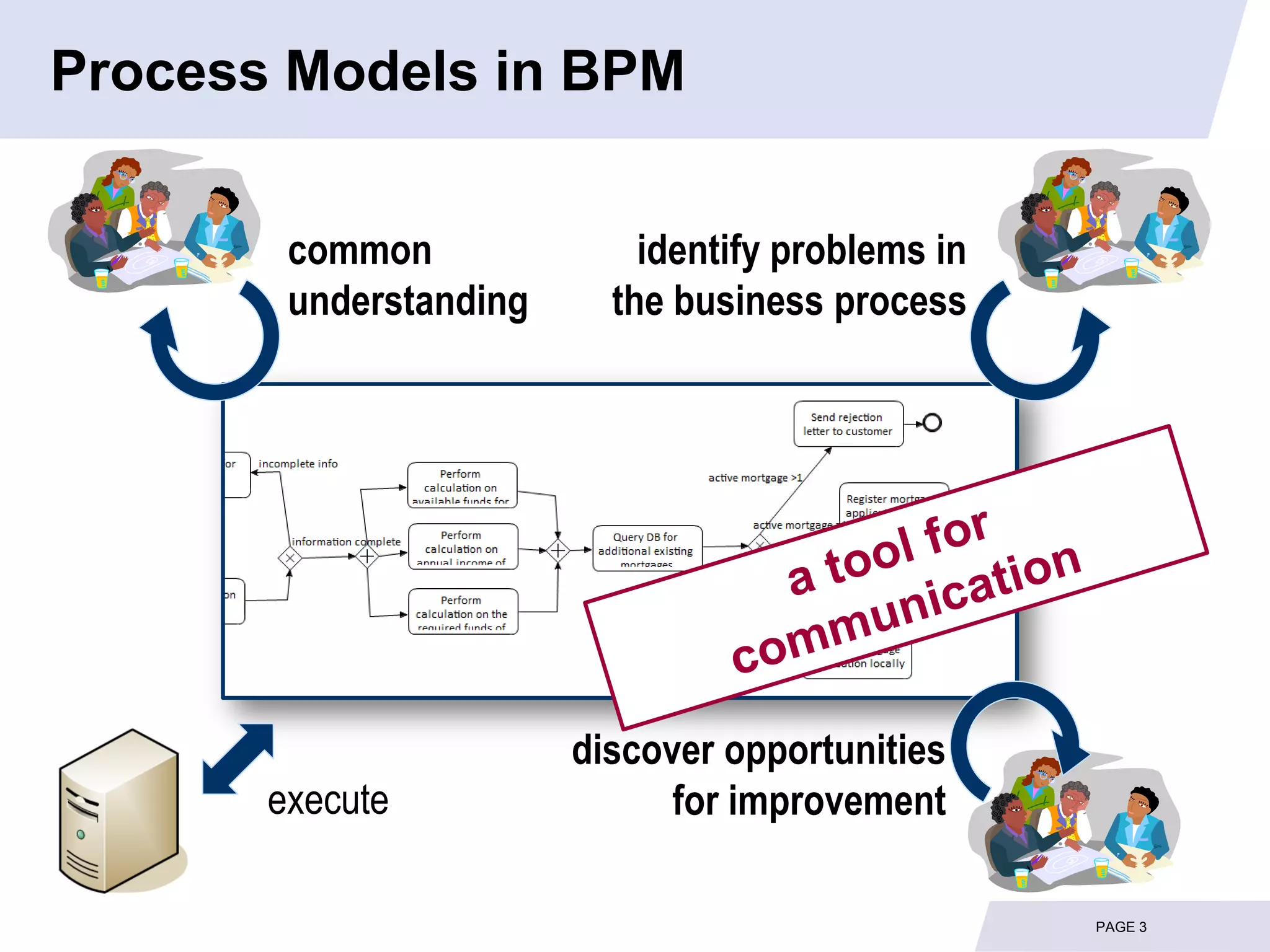
Process Models in BPM


        common              identify problems in
        understanding     the business process


                        discover opportunities
       execute                for improvement

                                                   PAGE 3
Quality Problems

 Error rates between 10% and 50% in industrial process
  model collections
 (Mendling 2009, Fahland et al. 2009, Mendling et al. 2008)


 impedes comprehensibility and maintainability
  of process models
 (Mendling 2008, Weber & Reichert 2008, Weber et al. 2011)
 • Non intention-revealing or inconsistent naming
   (Mendling et al. 2010)
 • Redundant process fragments (Hallerbach et al. 2010)
 • Large and unnecessarily complex process models
   (Soto et al. 2008)


                                                              PAGE 4
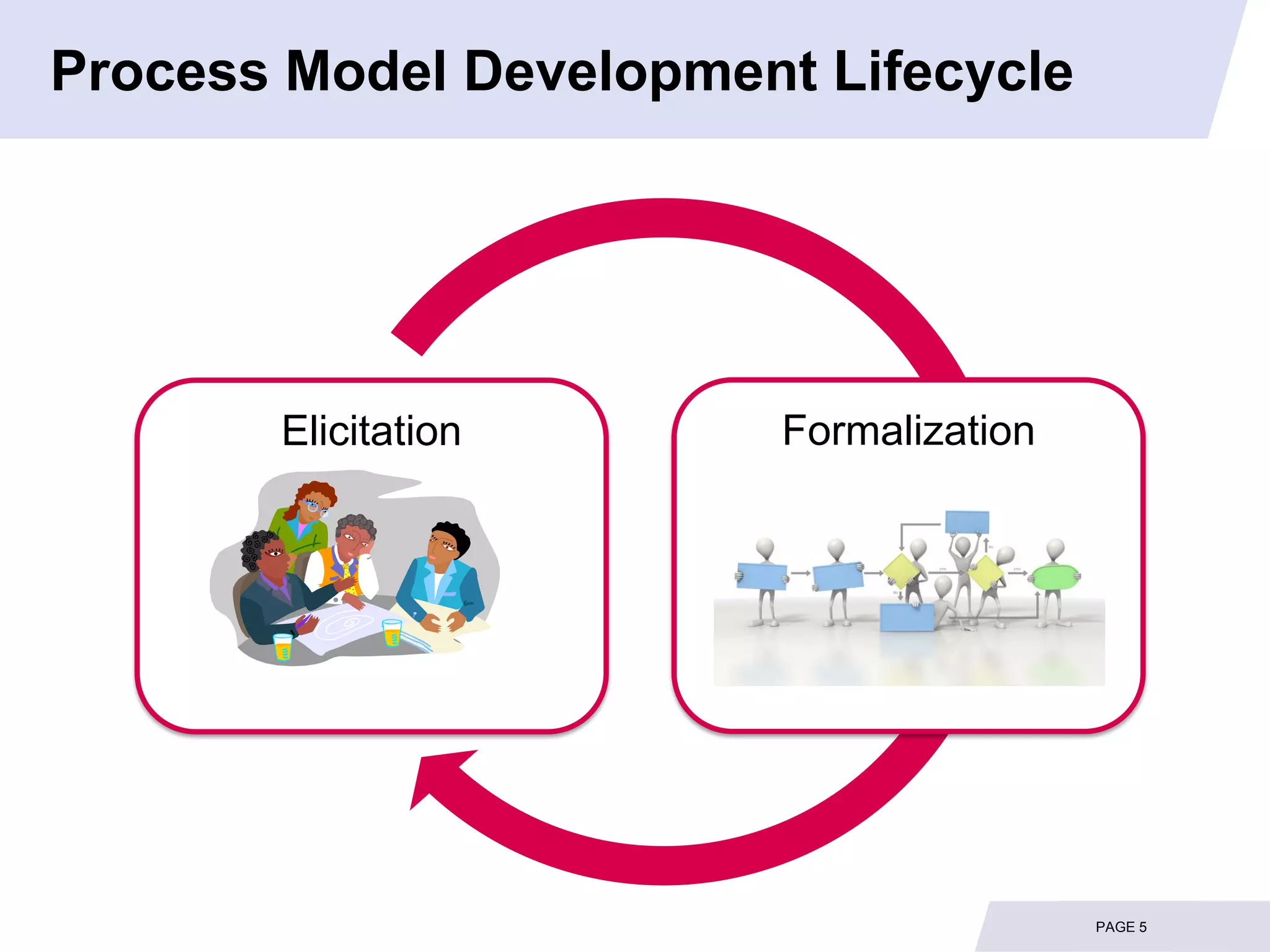
Process Model Development Lifecycle


       Elicitation       Formalization


                                         PAGE 5
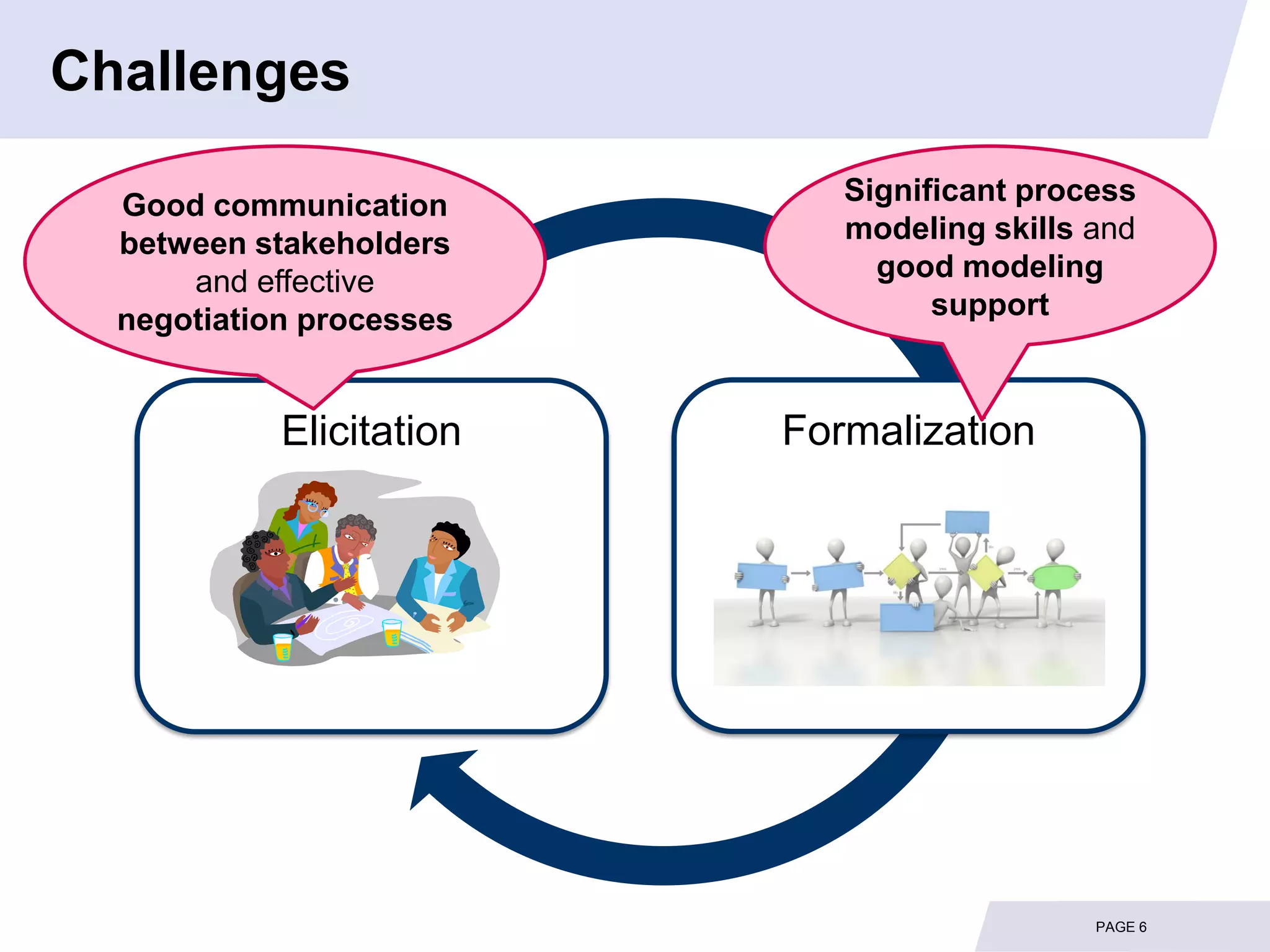
Challenges

  Good communication         Significant process
  between stakeholders       modeling skills and
      and effective            good modeling
  negotiation processes            support


            Elicitation   Formalization


                                             PAGE 6
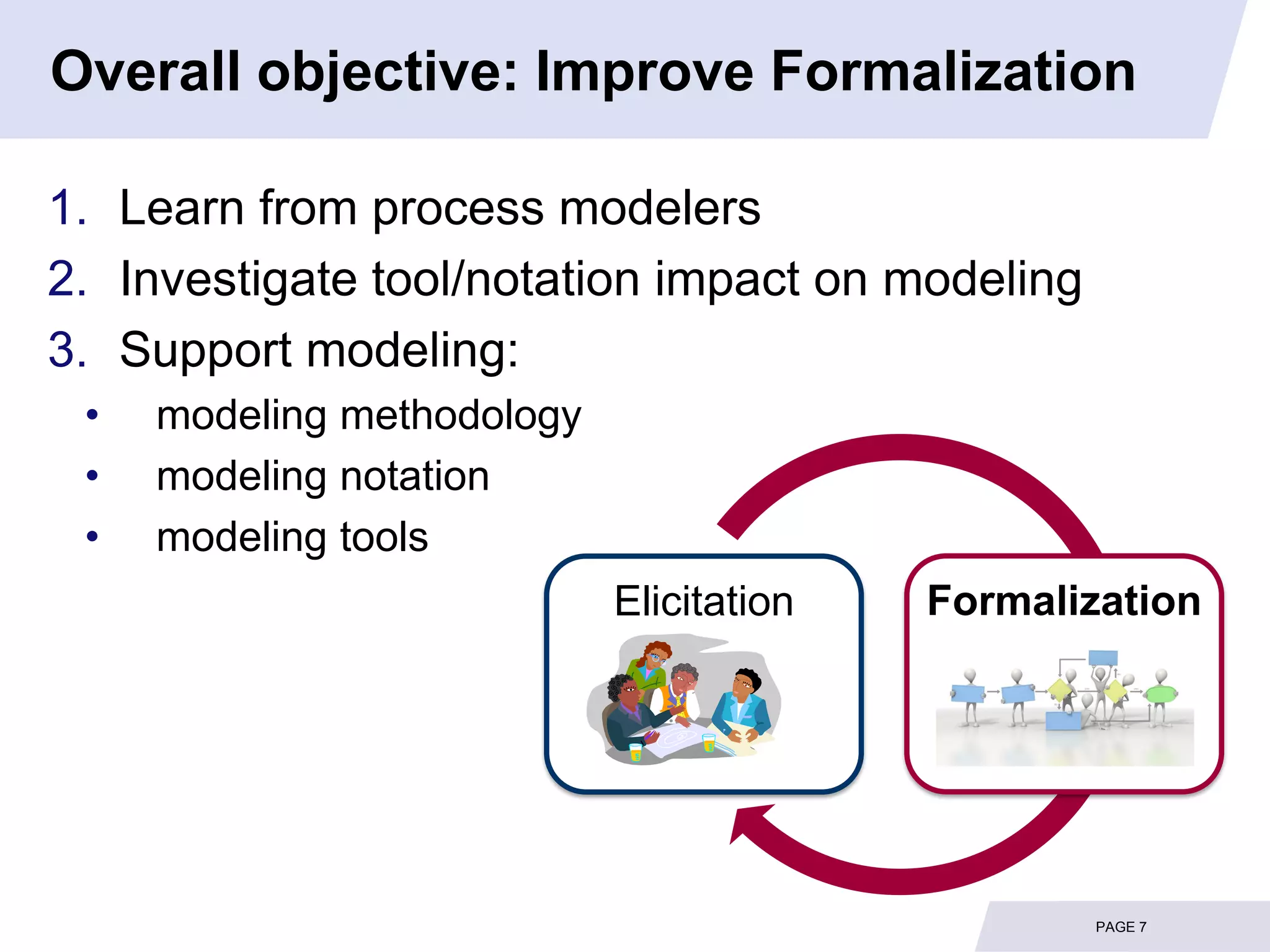
Overall objective: Improve Formalization

1. Learn from process modelers
2. Investigate tool/notation impact on modeling
3. Support modeling:
 •   modeling methodology
 •   modeling notation
 •   modeling tools
                            Elicitation   Formalization


                                                  PAGE 7
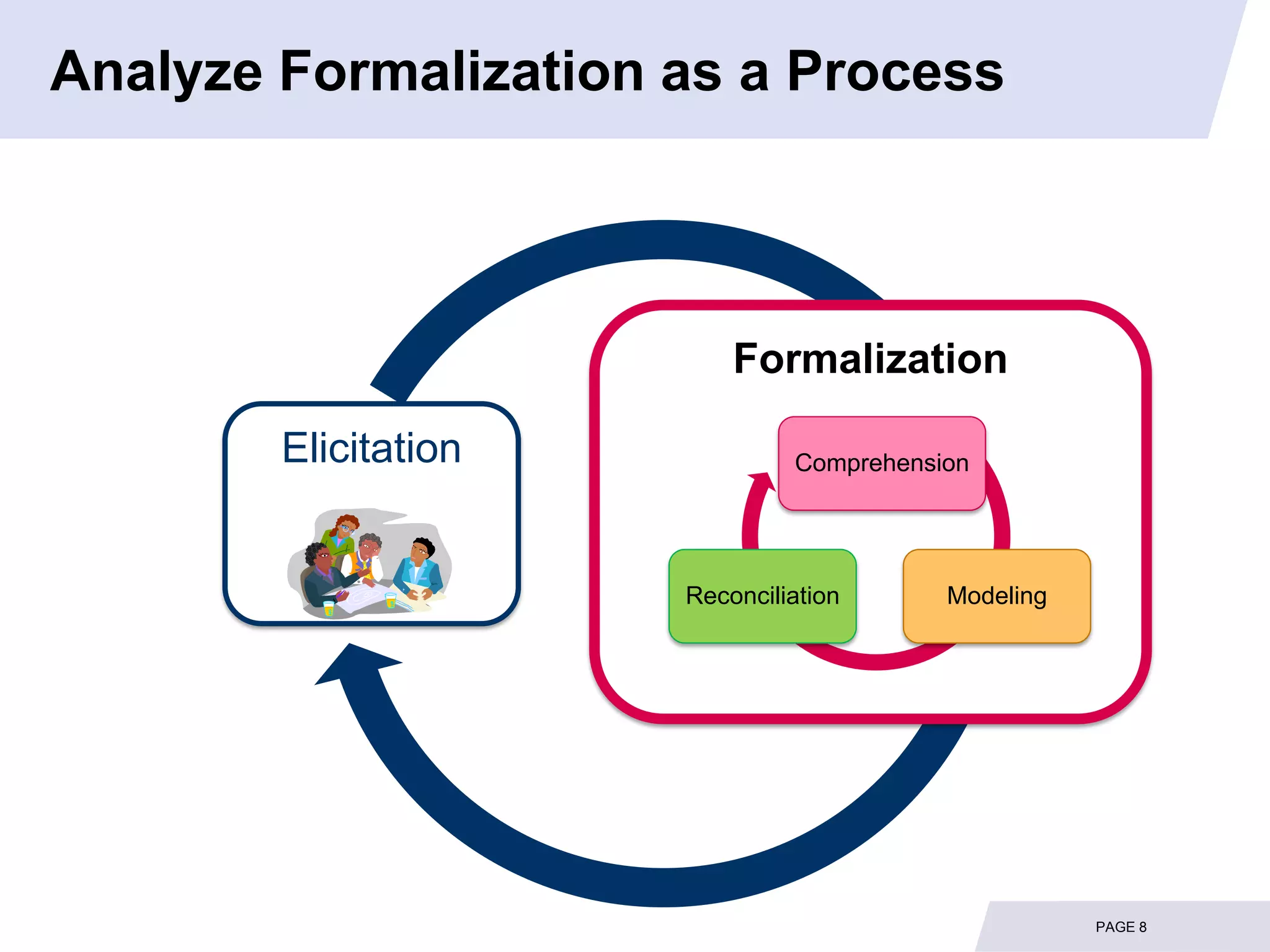
Analyze Formalization as a Process


                          Formalization

        Elicitation            Comprehension


                      Reconciliation      Modeling


                                                     PAGE 8
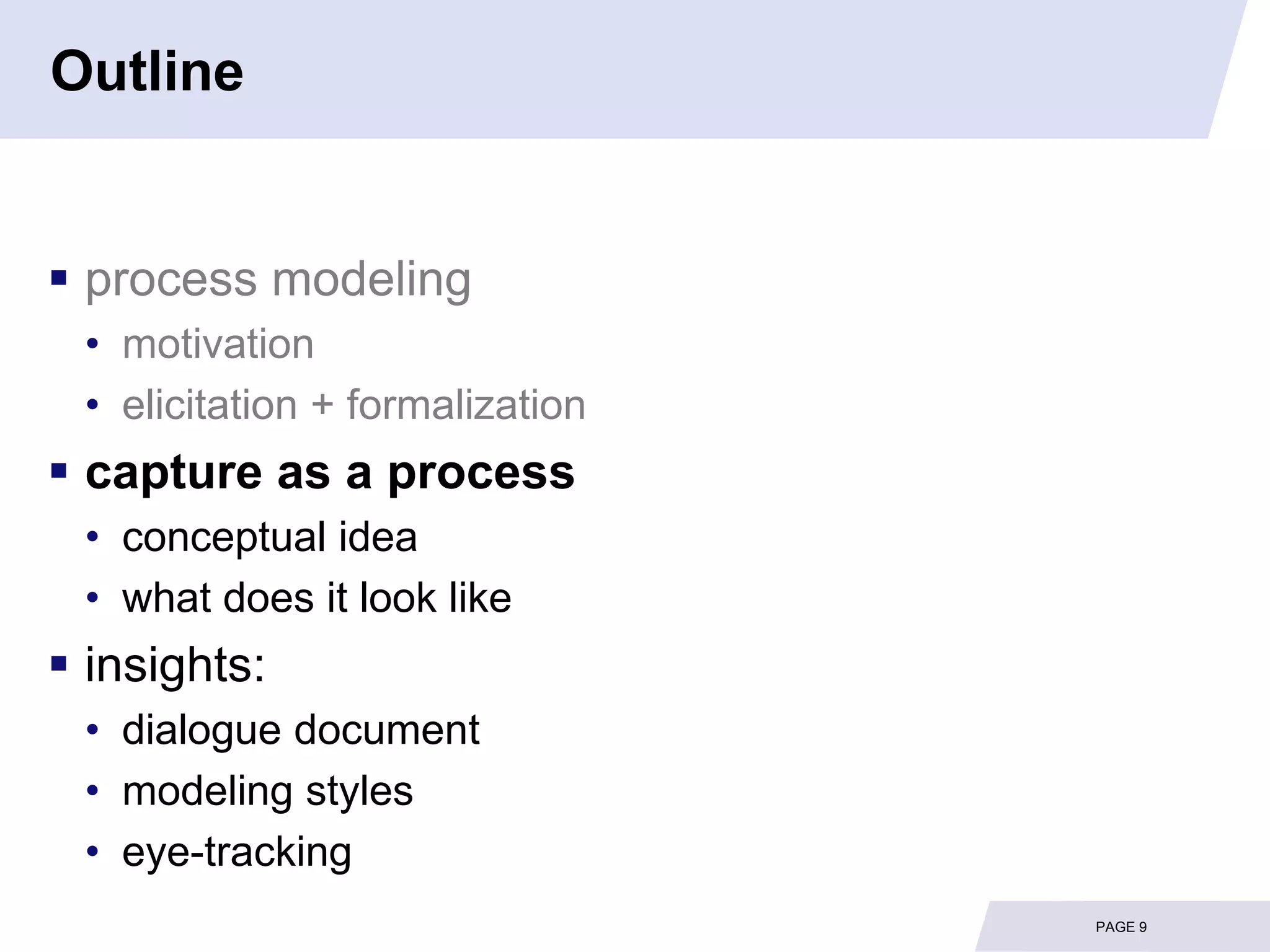
Outline


 process modeling
 • motivation
 • elicitation + formalization
 capture as a process
 • conceptual idea
 • what does it look like
 insights:
 • dialogue document
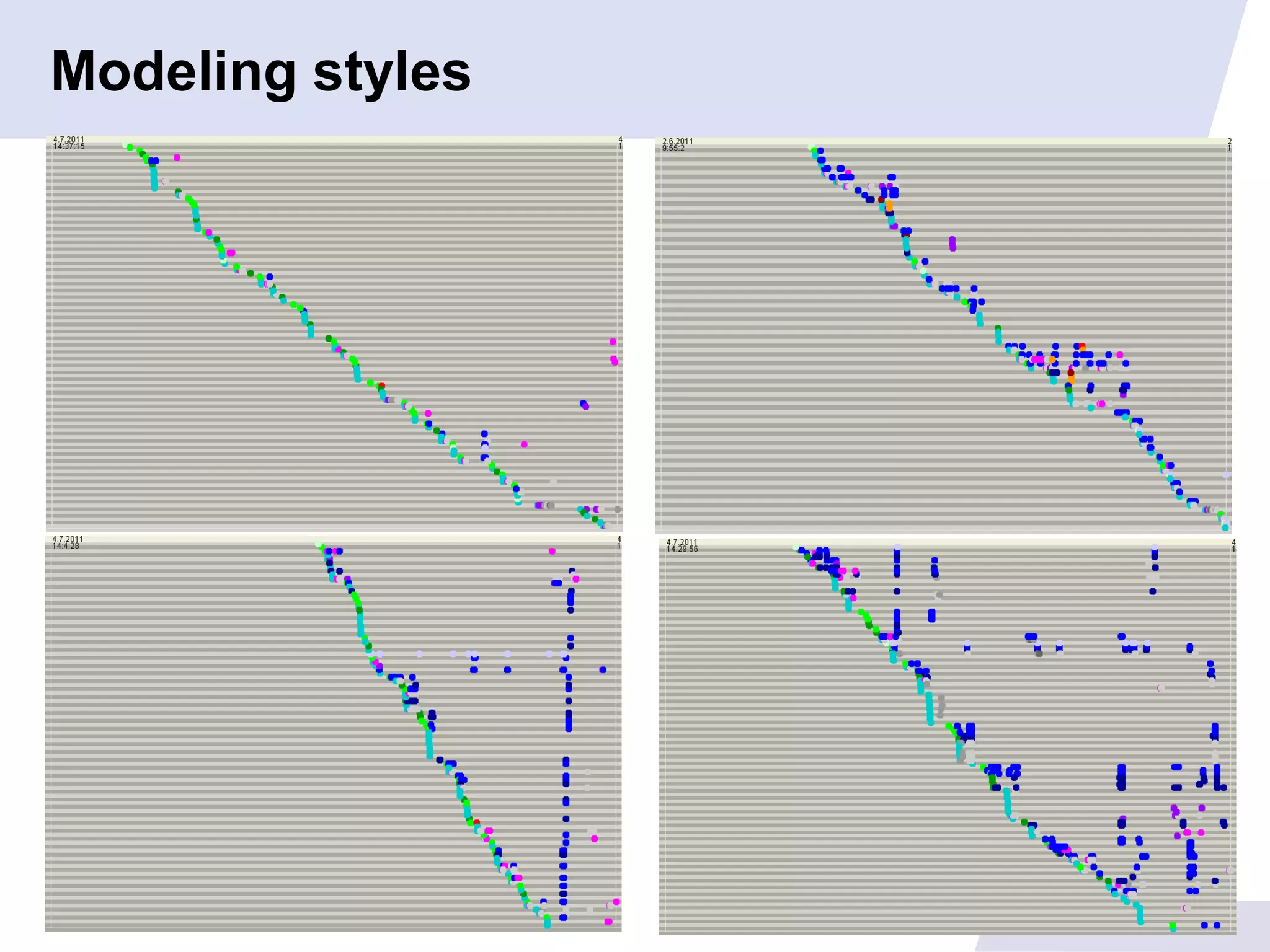
 • modeling styles
 • eye-tracking
                                 PAGE 9
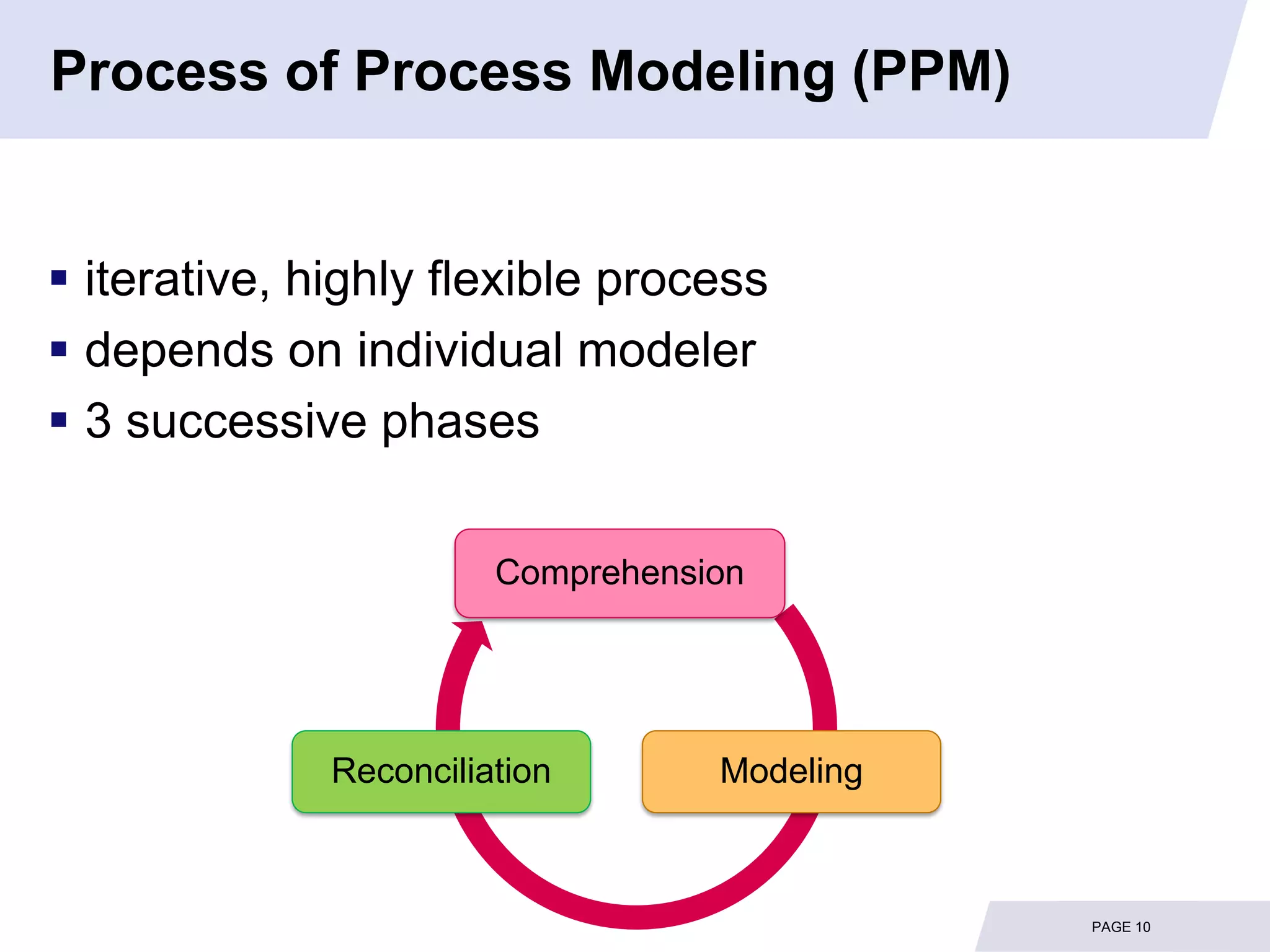
Process of Process Modeling (PPM)


 iterative, highly flexible process
 depends on individual modeler
 3 successive phases

                        Comprehension


              Reconciliation       Modeling


                                              PAGE 10
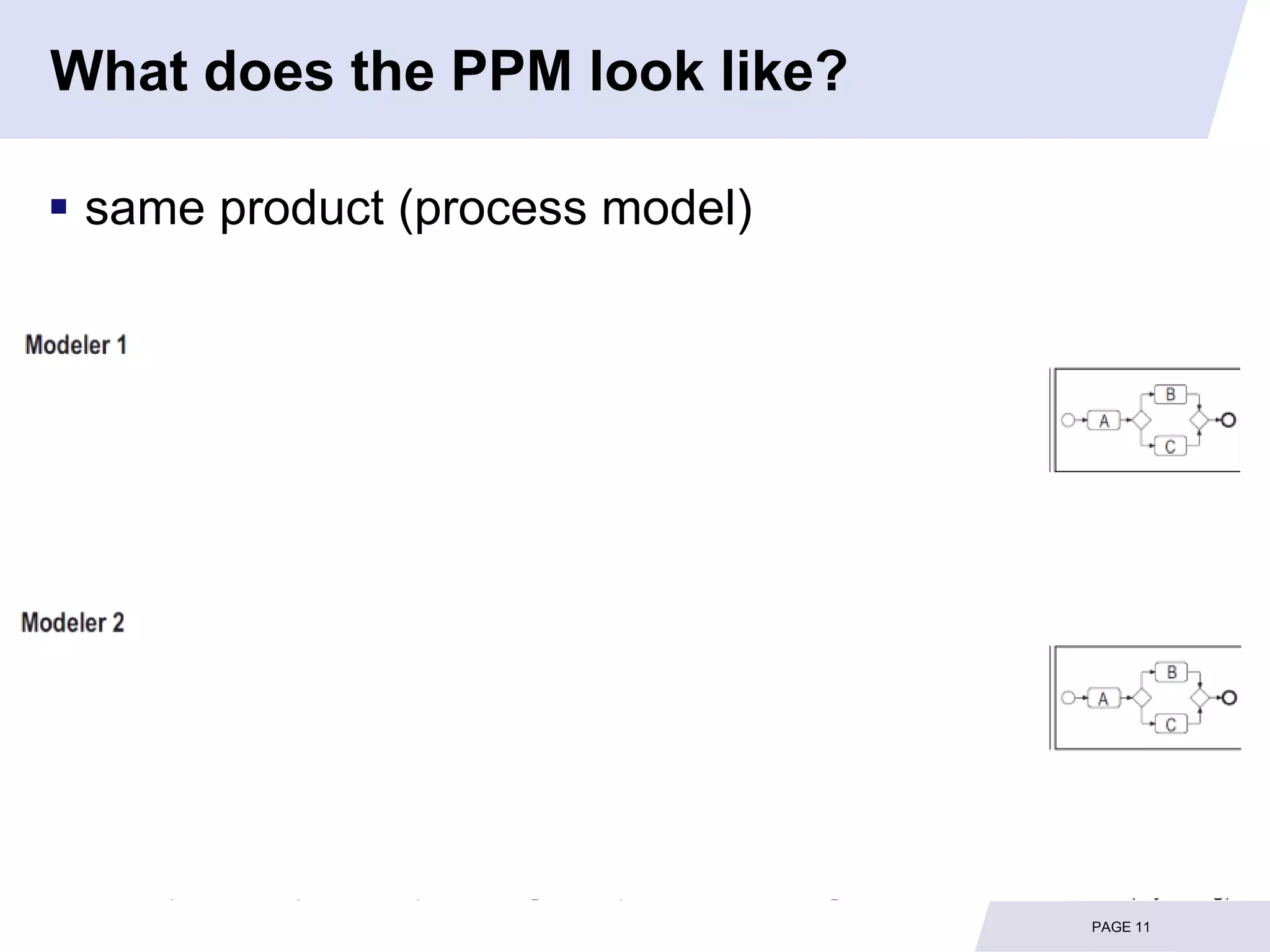
What does the PPM look like?

 same product (process model)


                                 PAGE 11
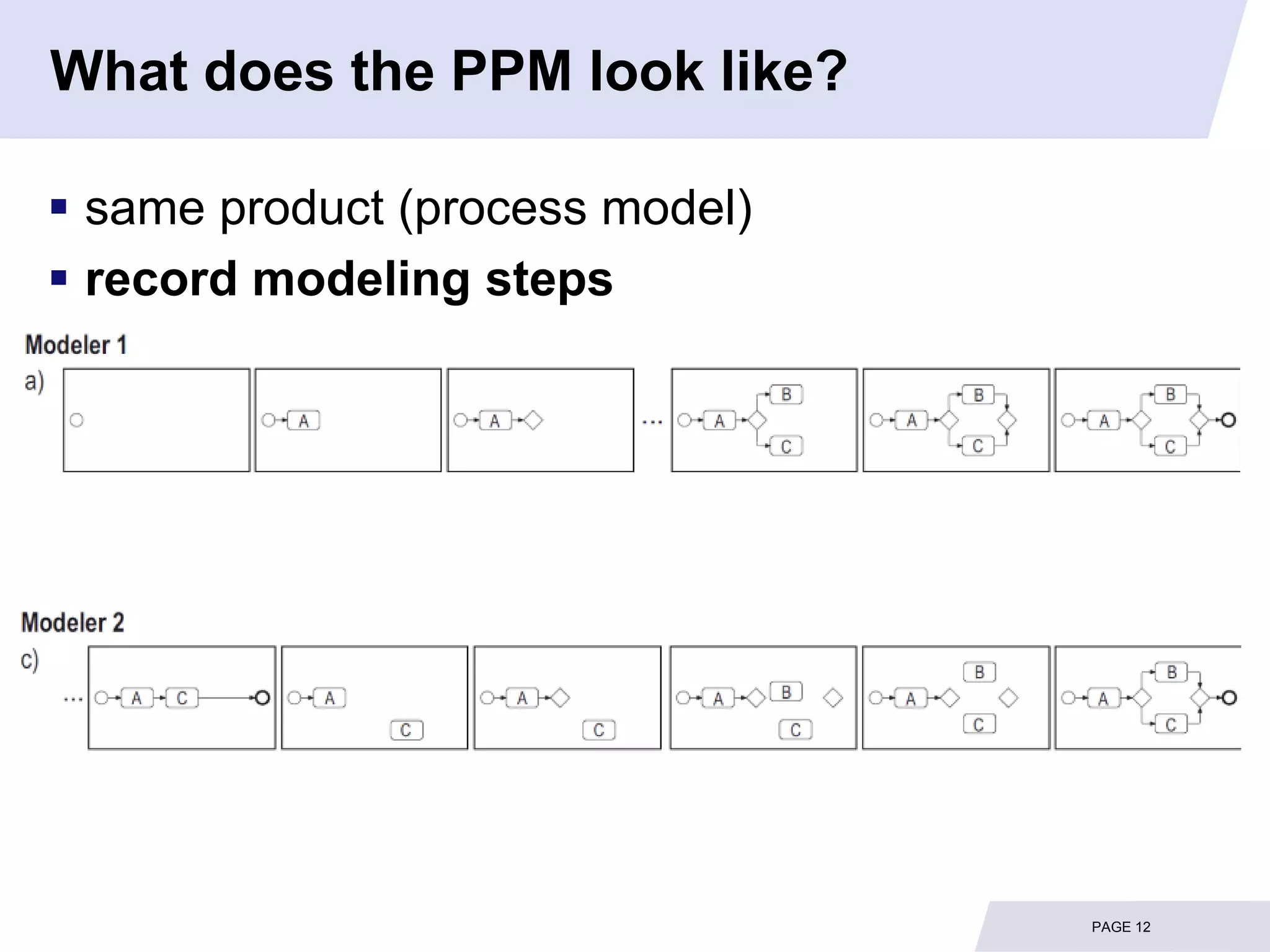
What does the PPM look like?

 same product (process model)
 record modeling steps


                                 PAGE 12
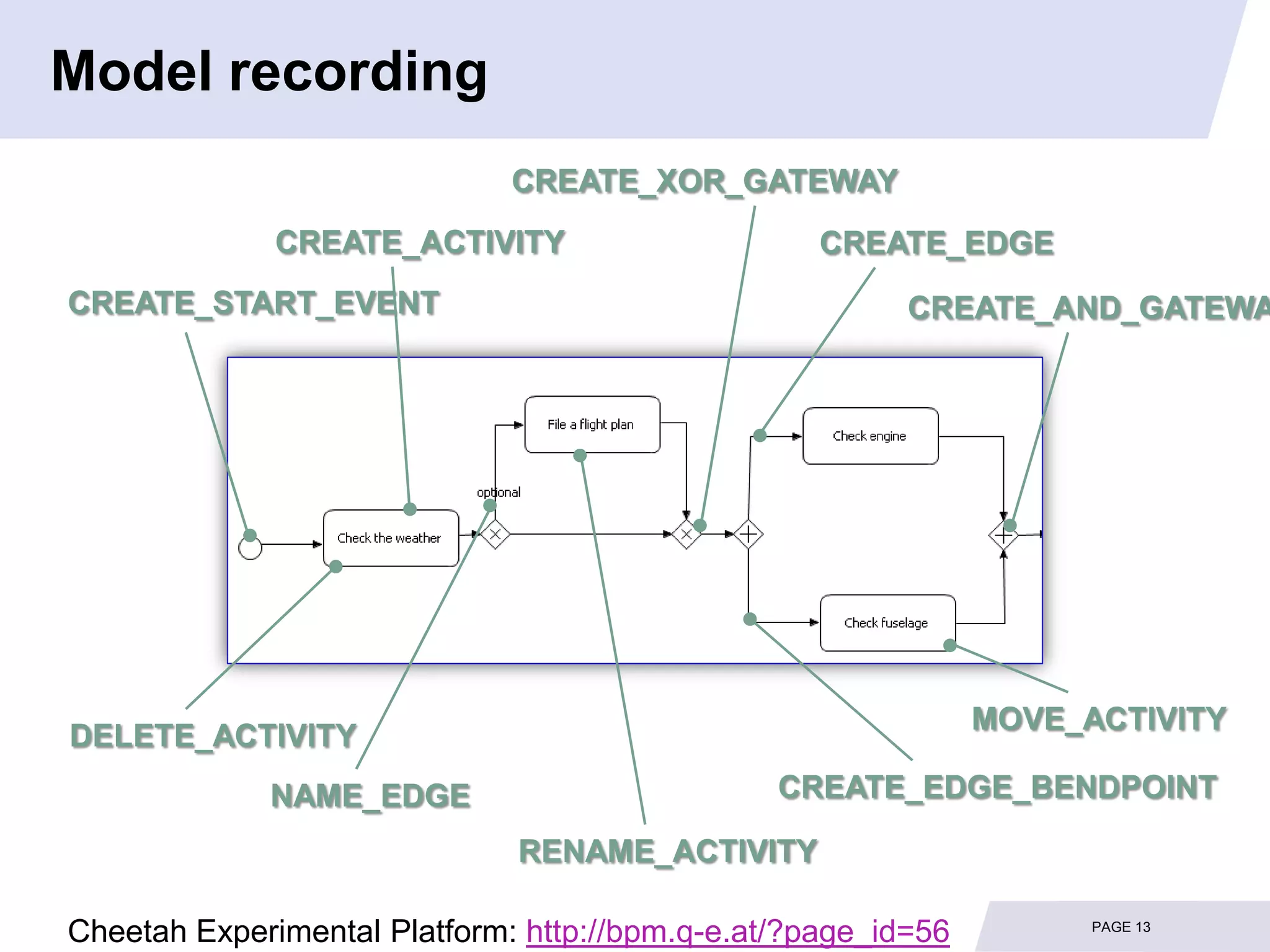
Model recording
                              CREATE_XOR_GATEWAY
              CREATE_ACTIVITY                      CREATE_EDGE
CREATE_START_EVENT                                       CREATE_AND_GATEWA


                                                               MOVE_ACTIVITY
DELETE_ACTIVITY
             NAME_EDGE                          CREATE_EDGE_BENDPOINT

                              RENAME_ACTIVITY

Cheetah Experimental Platform: http://bpm.q-e.at/?page_id=56         PAGE 13
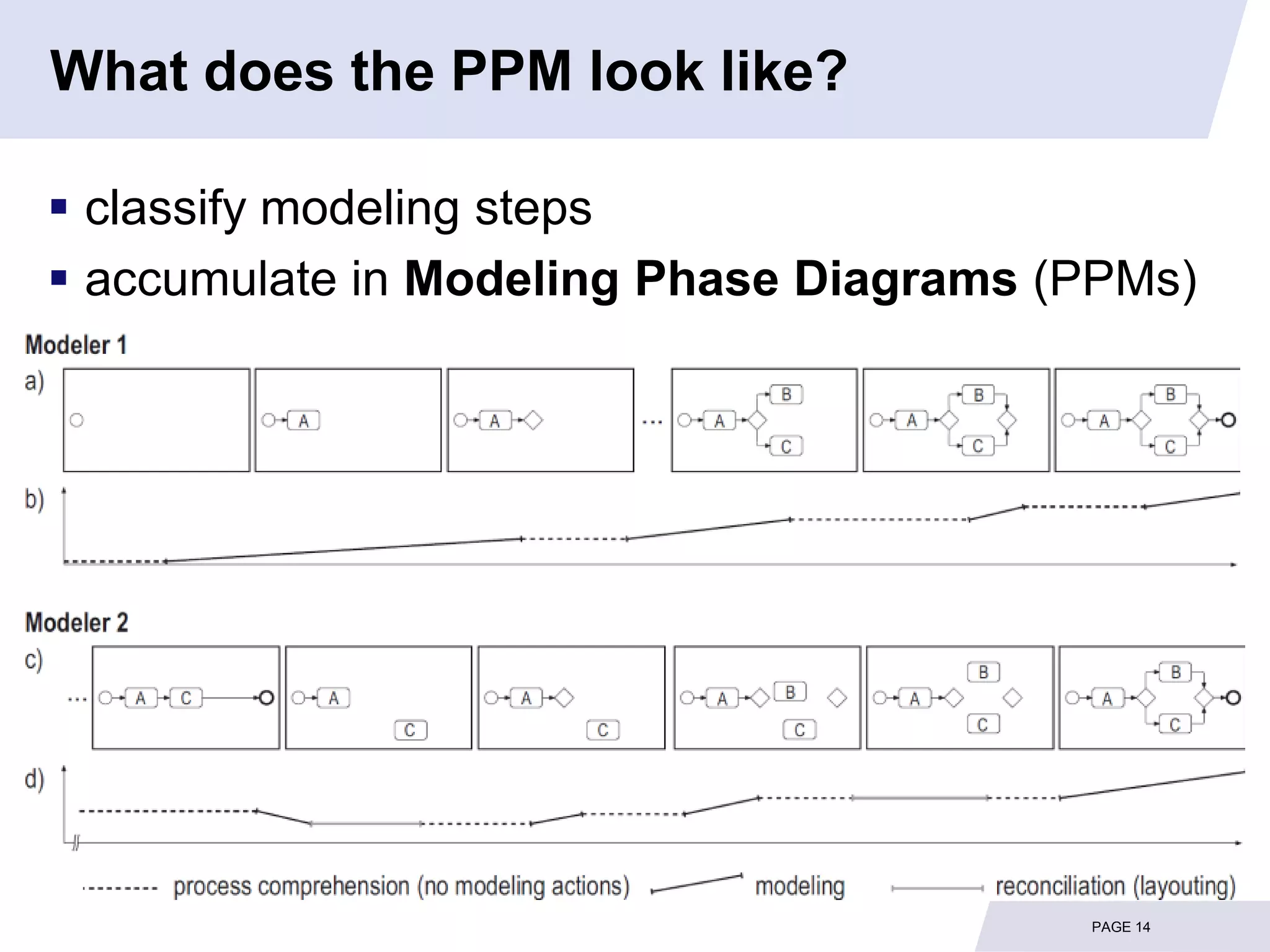
What does the PPM look like?

 classify modeling steps
 accumulate in Modeling Phase Diagrams (PPMs)


                                         PAGE 14
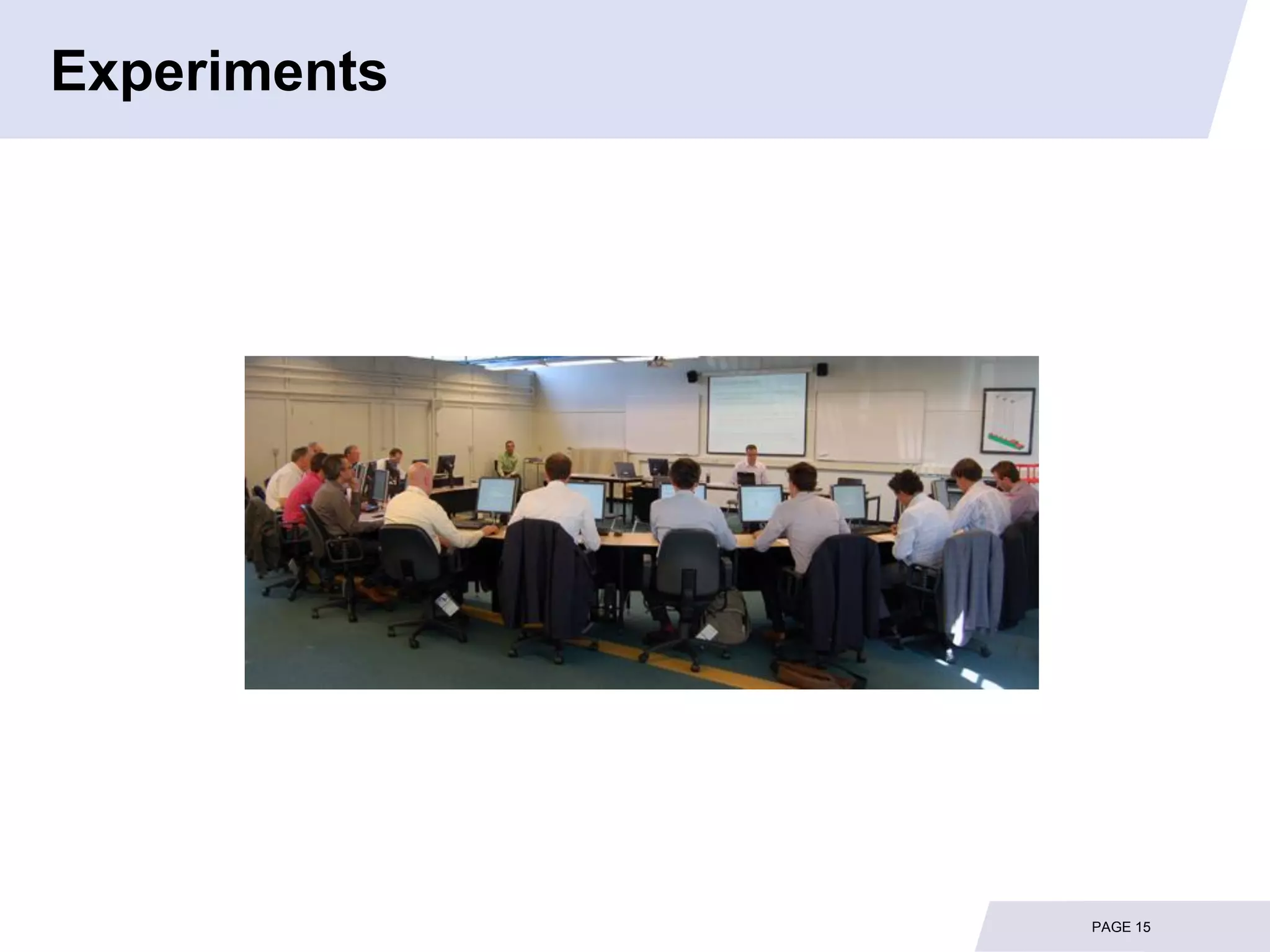
Experiments


              PAGE 15
Outline


 process modeling
 • motivation
 • elicitation + formalization
 capture as a process
 • conceptual idea
 • what does it look like
 some insights
 • dialogue document
 • attention fixation
 • modeling styles
                                 PAGE 16
DIALOGUE DOCUMENT


                    PAGE 17
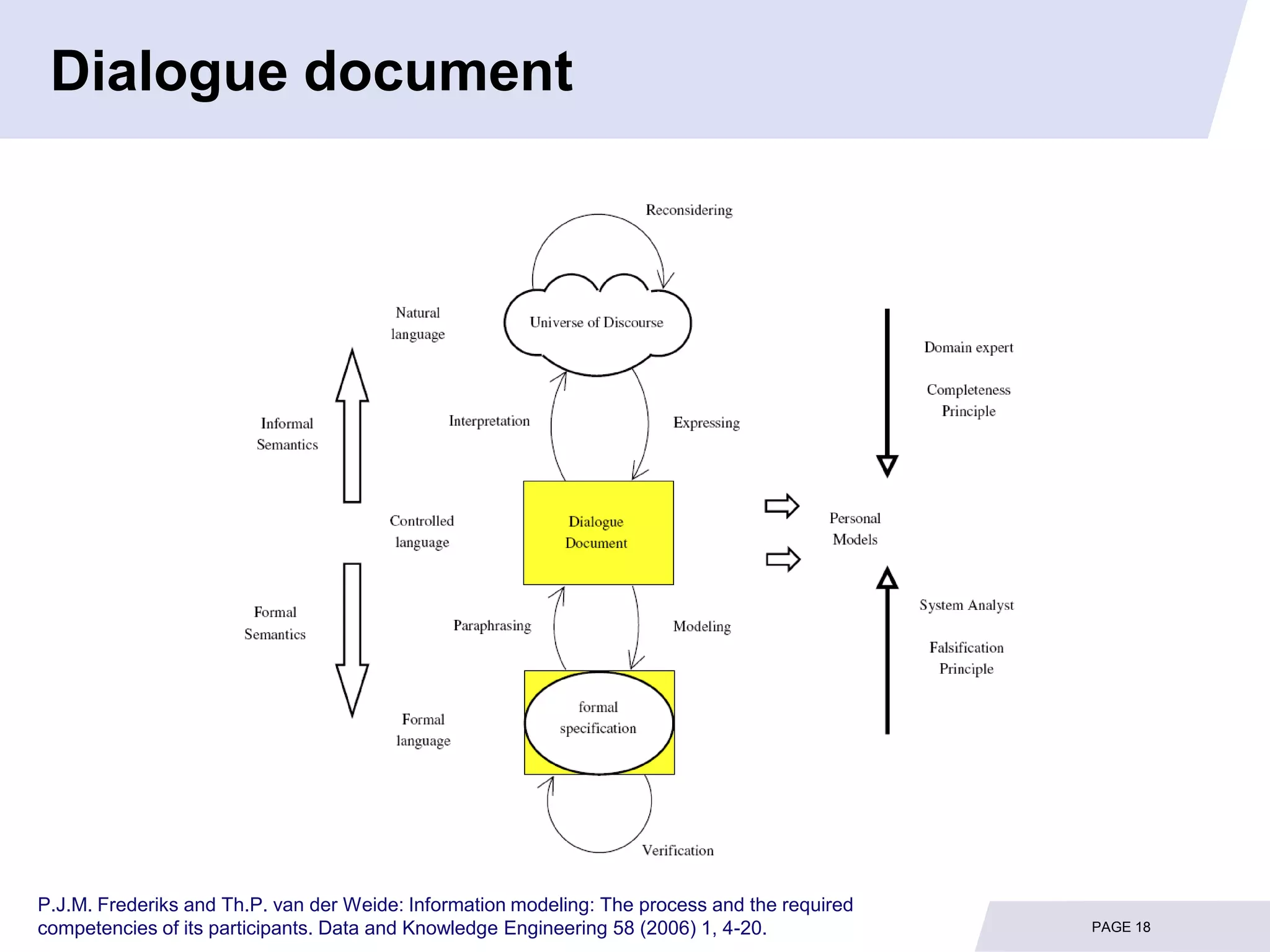
Dialogue document


P.J.M. Frederiks and Th.P. van der Weide: Information modeling: The process and the required
competencies of its participants. Data and Knowledge Engineering 58 (2006) 1, 4-20.            PAGE 18
Dialogue document

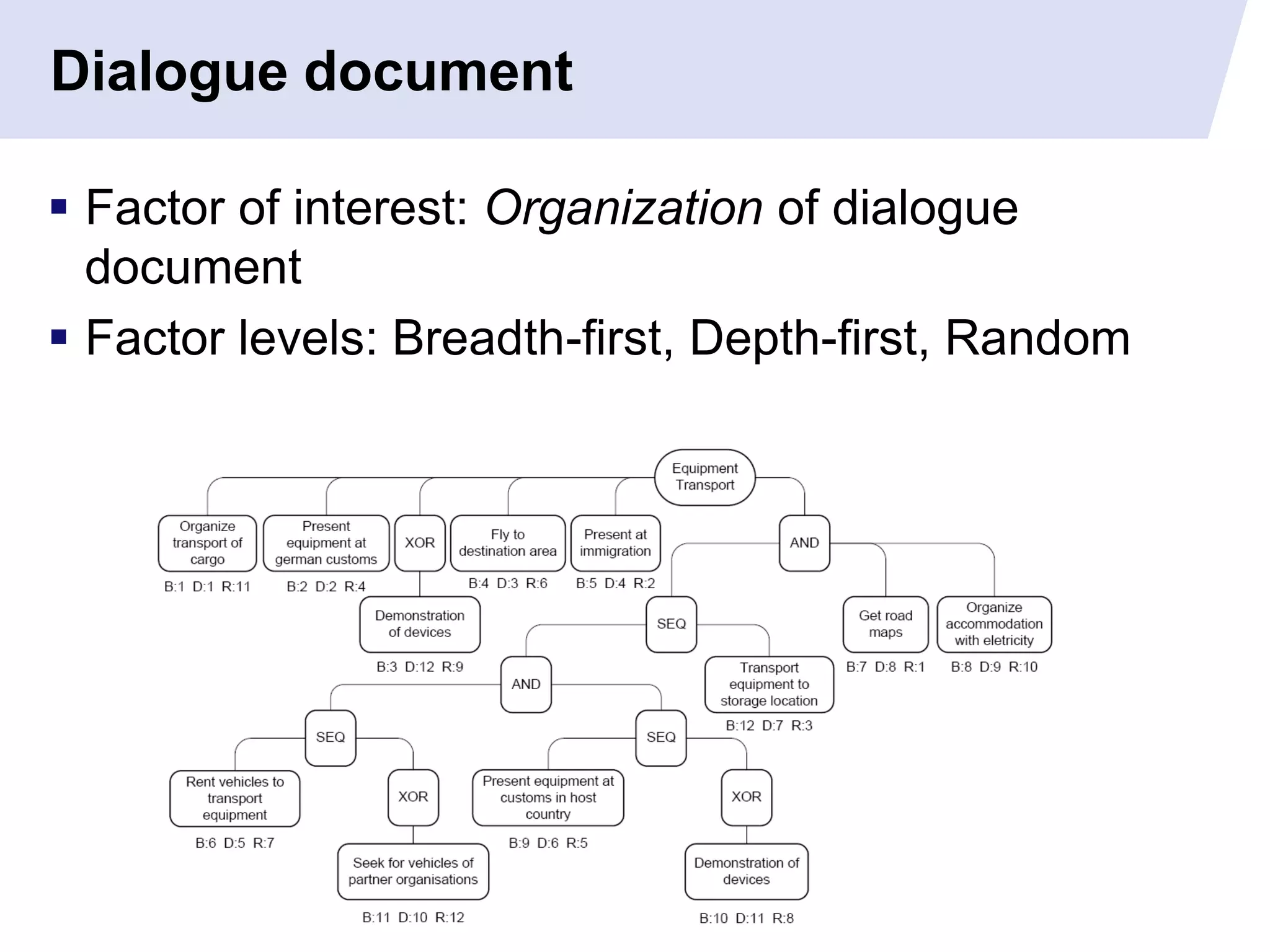
 Factor of interest: Organization of dialogue
  document
 Factor levels: Breadth-first, Depth-first, Random
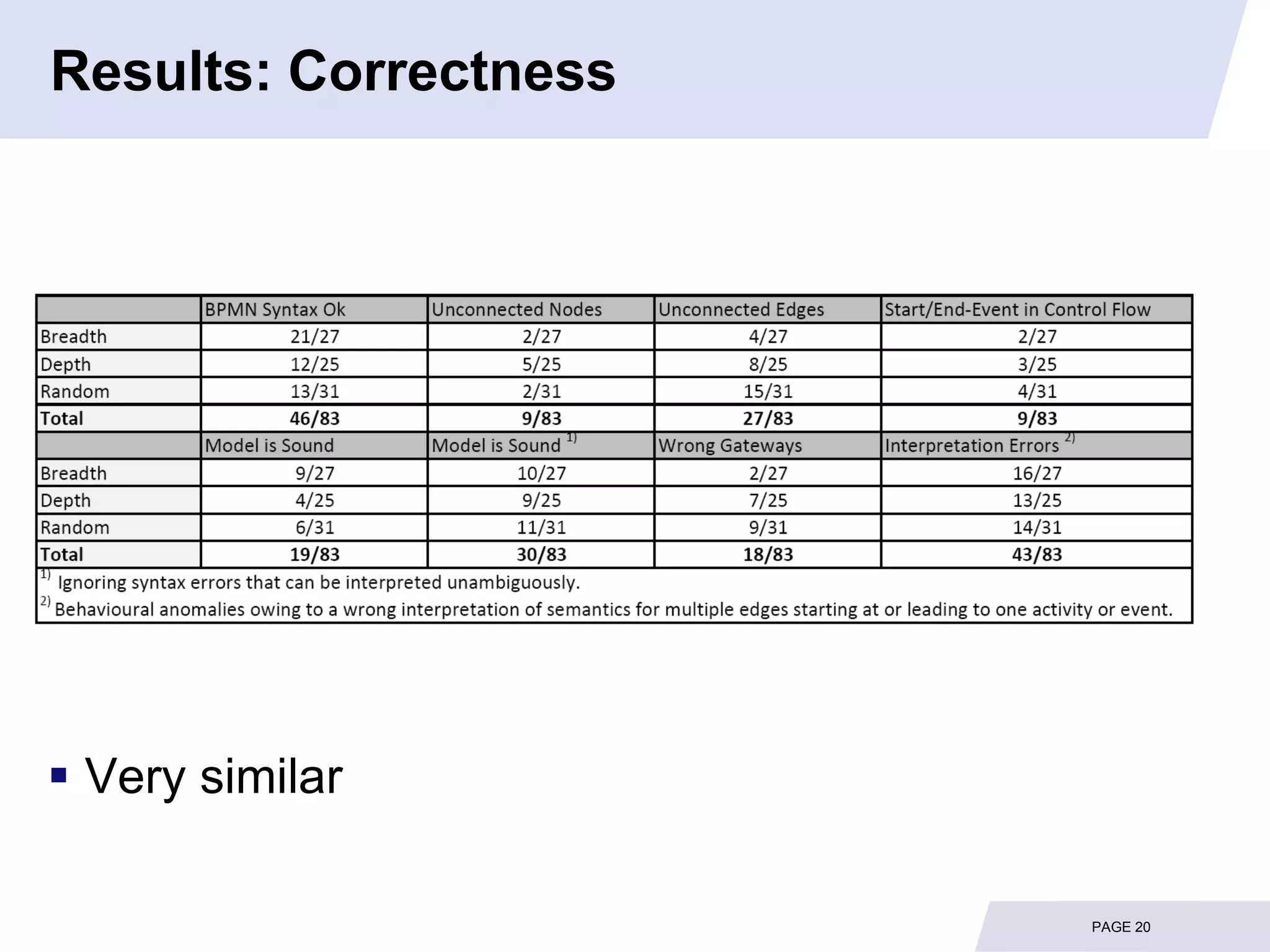
Results: Correctness


 Very similar

                       PAGE 20
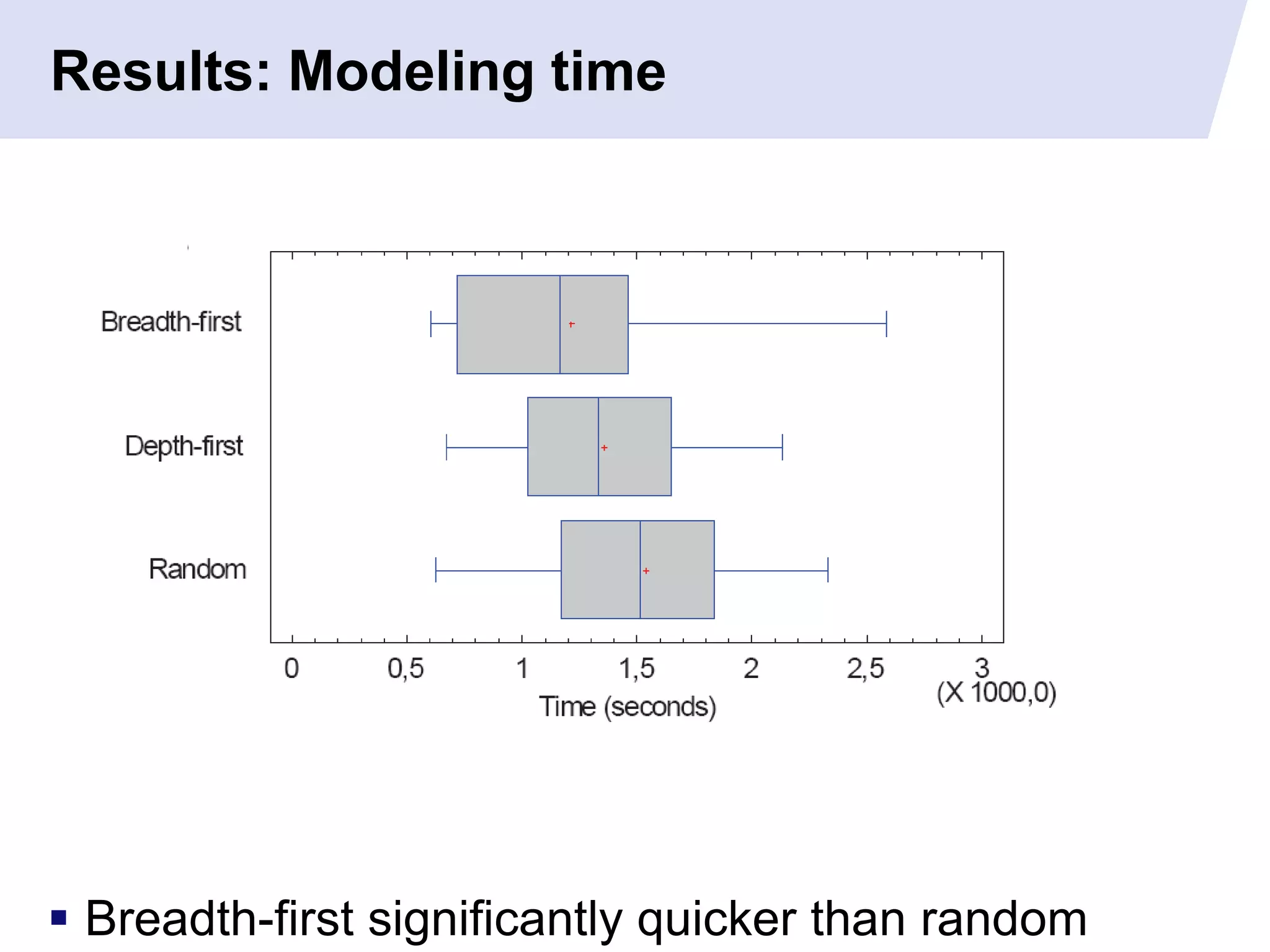
Results: Modeling time


 Breadth-first significantly quicker than random
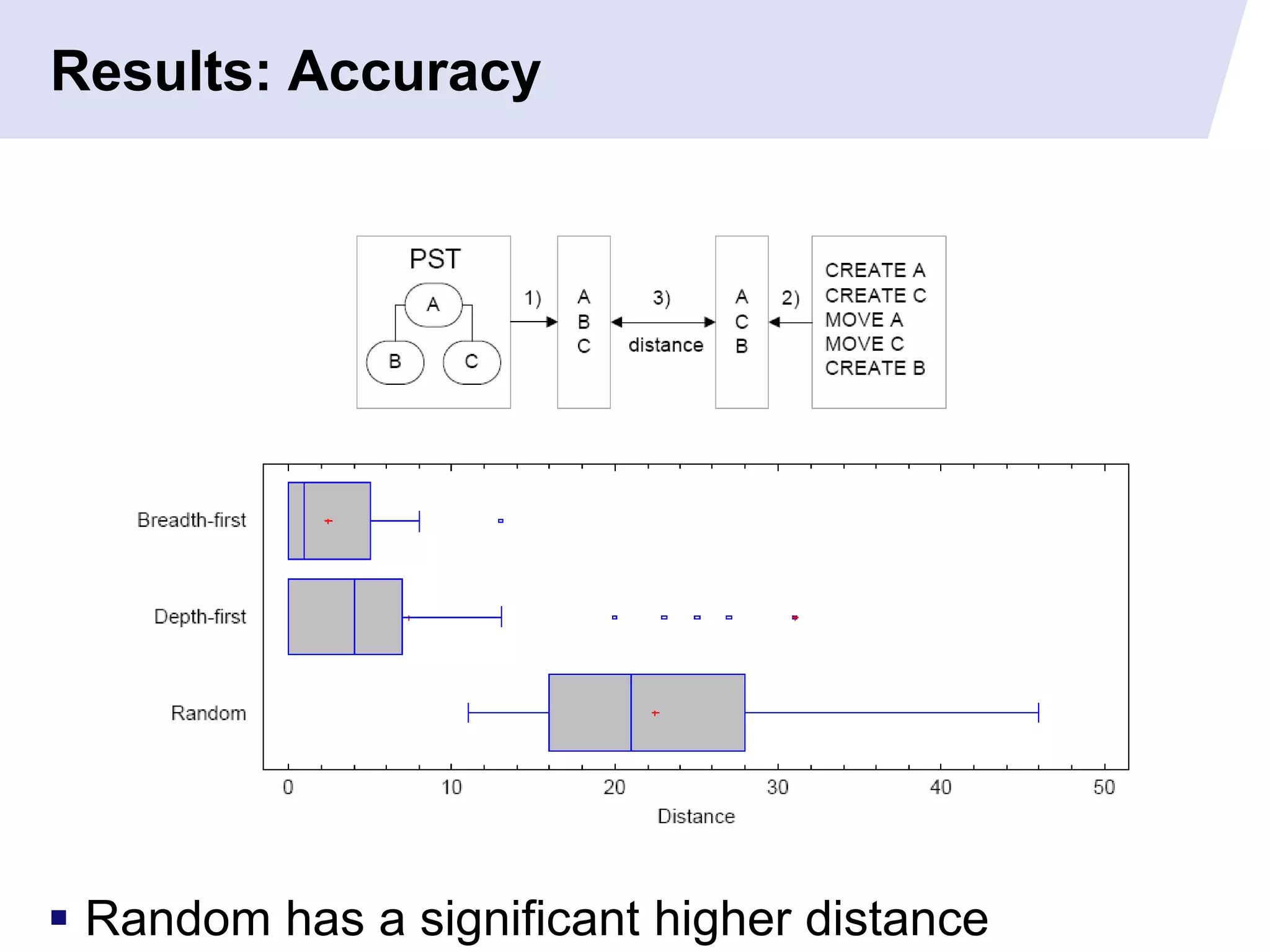
Results: Accuracy


 Random has a significant higher distance
Results – Dialogue document

 Modeling is difficult
 • High percentage of syntactical errors
 Organization dialogue document:
 • Limited effect on syntactical correctness
 • Big effect on accuracy
 Breadth first seems favorable:
 • Modeling time lowest
 • Modelers most closely follow dialogue document


                                                    PAGE 23
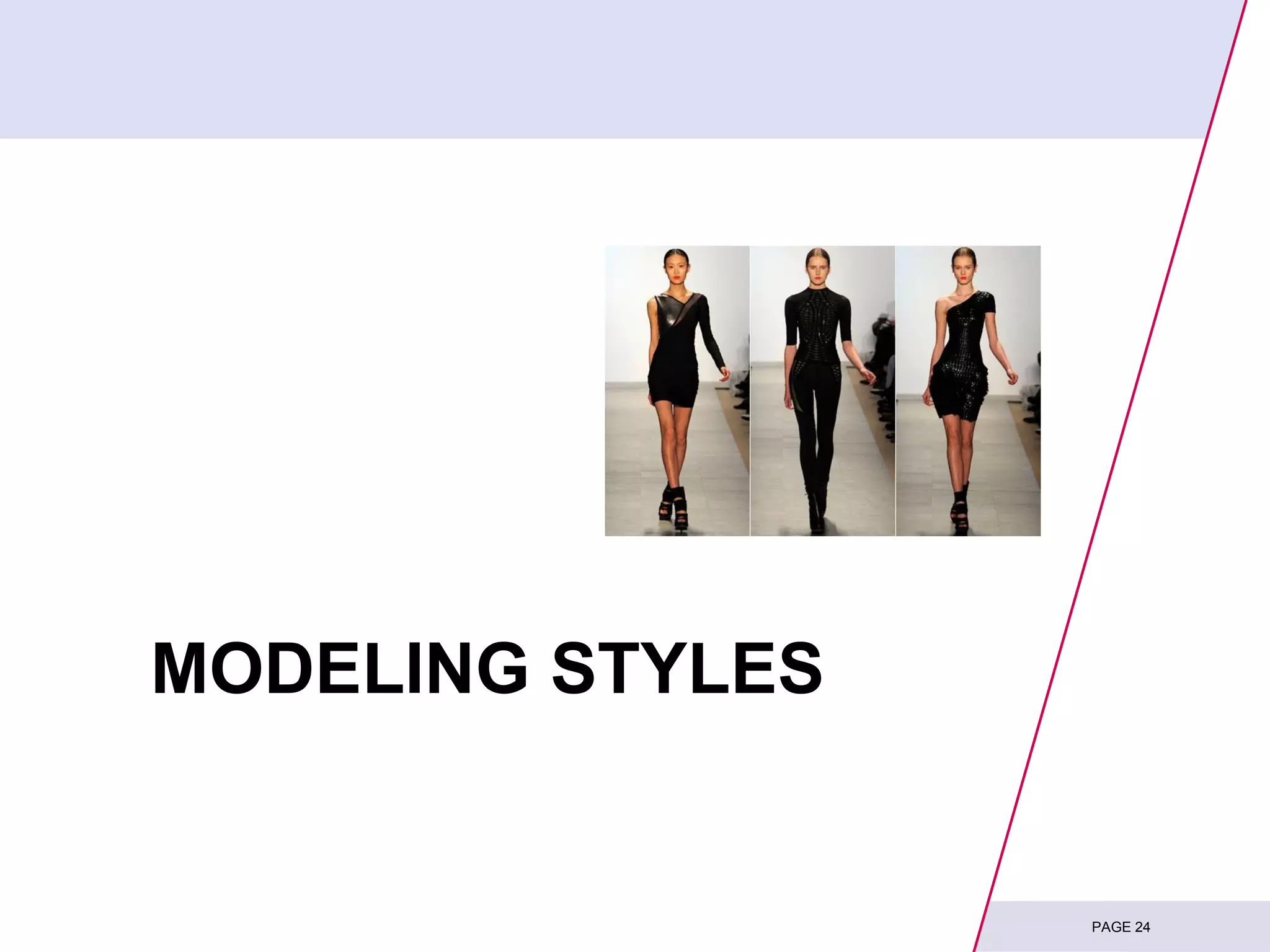
MODELING STYLES


                  PAGE 24
Modeling styles


                  PAGE 25
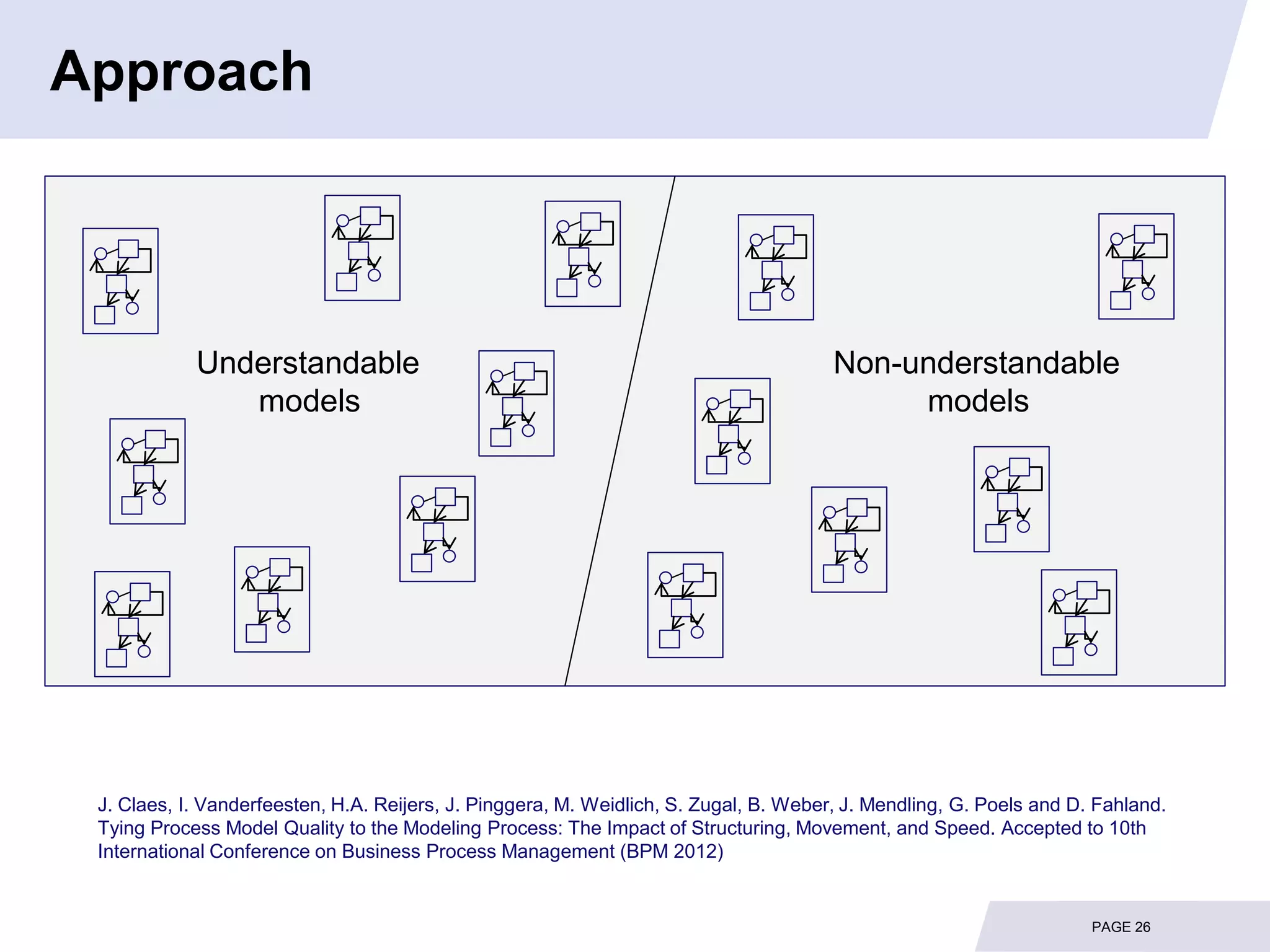
Approach


            Understandable                                                             Non-understandable
               models                                                                       models


 J. Claes, I. Vanderfeesten, H.A. Reijers, J. Pinggera, M. Weidlich, S. Zugal, B. Weber, J. Mendling, G. Poels and D. Fahland.
 Tying Process Model Quality to the Modeling Process: The Impact of Structuring, Movement, and Speed. Accepted to 10th
 International Conference on Business Process Management (BPM 2012)


                                                                                                                     PAGE 26
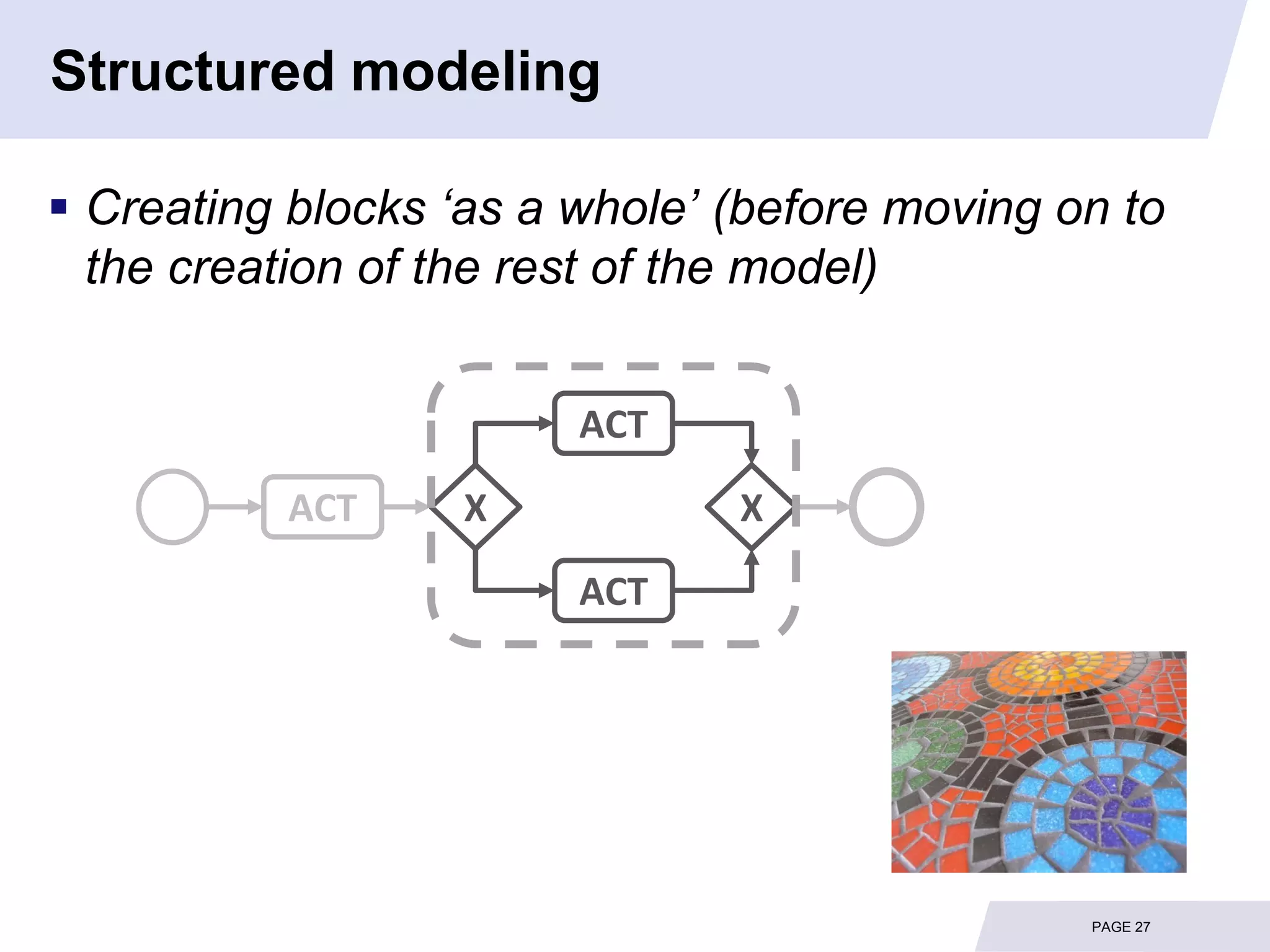
Structured modeling

 Creating blocks ‘as a whole’ (before moving on to
  the creation of the rest of the model)


                        ACT
          ACT      X           X
                        ACT


                                               PAGE 27
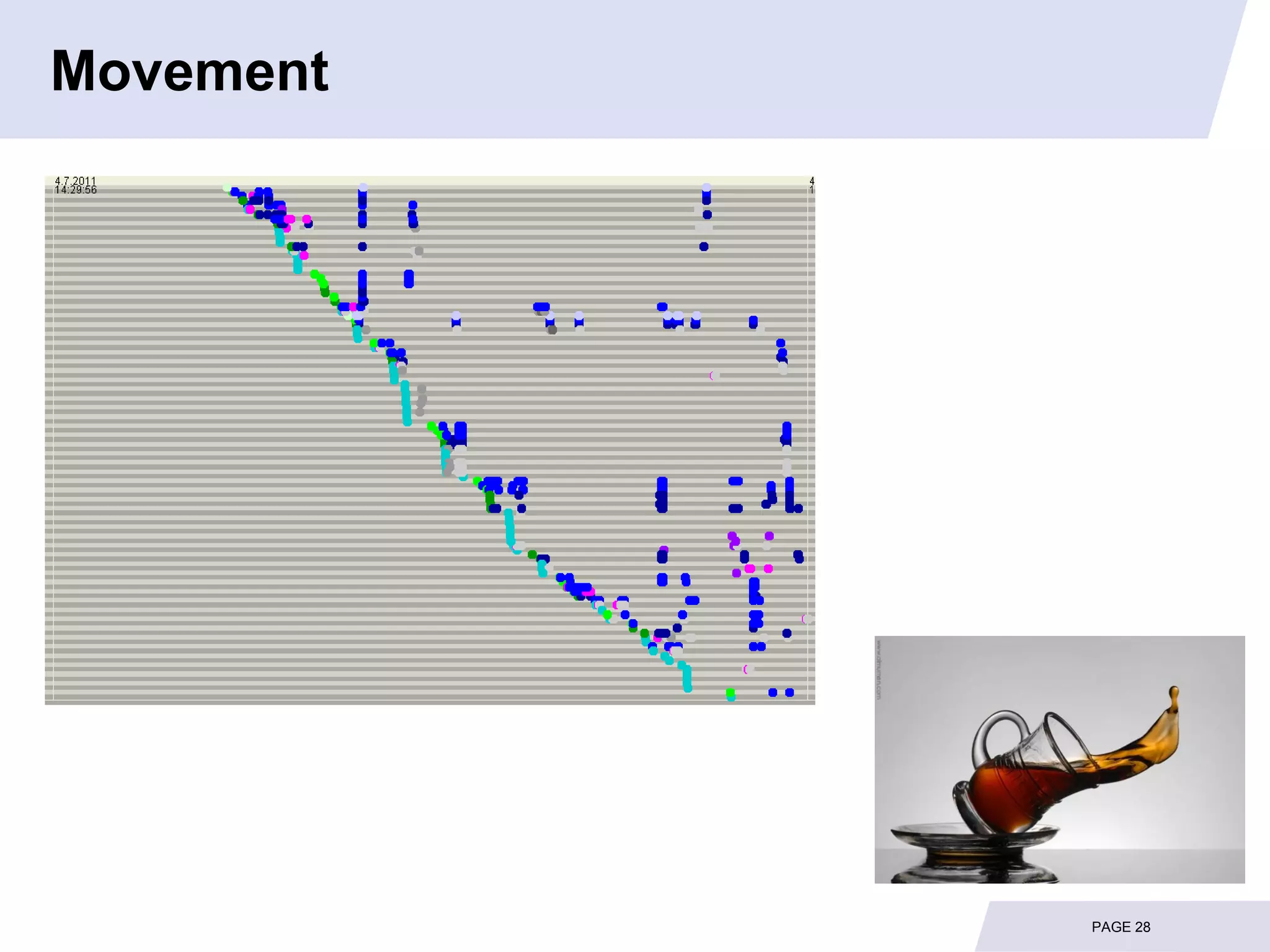
Movement


           PAGE 28
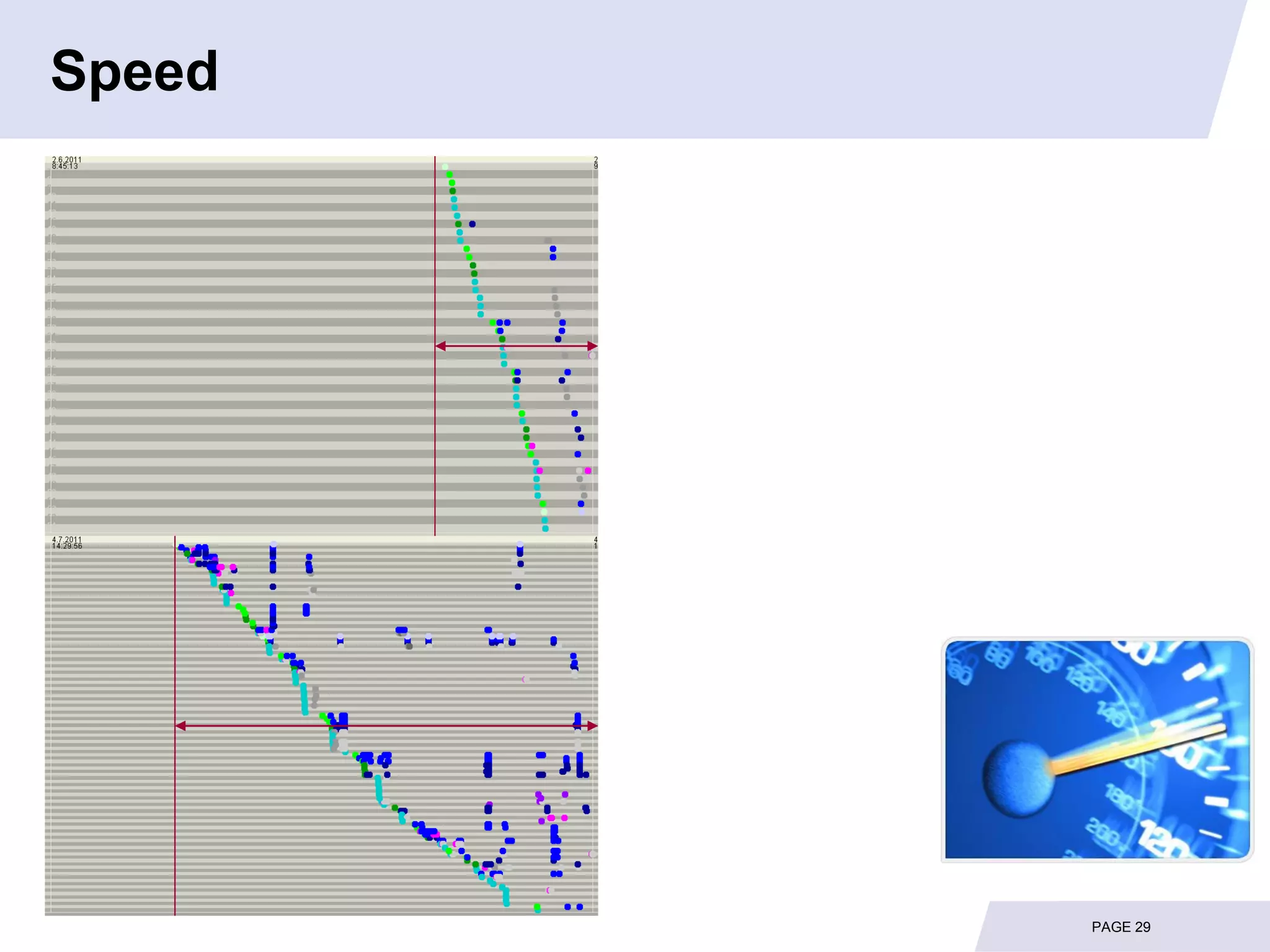
Speed


        PAGE 29
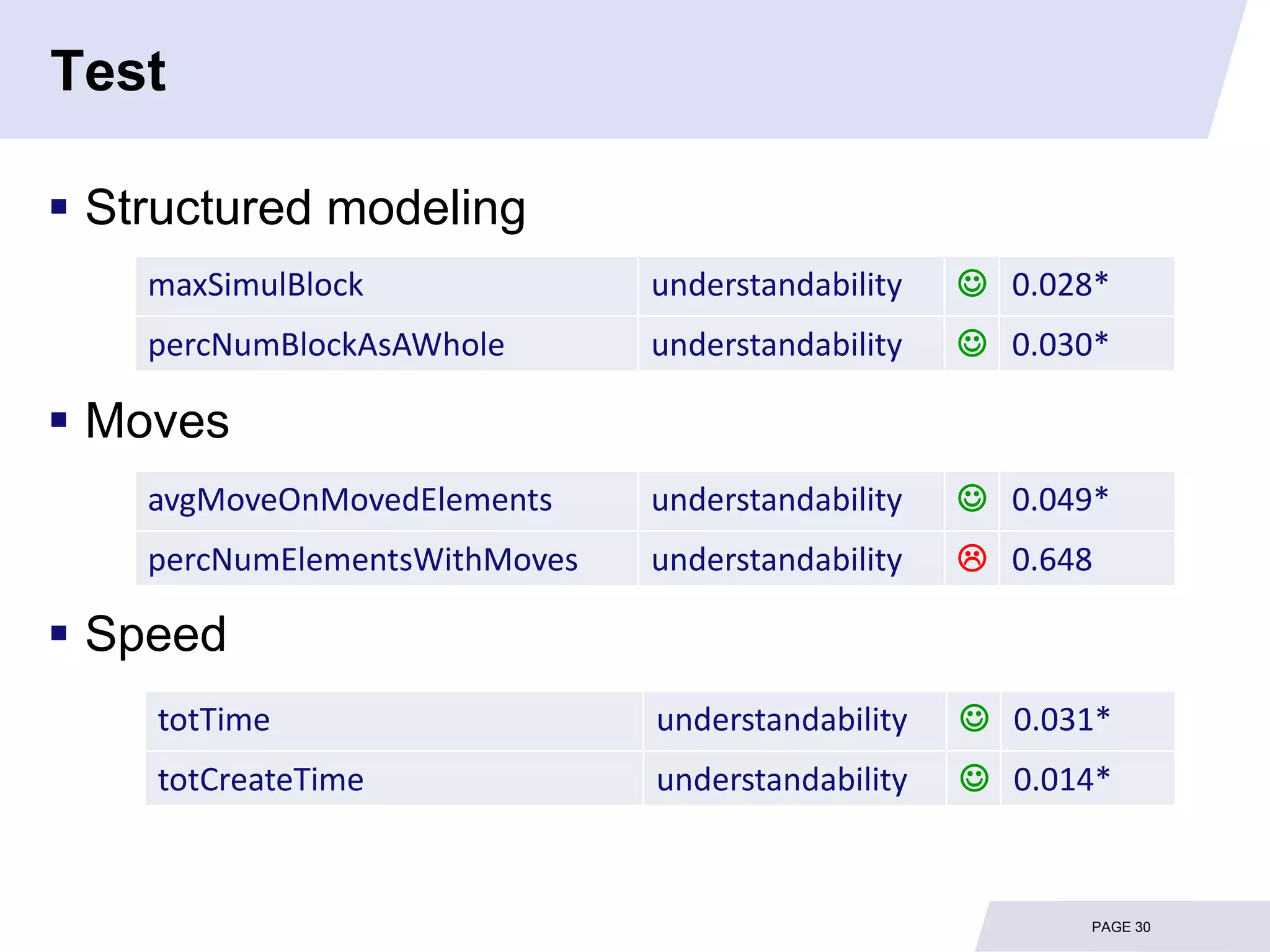
Test

 Structured modeling
    maxSimulBlock              understandability    0.028*
    percNumBlockAsAWhole       understandability    0.030*

 Moves
    avgMoveOnMovedElements     understandability    0.049*
    percNumElementsWithMoves   understandability    0.648

 Speed
    totTime                    understandability    0.031*
    totCreateTime              understandability    0.014*


                                                          PAGE 30
EYE-TRACKING


               PAGE 31
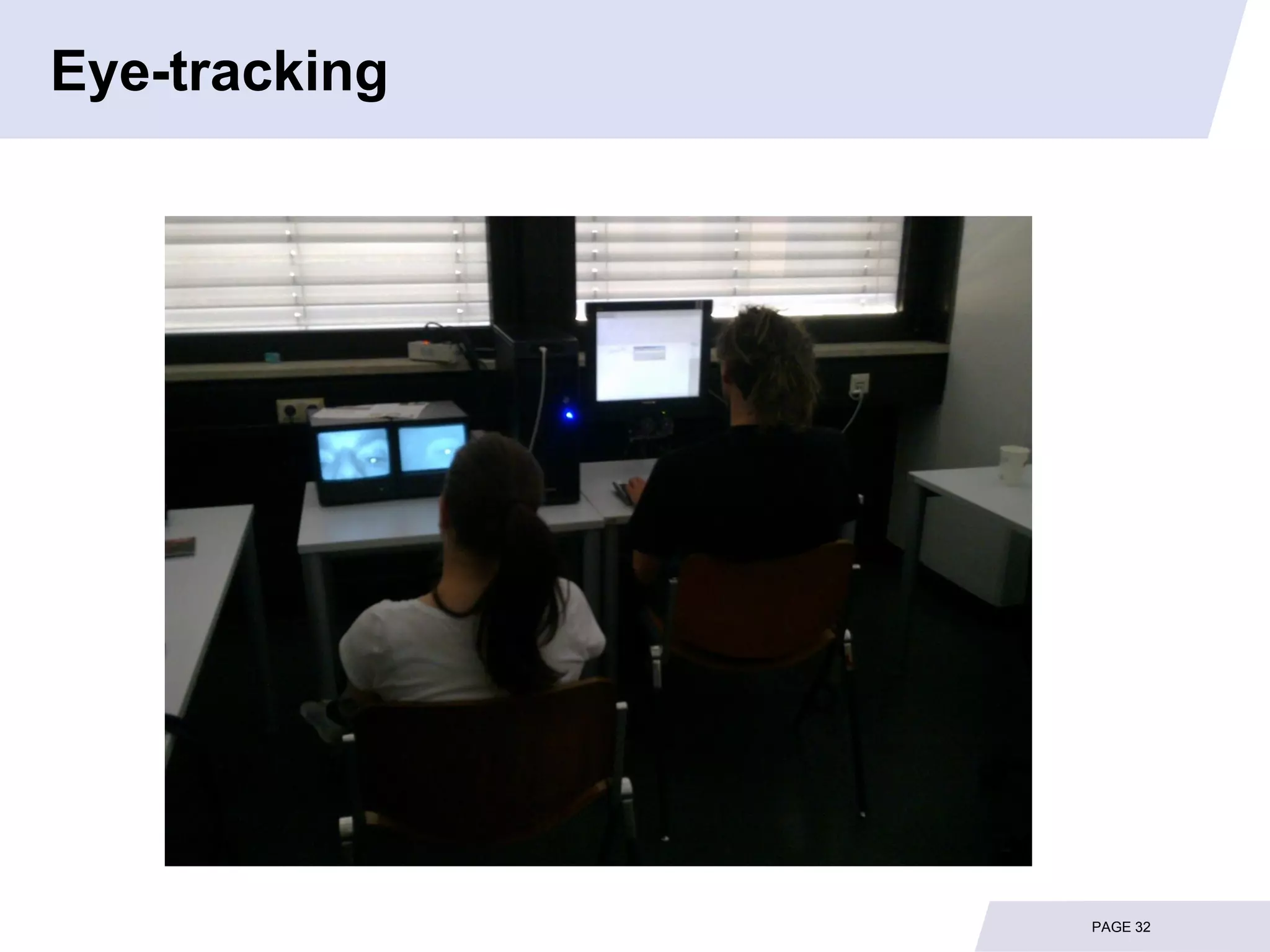
Eye-tracking


               PAGE 32
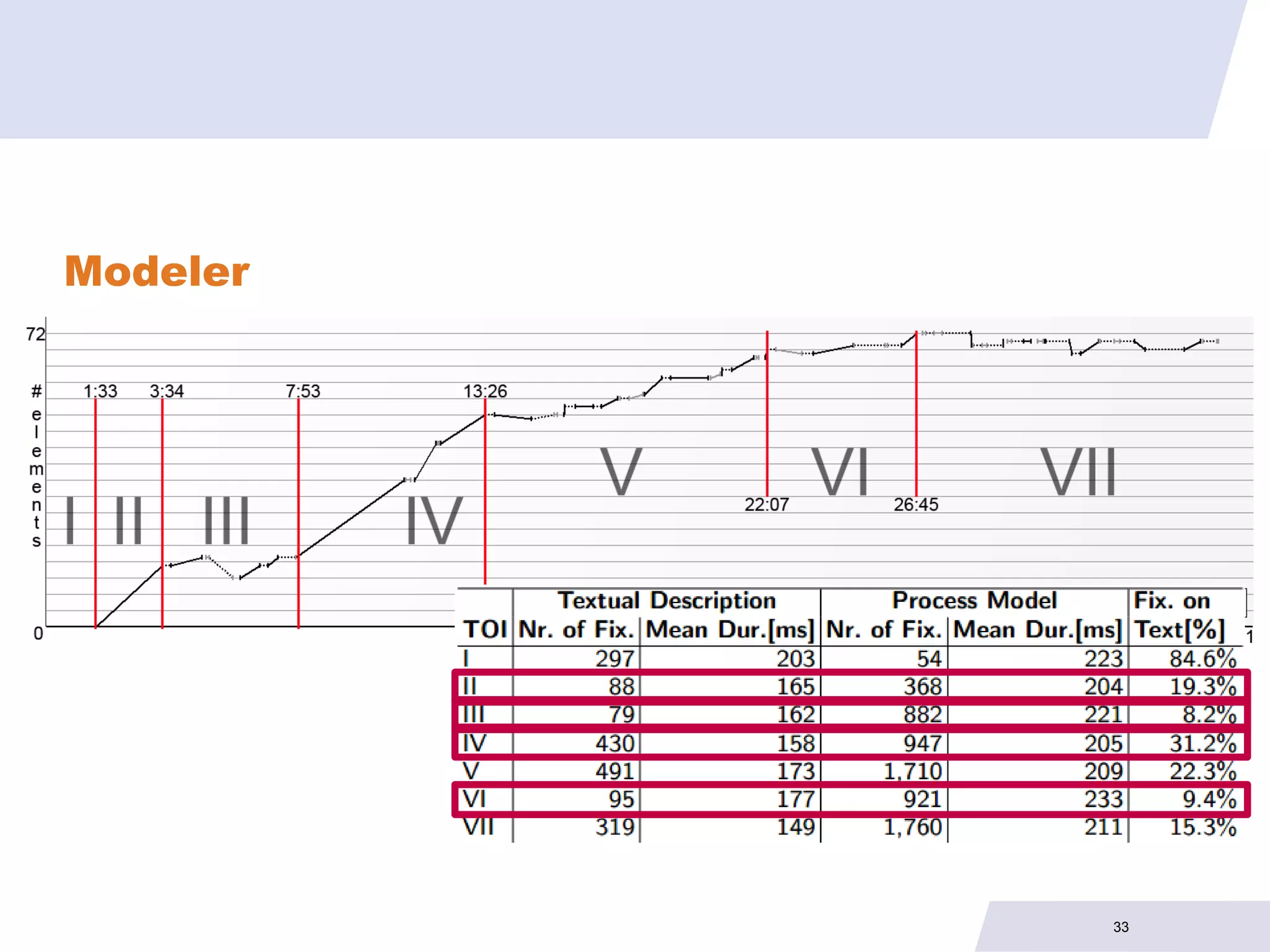
Modeler


          33
Summary

 creating a formal model is a process in itself
 we record and measure this process of modeling

 modeling is difficult
 structure dialogue document has an impact
 modeling styles differ – relation with model quality

 in search of what makes modeling difficult


                                                  PAGE 34
Take away

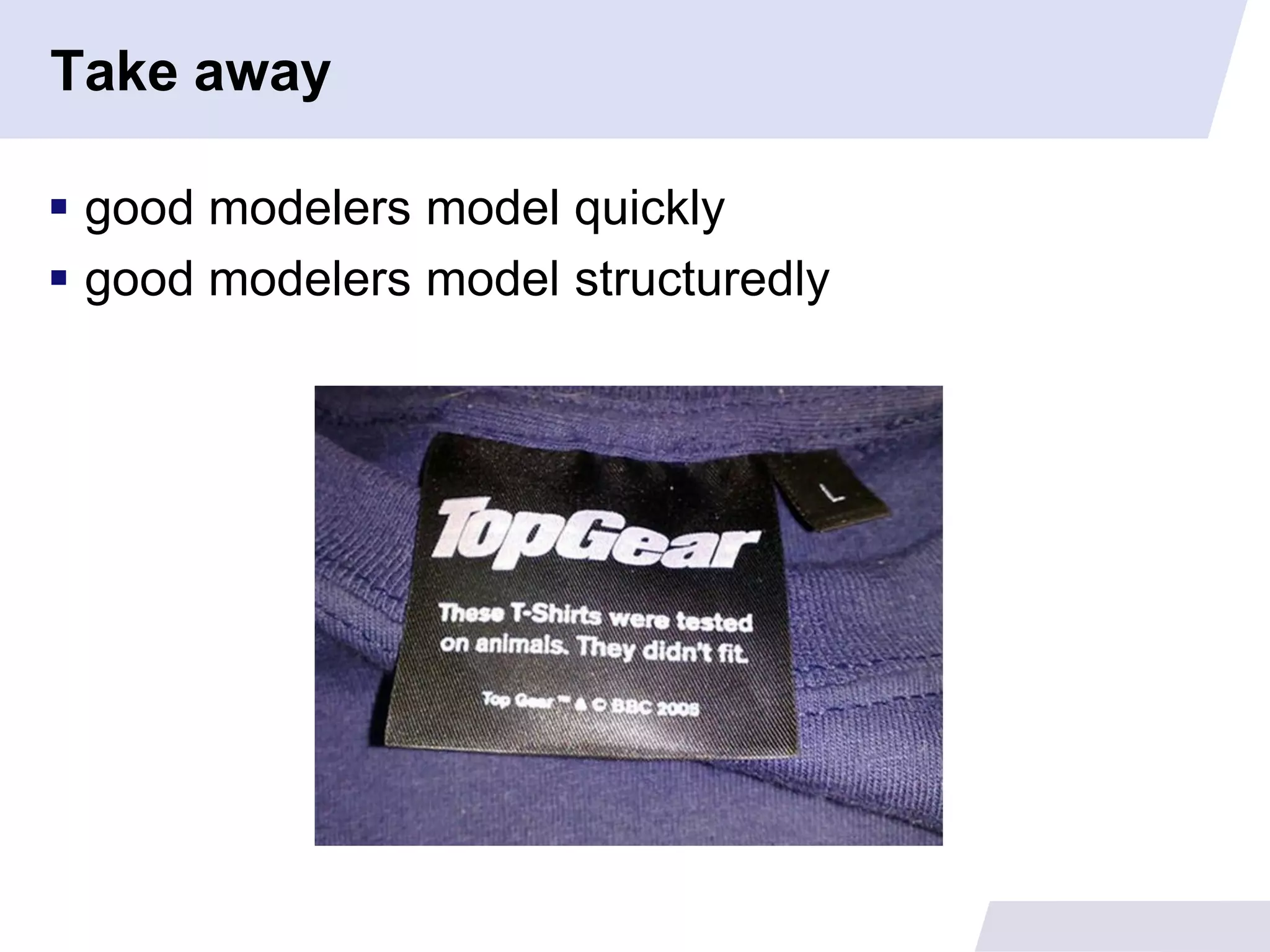
 good modelers model quickly
 good modelers model structuredly
The future

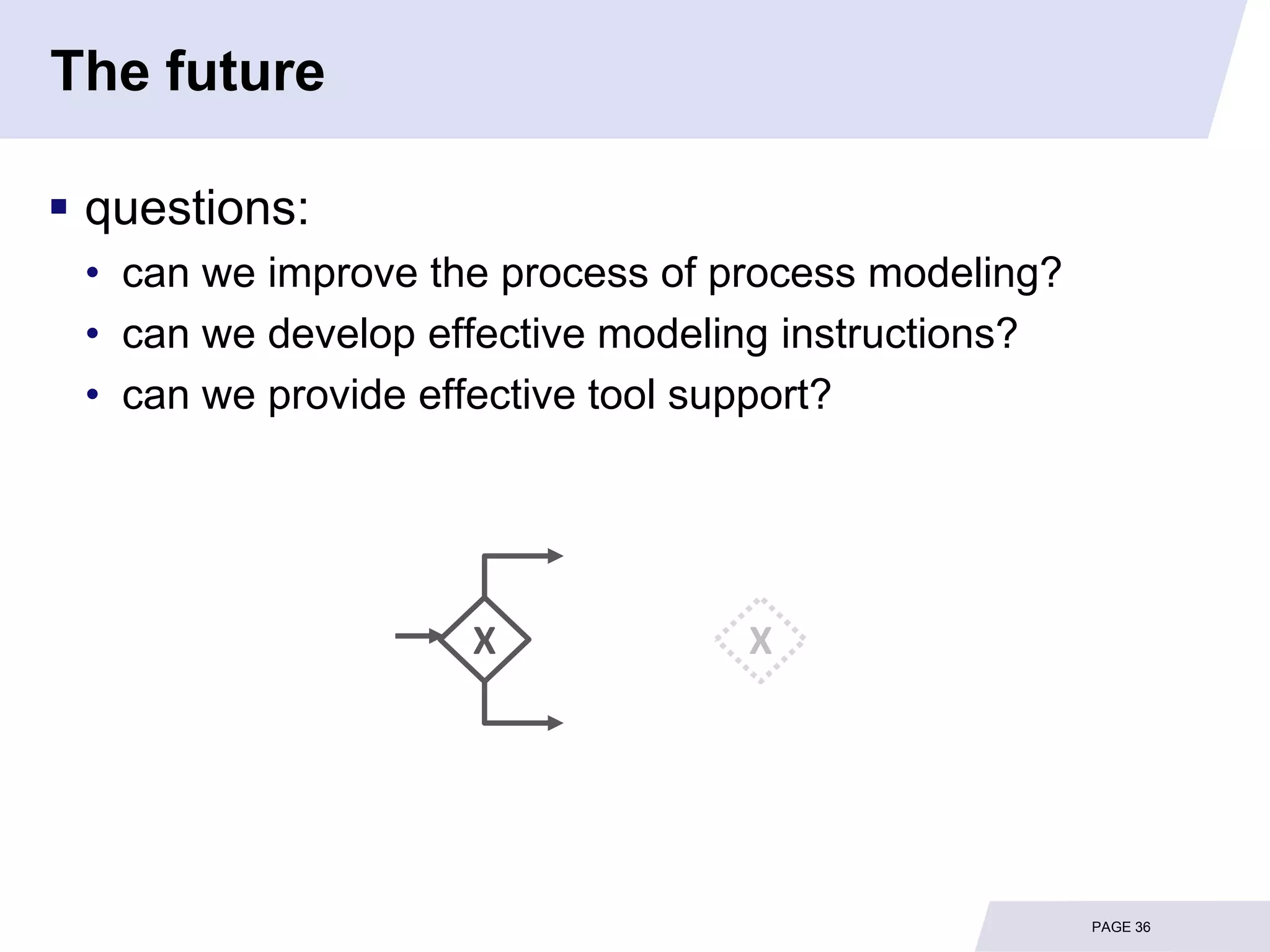
 questions:
 • can we improve the process of process modeling?
 • can we develop effective modeling instructions?
 • can we provide effective tool support?


                    X             X


                                                     PAGE 36
Questions?
                                S.N. Cant, D.R. Jeffery and B Henderson-Sellers: A conceptual model of cognitive complexity of
                                 elements of the programming process. Information and Software Technology 37 (1995) 7, pp.
                                 351-362.
                                J. Claes, I. Vanderfeesten, H.A. Reijers, J. Pinggera, M. Weidlich, S. Zugal, B. Weber, J.
                                 Mendling, G. Poels and D. Fahland. Tying Process Model Quality to the Modeling Process: The
                                 Impact of Structuring, Movement, and Speed. Accepted to 10th International Conference on
                                 Business Process Management (BPM 2012)
                                P.J.M. Frederiks and Th.P. van der Weide: Information modeling: The process and the required
                                 competencies of its participants. Data and Knowledge Engineering 58 (2006) 1, 4-20.
                                A. Hallerbach, T. Bauer and M. Reichert: Capturing Variability in Business Process Models: The
                                 Provop Approach. Journal of Software Maintenance and Evolution: Research and Practice 22
                                 (2010) 6–7, pp. 519–546.
                                J. Mendling: Metrics for Process Models: Empirical Foundations of Verification, Error Prediction
                                 and Guidelines for Correctness, Springer, 2008.
                                J. Mendling: Empirical Studies in Process Model Verification. Transactions on Petri Nets and
                                 Other Models of Concurrency II, Springer, 2009, pp. 208–224.
                                G. Miller: The Magical Number Seven, Plus or Minus Two: Some Limits on Our Capacity for
                                 Processing Information. Psychological Review 63 (1956), pp. 81-87.
                                J. Mendling, H.A. Reijers and J. Recker, Activity Labeling in Process Modeling: Empirical Insights
                                 and Recommendations, Information Systems 35 (2010) 4, pp. 467-482.
                                J. Mendling, H.M.W. Verbeek, B.F. van Dongen, W.M.P. van der Aalst and G. Neumann:
                                 Detection and Prediction of Errors in EPCs of the SAP Reference Model, Data & Knowledge
                                 Engineering 64 (2008) 1, pp. 312-329.
                                J. Pinggera, P. Soffer, S. Zugal, B. Weber, M. Weidlich, D. Fahland, H.A. Reijers and J. Mendling:
                                 Modeling Styles in Business Process Modeling. In: Proc. BPMDS ’12 (accepted), 2012.
  Hajo Reijers
                                P. Rittgen, Quality and perceived usefulness of process models, In: Proc. SAC’10, 2010, pp. 65-
  h.a.reijers@tue.nl             72.
                                A.-W. Scheer, ARIS - Business Process Modeling, 3rd ed., Springer 2000.
                                M. Soto, A. Ocampo and J. Munch: The Secret Life of a Process Description: A Look into the
  http://www.reijers.com         Evolution of a Large Process Model, In: Proc. ICSP'08, 2008, pp. 257-268.
  Twitter: @MultumNonMulta      B. Weber and M. Reichert: Refactoring Process Models in Large Process Repositories In: Proc.
                                 CAiSE'08 (2008), pp. 124-139.
                                B. Weber, M. Reichert, J. Mendling and H.A. Reijers: Refactoring Large Process Model
                                 Repositories.. Computers and Industry 62(2011) 5, pp. 467-486.


                                                                                                                 PAGE 37

The process of process modeling by Hajo Reijers

  • 1.
    Hajo Reijers The Process of Process Modeling
  • 2.
    Jakob Pinggera Stefan Zugal Barbara Weber Dirk Fahland Hajo Reijers Irene Vanderfeesten Matthias Weidlich Jan Mendling Pnina Soffer Jan Claes Geert Poels PAGE 2
  • 3.
    Process Models inBPM common identify problems in understanding the business process discover opportunities execute for improvement PAGE 3
  • 4.
    Quality Problems  Errorrates between 10% and 50% in industrial process model collections (Mendling 2009, Fahland et al. 2009, Mendling et al. 2008)  impedes comprehensibility and maintainability of process models (Mendling 2008, Weber & Reichert 2008, Weber et al. 2011) • Non intention-revealing or inconsistent naming (Mendling et al. 2010) • Redundant process fragments (Hallerbach et al. 2010) • Large and unnecessarily complex process models (Soto et al. 2008) PAGE 4
  • 5.
    Process Model DevelopmentLifecycle Elicitation Formalization PAGE 5
  • 6.
    Challenges Goodcommunication Significant process between stakeholders modeling skills and and effective good modeling negotiation processes support Elicitation Formalization PAGE 6
  • 7.
    Overall objective: ImproveFormalization 1. Learn from process modelers 2. Investigate tool/notation impact on modeling 3. Support modeling: • modeling methodology • modeling notation • modeling tools Elicitation Formalization PAGE 7
  • 8.
    Analyze Formalization asa Process Formalization Elicitation Comprehension Reconciliation Modeling PAGE 8
  • 9.
    Outline  process modeling • motivation • elicitation + formalization  capture as a process • conceptual idea • what does it look like  insights: • dialogue document • modeling styles • eye-tracking PAGE 9
  • 10.
    Process of ProcessModeling (PPM)  iterative, highly flexible process  depends on individual modeler  3 successive phases Comprehension Reconciliation Modeling PAGE 10
  • 11.
    What does thePPM look like?  same product (process model) PAGE 11
  • 12.
    What does thePPM look like?  same product (process model)  record modeling steps PAGE 12
  • 13.
    Model recording CREATE_XOR_GATEWAY CREATE_ACTIVITY CREATE_EDGE CREATE_START_EVENT CREATE_AND_GATEWA MOVE_ACTIVITY DELETE_ACTIVITY NAME_EDGE CREATE_EDGE_BENDPOINT RENAME_ACTIVITY Cheetah Experimental Platform: http://bpm.q-e.at/?page_id=56 PAGE 13
  • 14.
    What does thePPM look like?  classify modeling steps  accumulate in Modeling Phase Diagrams (PPMs) PAGE 14
  • 15.
    Experiments PAGE 15
  • 16.
    Outline  process modeling • motivation • elicitation + formalization  capture as a process • conceptual idea • what does it look like  some insights • dialogue document • attention fixation • modeling styles PAGE 16
  • 17.
  • 18.
    Dialogue document P.J.M. Frederiksand Th.P. van der Weide: Information modeling: The process and the required competencies of its participants. Data and Knowledge Engineering 58 (2006) 1, 4-20. PAGE 18
  • 19.
    Dialogue document  Factorof interest: Organization of dialogue document  Factor levels: Breadth-first, Depth-first, Random
  • 20.
  • 21.
    Results: Modeling time Breadth-first significantly quicker than random
  • 22.
    Results: Accuracy  Randomhas a significant higher distance
  • 23.
    Results – Dialoguedocument  Modeling is difficult • High percentage of syntactical errors  Organization dialogue document: • Limited effect on syntactical correctness • Big effect on accuracy  Breadth first seems favorable: • Modeling time lowest • Modelers most closely follow dialogue document PAGE 23
  • 24.
  • 25.
  • 26.
    Approach Understandable Non-understandable models models J. Claes, I. Vanderfeesten, H.A. Reijers, J. Pinggera, M. Weidlich, S. Zugal, B. Weber, J. Mendling, G. Poels and D. Fahland. Tying Process Model Quality to the Modeling Process: The Impact of Structuring, Movement, and Speed. Accepted to 10th International Conference on Business Process Management (BPM 2012) PAGE 26
  • 27.
    Structured modeling  Creatingblocks ‘as a whole’ (before moving on to the creation of the rest of the model) ACT ACT X X ACT PAGE 27
  • 28.
    Movement PAGE 28
  • 29.
    Speed PAGE 29
  • 30.
    Test  Structured modeling maxSimulBlock understandability  0.028* percNumBlockAsAWhole understandability  0.030*  Moves avgMoveOnMovedElements understandability  0.049* percNumElementsWithMoves understandability  0.648  Speed totTime understandability  0.031* totCreateTime understandability  0.014* PAGE 30
  • 31.
  • 32.
  • 33.
  • 34.
    Summary  creating aformal model is a process in itself  we record and measure this process of modeling  modeling is difficult  structure dialogue document has an impact  modeling styles differ – relation with model quality  in search of what makes modeling difficult PAGE 34
  • 35.
    Take away  goodmodelers model quickly  good modelers model structuredly
  • 36.
    The future  questions: • can we improve the process of process modeling? • can we develop effective modeling instructions? • can we provide effective tool support? X X PAGE 36
  • 37.
    Questions?  S.N. Cant, D.R. Jeffery and B Henderson-Sellers: A conceptual model of cognitive complexity of elements of the programming process. Information and Software Technology 37 (1995) 7, pp. 351-362.  J. Claes, I. Vanderfeesten, H.A. Reijers, J. Pinggera, M. Weidlich, S. Zugal, B. Weber, J. Mendling, G. Poels and D. Fahland. Tying Process Model Quality to the Modeling Process: The Impact of Structuring, Movement, and Speed. Accepted to 10th International Conference on Business Process Management (BPM 2012)  P.J.M. Frederiks and Th.P. van der Weide: Information modeling: The process and the required competencies of its participants. Data and Knowledge Engineering 58 (2006) 1, 4-20.  A. Hallerbach, T. Bauer and M. Reichert: Capturing Variability in Business Process Models: The Provop Approach. Journal of Software Maintenance and Evolution: Research and Practice 22 (2010) 6–7, pp. 519–546.  J. Mendling: Metrics for Process Models: Empirical Foundations of Verification, Error Prediction and Guidelines for Correctness, Springer, 2008.  J. Mendling: Empirical Studies in Process Model Verification. Transactions on Petri Nets and Other Models of Concurrency II, Springer, 2009, pp. 208–224.  G. Miller: The Magical Number Seven, Plus or Minus Two: Some Limits on Our Capacity for Processing Information. Psychological Review 63 (1956), pp. 81-87.  J. Mendling, H.A. Reijers and J. Recker, Activity Labeling in Process Modeling: Empirical Insights and Recommendations, Information Systems 35 (2010) 4, pp. 467-482.  J. Mendling, H.M.W. Verbeek, B.F. van Dongen, W.M.P. van der Aalst and G. Neumann: Detection and Prediction of Errors in EPCs of the SAP Reference Model, Data & Knowledge Engineering 64 (2008) 1, pp. 312-329.  J. Pinggera, P. Soffer, S. Zugal, B. Weber, M. Weidlich, D. Fahland, H.A. Reijers and J. Mendling: Modeling Styles in Business Process Modeling. In: Proc. BPMDS ’12 (accepted), 2012. Hajo Reijers  P. Rittgen, Quality and perceived usefulness of process models, In: Proc. SAC’10, 2010, pp. 65- h.a.reijers@tue.nl 72.  A.-W. Scheer, ARIS - Business Process Modeling, 3rd ed., Springer 2000.  M. Soto, A. Ocampo and J. Munch: The Secret Life of a Process Description: A Look into the http://www.reijers.com Evolution of a Large Process Model, In: Proc. ICSP'08, 2008, pp. 257-268. Twitter: @MultumNonMulta  B. Weber and M. Reichert: Refactoring Process Models in Large Process Repositories In: Proc. CAiSE'08 (2008), pp. 124-139.  B. Weber, M. Reichert, J. Mendling and H.A. Reijers: Refactoring Large Process Model Repositories.. Computers and Industry 62(2011) 5, pp. 467-486. PAGE 37