XPDL 2.0 and BPMN Tutorial
Business Process Management Summit

            February 1 2006
     Radisson Hotel, Miami, Florida
Introductions


 Mike Marin
   • Vice Chair Americas WfMC Technical Committee
   • Software Architect, FileNet Corporation, USA
   • mmarin <at> filenet.com
 Keith Swenson
   • Chair WfMC Technical Committee
   • VP of Research and Development, Fujitsu Software Corporation, USA
   • Kswenson <at> us.fujitsu.com
 Justin Brunt
   • Vice Chair Europe Technical Committee
   • Senior Product Manager, TIBCO Software Inc., UK
   • jbrunt <at> tibco.com
Agenda


 XPDL and BPMN - Uses and Background
   • Justin Brunt
 XPDL 2.0 and BPMN Tutorial
   • Mike Marin
 Examples and Demonstrations
   • Keith Swenson
XPDL and BPMN - Uses and Background
It’s All About Processes


 WfMC defines a process as:
   • “The representation of a business process in a form that supports
     automated manipulation, such as modeling, or enactment by a
     workflow [or business] management system. The process
     definition consists of a network of activities and their relationships,
     criteria to indicate the start and termination of the process, and
     information about the individual activities, such as participants,
     associated IT applications and data, etc.”
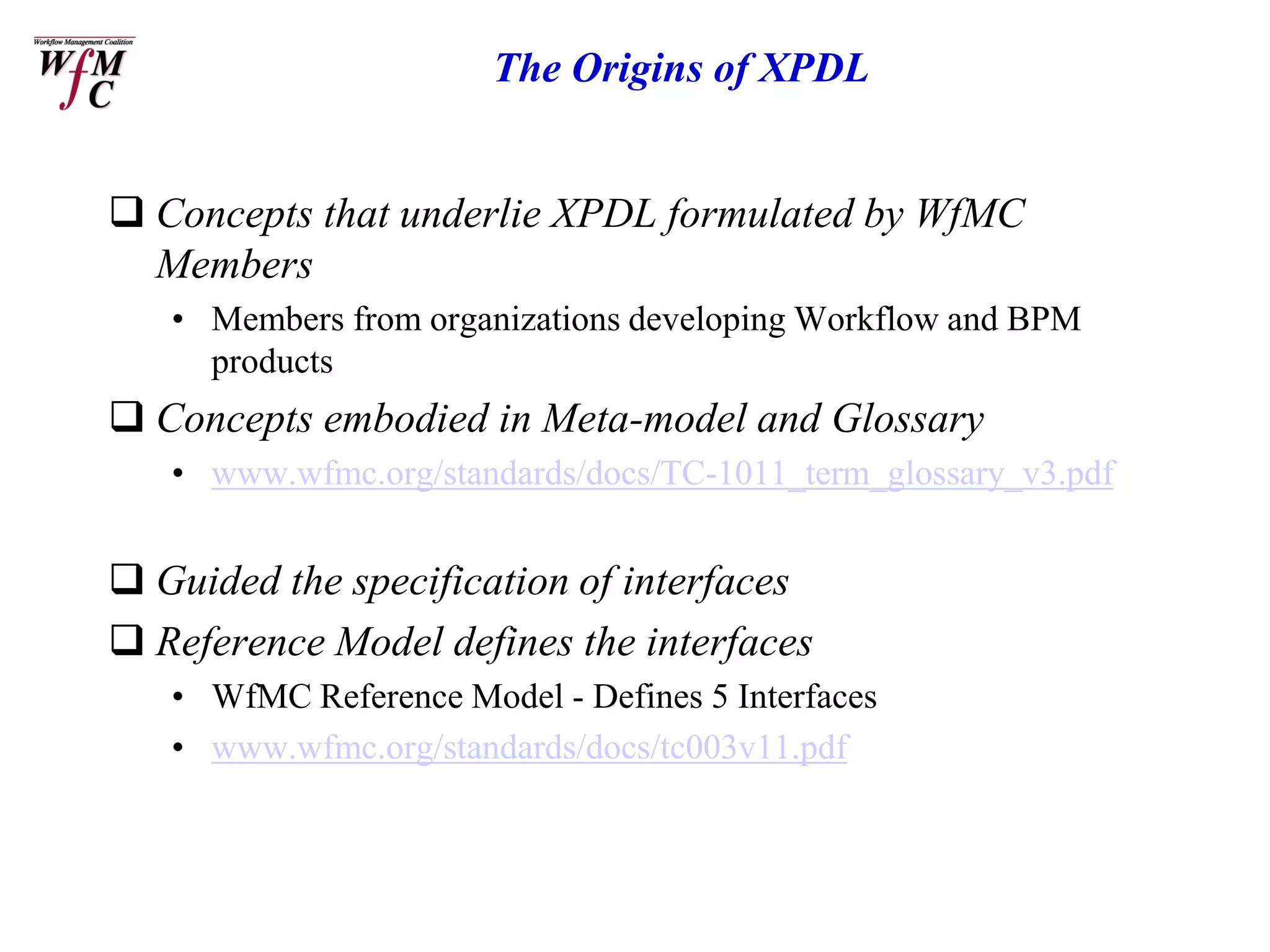
The Origins of XPDL


 Concepts that underlie XPDL formulated by WfMC
  Members
   • Members from organizations developing Workflow and BPM
     products
 Concepts embodied in Meta-model and Glossary
   • www.wfmc.org/standards/docs/TC-1011_term_glossary_v3.pdf


 Guided the specification of interfaces
 Reference Model defines the interfaces
   • WfMC Reference Model - Defines 5 Interfaces
   • www.wfmc.org/standards/docs/tc003v11.pdf
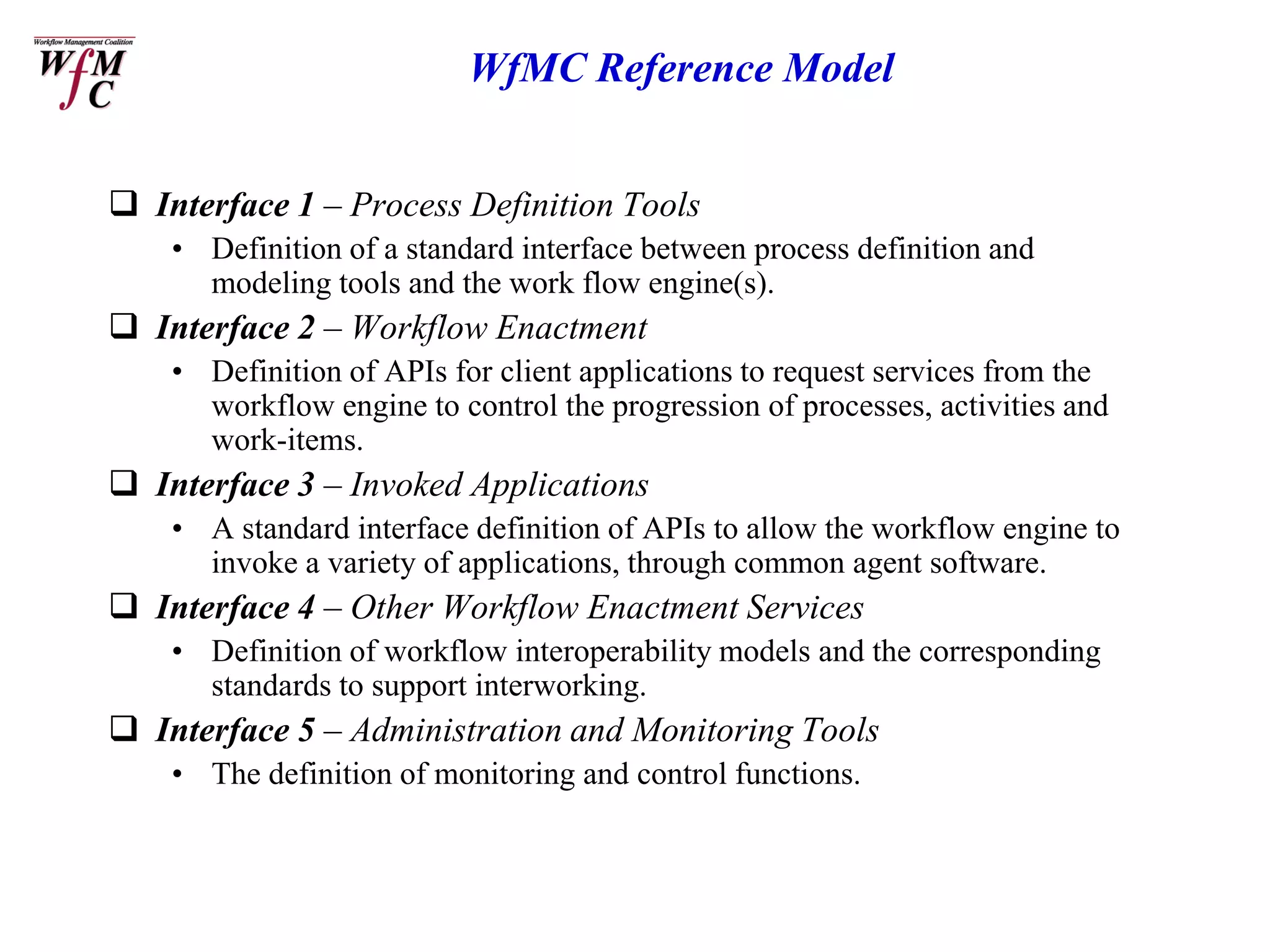
WfMC Reference Model


 Interface 1 – Process Definition Tools
    • Definition of a standard interface between process definition and
      modeling tools and the work flow engine(s).
 Interface 2 – Workflow Enactment
    • Definition of APIs for client applications to request services from the
      workflow engine to control the progression of processes, activities and
      work-items.
 Interface 3 – Invoked Applications
    • A standard interface definition of APIs to allow the workflow engine to
      invoke a variety of applications, through common agent software.
 Interface 4 – Other Workflow Enactment Services
    • Definition of workflow interoperability models and the corresponding
      standards to support interworking.
 Interface 5 – Administration and Monitoring Tools
    • The definition of monitoring and control functions.
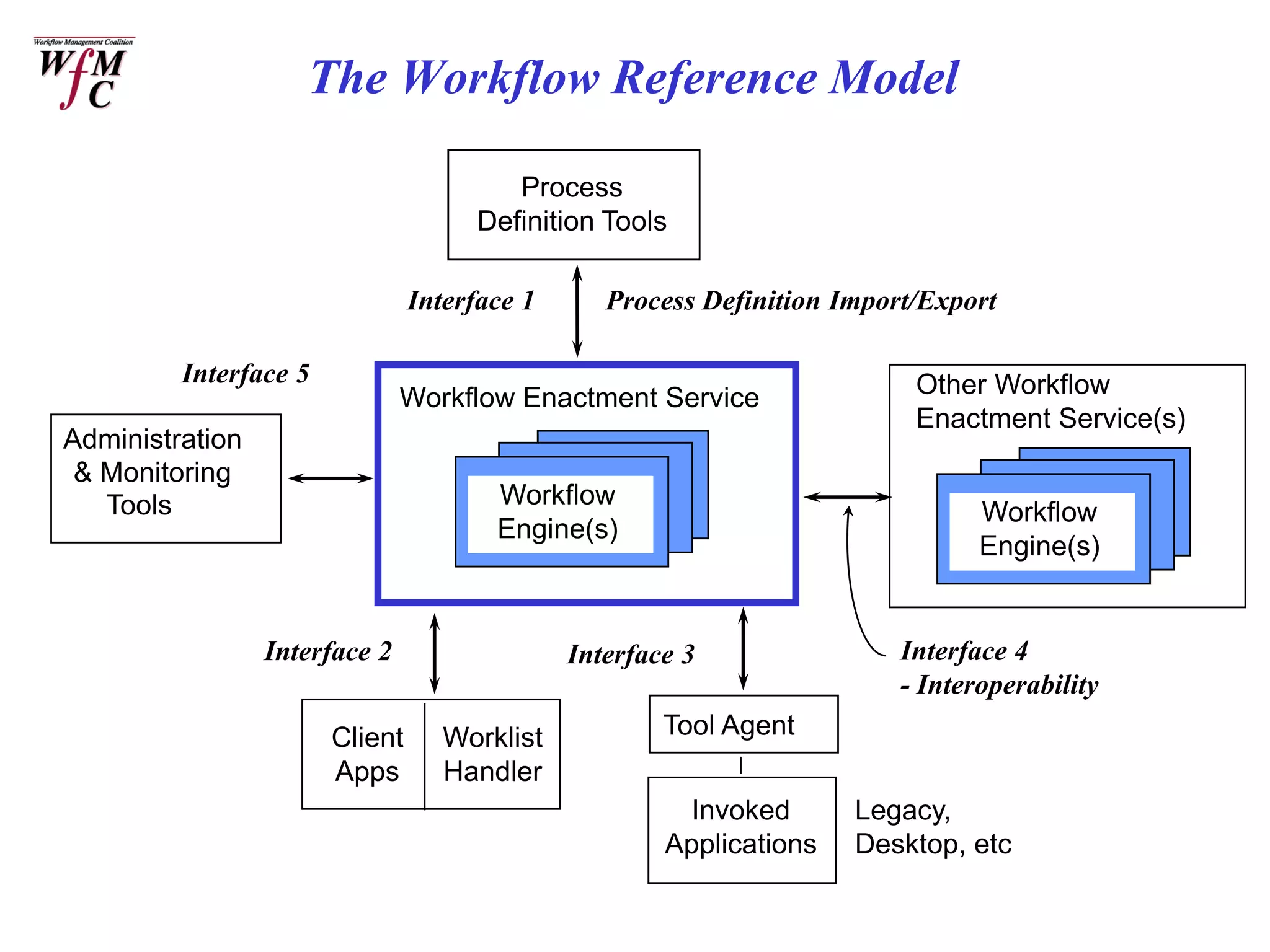
The Workflow Reference Model

                                         Process
                                      Definition Tools

                                Interface 1      Process Definition Import/Export

         Interface 5                                                      Other Workflow
                               Workflow Enactment Service
                                                                          Enactment Service(s)
Administration
 & Monitoring
   Tools                               Workflow
                                                                                Workflow
                                       Engine(s)
                                                                                Engine(s)


                 Interface 2                  Interface 3                Interface 4
                                                                         - Interoperability
                       Client      Worklist           Tool Agent
                       Apps        Handler
                                                        Invoked      Legacy,
                                                      Applications   Desktop, etc
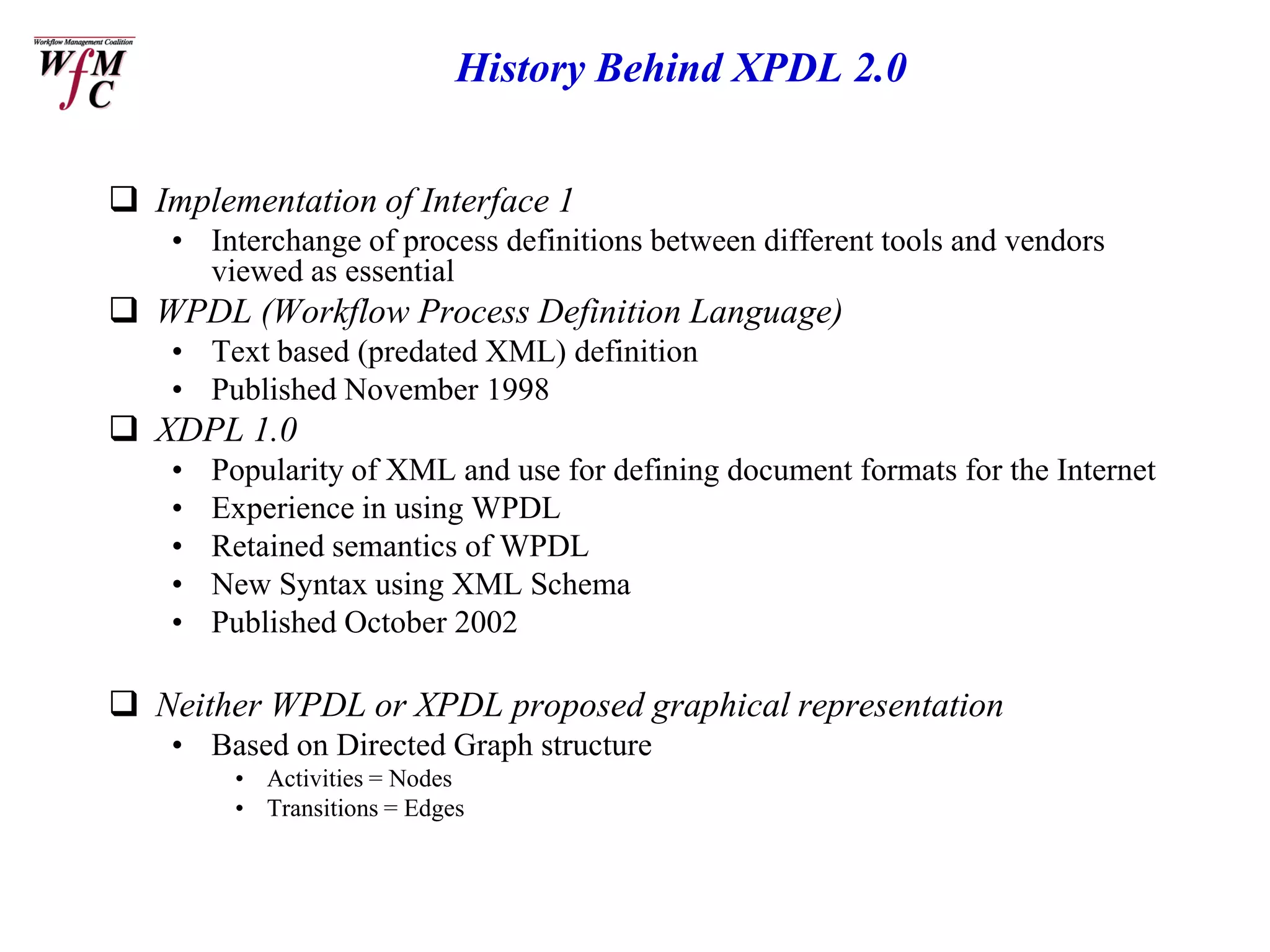
History Behind XPDL 2.0


 Implementation of Interface 1
    • Interchange of process definitions between different tools and vendors
      viewed as essential
 WPDL (Workflow Process Definition Language)
    • Text based (predated XML) definition
    • Published November 1998
 XDPL 1.0
    •   Popularity of XML and use for defining document formats for the Internet
    •   Experience in using WPDL
    •   Retained semantics of WPDL
    •   New Syntax using XML Schema
    •   Published October 2002

 Neither WPDL or XPDL proposed graphical representation
    • Based on Directed Graph structure
         • Activities = Nodes
         • Transitions = Edges
Origins of BPMN


 Developed by members of BPMI.org
   • Business Process Management Initiative
   • BPMI.org merged with OMG June 2005
   • www.bpmn.org, www.omg.org
 Encompasses techniques employed in flowcharts
 Unify and extend graphics to express semantics required
  by
   • Workflow Processes
   • EAI Processes
 Drawn on expertise from different modelling disciplines
   • UML Activity Diagram, UNL EDOC Business Processes, IDEF,
     ebXML BPSS, Activity-Decision Flow (ADF) Diagram,
     RosettaNet, LOVeM, Event Process Chains (EPCs)
Origins of BPMN


 Graphical Notation to express Business Processes
 Aimed at both Technical and Business Users
   • Facilitate communication between users of complex business
     processes
   • Readily understandable by all business users
   • Business Analysts create initial drafts of processes
   • Technical developers implementing processes
   • Business people manage and monitor processes
 Includes Mapping between Graphic Notation and
  constructs of BPM Execution Languages e.g. WS-BPEL
 Does not specify a mechanism for storage
 BPMN 1.0 Published May 2004
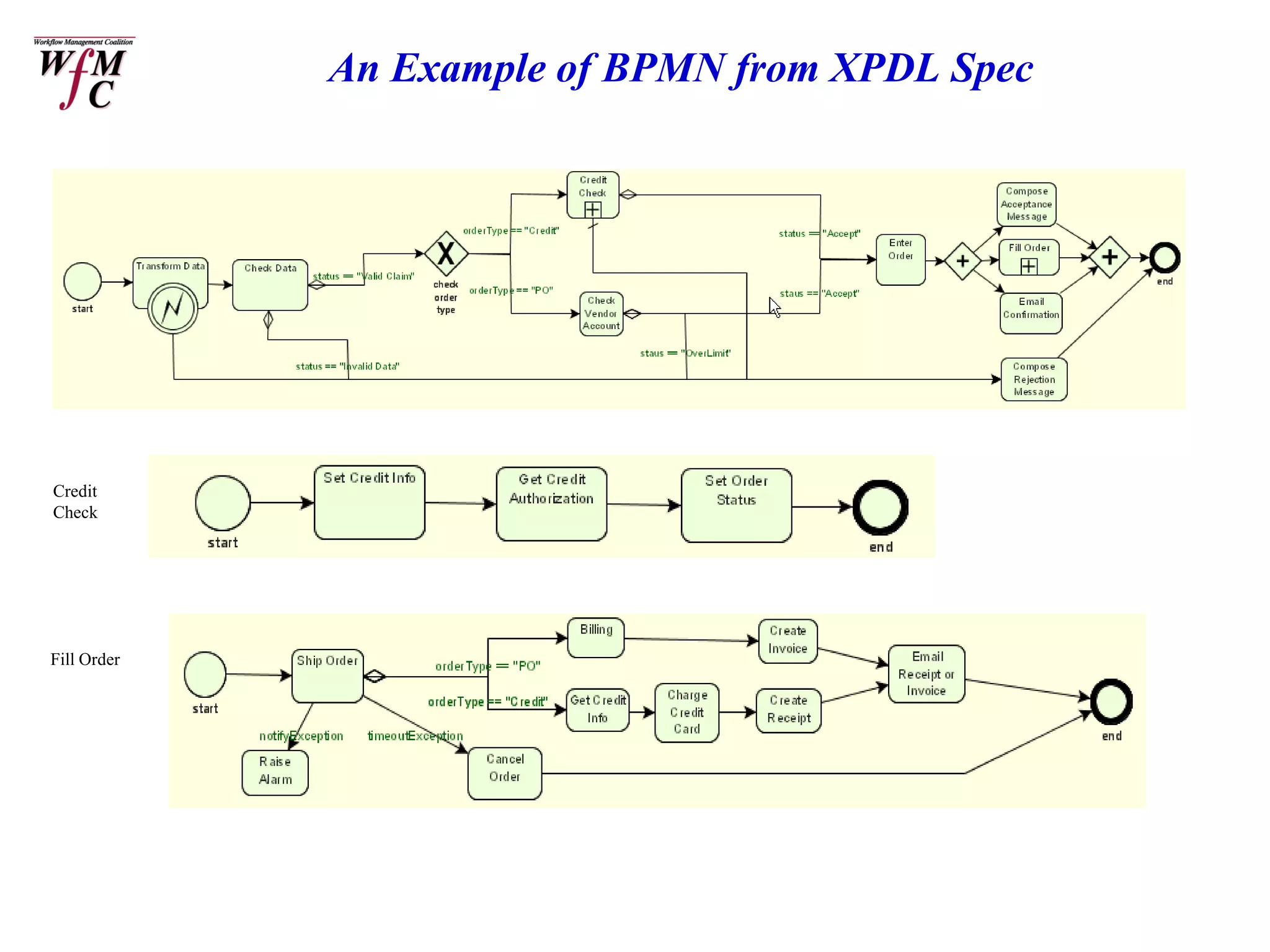
An Example of BPMN from XPDL Spec


Credit
Check


Fill Order
BPMN Scope


 Only supports modelling concepts that are applicable to
  Business Processes
 Does not include
   •   Organizational structures and resources
   •   Functional breakdowns
   •   Data and information models
   •   Strategy
   •   Business Rules
 Relationships between BPMN and other high-level
  business modelling will be defined at some later date
 BPMN shows flow of data and association of data to
  Artifacts
   • But it’s not a data flow diagram
Uses of BPMN


 Targeted at wide audience
 Allows creation of end-to-end business processes
 Three basic types of sub-model within an end-to-end
  BPMN model
   • Private (internal) business processes
       • Internal to a specific organization
   • Abstract (public) processes
       • Represents interaction between a private business process and another process
         or participant
       • Only activities used to communicate outside the private business process are
         included
   • Collaboration (global) processes
       • Represents interactions between 2 or more business entities
       • Sequence of activities representing message exchange between entities
Origins of XPDL 2.0


 Includes enhancements based on feedback received on
  XPDL 1.0
 Includes support for BPMN constructs
 Provides a mechanism to store process definitions drawn
  in BPMN
   • BPMN does not provide this
 Indirectly provides support for BPEL
   • BPMN provides support for BPEL
   • XPDL provides support for BPMN
 XPDL 2.0 is compatible with XPDL 1.0
   • Some minor exceptions – see later
 Published October 2005
Uses of XPDL 2.0


 Internal Process Definition Format for Workflow and
  BPM products
 Import/Export Format to exchange Process Definitions
  between components in a Workflow/BPM Product Suite
 Exchange Format for Process Definition interchange
  between different BPM/Workflow Products
   • Demonstrated by WfMC member organizations at public events
 Exchange Format for Process Definition interchange
  between Process Modeling and Simulation tools and
  BPM/WorkflowProducts
   • IDS Scheer’s ARIS Toolset
   • Zynium’s Visio based converters
Purposes of XPDL


 XPDL is extensible
   • Handle information used by a variety of different tools


 Different dialects of XPDL
   • Use extended attributes to define vendor specific features
 Different XML dialects
   • BPEL -> XPDL
   • Vendor specific exports to other tools
 Can use XSLT transforms to convert one dialect to another
Organizations Supporting XPDL


 ADVANTYS WorkflowGen www.workflowgen.com
 Amazonas Workflow www.objeng.ch
 BOC ADONIS 3.7 www.boc-eu.com
 InProces from Brein BV www.brein.nl
 CapeVisions (Global 360) www.capevisions.com/
 CARNOT Process Engine www.carnot.ag/index-en.htm
 ComActivity www.comactivity.net
Organizations Supporting XPDL Cont’d


 Enhydra Shark shark.enhydra.org
 Enhydra JaWE jawe.enhydra.org
 e.POWER WorkManager Builder by Integic www.integic.com
 Finantix Studio (FXS) www.soluta.net
 Fuego www.fuego.com/support/faqs.html#110
 Fujitsu Interstage BPM (i-Flow)
  www.fujitsu.com/global/services/software/interstage/products/bpm/
 Fujitsu Interstage Business Process Manager Studio
  www.fujitsu.com/global/services/software/interstage/wnew/pr120605.h
  tml
 Process Modeler by ITP-Commerce www.itp-
  commerce.com/index.php?pageid=B_001_12_1
Organizations Supporting XPDL Cont’d


 IT Pearls www.itpearls.com
 Lynx Flow Designer by Eclaire www.cynthia-
  tech.com/web/pro_sol/pro_sol_flowdesign.html
 Metoda S.p.A, OpenMet BPMF www.metoda.it
 Nautica
  nautica.sourceforge.jp/docs/reference/designertool/resource/japanese/
  index.html
 OfficeObjects®WorkFlow www.rodan.pl
 Ontology (BPMO) by Jenz & Partner GmbH
  www.bpiresearch.com/Resources/RE_OSSOnt/re_ossont.htm
 Open Business Engine sourceforge.net/projects/obe,
  obe.sourceforge.net/
 Oracle9i Warehouse Builder 9.2
  otn.oracle.com/products/warehouse/htdocs/datasheet92.htm
Organizations Supporting XPDL Cont’d


 Simprocess www.simprocess.com
 Tell-Eureka www.telleureka.com/technology/
 TIBCO® Staffware Process Suite 10.3
  www.tibco.com/software/process_management/staffware_
  processsuite.jsp
 Vignette Process Workflow Modeler
  www.vignette.com/Downloads/DS_ProcessWorkflowModel
  .pdf
 WfMOpen wfmopen.sf.net
 ZAPLET 3, PROCESS BUILDER
  www.zaplet.com/Pages/articles/ProcessBuilder.pdf
XPDL 2.0 Conformance


 Conformance for process definition import / export is
  essentially based upon conformance to the XPDL grammar
 There is a mandatory minimum set of objects which must
  be supported within XPDL
 There is a wide variation of capabilities in modelling tools
 An individual tool might conform to XPDL 2.0 but not be
  able to swap complete definitions with all other
  conforming products
 A product that claims conformance must generate valid,
  syntactically correct XPDL, and must be able to read valid
  XPDL files
 A valid, syntactically correct XPDL file, must conform and
  validate against the XPDL schema.
BPMN Conformance


 Visual Appearance of the BPMN Graphical Elements
   • Shape and Icons – tools must conform to shapes and markers
   • There is flexibility size, color, line size and text positions
   • Can make extensions with new markers or indicators
       • Must not conflict with existing elements
       • Must not change basic shape of graphical elements and markers
 Semantics of the BPMN Elements
   • Defines how elements interact with each other
 Exchange of BPMN Diagrams between Conformant Tools
   • Specification doesn’t define mechanism for exchange
   • That’s where XPDL 2.0 comes to the rescue!
 Conformant implementation is not required to process any
  non-normative extension elements or attributes
Finding XPDL and Related Information


 WfMC Website
  • http://www.wfmc.org
  • http://www.wfmc.org/standards/XPDL.htm


 OMG Website
  • http://www,omg.org
  • http://www.bpmn.org

2006 mm,ks,jb (miami, florida bpm summit) xpdl tutorial

  • 1.
    XPDL 2.0 andBPMN Tutorial Business Process Management Summit February 1 2006 Radisson Hotel, Miami, Florida
  • 2.
    Introductions  Mike Marin • Vice Chair Americas WfMC Technical Committee • Software Architect, FileNet Corporation, USA • mmarin <at> filenet.com  Keith Swenson • Chair WfMC Technical Committee • VP of Research and Development, Fujitsu Software Corporation, USA • Kswenson <at> us.fujitsu.com  Justin Brunt • Vice Chair Europe Technical Committee • Senior Product Manager, TIBCO Software Inc., UK • jbrunt <at> tibco.com
  • 3.
    Agenda  XPDL andBPMN - Uses and Background • Justin Brunt  XPDL 2.0 and BPMN Tutorial • Mike Marin  Examples and Demonstrations • Keith Swenson
  • 4.
    XPDL and BPMN- Uses and Background
  • 5.
    It’s All AboutProcesses  WfMC defines a process as: • “The representation of a business process in a form that supports automated manipulation, such as modeling, or enactment by a workflow [or business] management system. The process definition consists of a network of activities and their relationships, criteria to indicate the start and termination of the process, and information about the individual activities, such as participants, associated IT applications and data, etc.”
  • 6.
    The Origins ofXPDL  Concepts that underlie XPDL formulated by WfMC Members • Members from organizations developing Workflow and BPM products  Concepts embodied in Meta-model and Glossary • www.wfmc.org/standards/docs/TC-1011_term_glossary_v3.pdf  Guided the specification of interfaces  Reference Model defines the interfaces • WfMC Reference Model - Defines 5 Interfaces • www.wfmc.org/standards/docs/tc003v11.pdf
  • 7.
    WfMC Reference Model Interface 1 – Process Definition Tools • Definition of a standard interface between process definition and modeling tools and the work flow engine(s).  Interface 2 – Workflow Enactment • Definition of APIs for client applications to request services from the workflow engine to control the progression of processes, activities and work-items.  Interface 3 – Invoked Applications • A standard interface definition of APIs to allow the workflow engine to invoke a variety of applications, through common agent software.  Interface 4 – Other Workflow Enactment Services • Definition of workflow interoperability models and the corresponding standards to support interworking.  Interface 5 – Administration and Monitoring Tools • The definition of monitoring and control functions.
  • 8.
    The Workflow ReferenceModel Process Definition Tools Interface 1 Process Definition Import/Export Interface 5 Other Workflow Workflow Enactment Service Enactment Service(s) Administration & Monitoring Tools Workflow Workflow Engine(s) Engine(s) Interface 2 Interface 3 Interface 4 - Interoperability Client Worklist Tool Agent Apps Handler Invoked Legacy, Applications Desktop, etc
  • 9.
    History Behind XPDL2.0  Implementation of Interface 1 • Interchange of process definitions between different tools and vendors viewed as essential  WPDL (Workflow Process Definition Language) • Text based (predated XML) definition • Published November 1998  XDPL 1.0 • Popularity of XML and use for defining document formats for the Internet • Experience in using WPDL • Retained semantics of WPDL • New Syntax using XML Schema • Published October 2002  Neither WPDL or XPDL proposed graphical representation • Based on Directed Graph structure • Activities = Nodes • Transitions = Edges
  • 10.
    Origins of BPMN Developed by members of BPMI.org • Business Process Management Initiative • BPMI.org merged with OMG June 2005 • www.bpmn.org, www.omg.org  Encompasses techniques employed in flowcharts  Unify and extend graphics to express semantics required by • Workflow Processes • EAI Processes  Drawn on expertise from different modelling disciplines • UML Activity Diagram, UNL EDOC Business Processes, IDEF, ebXML BPSS, Activity-Decision Flow (ADF) Diagram, RosettaNet, LOVeM, Event Process Chains (EPCs)
  • 11.
    Origins of BPMN Graphical Notation to express Business Processes  Aimed at both Technical and Business Users • Facilitate communication between users of complex business processes • Readily understandable by all business users • Business Analysts create initial drafts of processes • Technical developers implementing processes • Business people manage and monitor processes  Includes Mapping between Graphic Notation and constructs of BPM Execution Languages e.g. WS-BPEL  Does not specify a mechanism for storage  BPMN 1.0 Published May 2004
  • 12.
    An Example ofBPMN from XPDL Spec Credit Check Fill Order
  • 13.
    BPMN Scope  Onlysupports modelling concepts that are applicable to Business Processes  Does not include • Organizational structures and resources • Functional breakdowns • Data and information models • Strategy • Business Rules  Relationships between BPMN and other high-level business modelling will be defined at some later date  BPMN shows flow of data and association of data to Artifacts • But it’s not a data flow diagram
  • 14.
    Uses of BPMN Targeted at wide audience  Allows creation of end-to-end business processes  Three basic types of sub-model within an end-to-end BPMN model • Private (internal) business processes • Internal to a specific organization • Abstract (public) processes • Represents interaction between a private business process and another process or participant • Only activities used to communicate outside the private business process are included • Collaboration (global) processes • Represents interactions between 2 or more business entities • Sequence of activities representing message exchange between entities
  • 15.
    Origins of XPDL2.0  Includes enhancements based on feedback received on XPDL 1.0  Includes support for BPMN constructs  Provides a mechanism to store process definitions drawn in BPMN • BPMN does not provide this  Indirectly provides support for BPEL • BPMN provides support for BPEL • XPDL provides support for BPMN  XPDL 2.0 is compatible with XPDL 1.0 • Some minor exceptions – see later  Published October 2005
  • 16.
    Uses of XPDL2.0  Internal Process Definition Format for Workflow and BPM products  Import/Export Format to exchange Process Definitions between components in a Workflow/BPM Product Suite  Exchange Format for Process Definition interchange between different BPM/Workflow Products • Demonstrated by WfMC member organizations at public events  Exchange Format for Process Definition interchange between Process Modeling and Simulation tools and BPM/WorkflowProducts • IDS Scheer’s ARIS Toolset • Zynium’s Visio based converters
  • 17.
    Purposes of XPDL XPDL is extensible • Handle information used by a variety of different tools  Different dialects of XPDL • Use extended attributes to define vendor specific features  Different XML dialects • BPEL -> XPDL • Vendor specific exports to other tools  Can use XSLT transforms to convert one dialect to another
  • 18.
    Organizations Supporting XPDL ADVANTYS WorkflowGen www.workflowgen.com  Amazonas Workflow www.objeng.ch  BOC ADONIS 3.7 www.boc-eu.com  InProces from Brein BV www.brein.nl  CapeVisions (Global 360) www.capevisions.com/  CARNOT Process Engine www.carnot.ag/index-en.htm  ComActivity www.comactivity.net
  • 19.
    Organizations Supporting XPDLCont’d  Enhydra Shark shark.enhydra.org  Enhydra JaWE jawe.enhydra.org  e.POWER WorkManager Builder by Integic www.integic.com  Finantix Studio (FXS) www.soluta.net  Fuego www.fuego.com/support/faqs.html#110  Fujitsu Interstage BPM (i-Flow) www.fujitsu.com/global/services/software/interstage/products/bpm/  Fujitsu Interstage Business Process Manager Studio www.fujitsu.com/global/services/software/interstage/wnew/pr120605.h tml  Process Modeler by ITP-Commerce www.itp- commerce.com/index.php?pageid=B_001_12_1
  • 20.
    Organizations Supporting XPDLCont’d  IT Pearls www.itpearls.com  Lynx Flow Designer by Eclaire www.cynthia- tech.com/web/pro_sol/pro_sol_flowdesign.html  Metoda S.p.A, OpenMet BPMF www.metoda.it  Nautica nautica.sourceforge.jp/docs/reference/designertool/resource/japanese/ index.html  OfficeObjects®WorkFlow www.rodan.pl  Ontology (BPMO) by Jenz & Partner GmbH www.bpiresearch.com/Resources/RE_OSSOnt/re_ossont.htm  Open Business Engine sourceforge.net/projects/obe, obe.sourceforge.net/  Oracle9i Warehouse Builder 9.2 otn.oracle.com/products/warehouse/htdocs/datasheet92.htm
  • 21.
    Organizations Supporting XPDLCont’d  Simprocess www.simprocess.com  Tell-Eureka www.telleureka.com/technology/  TIBCO® Staffware Process Suite 10.3 www.tibco.com/software/process_management/staffware_ processsuite.jsp  Vignette Process Workflow Modeler www.vignette.com/Downloads/DS_ProcessWorkflowModel .pdf  WfMOpen wfmopen.sf.net  ZAPLET 3, PROCESS BUILDER www.zaplet.com/Pages/articles/ProcessBuilder.pdf
  • 22.
    XPDL 2.0 Conformance Conformance for process definition import / export is essentially based upon conformance to the XPDL grammar  There is a mandatory minimum set of objects which must be supported within XPDL  There is a wide variation of capabilities in modelling tools  An individual tool might conform to XPDL 2.0 but not be able to swap complete definitions with all other conforming products  A product that claims conformance must generate valid, syntactically correct XPDL, and must be able to read valid XPDL files  A valid, syntactically correct XPDL file, must conform and validate against the XPDL schema.
  • 23.
    BPMN Conformance  VisualAppearance of the BPMN Graphical Elements • Shape and Icons – tools must conform to shapes and markers • There is flexibility size, color, line size and text positions • Can make extensions with new markers or indicators • Must not conflict with existing elements • Must not change basic shape of graphical elements and markers  Semantics of the BPMN Elements • Defines how elements interact with each other  Exchange of BPMN Diagrams between Conformant Tools • Specification doesn’t define mechanism for exchange • That’s where XPDL 2.0 comes to the rescue!  Conformant implementation is not required to process any non-normative extension elements or attributes
  • 24.
    Finding XPDL andRelated Information  WfMC Website • http://www.wfmc.org • http://www.wfmc.org/standards/XPDL.htm  OMG Website • http://www,omg.org • http://www.bpmn.org