Welcome!


© ITSM Academy
About ITSM Academy

          Accredited Education                                  Since 2003 - Tens of Thousands
                   Certified Process Design Engineer (CPDE)     Trained and Certified
                   ITIL® Foundation                             ITSM Professional Diplomas
                   ITIL Capability (OSA|PPO|RCV|SOA)               Change/Support/SLM
                   ITIL Lifecycle (SS|SD|ST|SO|CSI)             Public Classes throughout U.S.
                   ITIL Managing Across the Lifecycle (MALC)
                                                                 Corporate On-Site Classes
                   ITIL Service Manager Bridge
                                                                 Virtual Classes
                   ISO/IEC 20000 Foundation
                                                                 Courseware Licensing
                   MOF Foundation
                                                                    Corporate & Partner (GEM)
          Practical, Value-Add Workshops
                                                                 Alumni Program
                   ITSM Leadership
                                                                 PMI Global Education Provider
                   ITIL, MOF, ISO 20K Overviews
                   Apollo 13, Visible Ops: The Class            Certified Woman-Owned
                   And more!
ITIL® is a Registered Trade Mark of the Cabinet Office.
© ITSM Academy                                            2
                                                                     Welcome!
Agenda

      What is a model?
      Using models for common processes
        Incident
        Problem
        Request
        Change
      Getting started with models


Thanks for joining us today.
Please use the chat feature to send in your questions.
© ITSM Academy                          3
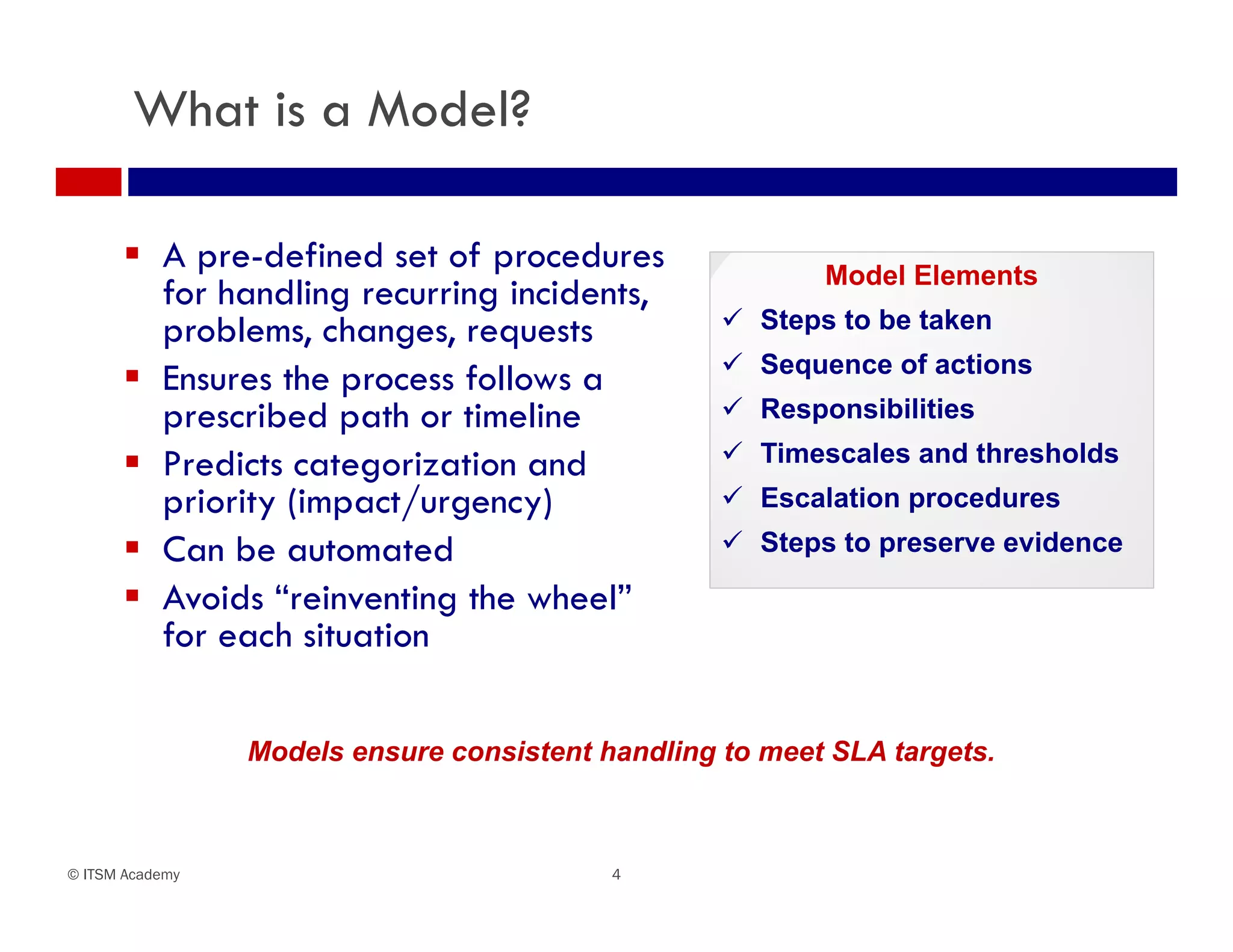
What is a Model?

       A pre-defined set of procedures                   Model Elements
        for handling recurring incidents,
        problems, changes, requests                 Steps to be taken
                                                    Sequence of actions
       Ensures the process follows a
        prescribed path or timeline                 Responsibilities

       Predicts categorization and                 Timescales and thresholds
        priority (impact/urgency)                   Escalation procedures
       Can be automated                            Steps to preserve evidence

       Avoids “reinventing the wheel”
        for each situation

                 Models ensure consistent handling to meet SLA targets.


© ITSM Academy                             4
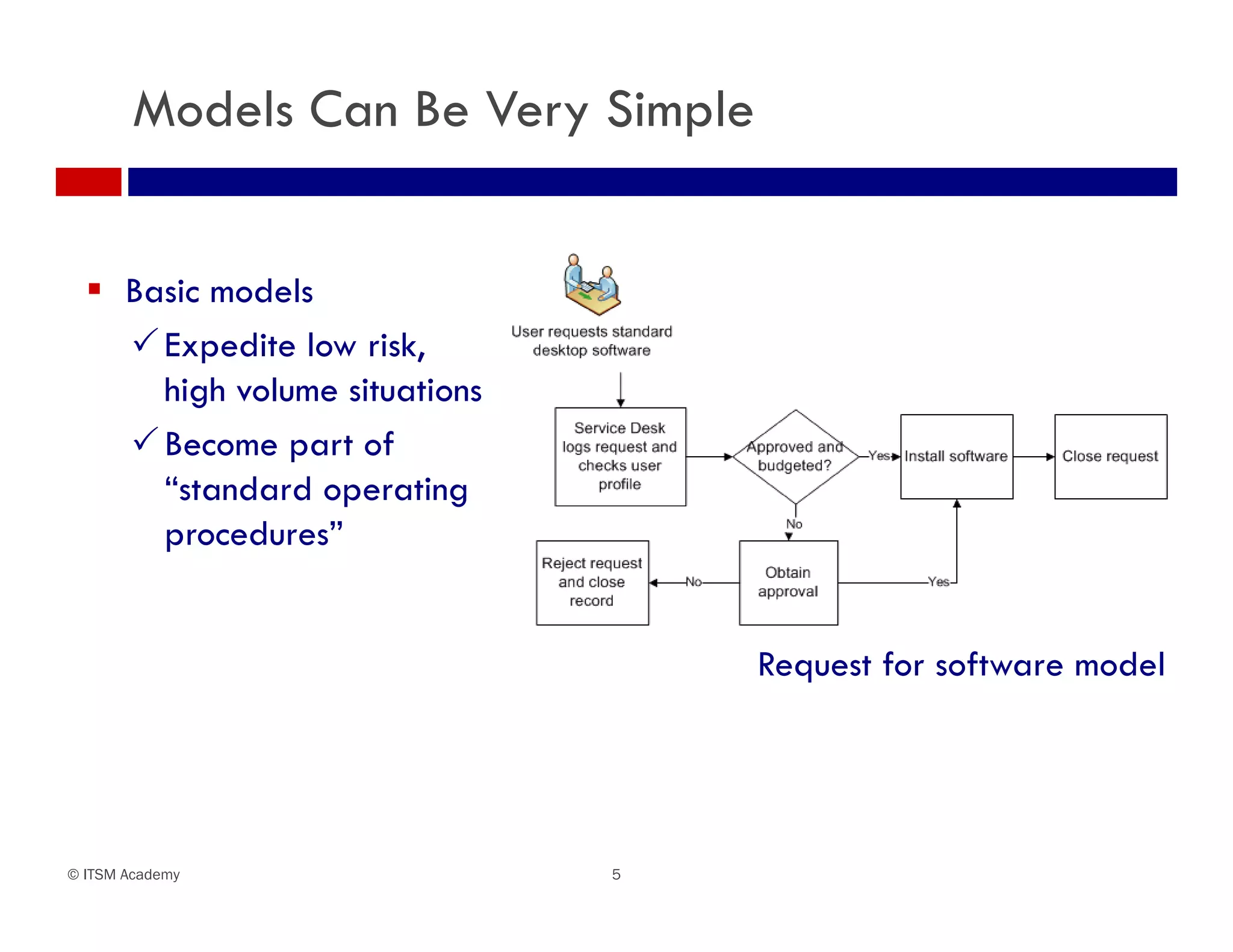
Models Can Be Very Simple


   Basic models
     Expedite low risk,
      high volume situations
     Become part of
      “standard operating
      procedures”


                                    Request for software model


© ITSM Academy                 5
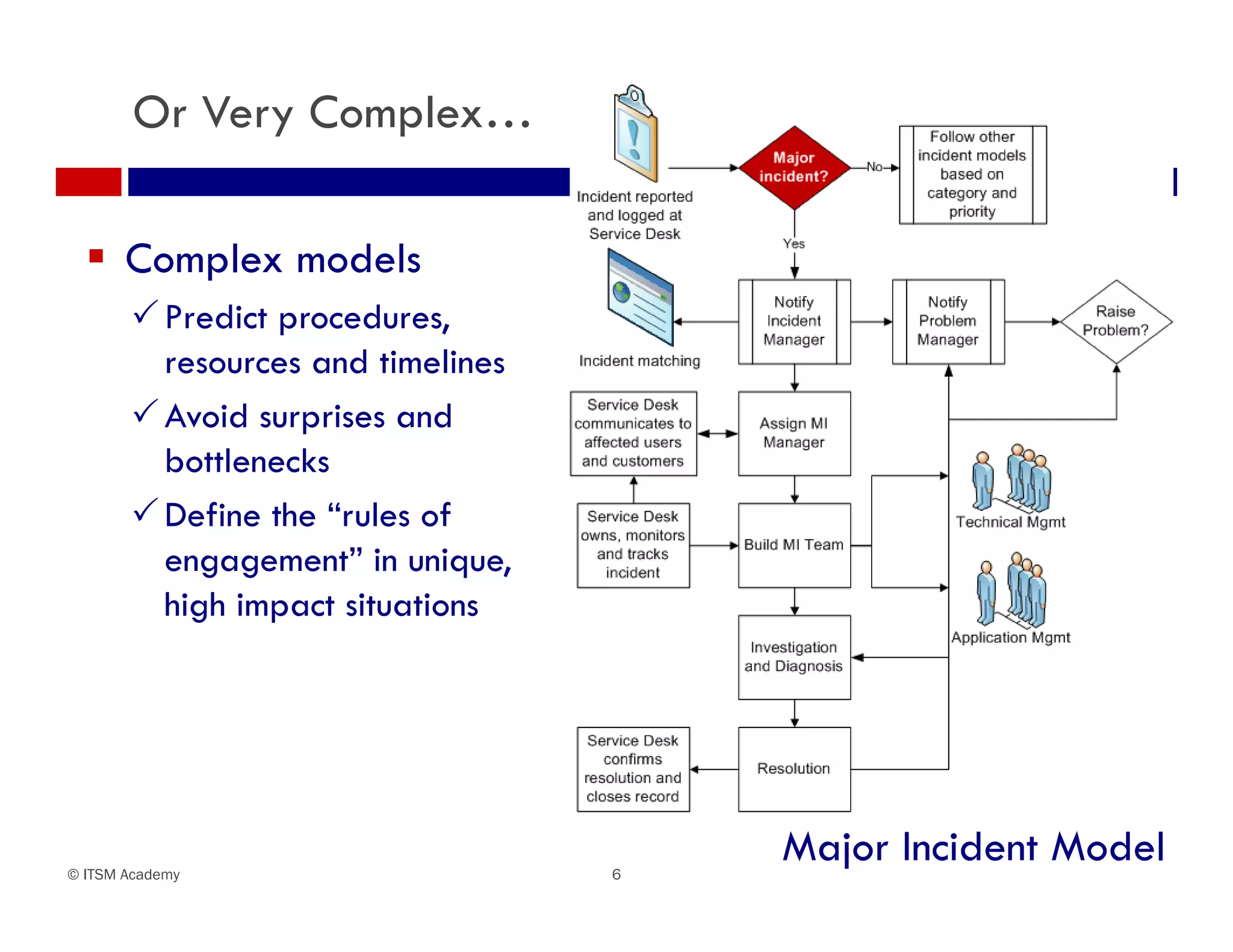
Or Very Complex…

   Complex models
        Predict procedures,
         resources and timelines
        Avoid surprises and
         bottlenecks
        Define the “rules of
         engagement” in unique,
         high impact situations


© ITSM Academy                     6
                                       Major Incident Model
Using Models for Common Processes


© ITSM Academy
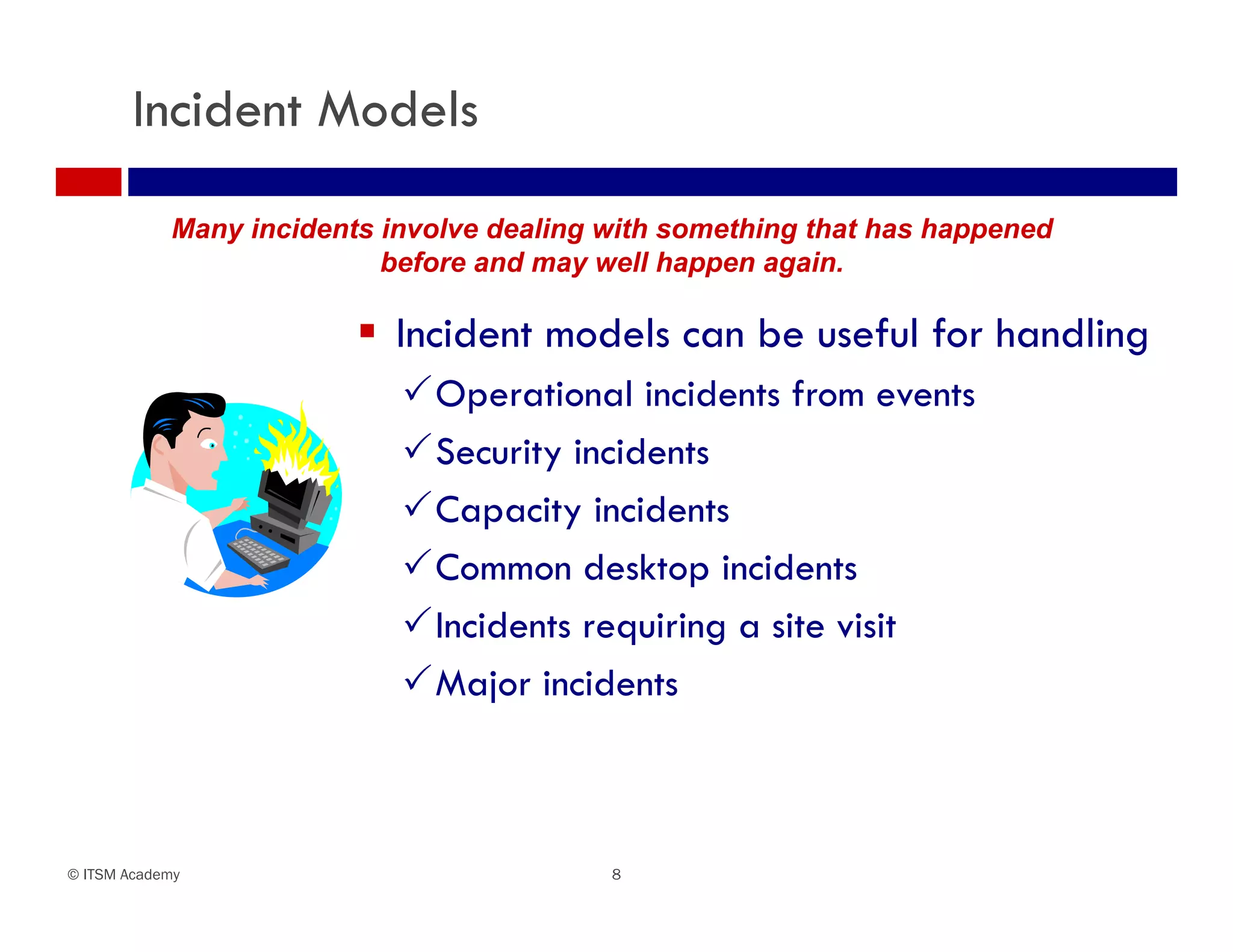
Incident Models

            Many incidents involve dealing with something that has happened
                           before and may well happen again.

                          Incident models can be useful for handling
                            Operational incidents from events
                            Security incidents
                            Capacity incidents
                            Common desktop incidents
                            Incidents requiring a site visit
                            Major incidents


© ITSM Academy                             8
Problem Models

            Many problems will be unique and require individual handling.


          Problem models can be useful for handling
                 Dormant problems
                 Underlying problems
                 Repetitive problems (across domains, regions, etc.)
                 Supplier-dependent problems
                 Major Problems

          Problem models will also help define the skills required to identify
                   root cause and permanently remove the error.


© ITSM Academy                               9
Request Models

                     A service request is a user request for a proven, repeatable,
                              preapproved and proceduralized service.


          Request Models can be useful for handling
                  New hires
                  Moves
                  Desktop software installation
                  Requests for access to a service
                  Requests for information or help (questions)
                  Standard procurements and services

                         Request models should include thresholds for
                                scope, budget and authorities.


© ITSM Academy                                 10
Change Models (1)

      Change models will define the entry into and rigor of Change Management.

                        Change models will
                            Communicate what people should expect for
                             each type of change
                            Define the steps for a specific type of change
                            Be based on risk and impact
                            Define authorities and approval
                            Describe the level of impact assessment
                            Define timelines and possibly scheduling
                            Describe documentation requirements
                 Change models can reduce the level of bureaucracy
                      associated with Change Management.

© ITSM Academy                           11
Change Models (2)

          Change Models can be useful in handling
                 Standard changes
                 Major technology or application changes
                 Local changes
                 Emergency changes
                 Changes to the Service Portfolio
                 RFCs to a specific service
                 Project scope change proposal
                 Operational activities such as tuning, no-impact reboots
                  and planned maintenance

            There should be a separate model for each approved standard change.

© ITSM Academy                             12
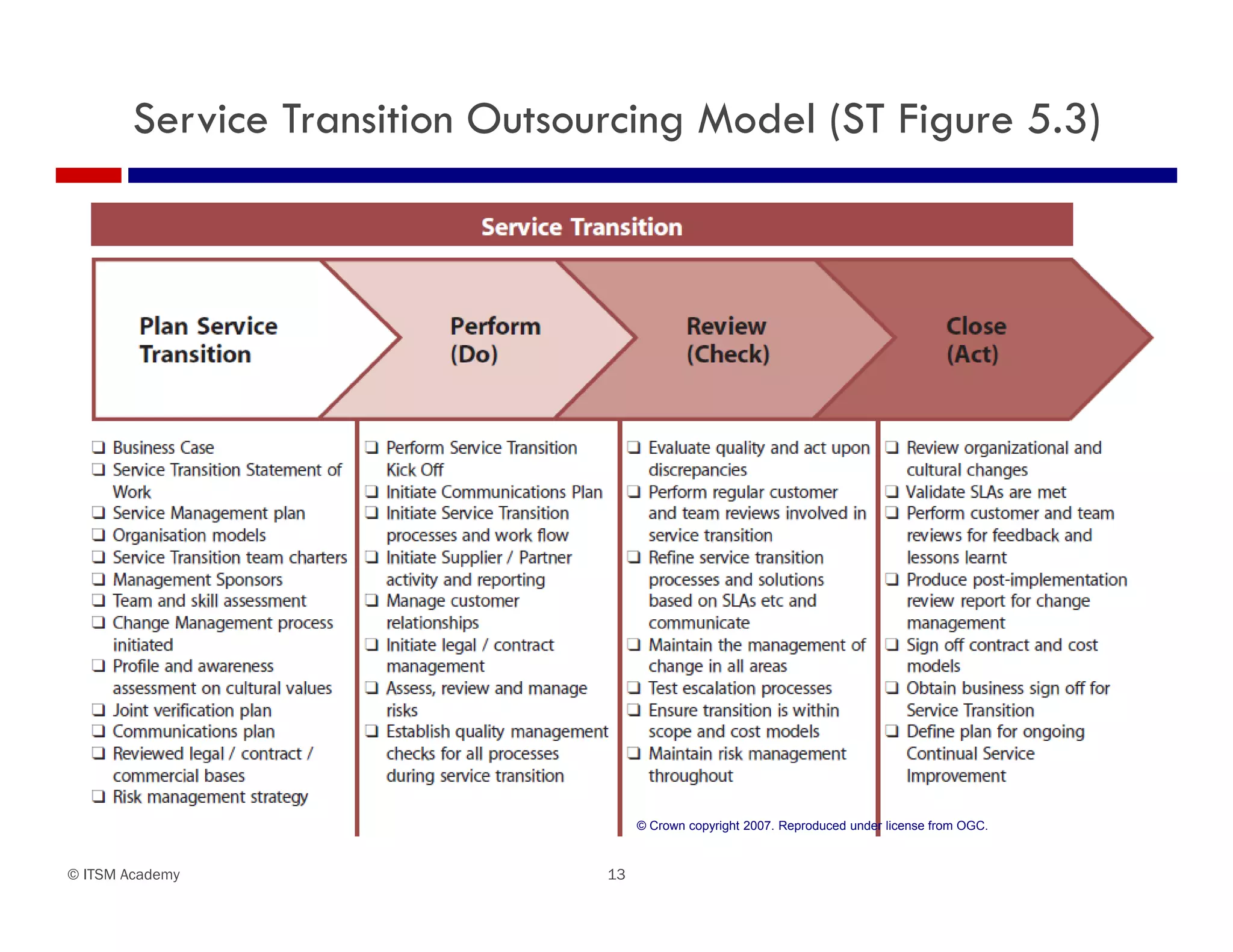
Service Transition Outsourcing Model (ST Figure 5.3)


                                      © Crown copyright 2007. Reproduced under license from OGC.


© ITSM Academy                   13
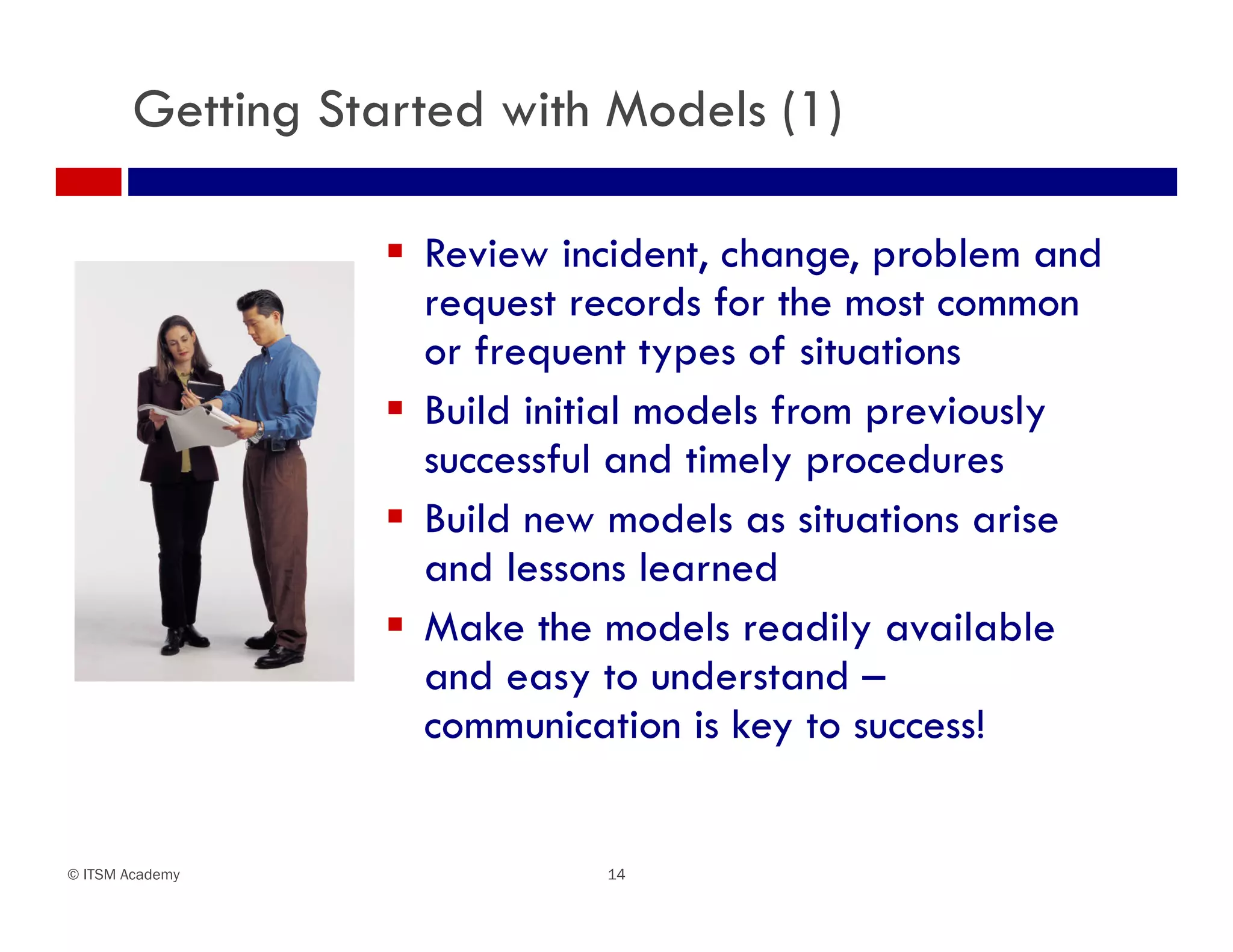
Getting Started with Models (1)

                    Review incident, change, problem and
                     request records for the most common
                     or frequent types of situations
                    Build initial models from previously
                     successful and timely procedures
                    Build new models as situations arise
                     and lessons learned
                    Make the models readily available
                     and easy to understand –
                     communication is key to success!


© ITSM Academy                14
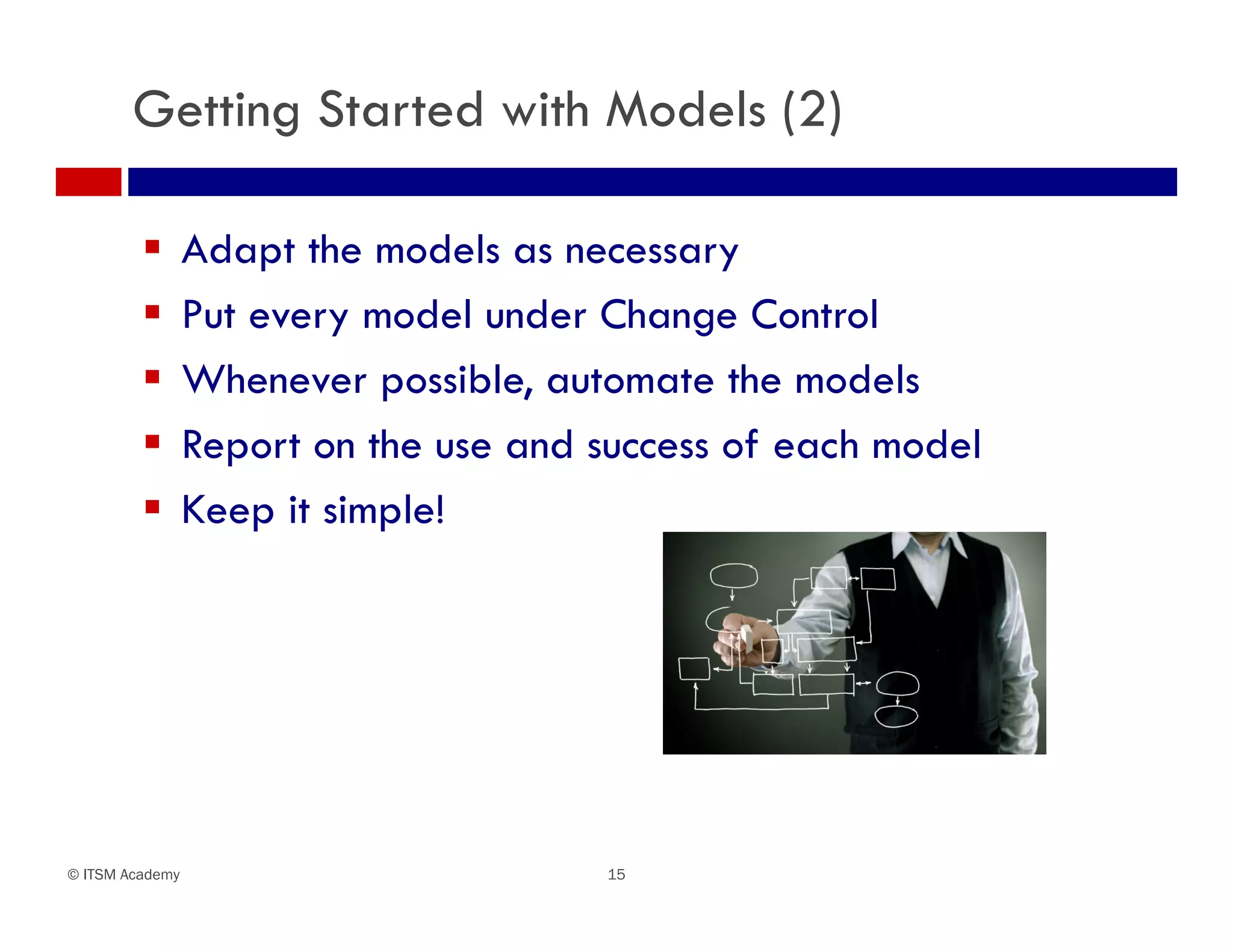
Getting Started with Models (2)

                Adapt the models as necessary
                Put every model under Change Control
                Whenever possible, automate the models
                Report on the use and success of each model
                Keep it simple!


© ITSM Academy                         15
Questions?


© ITSM Academy       16
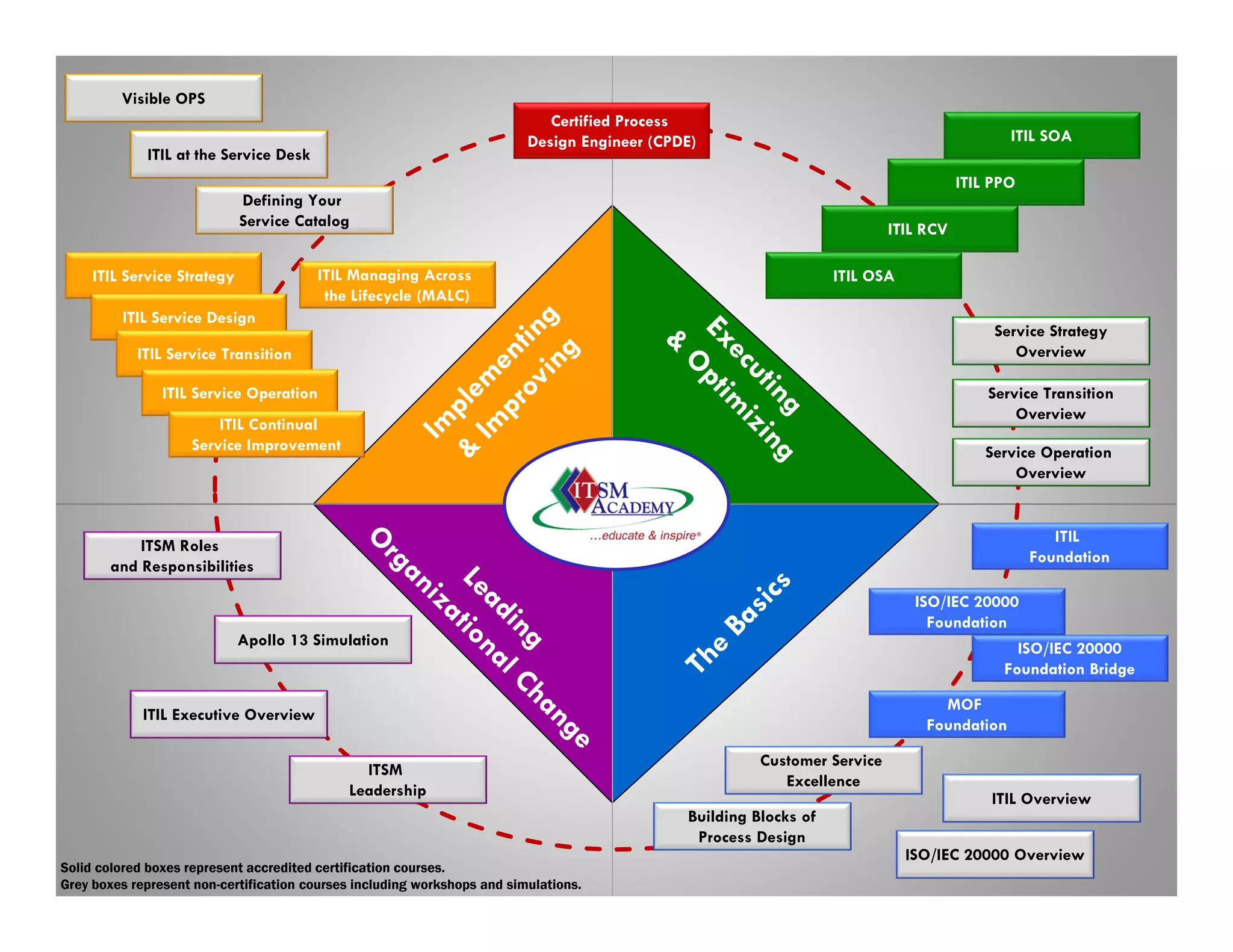
Visible OPS
                                                                             Certified Process
                                                                          Design Engineer (CPDE)                                             ITIL SOA
             ITIL at the Service Desk
                                                                                                                                      ITIL PPO
                             Defining Your
                             Service Catalog                                                                               ITIL RCV

     ITIL Service Strategy              ITIL Managing Across                                                       ITIL OSA
                                         the Lifecycle (MALC)
         ITIL Service Design
                                                                                                                                           Service Strategy
            ITIL Service Transition                                                                                                           Overview

                ITIL Service Operation                                                                                                    Service Transition
                                                                                                                                              Overview
                        ITIL Continual
                    Service Improvement                                                                                                  Service Operation
                                                                                                                                             Overview


                                                                                                                                                    ITIL
           ITSM Roles
                                                                                                                                                 Foundation
       and Responsibilities

                                                                                                                               ISO/IEC 20000
                                                                                                                                 Foundation
                             Apollo 13 Simulation                                                                                             ISO/IEC 20000
                                                                                                                                            Foundation Bridge

                                                                                                                                  MOF
             ITIL Executive Overview
                                                                                                                                Foundation

                                                                                                        Customer Service
                                               ITSM
                                                                                                           Excellence
                                             Leadership                                                                                   ITIL Overview
                                                                                              Building Blocks of
                                                                                               Process Design
                                                                                                                              ISO/IEC 20000 Overview
Solid colored boxes represent accredited certification courses.
Grey boxes represent non-certification courses including workshops and simulations.
ITSM Academy Affiliates


© ITSM Academy, v2 October 2011   18
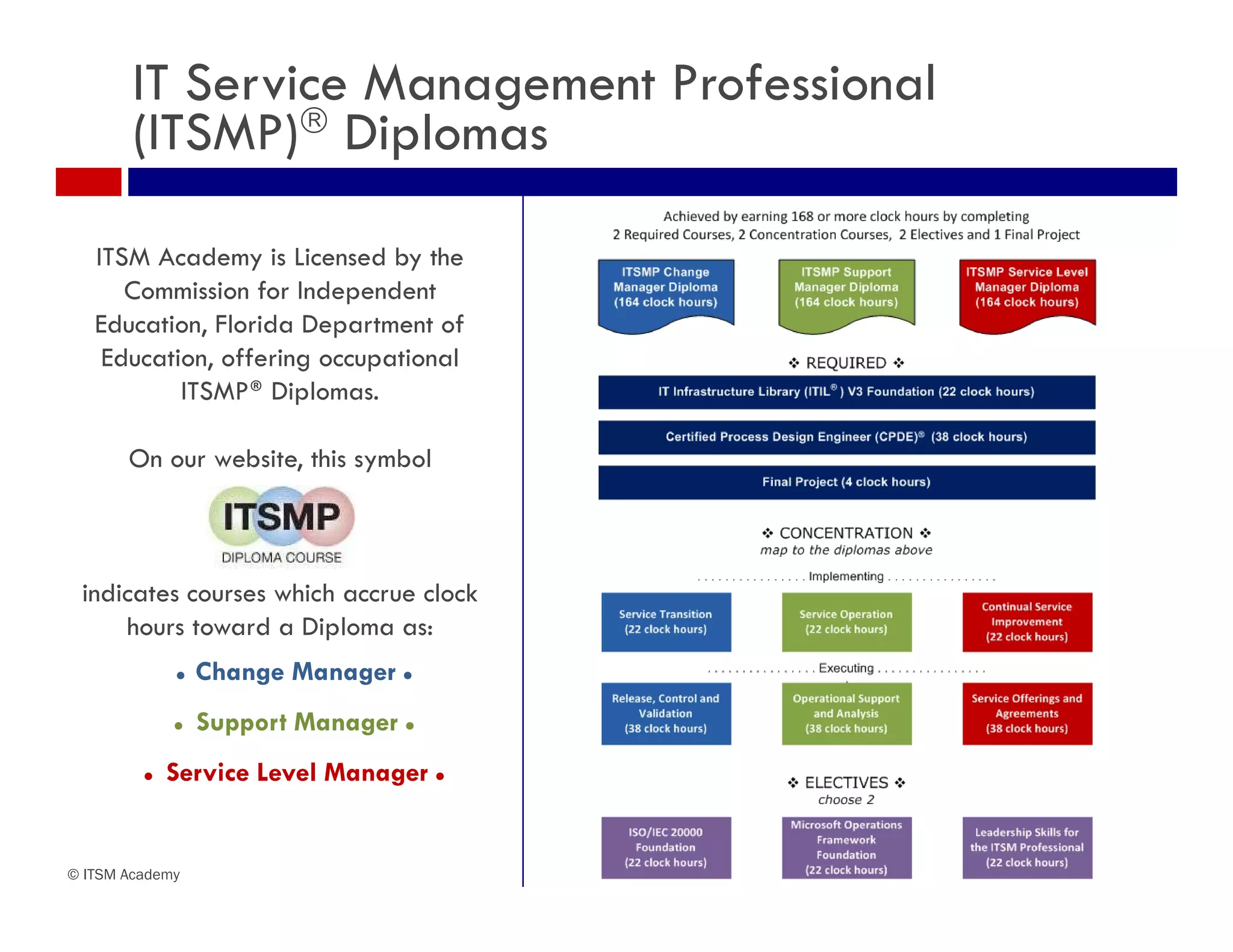
IT Service Management Professional
        (ITSMP) Diplomas

   ITSM Academy is Licensed by the
      Commission for Independent
   Education, Florida Department of
    Education, offering occupational
           ITSMP® Diplomas.

       On our website, this symbol


 indicates courses which accrue clock
     hours toward a Diploma as:
                Change Manager 
                Support Manager 
            Service Level Manager 


© ITSM Academy                          19
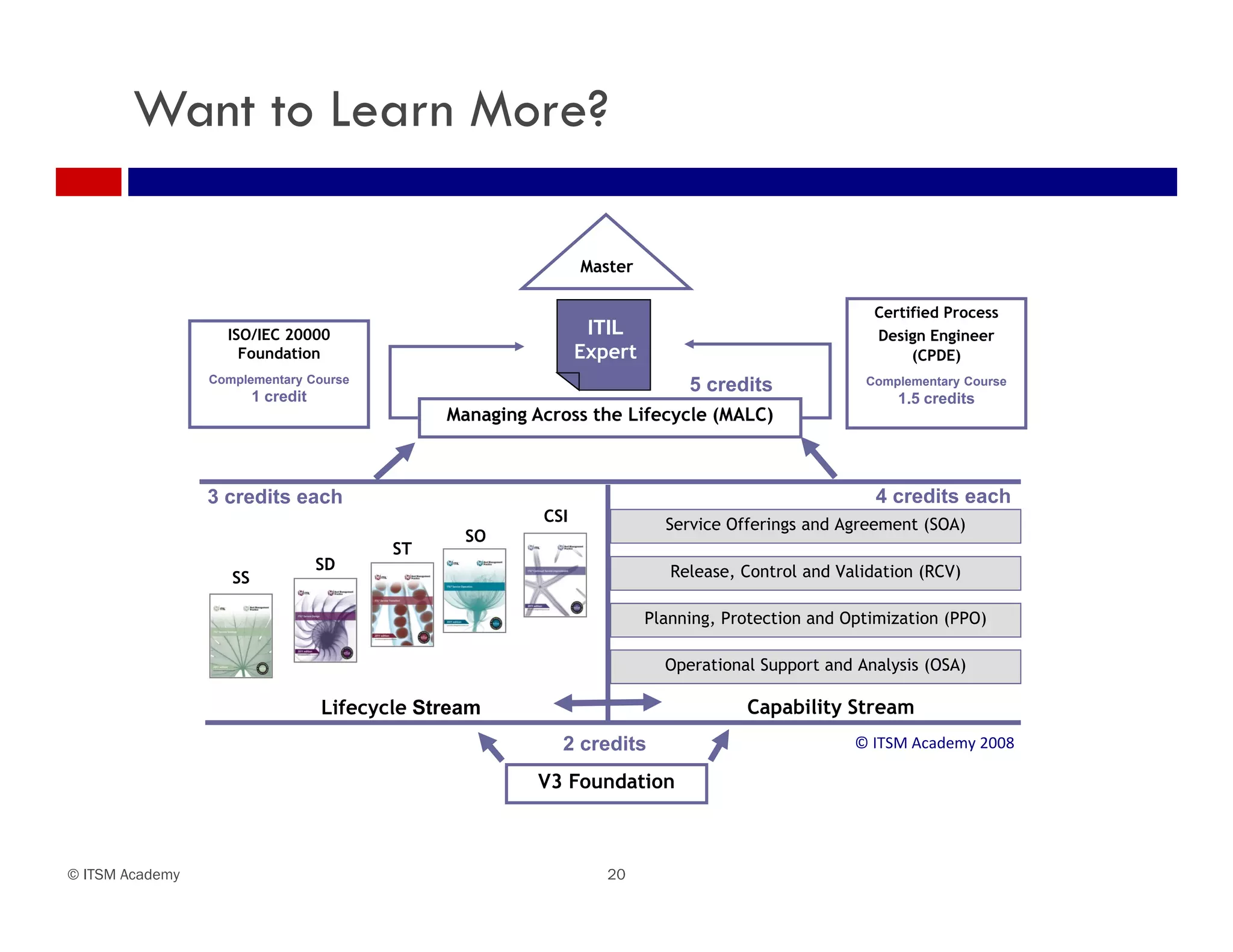
Want to Learn More?

                                                                Master

                                                                                                     Certified Process
                   ISO/IEC 20000                                 ITIL                                Design Engineer
                     Foundation                                 Expert                                    (CPDE)
                 Complementary Course
                                                                              5 credits             Complementary Course
                         1 credit                                                                       1.5 credits
                                                Managing Across the Lifecycle (MALC)


                 3 credits each                                                                       4 credits each
                                                          CSI              Service Offerings and Agreement (SOA)
                                                  SO
                                           ST
                                    SD                                      Release, Control and Validation (RCV)
                    SS

                                                                         Planning, Protection and Optimization (PPO)

                                                                           Operational Support and Analysis (OSA)

                                    Lifecycle Stream                                 Capability Stream
                                                            2 credits                              © ITSM Academy 2008

                                                          V3 Foundation


© ITSM Academy                                                     20
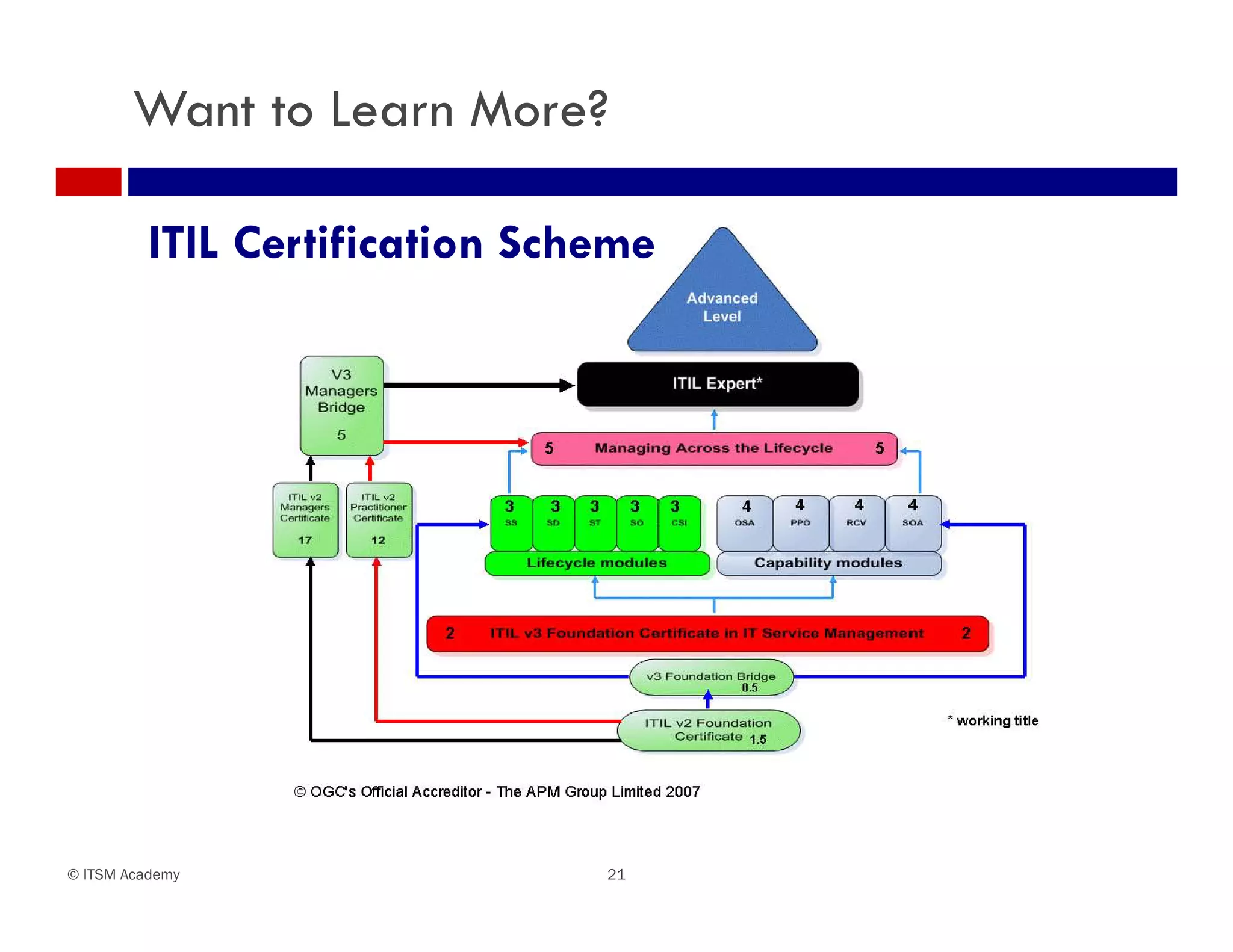
Want to Learn More?

          ITIL Certification Scheme


© ITSM Academy                  21

Using Models for Incident, Change, Problem and Request Fulfillment Management

  • 1.
  • 2.
    About ITSM Academy  Accredited Education  Since 2003 - Tens of Thousands  Certified Process Design Engineer (CPDE) Trained and Certified  ITIL® Foundation  ITSM Professional Diplomas  ITIL Capability (OSA|PPO|RCV|SOA)  Change/Support/SLM  ITIL Lifecycle (SS|SD|ST|SO|CSI)  Public Classes throughout U.S.  ITIL Managing Across the Lifecycle (MALC)  Corporate On-Site Classes  ITIL Service Manager Bridge  Virtual Classes  ISO/IEC 20000 Foundation  Courseware Licensing  MOF Foundation  Corporate & Partner (GEM)  Practical, Value-Add Workshops  Alumni Program  ITSM Leadership  PMI Global Education Provider  ITIL, MOF, ISO 20K Overviews  Apollo 13, Visible Ops: The Class  Certified Woman-Owned  And more! ITIL® is a Registered Trade Mark of the Cabinet Office. © ITSM Academy 2 Welcome!
  • 3.
    Agenda  What is a model?  Using models for common processes Incident Problem Request Change  Getting started with models Thanks for joining us today. Please use the chat feature to send in your questions. © ITSM Academy 3
  • 4.
    What is aModel?  A pre-defined set of procedures Model Elements for handling recurring incidents, problems, changes, requests  Steps to be taken  Sequence of actions  Ensures the process follows a prescribed path or timeline  Responsibilities  Predicts categorization and  Timescales and thresholds priority (impact/urgency)  Escalation procedures  Can be automated  Steps to preserve evidence  Avoids “reinventing the wheel” for each situation Models ensure consistent handling to meet SLA targets. © ITSM Academy 4
  • 5.
    Models Can BeVery Simple  Basic models  Expedite low risk, high volume situations  Become part of “standard operating procedures” Request for software model © ITSM Academy 5
  • 6.
    Or Very Complex…  Complex models  Predict procedures, resources and timelines  Avoid surprises and bottlenecks  Define the “rules of engagement” in unique, high impact situations © ITSM Academy 6 Major Incident Model
  • 7.
    Using Models forCommon Processes © ITSM Academy
  • 8.
    Incident Models Many incidents involve dealing with something that has happened before and may well happen again.  Incident models can be useful for handling Operational incidents from events Security incidents Capacity incidents Common desktop incidents Incidents requiring a site visit Major incidents © ITSM Academy 8
  • 9.
    Problem Models Many problems will be unique and require individual handling.  Problem models can be useful for handling Dormant problems Underlying problems Repetitive problems (across domains, regions, etc.) Supplier-dependent problems Major Problems Problem models will also help define the skills required to identify root cause and permanently remove the error. © ITSM Academy 9
  • 10.
    Request Models A service request is a user request for a proven, repeatable, preapproved and proceduralized service.  Request Models can be useful for handling  New hires  Moves  Desktop software installation  Requests for access to a service  Requests for information or help (questions)  Standard procurements and services Request models should include thresholds for scope, budget and authorities. © ITSM Academy 10
  • 11.
    Change Models (1) Change models will define the entry into and rigor of Change Management.  Change models will  Communicate what people should expect for each type of change  Define the steps for a specific type of change  Be based on risk and impact  Define authorities and approval  Describe the level of impact assessment  Define timelines and possibly scheduling  Describe documentation requirements Change models can reduce the level of bureaucracy associated with Change Management. © ITSM Academy 11
  • 12.
    Change Models (2)  Change Models can be useful in handling Standard changes Major technology or application changes Local changes Emergency changes Changes to the Service Portfolio RFCs to a specific service Project scope change proposal Operational activities such as tuning, no-impact reboots and planned maintenance There should be a separate model for each approved standard change. © ITSM Academy 12
  • 13.
    Service Transition OutsourcingModel (ST Figure 5.3) © Crown copyright 2007. Reproduced under license from OGC. © ITSM Academy 13
  • 14.
    Getting Started withModels (1)  Review incident, change, problem and request records for the most common or frequent types of situations  Build initial models from previously successful and timely procedures  Build new models as situations arise and lessons learned  Make the models readily available and easy to understand – communication is key to success! © ITSM Academy 14
  • 15.
    Getting Started withModels (2)  Adapt the models as necessary  Put every model under Change Control  Whenever possible, automate the models  Report on the use and success of each model  Keep it simple! © ITSM Academy 15
  • 16.
  • 17.
    Visible OPS Certified Process Design Engineer (CPDE) ITIL SOA ITIL at the Service Desk ITIL PPO Defining Your Service Catalog ITIL RCV ITIL Service Strategy ITIL Managing Across ITIL OSA the Lifecycle (MALC) ITIL Service Design Service Strategy ITIL Service Transition Overview ITIL Service Operation Service Transition Overview ITIL Continual Service Improvement Service Operation Overview ITIL ITSM Roles Foundation and Responsibilities ISO/IEC 20000 Foundation Apollo 13 Simulation ISO/IEC 20000 Foundation Bridge MOF ITIL Executive Overview Foundation Customer Service ITSM Excellence Leadership ITIL Overview Building Blocks of Process Design ISO/IEC 20000 Overview Solid colored boxes represent accredited certification courses. Grey boxes represent non-certification courses including workshops and simulations.
  • 18.
    ITSM Academy Affiliates ©ITSM Academy, v2 October 2011 18
  • 19.
    IT Service ManagementProfessional (ITSMP) Diplomas ITSM Academy is Licensed by the Commission for Independent Education, Florida Department of Education, offering occupational ITSMP® Diplomas. On our website, this symbol indicates courses which accrue clock hours toward a Diploma as:  Change Manager   Support Manager   Service Level Manager  © ITSM Academy 19
  • 20.
    Want to LearnMore? Master Certified Process ISO/IEC 20000 ITIL Design Engineer Foundation Expert (CPDE) Complementary Course 5 credits Complementary Course 1 credit 1.5 credits Managing Across the Lifecycle (MALC) 3 credits each 4 credits each CSI Service Offerings and Agreement (SOA) SO ST SD Release, Control and Validation (RCV) SS Planning, Protection and Optimization (PPO) Operational Support and Analysis (OSA) Lifecycle Stream Capability Stream 2 credits © ITSM Academy 2008 V3 Foundation © ITSM Academy 20
  • 21.
    Want to LearnMore? ITIL Certification Scheme © ITSM Academy 21