TRANSPORTATION OF
CONCRETE
1
Richu George Varghese
Assistant Professor
Mangalam College of Engineering and Technology
Introduction
◻ Transferring of concrete from mixing plant to
construction site
◻ Important activity in the production of concrete.
◻ Time taken in transit should be a design parameter
as it depends on
1. Initial setting time
2. Requirement of workability at the destination.
◻ Method of transportation adopted at site should be
decided in advance so that suitable admixtures can
be decided
2
Precautions and Objective
◻ Precautions:
□ Transportation of concrete tends to produce
segregation and loss of slump, if the distance is long
□ Movement of hand trolley or truck on rough road
surface makes vibration
□ Results in deposition of heavy aggregates at bottom of
truck
□ Water and cement slurry comes on top
◻ Main objective – ensure that water cement ratio,
slump or consistency, air content and homogeneity
are not modified from their intended states.
3
4
◻ Goals :
□ to prevent segregation
□ to not reduce the workability of the mix.
◻ General rule of thumb,
□ Thirty to sixty minutes - small jobs
□ At ready-mix plant, concrete should be discharged
from a truck mixer or agitator truck within two hours.
□ If non-agitating transporting equipment is used, this
time is reduced to one hour.
5
Types of
transportation
Vertical Horizontal
Methods of transportation of concrete
◻ Mortar pan
◻ Wheel barrow, hand cart
◻ Crane, bucket and rope way
◻ Truck mixer and dumpers
◻ Belt conveyors
◻ Chute
◻ Skip and hoist
◻ Transit mixer
◻ Pump and pipe line
◻ Helicopter
6
Mortar pan
◻ Labour intensive method
◻ Generally used for small works
◻ No chances of segregation of concrete
◻ Greater surface area of concrete exposed to sun,
drying conditions great loss of water
particularly in hot weather
◻ Mortar pan must be wetted to start with and must
be kept clean
7
8
Crane , bucket and rope way
◻ Crane bucket and ropeway are used for transporting
concrete above ground level
◻ Crane:
□ Main consideration in selecting the crane is height and
radius of operation
□ Fast and versatile and allows movement in all
directions
□ Depending upon the site, cranes may be - derrik crane,
tower crane, crawler mounted, wheel mounted, or
hydraulic crane
9
10
Bucket
11
□ Square or circular
□ Needs the aid of a crane, cableway, or hoist so that it
can be moved horizontally or vertically.
□ Types:
■ Opening at bottom: door opened and released
■ Opening at top: discharged by tilting or using forced action
□ Size – 0.5 m^3
12
Ropeway
13
•Suitable for works in valley, over high piers and long dam sites.
•Excessive free fall of concrete should be avoided to minimize
segregation
•Concrete is transported in a container with help of rope and
pulleys
Belt conveyors
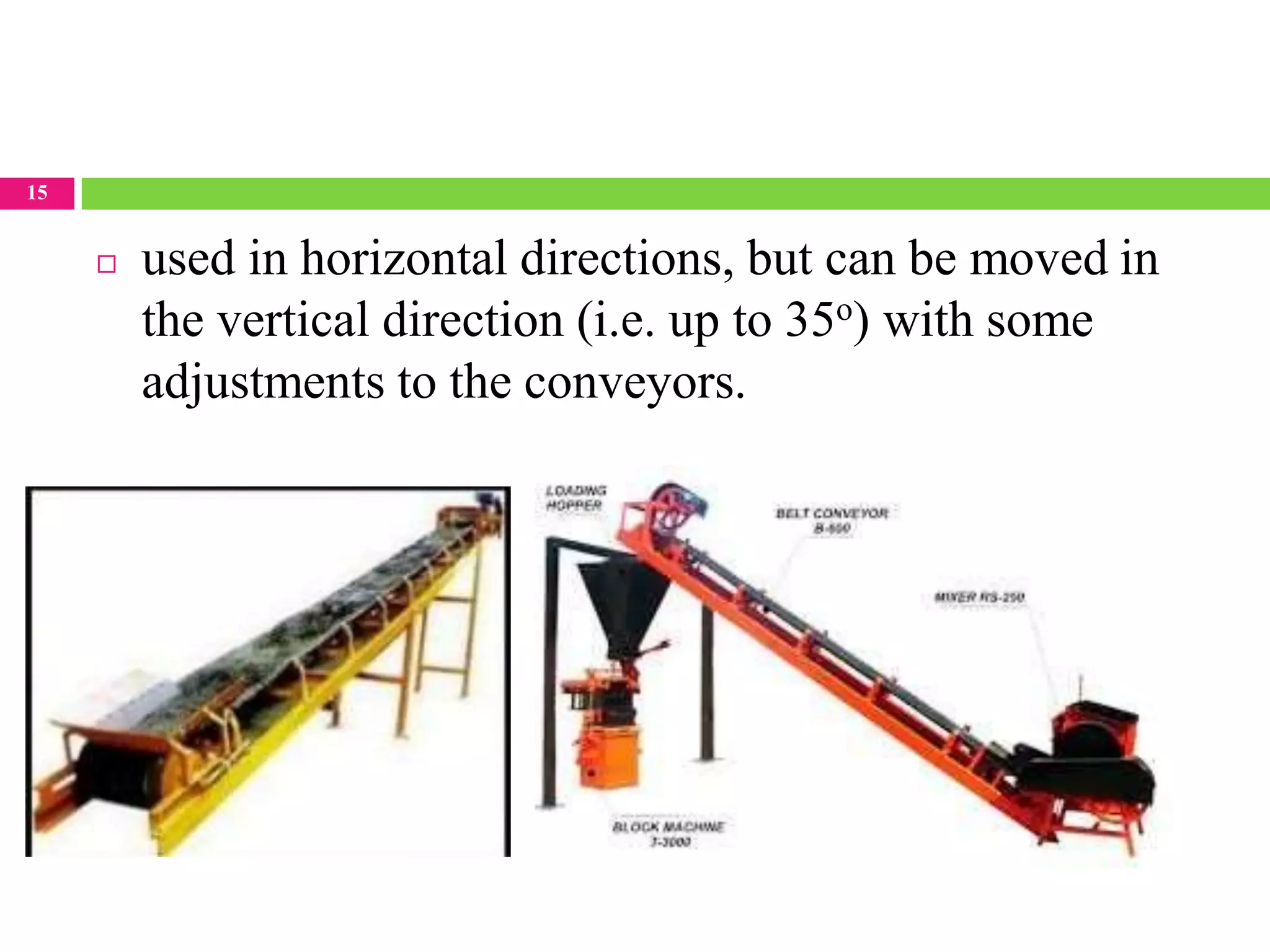
◻ It has limited application due to
□ Chances of segregation on steep slopes, roller points
and changes in direction of belt
□ Over-exposure of concrete to environment.
◻ Used for continuous operations
◻ Low slump concrete - for slower moving belts and higher
slump concrete - faster moving belts
◻ 100 - 350 cubic yards per hour
◻ Concrete mix is spread very thinly on the conveyor and is
susceptible to loss of moisture during hot weather
conditions.
14
15
◻ used in horizontal directions, but can be moved in
the vertical direction (i.e. up to 35o) with some
adjustments to the conveyors.
16
Chute
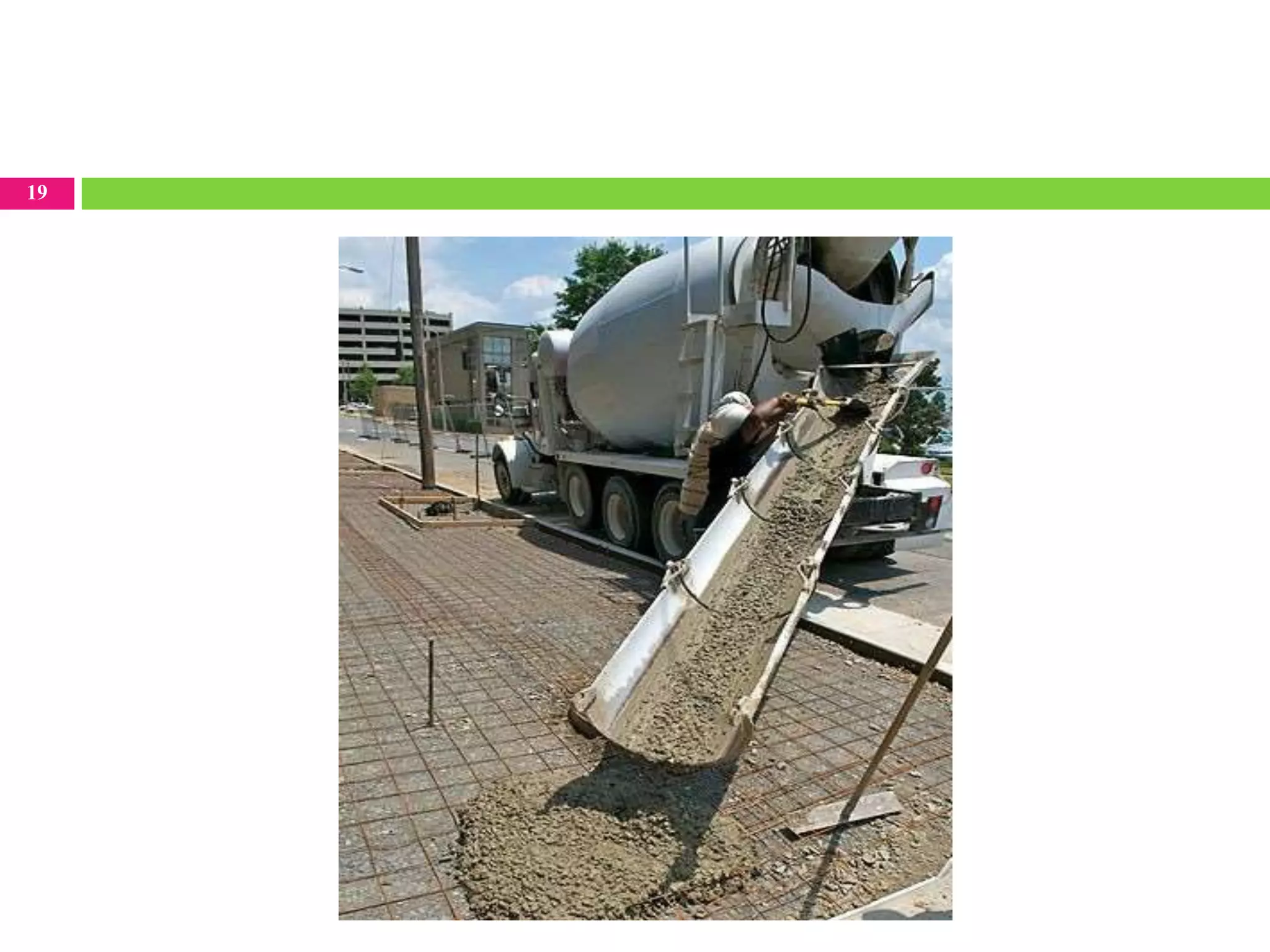
◻ Used for concreting in deep locations.
◻ Care should be taken that slope should not be flatter
than 1V:2.5H, otherwise concrete will not slide down.
◻ Workability should not be changed to suit the delivery
by chute.
◻ Technically it is not a very good method but it is
extensively used in the field.
◻ Should only be used in short lengths since concrete
becomes more susceptible to segregation and drying
out.
17
18
◻ When they are used, it is very important that the
concrete mix is workable and cohesive, hence
should be re-mixed at the lower end by passing
down through a funnel-shaped pipe or drop chute.
19
Helicopter
◻ more economical in the hilly regions like high
mountains. Very fastly one can transport concrete
to the construction site within mins.
20
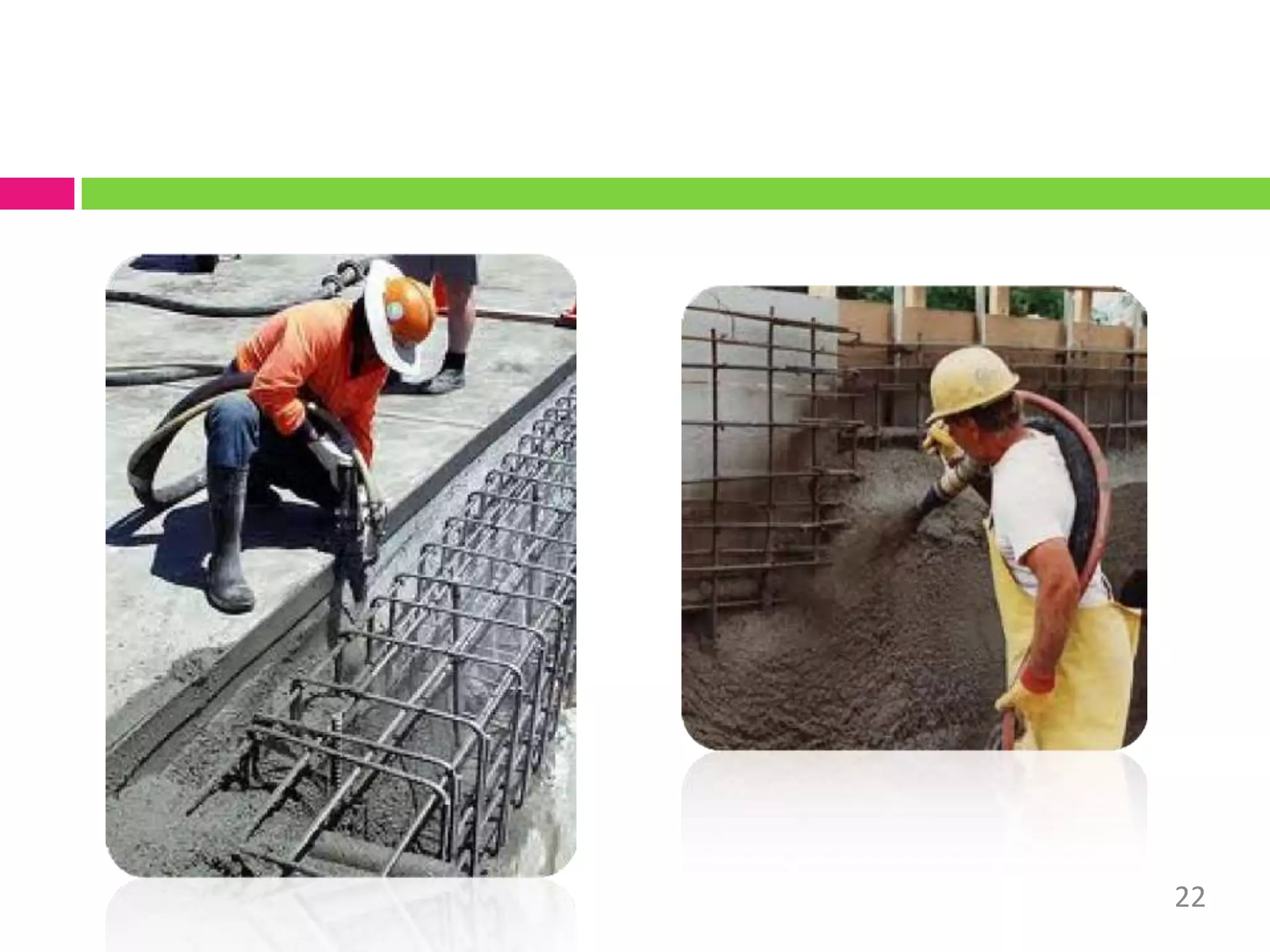
PNEUMATIC GUNS
(SHOTCRETE)
21
□ Used where concrete is to be placed in difficult
locations and where thin sections and large areas
are needed
22
TREMIE
23
□ In the Tremie Concrete method, concrete is placed below
water level through a pipe, the lower end of which is kept
immersed in fresh concrete so that the rising concrete from
the bottom displaces the water without washing out the
cement content.
□ The tremie concrete method is often used in bridges that span
bodies of water. In this case, the pier footing is supported by a
tremie. Tremie pipes are also used to pour the concrete in
slurry walls.
24
Use of technology
21
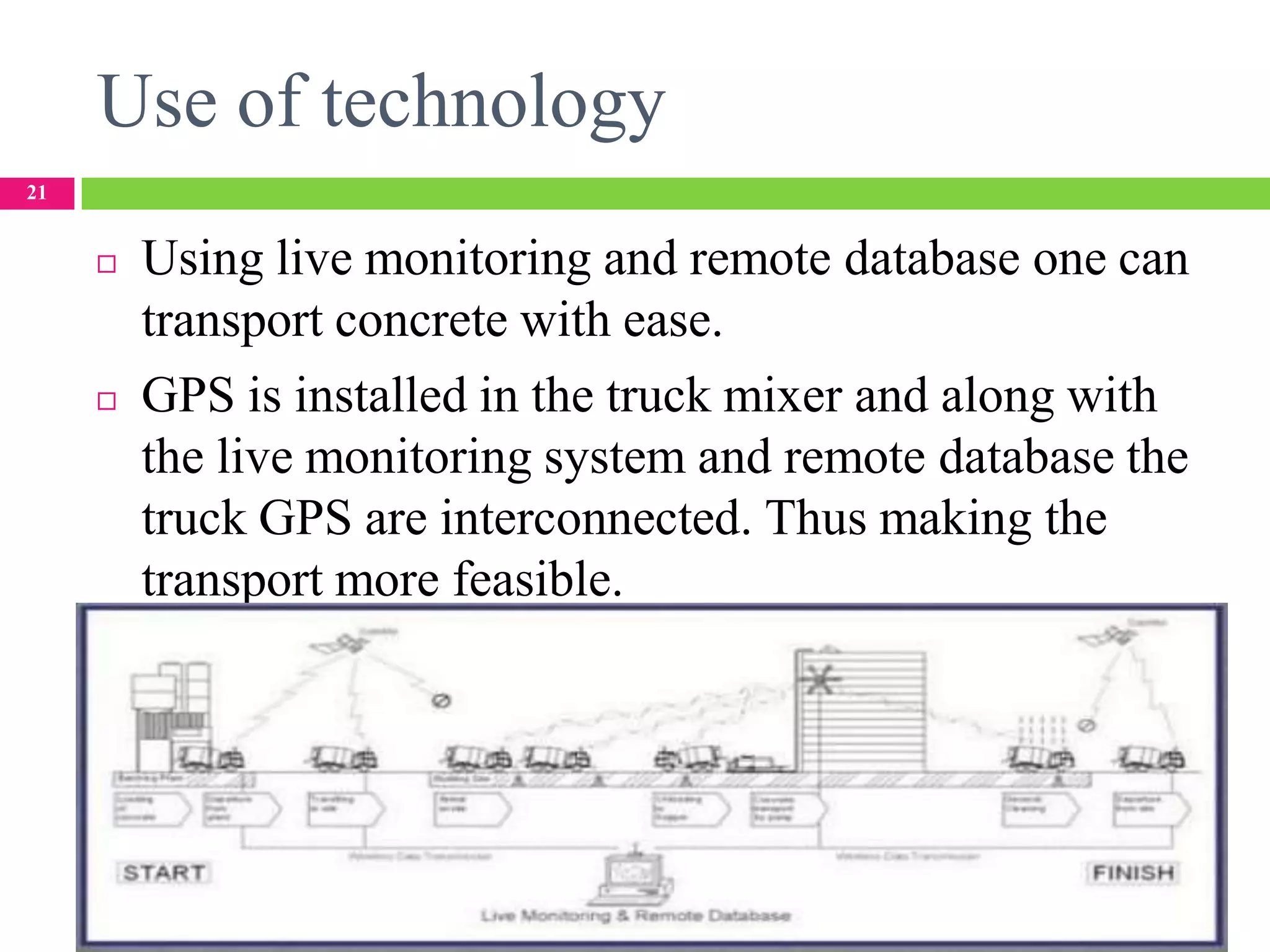
◻ Using live monitoring and remote database one can
transport concrete with ease.
◻ GPS is installed in the truck mixer and along with
the live monitoring system and remote database the
truck GPS are interconnected. Thus making the
transport more feasible.
Transportation of concrete

Transportation of concrete

  • 1.
    TRANSPORTATION OF CONCRETE 1 Richu GeorgeVarghese Assistant Professor Mangalam College of Engineering and Technology
  • 2.
    Introduction ◻ Transferring ofconcrete from mixing plant to construction site ◻ Important activity in the production of concrete. ◻ Time taken in transit should be a design parameter as it depends on 1. Initial setting time 2. Requirement of workability at the destination. ◻ Method of transportation adopted at site should be decided in advance so that suitable admixtures can be decided 2
  • 3.
    Precautions and Objective ◻Precautions: □ Transportation of concrete tends to produce segregation and loss of slump, if the distance is long □ Movement of hand trolley or truck on rough road surface makes vibration □ Results in deposition of heavy aggregates at bottom of truck □ Water and cement slurry comes on top ◻ Main objective – ensure that water cement ratio, slump or consistency, air content and homogeneity are not modified from their intended states. 3
  • 4.
    4 ◻ Goals : □to prevent segregation □ to not reduce the workability of the mix. ◻ General rule of thumb, □ Thirty to sixty minutes - small jobs □ At ready-mix plant, concrete should be discharged from a truck mixer or agitator truck within two hours. □ If non-agitating transporting equipment is used, this time is reduced to one hour.
  • 5.
  • 6.
    Methods of transportationof concrete ◻ Mortar pan ◻ Wheel barrow, hand cart ◻ Crane, bucket and rope way ◻ Truck mixer and dumpers ◻ Belt conveyors ◻ Chute ◻ Skip and hoist ◻ Transit mixer ◻ Pump and pipe line ◻ Helicopter 6
  • 7.
    Mortar pan ◻ Labourintensive method ◻ Generally used for small works ◻ No chances of segregation of concrete ◻ Greater surface area of concrete exposed to sun, drying conditions great loss of water particularly in hot weather ◻ Mortar pan must be wetted to start with and must be kept clean 7
  • 8.
  • 9.
    Crane , bucketand rope way ◻ Crane bucket and ropeway are used for transporting concrete above ground level ◻ Crane: □ Main consideration in selecting the crane is height and radius of operation □ Fast and versatile and allows movement in all directions □ Depending upon the site, cranes may be - derrik crane, tower crane, crawler mounted, wheel mounted, or hydraulic crane 9
  • 10.
  • 11.
    Bucket 11 □ Square orcircular □ Needs the aid of a crane, cableway, or hoist so that it can be moved horizontally or vertically. □ Types: ■ Opening at bottom: door opened and released ■ Opening at top: discharged by tilting or using forced action □ Size – 0.5 m^3
  • 12.
  • 13.
    Ropeway 13 •Suitable for worksin valley, over high piers and long dam sites. •Excessive free fall of concrete should be avoided to minimize segregation •Concrete is transported in a container with help of rope and pulleys
  • 14.
    Belt conveyors ◻ Ithas limited application due to □ Chances of segregation on steep slopes, roller points and changes in direction of belt □ Over-exposure of concrete to environment. ◻ Used for continuous operations ◻ Low slump concrete - for slower moving belts and higher slump concrete - faster moving belts ◻ 100 - 350 cubic yards per hour ◻ Concrete mix is spread very thinly on the conveyor and is susceptible to loss of moisture during hot weather conditions. 14
  • 15.
    15 ◻ used inhorizontal directions, but can be moved in the vertical direction (i.e. up to 35o) with some adjustments to the conveyors.
  • 16.
  • 17.
    Chute ◻ Used forconcreting in deep locations. ◻ Care should be taken that slope should not be flatter than 1V:2.5H, otherwise concrete will not slide down. ◻ Workability should not be changed to suit the delivery by chute. ◻ Technically it is not a very good method but it is extensively used in the field. ◻ Should only be used in short lengths since concrete becomes more susceptible to segregation and drying out. 17
  • 18.
    18 ◻ When theyare used, it is very important that the concrete mix is workable and cohesive, hence should be re-mixed at the lower end by passing down through a funnel-shaped pipe or drop chute.
  • 19.
  • 20.
    Helicopter ◻ more economicalin the hilly regions like high mountains. Very fastly one can transport concrete to the construction site within mins. 20
  • 21.
    PNEUMATIC GUNS (SHOTCRETE) 21 □ Usedwhere concrete is to be placed in difficult locations and where thin sections and large areas are needed
  • 22.
  • 23.
    TREMIE 23 □ In theTremie Concrete method, concrete is placed below water level through a pipe, the lower end of which is kept immersed in fresh concrete so that the rising concrete from the bottom displaces the water without washing out the cement content. □ The tremie concrete method is often used in bridges that span bodies of water. In this case, the pier footing is supported by a tremie. Tremie pipes are also used to pour the concrete in slurry walls.
  • 24.
  • 25.
    Use of technology 21 ◻Using live monitoring and remote database one can transport concrete with ease. ◻ GPS is installed in the truck mixer and along with the live monitoring system and remote database the truck GPS are interconnected. Thus making the transport more feasible.