
Retainers in RPD
INDIAN DENTAL ACADEMY
Leader in continuing dental education
www.indiandentalacademy.com
 Retention can be defined as that
quality inherent in a prosthesis that
resists the vertical forces of
dislodgement.
Or
 It is the resistance to removal from
vertical forces which tend to dislodge
prosthesis away from its foundation.
www.indiandentalacademy.com
 Retention for removable partial denture is
achieved primarily by
 Mechanical means (Direct & indirect
retainers)
 Harnessing the patient’s muscular control
acting through polished surfaces of denture
 Using inherent physical forces which arise
from coverage of mucosa by the denture
www.indiandentalacademy.com
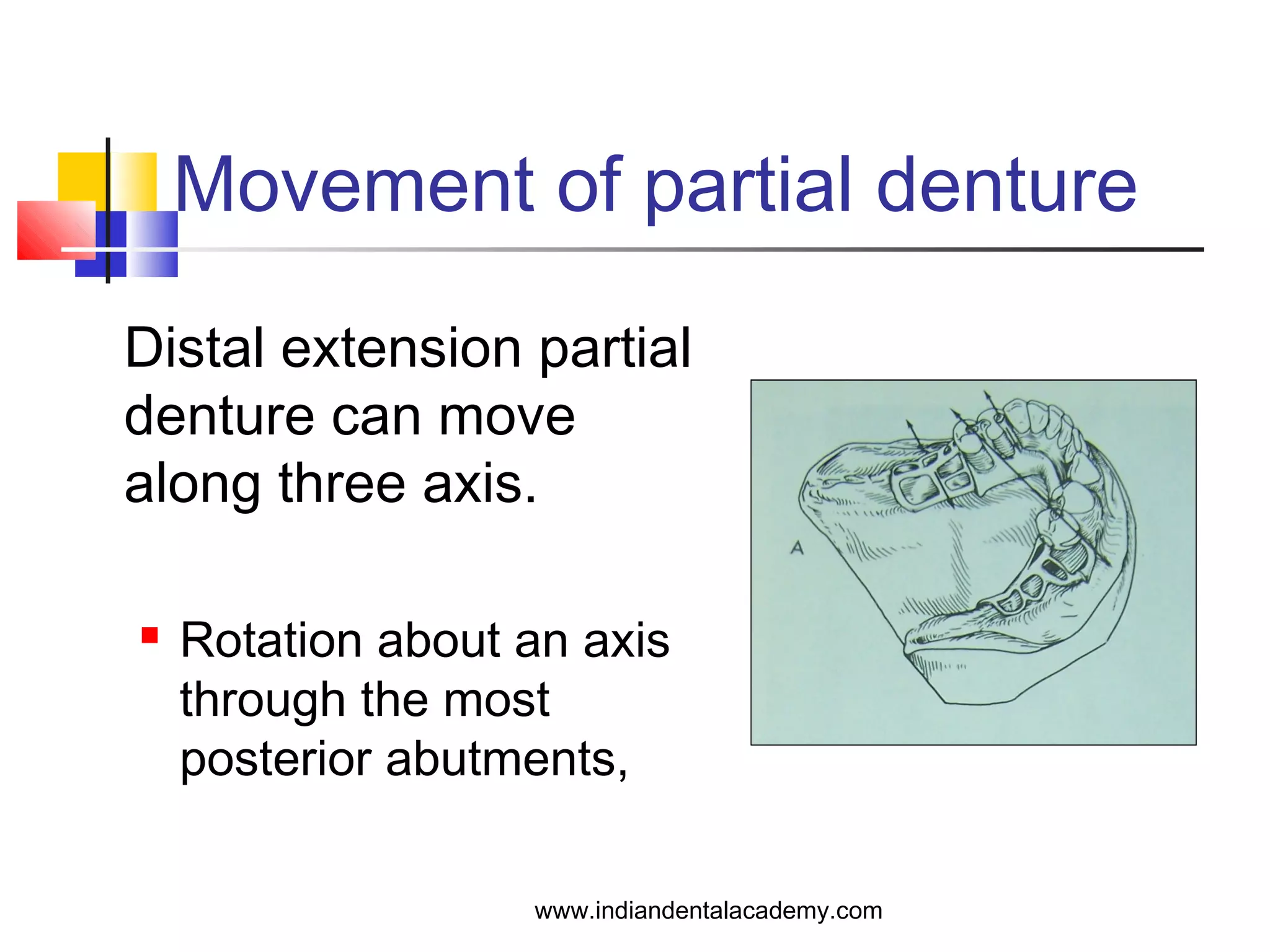
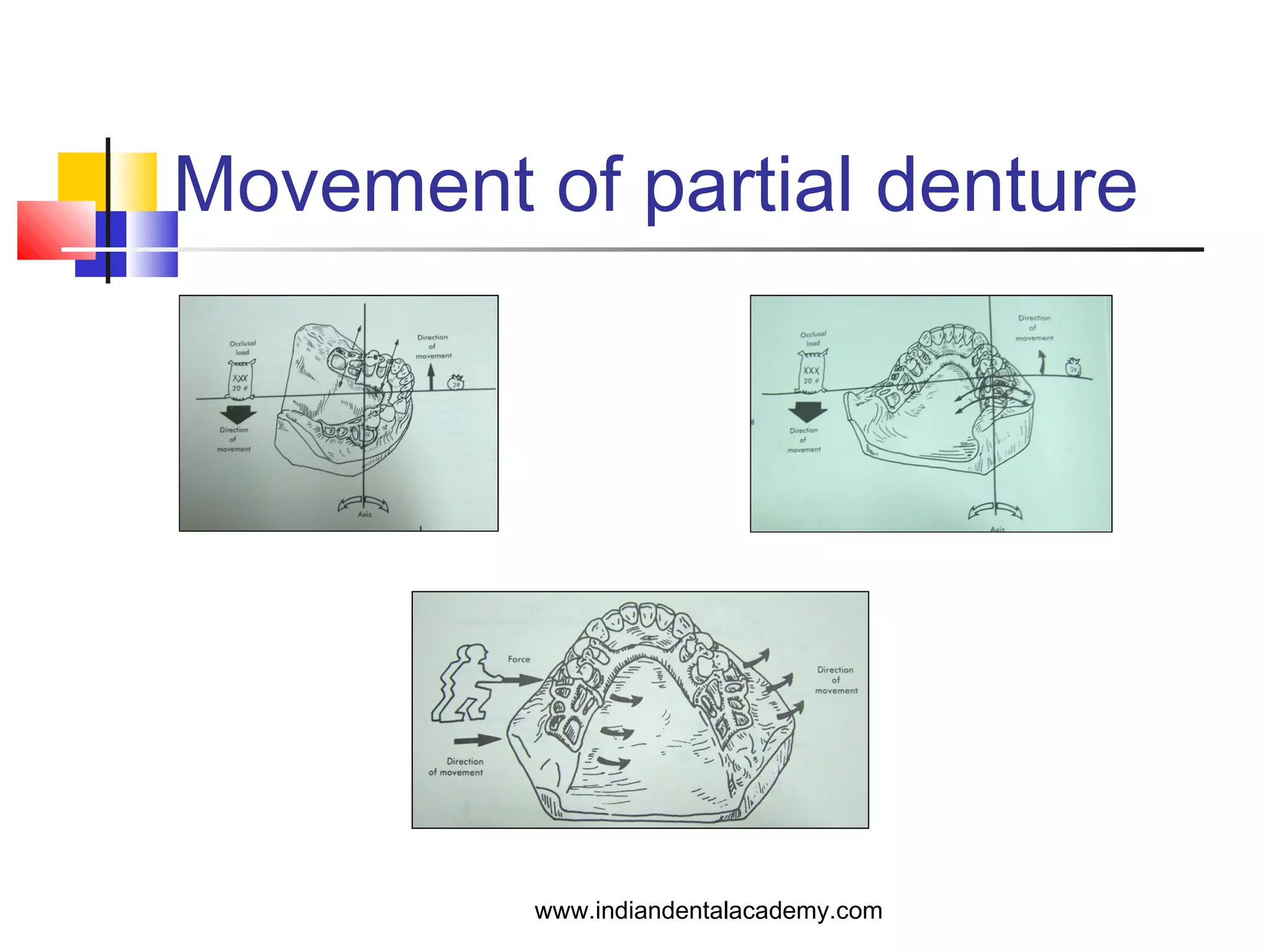
Movement of partial denture
Distal extension partial
denture can move
along three axis.
 Rotation about an axis
through the most
posterior abutments,
www.indiandentalacademy.com
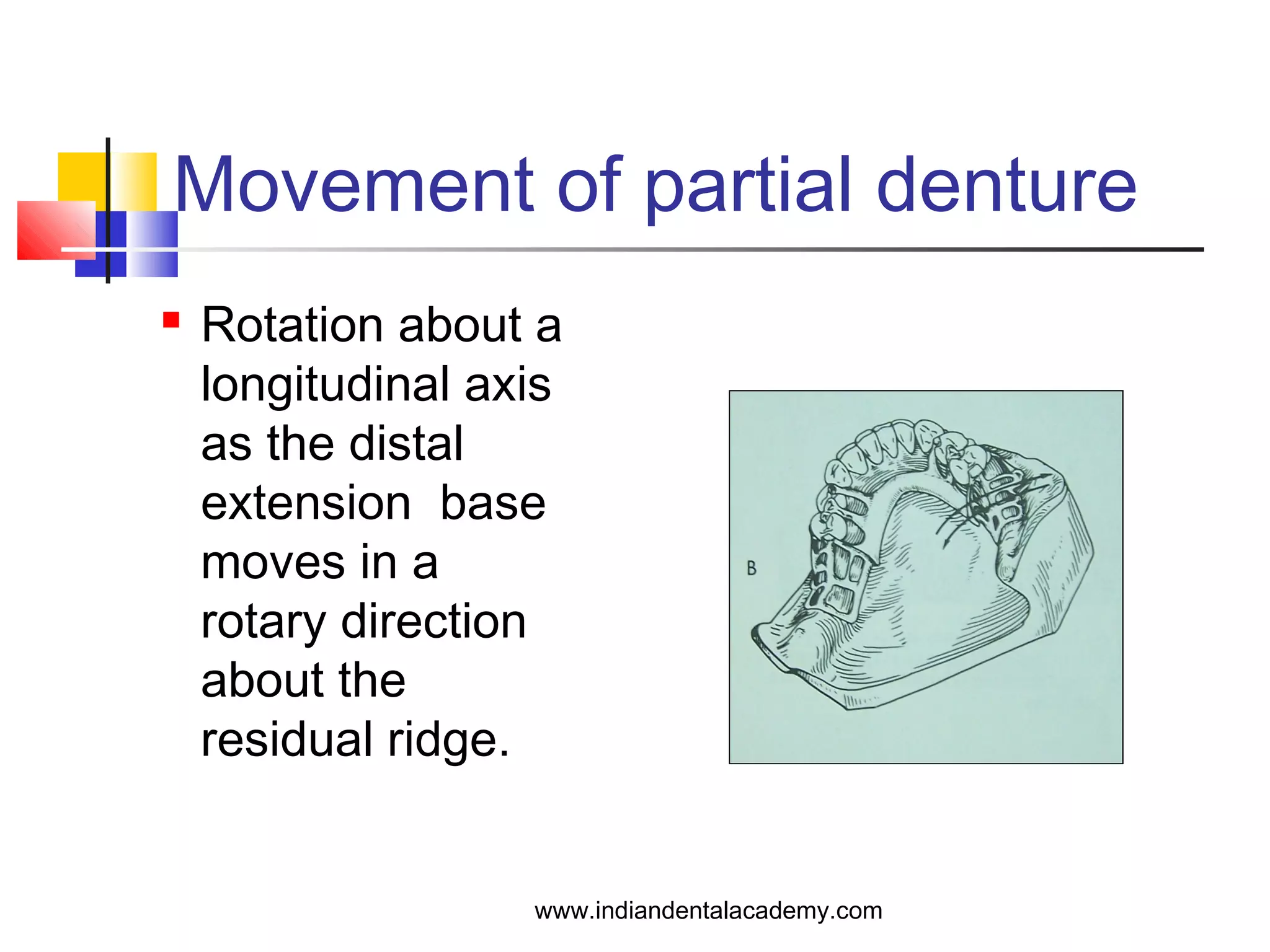
Movement of partial denture
 Rotation about a
longitudinal axis
as the distal
extension base
moves in a
rotary direction
about the
residual ridge.
www.indiandentalacademy.com
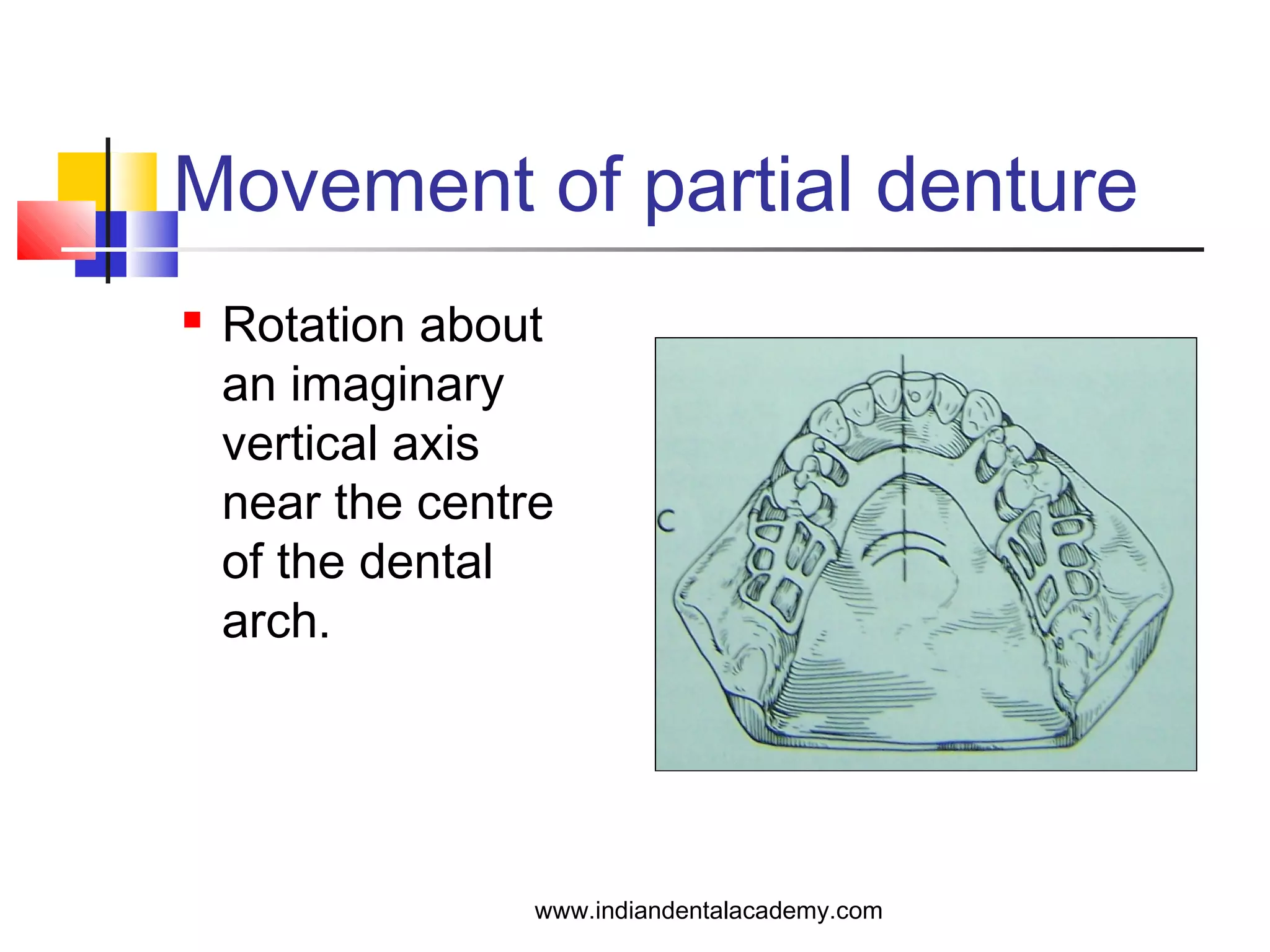
Movement of partial denture
 Rotation about
an imaginary
vertical axis
near the centre
of the dental
arch.
www.indiandentalacademy.com
Retainers
 Direct retainer
 Intracoronal
 Extracoronal
 Indirect Retainer
www.indiandentalacademy.com
Intracoronal retainers
 Prefabricated
 Provide retention by frictional resistance
www.indiandentalacademy.com
Intracoronal retainers
Advantage
 Batter esthetics
 Better vertical support trough a rest seat
located more favorably in relation to
horizontal axis of the abutment tooth
 Horizontal stabilization is similar to that of an
internal rest
www.indiandentalacademy.com
Intracoronal retainers
Disadvantages
 Require prepared abutments and castings
 Require somewhat complicated clinical and
laboratory procedures
 They eventually wear with resulting loss in retention
 Difficult to repair and replace
 Effective in proportion to their length and are
therefore least effective on short teeth
 Difficult to place completely within the circumference
of an abutment tooth
 More expensive
www.indiandentalacademy.com
Extracoronal direct retainer
 Prefabricated- Dalbo
 Custom made- Clasp
www.indiandentalacademy.com
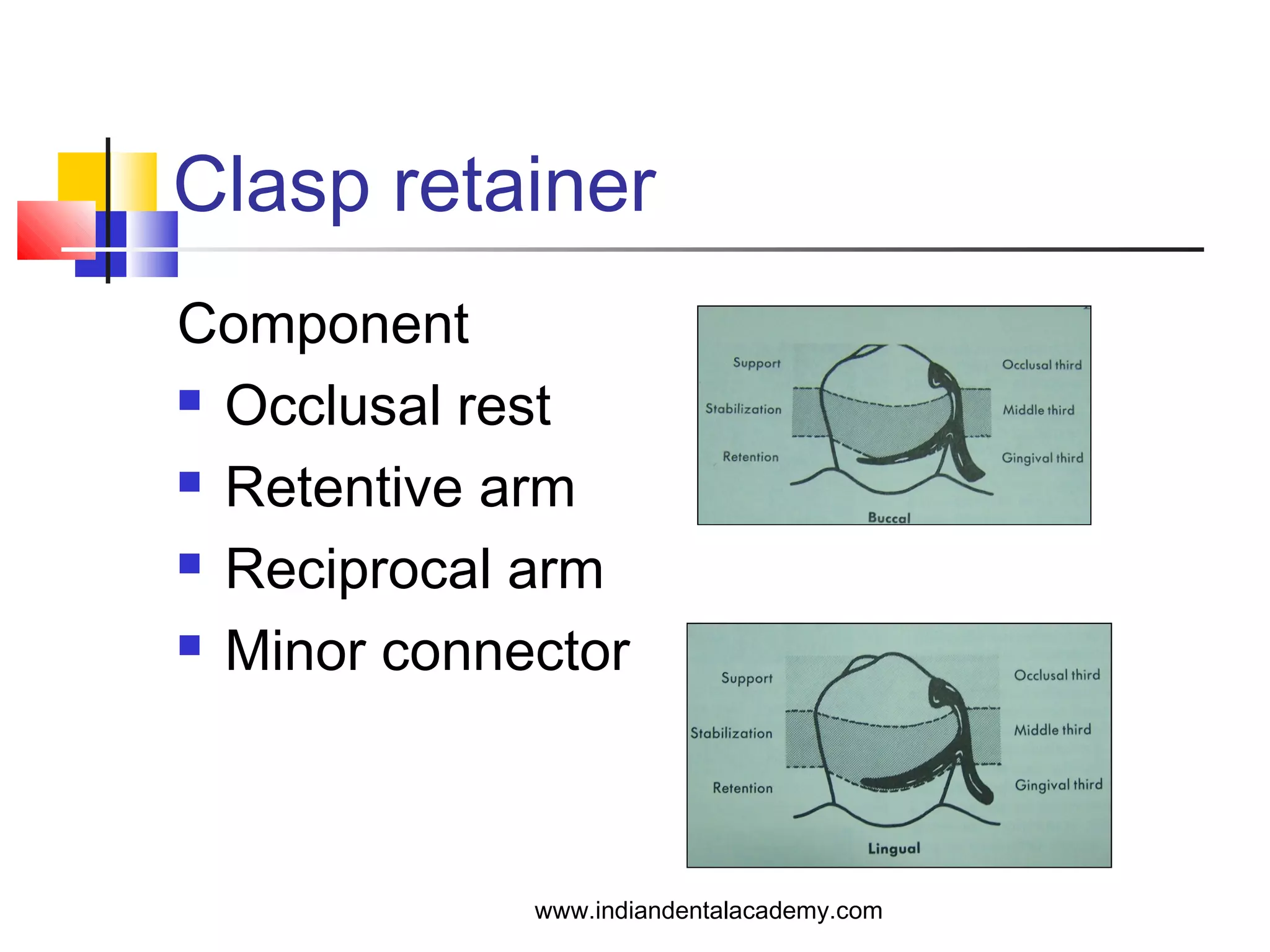
Clasp retainer
Component
 Occlusal rest
 Retentive arm
 Reciprocal arm
 Minor connector
www.indiandentalacademy.com
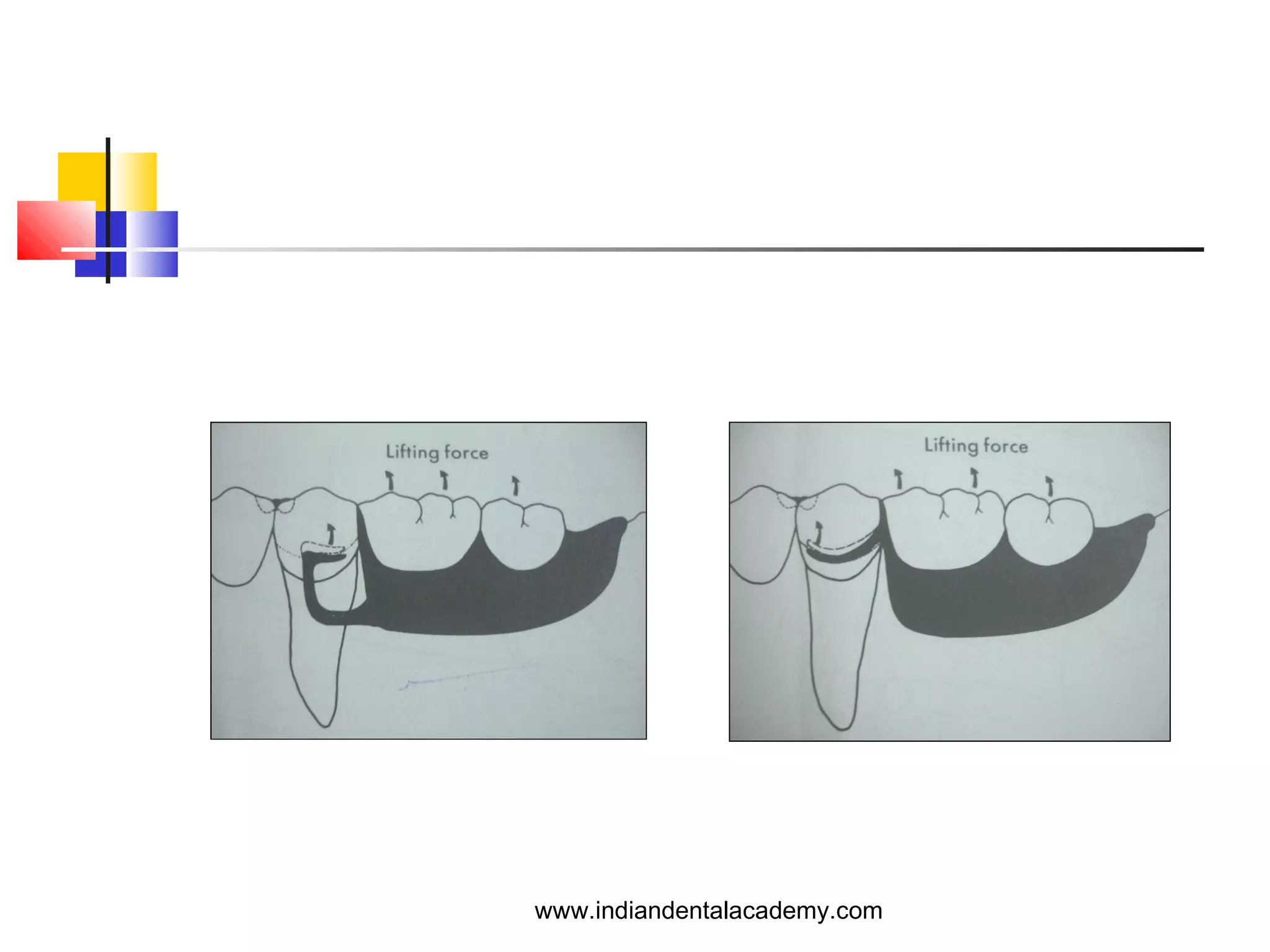
Amount of retention
 Size of angle of cervical convergence
 How far clasp arm is place in cervical
convergence
 Flexibility of clasp arm
 It’s length
 It’s relative diameter
 It’s cross-sectional form
 Material of clasp arm
www.indiandentalacademy.com
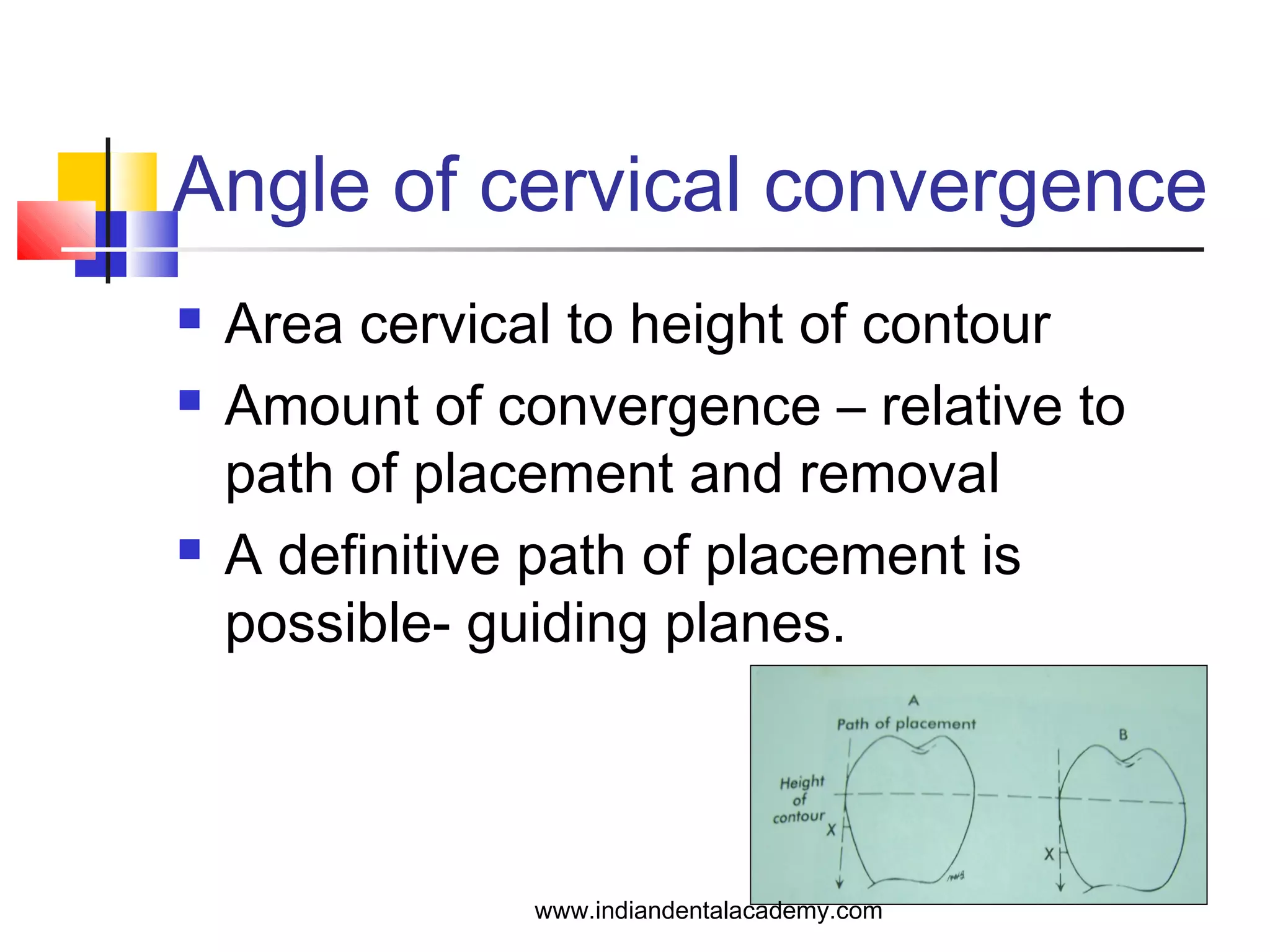
Angle of cervical convergence
 Area cervical to height of contour
 Amount of convergence – relative to
path of placement and removal
 A definitive path of placement is
possible- guiding planes.
www.indiandentalacademy.com
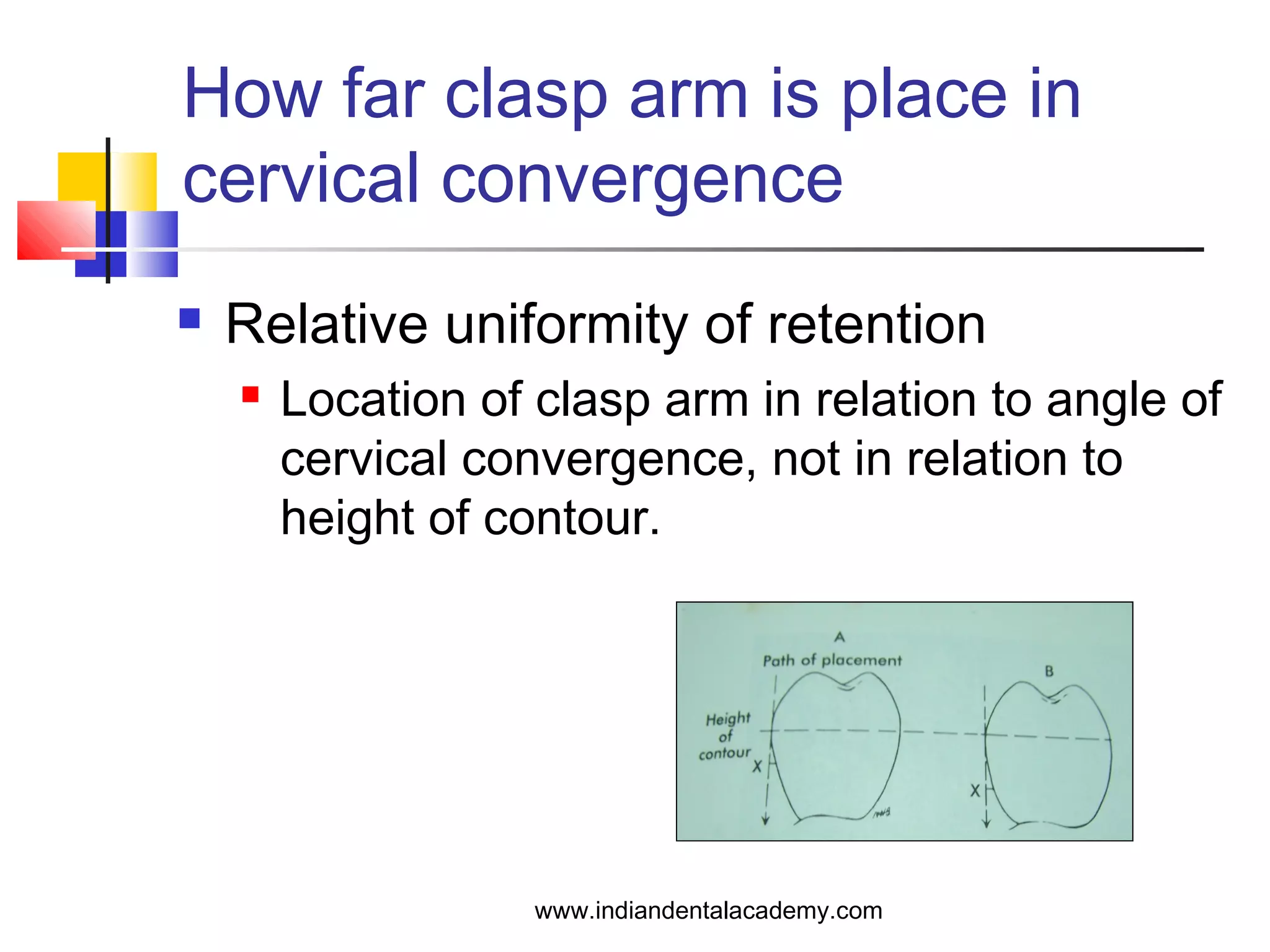
How far clasp arm is place in
cervical convergence
 Relative uniformity of retention
 Location of clasp arm in relation to angle of
cervical convergence, not in relation to
height of contour.
www.indiandentalacademy.com
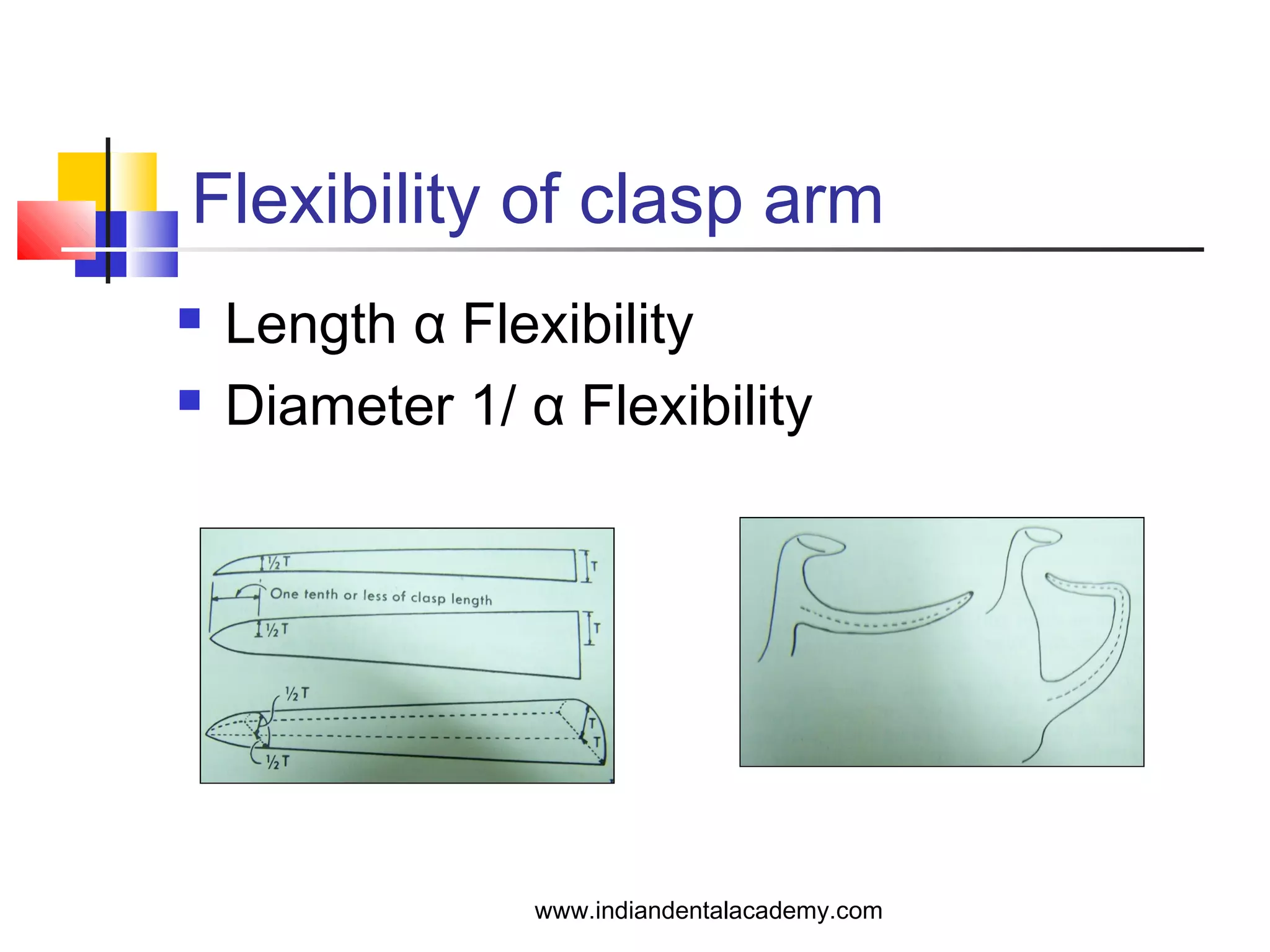
Flexibility of clasp arm
 Length α Flexibility
 Diameter 1/ α Flexibility
www.indiandentalacademy.com
Flexibility of clasp arm
 Cross sectional form
 Half round form →Unidirectional
 Round form →universal
 Material of clasp: Wrought wire > cast
gold > chrome alloys
www.indiandentalacademy.com
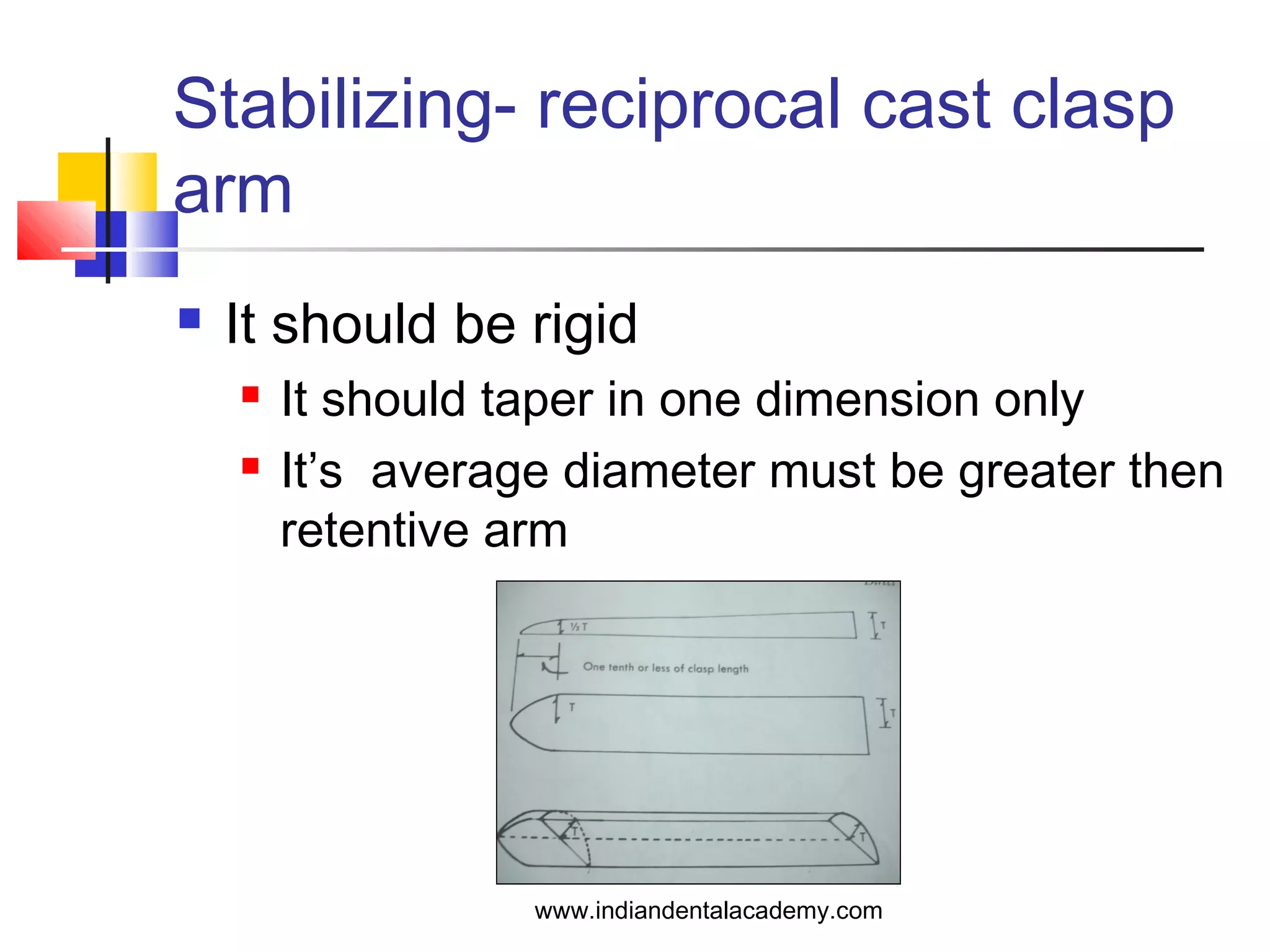
Stabilizing- reciprocal cast clasp
arm
 It should be rigid
 It should taper in one dimension only
 It’s average diameter must be greater then
retentive arm
www.indiandentalacademy.com
REQUIREMENTS OF
CLASP DESIGN
 Retention
 Stability
 Support
 Reciprocation
 Encirclement
 Passivity
www.indiandentalacademy.com
Basic principles of clasp
design
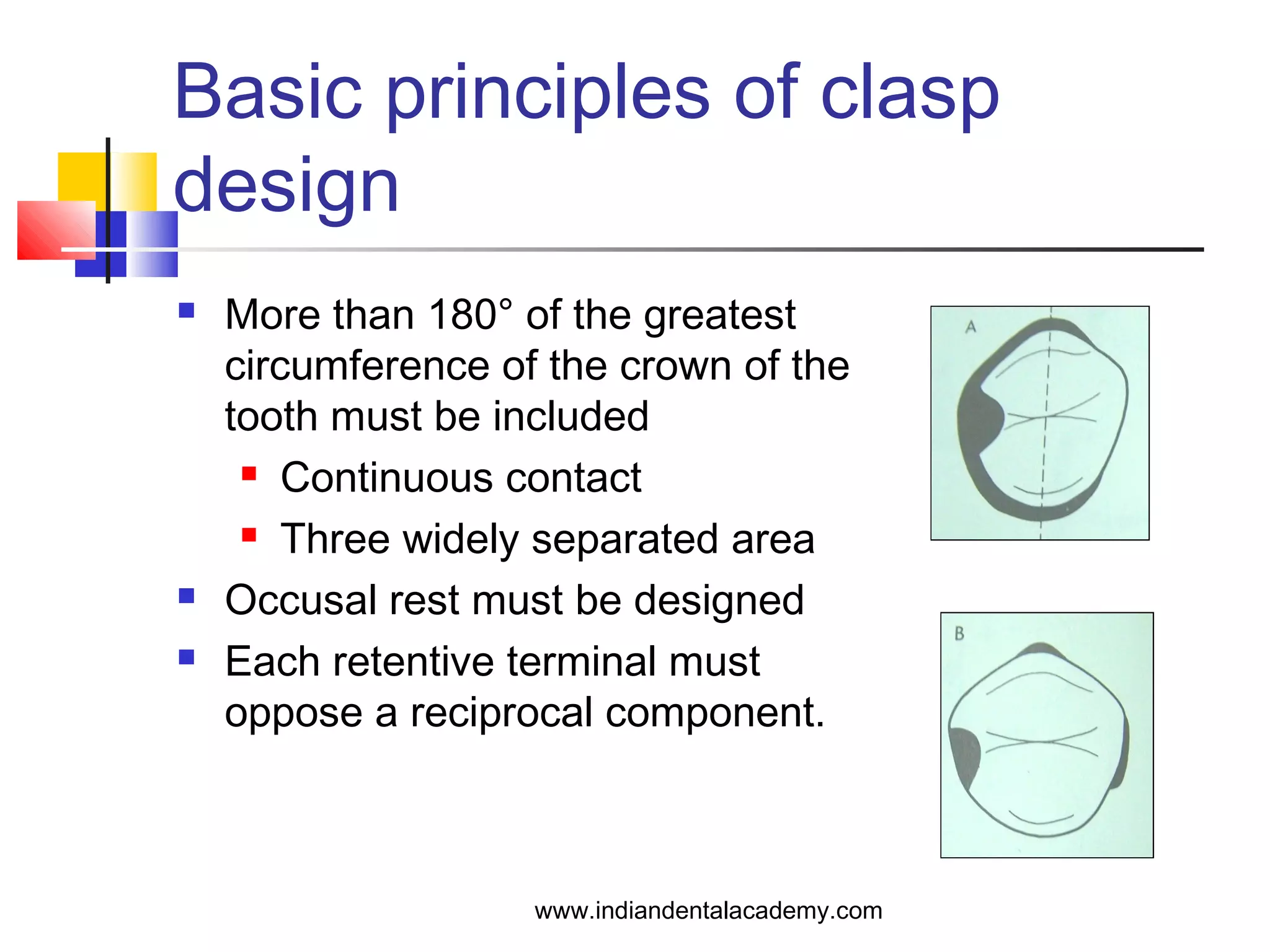
 More than 180° of the greatest
circumference of the crown of the
tooth must be included
 Continuous contact
 Three widely separated area
 Occusal rest must be designed
 Each retentive terminal must
oppose a reciprocal component.
www.indiandentalacademy.com
Basic principles of clasp
design
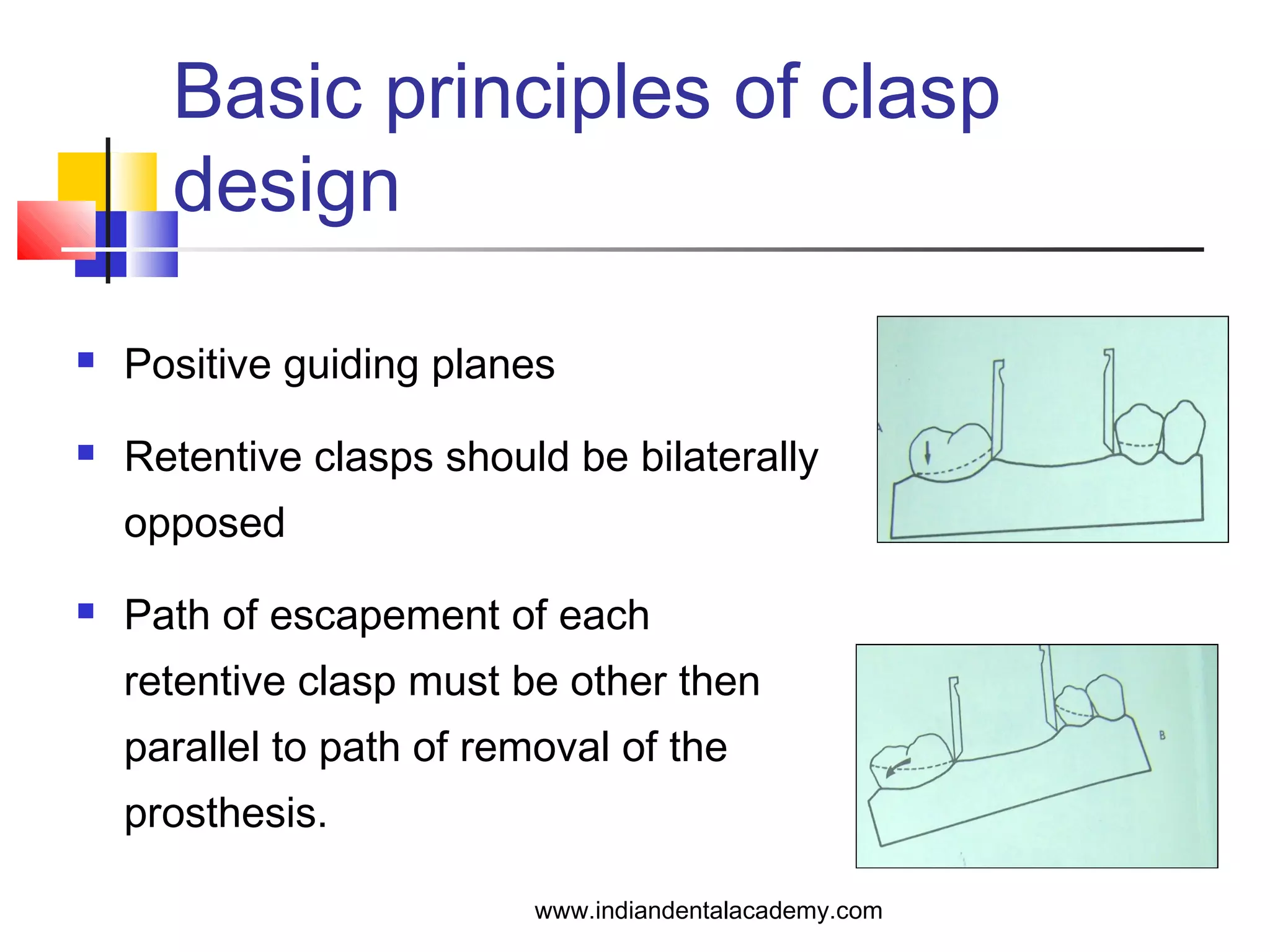
 Positive guiding planes
 Retentive clasps should be bilaterally
opposed
 Path of escapement of each
retentive clasp must be other then
parallel to path of removal of the
prosthesis.
www.indiandentalacademy.com
Basic principles of clasp
design
 Amount of retention should always be minimum
necessary
 Clasp retainer should not transmit off-vertical forces
to the abutment tooth.
 Reciprocal element →at the junction of gingival and
middle thirds
 Terminal end or retentive arm →Gingival third
www.indiandentalacademy.com
Type of clasps
 Circumferential clasp
 Ring clasp
 Embrasure clasp
 Multiple clasp
 Half- and –half clasp
 Reverse action clasp
 Bar clasp or RPI clasp
www.indiandentalacademy.com
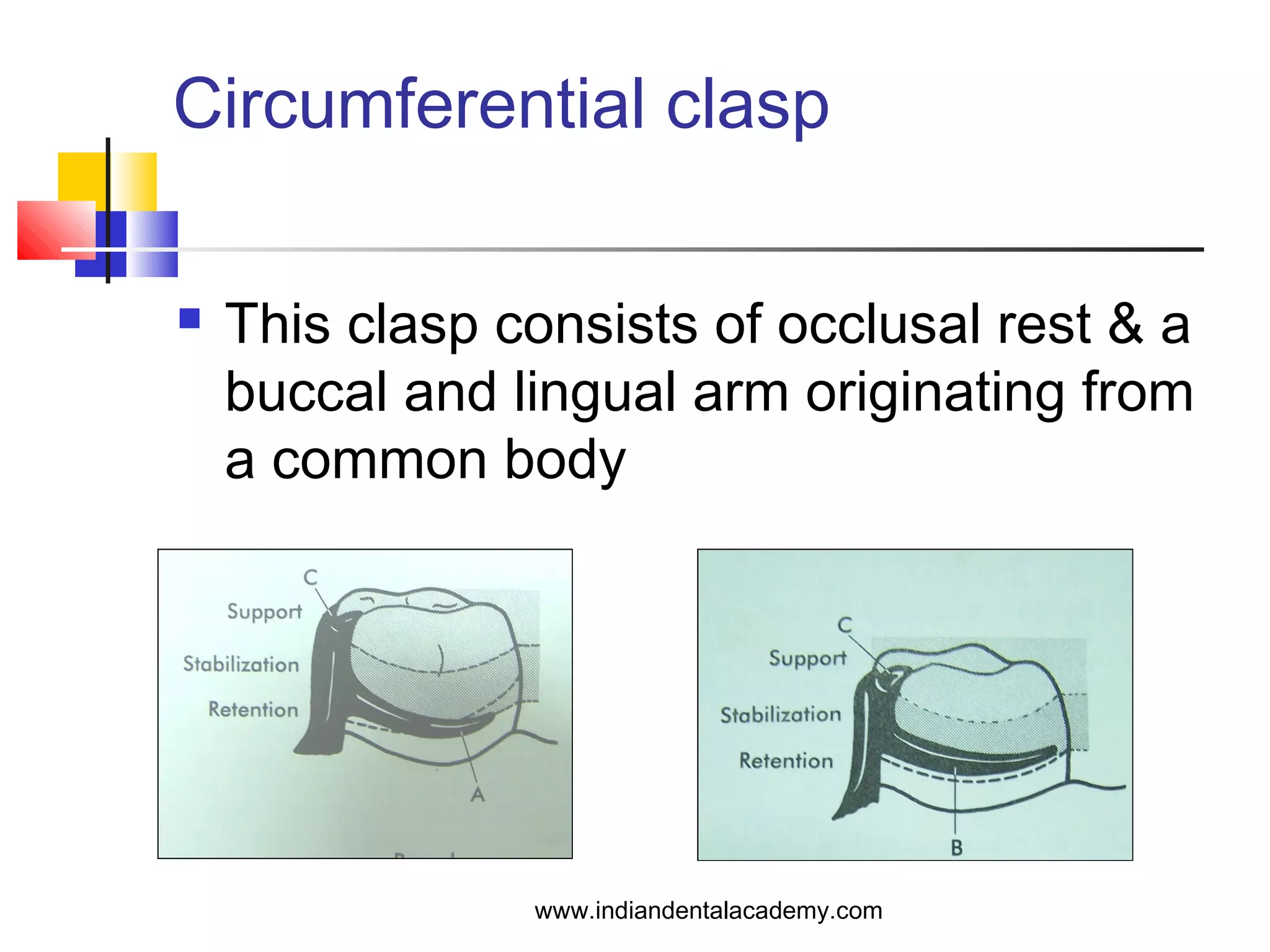
Circumferential clasp
 This clasp consists of occlusal rest & a
buccal and lingual arm originating from
a common body
www.indiandentalacademy.com
Circumferential clasp
 Most logical clasp for tooth supported partial
dentures because of excellent support,
bracing and retentive qualities
 Can be used in a wide variety of situations
www.indiandentalacademy.com
Circumferential clasp
Disadvantages
 More tooth coverage
 It’s occlusal approach may increase the width of
occlusal surface of the tooth
 More metal may be displayed than bar clasp
 It’s half round form prevents to increase or decrease
retention
www.indiandentalacademy.com
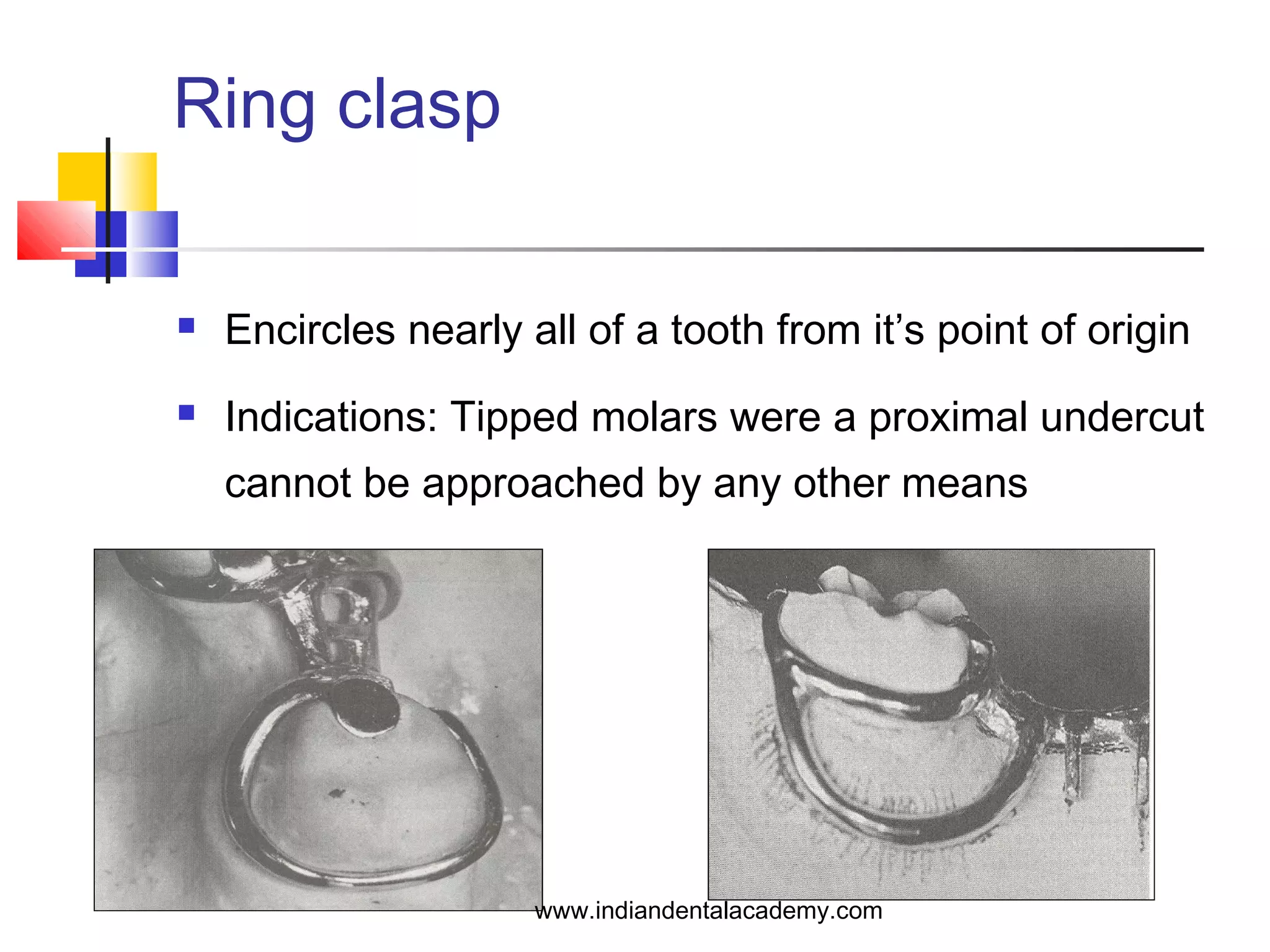
Ring clasp
 Encircles nearly all of a tooth from it’s point of origin
 Indications: Tipped molars were a proximal undercut
cannot be approached by any other means
www.indiandentalacademy.com
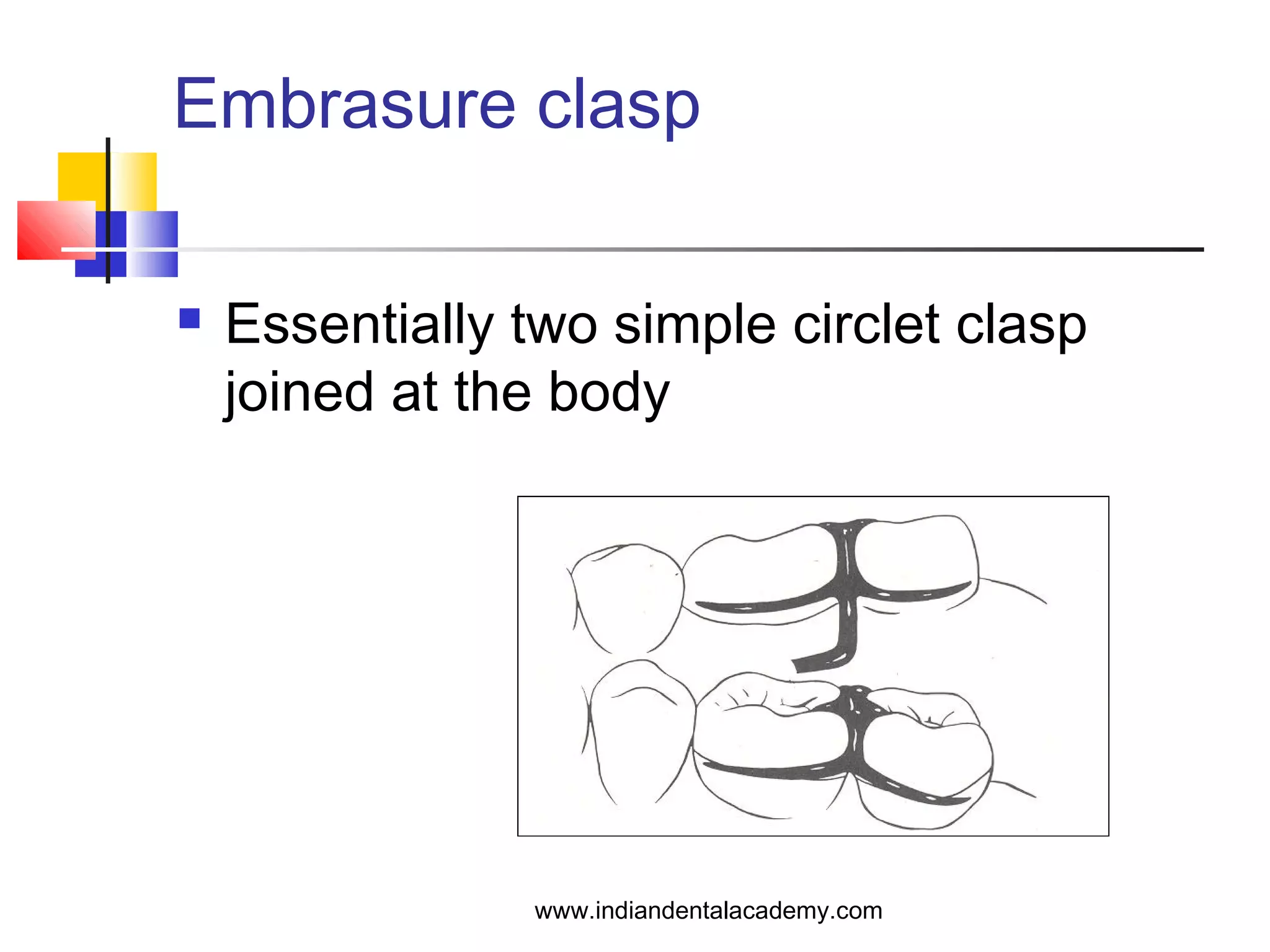
Embrasure clasp
 Essentially two simple circlet clasp
joined at the body
www.indiandentalacademy.com
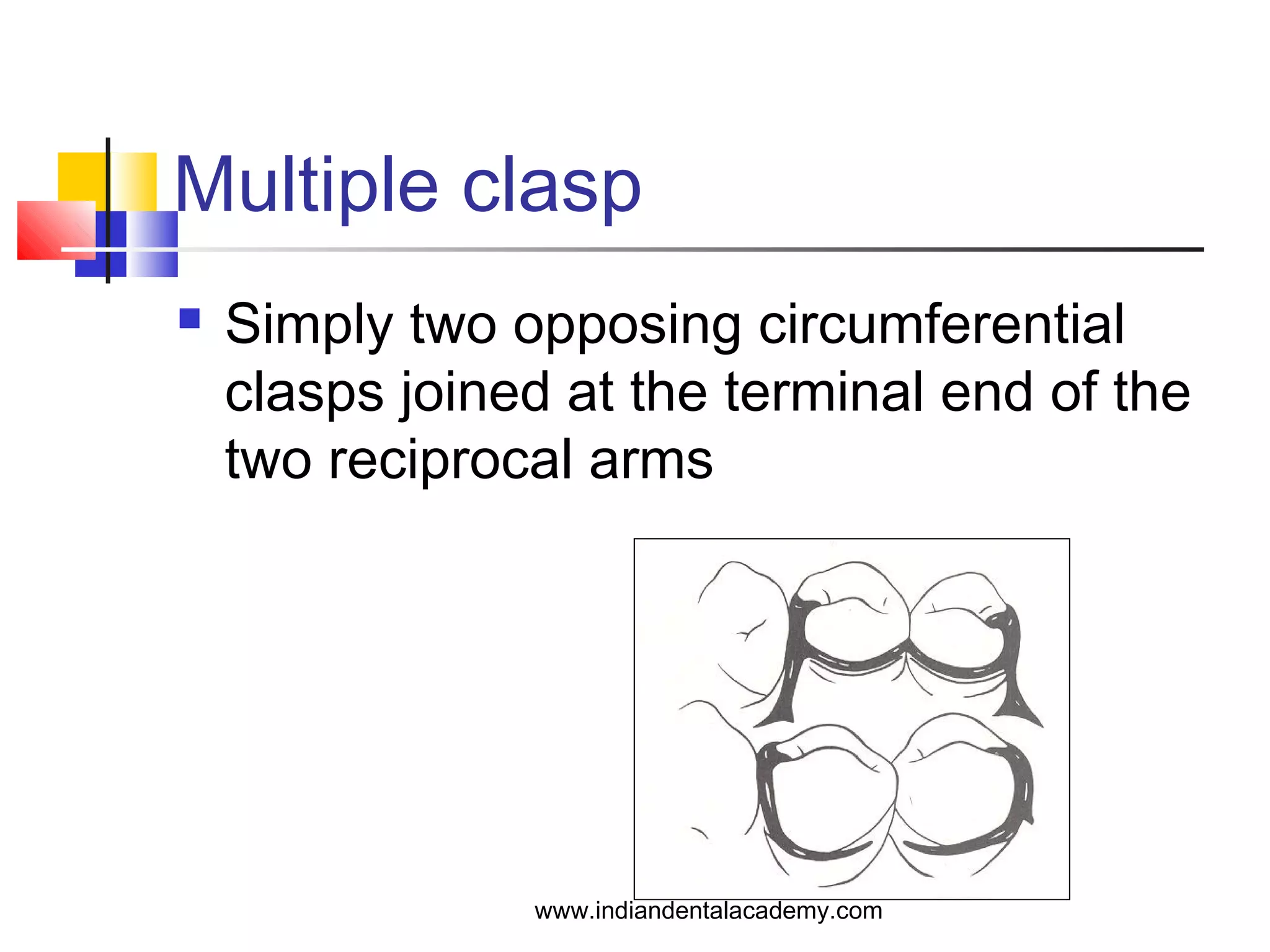
Multiple clasp
 Simply two opposing circumferential
clasps joined at the terminal end of the
two reciprocal arms
www.indiandentalacademy.com
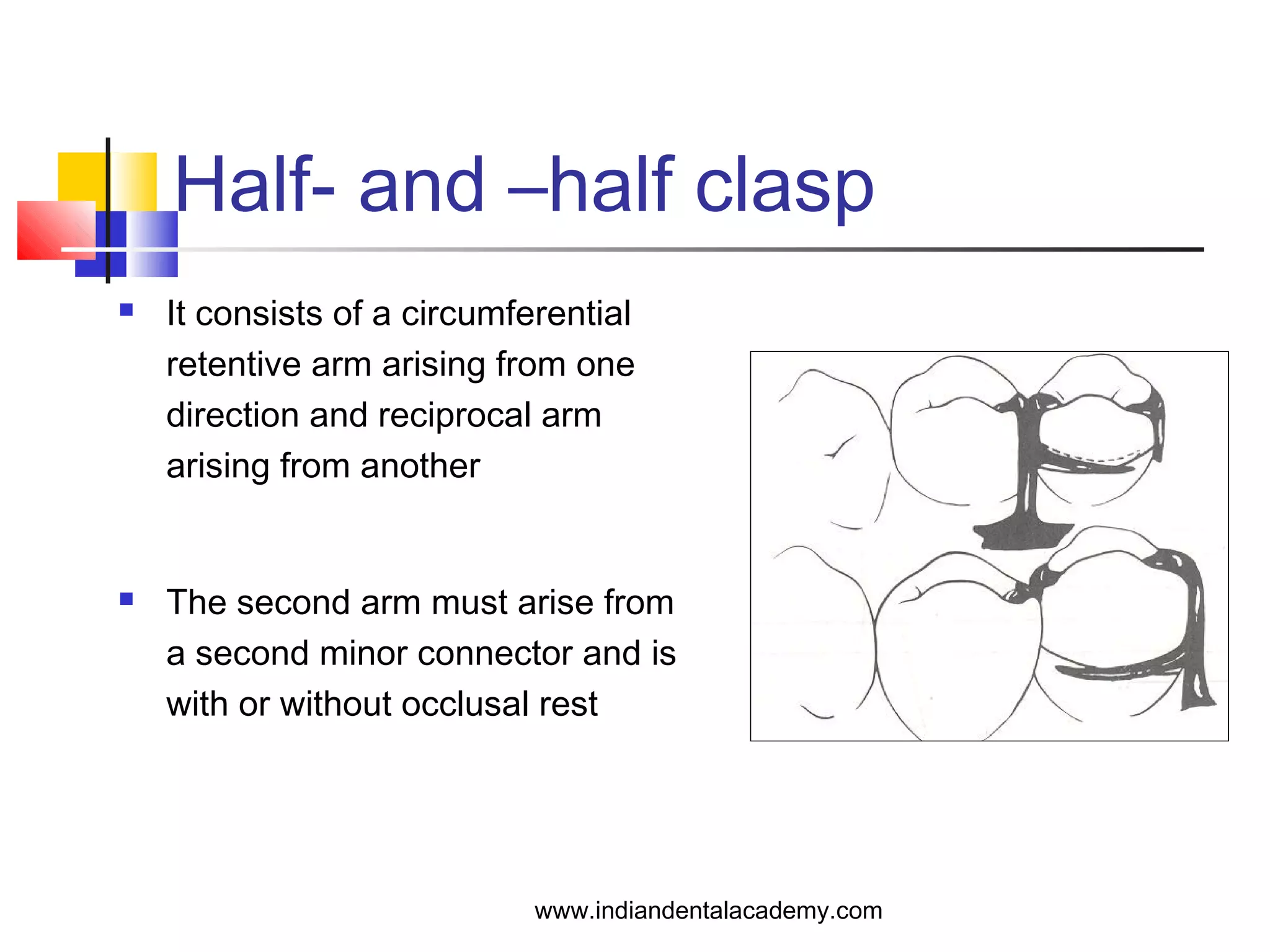
Half- and –half clasp
 It consists of a circumferential
retentive arm arising from one
direction and reciprocal arm
arising from another
 The second arm must arise from
a second minor connector and is
with or without occlusal rest
www.indiandentalacademy.com
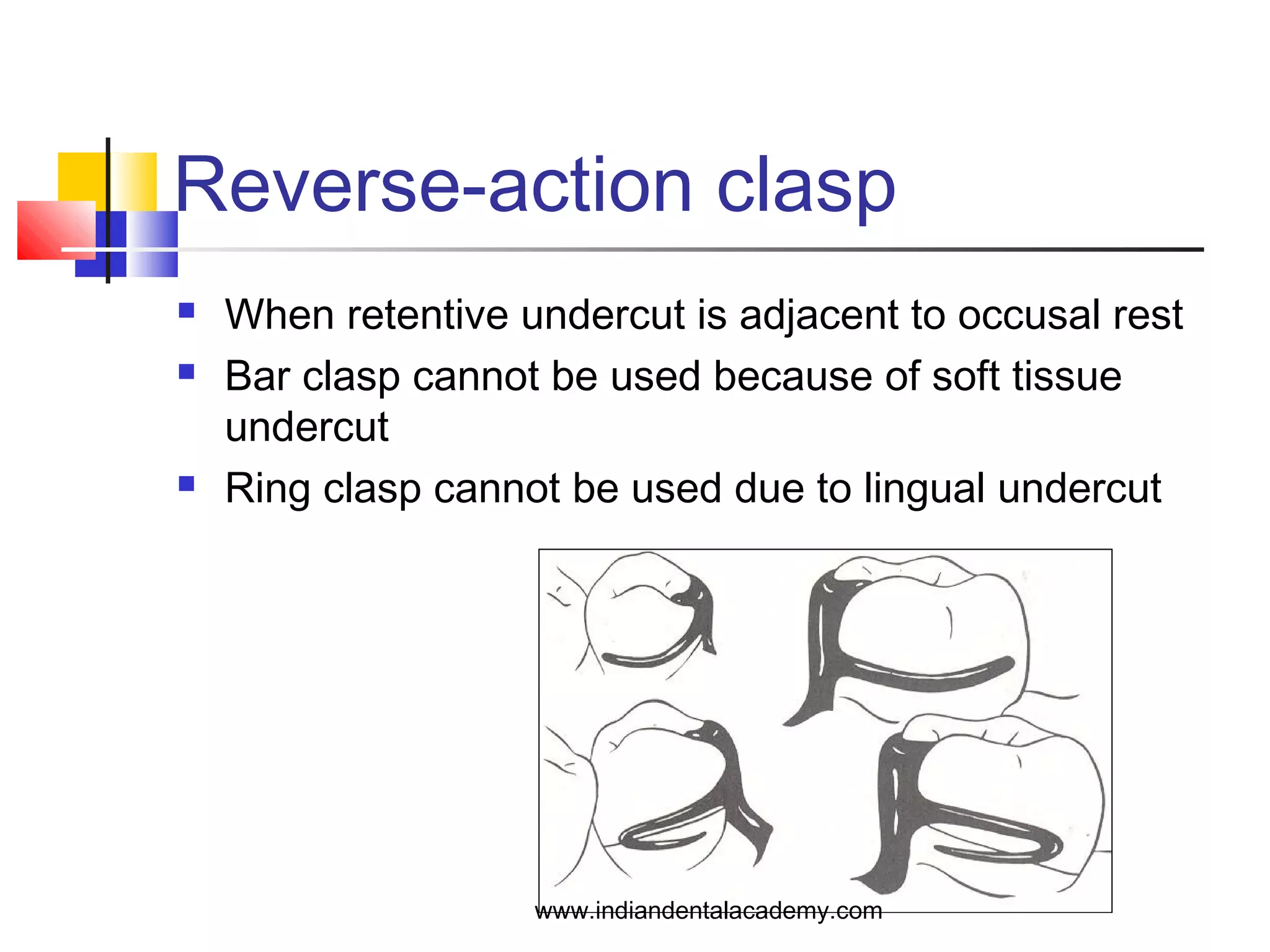
Reverse-action clasp
 When retentive undercut is adjacent to occusal rest
 Bar clasp cannot be used because of soft tissue
undercut
 Ring clasp cannot be used due to lingual undercut
www.indiandentalacademy.com
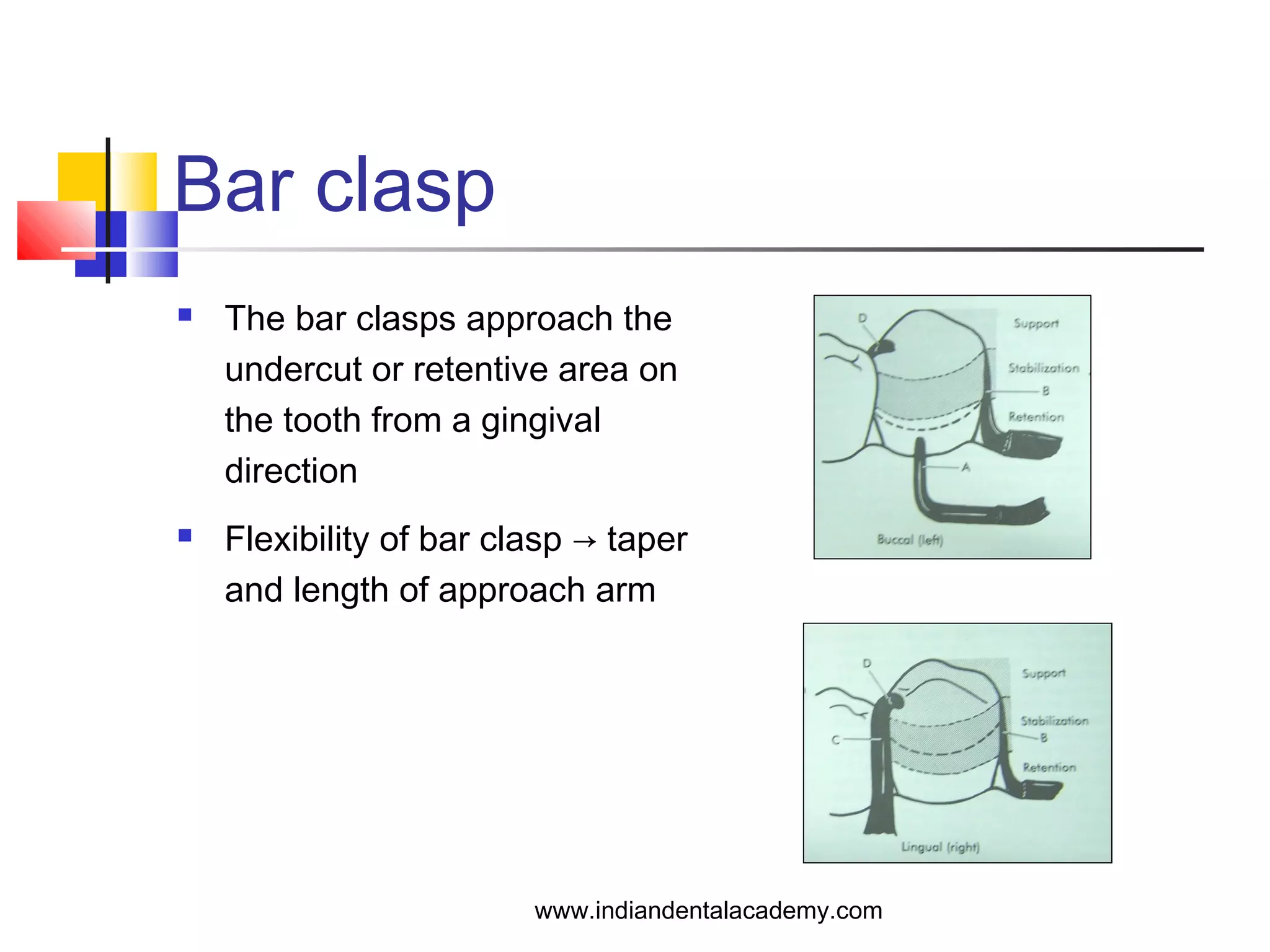
Bar clasp
 The bar clasps approach the
undercut or retentive area on
the tooth from a gingival
direction
 Flexibility of bar clasp → taper
and length of approach arm
www.indiandentalacademy.com
Bar clasp
DISADVANTAGES
 Greater tendency to trap food debris
 Does not contribute as much to
bracing and stabilization as most
circumferential clasps do
www.indiandentalacademy.com
Bar clasp
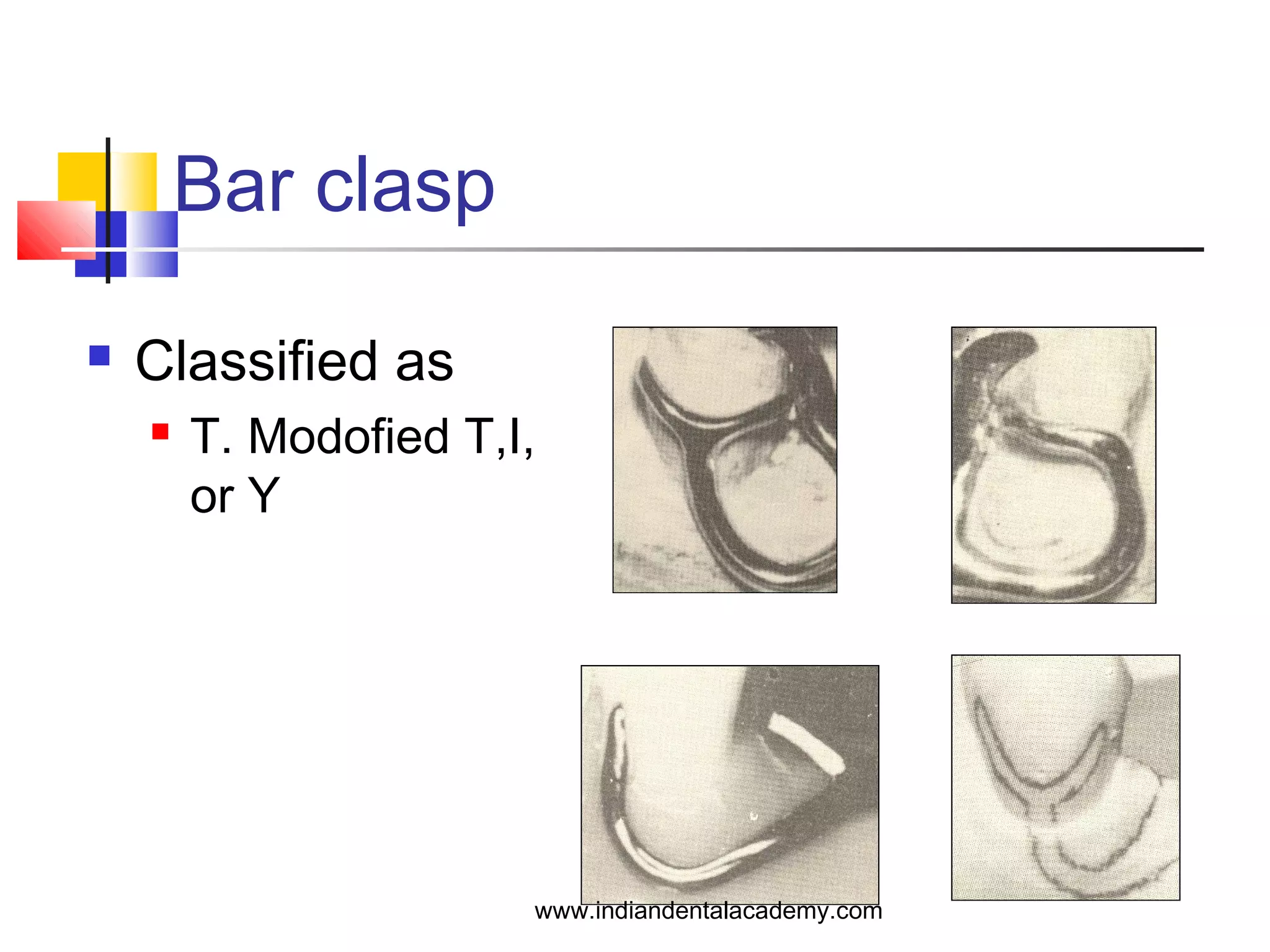
 Classified as
 T. Modofied T,I,
or Y
www.indiandentalacademy.com
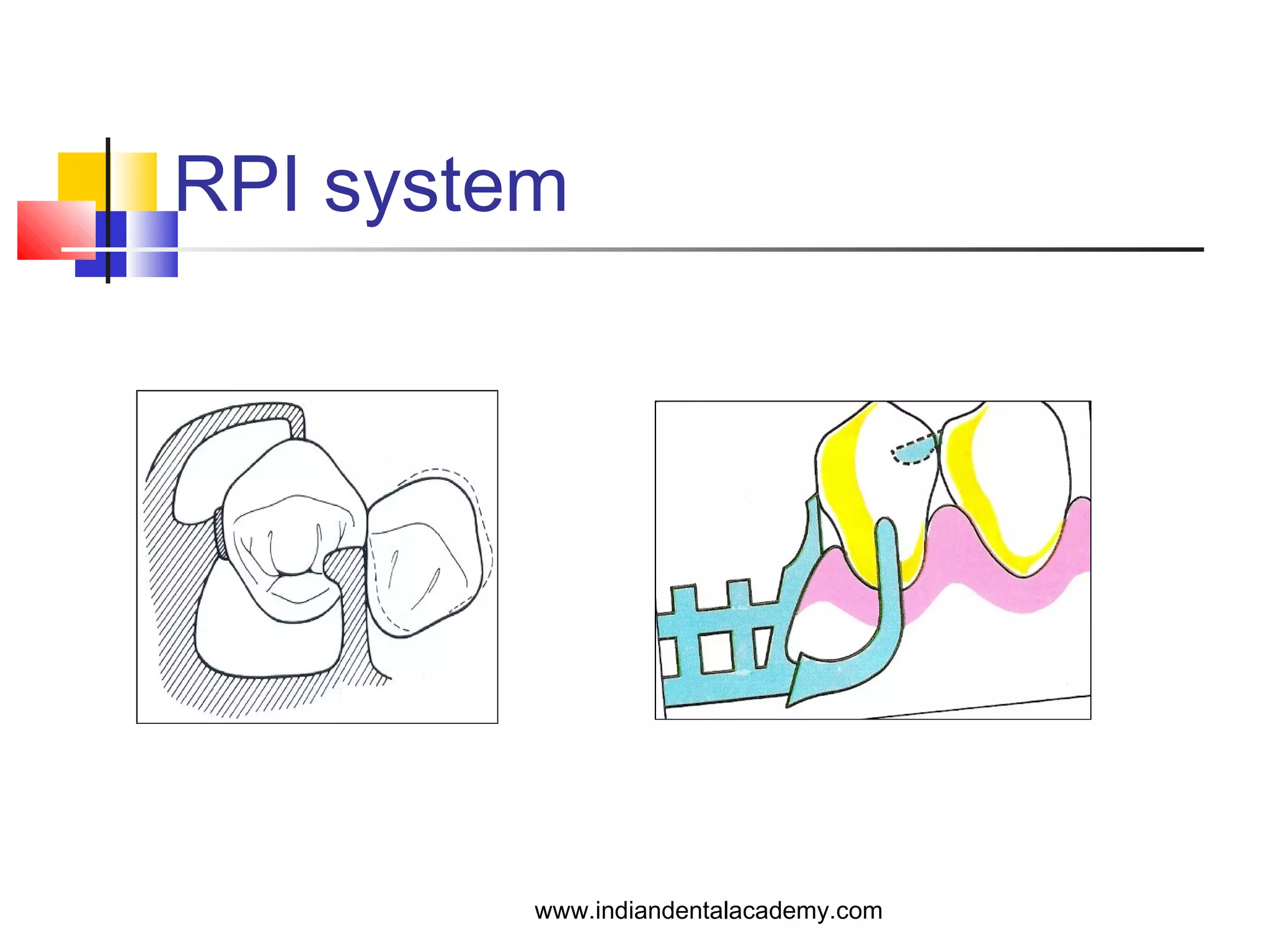
RPI system
www.indiandentalacademy.com
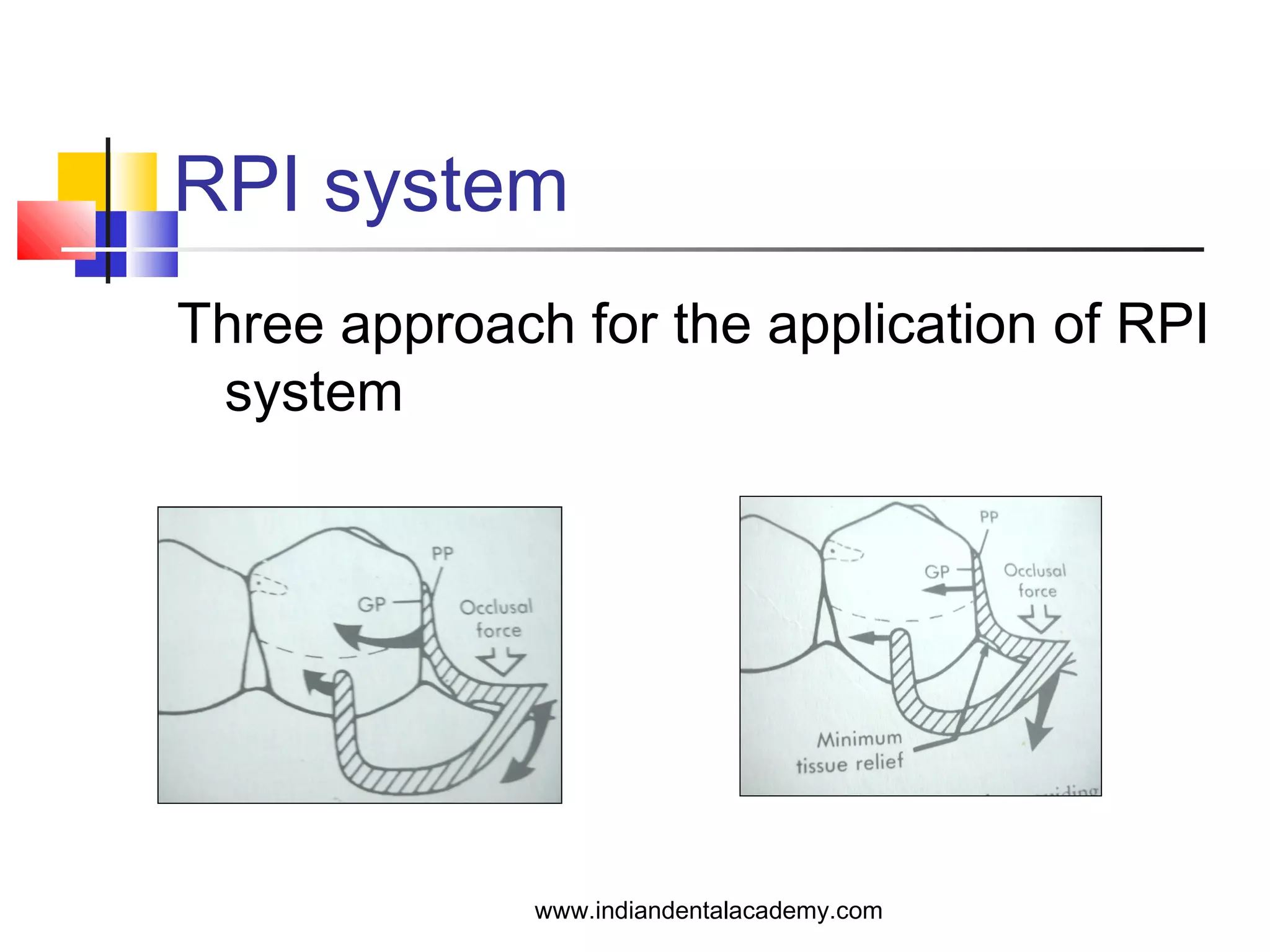
RPI system
Three approach for the application of RPI
system
www.indiandentalacademy.com
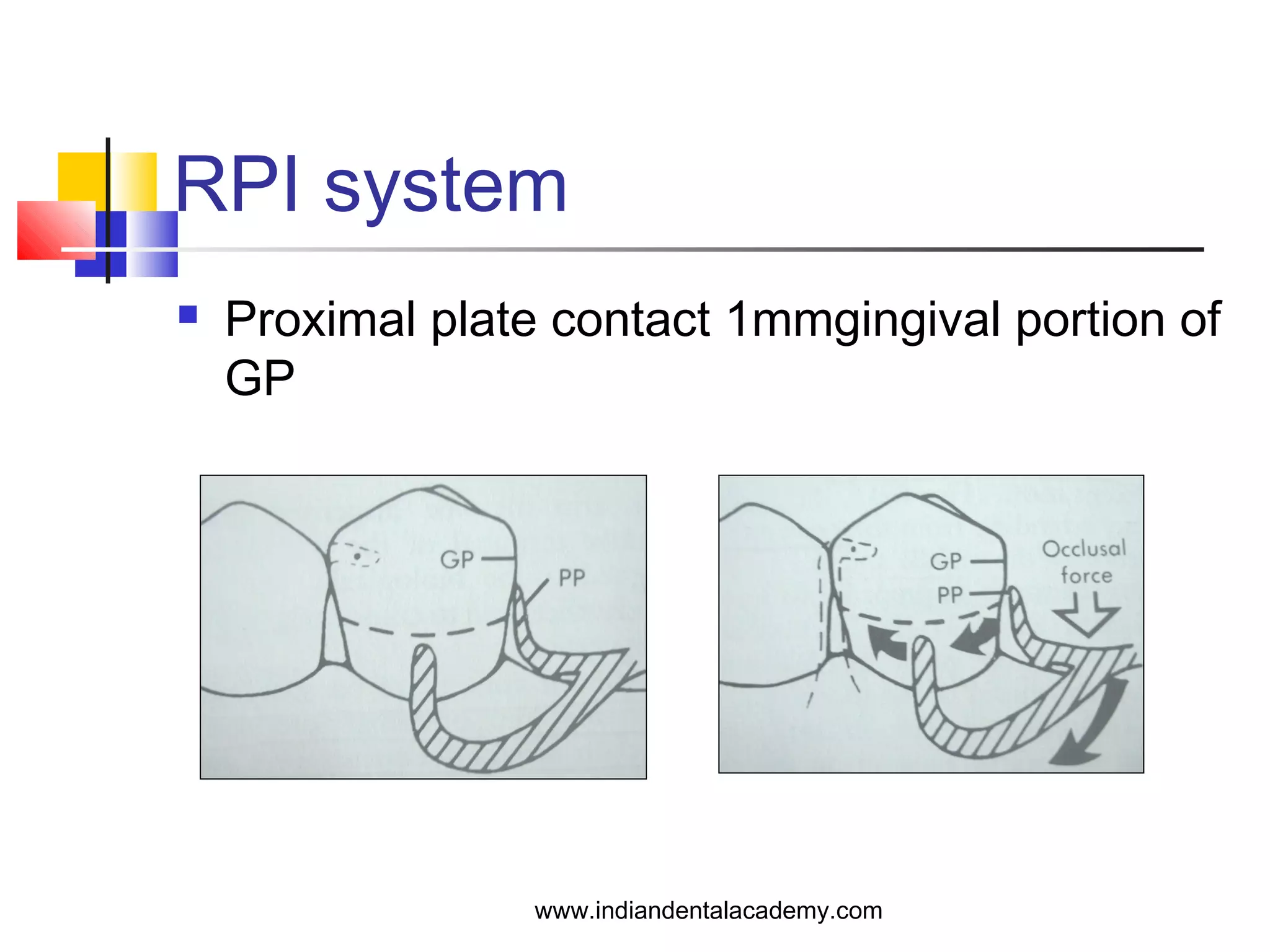
RPI system
 Proximal plate contact 1mmgingival portion of
GP
www.indiandentalacademy.com
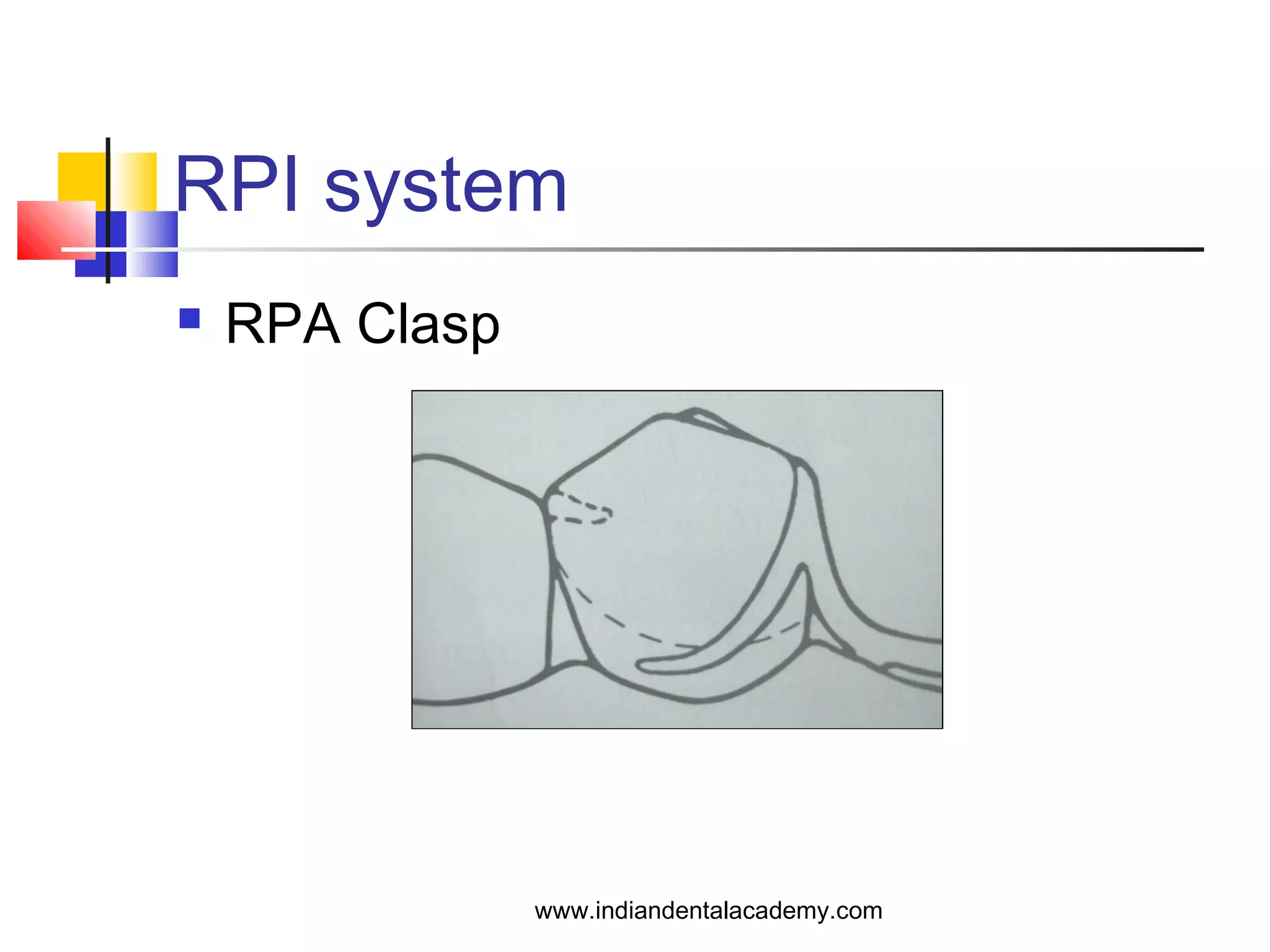
RPI system
 RPA Clasp
www.indiandentalacademy.com
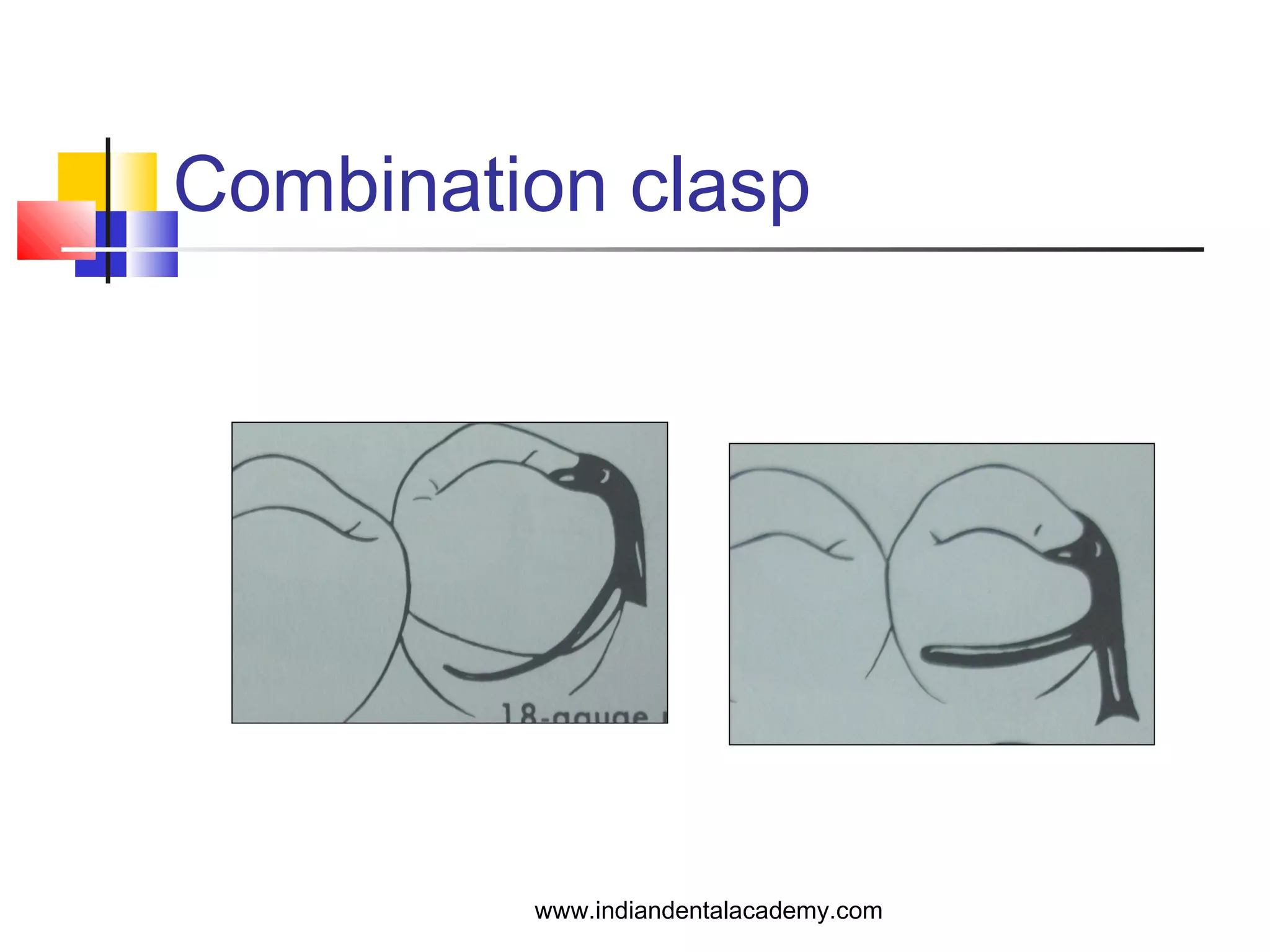
Combination clasp
 It is a circumferential clasp, but bar
clasp may be used
 wrought wire retentive clasp arm and a
cast reciprocal clasp arm
 If high heat chrome alloy is used, the
wrought wire must be soldered to the
completed framework
www.indiandentalacademy.com
Combination clasp
www.indiandentalacademy.com
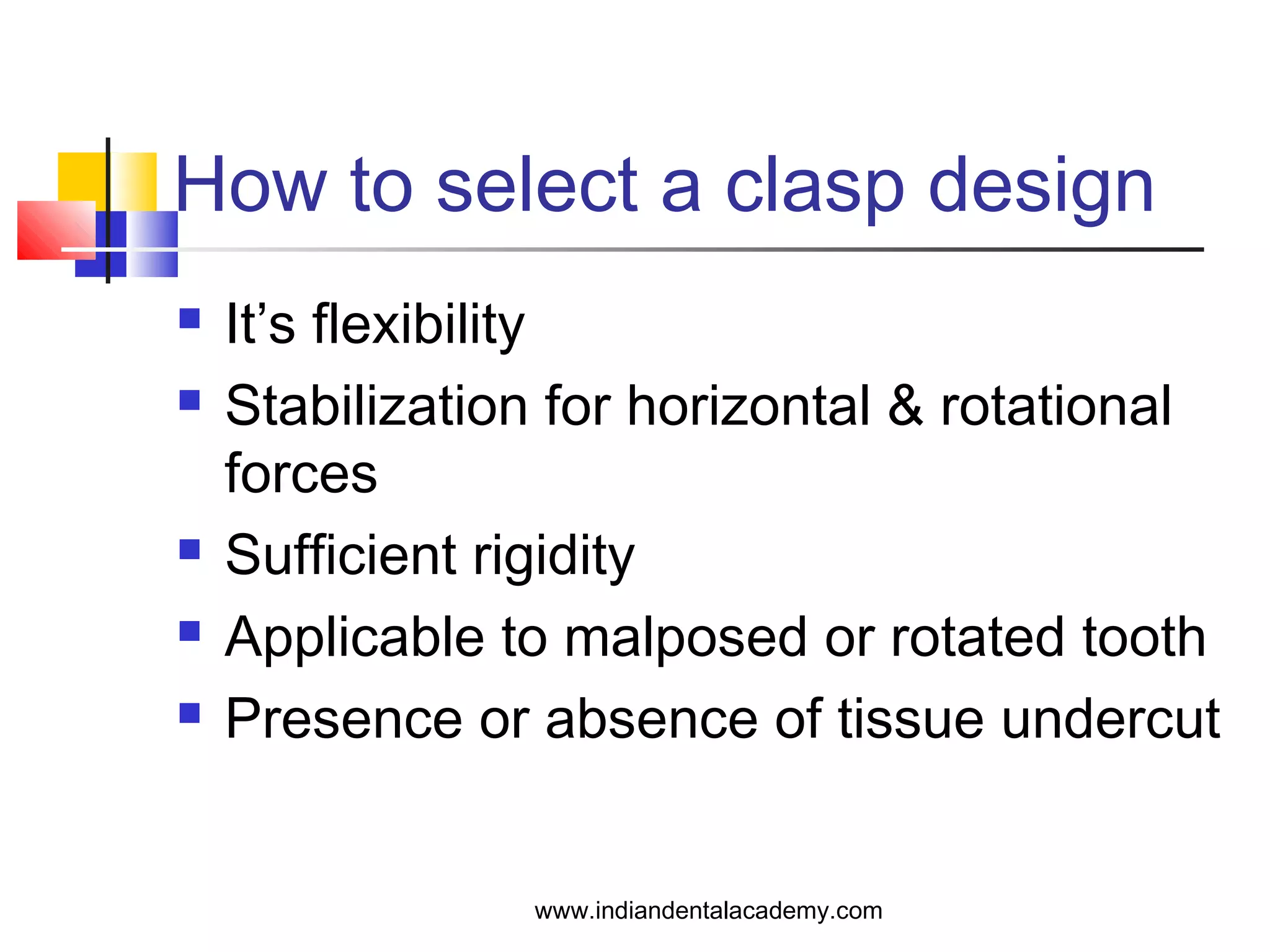
How to select a clasp design
 It’s flexibility
 Stabilization for horizontal & rotational
forces
 Sufficient rigidity
 Applicable to malposed or rotated tooth
 Presence or absence of tissue undercut
www.indiandentalacademy.com
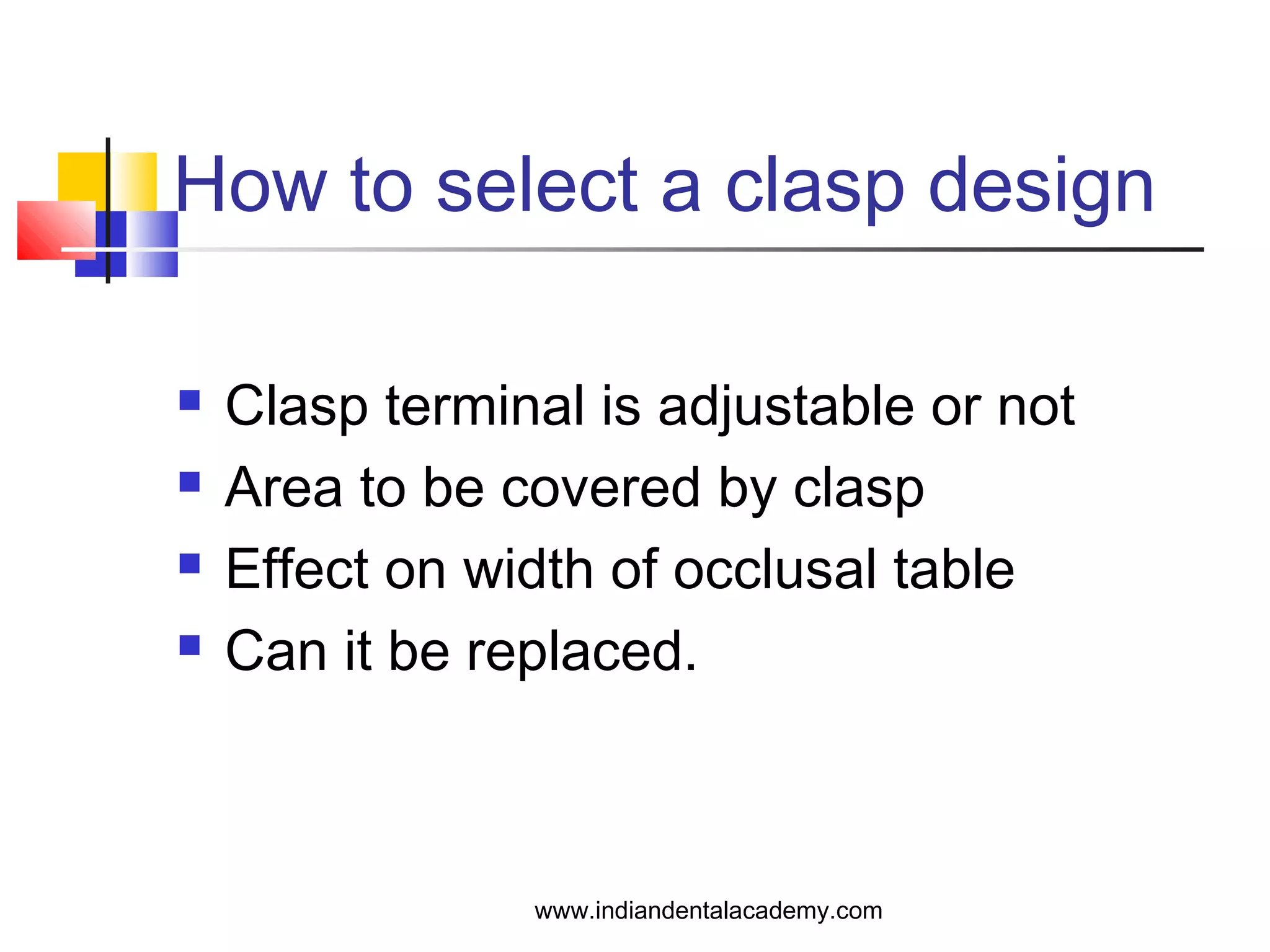
How to select a clasp design
 Clasp terminal is adjustable or not
 Area to be covered by clasp
 Effect on width of occlusal table
 Can it be replaced.
www.indiandentalacademy.com
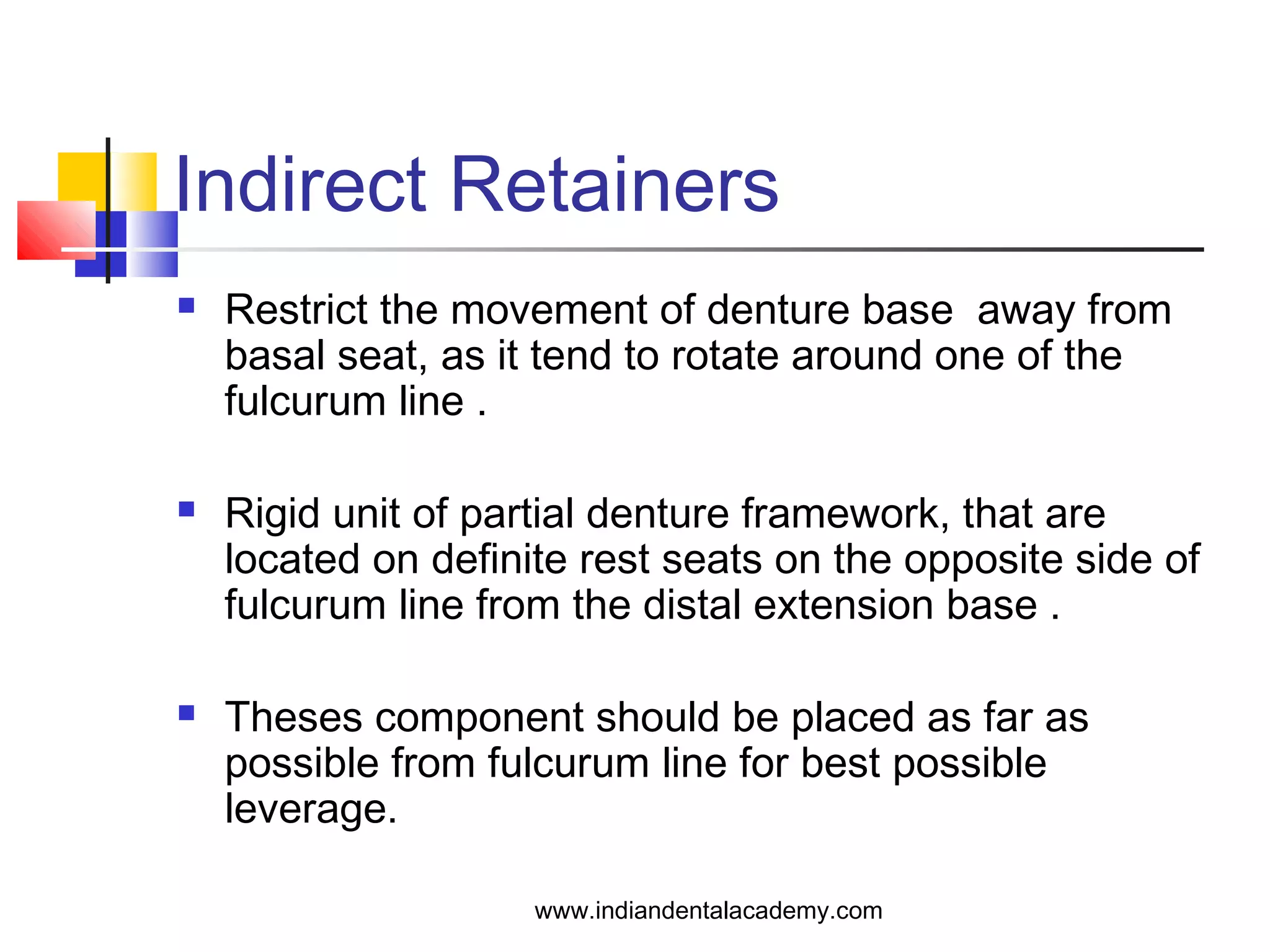
Indirect Retainers
 Restrict the movement of denture base away from
basal seat, as it tend to rotate around one of the
fulcurum line .
 Rigid unit of partial denture framework, that are
located on definite rest seats on the opposite side of
fulcurum line from the distal extension base .
 Theses component should be placed as far as
possible from fulcurum line for best possible
leverage.
www.indiandentalacademy.com
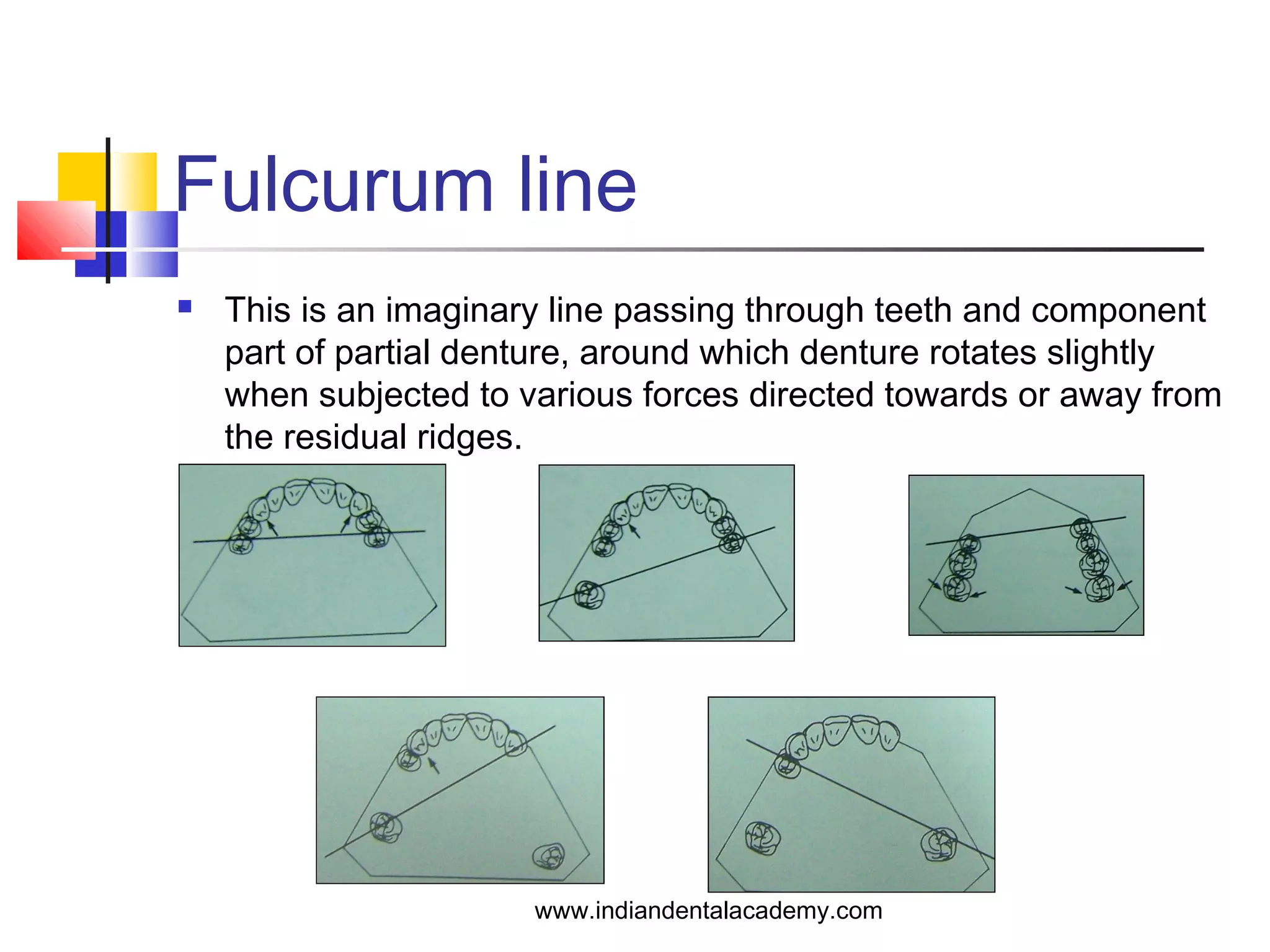
Movement of partial denture
www.indiandentalacademy.com
Fulcurum line
 This is an imaginary line passing through teeth and component
part of partial denture, around which denture rotates slightly
when subjected to various forces directed towards or away from
the residual ridges.
www.indiandentalacademy.com
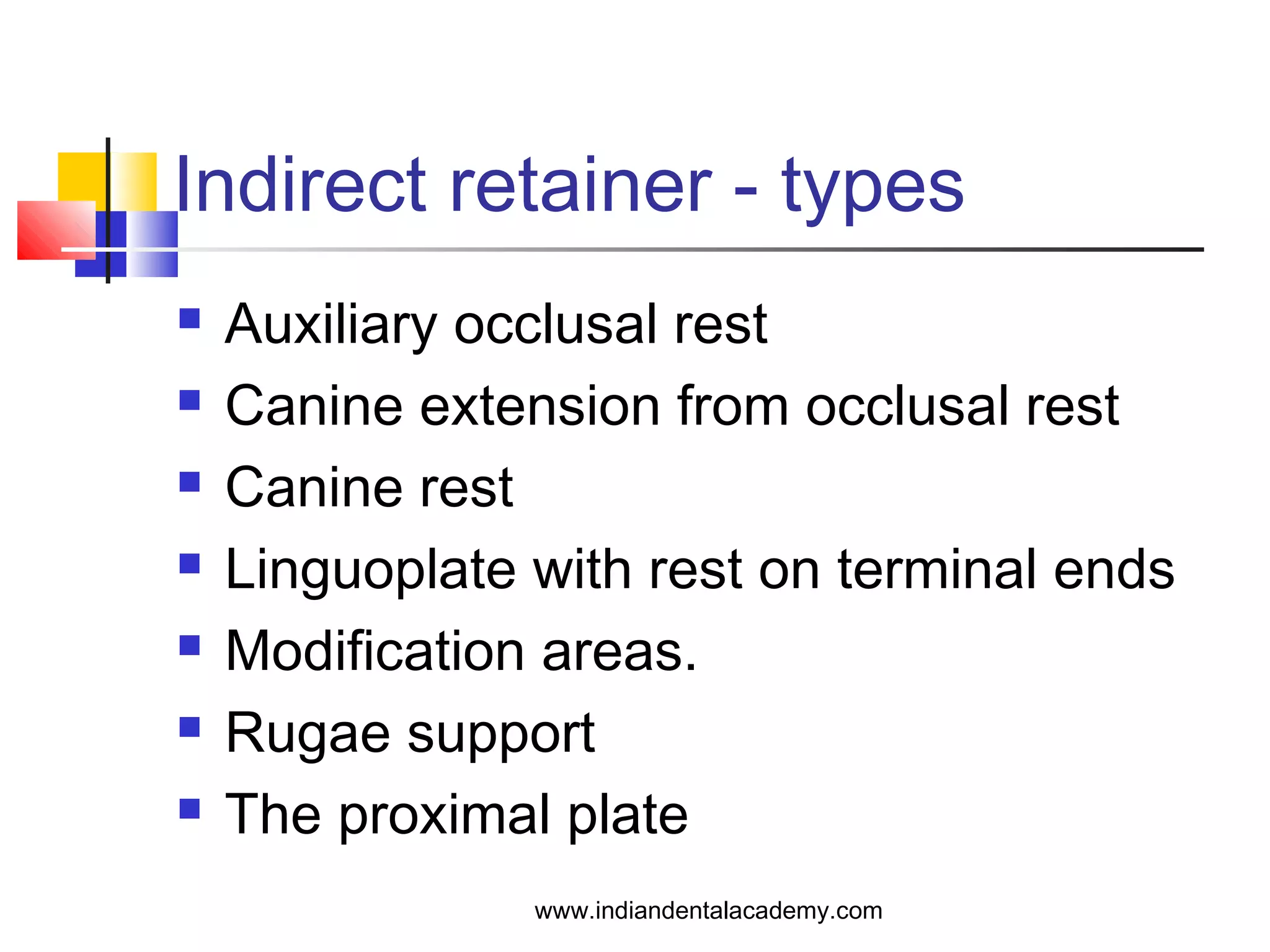
Indirect retainer - types
 Auxiliary occlusal rest
 Canine extension from occlusal rest
 Canine rest
 Linguoplate with rest on terminal ends
 Modification areas.
 Rugae support
 The proximal plate
www.indiandentalacademy.com
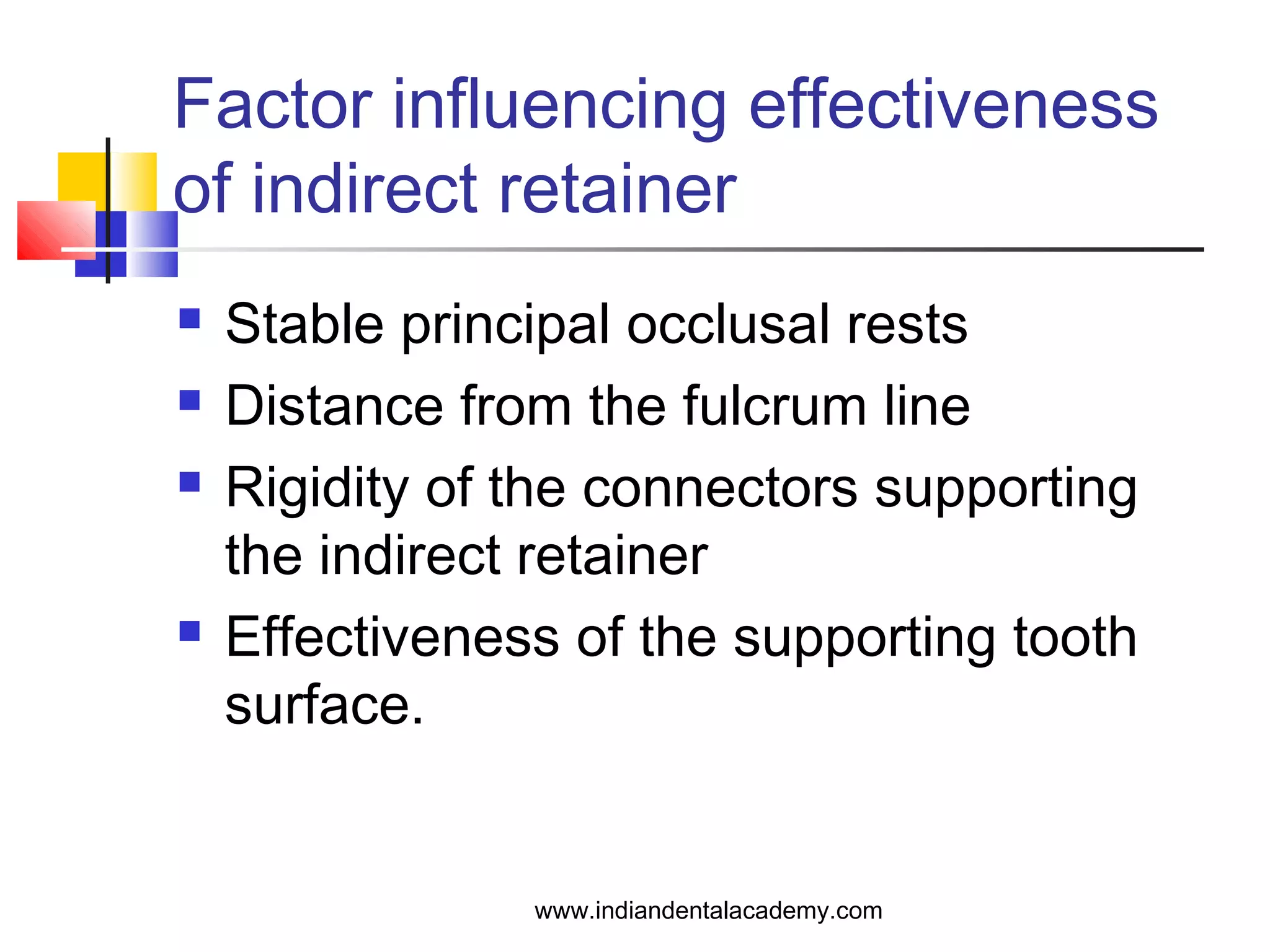
Factor influencing effectiveness
of indirect retainer
 Stable principal occlusal rests
 Distance from the fulcrum line
 Rigidity of the connectors supporting
the indirect retainer
 Effectiveness of the supporting tooth
surface.
www.indiandentalacademy.com
CONCLUSION
 We can select any of the clasp
designs but that should be
based on sound biological &
mechanical principles of clasp
designs
www.indiandentalacademy.com
THANK YOU
For more details please visit
www.indiandentalacademy.com

Retainers in RPD/ Labial orthodontics

  • 1.
    Retainers in RPD INDIANDENTAL ACADEMY Leader in continuing dental education www.indiandentalacademy.com www.indiandentalacademy.com
  • 2.
     Retention canbe defined as that quality inherent in a prosthesis that resists the vertical forces of dislodgement. Or  It is the resistance to removal from vertical forces which tend to dislodge prosthesis away from its foundation. www.indiandentalacademy.com
  • 3.
     Retention forremovable partial denture is achieved primarily by  Mechanical means (Direct & indirect retainers)  Harnessing the patient’s muscular control acting through polished surfaces of denture  Using inherent physical forces which arise from coverage of mucosa by the denture www.indiandentalacademy.com
  • 4.
    Movement of partialdenture Distal extension partial denture can move along three axis.  Rotation about an axis through the most posterior abutments, www.indiandentalacademy.com
  • 5.
    Movement of partialdenture  Rotation about a longitudinal axis as the distal extension base moves in a rotary direction about the residual ridge. www.indiandentalacademy.com
  • 6.
    Movement of partialdenture  Rotation about an imaginary vertical axis near the centre of the dental arch. www.indiandentalacademy.com
  • 7.
    Retainers  Direct retainer Intracoronal  Extracoronal  Indirect Retainer www.indiandentalacademy.com
  • 8.
    Intracoronal retainers  Prefabricated Provide retention by frictional resistance www.indiandentalacademy.com
  • 9.
    Intracoronal retainers Advantage  Batteresthetics  Better vertical support trough a rest seat located more favorably in relation to horizontal axis of the abutment tooth  Horizontal stabilization is similar to that of an internal rest www.indiandentalacademy.com
  • 10.
    Intracoronal retainers Disadvantages  Requireprepared abutments and castings  Require somewhat complicated clinical and laboratory procedures  They eventually wear with resulting loss in retention  Difficult to repair and replace  Effective in proportion to their length and are therefore least effective on short teeth  Difficult to place completely within the circumference of an abutment tooth  More expensive www.indiandentalacademy.com
  • 11.
    Extracoronal direct retainer Prefabricated- Dalbo  Custom made- Clasp www.indiandentalacademy.com
  • 12.
    Clasp retainer Component  Occlusalrest  Retentive arm  Reciprocal arm  Minor connector www.indiandentalacademy.com
  • 13.
    Amount of retention Size of angle of cervical convergence  How far clasp arm is place in cervical convergence  Flexibility of clasp arm  It’s length  It’s relative diameter  It’s cross-sectional form  Material of clasp arm www.indiandentalacademy.com
  • 14.
  • 15.
    Angle of cervicalconvergence  Area cervical to height of contour  Amount of convergence – relative to path of placement and removal  A definitive path of placement is possible- guiding planes. www.indiandentalacademy.com
  • 16.
    How far clasparm is place in cervical convergence  Relative uniformity of retention  Location of clasp arm in relation to angle of cervical convergence, not in relation to height of contour. www.indiandentalacademy.com
  • 17.
    Flexibility of clasparm  Length α Flexibility  Diameter 1/ α Flexibility www.indiandentalacademy.com
  • 18.
    Flexibility of clasparm  Cross sectional form  Half round form →Unidirectional  Round form →universal  Material of clasp: Wrought wire > cast gold > chrome alloys www.indiandentalacademy.com
  • 19.
    Stabilizing- reciprocal castclasp arm  It should be rigid  It should taper in one dimension only  It’s average diameter must be greater then retentive arm www.indiandentalacademy.com
  • 20.
    REQUIREMENTS OF CLASP DESIGN Retention  Stability  Support  Reciprocation  Encirclement  Passivity www.indiandentalacademy.com
  • 21.
    Basic principles ofclasp design  More than 180° of the greatest circumference of the crown of the tooth must be included  Continuous contact  Three widely separated area  Occusal rest must be designed  Each retentive terminal must oppose a reciprocal component. www.indiandentalacademy.com
  • 22.
    Basic principles ofclasp design  Positive guiding planes  Retentive clasps should be bilaterally opposed  Path of escapement of each retentive clasp must be other then parallel to path of removal of the prosthesis. www.indiandentalacademy.com
  • 23.
    Basic principles ofclasp design  Amount of retention should always be minimum necessary  Clasp retainer should not transmit off-vertical forces to the abutment tooth.  Reciprocal element →at the junction of gingival and middle thirds  Terminal end or retentive arm →Gingival third www.indiandentalacademy.com
  • 24.
    Type of clasps Circumferential clasp  Ring clasp  Embrasure clasp  Multiple clasp  Half- and –half clasp  Reverse action clasp  Bar clasp or RPI clasp www.indiandentalacademy.com
  • 25.
    Circumferential clasp  Thisclasp consists of occlusal rest & a buccal and lingual arm originating from a common body www.indiandentalacademy.com
  • 26.
    Circumferential clasp  Mostlogical clasp for tooth supported partial dentures because of excellent support, bracing and retentive qualities  Can be used in a wide variety of situations www.indiandentalacademy.com
  • 27.
    Circumferential clasp Disadvantages  Moretooth coverage  It’s occlusal approach may increase the width of occlusal surface of the tooth  More metal may be displayed than bar clasp  It’s half round form prevents to increase or decrease retention www.indiandentalacademy.com
  • 28.
    Ring clasp  Encirclesnearly all of a tooth from it’s point of origin  Indications: Tipped molars were a proximal undercut cannot be approached by any other means www.indiandentalacademy.com
  • 29.
    Embrasure clasp  Essentiallytwo simple circlet clasp joined at the body www.indiandentalacademy.com
  • 30.
    Multiple clasp  Simplytwo opposing circumferential clasps joined at the terminal end of the two reciprocal arms www.indiandentalacademy.com
  • 31.
    Half- and –halfclasp  It consists of a circumferential retentive arm arising from one direction and reciprocal arm arising from another  The second arm must arise from a second minor connector and is with or without occlusal rest www.indiandentalacademy.com
  • 32.
    Reverse-action clasp  Whenretentive undercut is adjacent to occusal rest  Bar clasp cannot be used because of soft tissue undercut  Ring clasp cannot be used due to lingual undercut www.indiandentalacademy.com
  • 33.
    Bar clasp  Thebar clasps approach the undercut or retentive area on the tooth from a gingival direction  Flexibility of bar clasp → taper and length of approach arm www.indiandentalacademy.com
  • 34.
    Bar clasp DISADVANTAGES  Greatertendency to trap food debris  Does not contribute as much to bracing and stabilization as most circumferential clasps do www.indiandentalacademy.com
  • 35.
    Bar clasp  Classifiedas  T. Modofied T,I, or Y www.indiandentalacademy.com
  • 36.
  • 37.
    RPI system Three approachfor the application of RPI system www.indiandentalacademy.com
  • 38.
    RPI system  Proximalplate contact 1mmgingival portion of GP www.indiandentalacademy.com
  • 39.
    RPI system  RPAClasp www.indiandentalacademy.com
  • 40.
    Combination clasp  Itis a circumferential clasp, but bar clasp may be used  wrought wire retentive clasp arm and a cast reciprocal clasp arm  If high heat chrome alloy is used, the wrought wire must be soldered to the completed framework www.indiandentalacademy.com
  • 41.
  • 42.
    How to selecta clasp design  It’s flexibility  Stabilization for horizontal & rotational forces  Sufficient rigidity  Applicable to malposed or rotated tooth  Presence or absence of tissue undercut www.indiandentalacademy.com
  • 43.
    How to selecta clasp design  Clasp terminal is adjustable or not  Area to be covered by clasp  Effect on width of occlusal table  Can it be replaced. www.indiandentalacademy.com
  • 44.
    Indirect Retainers  Restrictthe movement of denture base away from basal seat, as it tend to rotate around one of the fulcurum line .  Rigid unit of partial denture framework, that are located on definite rest seats on the opposite side of fulcurum line from the distal extension base .  Theses component should be placed as far as possible from fulcurum line for best possible leverage. www.indiandentalacademy.com
  • 45.
    Movement of partialdenture www.indiandentalacademy.com
  • 46.
    Fulcurum line  Thisis an imaginary line passing through teeth and component part of partial denture, around which denture rotates slightly when subjected to various forces directed towards or away from the residual ridges. www.indiandentalacademy.com
  • 47.
    Indirect retainer -types  Auxiliary occlusal rest  Canine extension from occlusal rest  Canine rest  Linguoplate with rest on terminal ends  Modification areas.  Rugae support  The proximal plate www.indiandentalacademy.com
  • 48.
    Factor influencing effectiveness ofindirect retainer  Stable principal occlusal rests  Distance from the fulcrum line  Rigidity of the connectors supporting the indirect retainer  Effectiveness of the supporting tooth surface. www.indiandentalacademy.com
  • 49.
    CONCLUSION  We canselect any of the clasp designs but that should be based on sound biological & mechanical principles of clasp designs www.indiandentalacademy.com
  • 50.
    THANK YOU For moredetails please visit www.indiandentalacademy.com www.indiandentalacademy.com