OCCLUSION
IN
PROSTHODONTICS
Dr. Aeysha Siddika
FCPS (Trainee)
Department of prosthodontics
Faculty of Dentistry
BSMMU
OCCLUSION
The static relationship between the
incising or masticating
surfaces of the maxillary or mandibular
teeth or tooth
analogues.
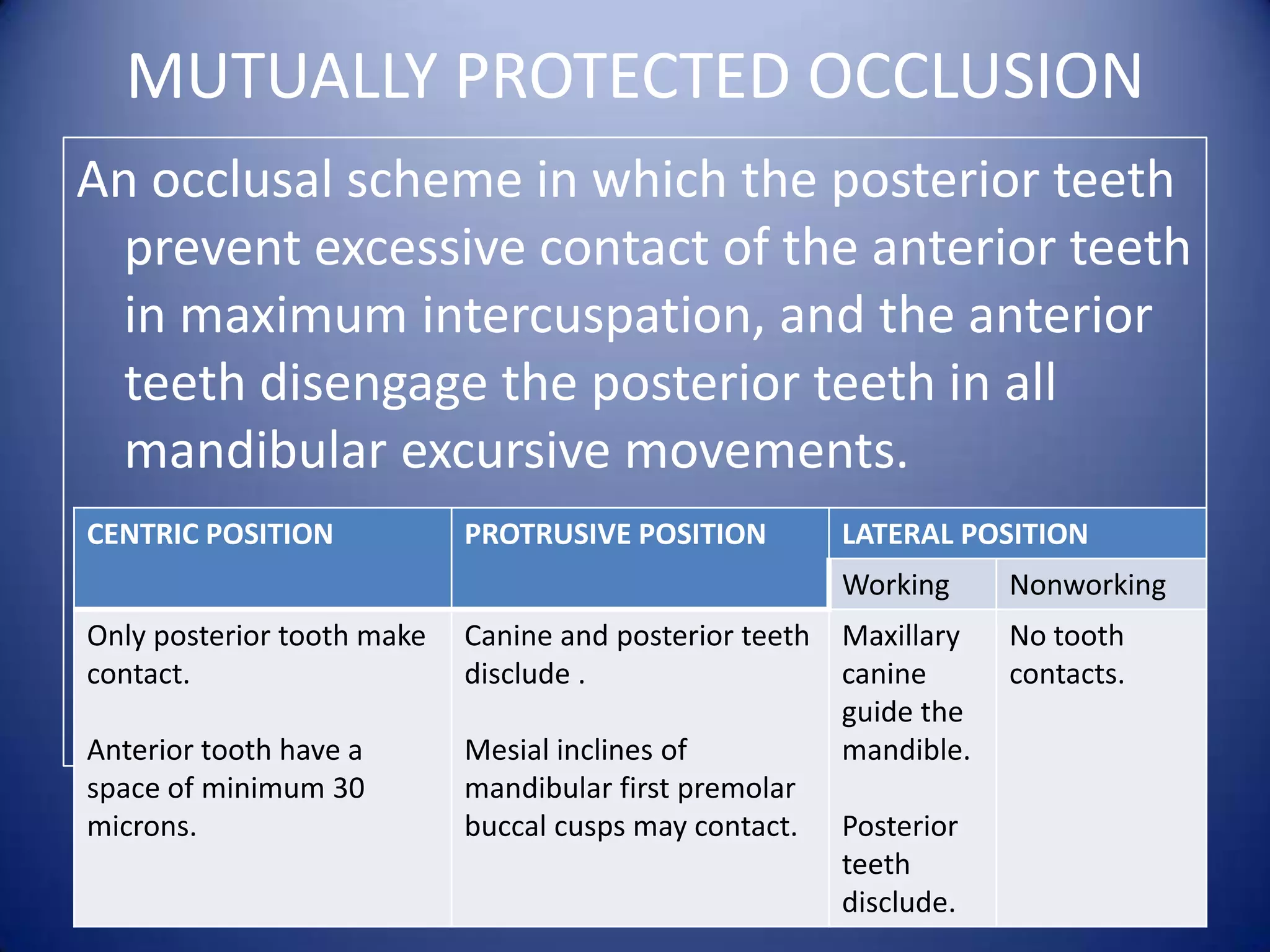
MUTUALLY PROTECTED OCCLUSION
An occlusal scheme in which the posterior teeth
prevent excessive contact of the anterior teeth
in maximum intercuspation, and the anterior
teeth disengage the posterior teeth in all
mandibular excursive movements.
CENTRIC POSITION PROTRUSIVE POSITION LATERAL POSITION
Working Nonworking
Only posterior tooth make
contact.
Anterior tooth have a
space of minimum 30
microns.
Canine and posterior teeth
disclude .
Mesial inclines of
mandibular first premolar
buccal cusps may contact.
Maxillary
canine
guide the
mandible.
Posterior
teeth
disclude.
No tooth
contacts.
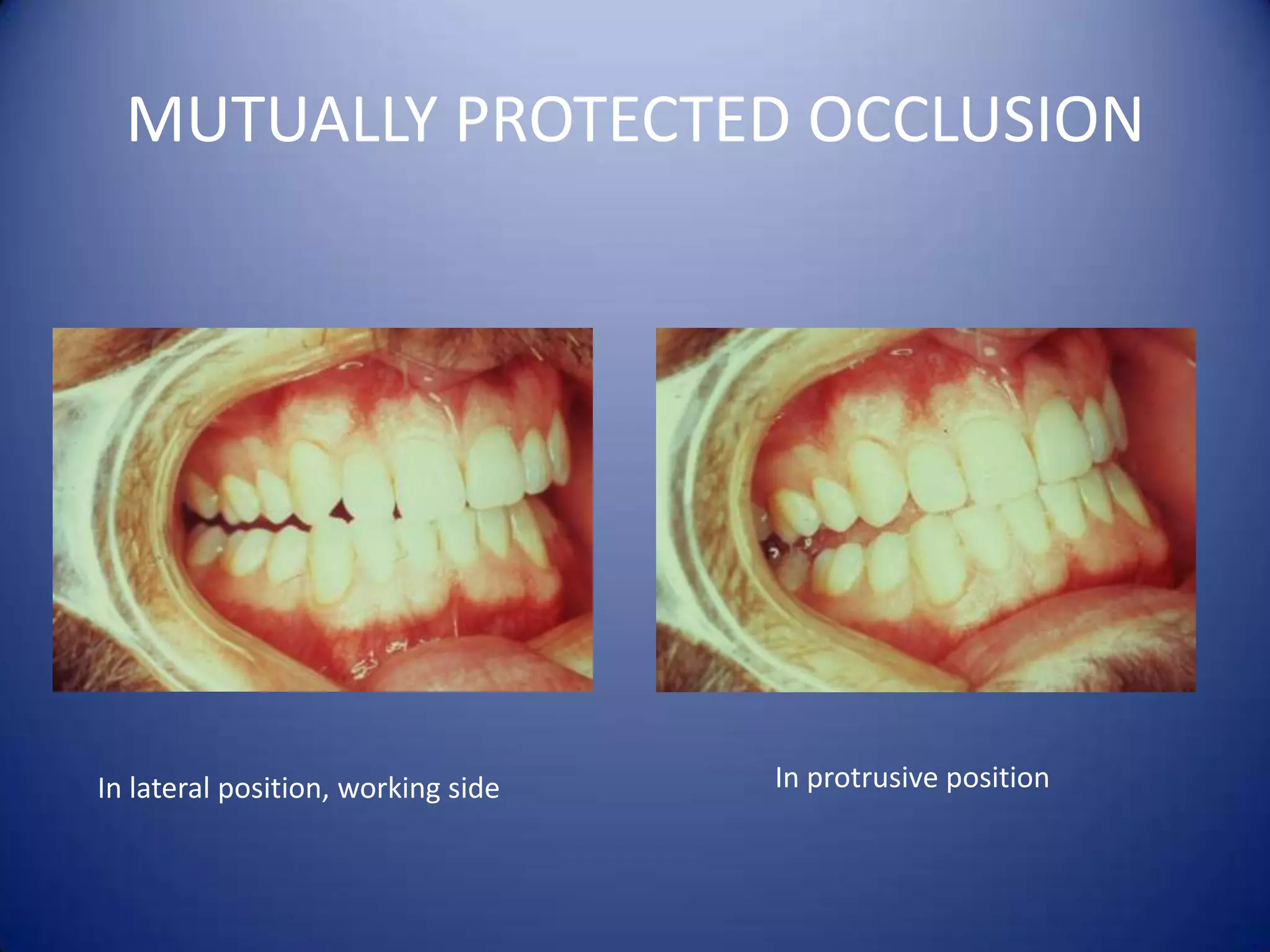
MUTUALLY PROTECTED OCCLUSION
In lateral position, working side In protrusive position
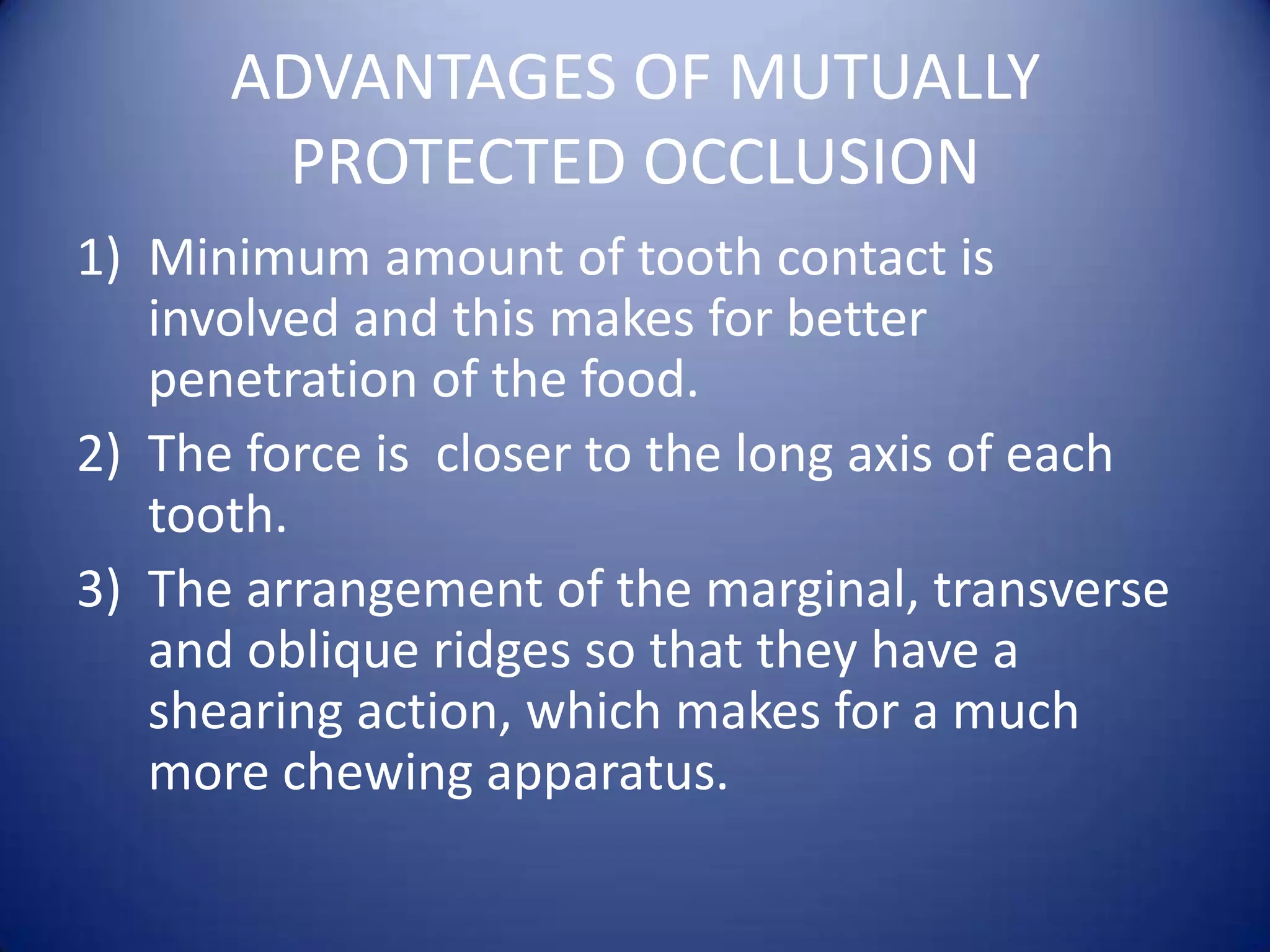
ADVANTAGES OF MUTUALLY
PROTECTED OCCLUSION
1) Minimum amount of tooth contact is
involved and this makes for better
penetration of the food.
2) The force is closer to the long axis of each
tooth.
3) The arrangement of the marginal, transverse
and oblique ridges so that they have a
shearing action, which makes for a much
more chewing apparatus.
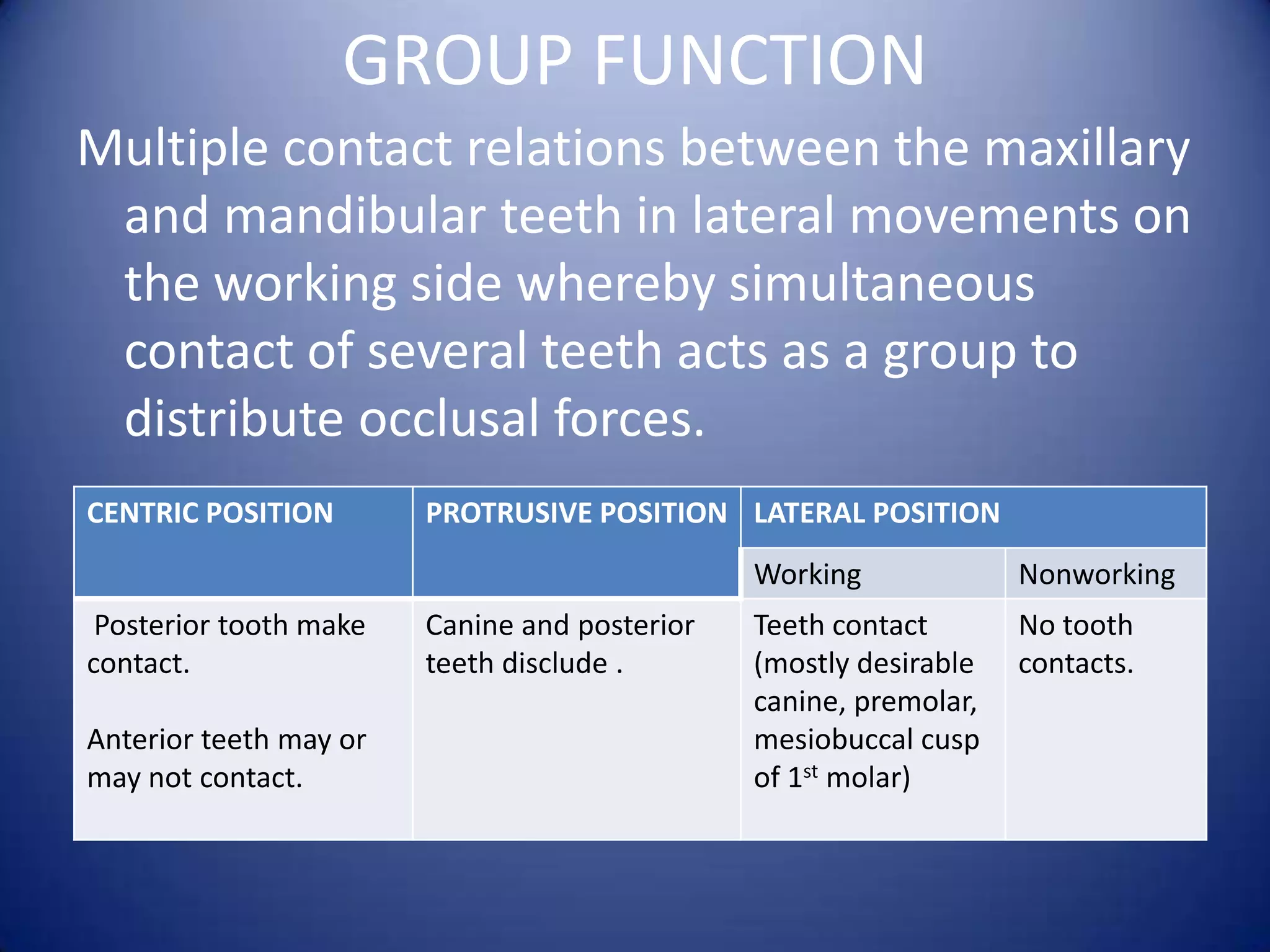
GROUP FUNCTION
Multiple contact relations between the maxillary
and mandibular teeth in lateral movements on
the working side whereby simultaneous
contact of several teeth acts as a group to
distribute occlusal forces.
CENTRIC POSITION PROTRUSIVE POSITION LATERAL POSITION
Working Nonworking
Posterior tooth make
contact.
Anterior teeth may or
may not contact.
Canine and posterior
teeth disclude .
Teeth contact
(mostly desirable
canine, premolar,
mesiobuccal cusp
of 1st molar)
No tooth
contacts.
GROUP FUNCTION
ADVANTAGES OF GROUP FUNCTION
OCLUSION
1) Lateral pressure are distributed to all working
side tooth.
2) Long centric, so allow some freedom of
movement in an anteroposterior direction.
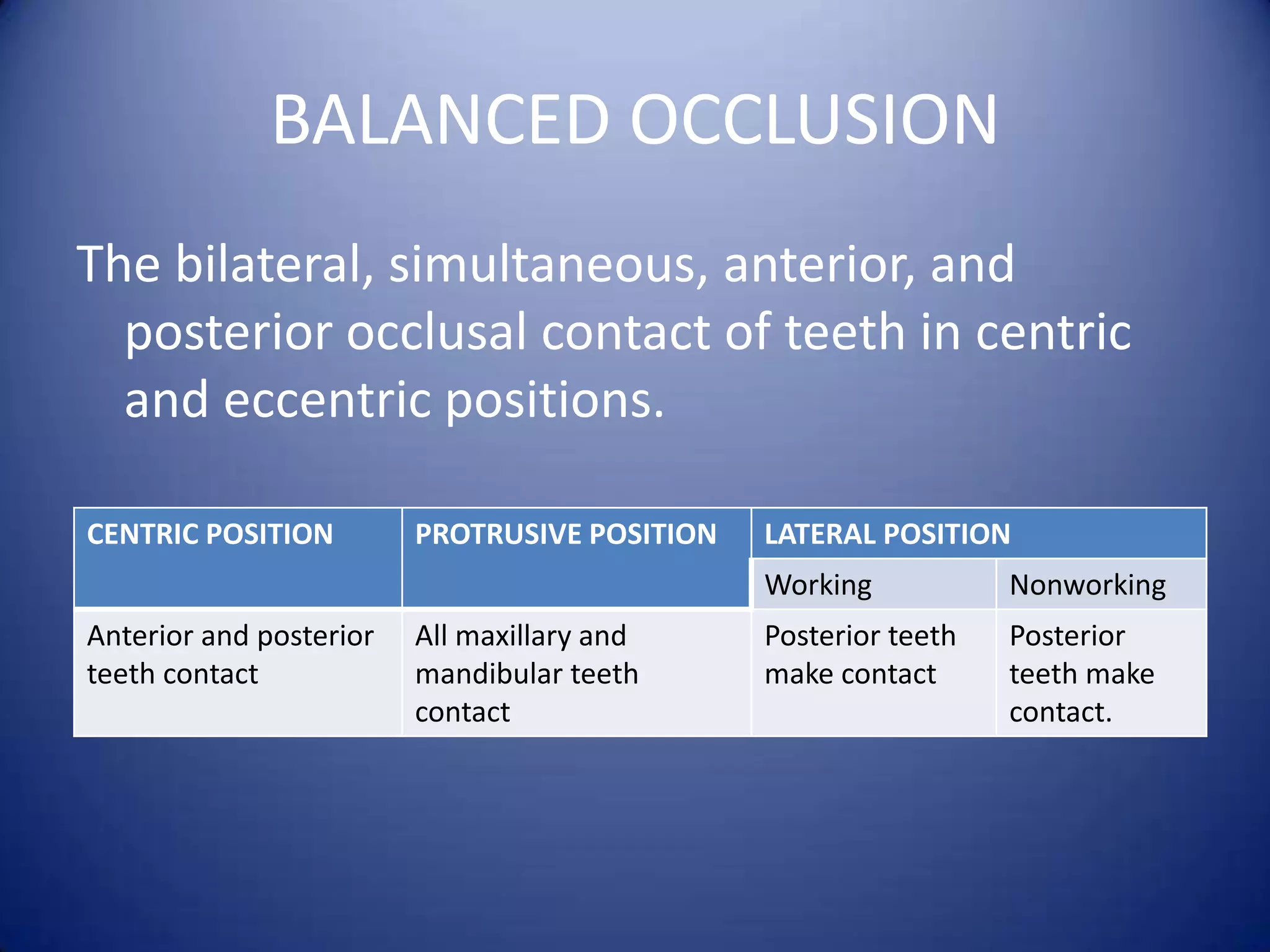
BALANCED OCCLUSION
The bilateral, simultaneous, anterior, and
posterior occlusal contact of teeth in centric
and eccentric positions.
CENTRIC POSITION PROTRUSIVE POSITION LATERAL POSITION
Working Nonworking
Anterior and posterior
teeth contact
All maxillary and
mandibular teeth
contact
Posterior teeth
make contact
Posterior
teeth make
contact.
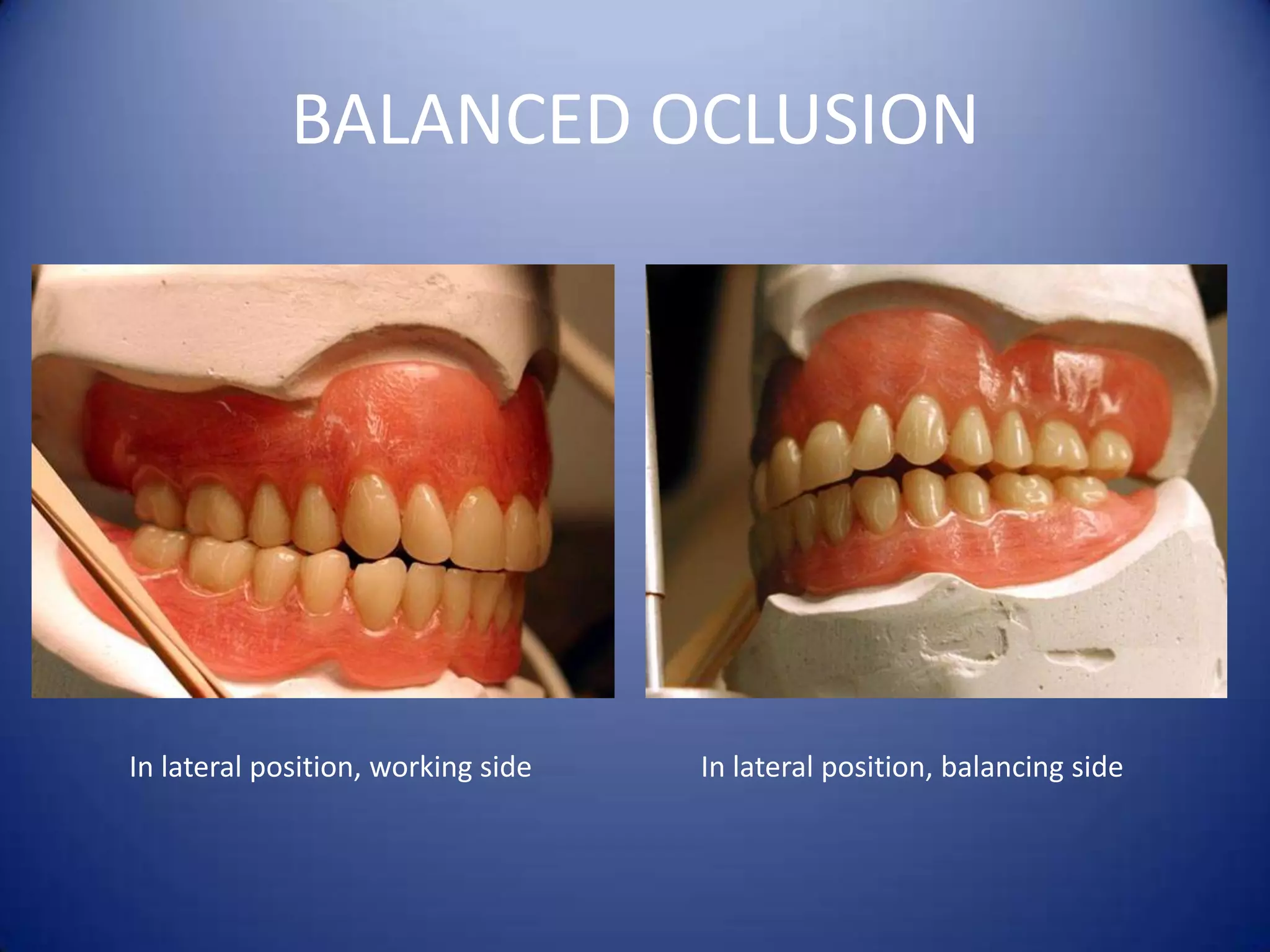
BALANCED OCLUSION
In lateral position, working side In lateral position, balancing side
ADVANTAGES OF BALANCED
OCCLUSION
1) Help to seat the denture in a stable position
during function.
2) Patients do not upset the normal static,
stable, and retentive position of their
dentures.
3) In balanced occlusion, the denture bases are
stable during bruxing activity.
OCCLUSION IN NATURAL DENTITION
• Posterior disclusion on protrusion
• Disclusion on non working side during lateral
movement.
• Occlusion on working side (either canine
guided/group function) during lateral
movement.
DESIRABLE OCCLUSION FOR
COMPLETE DENTURE
1) Stability of occlusion in centric relation.
2) Balanced for all eccentric contacts bilaterally
for all eccentric mandibular movements
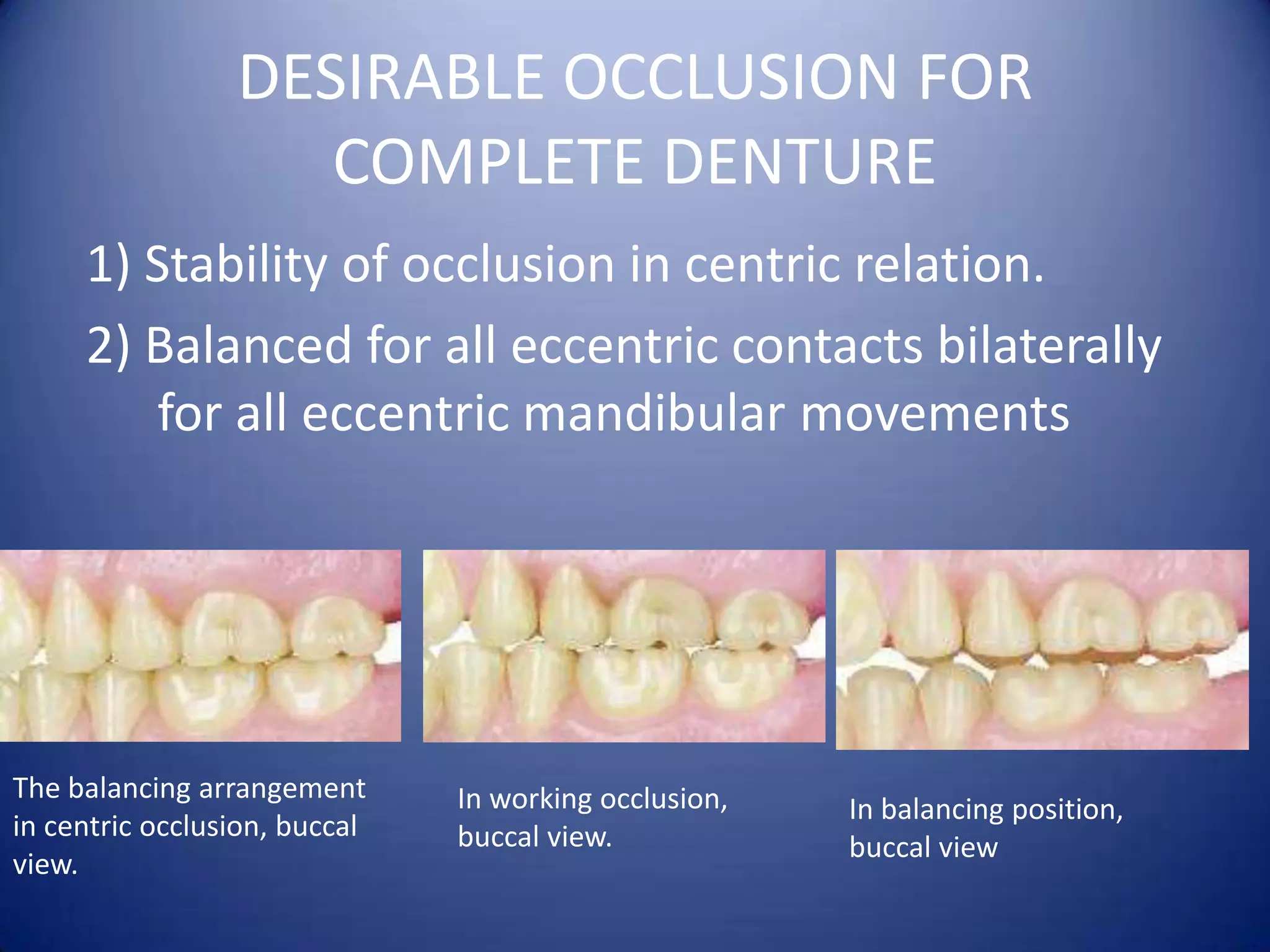
The balancing arrangement
in centric occlusion, buccal
view.
In working occlusion,
buccal view.
In balancing position,
buccal view
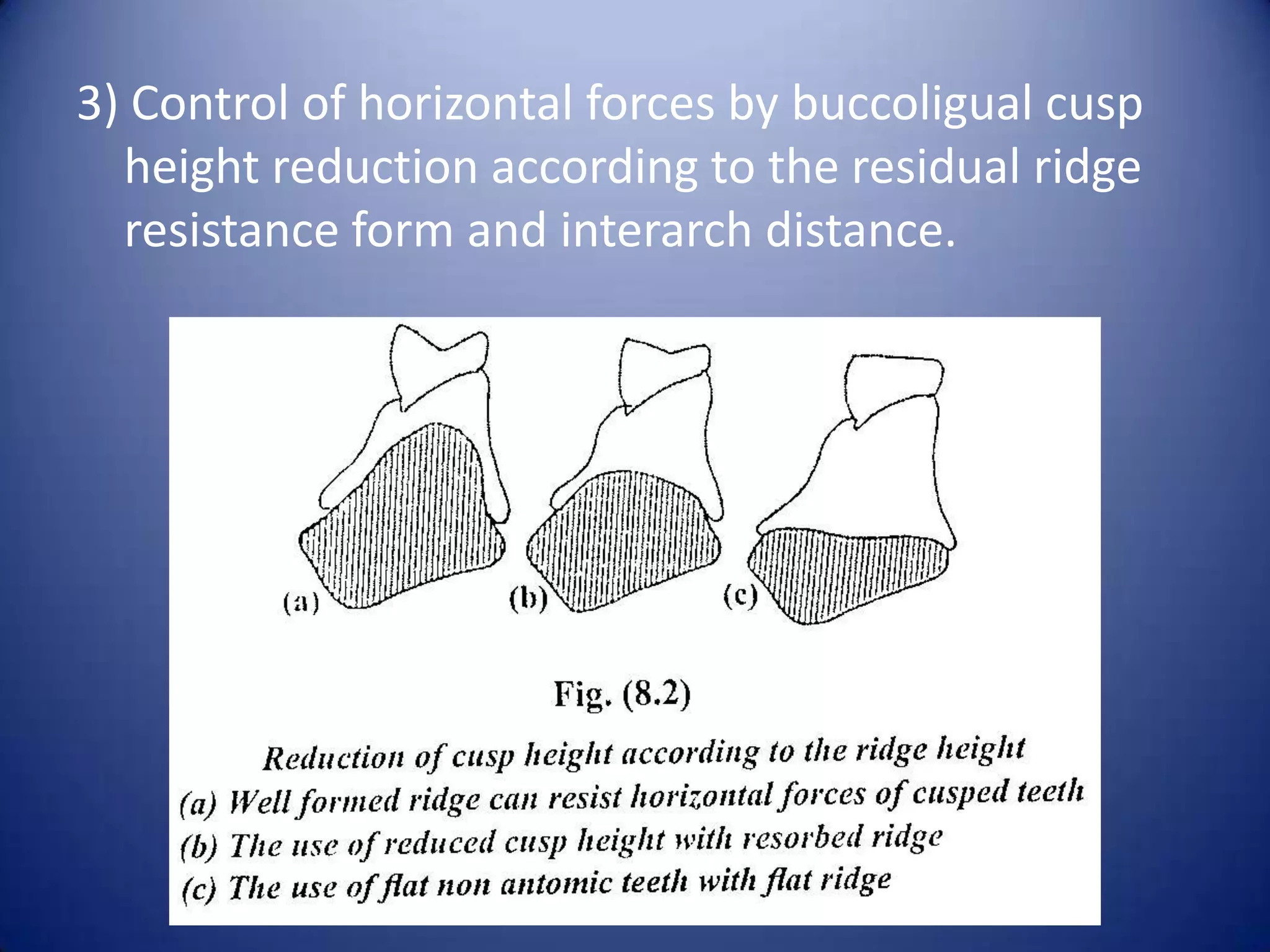
3) Control of horizontal forces by buccoligual cusp
height reduction according to the residual ridge
resistance form and interarch distance.
4) Functional lever balance by favorable tooth to
ridge crest position
5) Unlocking the cusp mesiodistally to allow for
gradual but inevitable settling of the bases due to
tissue deformation and bone resorption.
6) Cutting and shearing efficiency of the occlusal
surface (sharp cusps or ridges).
7) Anterior clearance of teeth during mastication.
Minimum occlusal contact between the upper
and lower teeth to reduce pressure during
function.
DESIRABLE OCCLUSION FOR RPD
**Simultaneous bilateral contacts of opposing posterior
teeth must occur in centric occlusion.
1)Kennedy class-I-
>>> Mandibular RPD opposed by natural dentition.
Contact on working side
No contact on balancing side.
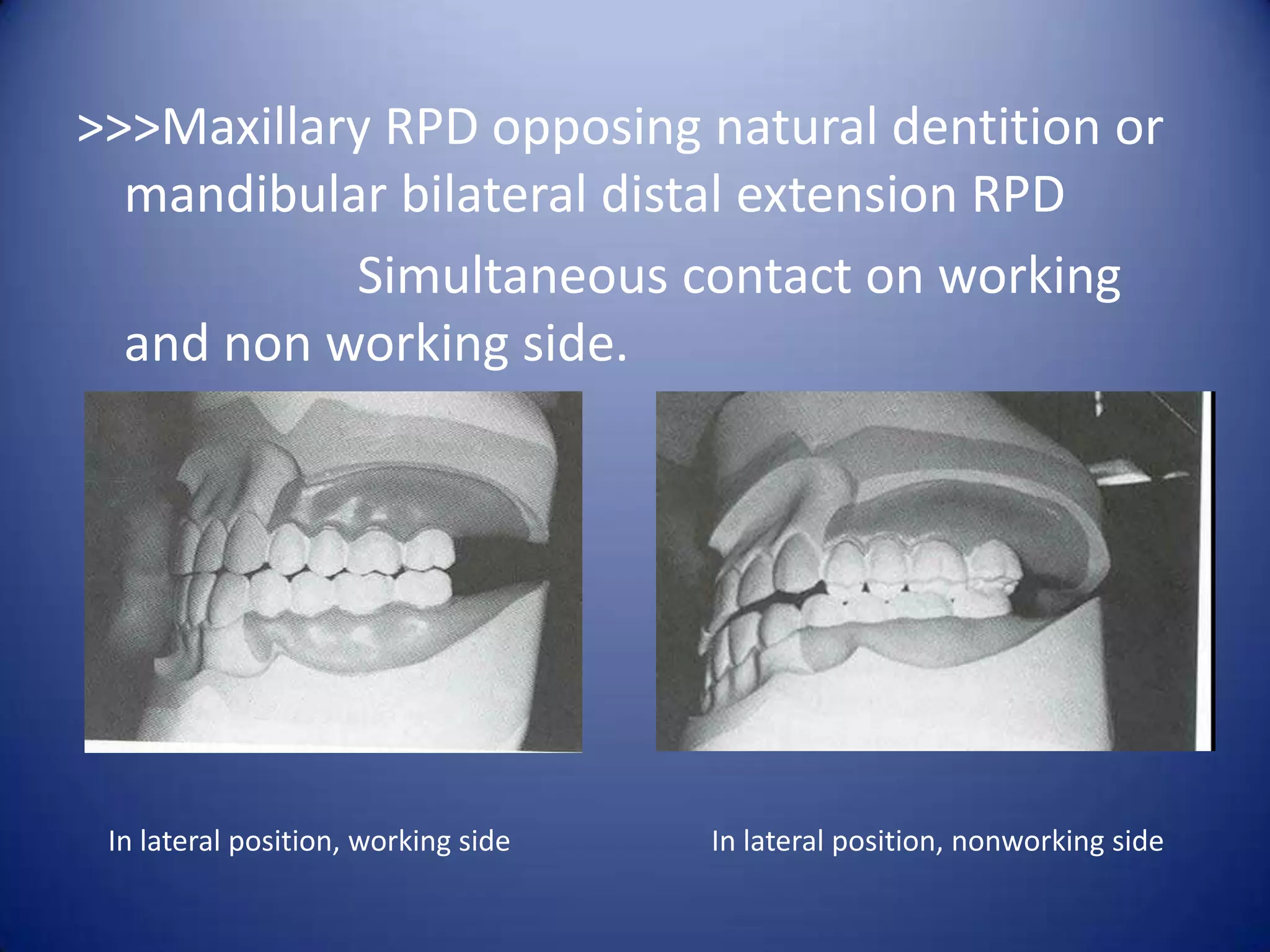
>>>Maxillary RPD opposing natural dentition or
mandibular bilateral distal extension RPD
Simultaneous contact on working
and non working side.
In lateral position, nonworking sideIn lateral position, working side
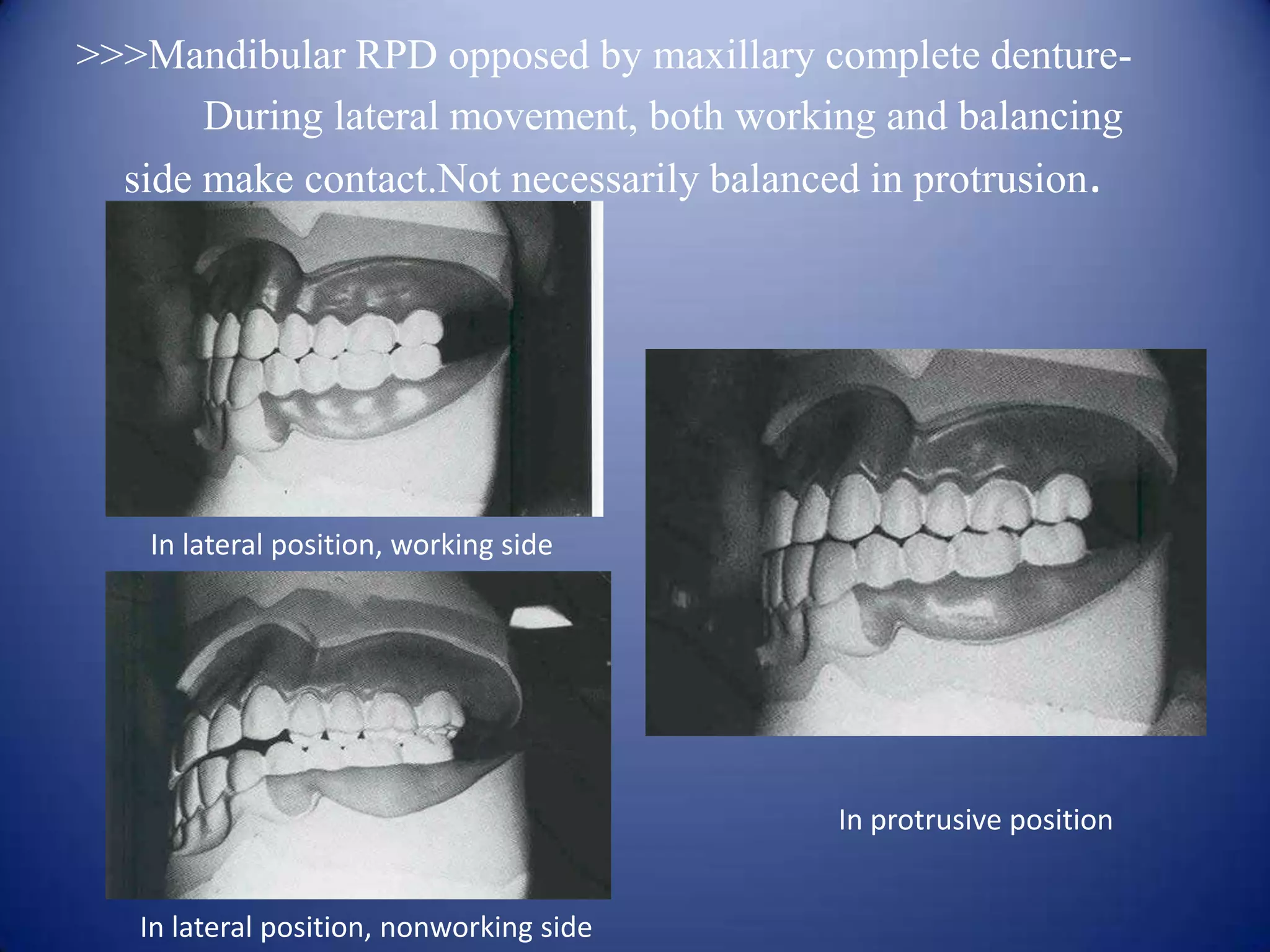
>>>Mandibular RPD opposed by maxillary complete denture-
During lateral movement, both working and balancing
side make contact.Not necessarily balanced in protrusion.
In lateral position, nonworking side
In lateral position, working side
In protrusive position
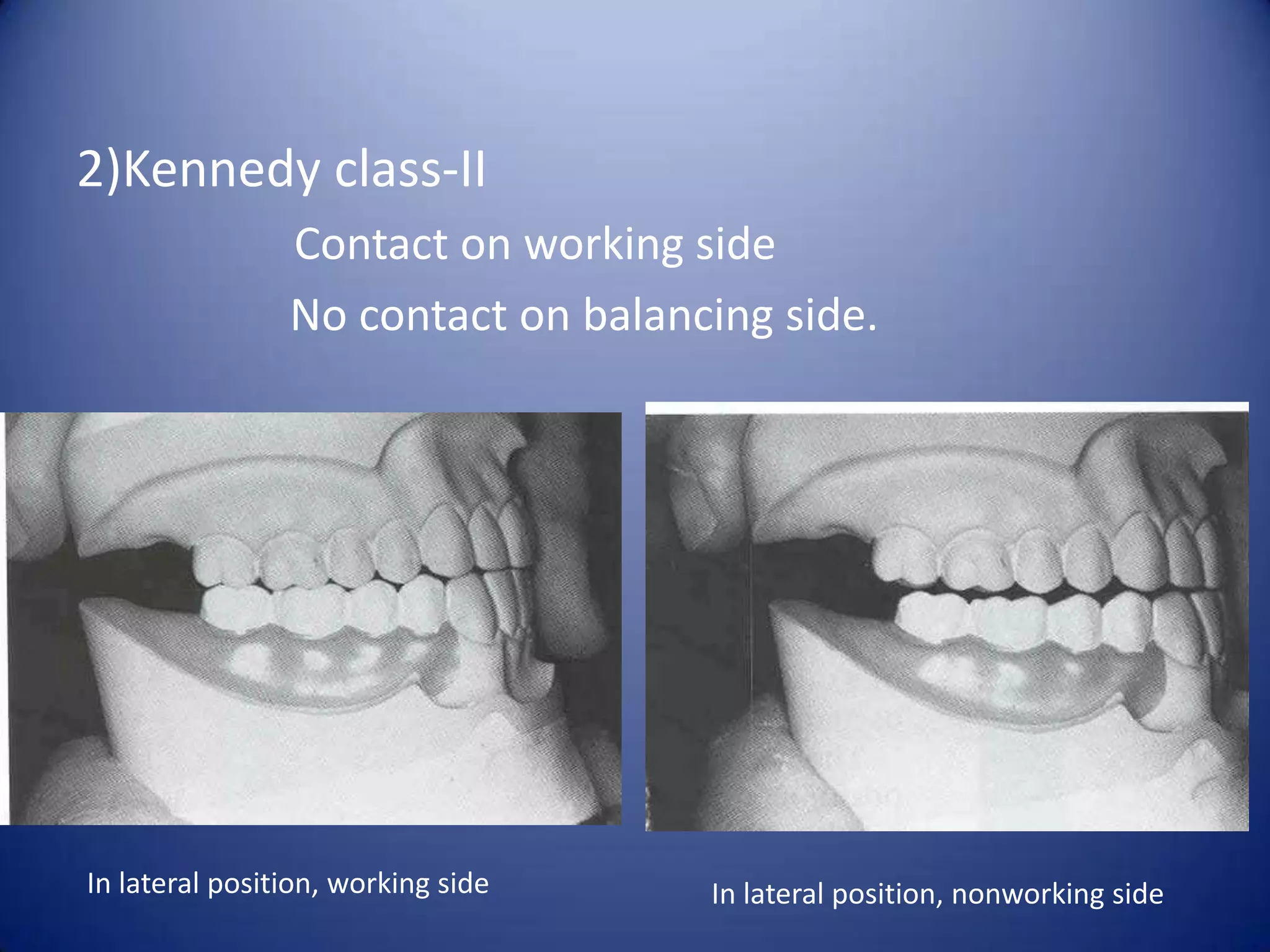
2)Kennedy class-II
Contact on working side
No contact on balancing side.
In lateral position, nonworking sideIn lateral position, working side
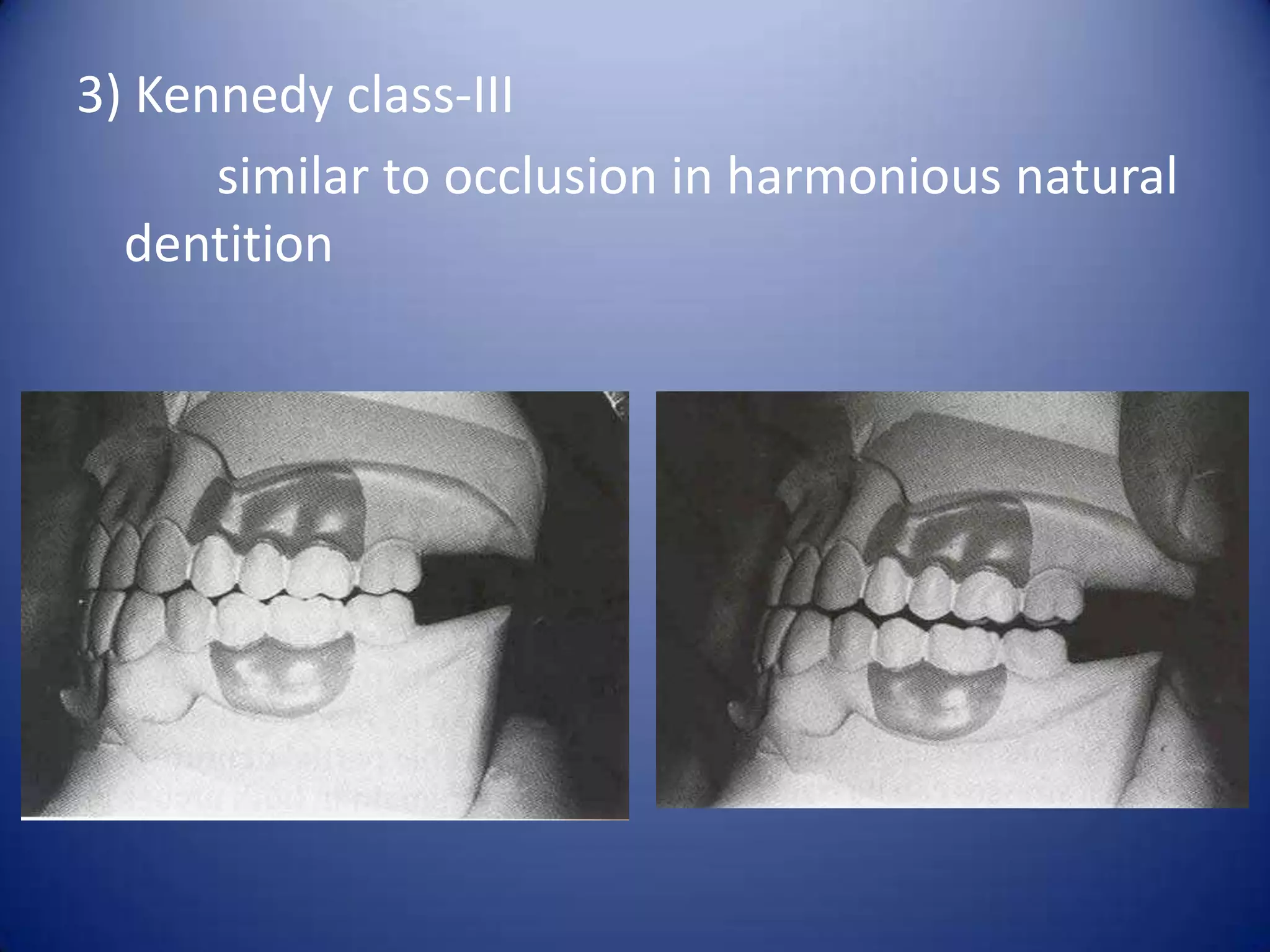
3) Kennedy class-III
similar to occlusion in harmonious natural
dentition
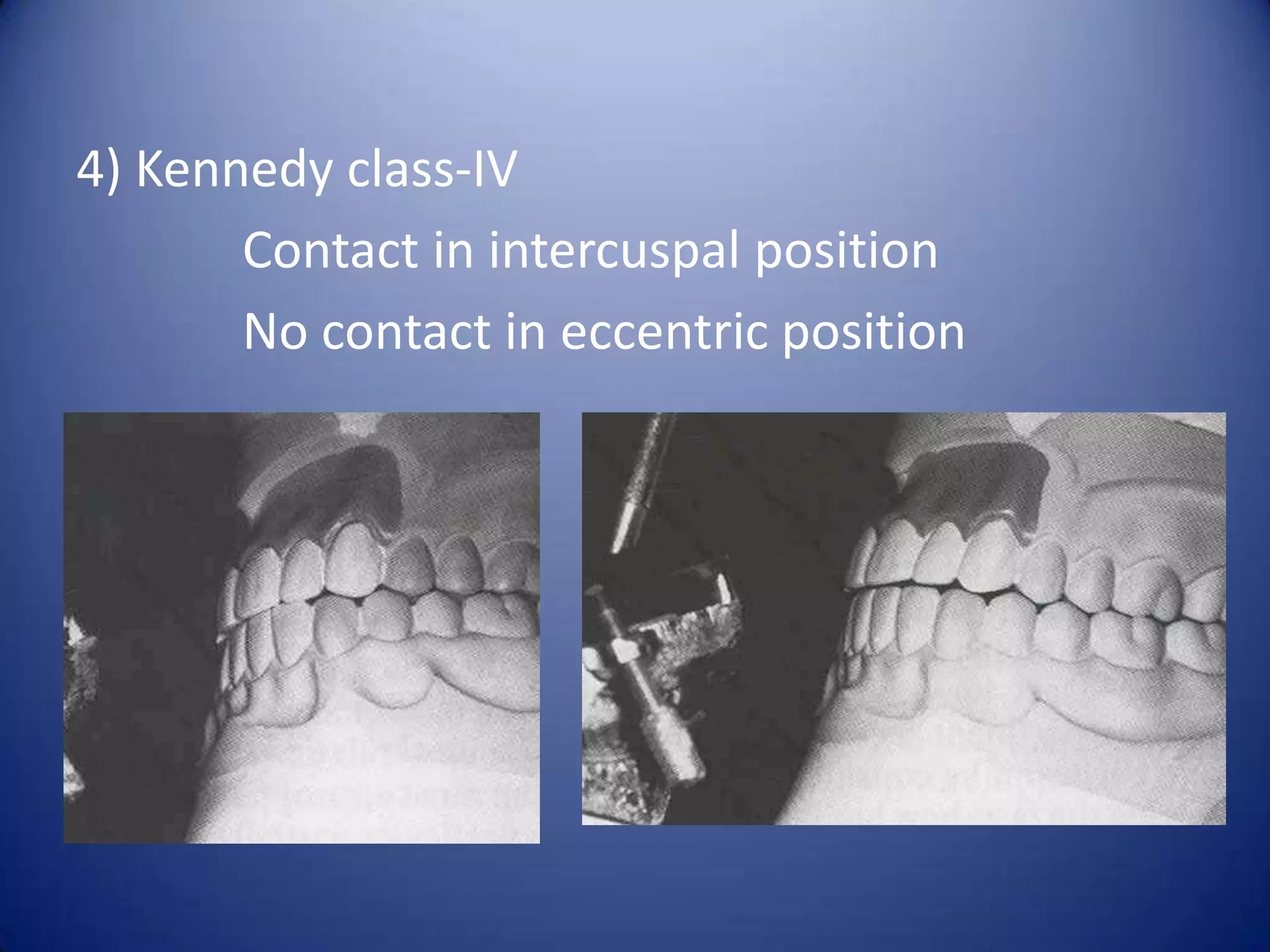
4) Kennedy class-IV
Contact in intercuspal position
No contact in eccentric position
DESIRABLE OCCLUSION FOR FPD
**Similar as occlusion in natural dentition
Either mutually protected or group
function occlusion.
**In the following cases, desirable occlusion should
be group function
-Periodontally compromised supporting
anterior teeth.
-Missing canine
-Angle class-II and class-III malocclusion
-Crossbite
DESIRABLE OCCLUSION FOR
OSSTEOINTEGRATED PROSTHESIS
1) Full-arch fixed prosthesis
Bilateral balanced occlusion with opposing complete
denture
Group function occlusion or mutually protected
occlusion with shallow anterior guidance when opposing
natural dentition
Freedom in centric (1–1.5mm)
2) Overdenture
Bilateral balanced occlusion using lingualized
occlusion
Monoplane occlusion on a severely resorbed ridge
3) Posterior fixed prosthesis
Anterior guidance with natural dentition
Group function occlusion with compromised
canines
Centered contacts, narrow occlusal tables, flat cusps
Cross bite posterior occlusion when necessary
4) Single implant prosthesis
Anterior or lateral guidance with natural dentition
Light contact at heavy bite and no contact at light
bite
Centered contacts (1–1.5mm flat area)
Increased proximal contact
References:
1) JUNHEI FUJIMOTO: CONTEMPORARY FIXED PROSTHODONTICS.
2) HERBERT T. SHILINBURG, FUNDEMENTAL OF FIXED
PROSTHODONTICS.
3) SUMAIYA HOBO: OSSEOINTEGRATION AND OCCLUSAL
REHABILITATION
4) SHELDON WINKLER: ESSENTIALS OF COMPLETE DENTURE
PROSTHODONTICS.
5) DEEPAK NALLASWAMY VEERAIYAN: TEXTBOOK OF
PROSTHODONTICS
6) SOME INFORMATION FROM INTERNATE

Occluion in prosthodontics

  • 1.
    OCCLUSION IN PROSTHODONTICS Dr. Aeysha Siddika FCPS(Trainee) Department of prosthodontics Faculty of Dentistry BSMMU
  • 2.
    OCCLUSION The static relationshipbetween the incising or masticating surfaces of the maxillary or mandibular teeth or tooth analogues.
  • 3.
    MUTUALLY PROTECTED OCCLUSION Anocclusal scheme in which the posterior teeth prevent excessive contact of the anterior teeth in maximum intercuspation, and the anterior teeth disengage the posterior teeth in all mandibular excursive movements. CENTRIC POSITION PROTRUSIVE POSITION LATERAL POSITION Working Nonworking Only posterior tooth make contact. Anterior tooth have a space of minimum 30 microns. Canine and posterior teeth disclude . Mesial inclines of mandibular first premolar buccal cusps may contact. Maxillary canine guide the mandible. Posterior teeth disclude. No tooth contacts.
  • 4.
    MUTUALLY PROTECTED OCCLUSION Inlateral position, working side In protrusive position
  • 5.
    ADVANTAGES OF MUTUALLY PROTECTEDOCCLUSION 1) Minimum amount of tooth contact is involved and this makes for better penetration of the food. 2) The force is closer to the long axis of each tooth. 3) The arrangement of the marginal, transverse and oblique ridges so that they have a shearing action, which makes for a much more chewing apparatus.
  • 6.
    GROUP FUNCTION Multiple contactrelations between the maxillary and mandibular teeth in lateral movements on the working side whereby simultaneous contact of several teeth acts as a group to distribute occlusal forces. CENTRIC POSITION PROTRUSIVE POSITION LATERAL POSITION Working Nonworking Posterior tooth make contact. Anterior teeth may or may not contact. Canine and posterior teeth disclude . Teeth contact (mostly desirable canine, premolar, mesiobuccal cusp of 1st molar) No tooth contacts.
  • 7.
  • 8.
    ADVANTAGES OF GROUPFUNCTION OCLUSION 1) Lateral pressure are distributed to all working side tooth. 2) Long centric, so allow some freedom of movement in an anteroposterior direction.
  • 9.
    BALANCED OCCLUSION The bilateral,simultaneous, anterior, and posterior occlusal contact of teeth in centric and eccentric positions. CENTRIC POSITION PROTRUSIVE POSITION LATERAL POSITION Working Nonworking Anterior and posterior teeth contact All maxillary and mandibular teeth contact Posterior teeth make contact Posterior teeth make contact.
  • 10.
    BALANCED OCLUSION In lateralposition, working side In lateral position, balancing side
  • 11.
    ADVANTAGES OF BALANCED OCCLUSION 1)Help to seat the denture in a stable position during function. 2) Patients do not upset the normal static, stable, and retentive position of their dentures. 3) In balanced occlusion, the denture bases are stable during bruxing activity.
  • 12.
    OCCLUSION IN NATURALDENTITION • Posterior disclusion on protrusion • Disclusion on non working side during lateral movement. • Occlusion on working side (either canine guided/group function) during lateral movement.
  • 13.
    DESIRABLE OCCLUSION FOR COMPLETEDENTURE 1) Stability of occlusion in centric relation. 2) Balanced for all eccentric contacts bilaterally for all eccentric mandibular movements The balancing arrangement in centric occlusion, buccal view. In working occlusion, buccal view. In balancing position, buccal view
  • 14.
    3) Control ofhorizontal forces by buccoligual cusp height reduction according to the residual ridge resistance form and interarch distance.
  • 15.
    4) Functional leverbalance by favorable tooth to ridge crest position
  • 16.
    5) Unlocking thecusp mesiodistally to allow for gradual but inevitable settling of the bases due to tissue deformation and bone resorption. 6) Cutting and shearing efficiency of the occlusal surface (sharp cusps or ridges). 7) Anterior clearance of teeth during mastication. Minimum occlusal contact between the upper and lower teeth to reduce pressure during function.
  • 17.
    DESIRABLE OCCLUSION FORRPD **Simultaneous bilateral contacts of opposing posterior teeth must occur in centric occlusion. 1)Kennedy class-I- >>> Mandibular RPD opposed by natural dentition. Contact on working side No contact on balancing side.
  • 18.
    >>>Maxillary RPD opposingnatural dentition or mandibular bilateral distal extension RPD Simultaneous contact on working and non working side. In lateral position, nonworking sideIn lateral position, working side
  • 19.
    >>>Mandibular RPD opposedby maxillary complete denture- During lateral movement, both working and balancing side make contact.Not necessarily balanced in protrusion. In lateral position, nonworking side In lateral position, working side In protrusive position
  • 20.
    2)Kennedy class-II Contact onworking side No contact on balancing side. In lateral position, nonworking sideIn lateral position, working side
  • 21.
    3) Kennedy class-III similarto occlusion in harmonious natural dentition
  • 22.
    4) Kennedy class-IV Contactin intercuspal position No contact in eccentric position
  • 23.
    DESIRABLE OCCLUSION FORFPD **Similar as occlusion in natural dentition Either mutually protected or group function occlusion. **In the following cases, desirable occlusion should be group function -Periodontally compromised supporting anterior teeth. -Missing canine -Angle class-II and class-III malocclusion -Crossbite
  • 24.
    DESIRABLE OCCLUSION FOR OSSTEOINTEGRATEDPROSTHESIS 1) Full-arch fixed prosthesis Bilateral balanced occlusion with opposing complete denture Group function occlusion or mutually protected occlusion with shallow anterior guidance when opposing natural dentition Freedom in centric (1–1.5mm) 2) Overdenture Bilateral balanced occlusion using lingualized occlusion Monoplane occlusion on a severely resorbed ridge
  • 25.
    3) Posterior fixedprosthesis Anterior guidance with natural dentition Group function occlusion with compromised canines Centered contacts, narrow occlusal tables, flat cusps Cross bite posterior occlusion when necessary 4) Single implant prosthesis Anterior or lateral guidance with natural dentition Light contact at heavy bite and no contact at light bite Centered contacts (1–1.5mm flat area) Increased proximal contact
  • 26.
    References: 1) JUNHEI FUJIMOTO:CONTEMPORARY FIXED PROSTHODONTICS. 2) HERBERT T. SHILINBURG, FUNDEMENTAL OF FIXED PROSTHODONTICS. 3) SUMAIYA HOBO: OSSEOINTEGRATION AND OCCLUSAL REHABILITATION 4) SHELDON WINKLER: ESSENTIALS OF COMPLETE DENTURE PROSTHODONTICS. 5) DEEPAK NALLASWAMY VEERAIYAN: TEXTBOOK OF PROSTHODONTICS 6) SOME INFORMATION FROM INTERNATE