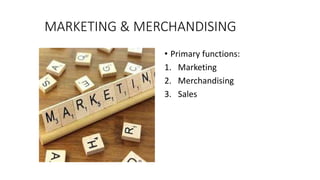
MARKETING & MERCHANDISING
• Primary functions:
1. Marketing
2. Merchandising
3. Sales
• Marketing:
1. It refers to flow of goods from producers to customers
2. It is the function which defines characteristics of company actual &
potential markets and promoting company products and range
3. Marketing manager has an important role in determining market
orientation and product line of the company
• Merchandising:
1. It can be defined as product development and overall production
strategy and delivering the products to customers or buyers
2. Merchandising not only has to adjust to market variations but also
to anticipate the changes in the market
• Sales:
1. It is nothing but taking the product to the customers
2. It has the following:
a. Approaching the customers
b. Determining their requirements
c. Sales presentation preparation
d. Setting objectives
e. Getting the customers to place the order
f. After delivering check the customer satisfaction
• Marketing:
1. Regardless of the size of the company and its organizational
structure marketing functions deals with the following:
a. Marketing calendar
b. Product pricing
c. Product planning
d. customers
• Marketing calendar:
1. It provides operational framework for a season
2. The exact timings and sequence of events will be specified in the
calendar
3. It may include as following:
a. Finalizing collection plan
b. Approving the collection
c. Preparing sales forecast budget
d. Arranging fashion shows or events at national or international
e. Meeting with sales persons
f. Deciding styles and quantities of garments
• Product pricing:
1. The price of the garment is the consensus of its value and at all
times clothing company has to adjust to the market price of the
products
2. This price is determined by the total supply of the product offered
by all sellers against the demand of the product
• The pricing of the garment has 2 stages
a. Price evaluation
b. Bracketing prices
• price evaluation:
1. Conventional costing is not sufficient or it is not going reflect the
actual sales value of the garment
2. There is need to have subjective evaluation of selling prices when
the prices of similar garments in the collection are compared
• Bracketing price:
1. Most buyers for large group work accordingly to retail selling prices
categories for particular types of merchandise in order to cover the
relevant sectors of the market
2. Retail gross margins on regular as against sales merchandise would
vary accordingly to the degree of risk taken in purchasing
• Product planning:
1. It is process of determing the type and variety of garments
produced by the company
2. In this type of traditional economics the types of clothing produced
undergo little change over a long period
3. If economics expands the range of clothing produced tends to
increase and change occurs in products themselves
4. This wide range of products enables a clothing company to find its
own niche in a suitable sector of the market
• Customers:
1. There are different types of customers in the market. Each have
their own characteristics
2. To know better it is to know about the different types of retail &
wholesale organizations
a. Departmental stores g. Independent shops
b. Specialty departmental stores h. specialty whole salers
c. Chain stores
d. Super markets
e. Co-operatives
f. Mail order
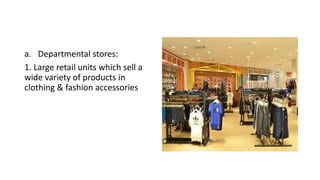
a. Departmental stores:
1. Large retail units which sell a
wide variety of products in
clothing & fashion accessories
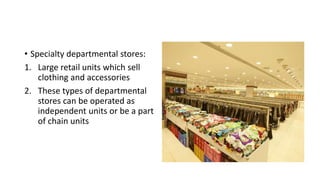
• Specialty departmental stores:
1. Large retail units which sell
clothing and accessories
2. These types of departmental
stores can be operated as
independent units or be a part
of chain units
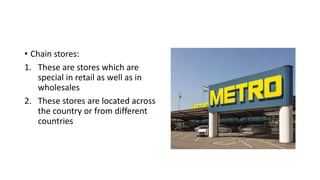
• Chain stores:
1. These are stores which are
special in retail as well as in
wholesales
2. These stores are located across
the country or from different
countries
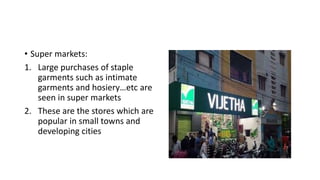
• Super markets:
1. Large purchases of staple
garments such as intimate
garments and hosiery…etc are
seen in super markets
2. These are the stores which are
popular in small towns and
developing cities
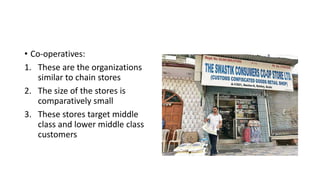
• Co-operatives:
1. These are the organizations
similar to chain stores
2. The size of the stores is
comparatively small
3. These stores target middle
class and lower middle class
customers
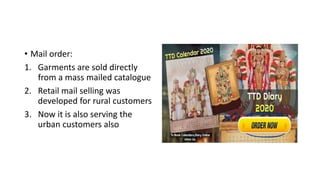
• Mail order:
1. Garments are sold directly
from a mass mailed catalogue
2. Retail mail selling was
developed for rural customers
3. Now it is also serving the
urban customers also
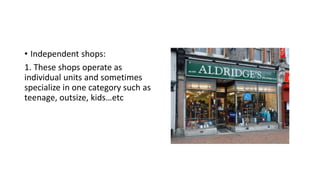
• Independent shops:
1. These shops operate as
individual units and sometimes
specialize in one category such as
teenage, outsize, kids…etc
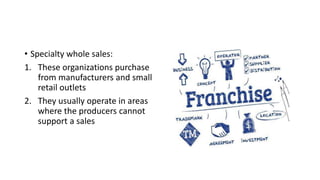
• Specialty whole sales:
1. These organizations purchase
from manufacturers and small
retail outlets
2. They usually operate in areas
where the producers cannot
support a sales
• Merchandising:
1. It is the second major element of marketing
2. It is the physical movement of merchandise from factory to retail
stores
3. Most companies use direct channels of distribution i.e directly to
retail outlets or their nominated distributors
4. They are also responsible for warehousing of the finished goods,
allocating customer orders, packing the orders, transport the
orders, tracking the inventory…etc
• Four channels of communication:
1. Advertising
2. Selling
3. Personal selling
4. presentations
• Advertising:
1. This is the non-personal presentation of goods by a name or brand
2. Some of the media used for advertising are newspapers, magazines,
poster, radio, t.v….etc.
3. They need to develop strong brand or corporate image which put the
company or brand on strong hold
• Selling:
1. The selling can be achieved through the following channels:
a. Show room staff
b. Representatives
c. Agents
Show room staff:
1. These are sales personnel employed by the company & working
centrally located showrooms
2. They serve visiting & call on major customers
• representatives:
1. Unlike showroom staff the representatives visit all their customers
in their own premises and generally deal with small retailers
• Agents:
1. These are independent selling organizations who can represent a
number of manufacturers producing non-competing types of
merchandise
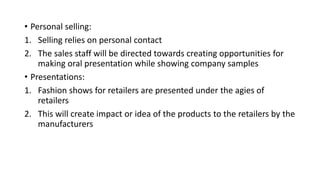
• Personal selling:
1. Selling relies on personal contact
2. The sales staff will be directed towards creating opportunities for
making oral presentation while showing company samples
• Presentations:
1. Fashion shows for retailers are presented under the agies of
retailers
2. This will create impact or idea of the products to the retailers by the
manufacturers
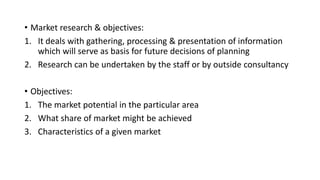
• Market research & objectives:
1. It deals with gathering, processing & presentation of information
which will serve as basis for future decisions of planning
2. Research can be undertaken by the staff or by outside consultancy
• Objectives:
1. The market potential in the particular area
2. What share of market might be achieved
3. Characteristics of a given market
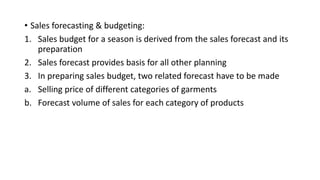
• Sales forecasting & budgeting:
1. Sales budget for a season is derived from the sales forecast and its
preparation
2. Sales forecast provides basis for all other planning
3. In preparing sales budget, two related forecast have to be made
a. Selling price of different categories of garments
b. Forecast volume of sales for each category of products
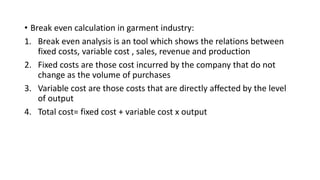
• Break even calculation in garment industry:
1. Break even analysis is an tool which shows the relations between
fixed costs, variable cost , sales, revenue and production
2. Fixed costs are those cost incurred by the company that do not
change as the volume of purchases
3. Variable cost are those costs that are directly affected by the level
of output
4. Total cost= fixed cost + variable cost x output
• Government policy & legislation:
1. Government is the influencer which actually drives or position in
the market
2. Government can influence policy related to inflation, investment
and employment
3. Government also influences on taxation, like GST, import tax and
export tax….etc.

Marketing & merchandising.pptx

  • 1.
    MARKETING & MERCHANDISING •Primary functions: 1. Marketing 2. Merchandising 3. Sales
  • 2.
    • Marketing: 1. Itrefers to flow of goods from producers to customers 2. It is the function which defines characteristics of company actual & potential markets and promoting company products and range 3. Marketing manager has an important role in determining market orientation and product line of the company
  • 3.
    • Merchandising: 1. Itcan be defined as product development and overall production strategy and delivering the products to customers or buyers 2. Merchandising not only has to adjust to market variations but also to anticipate the changes in the market
  • 4.
    • Sales: 1. Itis nothing but taking the product to the customers 2. It has the following: a. Approaching the customers b. Determining their requirements c. Sales presentation preparation d. Setting objectives e. Getting the customers to place the order f. After delivering check the customer satisfaction
  • 5.
    • Marketing: 1. Regardlessof the size of the company and its organizational structure marketing functions deals with the following: a. Marketing calendar b. Product pricing c. Product planning d. customers
  • 6.
    • Marketing calendar: 1.It provides operational framework for a season 2. The exact timings and sequence of events will be specified in the calendar 3. It may include as following: a. Finalizing collection plan b. Approving the collection c. Preparing sales forecast budget d. Arranging fashion shows or events at national or international e. Meeting with sales persons f. Deciding styles and quantities of garments
  • 7.
    • Product pricing: 1.The price of the garment is the consensus of its value and at all times clothing company has to adjust to the market price of the products 2. This price is determined by the total supply of the product offered by all sellers against the demand of the product
  • 8.
    • The pricingof the garment has 2 stages a. Price evaluation b. Bracketing prices • price evaluation: 1. Conventional costing is not sufficient or it is not going reflect the actual sales value of the garment 2. There is need to have subjective evaluation of selling prices when the prices of similar garments in the collection are compared
  • 9.
    • Bracketing price: 1.Most buyers for large group work accordingly to retail selling prices categories for particular types of merchandise in order to cover the relevant sectors of the market 2. Retail gross margins on regular as against sales merchandise would vary accordingly to the degree of risk taken in purchasing
  • 10.
    • Product planning: 1.It is process of determing the type and variety of garments produced by the company 2. In this type of traditional economics the types of clothing produced undergo little change over a long period 3. If economics expands the range of clothing produced tends to increase and change occurs in products themselves 4. This wide range of products enables a clothing company to find its own niche in a suitable sector of the market
  • 11.
    • Customers: 1. Thereare different types of customers in the market. Each have their own characteristics 2. To know better it is to know about the different types of retail & wholesale organizations a. Departmental stores g. Independent shops b. Specialty departmental stores h. specialty whole salers c. Chain stores d. Super markets e. Co-operatives f. Mail order
  • 12.
    a. Departmental stores: 1.Large retail units which sell a wide variety of products in clothing & fashion accessories
  • 13.
    • Specialty departmentalstores: 1. Large retail units which sell clothing and accessories 2. These types of departmental stores can be operated as independent units or be a part of chain units
  • 14.
    • Chain stores: 1.These are stores which are special in retail as well as in wholesales 2. These stores are located across the country or from different countries
  • 15.
    • Super markets: 1.Large purchases of staple garments such as intimate garments and hosiery…etc are seen in super markets 2. These are the stores which are popular in small towns and developing cities
  • 16.
    • Co-operatives: 1. Theseare the organizations similar to chain stores 2. The size of the stores is comparatively small 3. These stores target middle class and lower middle class customers
  • 17.
    • Mail order: 1.Garments are sold directly from a mass mailed catalogue 2. Retail mail selling was developed for rural customers 3. Now it is also serving the urban customers also
  • 18.
    • Independent shops: 1.These shops operate as individual units and sometimes specialize in one category such as teenage, outsize, kids…etc
  • 19.
    • Specialty wholesales: 1. These organizations purchase from manufacturers and small retail outlets 2. They usually operate in areas where the producers cannot support a sales
  • 20.
    • Merchandising: 1. Itis the second major element of marketing 2. It is the physical movement of merchandise from factory to retail stores 3. Most companies use direct channels of distribution i.e directly to retail outlets or their nominated distributors 4. They are also responsible for warehousing of the finished goods, allocating customer orders, packing the orders, transport the orders, tracking the inventory…etc
  • 21.
    • Four channelsof communication: 1. Advertising 2. Selling 3. Personal selling 4. presentations
  • 22.
    • Advertising: 1. Thisis the non-personal presentation of goods by a name or brand 2. Some of the media used for advertising are newspapers, magazines, poster, radio, t.v….etc. 3. They need to develop strong brand or corporate image which put the company or brand on strong hold
  • 23.
    • Selling: 1. Theselling can be achieved through the following channels: a. Show room staff b. Representatives c. Agents Show room staff: 1. These are sales personnel employed by the company & working centrally located showrooms 2. They serve visiting & call on major customers
  • 24.
    • representatives: 1. Unlikeshowroom staff the representatives visit all their customers in their own premises and generally deal with small retailers • Agents: 1. These are independent selling organizations who can represent a number of manufacturers producing non-competing types of merchandise
  • 25.
    • Personal selling: 1.Selling relies on personal contact 2. The sales staff will be directed towards creating opportunities for making oral presentation while showing company samples • Presentations: 1. Fashion shows for retailers are presented under the agies of retailers 2. This will create impact or idea of the products to the retailers by the manufacturers
  • 26.
    • Market research& objectives: 1. It deals with gathering, processing & presentation of information which will serve as basis for future decisions of planning 2. Research can be undertaken by the staff or by outside consultancy • Objectives: 1. The market potential in the particular area 2. What share of market might be achieved 3. Characteristics of a given market
  • 27.
    • Sales forecasting& budgeting: 1. Sales budget for a season is derived from the sales forecast and its preparation 2. Sales forecast provides basis for all other planning 3. In preparing sales budget, two related forecast have to be made a. Selling price of different categories of garments b. Forecast volume of sales for each category of products
  • 28.
    • Break evencalculation in garment industry: 1. Break even analysis is an tool which shows the relations between fixed costs, variable cost , sales, revenue and production 2. Fixed costs are those cost incurred by the company that do not change as the volume of purchases 3. Variable cost are those costs that are directly affected by the level of output 4. Total cost= fixed cost + variable cost x output
  • 29.
    • Government policy& legislation: 1. Government is the influencer which actually drives or position in the market 2. Government can influence policy related to inflation, investment and employment 3. Government also influences on taxation, like GST, import tax and export tax….etc.