




























Resuscitation 2015:
Beyond ACLS
Andrew J. Bowman, MSN, ACNP-BC, NRP
Faculty Disclosure
• Session goal: Discuss FOAMed & possible alternative
approaches to management of adult cardiac arrest
beyond standard ACLS
• Conflicts of interest: None
• Employer: Witham Health Services Emergency
Major Hospital Emergency
Hendricks Regional Health Emergency
• Sponsorship / commercial support: None
The Emergency Nurses Association is
accredited as a provider of continuing
nursing education by the American
Nurses Credentialing Center’s
Commission on Accreditation.
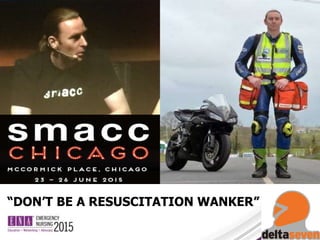
“DON’T BE A RESUSCITATION WANKER”
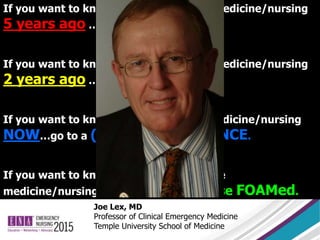
Joe Lex, MD
Professor of Clinical Emergency Medicine
Temple University School of Medicine
If you want to know how we practiced medicine/nursing
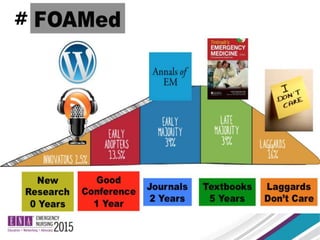
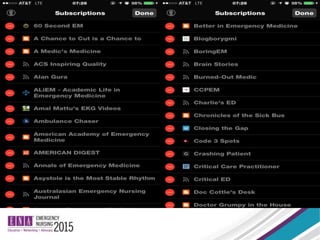
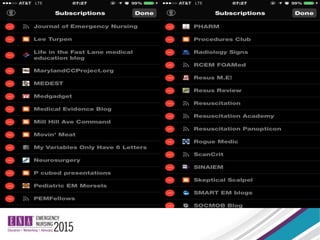
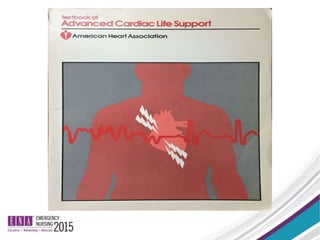
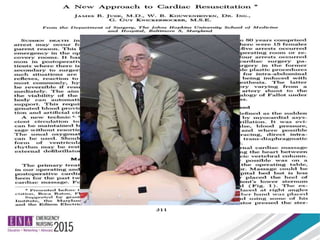
5 years ago …read a TEXTBOOK.
If you want to know how we practiced medicine/nursing
2 years ago …read a JOURNAL.
If you want to know how we practice medicine/nursing
NOW…go to a (GOOD) CONFERENCE.
If you want to know how we will practice
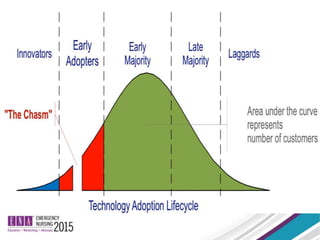
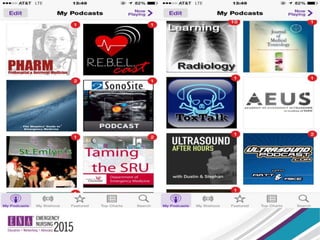
medicine/nursing TOMORROW … use FOAMed.
#
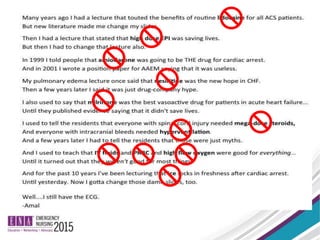
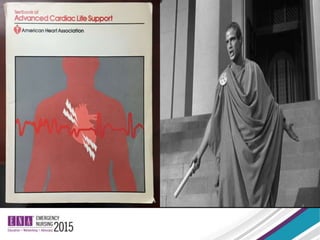
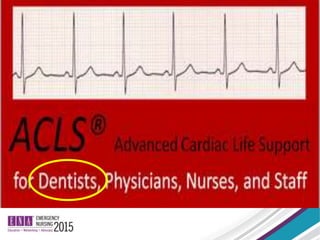
This is NOT your dentists’ ACLS
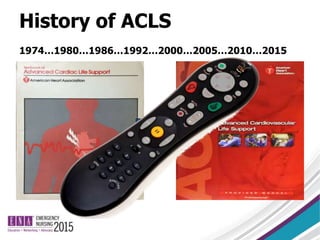
History of ACLS
1974…1980…1986…1992…2000…2005…2010…2015
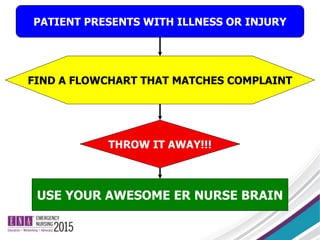
PATIENT PRESENTS WITH ILLNESS OR INJURY
THROW IT AWAY!!!
FIND A FLOWCHART THAT MATCHES COMPLAINT
USE YOUR AWESOME ER NURSE BRAIN
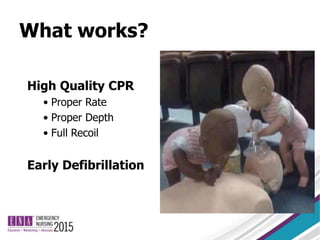
What works?
High Quality CPR
• Proper Rate
• Proper Depth
• Full Recoil
Early Defibrillation
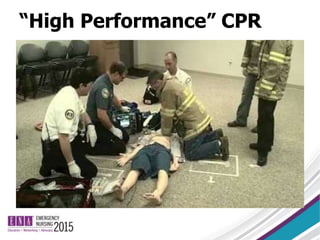
“High Performance” CPR
BSE
• ROSC
• Admission to ER
• Admission to Hospital
• Discharge alive from hospital
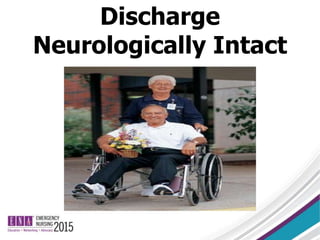
Discharge
Neurologically Intact
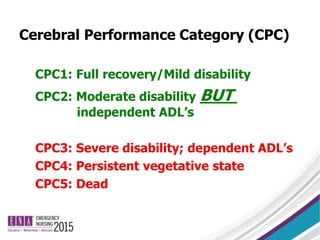
Cerebral Performance Category (CPC)
CPC1: Full recovery/Mild disability
CPC2: Moderate disability BUT
independent ADL’s
CPC3: Severe disability; dependent ADL’s
CPC4: Persistent vegetative state
CPC5: Dead
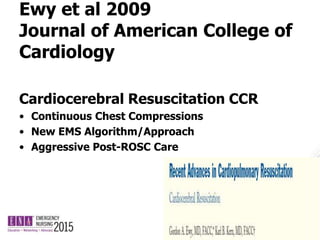
Ewy et al 2009
Journal of American College of
Cardiology
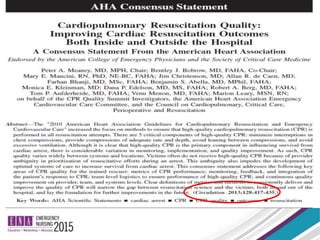
Cardiocerebral Resuscitation CCR
• Continuous Chest Compressions
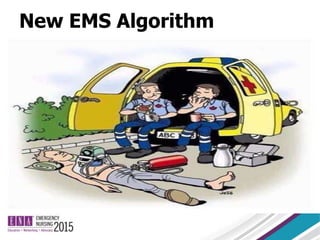
• New EMS Algorithm/Approach
• Aggressive Post-ROSC Care
Continuous Compressions
Initial compression
only CPR for anyone
with witnessed
unexpected collapse
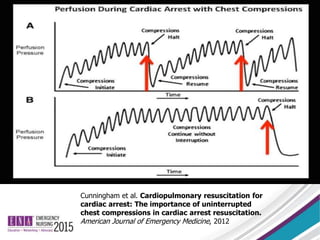
Cunningham et al. Cardiopulmonary resuscitation for
cardiac arrest: The importance of uninterrupted
chest compressions in cardiac arrest resuscitation.
American Journal of Emergency Medicine, 2012
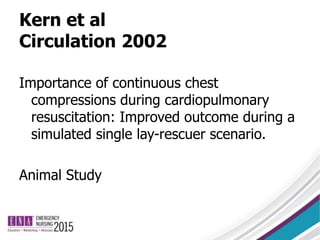
Kern et al
Circulation 2002
Importance of continuous chest
compressions during cardiopulmonary
resuscitation: Improved outcome during a
simulated single lay-rescuer scenario.
Animal Study
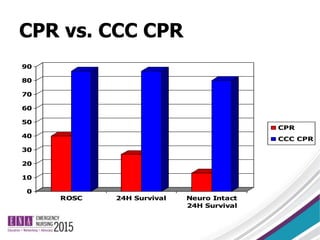
CPR vs. CCC CPR
0
10
20
30
40
50
60
70
80
90
ROSC 24H Survival Neuro Intact
24H Survival
CPR
CCC CPR
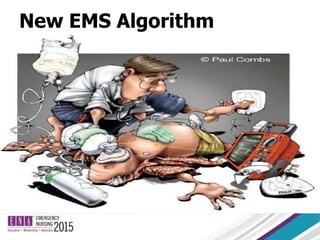
New EMS Algorithm
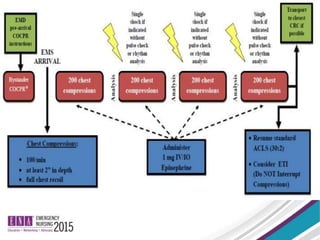
New EMS Algorithm
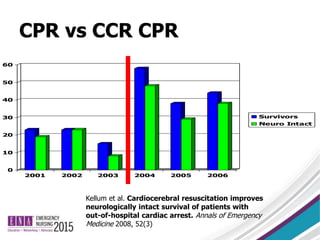
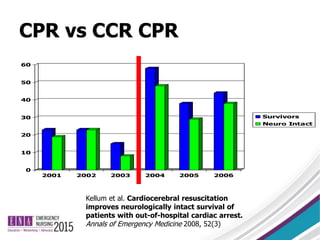
CPR vs CCR CPR
0
10
20
30
40
50
60
2001 2002 2003 2004 2005 2006
Survivors
Neuro Intact
Kellum et al. Cardiocerebral resuscitation improves
neurologically intact survival of patients with
out-of-hospital cardiac arrest. Annals of Emergency
Medicine 2008, 52(3)
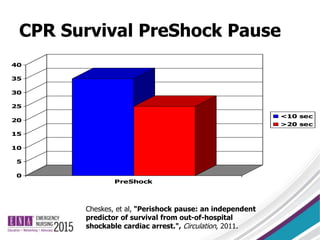
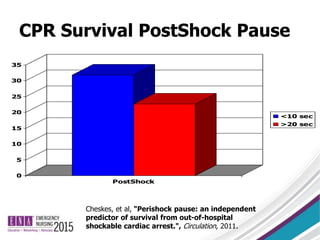
Cheskes, et al, "Perishock pause: an independent
predictor of survival from out-of-hospital
shockable cardiac arrest.", Circulation, 2011.
0
5
10
15
20
25
30
35
40
PreShock
<10 sec
>20 sec
CPR Survival PreShock Pause
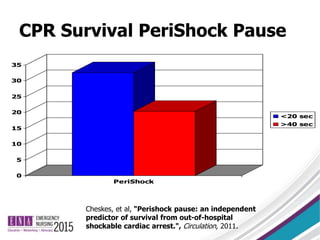
Cheskes, et al, "Perishock pause: an independent
predictor of survival from out-of-hospital
shockable cardiac arrest.", Circulation, 2011.
0
5
10
15
20
25
30
35
PeriShock
<20 sec
>40 sec
CPR Survival PeriShock Pause
Cheskes, et al, "Perishock pause: an independent
predictor of survival from out-of-hospital
shockable cardiac arrest.", Circulation, 2011.
0
5
10
15
20
25
30
35
PostShock
<10 sec
>20 sec
CPR Survival PostShock Pause
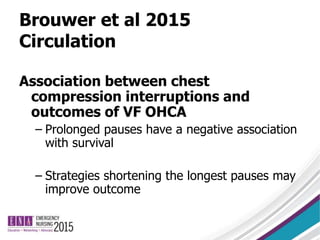
Brouwer et al 2015
Circulation
Association between chest
compression interruptions and
outcomes of VF OHCA
– Prolonged pauses have a negative association
with survival
– Strategies shortening the longest pauses may
improve outcome
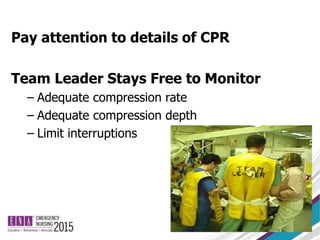
Pay attention to details of CPR
Team Leader Stays Free to Monitor
– Adequate compression rate
– Adequate compression depth
– Limit interruptions
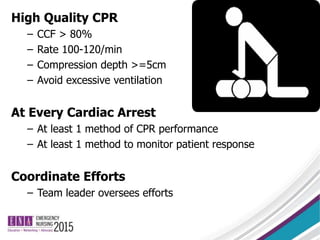
High Quality CPR
– CCF > 80%
– Rate 100-120/min
– Compression depth >=5cm
– Avoid excessive ventilation
At Every Cardiac Arrest
– At least 1 method of CPR performance
– At least 1 method to monitor patient response
Coordinate Efforts
– Team leader oversees efforts
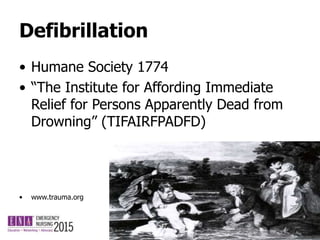
Defibrillation
• Humane Society 1774
• “The Institute for Affording Immediate
Relief for Persons Apparently Dead from
Drowning” (TIFAIRFPADFD)
• www.trauma.org
Defibrillation
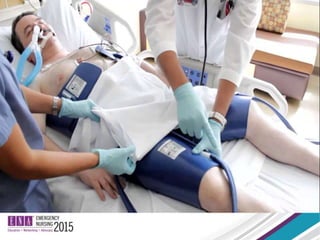
Hands ON or Hands OFF?
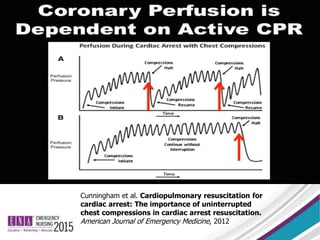
Cunningham et al. Cardiopulmonary resuscitation for
cardiac arrest: The importance of uninterrupted
chest compressions in cardiac arrest resuscitation.
American Journal of Emergency Medicine, 2012
Larry Mellick, MD
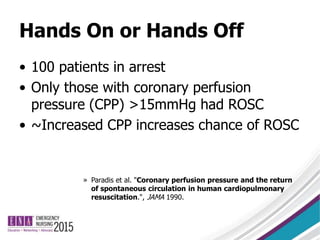
Hands On or Hands Off
• 100 patients in arrest
• Only those with coronary perfusion
pressure (CPP) >15mmHg had ROSC
• ~Increased CPP increases chance of ROSC
» Paradis et al. "Coronary perfusion pressure and the return
of spontaneous circulation in human cardiopulmonary
resuscitation.", JAMA 1990.
CPR vs CCR CPR
0
10
20
30
40
50
60
2001 2002 2003 2004 2005 2006
Survivors
Neuro Intact
Kellum et al. Cardiocerebral resuscitation
improves neurologically intact survival of
patients with out-of-hospital cardiac arrest.
Annals of Emergency Medicine 2008, 52(3)
Hands On or Hands Off
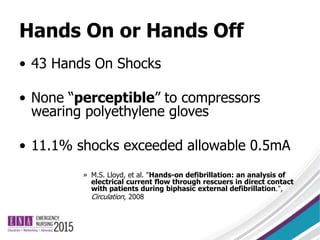
• 43 Hands On Shocks
• None “perceptible” to compressors
wearing polyethylene gloves
• 11.1% shocks exceeded allowable 0.5mA
» M.S. Lloyd, et al. "Hands-on defibrillation: an analysis of
electrical current flow through rescuers in direct contact
with patients during biphasic external defibrillation.",
Circulation, 2008
Hands On or Hands Off
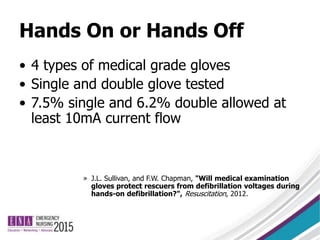
• 4 types of medical grade gloves
• Single and double glove tested
• 7.5% single and 6.2% double allowed at
least 10mA current flow
» J.L. Sullivan, and F.W. Chapman, "Will medical examination
gloves protect rescuers from defibrillation voltages during
hands-on defibrillation?", Resuscitation, 2012.
Hands On or Hands Off
Weingart Mellick
Hands On or Hands Off?
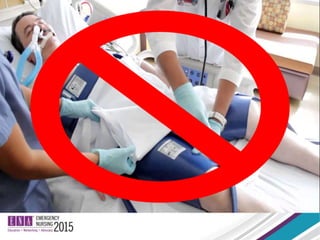
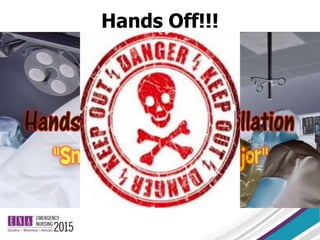
Hands Off!!!
Hands Off!!!
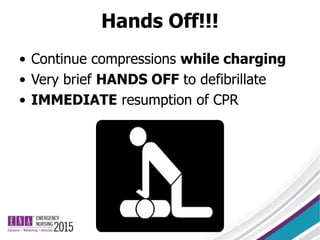
• Continue compressions while charging
• Very brief HANDS OFF to defibrillate
• IMMEDIATE resumption of CPR
Unless??
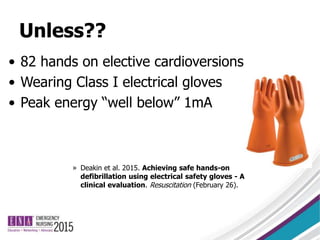
• 82 hands on elective cardioversions
• Wearing Class I electrical gloves
• Peak energy “well below” 1mA
» Deakin et al. 2015. Achieving safe hands-on
defibrillation using electrical safety gloves - A
clinical evaluation. Resuscitation (February 26).
Hoch et al 1994
Journal of American College of
Cardiology
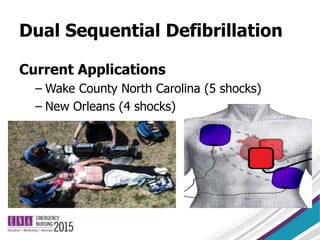
Refractory V-Fib
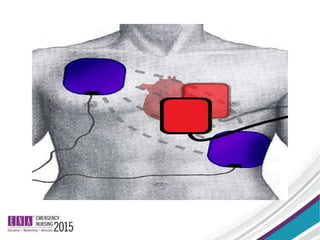
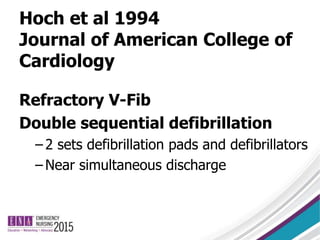
Double sequential defibrillation
– 2 sets defibrillation pads and defibrillators
– Near simultaneous discharge
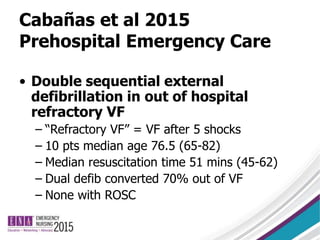
Cabañas et al 2015
Prehospital Emergency Care
• Double sequential external
defibrillation in out of hospital
refractory VF
– “Refractory VF” = VF after 5 shocks
– 10 pts median age 76.5 (65-82)
– Median resuscitation time 51 mins (45-62)
– Dual defib converted 70% out of VF
– None with ROSC
Dual Sequential Defibrillation
Current Applications
– Wake County North Carolina (5 shocks)
– New Orleans (4 shocks)
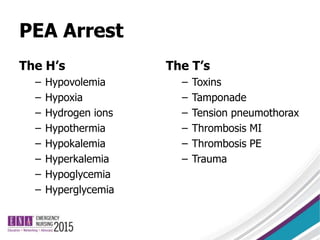
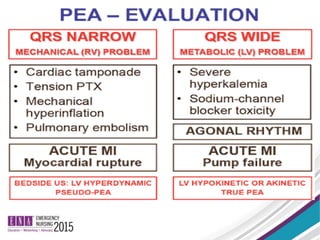
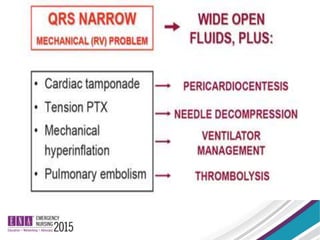
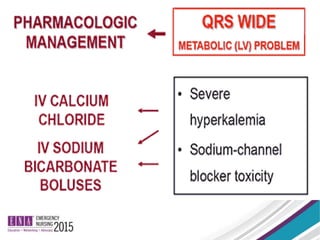
PEA Arrest
The H’s
– Hypovolemia
– Hypoxia
– Hydrogen ions
– Hypothermia
– Hypokalemia
– Hyperkalemia
– Hypoglycemia
– Hyperglycemia
The T’s
– Toxins
– Tamponade
– Tension pneumothorax
– Thrombosis MI
– Thrombosis PE
– Trauma
Littmann et al 2013
Medical Principles & Practice
• A simplified and structured teaching tool
for the evaluation and management of
pulseless electrical activity.
?
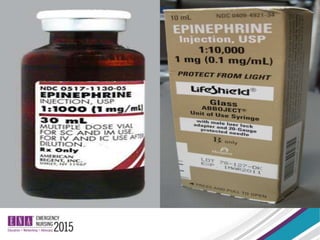
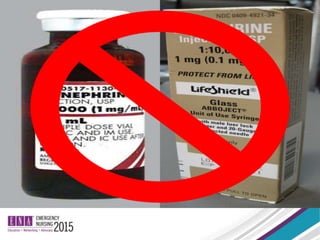
Epinephrine in arrest has minimal
supportive evidence
Has become the de facto “standard of
care”
Are we doing more harm than good?
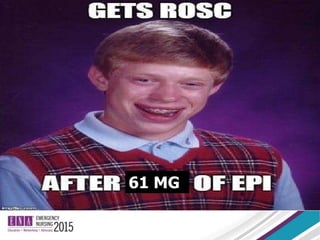
61 MG
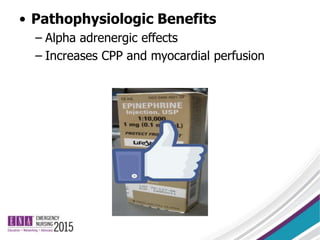
• Pathophysiologic Benefits
– Alpha adrenergic effects
– Increases CPP and myocardial perfusion
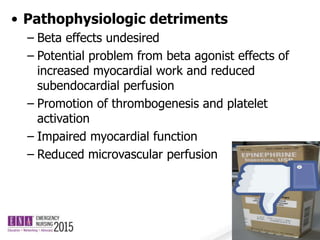
• Pathophysiologic detriments
– Beta effects undesired
– Potential problem from beta agonist effects of
increased myocardial work and reduced
subendocardial perfusion
– Promotion of thrombogenesis and platelet
activation
– Impaired myocardial function
– Reduced microvascular perfusion
Stiell et al 2004
New England Journal of Medicine
• OPALS (Ottawa Prehospital
Advanced Life Support Study)
• Prospective before and after
• 12 months CPR + Defib
• 36 months ACLS
• ACLS = Significant increase ROSC
but no significant improvement
survival to discharge
Nakahara et al 2013
British Medical Journal
• Prehospital adrenaline improves long term
outcome with OHCA but increase of
neurologically intact survival was minimal
Jacobs et al 2011
Resuscitation
• RDCT
• Lost support of EMS providers
• Increased likelihood of ROSC
• No statistically significant
improvement in survival to
discharge
Machida et al 2012
Journal of Cardiology
• Adrenaline made no difference to survival
• Adrenaline made no difference to risk of
severe brain damage
Woodhouse et al 1995
Resuscitation
• High dose adrenaline did show
improvement to beneficial rhythm
• No improvement in immediate or
long term survival with high dose
or standard dose adrenaline
• “Patient reaching point of use of
adrenaline have uniformly poor
survival”
Ong et al 2007
Annals of Emergency Medicine
• No improvement with epinephrine
– ROSC
– Survival to admission
– Survival to discharge
Dumas et al 2014
Journal of the American
College of Cardiology
• Prehospital use of epinephrine in those
who achieved ROSC had lower chance of
survival
• Dose related
Herlitz et al 1995
Resuscitation
• Adrenaline for VF presentation
• Improved ROSC with adrenaline
• Discharge alive did not improve
• Same results in those who
converted to EMD (PEA) or
asystole
Holmberg et al 2002
Resuscitation
• Outcome with OHCA with epinephrine or
intubation
• Both predictors of low survival
Hayashi et al 2012
Circulation Journal
• Epinephrine significantly lower rate
of neurologically intact 1-month
survival
• VF arrests that got epinephrine
within 10 minutes had improved
outcome but delayed epinephrine
did not show benefit
Olasveengen et al 2012
Resuscitation
• Adrenaline associated with
improved short term survival
• Decreased survival to discharge
• Decreased survival with
favorable neurological outcome
Hagihara et al 2012
Journal of the American
Medical Association
• Prehospital epinephrine increased
ROSC
• Decreased survival at 1-month
• Decreased good functional
outcome at 1-month
Ono et al 2015
Journal of Intensive Care
• Epinephrine associated with
increased ROSC
• Improvement in neurological
outcome
• Only in those with CPR 15-19
minutes
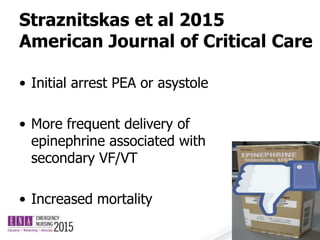
Straznitskas et al 2015
American Journal of Critical Care
• Initial arrest PEA or asystole
• More frequent delivery of
epinephrine associated with
secondary VF/VT
• Increased mortality
Epinephrine and other ACLS drugs lead to more
patients with ROSC but no increase in the
number of patients with good neurologic
outcomes after OHCA.
Actual ACLS recommendation for epinephrine.
“it is reasonable to consider administering
a 1 mg dose of IV/IO epinephrine every 3
to 5 minutes during adult cardiac arrest.”
Hemodynamic Directed Dosing
of Epinephrine (HDDE)
• Instead of 1mg q 3-5 minutes
• Individualized dosing based on CPP,
CPR DBP or EtCO2
• Goal to overall give less epinephrine and
potentially avoid bad effects
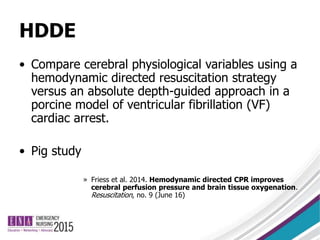
HDDE
• Compare cerebral physiological variables using a
hemodynamic directed resuscitation strategy
versus an absolute depth-guided approach in a
porcine model of ventricular fibrillation (VF)
cardiac arrest.
• Pig study
» Friess et al. 2014. Hemodynamic directed CPR improves
cerebral perfusion pressure and brain tissue oxygenation.
Resuscitation, no. 9 (June 16)
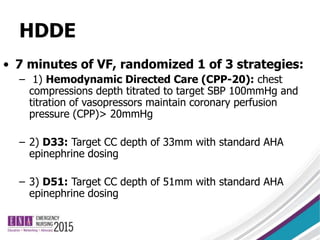
HDDE
• 7 minutes of VF, randomized 1 of 3 strategies:
– 1) Hemodynamic Directed Care (CPP-20): chest
compressions depth titrated to target SBP 100mmHg and
titration of vasopressors maintain coronary perfusion
pressure (CPP)> 20mmHg
– 2) D33: Target CC depth of 33mm with standard AHA
epinephrine dosing
– 3) D51: Target CC depth of 51mm with standard AHA
epinephrine dosing
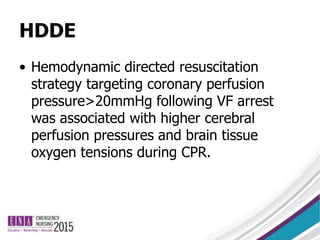
HDDE
• Hemodynamic directed resuscitation
strategy targeting coronary perfusion
pressure>20mmHg following VF arrest
was associated with higher cerebral
perfusion pressures and brain tissue
oxygen tensions during CPR.
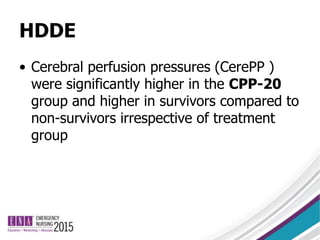
HDDE
• Cerebral perfusion pressures (CerePP )
were significantly higher in the CPP-20
group and higher in survivors compared to
non-survivors irrespective of treatment
group
HDDE
• Paradis, Norman A. 1990. Coronary
Perfusion Pressure and the Return of
Spontaneous Circulation in Human
Cardiopulmonary Resuscitation.
JAMA: The Journal of the American
Medical Association. American Medical
Association (AMA), February 23
• Human study
HDDE
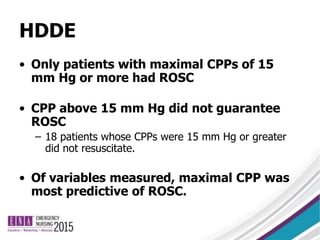
• Only patients with maximal CPPs of 15
mm Hg or more had ROSC
• CPP above 15 mm Hg did not guarantee
ROSC
– 18 patients whose CPPs were 15 mm Hg or greater
did not resuscitate.
• Of variables measured, maximal CPP was
most predictive of ROSC.
HDDE
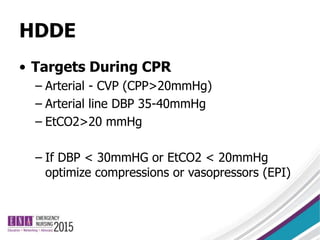
• Targets During CPR
– Arterial - CVP (CPP>20mmHg)
– Arterial line DBP 35-40mmHg
– EtCO2>20 mmHg
– If DBP < 30mmHG or EtCO2 < 20mmHg
optimize compressions or vasopressors (EPI)
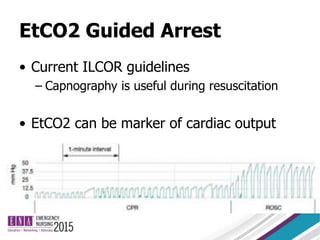
EtCO2 Guided Arrest
• Current ILCOR guidelines
– Capnography is useful during resuscitation
• EtCO2 can be marker of cardiac output
EtCO2 Guided Arrest
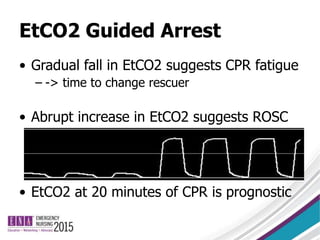
• Gradual fall in EtCO2 suggests CPR fatigue
– -> time to change rescuer
• Abrupt increase in EtCO2 suggests ROSC
• EtCO2 at 20 minutes of CPR is prognostic
EtCO2 Guided Arrest
• >20 mmHg at 20 minutes CPR -> higher
chance of ROSC
• <10 mmHg at 20 mintues CPR -> almost
no chance of ROSC
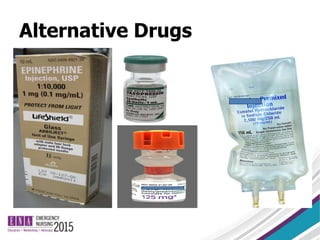
Alternative Drugs
Mentzelopoulos et al 2013
Journal of American Medical
Association
• Patients with cardiac arrest have
shown improved return of spontaneous
circulation and survival to hospital
discharge with the vasopressin-steroid-
epinephrine (VSE) combination.
VSE
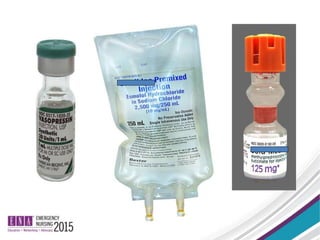
• Group1 (VSE Group)
– Vasopressin + epinephrine + methylprednisolone
• Group 2 (Control Group)
– Saline placebo + epinephrine + saline placebo
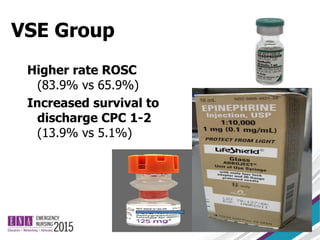
VSE Group
Higher rate ROSC
(83.9% vs 65.9%)
Increased survival to
discharge CPC 1-2
(13.9% vs 5.1%)
Driver et al 2014
Resuscitation
• Use of esmolol after failure of standard
cardiopulmonary resuscitation to treat
patients with refractory VF
• Potential benefit to use of beta blockade
in cardiac arrest
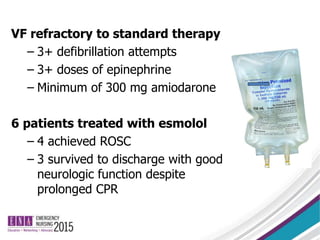
VF refractory to standard therapy
– 3+ defibrillation attempts
– 3+ doses of epinephrine
– Minimum of 300 mg amiodarone
6 patients treated with esmolol
– 4 achieved ROSC
– 3 survived to discharge with good
neurologic function despite
prolonged CPR
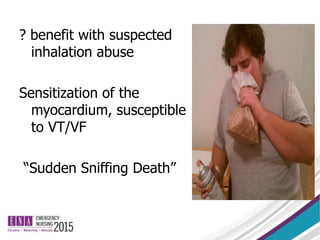
? benefit with suspected
inhalation abuse
Sensitization of the
myocardium, susceptible
to VT/VF
“Sudden Sniffing Death”
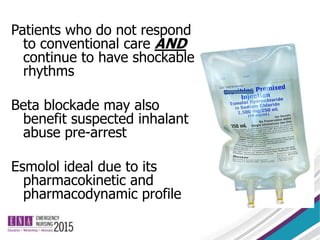
Patients who do not respond
to conventional care AND
continue to have shockable
rhythms
Beta blockade may also
benefit suspected inhalant
abuse pre-arrest
Esmolol ideal due to its
pharmacokinetic and
pharmacodynamic profile
ROSC
We have a pulse…!!! Now what…???
• Focused/Detailed H&P
• Evaluate Airway / ETT
– PaO2 < 300mmHg, SaO2 94-98%, PaCO2 35-45mmHg
• Assess for Neurological Dysfunction
• Labs
• CXR, POCUS, EKG
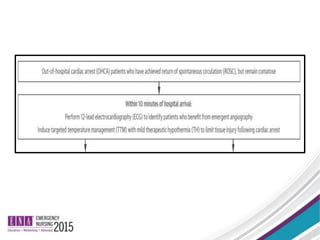
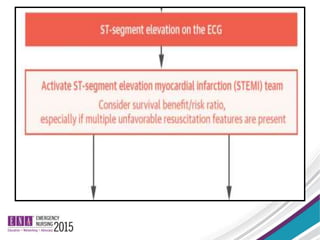
• Cath Lab: VF/VT or ST Segment Changes
• Pressors or Fluids for MAP 85-100mmHg
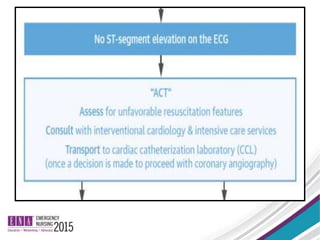
• Targeted Temperature Management
http://www.emdocs.net/ive-got-a-pulse-now-
what-post-arrest-care-in-the-acute-setting/
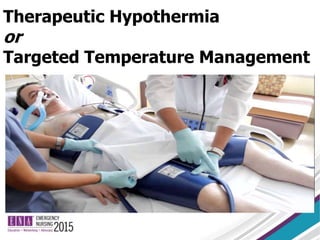
Therapeutic Hypothermia
or
Targeted Temperature Management
Bernard et al 2002
New England Journal of Medicine
• Treatment with moderate hypothermia
(33°C) appears to improve outcomes after
ROSC from OHCA
Holzer et al 2002
New England Journal of Medicine
• HACA (Hypothermia After Cardiac Arrest)
• Patients with ROSC after OHCA due to VF
• Moderate hypothermia (32°-34°C)
increased rate of favorable neurological
outcome and reduced mortality
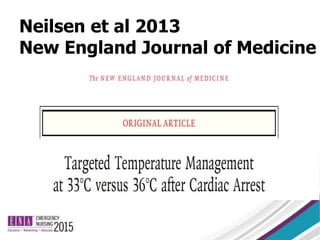
Neilsen et al 2013
New England Journal of Medicine
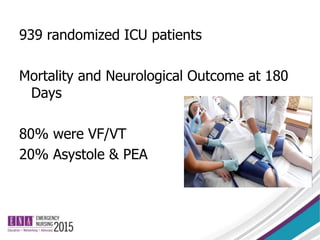
939 randomized ICU patients
Mortality and Neurological Outcome at 180
Days
80% were VF/VT
20% Asystole & PEA
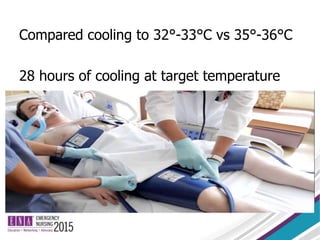
Compared cooling to 32°-33°C vs 35°-36°C
28 hours of cooling at target temperature
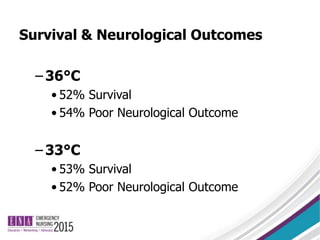
Survival & Neurological Outcomes
– 36°C
• 52% Survival
• 54% Poor Neurological Outcome
– 33°C
• 53% Survival
• 52% Poor Neurological Outcome
Very good study
Likely DO NOT need to
target to 32-33°C
Key factor is to avoid
HYPERthermia
Huang et al 2015
Resuscitation
• Meta-analysis of prehospital therapeutic
hypothermia
• 8 trials with 2379 patients
• Prehospital initiation did not improve
survival to:
– Admission
– Discharge
– Good neurological functional recovery
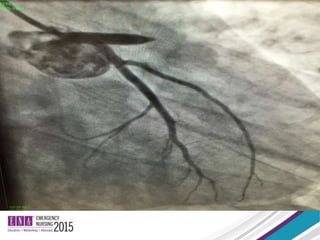
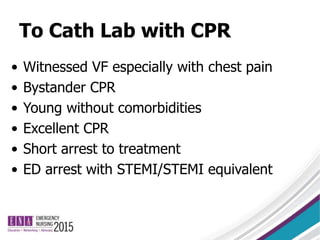
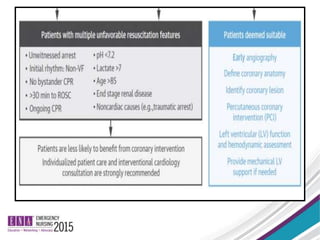
To Cath Lab with CPR
• Witnessed VF especially with chest pain
• Bystander CPR
• Young without comorbidities
• Excellent CPR
• Short arrest to treatment
• ED arrest with STEMI/STEMI equivalent
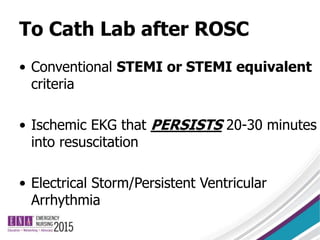
To Cath Lab after ROSC
• Conventional STEMI or STEMI equivalent
criteria
• Ischemic EKG that PERSISTS 20-30 minutes
into resuscitation
• Electrical Storm/Persistent Ventricular
Arrhythmia
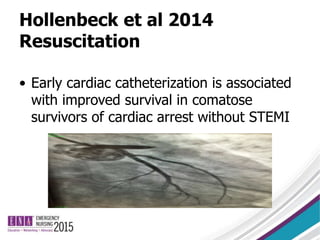
Hollenbeck et al 2014
Resuscitation
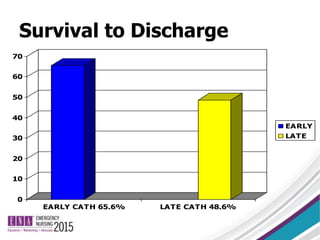
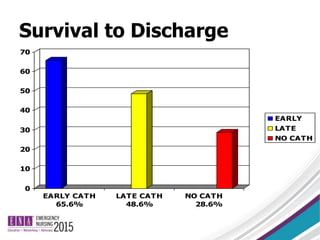
• Early cardiac catheterization is associated
with improved survival in comatose
survivors of cardiac arrest without STEMI
Hollenbeck et al 2014
Resuscitation
• 754 consecutive comatose s/p arrest
• 269 VF/VT and received TTM
• 26.6% “no MI” had acute coronary
occlusion
Survival to Discharge
0
10
20
30
40
50
60
70
EARLY CATH 65.6% LATE CATH 48.6%
EARLY
LATE
Survival to Discharge
0
10
20
30
40
50
60
70
EARLY CATH
65.6%
LATE CATH
48.6%
NO CATH
28.6%
EARLY
LATE
NO CATH
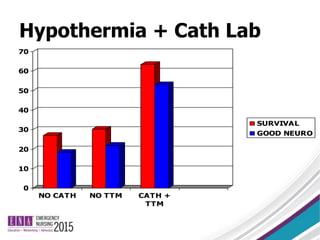
Hypothermia + Cath Lab
0
10
20
30
40
50
60
70
NO CATH NO TTM CATH +
TTM
SURVIVAL
GOOD NEURO
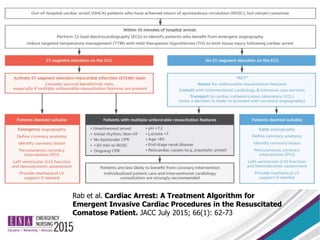
Rab et al. Cardiac Arrest: A Treatment Algorithm for
Emergent Invasive Cardiac Procedures in the Resuscitated
Comatose Patient. JACC July 2015; 66(1): 62-73
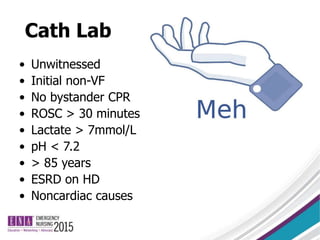
Cath Lab
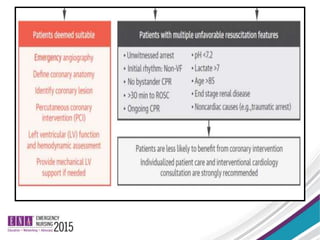
• Unwitnessed
• Initial non-VF
• No bystander CPR
• ROSC > 30 minutes
• Lactate > 7mmol/L
• pH < 7.2
• > 85 years
• ESRD on HD
• Noncardiac causes
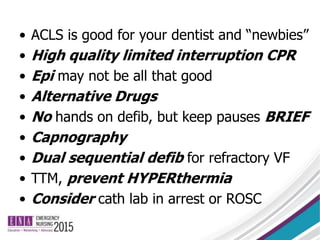
• ACLS is good for your dentist and “newbies”
• High quality limited interruption CPR
• Epi may not be all that good
• Alternative Drugs
• No hands on defib, but keep pauses BRIEF
• Capnography
• Dual sequential defib for refractory VF
• TTM, prevent HYPERthermia
• Consider cath lab in arrest or ROSC
The 5 C’s
DON’T BE A RESUSCITATION
WANKER
DO WHAT IS HONORABLE
ENA 2015 Resuscitation 2015

ENA 2015 Resuscitation 2015

  • 2.
    Resuscitation 2015: Beyond ACLS AndrewJ. Bowman, MSN, ACNP-BC, NRP
  • 3.
    Faculty Disclosure • Sessiongoal: Discuss FOAMed & possible alternative approaches to management of adult cardiac arrest beyond standard ACLS • Conflicts of interest: None • Employer: Witham Health Services Emergency Major Hospital Emergency Hendricks Regional Health Emergency • Sponsorship / commercial support: None
  • 4.
    The Emergency NursesAssociation is accredited as a provider of continuing nursing education by the American Nurses Credentialing Center’s Commission on Accreditation.
  • 5.
    “DON’T BE ARESUSCITATION WANKER”
  • 9.
    Joe Lex, MD Professorof Clinical Emergency Medicine Temple University School of Medicine If you want to know how we practiced medicine/nursing 5 years ago …read a TEXTBOOK. If you want to know how we practiced medicine/nursing 2 years ago …read a JOURNAL. If you want to know how we practice medicine/nursing NOW…go to a (GOOD) CONFERENCE. If you want to know how we will practice medicine/nursing TOMORROW … use FOAMed.
  • 12.
  • 27.
    This is NOTyour dentists’ ACLS
  • 40.
  • 43.
    PATIENT PRESENTS WITHILLNESS OR INJURY THROW IT AWAY!!! FIND A FLOWCHART THAT MATCHES COMPLAINT USE YOUR AWESOME ER NURSE BRAIN
  • 44.
    What works? High QualityCPR • Proper Rate • Proper Depth • Full Recoil Early Defibrillation
  • 45.
  • 46.
    BSE • ROSC • Admissionto ER • Admission to Hospital • Discharge alive from hospital
  • 47.
  • 48.
    Cerebral Performance Category(CPC) CPC1: Full recovery/Mild disability CPC2: Moderate disability BUT independent ADL’s CPC3: Severe disability; dependent ADL’s CPC4: Persistent vegetative state CPC5: Dead
  • 50.
    Ewy et al2009 Journal of American College of Cardiology Cardiocerebral Resuscitation CCR • Continuous Chest Compressions • New EMS Algorithm/Approach • Aggressive Post-ROSC Care
  • 51.
    Continuous Compressions Initial compression onlyCPR for anyone with witnessed unexpected collapse
  • 52.
    Cunningham et al.Cardiopulmonary resuscitation for cardiac arrest: The importance of uninterrupted chest compressions in cardiac arrest resuscitation. American Journal of Emergency Medicine, 2012
  • 53.
    Kern et al Circulation2002 Importance of continuous chest compressions during cardiopulmonary resuscitation: Improved outcome during a simulated single lay-rescuer scenario. Animal Study
  • 54.
    CPR vs. CCCCPR 0 10 20 30 40 50 60 70 80 90 ROSC 24H Survival Neuro Intact 24H Survival CPR CCC CPR
  • 55.
  • 57.
  • 58.
    CPR vs CCRCPR 0 10 20 30 40 50 60 2001 2002 2003 2004 2005 2006 Survivors Neuro Intact Kellum et al. Cardiocerebral resuscitation improves neurologically intact survival of patients with out-of-hospital cardiac arrest. Annals of Emergency Medicine 2008, 52(3)
  • 59.
    Cheskes, et al,"Perishock pause: an independent predictor of survival from out-of-hospital shockable cardiac arrest.", Circulation, 2011. 0 5 10 15 20 25 30 35 40 PreShock <10 sec >20 sec CPR Survival PreShock Pause
  • 60.
    Cheskes, et al,"Perishock pause: an independent predictor of survival from out-of-hospital shockable cardiac arrest.", Circulation, 2011. 0 5 10 15 20 25 30 35 PeriShock <20 sec >40 sec CPR Survival PeriShock Pause
  • 61.
    Cheskes, et al,"Perishock pause: an independent predictor of survival from out-of-hospital shockable cardiac arrest.", Circulation, 2011. 0 5 10 15 20 25 30 35 PostShock <10 sec >20 sec CPR Survival PostShock Pause
  • 62.
    Brouwer et al2015 Circulation Association between chest compression interruptions and outcomes of VF OHCA – Prolonged pauses have a negative association with survival – Strategies shortening the longest pauses may improve outcome
  • 64.
    Pay attention todetails of CPR Team Leader Stays Free to Monitor – Adequate compression rate – Adequate compression depth – Limit interruptions
  • 66.
    High Quality CPR –CCF > 80% – Rate 100-120/min – Compression depth >=5cm – Avoid excessive ventilation At Every Cardiac Arrest – At least 1 method of CPR performance – At least 1 method to monitor patient response Coordinate Efforts – Team leader oversees efforts
  • 68.
    Defibrillation • Humane Society1774 • “The Institute for Affording Immediate Relief for Persons Apparently Dead from Drowning” (TIFAIRFPADFD) • www.trauma.org
  • 69.
  • 70.
    Cunningham et al.Cardiopulmonary resuscitation for cardiac arrest: The importance of uninterrupted chest compressions in cardiac arrest resuscitation. American Journal of Emergency Medicine, 2012
  • 71.
  • 73.
    Hands On orHands Off • 100 patients in arrest • Only those with coronary perfusion pressure (CPP) >15mmHg had ROSC • ~Increased CPP increases chance of ROSC » Paradis et al. "Coronary perfusion pressure and the return of spontaneous circulation in human cardiopulmonary resuscitation.", JAMA 1990.
  • 74.
    CPR vs CCRCPR 0 10 20 30 40 50 60 2001 2002 2003 2004 2005 2006 Survivors Neuro Intact Kellum et al. Cardiocerebral resuscitation improves neurologically intact survival of patients with out-of-hospital cardiac arrest. Annals of Emergency Medicine 2008, 52(3)
  • 75.
    Hands On orHands Off • 43 Hands On Shocks • None “perceptible” to compressors wearing polyethylene gloves • 11.1% shocks exceeded allowable 0.5mA » M.S. Lloyd, et al. "Hands-on defibrillation: an analysis of electrical current flow through rescuers in direct contact with patients during biphasic external defibrillation.", Circulation, 2008
  • 76.
    Hands On orHands Off • 4 types of medical grade gloves • Single and double glove tested • 7.5% single and 6.2% double allowed at least 10mA current flow » J.L. Sullivan, and F.W. Chapman, "Will medical examination gloves protect rescuers from defibrillation voltages during hands-on defibrillation?", Resuscitation, 2012.
  • 77.
    Hands On orHands Off Weingart Mellick
  • 78.
    Hands On orHands Off?
  • 79.
  • 80.
    Hands Off!!! • Continuecompressions while charging • Very brief HANDS OFF to defibrillate • IMMEDIATE resumption of CPR
  • 81.
    Unless?? • 82 handson elective cardioversions • Wearing Class I electrical gloves • Peak energy “well below” 1mA » Deakin et al. 2015. Achieving safe hands-on defibrillation using electrical safety gloves - A clinical evaluation. Resuscitation (February 26).
  • 83.
    Hoch et al1994 Journal of American College of Cardiology Refractory V-Fib Double sequential defibrillation – 2 sets defibrillation pads and defibrillators – Near simultaneous discharge
  • 84.
    Cabañas et al2015 Prehospital Emergency Care • Double sequential external defibrillation in out of hospital refractory VF – “Refractory VF” = VF after 5 shocks – 10 pts median age 76.5 (65-82) – Median resuscitation time 51 mins (45-62) – Dual defib converted 70% out of VF – None with ROSC
  • 85.
    Dual Sequential Defibrillation CurrentApplications – Wake County North Carolina (5 shocks) – New Orleans (4 shocks)
  • 87.
    PEA Arrest The H’s –Hypovolemia – Hypoxia – Hydrogen ions – Hypothermia – Hypokalemia – Hyperkalemia – Hypoglycemia – Hyperglycemia The T’s – Toxins – Tamponade – Tension pneumothorax – Thrombosis MI – Thrombosis PE – Trauma
  • 88.
    Littmann et al2013 Medical Principles & Practice • A simplified and structured teaching tool for the evaluation and management of pulseless electrical activity.
  • 93.
  • 94.
    Epinephrine in arresthas minimal supportive evidence Has become the de facto “standard of care” Are we doing more harm than good?
  • 95.
  • 96.
    • Pathophysiologic Benefits –Alpha adrenergic effects – Increases CPP and myocardial perfusion
  • 97.
    • Pathophysiologic detriments –Beta effects undesired – Potential problem from beta agonist effects of increased myocardial work and reduced subendocardial perfusion – Promotion of thrombogenesis and platelet activation – Impaired myocardial function – Reduced microvascular perfusion
  • 99.
    Stiell et al2004 New England Journal of Medicine • OPALS (Ottawa Prehospital Advanced Life Support Study) • Prospective before and after • 12 months CPR + Defib • 36 months ACLS • ACLS = Significant increase ROSC but no significant improvement survival to discharge
  • 100.
    Nakahara et al2013 British Medical Journal • Prehospital adrenaline improves long term outcome with OHCA but increase of neurologically intact survival was minimal
  • 101.
    Jacobs et al2011 Resuscitation • RDCT • Lost support of EMS providers • Increased likelihood of ROSC • No statistically significant improvement in survival to discharge
  • 102.
    Machida et al2012 Journal of Cardiology • Adrenaline made no difference to survival • Adrenaline made no difference to risk of severe brain damage
  • 103.
    Woodhouse et al1995 Resuscitation • High dose adrenaline did show improvement to beneficial rhythm • No improvement in immediate or long term survival with high dose or standard dose adrenaline • “Patient reaching point of use of adrenaline have uniformly poor survival”
  • 104.
    Ong et al2007 Annals of Emergency Medicine • No improvement with epinephrine – ROSC – Survival to admission – Survival to discharge
  • 105.
    Dumas et al2014 Journal of the American College of Cardiology • Prehospital use of epinephrine in those who achieved ROSC had lower chance of survival • Dose related
  • 106.
    Herlitz et al1995 Resuscitation • Adrenaline for VF presentation • Improved ROSC with adrenaline • Discharge alive did not improve • Same results in those who converted to EMD (PEA) or asystole
  • 107.
    Holmberg et al2002 Resuscitation • Outcome with OHCA with epinephrine or intubation • Both predictors of low survival
  • 108.
    Hayashi et al2012 Circulation Journal • Epinephrine significantly lower rate of neurologically intact 1-month survival • VF arrests that got epinephrine within 10 minutes had improved outcome but delayed epinephrine did not show benefit
  • 109.
    Olasveengen et al2012 Resuscitation • Adrenaline associated with improved short term survival • Decreased survival to discharge • Decreased survival with favorable neurological outcome
  • 110.
    Hagihara et al2012 Journal of the American Medical Association • Prehospital epinephrine increased ROSC • Decreased survival at 1-month • Decreased good functional outcome at 1-month
  • 111.
    Ono et al2015 Journal of Intensive Care • Epinephrine associated with increased ROSC • Improvement in neurological outcome • Only in those with CPR 15-19 minutes
  • 112.
    Straznitskas et al2015 American Journal of Critical Care • Initial arrest PEA or asystole • More frequent delivery of epinephrine associated with secondary VF/VT • Increased mortality
  • 114.
    Epinephrine and otherACLS drugs lead to more patients with ROSC but no increase in the number of patients with good neurologic outcomes after OHCA. Actual ACLS recommendation for epinephrine. “it is reasonable to consider administering a 1 mg dose of IV/IO epinephrine every 3 to 5 minutes during adult cardiac arrest.”
  • 116.
    Hemodynamic Directed Dosing ofEpinephrine (HDDE) • Instead of 1mg q 3-5 minutes • Individualized dosing based on CPP, CPR DBP or EtCO2 • Goal to overall give less epinephrine and potentially avoid bad effects
  • 117.
    HDDE • Compare cerebralphysiological variables using a hemodynamic directed resuscitation strategy versus an absolute depth-guided approach in a porcine model of ventricular fibrillation (VF) cardiac arrest. • Pig study » Friess et al. 2014. Hemodynamic directed CPR improves cerebral perfusion pressure and brain tissue oxygenation. Resuscitation, no. 9 (June 16)
  • 118.
    HDDE • 7 minutesof VF, randomized 1 of 3 strategies: – 1) Hemodynamic Directed Care (CPP-20): chest compressions depth titrated to target SBP 100mmHg and titration of vasopressors maintain coronary perfusion pressure (CPP)> 20mmHg – 2) D33: Target CC depth of 33mm with standard AHA epinephrine dosing – 3) D51: Target CC depth of 51mm with standard AHA epinephrine dosing
  • 119.
    HDDE • Hemodynamic directedresuscitation strategy targeting coronary perfusion pressure>20mmHg following VF arrest was associated with higher cerebral perfusion pressures and brain tissue oxygen tensions during CPR.
  • 120.
    HDDE • Cerebral perfusionpressures (CerePP ) were significantly higher in the CPP-20 group and higher in survivors compared to non-survivors irrespective of treatment group
  • 121.
    HDDE • Paradis, NormanA. 1990. Coronary Perfusion Pressure and the Return of Spontaneous Circulation in Human Cardiopulmonary Resuscitation. JAMA: The Journal of the American Medical Association. American Medical Association (AMA), February 23 • Human study
  • 122.
    HDDE • Only patientswith maximal CPPs of 15 mm Hg or more had ROSC • CPP above 15 mm Hg did not guarantee ROSC – 18 patients whose CPPs were 15 mm Hg or greater did not resuscitate. • Of variables measured, maximal CPP was most predictive of ROSC.
  • 123.
    HDDE • Targets DuringCPR – Arterial - CVP (CPP>20mmHg) – Arterial line DBP 35-40mmHg – EtCO2>20 mmHg – If DBP < 30mmHG or EtCO2 < 20mmHg optimize compressions or vasopressors (EPI)
  • 124.
    EtCO2 Guided Arrest •Current ILCOR guidelines – Capnography is useful during resuscitation • EtCO2 can be marker of cardiac output
  • 125.
    EtCO2 Guided Arrest •Gradual fall in EtCO2 suggests CPR fatigue – -> time to change rescuer • Abrupt increase in EtCO2 suggests ROSC • EtCO2 at 20 minutes of CPR is prognostic
  • 126.
    EtCO2 Guided Arrest •>20 mmHg at 20 minutes CPR -> higher chance of ROSC • <10 mmHg at 20 mintues CPR -> almost no chance of ROSC
  • 127.
  • 128.
    Mentzelopoulos et al2013 Journal of American Medical Association • Patients with cardiac arrest have shown improved return of spontaneous circulation and survival to hospital discharge with the vasopressin-steroid- epinephrine (VSE) combination.
  • 129.
    VSE • Group1 (VSEGroup) – Vasopressin + epinephrine + methylprednisolone • Group 2 (Control Group) – Saline placebo + epinephrine + saline placebo
  • 130.
    VSE Group Higher rateROSC (83.9% vs 65.9%) Increased survival to discharge CPC 1-2 (13.9% vs 5.1%)
  • 131.
    Driver et al2014 Resuscitation • Use of esmolol after failure of standard cardiopulmonary resuscitation to treat patients with refractory VF • Potential benefit to use of beta blockade in cardiac arrest
  • 132.
    VF refractory tostandard therapy – 3+ defibrillation attempts – 3+ doses of epinephrine – Minimum of 300 mg amiodarone 6 patients treated with esmolol – 4 achieved ROSC – 3 survived to discharge with good neurologic function despite prolonged CPR
  • 133.
    ? benefit withsuspected inhalation abuse Sensitization of the myocardium, susceptible to VT/VF “Sudden Sniffing Death”
  • 134.
    Patients who donot respond to conventional care AND continue to have shockable rhythms Beta blockade may also benefit suspected inhalant abuse pre-arrest Esmolol ideal due to its pharmacokinetic and pharmacodynamic profile
  • 135.
    ROSC We have apulse…!!! Now what…???
  • 137.
    • Focused/Detailed H&P •Evaluate Airway / ETT – PaO2 < 300mmHg, SaO2 94-98%, PaCO2 35-45mmHg • Assess for Neurological Dysfunction • Labs • CXR, POCUS, EKG • Cath Lab: VF/VT or ST Segment Changes • Pressors or Fluids for MAP 85-100mmHg • Targeted Temperature Management http://www.emdocs.net/ive-got-a-pulse-now- what-post-arrest-care-in-the-acute-setting/
  • 138.
  • 139.
    Bernard et al2002 New England Journal of Medicine • Treatment with moderate hypothermia (33°C) appears to improve outcomes after ROSC from OHCA
  • 140.
    Holzer et al2002 New England Journal of Medicine • HACA (Hypothermia After Cardiac Arrest) • Patients with ROSC after OHCA due to VF • Moderate hypothermia (32°-34°C) increased rate of favorable neurological outcome and reduced mortality
  • 141.
    Neilsen et al2013 New England Journal of Medicine
  • 142.
    939 randomized ICUpatients Mortality and Neurological Outcome at 180 Days 80% were VF/VT 20% Asystole & PEA
  • 143.
    Compared cooling to32°-33°C vs 35°-36°C 28 hours of cooling at target temperature
  • 144.
    Survival & NeurologicalOutcomes – 36°C • 52% Survival • 54% Poor Neurological Outcome – 33°C • 53% Survival • 52% Poor Neurological Outcome
  • 145.
    Very good study LikelyDO NOT need to target to 32-33°C Key factor is to avoid HYPERthermia
  • 146.
    Huang et al2015 Resuscitation • Meta-analysis of prehospital therapeutic hypothermia • 8 trials with 2379 patients • Prehospital initiation did not improve survival to: – Admission – Discharge – Good neurological functional recovery
  • 147.
    To Cath Labwith CPR • Witnessed VF especially with chest pain • Bystander CPR • Young without comorbidities • Excellent CPR • Short arrest to treatment • ED arrest with STEMI/STEMI equivalent
  • 148.
    To Cath Labafter ROSC • Conventional STEMI or STEMI equivalent criteria • Ischemic EKG that PERSISTS 20-30 minutes into resuscitation • Electrical Storm/Persistent Ventricular Arrhythmia
  • 149.
    Hollenbeck et al2014 Resuscitation • Early cardiac catheterization is associated with improved survival in comatose survivors of cardiac arrest without STEMI
  • 150.
    Hollenbeck et al2014 Resuscitation • 754 consecutive comatose s/p arrest • 269 VF/VT and received TTM • 26.6% “no MI” had acute coronary occlusion
  • 151.
    Survival to Discharge 0 10 20 30 40 50 60 70 EARLYCATH 65.6% LATE CATH 48.6% EARLY LATE
  • 152.
    Survival to Discharge 0 10 20 30 40 50 60 70 EARLYCATH 65.6% LATE CATH 48.6% NO CATH 28.6% EARLY LATE NO CATH
  • 153.
    Hypothermia + CathLab 0 10 20 30 40 50 60 70 NO CATH NO TTM CATH + TTM SURVIVAL GOOD NEURO
  • 154.
    Rab et al.Cardiac Arrest: A Treatment Algorithm for Emergent Invasive Cardiac Procedures in the Resuscitated Comatose Patient. JACC July 2015; 66(1): 62-73
  • 160.
    Cath Lab • Unwitnessed •Initial non-VF • No bystander CPR • ROSC > 30 minutes • Lactate > 7mmol/L • pH < 7.2 • > 85 years • ESRD on HD • Noncardiac causes
  • 161.
    • ACLS isgood for your dentist and “newbies” • High quality limited interruption CPR • Epi may not be all that good • Alternative Drugs • No hands on defib, but keep pauses BRIEF • Capnography • Dual sequential defib for refractory VF • TTM, prevent HYPERthermia • Consider cath lab in arrest or ROSC
  • 162.
  • 166.
    DON’T BE ARESUSCITATION WANKER DO WHAT IS HONORABLE