ET-1122 –
Environmental Studies
Dr. Debasish Panda
Professor Civil Engineering
Syllabus
• Unit 1 : Introduction to Environmental Studies and
Natural Resources
• Unit 2 :Ecosystems and Biodiversity
• Unit 3 :Environmental Pollution
• Unit 4 : Social issues and the Environment
• Unit 5 :Human Population and the Environment
BOOKS
1. Bharucha, E. 2004, Environmental Studies, University Grants
Commission, New Delhi.
2. Joseph, B. 2006, Environmental Science and Engineering, Tata
Mc-Graw Hill Publishing Company, New Delhi.
3. Anjaneyalu, Y, 2004 Introduction to Environmental Science, Rao
P.N. (Editor), BS Publications, Hyderabad, A.P. India.
4. Rajagopalan, R. 2005, Environmental Studies: From Crisis to
Cure, Oxford University Press, London.
5. Anil Kumar DE and Arnab Kumar DE., Environmental Studies, New
AGE International Publishers, New Delhi.
6. Anubha Kauishik and Kaushik CP., Environmental Science and
Engineering, New AGE International Publishers, New Delhi.
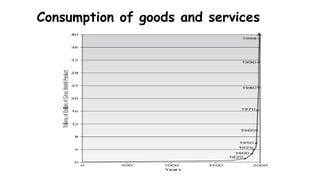
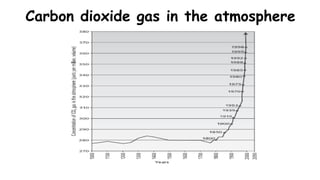
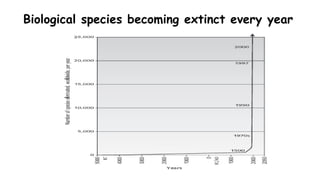
Lecture- 1
Introduction to
Environmental Studies
Objectives
• After studying this chapter, you should be able to:
• Appreciate the fact that the world is facing an
environmental crisis
• Describe the global environmental crisis through examples
and statistics
• Describe exponential growth, the spikes and their
implications
• Trace the origins of the environmental crisis to the Idea of
Progress and the change in our attitude towards nature
Objectives (contd)
• Explain the concept of ecological footprint
• Define terms like environment, ecology, and environmental
studies
• Appreciate the interdisciplinary nature of environmental
studies.
Questions Addressed
•What is the scale of the global
environmental crisis and what are its
causes?
•What is sustainable development?
•What is the scope of Environmental Studies
and why should you study the subject?
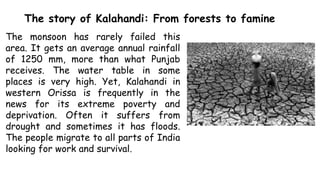
The story of Kalahandi: From forests to famine
The monsoon has rarely failed this
area. It gets an average annual rainfall
of 1250 mm, more than what Punjab
receives. The water table in some
places is very high. Yet, Kalahandi in
western Orissa is frequently in the
news for its extreme poverty and
deprivation. Often it suffers from
drought and sometimes it has floods.
The people migrate to all parts of India
looking for work and survival.
The Story of Kalahandi
• Kalahandi District in Orissa some decades ago:
• Full of forests
• 1000s of water sources controlled by community
• Abundant diversity of crops
• Kalahandi today:
• Extreme poverty and deprivation
• Often drought and famine
• Reasons for decline:
• Forests cut down
• Water sources taken over by govt., but not maintained
• Focus on large irrigation projects
What does the story of Kalahandi
tell us?
•Kalahandi is a classic case of environmental
degradation leading to poverty and
deprivation.
•Is Kalahandi a rare case or is it a typical
one?
•Is there really a global environmental crisis?
•If there is a crisis, what is the cure?
The Story of Ghoramara:
Climate Change and the Sundarbans Islands
• Ghoramara Island located in Sundarbans delta on the Bay of Bengal is slipping
under water due to rising seas. 4.6 sq km island, has almost halved in size
over the last 20 years. The future is uncertain as people of Ghoramara Island
live on the edge.
• Erosion and sinking of islands including Ghoramara
• Reasons:
• Sea level rise due to climate change
• Cutting down of coastal mangroves
• Collapse of wells
• Changing rainfall pattern
• Bengal Tiger and other species threatened
• Loss of forest cover
What does the story of Vanishing
Islands indicates?
• The islands of the Sunderbans are not unique in their
predicament.
• Sea level rise and severe weather are just two examples
of impact of climate change. Almost every aspect of our
lives will be affected by this phenomenon.
• Climage change is the defining issue of this century.
• It is the biggest threat humanity has ever faced.
Key Idea
Climate change is the biggest
threat that humanity has ever
faced.
Scientists and many analysts are
clear that we do not have much
time.
If we do not act fast, doomsday
will be on us soon.
State of the Planet Doomsday Clock:
3 Minutes to Midnight
• Doomsday Clock: Symbolic indicator of how close the
world is to a potentially civilization-ending catastrophe
• The closer the Clock is to midnight, the closer we are
to global calamity.
• Doomsday Clock is now set to 11.57 pm because of
unchecked climate change and nuclear build-up.
Is there really a Global
Environmental and Climate crisis?
•All the indicators show worsening trend:
•Global Warming and Climate Change
•Population explosion
•Water scarcity and lack of sanitation
•Loss of biological diversity
•Destruction of forests and degradation of
land
Worsening Environmental Indicators
(Contd)
• Pollution of air, water, soil
• Ocean and coastal areas in ecological decline
• Increasing number of disasters with greater damage
• Energy scarcity
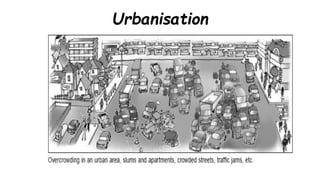
• Rapid urbanization and increasing waste generation
• Poor environmental governance
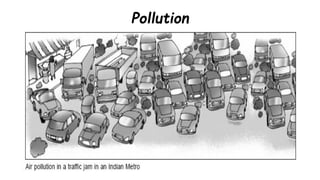
Pollution
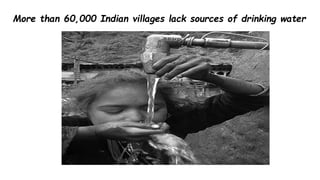
More than 60,000 Indian villages lack sources of drinking water
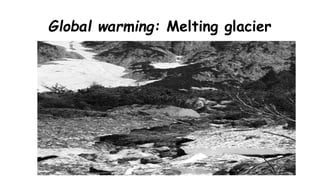
Global warming: Melting glacier
Urbanisation
Key Idea
Our Unsustainable Way of Living
1. We are consuming natural resources at a rate much higher
than that at which nature can regenerate them.
2. As we consume the resources, we are also creating waste
and pollution much faster than the rate at which nature can
absorb them.
• This is an unsustainable way of living and it can only lead to an
environmental and social catastrophe.
• The earth has existed for 5 billion years, humanity for 3 to 5 million years,
and civilization for 10,000 years.
• The earth and all its living beings have survived many crisis and cataclysmic
events.
• Will we not survive the current environmental crisis too?
• Surely nature will take care of the environmental problems over time?
• We may be correct in expecting the earth and many species to survive, but
we may be wrong in assuming that humanity will also continue to exist
forever. The reason is that there is something different happening now.
• In the past the changes in nature were slow but that is no longer true.
Human activity have drastically increased the pace at which things change.
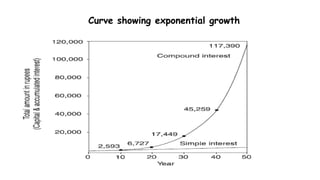
• What is happening now can be described by a simple mathematical curve or
graph- the exponential growth of a quantity with time.
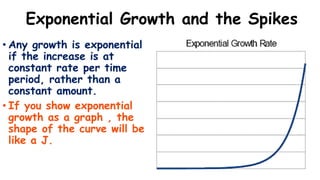
Exponential Growth and the Spikes
• Any growth is exponential
if the increase is at
constant rate per time
period, rather than a
constant amount.
• If you show exponential
growth as a graph , the
shape of the curve will be
like a J.
Curve showing exponential growth
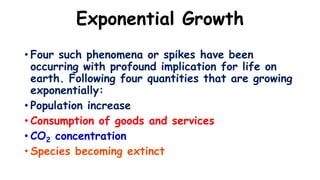
Exponential Growth
• Four such phenomena or spikes have been
occurring with profound implication for life on
earth. Following four quantities that are growing
exponentially:
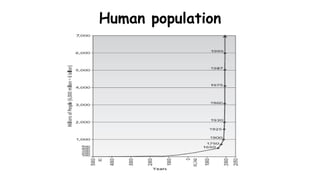
• Population increase
• Consumption of goods and services
• CO2 concentration
• Species becoming extinct
Human population
Consumption of goods and services
Carbon dioxide gas in the atmosphere
Biological species becoming extinct every year
Reasons for the Spikes:
Changed Relationship between Man and Nature
• Our beliefs today:
• Humans are a superior species and can indefinitely exploit
nature.
• Our progress towards a better life would be linear and
continuous (Idea of Progress).
• Science and technology would help us in this quest for
ceaseless progress and development.
• Our ecological footprints is getting larger and larger.
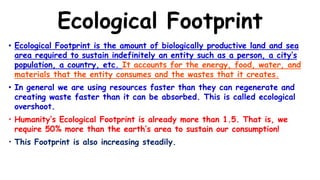
Ecological Footprint
• Ecological Footprint is the amount of biologically productive land and sea
area required to sustain indefinitely an entity such as a person, a city’s
population, a country, etc. It accounts for the energy, food, water, and
materials that the entity consumes and the wastes that it creates.
• In general we are using resources faster than they can regenerate and
creating waste faster than it can be absorbed. This is called ecological
overshoot.
• Humanity’s Ecological Footprint is already more than 1.5. That is, we
require 50% more than the earth’s area to sustain our consumption!
• This Footprint is also increasing steadily.
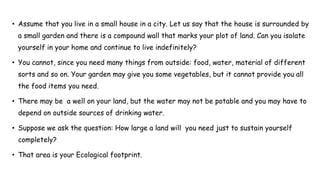
• Assume that you live in a small house in a city. Let us say that the house is surrounded by
a small garden and there is a compound wall that marks your plot of land. Can you isolate
yourself in your home and continue to live indefinitely?
• You cannot, since you need many things from outside: food, water, material of different
sorts and so on. Your garden may give you some vegetables, but it cannot provide you all
the food items you need.
• There may be a well on your land, but the water may not be potable and you may have to
depend on outside sources of drinking water.
• Suppose we ask the question: How large a land will you need just to sustain yourself
completely?
• That area is your Ecological footprint.
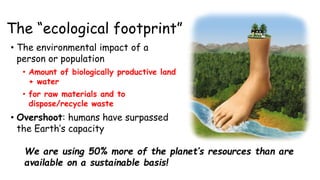
The “ecological footprint”
• The environmental impact of a
person or population
• Amount of biologically productive land
+ water
• for raw materials and to
dispose/recycle waste
• Overshoot: humans have surpassed
the Earth’s capacity
We are using 50% more of the planet’s resources than are
available on a sustainable basis!
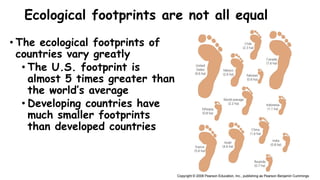
Ecological footprints are not all equal
• The ecological footprints of
countries vary greatly
• The U.S. footprint is
almost 5 times greater than
the world’s average
• Developing countries have
much smaller footprints
than developed countries
Sustainable Development
Development
that meets the needs of the present
without compromising
the ability of future generations
to meet their own needs.
Subjects of Study
• Ecology: is the science that studies the relationships between
living things and the environment.
• Environmental Science: is the systematic and scientific study
of the environment and our role in it.
• Environmental Studies: can be defined as the branch of
study concerned with environmental issues. It has a broader
canvas than environmental science and includes the social aspects
of the environment. It does deals with science where necessary,
but at a level understandable to the non-scientist.
Interdisciplinary nature of these subjects
• Environmental sciences is the combination of biological,
chemical, geological, and mathematical principles as they
apply to the environment and environmental problems.
Commonly, environmental sciences is thought of as the
study of solving these problems, such as degradation and
pollution of the environment, that may have been caused
by humans. Environmental sciences also focuses on
preserving and managing natural resources.
• Environmental studies broadens the field as it includes
more emphasis on the political, economic, and social
aspects related to the environment, topics which include
sustainability.
????
WHY WE HAVE TO
STUDY A COURSE IN
‘ENVIRONMENTAL
STUDIES’ ???
Objective of this course is
to develop concern for our
own environment
which will lead us to act at
our own level to protect the
environment we all live in.
• There are three reasons for studying the state of the
environment.
• The first, is the need for information that clarifies modern
environmental concepts like equitable use of natural resources,
more sustainable life styles etc.
• Second, there is a need to change the way in which we view our
own environment, using practical approach based on observation
and self learning.
• Third, there is a need to create a concern for our environment
that will trigger pro-environmental action, including simple
activities we can do in our daily life to protect it.
Why is Environmental Education Provided to Engineers?
• Engineering graduates entering industry get benefitted from environmental competence in their practice
fields. This is because planning, extraction, design and manufacturing, all have some common and some unique
regulations for their environmental effects.
• Engineers are capable of finding creative solutions for climate change and other environmental problems.
• They will play a crucial role in helping the human race coexist with the rest of the world in decades to come.
This is because, engineers use principles of chemistry and biology to prevent or solve environmental problems.
• They work in many areas, including industrial hygiene, land management, air pollution control, toxic-materials
control, etc.
• The duties of an environmental engineer range from planning and designing an effective waste-treatment
plant, to study the effects of pollution on humans.
• A sales engineer in the environmental engineering field may be responsible for the sale of air pollution control
products to factories.
• In addition to sale, they often assist with the design and modification of their products based on customer
feedback.
You are going to be Modern day Professionals
Being Modern day Professionals, You will be
required to encounter Environment related
problems at all levels- Most importantly as
Technical Managers directly facing the Society
at large.
What do You Mean by this ?
In what way we are responsible ?
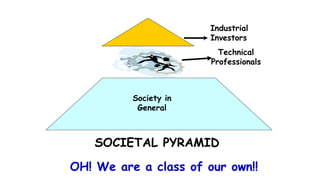
Industrial
Investors
Technical
Professionals
SOCIETAL PYRAMID
OH! We are a class of our own!!
Society in
General
Industrial Usage
Basic Societal
Usage
RESOURCE DISTRIBUTION PYRAMID
But our base is shaky!! We got to face the music !!
Bosses will ask you to face the public !!
ASSIGNMENT – I
1) There is a view that all our problems and our domination over
nature stated when we started practicing agriculture about
10,000 years ago. Examine this view and give argument in
favour and against.
2) In your opinion, what should be the difference in the way the
two subjects, environmental science and environmental studies
are taught to under graduates?
3) Why are many environmental problems so difficult to solve?

Intr_EVS.pdf

  • 1.
    ET-1122 – Environmental Studies Dr.Debasish Panda Professor Civil Engineering
  • 2.
    Syllabus • Unit 1: Introduction to Environmental Studies and Natural Resources • Unit 2 :Ecosystems and Biodiversity • Unit 3 :Environmental Pollution • Unit 4 : Social issues and the Environment • Unit 5 :Human Population and the Environment
  • 3.
    BOOKS 1. Bharucha, E.2004, Environmental Studies, University Grants Commission, New Delhi. 2. Joseph, B. 2006, Environmental Science and Engineering, Tata Mc-Graw Hill Publishing Company, New Delhi. 3. Anjaneyalu, Y, 2004 Introduction to Environmental Science, Rao P.N. (Editor), BS Publications, Hyderabad, A.P. India. 4. Rajagopalan, R. 2005, Environmental Studies: From Crisis to Cure, Oxford University Press, London. 5. Anil Kumar DE and Arnab Kumar DE., Environmental Studies, New AGE International Publishers, New Delhi. 6. Anubha Kauishik and Kaushik CP., Environmental Science and Engineering, New AGE International Publishers, New Delhi.
  • 5.
  • 6.
    Objectives • After studyingthis chapter, you should be able to: • Appreciate the fact that the world is facing an environmental crisis • Describe the global environmental crisis through examples and statistics • Describe exponential growth, the spikes and their implications • Trace the origins of the environmental crisis to the Idea of Progress and the change in our attitude towards nature
  • 7.
    Objectives (contd) • Explainthe concept of ecological footprint • Define terms like environment, ecology, and environmental studies • Appreciate the interdisciplinary nature of environmental studies.
  • 8.
    Questions Addressed •What isthe scale of the global environmental crisis and what are its causes? •What is sustainable development? •What is the scope of Environmental Studies and why should you study the subject?
  • 9.
    The story ofKalahandi: From forests to famine The monsoon has rarely failed this area. It gets an average annual rainfall of 1250 mm, more than what Punjab receives. The water table in some places is very high. Yet, Kalahandi in western Orissa is frequently in the news for its extreme poverty and deprivation. Often it suffers from drought and sometimes it has floods. The people migrate to all parts of India looking for work and survival.
  • 10.
    The Story ofKalahandi • Kalahandi District in Orissa some decades ago: • Full of forests • 1000s of water sources controlled by community • Abundant diversity of crops • Kalahandi today: • Extreme poverty and deprivation • Often drought and famine • Reasons for decline: • Forests cut down • Water sources taken over by govt., but not maintained • Focus on large irrigation projects
  • 11.
    What does thestory of Kalahandi tell us? •Kalahandi is a classic case of environmental degradation leading to poverty and deprivation. •Is Kalahandi a rare case or is it a typical one? •Is there really a global environmental crisis? •If there is a crisis, what is the cure?
  • 12.
    The Story ofGhoramara: Climate Change and the Sundarbans Islands • Ghoramara Island located in Sundarbans delta on the Bay of Bengal is slipping under water due to rising seas. 4.6 sq km island, has almost halved in size over the last 20 years. The future is uncertain as people of Ghoramara Island live on the edge. • Erosion and sinking of islands including Ghoramara • Reasons: • Sea level rise due to climate change • Cutting down of coastal mangroves • Collapse of wells • Changing rainfall pattern • Bengal Tiger and other species threatened • Loss of forest cover
  • 13.
    What does thestory of Vanishing Islands indicates? • The islands of the Sunderbans are not unique in their predicament. • Sea level rise and severe weather are just two examples of impact of climate change. Almost every aspect of our lives will be affected by this phenomenon. • Climage change is the defining issue of this century. • It is the biggest threat humanity has ever faced.
  • 14.
    Key Idea Climate changeis the biggest threat that humanity has ever faced.
  • 15.
    Scientists and manyanalysts are clear that we do not have much time. If we do not act fast, doomsday will be on us soon.
  • 16.
    State of thePlanet Doomsday Clock: 3 Minutes to Midnight • Doomsday Clock: Symbolic indicator of how close the world is to a potentially civilization-ending catastrophe • The closer the Clock is to midnight, the closer we are to global calamity. • Doomsday Clock is now set to 11.57 pm because of unchecked climate change and nuclear build-up.
  • 17.
    Is there reallya Global Environmental and Climate crisis? •All the indicators show worsening trend: •Global Warming and Climate Change •Population explosion •Water scarcity and lack of sanitation •Loss of biological diversity •Destruction of forests and degradation of land
  • 18.
    Worsening Environmental Indicators (Contd) •Pollution of air, water, soil • Ocean and coastal areas in ecological decline • Increasing number of disasters with greater damage • Energy scarcity • Rapid urbanization and increasing waste generation • Poor environmental governance
  • 19.
  • 20.
    More than 60,000Indian villages lack sources of drinking water
  • 21.
  • 22.
  • 23.
    Key Idea Our UnsustainableWay of Living 1. We are consuming natural resources at a rate much higher than that at which nature can regenerate them. 2. As we consume the resources, we are also creating waste and pollution much faster than the rate at which nature can absorb them. • This is an unsustainable way of living and it can only lead to an environmental and social catastrophe.
  • 24.
    • The earthhas existed for 5 billion years, humanity for 3 to 5 million years, and civilization for 10,000 years. • The earth and all its living beings have survived many crisis and cataclysmic events. • Will we not survive the current environmental crisis too? • Surely nature will take care of the environmental problems over time? • We may be correct in expecting the earth and many species to survive, but we may be wrong in assuming that humanity will also continue to exist forever. The reason is that there is something different happening now. • In the past the changes in nature were slow but that is no longer true. Human activity have drastically increased the pace at which things change. • What is happening now can be described by a simple mathematical curve or graph- the exponential growth of a quantity with time.
  • 25.
    Exponential Growth andthe Spikes • Any growth is exponential if the increase is at constant rate per time period, rather than a constant amount. • If you show exponential growth as a graph , the shape of the curve will be like a J.
  • 26.
  • 27.
    Exponential Growth • Foursuch phenomena or spikes have been occurring with profound implication for life on earth. Following four quantities that are growing exponentially: • Population increase • Consumption of goods and services • CO2 concentration • Species becoming extinct
  • 28.
  • 29.
  • 30.
    Carbon dioxide gasin the atmosphere
  • 31.
    Biological species becomingextinct every year
  • 32.
    Reasons for theSpikes: Changed Relationship between Man and Nature • Our beliefs today: • Humans are a superior species and can indefinitely exploit nature. • Our progress towards a better life would be linear and continuous (Idea of Progress). • Science and technology would help us in this quest for ceaseless progress and development. • Our ecological footprints is getting larger and larger.
  • 33.
    Ecological Footprint • EcologicalFootprint is the amount of biologically productive land and sea area required to sustain indefinitely an entity such as a person, a city’s population, a country, etc. It accounts for the energy, food, water, and materials that the entity consumes and the wastes that it creates. • In general we are using resources faster than they can regenerate and creating waste faster than it can be absorbed. This is called ecological overshoot. • Humanity’s Ecological Footprint is already more than 1.5. That is, we require 50% more than the earth’s area to sustain our consumption! • This Footprint is also increasing steadily.
  • 34.
    • Assume thatyou live in a small house in a city. Let us say that the house is surrounded by a small garden and there is a compound wall that marks your plot of land. Can you isolate yourself in your home and continue to live indefinitely? • You cannot, since you need many things from outside: food, water, material of different sorts and so on. Your garden may give you some vegetables, but it cannot provide you all the food items you need. • There may be a well on your land, but the water may not be potable and you may have to depend on outside sources of drinking water. • Suppose we ask the question: How large a land will you need just to sustain yourself completely? • That area is your Ecological footprint.
  • 35.
    The “ecological footprint” •The environmental impact of a person or population • Amount of biologically productive land + water • for raw materials and to dispose/recycle waste • Overshoot: humans have surpassed the Earth’s capacity We are using 50% more of the planet’s resources than are available on a sustainable basis!
  • 36.
    Ecological footprints arenot all equal • The ecological footprints of countries vary greatly • The U.S. footprint is almost 5 times greater than the world’s average • Developing countries have much smaller footprints than developed countries
  • 37.
    Sustainable Development Development that meetsthe needs of the present without compromising the ability of future generations to meet their own needs.
  • 38.
    Subjects of Study •Ecology: is the science that studies the relationships between living things and the environment. • Environmental Science: is the systematic and scientific study of the environment and our role in it. • Environmental Studies: can be defined as the branch of study concerned with environmental issues. It has a broader canvas than environmental science and includes the social aspects of the environment. It does deals with science where necessary, but at a level understandable to the non-scientist. Interdisciplinary nature of these subjects
  • 39.
    • Environmental sciencesis the combination of biological, chemical, geological, and mathematical principles as they apply to the environment and environmental problems. Commonly, environmental sciences is thought of as the study of solving these problems, such as degradation and pollution of the environment, that may have been caused by humans. Environmental sciences also focuses on preserving and managing natural resources. • Environmental studies broadens the field as it includes more emphasis on the political, economic, and social aspects related to the environment, topics which include sustainability.
  • 40.
    ???? WHY WE HAVETO STUDY A COURSE IN ‘ENVIRONMENTAL STUDIES’ ???
  • 41.
    Objective of thiscourse is to develop concern for our own environment which will lead us to act at our own level to protect the environment we all live in.
  • 42.
    • There arethree reasons for studying the state of the environment. • The first, is the need for information that clarifies modern environmental concepts like equitable use of natural resources, more sustainable life styles etc. • Second, there is a need to change the way in which we view our own environment, using practical approach based on observation and self learning. • Third, there is a need to create a concern for our environment that will trigger pro-environmental action, including simple activities we can do in our daily life to protect it.
  • 43.
    Why is EnvironmentalEducation Provided to Engineers? • Engineering graduates entering industry get benefitted from environmental competence in their practice fields. This is because planning, extraction, design and manufacturing, all have some common and some unique regulations for their environmental effects. • Engineers are capable of finding creative solutions for climate change and other environmental problems. • They will play a crucial role in helping the human race coexist with the rest of the world in decades to come. This is because, engineers use principles of chemistry and biology to prevent or solve environmental problems. • They work in many areas, including industrial hygiene, land management, air pollution control, toxic-materials control, etc. • The duties of an environmental engineer range from planning and designing an effective waste-treatment plant, to study the effects of pollution on humans. • A sales engineer in the environmental engineering field may be responsible for the sale of air pollution control products to factories. • In addition to sale, they often assist with the design and modification of their products based on customer feedback.
  • 44.
    You are goingto be Modern day Professionals Being Modern day Professionals, You will be required to encounter Environment related problems at all levels- Most importantly as Technical Managers directly facing the Society at large. What do You Mean by this ? In what way we are responsible ?
  • 45.
  • 46.
    Industrial Usage Basic Societal Usage RESOURCEDISTRIBUTION PYRAMID But our base is shaky!! We got to face the music !! Bosses will ask you to face the public !!
  • 47.
    ASSIGNMENT – I 1)There is a view that all our problems and our domination over nature stated when we started practicing agriculture about 10,000 years ago. Examine this view and give argument in favour and against. 2) In your opinion, what should be the difference in the way the two subjects, environmental science and environmental studies are taught to under graduates? 3) Why are many environmental problems so difficult to solve?