RETROFITTING OF
CONCRETE STRUCTURE
Submitted by-
MODI PRISHAKTI J.
Enroll. No.
166128306507
Definition:
It is the modification of existing structures to
make them more resistant to seismic activity,
ground motion, or soil failure due to
earthquakes.
The retrofit techniques are also applicable for
other natural hazards such as tropical
cyclones, tornadoes, and severe winds from
thunderstorms.
Need for Seismic Retrofitting:
• To ensure the safety and security of a building,
employees, structure functionality, machinery and
inventory
• Essential to reduce hazard and losses from non-
structural elements.
• predominantly concerned with structural
improvement to reduce seismic hazard.
• Important buildings must be strengthened whose
services are assumed to be essential just after an
earthquake like hospitals.
Problems faced by Structural Engineers are:
Lack of standards for retrofitting methods –
Effectiveness of each methods varies a lot depending
upon parameters like type of structures, material
condition, amount of damage etc.
Basic Concept of Retrofitting:
The aim is at:
•Upgradation of lateral strength of the structure
•Increase in the ductility of the structure
•Increase in strength and ductility
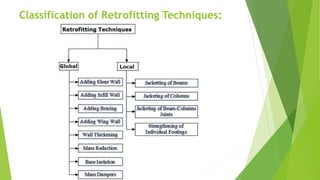
Classification of Retrofitting Techniques:
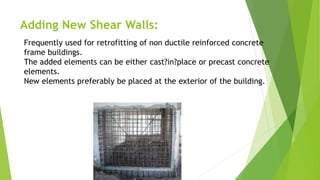
Adding New Shear Walls:
Frequently used for retrofitting of non ductile reinforced concrete
frame buildings.
The added elements can be either cast?in?place or precast concrete
elements.
New elements preferably be placed at the exterior of the building.
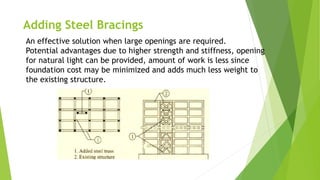
Adding Steel Bracings
An effective solution when large openings are required.
Potential advantages due to higher strength and stiffness, opening
for natural light can be provided, amount of work is less since
foundation cost may be minimized and adds much less weight to
the existing structure.
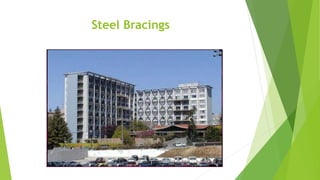
Steel Bracings
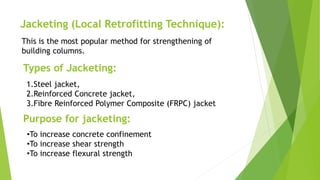
Jacketing (Local Retrofitting Technique):
This is the most popular method for strengthening of
building columns.
Types of Jacketing:
1.Steel jacket,
2.Reinforced Concrete jacket,
3.Fibre Reinforced Polymer Composite (FRPC) jacket
Purpose for jacketing:
•To increase concrete confinement
•To increase shear strength
•To increase flexural strength
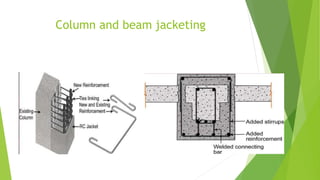
Column and beam jacketing
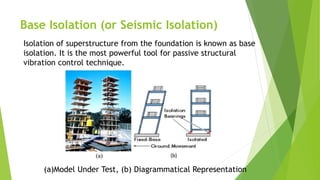
Base Isolation (or Seismic Isolation)
Isolation of superstructure from the foundation is known as base
isolation. It is the most powerful tool for passive structural
vibration control technique.
(a)Model Under Test, (b) Diagrammatical Representation
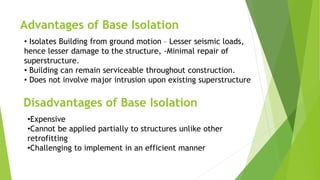
Advantages of Base Isolation
• Isolates Building from ground motion – Lesser seismic loads,
hence lesser damage to the structure, -Minimal repair of
superstructure.
• Building can remain serviceable throughout construction.
• Does not involve major intrusion upon existing superstructure
Disadvantages of Base Isolation
•Expensive
•Cannot be applied partially to structures unlike other
retrofitting
•Challenging to implement in an efficient manner
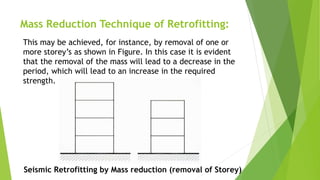
Mass Reduction Technique of Retrofitting:
This may be achieved, for instance, by removal of one or
more storey’s as shown in Figure. In this case it is evident
that the removal of the mass will lead to a decrease in the
period, which will lead to an increase in the required
strength.
Seismic Retrofitting by Mass reduction (removal of Storey)
Wall Thickening Technique of Retrofitting:
The existing walls of a building are added certain thickness
by adding bricks, concrete and steel aligned at certain
places as reinforcement, such that the weight of wall
increases and it can bear more vertical and horizontal
loads, and also its designed under special conditions that
the transverse loads does not cause sudden failure of the
wall.
Indian Standard Codes for Earthquake
Design of Structures:
•IS: 1893-2002 (part-1) Criteria for Earthquake Resistant
Design of Structures (Part 1 : General Provision and
Buildings) – Code of Practice
•IS: 4326-1993 Earthquake Resistant Design and Construction
of Buildings – Code of Practice
•IS: 13920-1993 Ductile Detailing of Reinforced Concrete
Structures subjected to Seismic Forces – Code of Practice
•IS: 13935-1993 Repair and Seismic Strengthening of
Buildings – Guidelines
•IS: 13828-1993 Improving Earthquake Resistance of Low
Strength Masonry Buildings – Guidelines
•IS: 13827-1993 Improving Earthquake Resistance of Earthen
Buildings – Guidelines
Conclusion – Retrofitting Techniques for
concrete structures:
•Seismic Retrofitting is a suitable technology for protection
of a variety of structures.
•It has matured in the recent years to a highly reliable
technology.
•But, the expertise needed is not available in the basic
level.
•The main challenge is to achieve a desired performance
level at a minimum cost, which can be achieved through a
detailed nonlinear analysis.
•Optimization techniques are needed to know the most
efficient retrofit for a particular structure.
•Proper Design Codes are needed to be published as code
of practice for professionals related to this field.
THANK
YOU

RETROFITTING OF CONCRETE STRUCTURE

  • 1.
    RETROFITTING OF CONCRETE STRUCTURE Submittedby- MODI PRISHAKTI J. Enroll. No. 166128306507
  • 2.
    Definition: It is themodification of existing structures to make them more resistant to seismic activity, ground motion, or soil failure due to earthquakes. The retrofit techniques are also applicable for other natural hazards such as tropical cyclones, tornadoes, and severe winds from thunderstorms.
  • 3.
    Need for SeismicRetrofitting: • To ensure the safety and security of a building, employees, structure functionality, machinery and inventory • Essential to reduce hazard and losses from non- structural elements. • predominantly concerned with structural improvement to reduce seismic hazard. • Important buildings must be strengthened whose services are assumed to be essential just after an earthquake like hospitals.
  • 4.
    Problems faced byStructural Engineers are: Lack of standards for retrofitting methods – Effectiveness of each methods varies a lot depending upon parameters like type of structures, material condition, amount of damage etc. Basic Concept of Retrofitting: The aim is at: •Upgradation of lateral strength of the structure •Increase in the ductility of the structure •Increase in strength and ductility
  • 5.
  • 6.
    Adding New ShearWalls: Frequently used for retrofitting of non ductile reinforced concrete frame buildings. The added elements can be either cast?in?place or precast concrete elements. New elements preferably be placed at the exterior of the building.
  • 7.
    Adding Steel Bracings Aneffective solution when large openings are required. Potential advantages due to higher strength and stiffness, opening for natural light can be provided, amount of work is less since foundation cost may be minimized and adds much less weight to the existing structure.
  • 8.
  • 9.
    Jacketing (Local RetrofittingTechnique): This is the most popular method for strengthening of building columns. Types of Jacketing: 1.Steel jacket, 2.Reinforced Concrete jacket, 3.Fibre Reinforced Polymer Composite (FRPC) jacket Purpose for jacketing: •To increase concrete confinement •To increase shear strength •To increase flexural strength
  • 10.
    Column and beamjacketing
  • 11.
    Base Isolation (orSeismic Isolation) Isolation of superstructure from the foundation is known as base isolation. It is the most powerful tool for passive structural vibration control technique. (a)Model Under Test, (b) Diagrammatical Representation
  • 12.
    Advantages of BaseIsolation • Isolates Building from ground motion – Lesser seismic loads, hence lesser damage to the structure, -Minimal repair of superstructure. • Building can remain serviceable throughout construction. • Does not involve major intrusion upon existing superstructure Disadvantages of Base Isolation •Expensive •Cannot be applied partially to structures unlike other retrofitting •Challenging to implement in an efficient manner
  • 13.
    Mass Reduction Techniqueof Retrofitting: This may be achieved, for instance, by removal of one or more storey’s as shown in Figure. In this case it is evident that the removal of the mass will lead to a decrease in the period, which will lead to an increase in the required strength. Seismic Retrofitting by Mass reduction (removal of Storey)
  • 14.
    Wall Thickening Techniqueof Retrofitting: The existing walls of a building are added certain thickness by adding bricks, concrete and steel aligned at certain places as reinforcement, such that the weight of wall increases and it can bear more vertical and horizontal loads, and also its designed under special conditions that the transverse loads does not cause sudden failure of the wall.
  • 15.
    Indian Standard Codesfor Earthquake Design of Structures: •IS: 1893-2002 (part-1) Criteria for Earthquake Resistant Design of Structures (Part 1 : General Provision and Buildings) – Code of Practice •IS: 4326-1993 Earthquake Resistant Design and Construction of Buildings – Code of Practice •IS: 13920-1993 Ductile Detailing of Reinforced Concrete Structures subjected to Seismic Forces – Code of Practice •IS: 13935-1993 Repair and Seismic Strengthening of Buildings – Guidelines •IS: 13828-1993 Improving Earthquake Resistance of Low Strength Masonry Buildings – Guidelines •IS: 13827-1993 Improving Earthquake Resistance of Earthen Buildings – Guidelines
  • 16.
    Conclusion – RetrofittingTechniques for concrete structures: •Seismic Retrofitting is a suitable technology for protection of a variety of structures. •It has matured in the recent years to a highly reliable technology. •But, the expertise needed is not available in the basic level. •The main challenge is to achieve a desired performance level at a minimum cost, which can be achieved through a detailed nonlinear analysis. •Optimization techniques are needed to know the most efficient retrofit for a particular structure. •Proper Design Codes are needed to be published as code of practice for professionals related to this field.
  • 17.