IJRET: International Journal of Research in Engineering and Technology eISSN: 2319-1163 | pISSN: 2321-7308
_______________________________________________________________________________________
Volume: 04 Issue: 03 | Mar-2015, Available @ http://www.ijret.org 358
REVIEW PAPER ON SEISMIC RESPONSES OF MULTISTORED RCC
BUILDING WITH MASS IRREGULARITY
Sagar R Padol1
, Rajashekhar S. Talikoti2
1
PG Student, Late G. N. Sapkal College of Engineering,Nashik,Maharashtra, India
2
Head of Department, Late G. N. Sapkal College of Engineering, Nashik, Maharashtra, India
Abstract
From past earthquakes it is proved that many of structure are totally or partially damaged due to earthquake. So, it is necessary
to determine seismic responses of such buildings. There are different techniques of seismic analysis of structure. Time history
analysis is one of the important techniques for structural seismic analysis generally the evaluated structural response is non-
linear in nature. For such type of analysis, a representative earthquake time history is required. In this project work seismic
analysis of RCC buildings with mass irregularity at different floor level are carried out. Here for analysis different time histories
have been used. This paper highlights the effect of mass irregularity on different floor in RCC buildings with time history and
analysis is done by using ETABS software.
Keywords: Seismic Analysis, Time History Analysis, Base Shear, Storey Shear, Story Displacement.
--------------------------------------------------------------------***----------------------------------------------------------------------
1. INTRODUCTION
During an earthquake, failure of structure starts at points of
weakness. Generally weakness is due to geometry, mass
discontinuity and stiffness of structure. The structures
having this discontinuity are termed as Irregular structures.
These structures contain a large portion of urban
infrastructure. Hence structures fail during earthquakes due
to vertical irregularity.
According to IS 1893:
The irregularity in the building structures may be due to
irregular distributions in their mass, strength and stiffness
along the height of building. When this type of building are
constructed in high intensity zones, the design and analysis
of structure becomes complicated. There are two types of
irregularities-
1. Plan Irregularities.
2. Vertical Irregularities.
Vertical Irregularities are of five types-
a) Stiffness Irregularity — Soft Storey-A soft storey is one
in which the lateral stiffness is less than 70 percent of the
storey above or less than 80 percent of the average lateral
stiffness of the three storey’s above.
b) Stiffness Irregularity — Extreme Soft Storey-An extreme
soft storey is one in which the lateral stiffness is less than 60
percent of that in the storey above or less than 70 percent of
the average stiffness of the three storey’s above.
ii) Mass Irregularity-Mass irregularity shall be considered to
exist where the seismic weight of any storey is more than
200 percent of that of its adjacent storey’s. In case of roofs
irregularity need not be considered.
iii) Vertical Geometric Irregularity- A structure is
considered to be Vertical geometric irregular when the
horizontal dimension of the lateral force resisting system in
any storey is more than 150 percent of that in its adjacent
storey.
Buildings are designed as per Design based earthquake, but
the actual forces acting on the structure is more than the
design earthquake. So, in higher seismic zones Ductility
based design approach is preferred as ductility of the
structure narrows the gap. The primary objective in
designing an earthquake resistant structure is to ensure that
the building has enough ductility to withstand the
earthquake load.
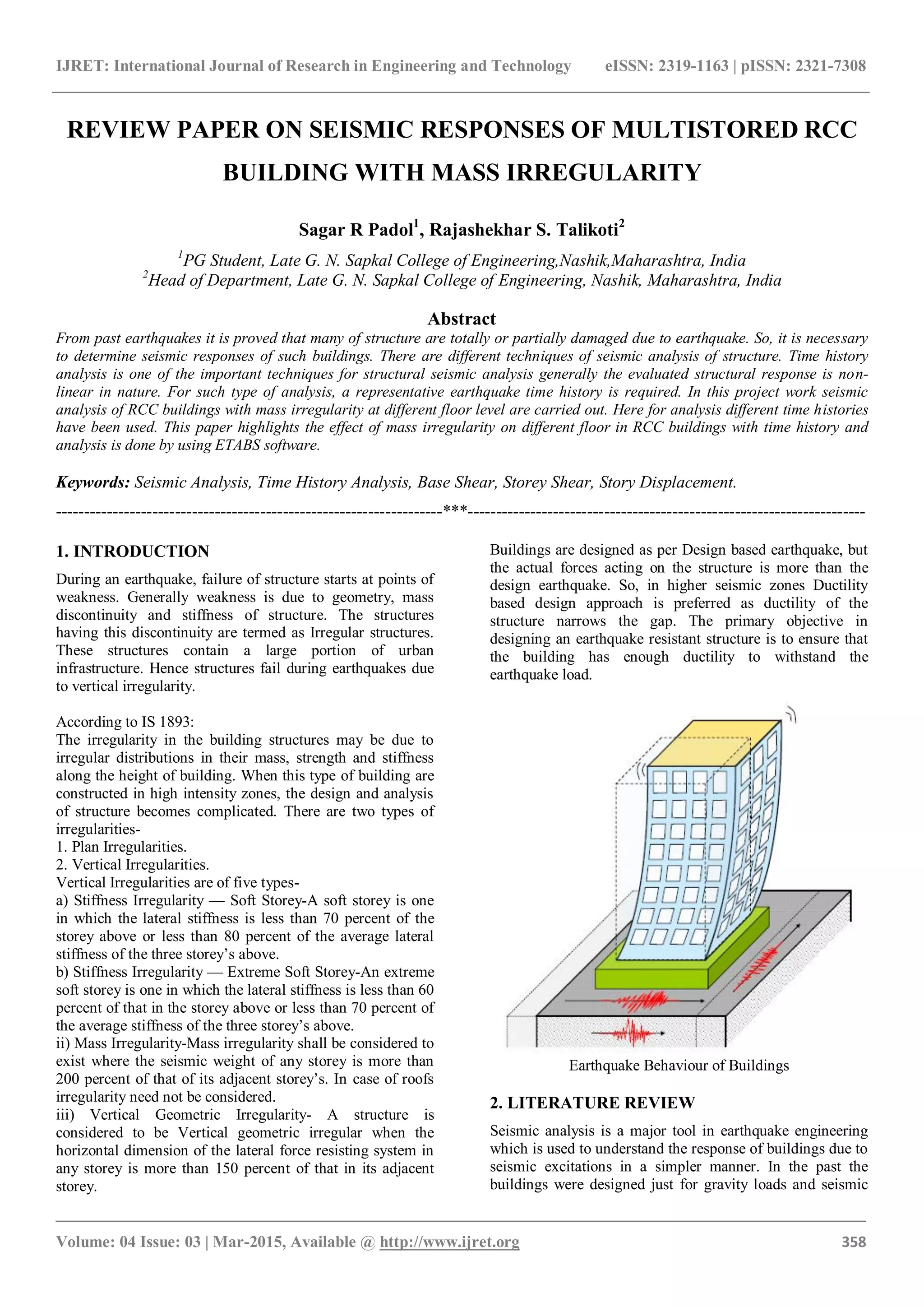
Earthquake Behaviour of Buildings
2. LITERATURE REVIEW
Seismic analysis is a major tool in earthquake engineering
which is used to understand the response of buildings due to
seismic excitations in a simpler manner. In the past the
buildings were designed just for gravity loads and seismic
IJRET: International Journal of Research in Engineering and Technology eISSN: 2319-1163 | pISSN: 2321-7308
_______________________________________________________________________________________
Volume: 04 Issue: 03 | Mar-2015, Available @ http://www.ijret.org 359
analysis is a recent development. It is a part of structural
analysis and a part of structural design where earthquake is
prevalent.
Mayuri D. Bhagwat et.al [1] In this work dynamic analysis
of G+12 multistoried practiced RCC building considering
for Koyna and Bhuj earthquake is carried out by time
history analysis and response spectrum analysis and seismic
responses of such building are comparatively studied and
modeled with the help of ETABS software. Two time
histories (i.e. Koyna and Bhuj) have been used to develop
different acceptable criteria (base shear, storey
displacement, storey drifts).
Himanshu Bansal et al [2] In this study the storey shear
force was found to be maximum for the first storey and it
decreased to a minimum in the top storey in all cases. It was
found that mass irregular building frames experience larger
base shear than similar regular building frames. The
stiffness irregular building experienced lesser base shear and
has larger inter storey drifts.
Mohit Sharma et al [3] In this study a G+30 storied regular
building. The static and dynamic analysis has done on
computer with the help of STAAD-Pro software using the
parameters for the design as per the IS-1893- 2002-Part-1
for the zones- 2 and 3.
A. B. M. Saiful Islam et al [4] In this study analyses results
show that isolation system considerably reduce earthquake
induced load on building. Furthermore, method of analysis
has been found to have considerable effect on the response
of low to medium rise buildings. Time history analysis
shows significant less base shear than that from response
spectrum analysis. Also, less isolator displacement is
obtained from time history analysis than that from response
spectrum analysis.
A S Patil et al [5] This study shows similar variations
pattern in Seismic responses such as base shear and storey
displacements with intensities V to X. From the study it is
recommended that analysis of multistoried RCC building
using Time History method becomes necessary to ensure
safety against earthquake force.
Md. Arman Chowdhury et al [6] In this study regular and
irregular and irregular building with and without isolator are
analyse. Installation of isolator in buildings which increases
the time period of the structure and due to this it reduces the
possibility of resonance of the structure. By providing
isolator in building the cost increases, but reinforcement
requirement and material cost is reduced
P. P. Chandurkar et al [7] In this study shear walls, is
considered as major earthquake resisting member. Structural
wall gives an effective bracing system and offer good
potential for lateral load resistance. So it is important to
determine the seismic response of the wall or shear wall. In
this study main focus is to determine the location for the
shear wall in multi storey building.
Prof. S.S. Patil et al [8] This study gives seismic analysis of
high rise building using program in STAAD Pro. with
considering different conditions of the lateral stiffness
system. Analysis is carried out by response spectrum
method. This analysis gives the effect of higher modes of
vibration and actual distribution of force in elastic range in
good way. These results include base shear, storey drift and
storey deflection are presented.
3. METHODOLOGY
If the structure not properly designed and constructed with
required quality they may cause large destruction of
structures due to earthquakes. Time history analysis is an
useful technique for seismic analysis of structure when the
structure shows nonlinear response. This method is step by
step analysis of the seismic responses of a structure to a
specified loading that may change with time.
1) Extensive literature survey by referring books,
technical papers carried out to understand basic
concept of topic.
2) Selection of type of structures.
3) Modeling of the selected structures
4) Analytical work is to be carried out.
5) Interpretation of result and conclusion.
In the present work it is proposed to carry out seismic
analysis of multistored RCC buildings using time history
analysis method considering mass irregularity at different
floor levels with the help of ETABS software.
4. CONCLUSION
Many of the studies have shown seismic analysis of the
RCC structures with different irregularities such as mass
irregularity, stiffness and vertical geometry irregularity.
Whenever a structure having different irregularity, it is
necessary to analyse the building in various earthquake
zones. From many past studies it is clear that effect of
earthquake on structure can be minimize by providing shear
wall, base isolation etc.
REFERENCES
[1] Mayuri D. Bhagwat, Dr.P.S.Patil, “Comparative
Study of Performance of Rcc Multistory Building For
Koyna and Bhuj Earthquakes” ,International Journal
of Advanced Technology in Engineering and Science
www.ijates.com Volume No.02, Issue No. 07, July
2014 ISSN (online): 2348 – 7550.
[2] Himanshu Bansal, Gagandeep, “Seismic Analysis
and Design of Vertically Irregular RC Building
Frames” International Journal of Science and
Research (IJSR) ISSN (Online): 2319-7064, Impact
Factor (2012): 3.358
[3] Mohit Sharma, Dr. Savita Maru, “ Dynamic Analysis
of Multistoried Regular Building” IOSR Journal of
Mechanical and Civil Engineering (IOSR-JMCE) e-
ISSN: 2278-1684,p-ISSN: 2320-334X, Volume 11,
Issue 1 Ver. II (Jan. 2014), PP 37-42
www.iosrjournals.org
IJRET: International Journal of Research in Engineering and Technology eISSN: 2319-1163 | pISSN: 2321-7308
_______________________________________________________________________________________
Volume: 04 Issue: 03 | Mar-2015, Available @ http://www.ijret.org 360
[4] A. B. M. Saiful Islam*, Mohammed Jameel and
Mohd Zamin Jummat, “Study on optimal isolation
system and dynamic structural responses in multi-
storey buildings” International Journal of the
Physical Sciences Vol. 6(9), pp. 2219-2228, 4 May,
2011 Available online at
http://www.academicjournals.org/IJPS DOI:
10.5897/IJPS10.441 ISSN 1992 - 1950 ©2011
Academic Journals.
[5] A S Patil and P D Kumbhar, “Time History Analysis
of MultistoriedRcc Buildings For Different Seismic
Intensities “ ISSN 2319 – 6009 www.ijscer.com Vol.
2, No. 3, August 2013 © 2013 IJSCER.
[6] Md. Arman Chowdhury, Wahid Hassan,
“Comparative study of the Dynamic Analysis of
Multi-storey Irregular building with or without Base
Isolator” International Journal of Scientific
Engineering and Technology (ISSN : 2277-1581)
Volume No.2, Issue No.9, pp : 909-912 1 Sept. 2013.
[7] ] P. P. Chandurkar, Dr. P. S. Pajgade, “ Seismic
Analysis of RCC Building with and Without Shear
Wall” International Journal of Modern Engineering
Research (IJMER) www.ijmer.com Vol. 3, Issue. 3,
May - June 2013 pp-1805-1810 ISSN: 2249-6645.
[8] Prof. S.S. Patil, ,Miss. S.A. Ghadge, ,Prof. C.G.
Konapure, , Prof. Mrs. C.A. Ghadge. “ Seismic
Analysis of High-Rise Building by Response
Spectrum Method” International Journal Of
Computational Engineering Research
(Ijceronline.Com) Vol. 3 Issue. 3
BIOGRAPHIES
Sagar Ramesh Padol, PG Student, Late G.
N. Sapkal College of Engineering Nashik,
Maharashtra, India
E-mail: padolsagar@gmail.com
Dr. Rajashekhar S. Talikoti, Head of
Department, Late G. N. Sapkal College of
Engineering, Nashik, Maharashtra, India
E-mail: rstalikoti@gmail.com

Review paper on seismic responses of multistored rcc building with mass irregularity

  • 1.
    IJRET: International Journalof Research in Engineering and Technology eISSN: 2319-1163 | pISSN: 2321-7308 _______________________________________________________________________________________ Volume: 04 Issue: 03 | Mar-2015, Available @ http://www.ijret.org 358 REVIEW PAPER ON SEISMIC RESPONSES OF MULTISTORED RCC BUILDING WITH MASS IRREGULARITY Sagar R Padol1 , Rajashekhar S. Talikoti2 1 PG Student, Late G. N. Sapkal College of Engineering,Nashik,Maharashtra, India 2 Head of Department, Late G. N. Sapkal College of Engineering, Nashik, Maharashtra, India Abstract From past earthquakes it is proved that many of structure are totally or partially damaged due to earthquake. So, it is necessary to determine seismic responses of such buildings. There are different techniques of seismic analysis of structure. Time history analysis is one of the important techniques for structural seismic analysis generally the evaluated structural response is non- linear in nature. For such type of analysis, a representative earthquake time history is required. In this project work seismic analysis of RCC buildings with mass irregularity at different floor level are carried out. Here for analysis different time histories have been used. This paper highlights the effect of mass irregularity on different floor in RCC buildings with time history and analysis is done by using ETABS software. Keywords: Seismic Analysis, Time History Analysis, Base Shear, Storey Shear, Story Displacement. --------------------------------------------------------------------***---------------------------------------------------------------------- 1. INTRODUCTION During an earthquake, failure of structure starts at points of weakness. Generally weakness is due to geometry, mass discontinuity and stiffness of structure. The structures having this discontinuity are termed as Irregular structures. These structures contain a large portion of urban infrastructure. Hence structures fail during earthquakes due to vertical irregularity. According to IS 1893: The irregularity in the building structures may be due to irregular distributions in their mass, strength and stiffness along the height of building. When this type of building are constructed in high intensity zones, the design and analysis of structure becomes complicated. There are two types of irregularities- 1. Plan Irregularities. 2. Vertical Irregularities. Vertical Irregularities are of five types- a) Stiffness Irregularity — Soft Storey-A soft storey is one in which the lateral stiffness is less than 70 percent of the storey above or less than 80 percent of the average lateral stiffness of the three storey’s above. b) Stiffness Irregularity — Extreme Soft Storey-An extreme soft storey is one in which the lateral stiffness is less than 60 percent of that in the storey above or less than 70 percent of the average stiffness of the three storey’s above. ii) Mass Irregularity-Mass irregularity shall be considered to exist where the seismic weight of any storey is more than 200 percent of that of its adjacent storey’s. In case of roofs irregularity need not be considered. iii) Vertical Geometric Irregularity- A structure is considered to be Vertical geometric irregular when the horizontal dimension of the lateral force resisting system in any storey is more than 150 percent of that in its adjacent storey. Buildings are designed as per Design based earthquake, but the actual forces acting on the structure is more than the design earthquake. So, in higher seismic zones Ductility based design approach is preferred as ductility of the structure narrows the gap. The primary objective in designing an earthquake resistant structure is to ensure that the building has enough ductility to withstand the earthquake load. Earthquake Behaviour of Buildings 2. LITERATURE REVIEW Seismic analysis is a major tool in earthquake engineering which is used to understand the response of buildings due to seismic excitations in a simpler manner. In the past the buildings were designed just for gravity loads and seismic
  • 2.
    IJRET: International Journalof Research in Engineering and Technology eISSN: 2319-1163 | pISSN: 2321-7308 _______________________________________________________________________________________ Volume: 04 Issue: 03 | Mar-2015, Available @ http://www.ijret.org 359 analysis is a recent development. It is a part of structural analysis and a part of structural design where earthquake is prevalent. Mayuri D. Bhagwat et.al [1] In this work dynamic analysis of G+12 multistoried practiced RCC building considering for Koyna and Bhuj earthquake is carried out by time history analysis and response spectrum analysis and seismic responses of such building are comparatively studied and modeled with the help of ETABS software. Two time histories (i.e. Koyna and Bhuj) have been used to develop different acceptable criteria (base shear, storey displacement, storey drifts). Himanshu Bansal et al [2] In this study the storey shear force was found to be maximum for the first storey and it decreased to a minimum in the top storey in all cases. It was found that mass irregular building frames experience larger base shear than similar regular building frames. The stiffness irregular building experienced lesser base shear and has larger inter storey drifts. Mohit Sharma et al [3] In this study a G+30 storied regular building. The static and dynamic analysis has done on computer with the help of STAAD-Pro software using the parameters for the design as per the IS-1893- 2002-Part-1 for the zones- 2 and 3. A. B. M. Saiful Islam et al [4] In this study analyses results show that isolation system considerably reduce earthquake induced load on building. Furthermore, method of analysis has been found to have considerable effect on the response of low to medium rise buildings. Time history analysis shows significant less base shear than that from response spectrum analysis. Also, less isolator displacement is obtained from time history analysis than that from response spectrum analysis. A S Patil et al [5] This study shows similar variations pattern in Seismic responses such as base shear and storey displacements with intensities V to X. From the study it is recommended that analysis of multistoried RCC building using Time History method becomes necessary to ensure safety against earthquake force. Md. Arman Chowdhury et al [6] In this study regular and irregular and irregular building with and without isolator are analyse. Installation of isolator in buildings which increases the time period of the structure and due to this it reduces the possibility of resonance of the structure. By providing isolator in building the cost increases, but reinforcement requirement and material cost is reduced P. P. Chandurkar et al [7] In this study shear walls, is considered as major earthquake resisting member. Structural wall gives an effective bracing system and offer good potential for lateral load resistance. So it is important to determine the seismic response of the wall or shear wall. In this study main focus is to determine the location for the shear wall in multi storey building. Prof. S.S. Patil et al [8] This study gives seismic analysis of high rise building using program in STAAD Pro. with considering different conditions of the lateral stiffness system. Analysis is carried out by response spectrum method. This analysis gives the effect of higher modes of vibration and actual distribution of force in elastic range in good way. These results include base shear, storey drift and storey deflection are presented. 3. METHODOLOGY If the structure not properly designed and constructed with required quality they may cause large destruction of structures due to earthquakes. Time history analysis is an useful technique for seismic analysis of structure when the structure shows nonlinear response. This method is step by step analysis of the seismic responses of a structure to a specified loading that may change with time. 1) Extensive literature survey by referring books, technical papers carried out to understand basic concept of topic. 2) Selection of type of structures. 3) Modeling of the selected structures 4) Analytical work is to be carried out. 5) Interpretation of result and conclusion. In the present work it is proposed to carry out seismic analysis of multistored RCC buildings using time history analysis method considering mass irregularity at different floor levels with the help of ETABS software. 4. CONCLUSION Many of the studies have shown seismic analysis of the RCC structures with different irregularities such as mass irregularity, stiffness and vertical geometry irregularity. Whenever a structure having different irregularity, it is necessary to analyse the building in various earthquake zones. From many past studies it is clear that effect of earthquake on structure can be minimize by providing shear wall, base isolation etc. REFERENCES [1] Mayuri D. Bhagwat, Dr.P.S.Patil, “Comparative Study of Performance of Rcc Multistory Building For Koyna and Bhuj Earthquakes” ,International Journal of Advanced Technology in Engineering and Science www.ijates.com Volume No.02, Issue No. 07, July 2014 ISSN (online): 2348 – 7550. [2] Himanshu Bansal, Gagandeep, “Seismic Analysis and Design of Vertically Irregular RC Building Frames” International Journal of Science and Research (IJSR) ISSN (Online): 2319-7064, Impact Factor (2012): 3.358 [3] Mohit Sharma, Dr. Savita Maru, “ Dynamic Analysis of Multistoried Regular Building” IOSR Journal of Mechanical and Civil Engineering (IOSR-JMCE) e- ISSN: 2278-1684,p-ISSN: 2320-334X, Volume 11, Issue 1 Ver. II (Jan. 2014), PP 37-42 www.iosrjournals.org
  • 3.
    IJRET: International Journalof Research in Engineering and Technology eISSN: 2319-1163 | pISSN: 2321-7308 _______________________________________________________________________________________ Volume: 04 Issue: 03 | Mar-2015, Available @ http://www.ijret.org 360 [4] A. B. M. Saiful Islam*, Mohammed Jameel and Mohd Zamin Jummat, “Study on optimal isolation system and dynamic structural responses in multi- storey buildings” International Journal of the Physical Sciences Vol. 6(9), pp. 2219-2228, 4 May, 2011 Available online at http://www.academicjournals.org/IJPS DOI: 10.5897/IJPS10.441 ISSN 1992 - 1950 ©2011 Academic Journals. [5] A S Patil and P D Kumbhar, “Time History Analysis of MultistoriedRcc Buildings For Different Seismic Intensities “ ISSN 2319 – 6009 www.ijscer.com Vol. 2, No. 3, August 2013 © 2013 IJSCER. [6] Md. Arman Chowdhury, Wahid Hassan, “Comparative study of the Dynamic Analysis of Multi-storey Irregular building with or without Base Isolator” International Journal of Scientific Engineering and Technology (ISSN : 2277-1581) Volume No.2, Issue No.9, pp : 909-912 1 Sept. 2013. [7] ] P. P. Chandurkar, Dr. P. S. Pajgade, “ Seismic Analysis of RCC Building with and Without Shear Wall” International Journal of Modern Engineering Research (IJMER) www.ijmer.com Vol. 3, Issue. 3, May - June 2013 pp-1805-1810 ISSN: 2249-6645. [8] Prof. S.S. Patil, ,Miss. S.A. Ghadge, ,Prof. C.G. Konapure, , Prof. Mrs. C.A. Ghadge. “ Seismic Analysis of High-Rise Building by Response Spectrum Method” International Journal Of Computational Engineering Research (Ijceronline.Com) Vol. 3 Issue. 3 BIOGRAPHIES Sagar Ramesh Padol, PG Student, Late G. N. Sapkal College of Engineering Nashik, Maharashtra, India E-mail: padolsagar@gmail.com Dr. Rajashekhar S. Talikoti, Head of Department, Late G. N. Sapkal College of Engineering, Nashik, Maharashtra, India E-mail: rstalikoti@gmail.com