Importance of Ductility in Structural Performance Analysis
Dr. Naveed Anwar emphasizes the critical role of ductility in the structural performance and seismic design of tall buildings, highlighting its significance in performance-based design. The document discusses the relationship between various force-deformation curves, the importance of moment-curvature relationships, and the effects of confinement on ductility in reinforced concrete structures. It also reviews the limitations of strength-based design and outlines how ductility can be enhanced through appropriate design methodologies and detailing.
Importance of Ductility in Structural Performance Analysis
1.
Dr. Naveed Anwar
Importanceof Ductility in
Structural Performance Analysis
Design of Tall Buildings: Trends and Achievements for
Structural Performance
Bangkok-Thailand
November 7-11, 2016
Naveed Anwar, PhD
2.
Dr. Naveed Anwar
2
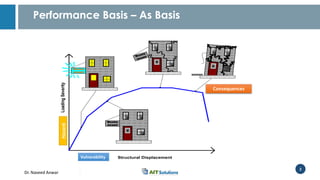
PerformanceBasis – As Basis
Structural Displacement
LoadingSeverity
Resta
urant
Resta
urant
Resta
urant
Hazard
Vulnerability
Consequences
Dr. Naveed Anwar
6
NewBook
Structural Cross-sections
Analysis and Design
Naveed Anwar, Fawad Najam
7.
Dr. Naveed Anwar
7
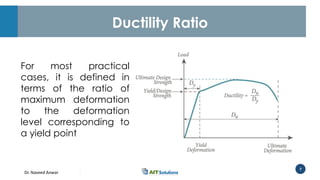
DuctilityRatio
For most practical
cases, it is defined in
terms of the ratio of
maximum deformation
to the deformation
level corresponding to
a yield point
8.
Dr. Naveed Anwar
8
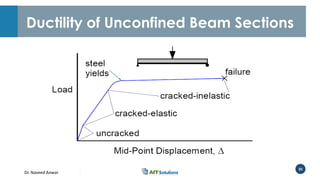
DuctilityUsage
• Strain-based definition of ductility is used at material level, while
rotation- or curvature- based definition also includes the effect of
shape, size and stiffness of cross-section
• All seismic design codes around the world recognize the
importance of ductility as it plays a vital role in structural
performance against earthquakes.
• Well-detailed steel and reinforced concrete (RC) structures, fulfilling
the ductility requirements of codes are expected to undergo large
plastic deformations with little decrease in strength.
9.
Dr. Naveed Anwar
9
Limitationsof Strength Based Design
• Cross-sections are capable of resisting a certain value of actions
based on assumed failure criterion
• Actions are obtained often from linear elastic analysis, and are
factored to provide certain factor of safety
• Strength design itself provides no information or control on the level
of deformation produced at that factored load level
• No information about behavior of the member if loads or actions
were to exceed the factored design load
Dr. Naveed Anwar
11
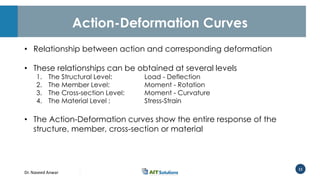
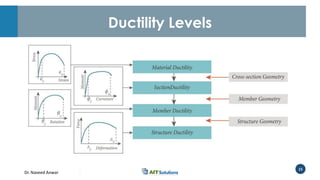
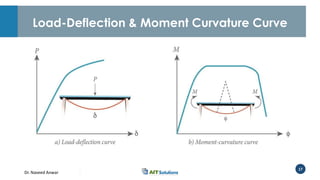
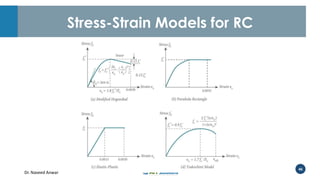
Action-DeformationCurves
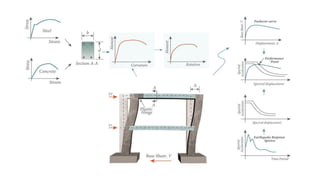
• Relationship between action and corresponding deformation
• These relationships can be obtained at several levels
1. The Structural Level: Load - Deflection
2. The Member Level: Moment - Rotation
3. The Cross-section Level: Moment - Curvature
4. The Material Level : Stress-Strain
• The Action-Deformation curves show the entire response of the
structure, member, cross-section or material
Dr. Naveed Anwar
13
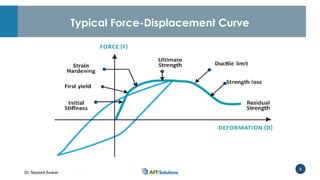
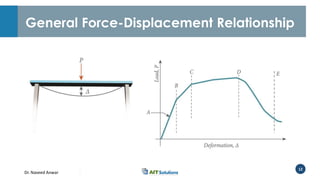
GeneralForce-Displacement Relationship
Point ‘A’ corresponds to the serviceability design considerations and working
strength or allowable strength design concepts.
Point ‘B’ is the point up to which the relationship between load and deformation
can be considered nearly linear and the deformations are relatively small.
Point ‘C’ roughly corresponds to the ultimate strength considerations or the design
capacity consideration.
Point ‘D’ is the point at which the load value starts to drop with increasing
deformations
Point ‘E’ is the point at which the load value is reduced to just a fraction of ultimate
load (residual strength)
14.
Dr. Naveed Anwar
14
Howto Get Action-Deformation Curves
1. By actual measurements
• Apply load, measure deflection
• Apply load, measure stress and strain
2. By computations
• Use material models, cross-section dimensions to get Moment-Curvature
Curves
3. By combination of measurement and computations
• Calibrate computation models with actual measurements
• Some parameters obtained by measurement and some by computations
Dr. Naveed Anwar
18
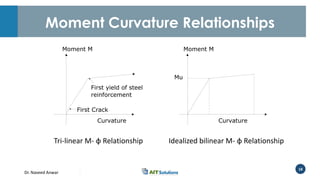
MomentCurvature Relationships
First Crack
First yield of steel
reinforcement
Moment M
Curvature
Moment M
Curvature
Mu
Tri-linear M- φ Relationship Idealized bilinear M- φ Relationship
19.
Dr. Naveed Anwar
19
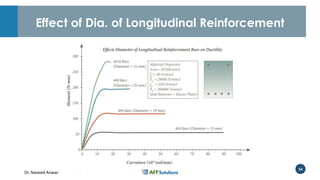
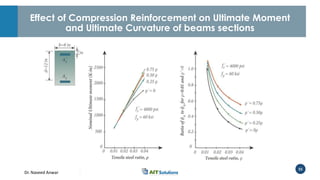
MomentCurvature (M-φ) Curve
• The load-deformation curves can be plotted between axial load and axial
shortening, shear force and shear deformation, moment and curvature, and
torsion and twist.
• Moment-curvature relationship is probably the most important and useful action-
deformation curve especially for flexural members such as beams, columns and
shear walls.
• Many of the design codes and design procedures or design handbooks do not
provide sufficient information for computation and use of M- relationships
20.
Dr. Naveed Anwar
20
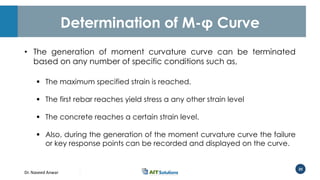
Determinationof M-φ Curve
• The generation of moment curvature curve can be terminated
based on any number of specific conditions such as,
The maximum specified strain is reached.
The first rebar reaches yield stress a any other strain level
The concrete reaches a certain strain level.
Also, during the generation of the moment curvature curve the failure
or key response points can be recorded and displayed on the curve.
21.
Dr. Naveed Anwar
21
Significanceof Moment Curvature Curve
• Information provided by M-φ curve is very useful for non-linear
analysis of structures including the evaluation of post-elastic
behavior.
• M-φ Curve is basis for the capacity-based, and performance-
based design methods especially analysis of structures using
nonlinear static procedures as well as in determining the rotational
capacity of plastic hinges formed during high seismic activity.
22.
Dr. Naveed Anwar
22
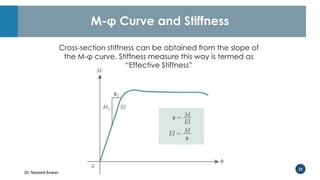
M-φCurve and Stiffness
Cross-section stiffness can be obtained from the slope of
the M-φ curve. Stiffness measure this way is termed as
“Effective Stiffness”
Dr. Naveed Anwar
25
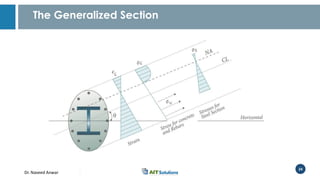
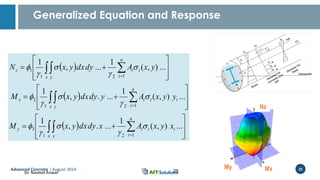
GeneralizedEquation and Response
25
...),(
1
....,
1
...),(
1
....,
1
...),(
1
...,
1
121
3
121
2
121
1
i
n
i
ii
x y
y
i
n
i
ii
x y
x
x y
n
i
iiz
xyxAxdydxyxM
yyxAydydxyxM
yxAdydxyxN
Nz
MxMyAdvanced Concrete l August-2014
y
h
c
fc
Strain
Stresses for
concrete and
R/F
Stresses for
Steel
f1
f2
fn
fs NA
CL
Horizontal
Dr. Naveed Anwar
27
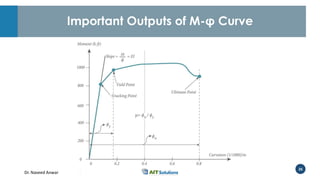
ImportantOutputs of M-φ Curve
1. Cracking Point
This point corresponds to the onset of material cracking of a cross-section. It
provides the moment and corresponding curvature for design considerations
related to start of cracking
2. Yield Point
This point corresponds to the onset of material yielding of a cross-section. It provides
the moment capacity and corresponding curvature for strength design of section.
3. Failure Point
This point corresponds to the maximum curvature and defines the maximum
deformation capacity of section.
28.
Dr. Naveed Anwar
28
ImportantOutputs of M-φ Curve
4. Ductility
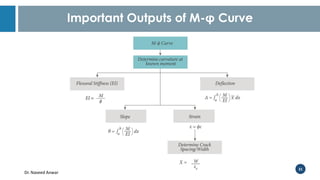
The ratio of ultimate curvature and yield curvature defines the section ductility.
𝜇 = 𝜙 𝑢/𝜙 𝑦
5. Stiffness of the Section at given M and 𝝓
Slope of M-𝜙 curve at any given point corresponds to the effective stiffness of the
section.
𝜙 =
𝑀
𝐸𝐼
and 𝐸𝐼 =
𝑀
𝜙
29.
Dr. Naveed Anwar
29
ImportantOutputs of M-φ Curve
6. Slope of the section at given Moment
M-𝜙 curve can also be used to determine rotation at any point in a member.
𝜃 =
𝑎
𝑏
𝑀
𝐸𝐼
𝑑𝑥
7. Deflection of the section at given Moment
Δ =
𝑎
𝑏
𝑀
𝐸𝐼
𝑥 𝑑𝑥
8. Strain at given Moment
ε = 𝜙𝑐
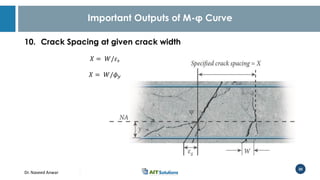
9. Crack Width at given Spacing
𝑊 = 𝜀 𝑠 . 𝑋
𝑊 = 𝜙 𝑦 . 𝑋
Dr. Naveed Anwar
32
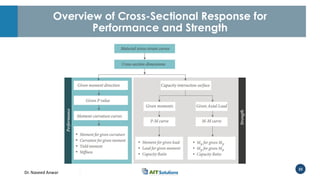
Procedureto Measure Deflection Using M-φ Curve
Cross-Section
Design for
Moment & Axial
Load
Generate M-φ
Curves
Plot Moment
and Axial Load
Diagram
Read Curvature
along Various
locations
Plot M/EI
diagram along
the length
Calculate the
area M/EI
diagram up to
that point
starting one end
of the member
Dr. Naveed Anwar
37
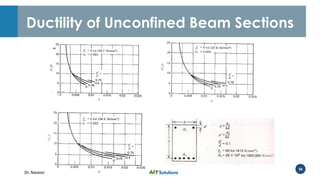
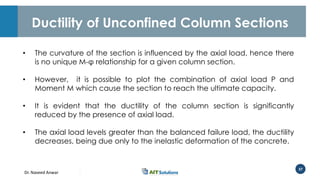
Ductilityof Unconfined Column Sections
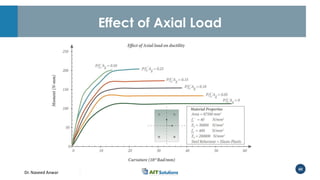
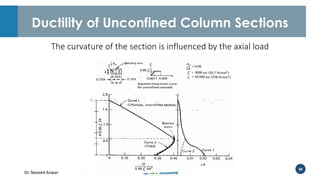
• The curvature of the section is influenced by the axial load, hence there
is no unique M-φ relationship for a given column section.
• However, it is possible to plot the combination of axial load P and
Moment M which cause the section to reach the ultimate capacity.
• It is evident that the ductility of the column section is significantly
reduced by the presence of axial load.
• The axial load levels greater than the balanced failure load, the ductility
decreases, being due only to the inelastic deformation of the concrete.
38.
Dr. Naveed Anwar
38
Ductilityof Unconfined Column Sections
The curvature of the section is influenced by the axial load
Dr. Naveed Anwar
41
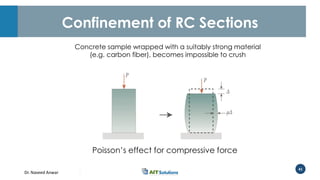
Confinementof RC Sections
Poisson’s effect for compressive force
Concrete sample wrapped with a suitably strong material
(e.g. carbon fiber), becomes impossible to crush
42.
Dr. Naveed Anwar
42
Confinementof RC Sections
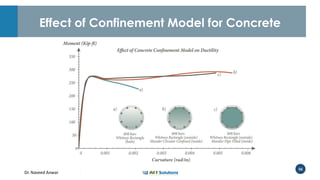
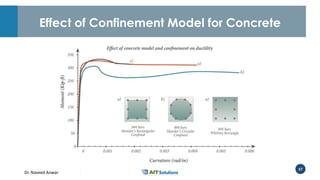
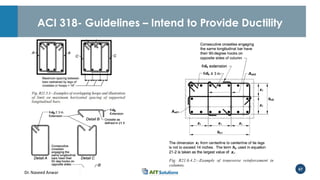
• Ductility can be improved if confining is done in such a way that the
concrete sample is allowed to expand very slowly.
• In RC members, concrete is confined using rectangular or circular steel
reinforcement hoops.
• One RC cross section have 2 types of concrete, i.e. the confined
concrete in the inner core and the cover concrete outside the core.
• Double confinement using multiple hoops is also quite common is bridges.
For RC columns, more attention is given to vertical reinforcement than
lateral reinforcement. However, most of the axial strength is contributed
by the lateral reinforcement
Dr. Naveed Anwar
44
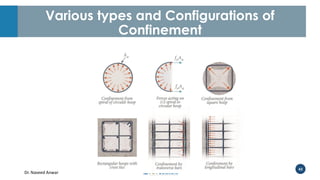
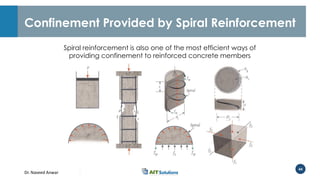
ConfinementProvided by Spiral Reinforcement
Spiral reinforcement is also one of the most efficient ways of
providing confinement to reinforced concrete members
45.
Dr. Naveed Anwar
45
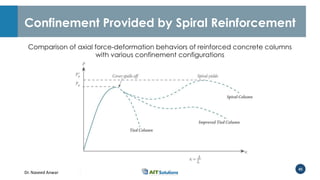
ConfinementProvided by Spiral Reinforcement
Comparison of axial force-deformation behaviors of reinforced concrete columns
with various confinement configurations
Dr. Naveed Anwar
48
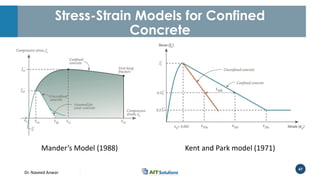
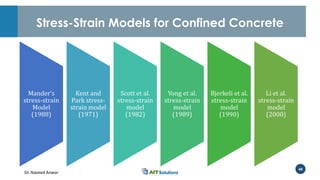
Stress-StrainModels for Confined Concrete
Mander’s
stress-strain
Model
(1988)
Kent and
Park stress-
strain model
(1971)
Scott et al.
stress-strain
model
(1982)
Yong et al.
stress-strain
model
(1989)
Bjerkeli et al.
stress-strain
model
(1990)
Li et al.
stress-strain
model
(2000)
Dr. Naveed Anwar
62
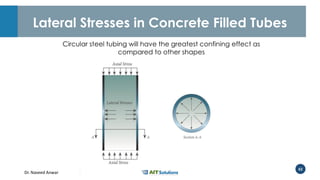
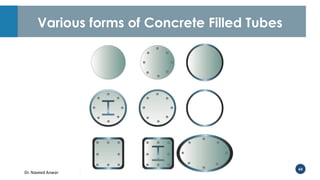
LateralStresses in Concrete Filled Tubes
Circular steel tubing will have the greatest confining effect as
compared to other shapes
63.
Dr. Naveed Anwar
63
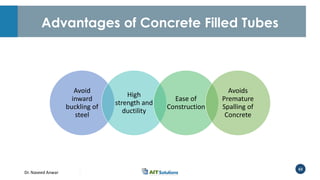
Advantagesof Concrete Filled Tubes
Avoid
inward
buckling of
steel
High
strength and
ductility
Ease of
Construction
Avoids
Premature
Spalling of
Concrete
Dr. Naveed Anwar
65
EfficientBonding between Steel Tube and
Concrete Cores
Efficient
Bonding
Use of
Mechanical
Connectors
Interlock at
Concrete
and Steel
Interface
Friction
between
Materials
Adhesion
due to
Chemical
Actions
Creep in
Concrete
Dr. Naveed Anwar
68
Itis important to recognize, explicitly
evaluate and provide Ductility in key
locations and members for improved
performance for extreme loads