THE CARDIOVASCULAR
SYSTEM
REVISION OF CARDIOVASCULAR ANATOMY
AND PHYSIOLOGY
BY. Dr Kifle Alamirew(MD)
1
CARDIOVASCULAR ANATOMY AND
PHYSIOLOGY
Cardio Vascular
System: Includes the
heart and blood
vessels( arteries, veins,
arterioles, veinules and
capillaries).
2
THE HEART
 rests on the diaphragm
 near the midline of the thoracic cavity
3
LAYERS OF THE HEART WALL
4
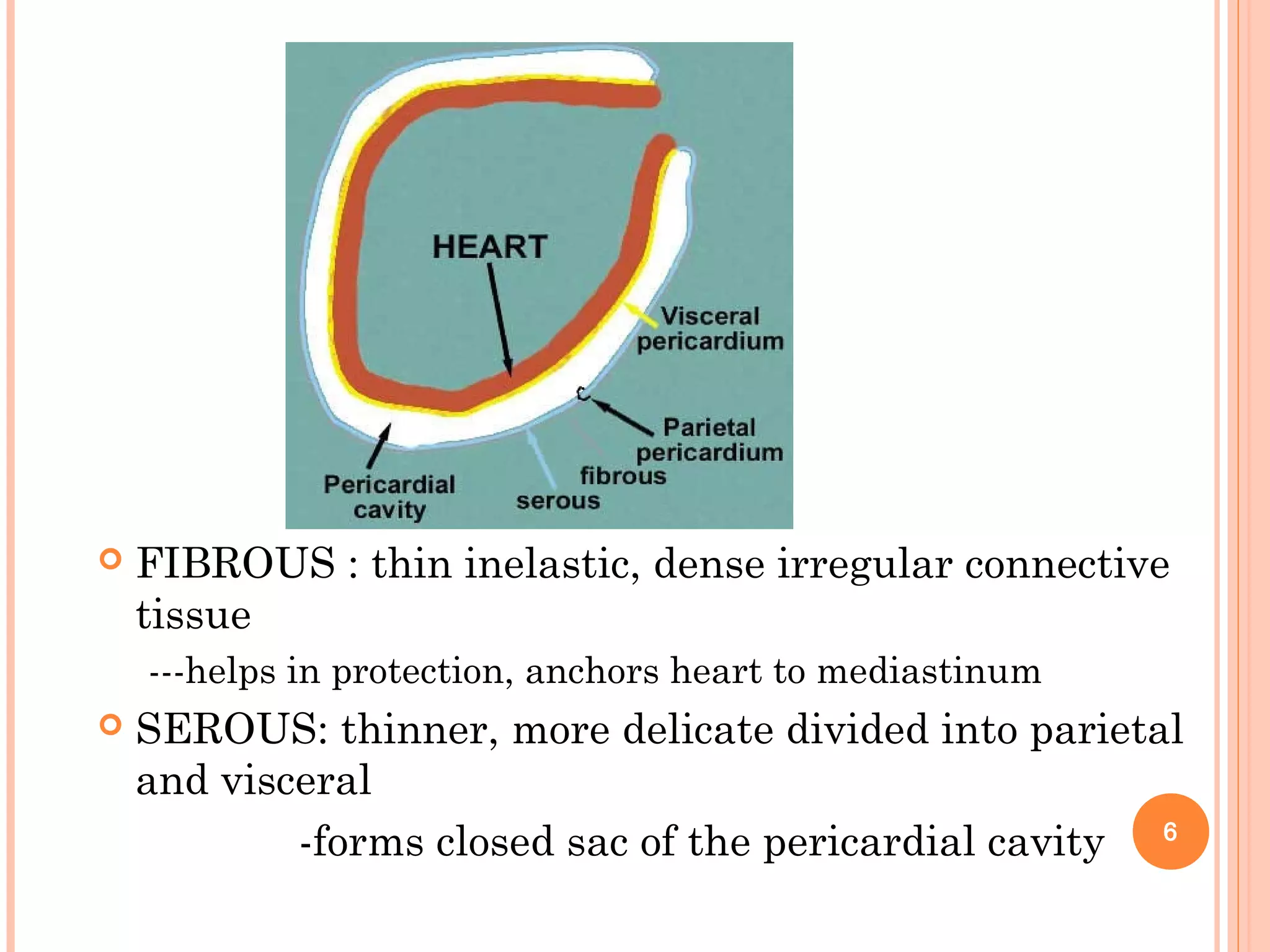
PERICARDIUM
confines heart to the
mediastinum
allows sufficient freedom
of movement.
consists of two layers:the
fibrous and serous.
5
 FIBROUS : thin inelastic, dense irregular connective
tissue
---helps in protection, anchors heart to mediastinum
 SEROUS: thinner, more delicate divided into parietal
and visceral
-forms closed sac of the pericardial cavity 6
 EPICARDIUM: composed of mesothelium and delicate
connective tissue (imparts a slippery texture to the outer
surface of the heart).
7
 MYOCARDIUM:responsible for pumping
 ENDOCARDIUM: thin layer of endothelium which is
continous with the lining of the large blood vessels
attached to the heart.
8
CHAMBERS OF THE HEART
9
HEART VALVES
 Semilunar valves: pulmonic
and aortic valve
 Atrioventricular valves:
tricuspid and mitral valve
10
BLOOD SUPPLY OF THE HEART
11
CONDUCTION SYSTEM OF THE HEART
 inherent and rhythmical beat is
due to autorhythmic fibers of the
cardiac muscle.
 these fibers have 2 important
function
- act as pace maker
- form the conduction system
12
CONT’D……
 There is a hierarchy of automaticity within
the tissue of the heart.
 The tissue that possesses the greatest
degree of automaticity (e.g., has the fastest
rate of spontaneous depolarization)
functions as the dominant pacemaker; it
generates a spontaneous action potential
 Normally the pacemaker is SA node.
 AV node is the only connection between atrium and
ventricle
 Impulse is delayed at AV node.
13
CONT’D…
 SA node would initiates action potential about
every 0.6 sec or 100 times/min
 the ANS alters the strength and timing of heart
beats
 Depolarization from endocardium to epicardium
and for repolarization the reverse is true
 The conduction system of the heart could be
assessed by ECG.
14
PHYSIOLOGIC CHARACTERISTICS
OF THE CONDUCTION CELLS
automaticity
excitability
conductivity
rhythmicity
contractility
15
PHASE OF ACTION POTENTIAL
 Phase 0: is the up stroke of the action
potential and is caused by a transient increase
in Na+ conductance.
 Phase 1: is a brief period of intial
depolarization and is as a result of movement
of K+ ions out of the cell and a decreased Na+
conductance.
 Phase 2: is the plateau of the action potentia
and is generated by a balance of repolarizing
potassium currents and depolarizing calcium
current.
 Phase 3: repolarization (Ca2+ conductance
decreases and K+ conductance increases)

16
PHASES OF ACTION POTENTIAL (VENTRICLES, ATRIA
, BUNDLE OF HIS, BUNDLE BRANCHES AND THE
PURKINJE SYSTEM)
17
CARDIAC CYCLE
18
HEART SOUNDS
 produced from blood
turbulence caused by closing of
heart valves
 s1 – atrioventricular valve
closure
 s2 – semilunar valve closure
 s3 – rapid ventricular filling
 s4 – atrial systole
19
CARDIAC OUTPUT
 CO = SV X HR
 FOR A RESTING ADULT
CO = 70mL/beat x75beats/min
= 5250 mL/min
= 5.25 L/min
mL/min mL/beat (Beats/min)
20
REGULATION OF STROKE VOLUME
 three factors regulate stroke volume
-preload
-contractility
-afterload
21
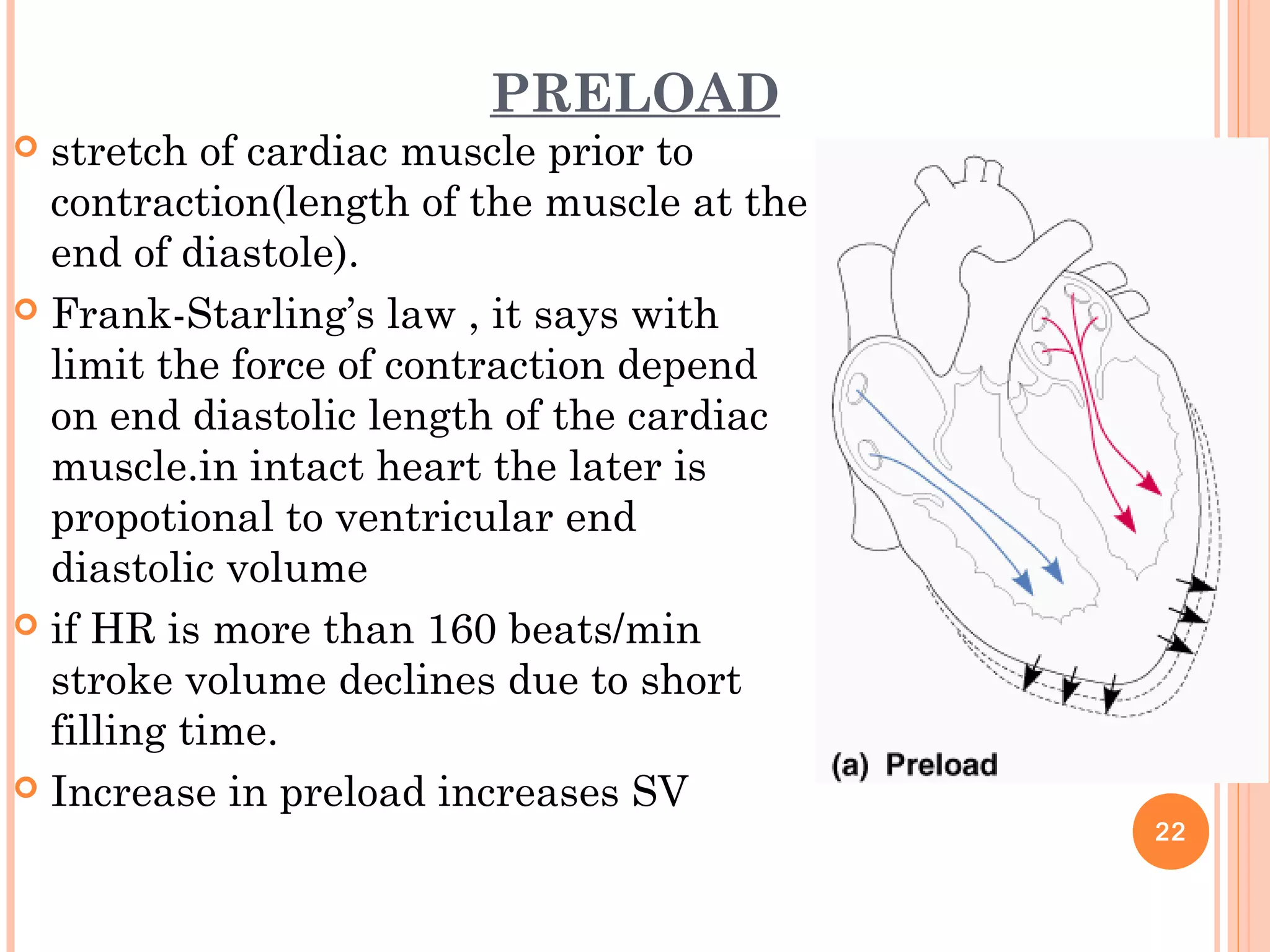
PRELOAD
 stretch of cardiac muscle prior to
contraction(length of the muscle at the
end of diastole).
 Frank-Starling’s law , it says with
limit the force of contraction depend
on end diastolic length of the cardiac
muscle.in intact heart the later is
propotional to ventricular end
diastolic volume
 if HR is more than 160 beats/min
stroke volume declines due to short
filling time.
 Increase in preload increases SV
22
FACTORS AFFECTING THE
PRELOAD
23
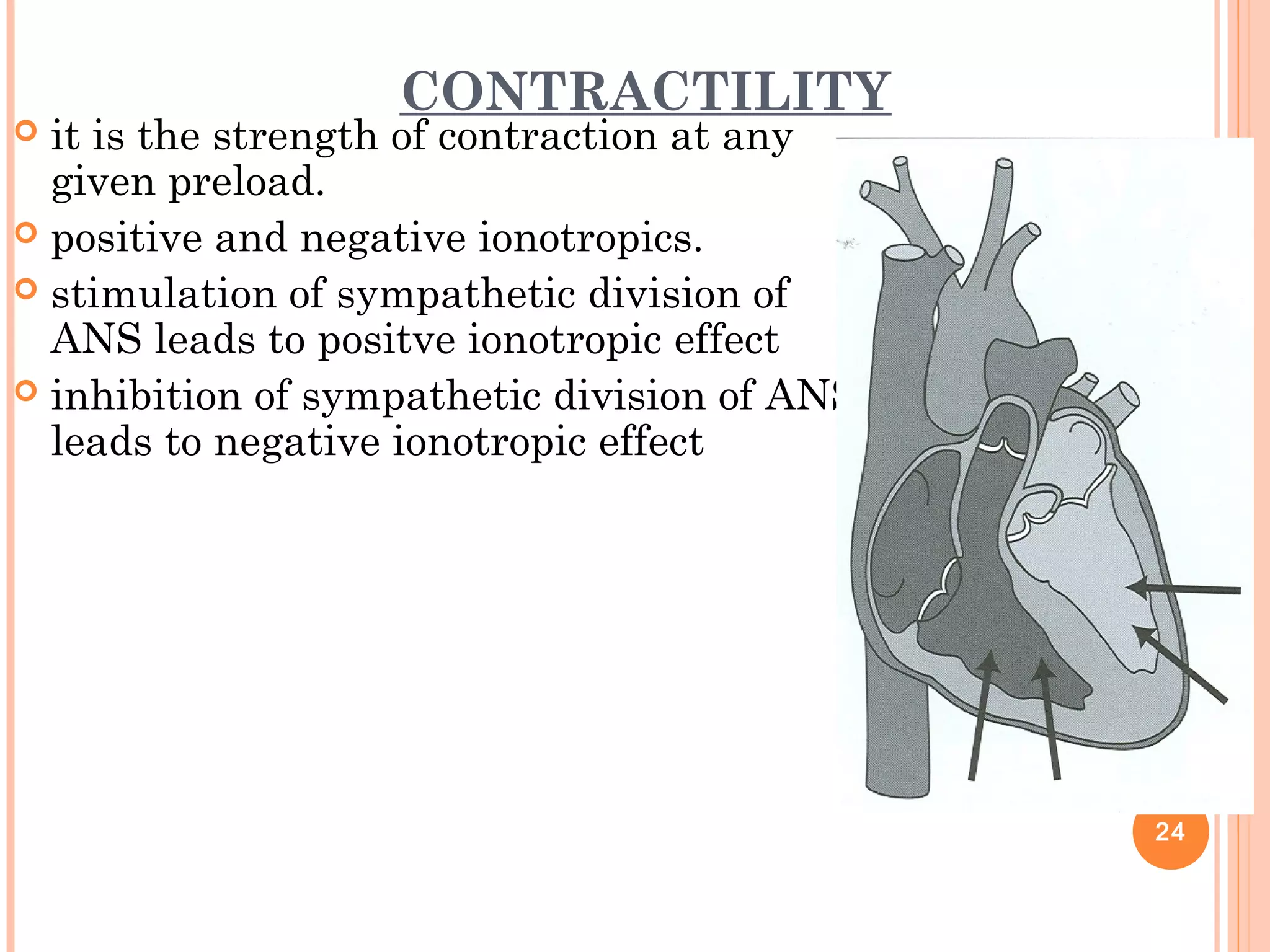
CONTRACTILITY
 it is the strength of contraction at any
given preload.
 positive and negative ionotropics.
 stimulation of sympathetic division of
ANS leads to positve ionotropic effect
 inhibition of sympathetic division of ANS
leads to negative ionotropic effect
24
CONT’D…..
25
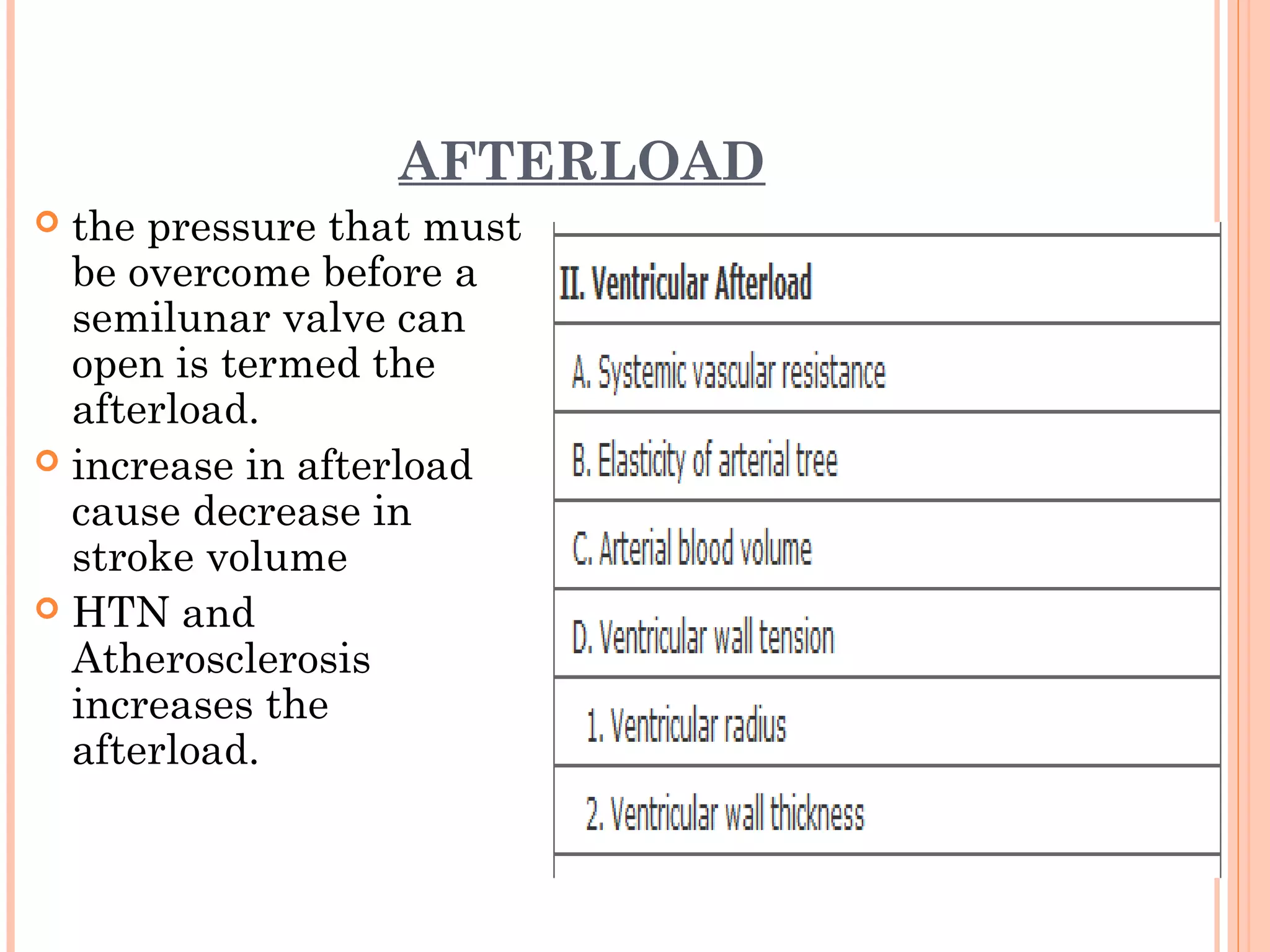
AFTERLOAD
 the pressure that must
be overcome before a
semilunar valve can
open is termed the
afterload.
 increase in afterload
cause decrease in
stroke volume
 HTN and
Atherosclerosis
increases the
afterload.
26
REGUALTION OF HEART RATE
 SA node initiates 100
beats/min if left to itself.
 tissue require different
volume of blood flow under
different conditions(ex:
exercise)
 ANS and hormones of adrenal
medulla are important in
regulating the heart rate.
27
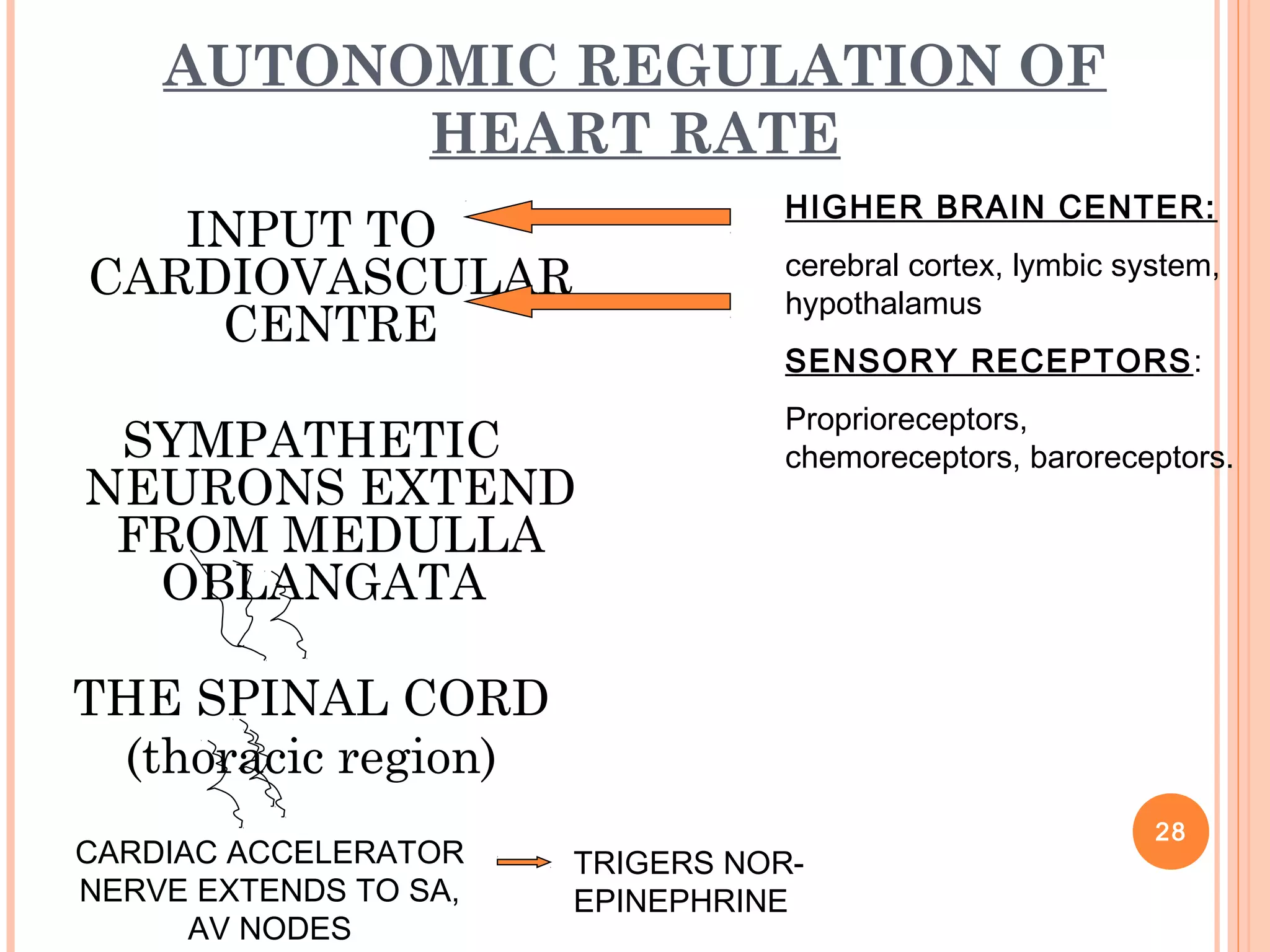
AUTONOMIC REGULATION OF
HEART RATE
INPUT TO
CARDIOVASCULAR
CENTRE
SYMPATHETIC
NEURONS EXTEND
FROM MEDULLA
OBLANGATA
THE SPINAL CORD
(thoracic region)
HIGHER BRAIN CENTER:
cerebral cortex, lymbic system,
hypothalamus
SENSORY RECEPTORS:
Proprioreceptors,
chemoreceptors, baroreceptors.
CARDIAC ACCELERATOR
NERVE EXTENDS TO SA,
AV NODES
TRIGERS NOR-
EPINEPHRINE
28
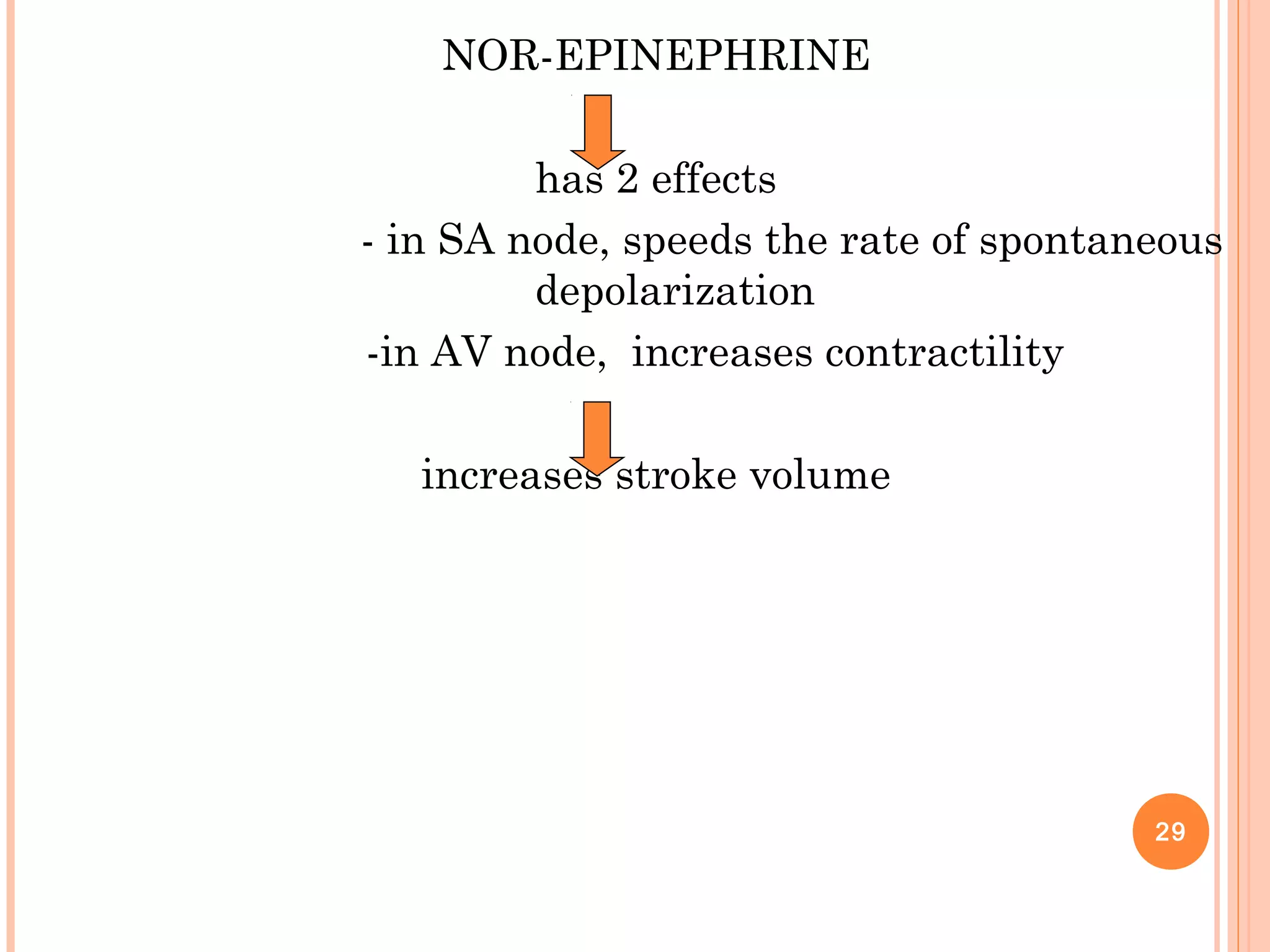
NOR-EPINEPHRINE
has 2 effects
- in SA node, speeds the rate of spontaneous
depolarization
-in AV node, increases contractility
increases stroke volume
29
PARASYMPATHETIC EFFECT
parasympathetic nerve reaches the heart via left vagus (x)
nerves
they release acetyl choline,
which decreases the heart rate
at rest parasympathetic stimulation predominates
30
CHEMICAL REGULATION OF HEART
RATE
 hormones: epinephrine and norepinephrine,
throid hromone also increases heart rate
 cations: elevated K+ and Na+ decreases heart
rate, moderate increase in interstitial Ca+ levels
speeds heart rate.
31
OTHER FACTORS IN HEART RATE
REGULATION
 age
 gender physical fitness
 body temperature
32
BLOOD VESSELS
Vascular ultrastructure
Different in different vessels
Trilaminar (three layers)
 Intima(endothelial cells)
 Tunica media
 Adventitia
33
HEMODYNAMIC AFFECTING
BLOOD FLOW
 blood pressure
 resistance
 venous return
34
BLOOD PRESSURE
 during systemic circulation, blood pressure falls as the
distance from the left ventricle increases
 MAP = diastolic pressure +
1/3 (sys pressure – diastolic pressure)
35
VASCULAR RESISTANCE
 it is the oppostion to blood flow due to friction
between blood and the walls of blood vessels.
 Depends on:
 size of the lumen-
R is inversely propotional to 1/d
 blood viscosity
 total blood vessel length
4
36
VENOUS RETURN
depends on
 heart contraction
 pressure in the Right atrium
besides this
 skeletal muscle pump
 respiratory pump
37
CONTROL OF BLOOD
PRESSURE AND
BLOOD FLOW
38
ROLE OF CARDIOVASCULAR
CENTRE
 proprioreceotors
 baroreceptors
 chemoreceptors
39
NEURAL REGULATION 0F BLOOD
PRESSURE
 baroreceptors
 chemoreceptors
40
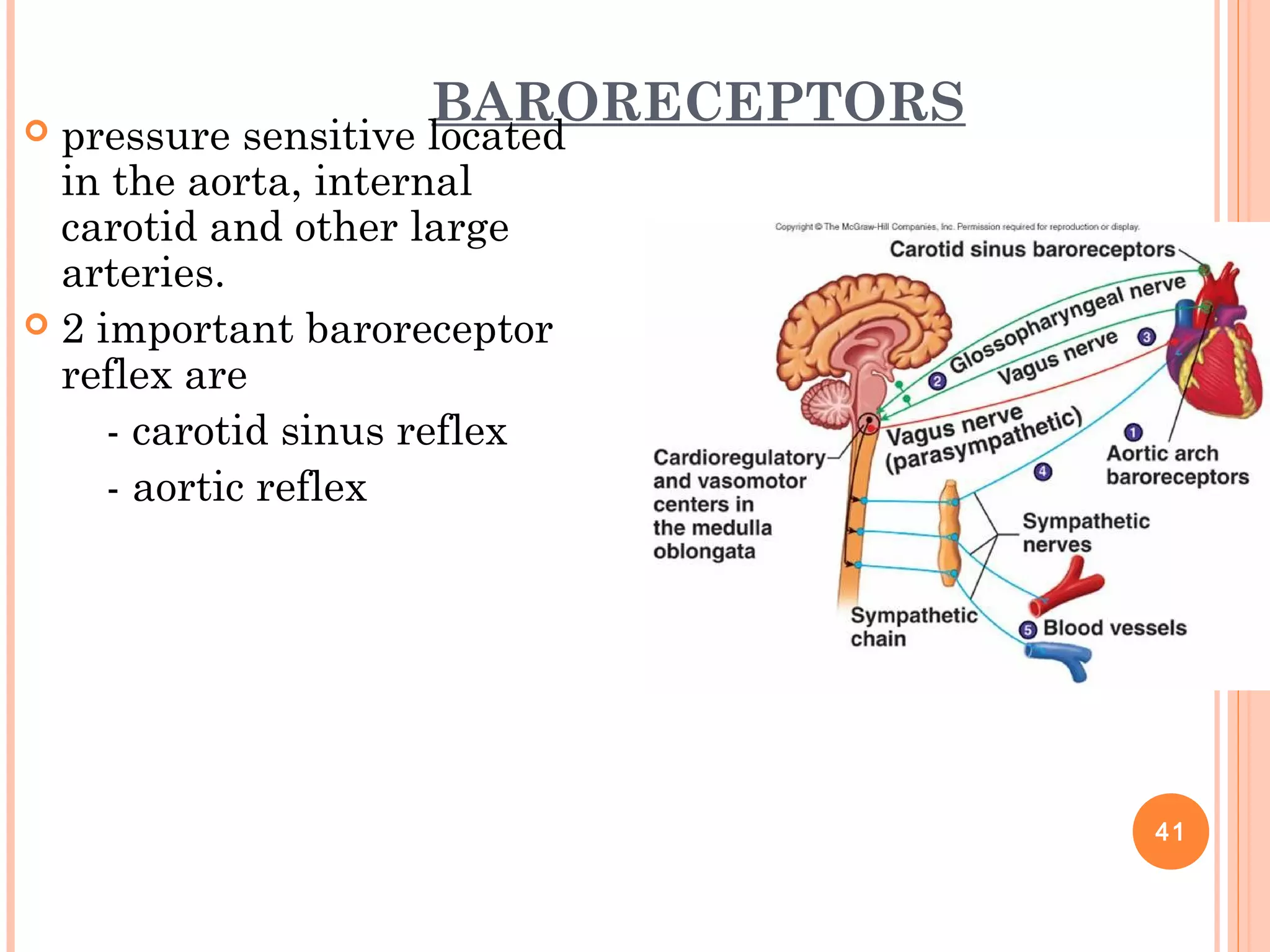
BARORECEPTORS pressure sensitive located
in the aorta, internal
carotid and other large
arteries.
 2 important baroreceptor
reflex are
- carotid sinus reflex
- aortic reflex
41
CHEMORECEPTOR REFLEX
present close to the
- baroreceptors of carotid sinus and arch of aorta
- they are called carotid bodies and aortic bodies.
42
HORMONAL REGULATION OF
BLOOD PRESSURE
 renin angiotensin-aldosterone mechanism
 epinephrine and nor epinephrine
 antidiuretic hormone
 atrial natriuretic peptide
43
AUTOREGULATION OF BLOOD
PRESSURE
 abilty of tissue to automatically
adjust its blood flow to match its
metabloic demand
is called autoregulation. mainly during
exercise.
44
 two type of stimuli causes autoregulatory changes
- physical changes
- vasodilating and vasoconstricting chemicals
45
PHYSICAL CHANGES
 warming and cooling causes vasodilation and
vasoconstriction respectively.
 smooth muscle in arteriole exhibit myogenic response
46
VASODILATING AND VASOCONSTRICTING
CHEMICALS
 several cells release a wide variety of chemicals
that alter the blood vessel diameter
 vasodilators - +, H+, Lasctic acid and adenosine
and mainly No
 vasoconstrictors – Thrombaxane A2 , serotonin and
endothelins
47
CARDIAC METABOLISM
Heart needs continuous supply energy
Use 15% of that of entire body
Glucose (feeding state and ionotropic agent)
and free fatty acid(fasting state(70%) and
stress)
Ischemia and stress end up with free fatty acid
accumulation
FFAs is arrhythmogenic.
48

1 anatomy and-physiology-of-the-cardiovascular-system (2)

  • 1.
    THE CARDIOVASCULAR SYSTEM REVISION OFCARDIOVASCULAR ANATOMY AND PHYSIOLOGY BY. Dr Kifle Alamirew(MD) 1
  • 2.
    CARDIOVASCULAR ANATOMY AND PHYSIOLOGY CardioVascular System: Includes the heart and blood vessels( arteries, veins, arterioles, veinules and capillaries). 2
  • 3.
    THE HEART  restson the diaphragm  near the midline of the thoracic cavity 3
  • 4.
    LAYERS OF THEHEART WALL 4
  • 5.
    PERICARDIUM confines heart tothe mediastinum allows sufficient freedom of movement. consists of two layers:the fibrous and serous. 5
  • 6.
     FIBROUS :thin inelastic, dense irregular connective tissue ---helps in protection, anchors heart to mediastinum  SEROUS: thinner, more delicate divided into parietal and visceral -forms closed sac of the pericardial cavity 6
  • 7.
     EPICARDIUM: composedof mesothelium and delicate connective tissue (imparts a slippery texture to the outer surface of the heart). 7
  • 8.
     MYOCARDIUM:responsible forpumping  ENDOCARDIUM: thin layer of endothelium which is continous with the lining of the large blood vessels attached to the heart. 8
  • 9.
  • 10.
    HEART VALVES  Semilunarvalves: pulmonic and aortic valve  Atrioventricular valves: tricuspid and mitral valve 10
  • 11.
    BLOOD SUPPLY OFTHE HEART 11
  • 12.
    CONDUCTION SYSTEM OFTHE HEART  inherent and rhythmical beat is due to autorhythmic fibers of the cardiac muscle.  these fibers have 2 important function - act as pace maker - form the conduction system 12
  • 13.
    CONT’D……  There isa hierarchy of automaticity within the tissue of the heart.  The tissue that possesses the greatest degree of automaticity (e.g., has the fastest rate of spontaneous depolarization) functions as the dominant pacemaker; it generates a spontaneous action potential  Normally the pacemaker is SA node.  AV node is the only connection between atrium and ventricle  Impulse is delayed at AV node. 13
  • 14.
    CONT’D…  SA nodewould initiates action potential about every 0.6 sec or 100 times/min  the ANS alters the strength and timing of heart beats  Depolarization from endocardium to epicardium and for repolarization the reverse is true  The conduction system of the heart could be assessed by ECG. 14
  • 15.
    PHYSIOLOGIC CHARACTERISTICS OF THECONDUCTION CELLS automaticity excitability conductivity rhythmicity contractility 15
  • 16.
    PHASE OF ACTIONPOTENTIAL  Phase 0: is the up stroke of the action potential and is caused by a transient increase in Na+ conductance.  Phase 1: is a brief period of intial depolarization and is as a result of movement of K+ ions out of the cell and a decreased Na+ conductance.  Phase 2: is the plateau of the action potentia and is generated by a balance of repolarizing potassium currents and depolarizing calcium current.  Phase 3: repolarization (Ca2+ conductance decreases and K+ conductance increases)  16
  • 17.
    PHASES OF ACTIONPOTENTIAL (VENTRICLES, ATRIA , BUNDLE OF HIS, BUNDLE BRANCHES AND THE PURKINJE SYSTEM) 17
  • 18.
  • 19.
    HEART SOUNDS  producedfrom blood turbulence caused by closing of heart valves  s1 – atrioventricular valve closure  s2 – semilunar valve closure  s3 – rapid ventricular filling  s4 – atrial systole 19
  • 20.
    CARDIAC OUTPUT  CO= SV X HR  FOR A RESTING ADULT CO = 70mL/beat x75beats/min = 5250 mL/min = 5.25 L/min mL/min mL/beat (Beats/min) 20
  • 21.
    REGULATION OF STROKEVOLUME  three factors regulate stroke volume -preload -contractility -afterload 21
  • 22.
    PRELOAD  stretch ofcardiac muscle prior to contraction(length of the muscle at the end of diastole).  Frank-Starling’s law , it says with limit the force of contraction depend on end diastolic length of the cardiac muscle.in intact heart the later is propotional to ventricular end diastolic volume  if HR is more than 160 beats/min stroke volume declines due to short filling time.  Increase in preload increases SV 22
  • 23.
  • 24.
    CONTRACTILITY  it isthe strength of contraction at any given preload.  positive and negative ionotropics.  stimulation of sympathetic division of ANS leads to positve ionotropic effect  inhibition of sympathetic division of ANS leads to negative ionotropic effect 24
  • 25.
  • 26.
    AFTERLOAD  the pressurethat must be overcome before a semilunar valve can open is termed the afterload.  increase in afterload cause decrease in stroke volume  HTN and Atherosclerosis increases the afterload. 26
  • 27.
    REGUALTION OF HEARTRATE  SA node initiates 100 beats/min if left to itself.  tissue require different volume of blood flow under different conditions(ex: exercise)  ANS and hormones of adrenal medulla are important in regulating the heart rate. 27
  • 28.
    AUTONOMIC REGULATION OF HEARTRATE INPUT TO CARDIOVASCULAR CENTRE SYMPATHETIC NEURONS EXTEND FROM MEDULLA OBLANGATA THE SPINAL CORD (thoracic region) HIGHER BRAIN CENTER: cerebral cortex, lymbic system, hypothalamus SENSORY RECEPTORS: Proprioreceptors, chemoreceptors, baroreceptors. CARDIAC ACCELERATOR NERVE EXTENDS TO SA, AV NODES TRIGERS NOR- EPINEPHRINE 28
  • 29.
    NOR-EPINEPHRINE has 2 effects -in SA node, speeds the rate of spontaneous depolarization -in AV node, increases contractility increases stroke volume 29
  • 30.
    PARASYMPATHETIC EFFECT parasympathetic nervereaches the heart via left vagus (x) nerves they release acetyl choline, which decreases the heart rate at rest parasympathetic stimulation predominates 30
  • 31.
    CHEMICAL REGULATION OFHEART RATE  hormones: epinephrine and norepinephrine, throid hromone also increases heart rate  cations: elevated K+ and Na+ decreases heart rate, moderate increase in interstitial Ca+ levels speeds heart rate. 31
  • 32.
    OTHER FACTORS INHEART RATE REGULATION  age  gender physical fitness  body temperature 32
  • 33.
    BLOOD VESSELS Vascular ultrastructure Differentin different vessels Trilaminar (three layers)  Intima(endothelial cells)  Tunica media  Adventitia 33
  • 34.
    HEMODYNAMIC AFFECTING BLOOD FLOW blood pressure  resistance  venous return 34
  • 35.
    BLOOD PRESSURE  duringsystemic circulation, blood pressure falls as the distance from the left ventricle increases  MAP = diastolic pressure + 1/3 (sys pressure – diastolic pressure) 35
  • 36.
    VASCULAR RESISTANCE  itis the oppostion to blood flow due to friction between blood and the walls of blood vessels.  Depends on:  size of the lumen- R is inversely propotional to 1/d  blood viscosity  total blood vessel length 4 36
  • 37.
    VENOUS RETURN depends on heart contraction  pressure in the Right atrium besides this  skeletal muscle pump  respiratory pump 37
  • 38.
    CONTROL OF BLOOD PRESSUREAND BLOOD FLOW 38
  • 39.
    ROLE OF CARDIOVASCULAR CENTRE proprioreceotors  baroreceptors  chemoreceptors 39
  • 40.
    NEURAL REGULATION 0FBLOOD PRESSURE  baroreceptors  chemoreceptors 40
  • 41.
    BARORECEPTORS pressure sensitivelocated in the aorta, internal carotid and other large arteries.  2 important baroreceptor reflex are - carotid sinus reflex - aortic reflex 41
  • 42.
    CHEMORECEPTOR REFLEX present closeto the - baroreceptors of carotid sinus and arch of aorta - they are called carotid bodies and aortic bodies. 42
  • 43.
    HORMONAL REGULATION OF BLOODPRESSURE  renin angiotensin-aldosterone mechanism  epinephrine and nor epinephrine  antidiuretic hormone  atrial natriuretic peptide 43
  • 44.
    AUTOREGULATION OF BLOOD PRESSURE abilty of tissue to automatically adjust its blood flow to match its metabloic demand is called autoregulation. mainly during exercise. 44
  • 45.
     two typeof stimuli causes autoregulatory changes - physical changes - vasodilating and vasoconstricting chemicals 45
  • 46.
    PHYSICAL CHANGES  warmingand cooling causes vasodilation and vasoconstriction respectively.  smooth muscle in arteriole exhibit myogenic response 46
  • 47.
    VASODILATING AND VASOCONSTRICTING CHEMICALS several cells release a wide variety of chemicals that alter the blood vessel diameter  vasodilators - +, H+, Lasctic acid and adenosine and mainly No  vasoconstrictors – Thrombaxane A2 , serotonin and endothelins 47
  • 48.
    CARDIAC METABOLISM Heart needscontinuous supply energy Use 15% of that of entire body Glucose (feeding state and ionotropic agent) and free fatty acid(fasting state(70%) and stress) Ischemia and stress end up with free fatty acid accumulation FFAs is arrhythmogenic. 48