Science of
Living System
Soumya De
School of Bioscience
Email: somde@iitkgp.ac.in
Tel: 03222-260514
BS20001
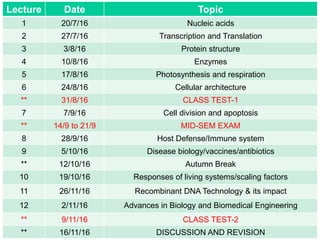
Lecture Date Topic
1 20/7/16 Nucleic acids
2 27/7/16 Transcription and Translation
3 3/8/16 Protein structure
4 10/8/16 Enzymes
5 17/8/16 Photosynthesis and respiration
6 24/8/16 Cellular architecture
** 31/8/16 CLASS TEST-1
7 7/9/16 Cell division and apoptosis
** 14/9 to 21/9 MID-SEM EXAM
8 28/9/16 Host Defense/Immune system
9 5/10/16 Disease biology/vaccines/antibiotics
** 12/10/16 Autumn Break
10 19/10/16 Responses of living systems/scaling factors
11 26/11/16 Recombinant DNA Technology & its impact
12 2/11/16 Advances in Biology and Biomedical Engineering
** 9/11/16 CLASS TEST-2
** 16/11/16 DISCUSSION AND REVISION
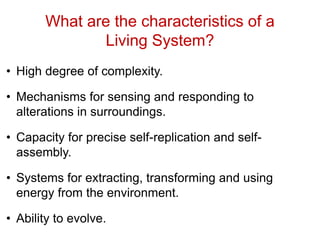
What are the characteristics of a
Living System?
• High degree of complexity.
• Mechanisms for sensing and responding to
alterations in surroundings.
• Capacity for precise self-replication and self-
assembly.
• Systems for extracting, transforming and using
energy from the environment.
• Ability to evolve.
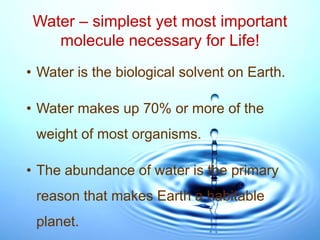
Water – simplest yet most important
molecule necessary for Life!
• Water is the biological solvent on Earth.
• Water makes up 70% or more of the
weight of most organisms.
• The abundance of water is the primary
reason that makes Earth a habitable
planet.
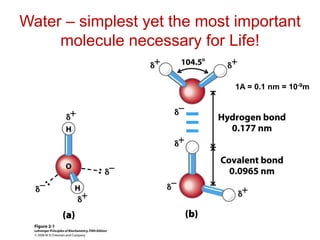
Water – simplest yet the most important
molecule necessary for Life!
1A = 0.1 nm = 10-9m
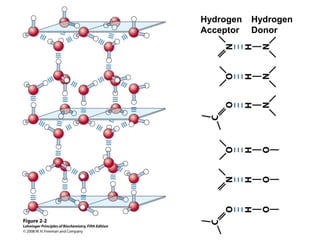
Hydrogen
Donor
Hydrogen
Acceptor
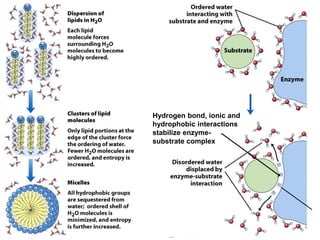
Hydrogen bond, ionic and
hydrophobic interactions
stabilize enzyme-
substrate complex
Henderson–Hasselbalch
Equation
Water is ionizable
H2O + H2O = H3O+ + OH-
KW (equilibrium constant)
[H+] x [OH-]
[H2O]
=
HA = H+ + A-
Ka (equilibrium constant)
[H+] x [A-]
[HA]
=
pH = pKa + log10
[A-]
[HA]
RNA: Ribonucleic Acid
DNA: Deoxyribonucleic Acid
Nucleic Acid
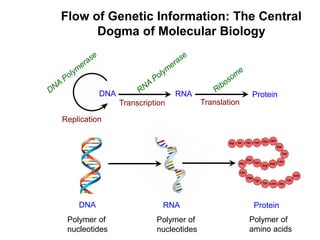
Flow of Genetic Information: The Central
Dogma of Molecular Biology
RNA ProteinDNA
Transcription Translation
Replication
RNA ProteinDNA
Polymer of
nucleotides
Polymer of
nucleotides
Polymer of
amino acids
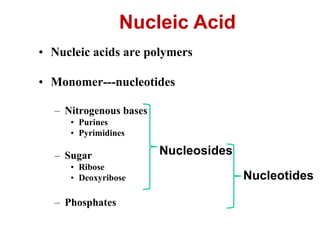
• Nucleic acids are polymers
• Monomer---nucleotides
– Nitrogenous bases
• Purines
• Pyrimidines
– Sugar
• Ribose
• Deoxyribose
– Phosphates
Nucleosides
Nucleotides
Nucleic Acid
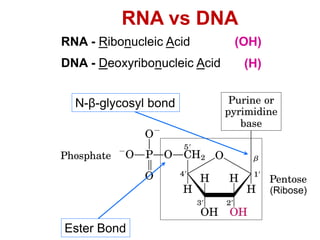
(Ribose)
RNA - Ribonucleic Acid
DNA - Deoxyribonucleic Acid
RNA vs DNA
Ester Bond
N-β-glycosyl bond
(OH)
(H)
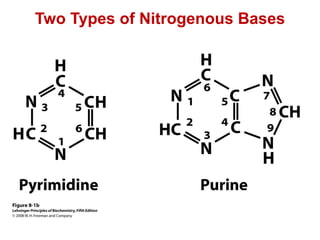
Two Types of Nitrogenous Bases
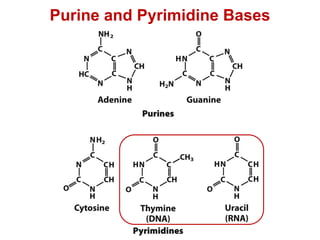
Purine and Pyrimidine Bases
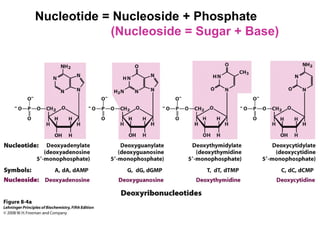
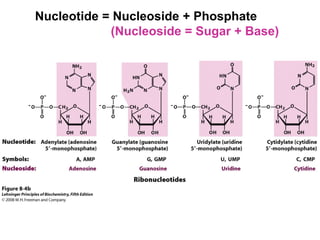
Nucleotide = Nucleoside + Phosphate
(Nucleoside = Sugar + Base)
Nucleotide = Nucleoside + Phosphate
(Nucleoside = Sugar + Base)
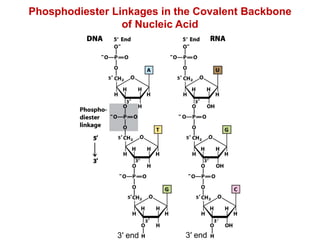
Phosphodiester Linkages in the Covalent Backbone
of Nucleic Acid
3′ end3′ end
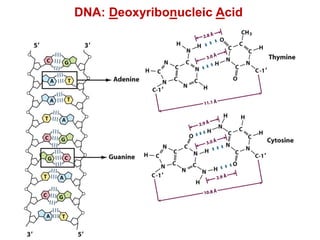
DNA: Deoxyribonucleic Acid
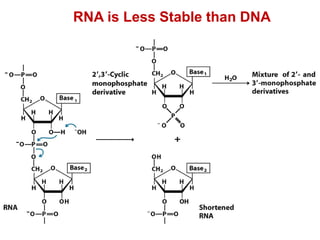
RNA is Less Stable than DNA
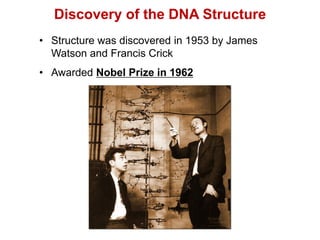
Discovery of the DNA Structure
• Structure was discovered in 1953 by James
Watson and Francis Crick
• Awarded Nobel Prize in 1962
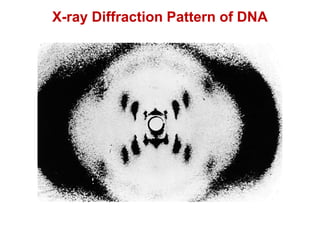
X-ray Diffraction Pattern of DNA
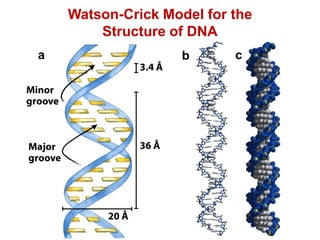
Watson-Crick Model for the
Structure of DNA
a b c
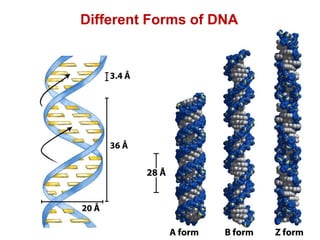
Different Forms of DNA
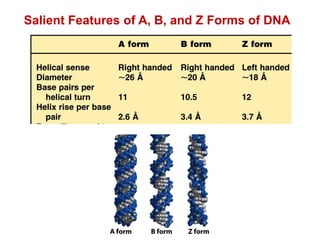
Salient Features of A, B, and Z Forms of DNA
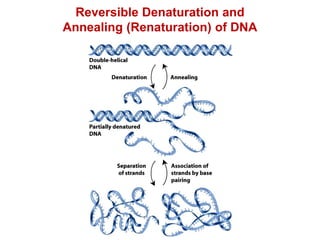
Reversible Denaturation and
Annealing (Renaturation) of DNA
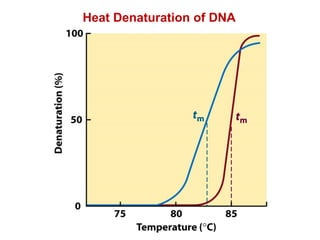
Heat Denaturation of DNA
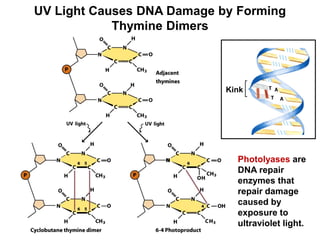
UV Light Causes DNA Damage by Forming
Thymine Dimers
Kink
Photolyases are
DNA repair
enzymes that
repair damage
caused by
exposure to
ultraviolet light.
DNA Replication: An Overview
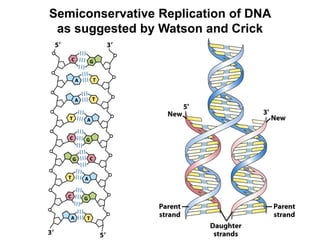
Semiconservative Replication of DNA
as suggested by Watson and Crick
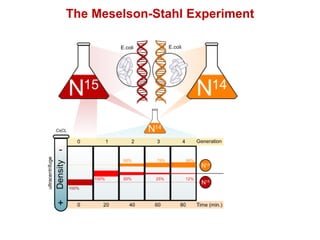
The Meselson-Stahl Experiment
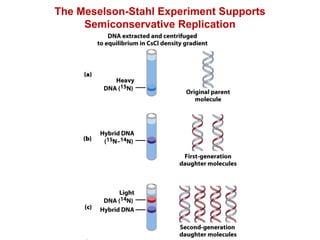
The Meselson-Stahl Experiment Supports
Semiconservative Replication
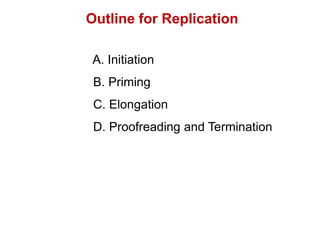
Outline for Replication
A. Initiation
B. Priming
C. Elongation
D. Proofreading and Termination
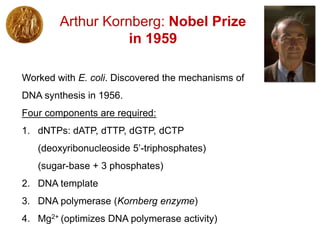
Worked with E. coli. Discovered the mechanisms of
DNA synthesis in 1956.
Four components are required:
1. dNTPs: dATP, dTTP, dGTP, dCTP
(deoxyribonucleoside 5’-triphosphates)
(sugar-base + 3 phosphates)
2. DNA template
3. DNA polymerase (Kornberg enzyme)
4. Mg2+ (optimizes DNA polymerase activity)
Arthur Kornberg: Nobel Prize
in 1959
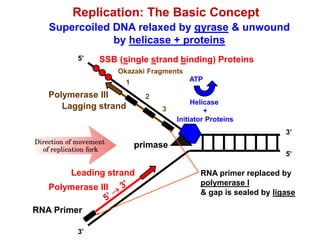
3
Polymerase III
Leading strand
5’
5’
3’
3’
Supercoiled DNA relaxed by gyrase & unwound
by helicase + proteins
Helicase
+
Initiator Proteins
ATP
SSB (single strand binding) Proteins
RNA Primer
primase
2Polymerase III
Lagging strand
Okazaki Fragments
1
RNA primer replaced by
polymerase I
& gap is sealed by ligase
Replication: The Basic Concept
Laboratory methods for
nucleic acid analysis
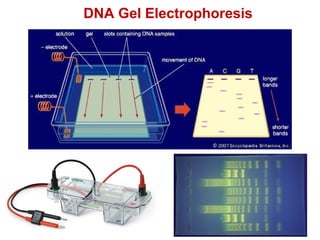
DNA Gel Electrophoresis
• Agarose gel is used to analyze a mixture of DNA.
• DNA is negatively charged and hence migrates towards the
positive terminal in the applied electric field gradient.
• Different DNA molecules separate according to mass.
• Smaller molecules migrate faster.
• DNA is visualized in the gel by staining with ethidium bromide,
which fluoresces under UV light.
• UV light at 302 nm or 365 nm wavelengths are used.
Polymerase Chain Reaction
(PCR) and Its Applications
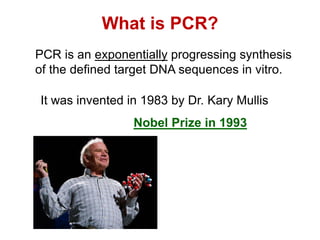
What is PCR?
PCR is an exponentially progressing synthesis
of the defined target DNA sequences in vitro.
It was invented in 1983 by Dr. Kary Mullis
Nobel Prize in 1993
Polymerase Chain Reaction (PCR)
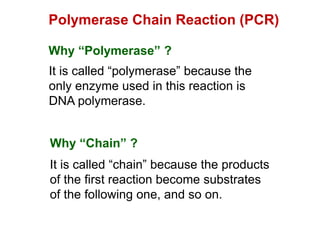
Why “Polymerase” ?
It is called “polymerase” because the
only enzyme used in this reaction is
DNA polymerase.
Why “Chain” ?
It is called “chain” because the products
of the first reaction become substrates
of the following one, and so on.
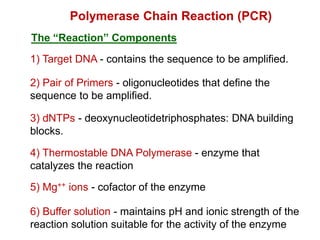
The “Reaction” Components
1) Target DNA - contains the sequence to be amplified.
2) Pair of Primers - oligonucleotides that define the
sequence to be amplified.
3) dNTPs - deoxynucleotidetriphosphates: DNA building
blocks.
4) Thermostable DNA Polymerase - enzyme that
catalyzes the reaction
5) Mg++ ions - cofactor of the enzyme
6) Buffer solution - maintains pH and ionic strength of the
reaction solution suitable for the activity of the enzyme
Polymerase Chain Reaction (PCR)
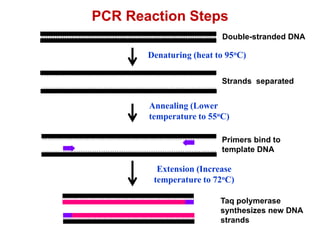
PCR Reaction Steps
Double-stranded DNA
Denaturing (heat to 95oC)
Strands separated
Annealing (Lower
temperature to 55oC)
Primers bind to
template DNA
Extension (Increase
temperature to 72oC)
Taq polymerase
synthesizes new DNA
strands
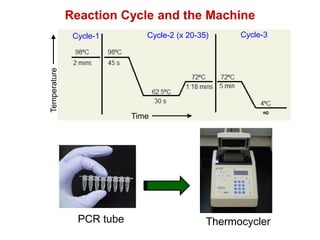
Reaction Cycle and the Machine
ThermocyclerPCR tube
Cycle-3Cycle-1 Cycle-2 (x 20-35)
Time
Temperature
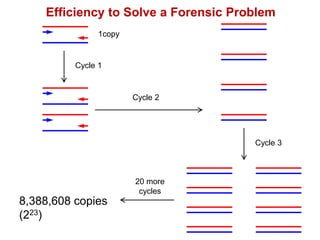
Efficiency to Solve a Forensic Problem
1copy
Cycle 1
Cycle 3
Cycle 2
8,388,608 copies
(223)
20 more
cycles
DNA Sequencing
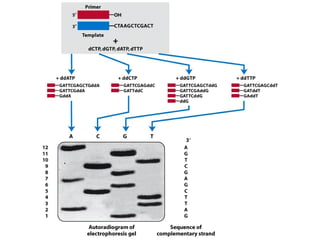
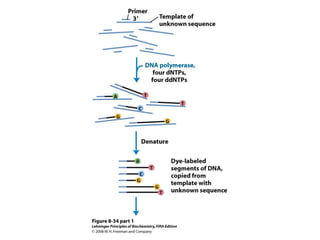
Sequencing is the process by which you determine the exact
order of the nucleotides in a given region of DNA
Dideoxynucleotide sequencing is done through
complementary chain synthesis and early termination
The synthesized chains are visualized by methods using:
– Radioactive labels
– Nonradioactive labels
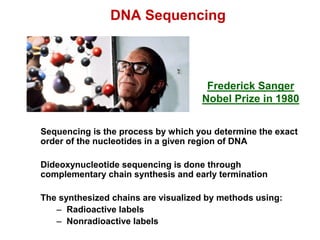
Frederick Sanger
Nobel Prize in 1980
Requirements for Sanger-Coulson
Sequencing
DNA to be sequenced must be in single strand form
The region to be sequenced must be 3’ flanked by
known sequence
Reagents needed are:
– A primer complementary to the known region
to direct chain synthesis.
– DNA polymerase.
– 4 deoxynucleotide triphosphates (dNTPs).
– 4 dideoxynucleotide triphosphates (ddNTPs).
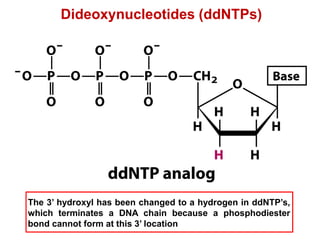
Dideoxynucleotides (ddNTPs)
The 3’ hydroxyl has been changed to a hydrogen in ddNTP’s,
which terminates a DNA chain because a phosphodiester
bond cannot form at this 3’ location
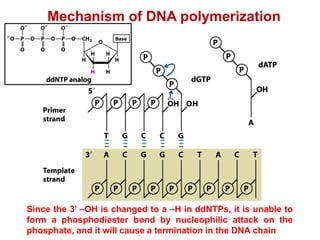
Since the 3’ –OH is changed to a –H in ddNTPs, it is unable to
form a phosphodiester bond by nucleophilic attack on the
phosphate, and it will cause a termination in the DNA chain
Mechanism of DNA polymerization
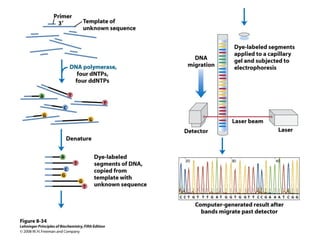
Sequencing Visualization Methods
Two forms of labeling:
– Radioactive
• Primer labeled (32P or 33P)
• dNTP labeled (35S)
– Nonradioactive
• Primer labeled
• ddNTP labeled (big dye terminator)
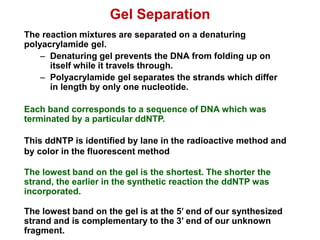
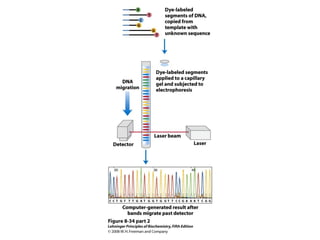
Gel Separation
The reaction mixtures are separated on a denaturing
polyacrylamide gel.
– Denaturing gel prevents the DNA from folding up on
itself while it travels through.
– Polyacrylamide gel separates the strands which differ
in length by only one nucleotide.
Each band corresponds to a sequence of DNA which was
terminated by a particular ddNTP.
This ddNTP is identified by lane in the radioactive method and
by color in the fluorescent method
The lowest band on the gel is the shortest. The shorter the
strand, the earlier in the synthetic reaction the ddNTP was
incorporated.
The lowest band on the gel is at the 5’ end of our synthesized
strand and is complementary to the 3’ end of our unknown
fragment.
http://bcs.whfreeman.com/lehninger5e/
Extra resources
Book:
The Double Helix: A Personal Account of the Discovery of the Structure of
DNA - By James D Watson
Videos:
DNA replication
https://www.youtube.com/watch?v=TNKWgcFPHqw
DNA sequencing:
https://www.youtube.com/watch?v=vK-HlMaitnE
Polymerase Chain Reaction (PCR)
http://video.mit.edu/watch/pcr-polymerase-chain-reaction-10948/
https://www.dnalc.org/view/15475-The-cycles-of-the-polymerase-chain-
reaction-PCR-3D-animation.html

Nucleic acid

  • 1.
    Science of Living System SoumyaDe School of Bioscience Email: somde@iitkgp.ac.in Tel: 03222-260514 BS20001
  • 2.
    Lecture Date Topic 120/7/16 Nucleic acids 2 27/7/16 Transcription and Translation 3 3/8/16 Protein structure 4 10/8/16 Enzymes 5 17/8/16 Photosynthesis and respiration 6 24/8/16 Cellular architecture ** 31/8/16 CLASS TEST-1 7 7/9/16 Cell division and apoptosis ** 14/9 to 21/9 MID-SEM EXAM 8 28/9/16 Host Defense/Immune system 9 5/10/16 Disease biology/vaccines/antibiotics ** 12/10/16 Autumn Break 10 19/10/16 Responses of living systems/scaling factors 11 26/11/16 Recombinant DNA Technology & its impact 12 2/11/16 Advances in Biology and Biomedical Engineering ** 9/11/16 CLASS TEST-2 ** 16/11/16 DISCUSSION AND REVISION
  • 3.
    What are thecharacteristics of a Living System? • High degree of complexity. • Mechanisms for sensing and responding to alterations in surroundings. • Capacity for precise self-replication and self- assembly. • Systems for extracting, transforming and using energy from the environment. • Ability to evolve.
  • 4.
    Water – simplestyet most important molecule necessary for Life! • Water is the biological solvent on Earth. • Water makes up 70% or more of the weight of most organisms. • The abundance of water is the primary reason that makes Earth a habitable planet.
  • 5.
    Water – simplestyet the most important molecule necessary for Life! 1A = 0.1 nm = 10-9m
  • 6.
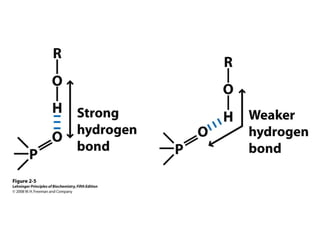
  • 8.
    Hydrogen bond, ionicand hydrophobic interactions stabilize enzyme- substrate complex
  • 9.
    Henderson–Hasselbalch Equation Water is ionizable H2O+ H2O = H3O+ + OH- KW (equilibrium constant) [H+] x [OH-] [H2O] = HA = H+ + A- Ka (equilibrium constant) [H+] x [A-] [HA] = pH = pKa + log10 [A-] [HA]
  • 11.
    RNA: Ribonucleic Acid DNA:Deoxyribonucleic Acid Nucleic Acid
  • 12.
    Flow of GeneticInformation: The Central Dogma of Molecular Biology RNA ProteinDNA Transcription Translation Replication RNA ProteinDNA Polymer of nucleotides Polymer of nucleotides Polymer of amino acids
  • 13.
    • Nucleic acidsare polymers • Monomer---nucleotides – Nitrogenous bases • Purines • Pyrimidines – Sugar • Ribose • Deoxyribose – Phosphates Nucleosides Nucleotides Nucleic Acid
  • 14.
    (Ribose) RNA - RibonucleicAcid DNA - Deoxyribonucleic Acid RNA vs DNA Ester Bond N-β-glycosyl bond (OH) (H)
  • 15.
    Two Types ofNitrogenous Bases
  • 16.
  • 17.
    Nucleotide = Nucleoside+ Phosphate (Nucleoside = Sugar + Base)
  • 18.
    Nucleotide = Nucleoside+ Phosphate (Nucleoside = Sugar + Base)
  • 19.
    Phosphodiester Linkages inthe Covalent Backbone of Nucleic Acid 3′ end3′ end
  • 20.
  • 21.
    RNA is LessStable than DNA
  • 22.
    Discovery of theDNA Structure • Structure was discovered in 1953 by James Watson and Francis Crick • Awarded Nobel Prize in 1962
  • 23.
  • 24.
    Watson-Crick Model forthe Structure of DNA a b c
  • 25.
  • 26.
    Salient Features ofA, B, and Z Forms of DNA
  • 27.
  • 28.
  • 29.
    UV Light CausesDNA Damage by Forming Thymine Dimers Kink Photolyases are DNA repair enzymes that repair damage caused by exposure to ultraviolet light.
  • 30.
  • 31.
    Semiconservative Replication ofDNA as suggested by Watson and Crick
  • 32.
  • 33.
    The Meselson-Stahl ExperimentSupports Semiconservative Replication
  • 34.
    Outline for Replication A.Initiation B. Priming C. Elongation D. Proofreading and Termination
  • 35.
    Worked with E.coli. Discovered the mechanisms of DNA synthesis in 1956. Four components are required: 1. dNTPs: dATP, dTTP, dGTP, dCTP (deoxyribonucleoside 5’-triphosphates) (sugar-base + 3 phosphates) 2. DNA template 3. DNA polymerase (Kornberg enzyme) 4. Mg2+ (optimizes DNA polymerase activity) Arthur Kornberg: Nobel Prize in 1959
  • 36.
    3 Polymerase III Leading strand 5’ 5’ 3’ 3’ SupercoiledDNA relaxed by gyrase & unwound by helicase + proteins Helicase + Initiator Proteins ATP SSB (single strand binding) Proteins RNA Primer primase 2Polymerase III Lagging strand Okazaki Fragments 1 RNA primer replaced by polymerase I & gap is sealed by ligase Replication: The Basic Concept
  • 37.
  • 38.
  • 39.
    DNA Gel Electrophoresis •Agarose gel is used to analyze a mixture of DNA. • DNA is negatively charged and hence migrates towards the positive terminal in the applied electric field gradient. • Different DNA molecules separate according to mass. • Smaller molecules migrate faster. • DNA is visualized in the gel by staining with ethidium bromide, which fluoresces under UV light. • UV light at 302 nm or 365 nm wavelengths are used.
  • 40.
    Polymerase Chain Reaction (PCR)and Its Applications
  • 41.
    What is PCR? PCRis an exponentially progressing synthesis of the defined target DNA sequences in vitro. It was invented in 1983 by Dr. Kary Mullis Nobel Prize in 1993
  • 42.
    Polymerase Chain Reaction(PCR) Why “Polymerase” ? It is called “polymerase” because the only enzyme used in this reaction is DNA polymerase. Why “Chain” ? It is called “chain” because the products of the first reaction become substrates of the following one, and so on.
  • 43.
    The “Reaction” Components 1)Target DNA - contains the sequence to be amplified. 2) Pair of Primers - oligonucleotides that define the sequence to be amplified. 3) dNTPs - deoxynucleotidetriphosphates: DNA building blocks. 4) Thermostable DNA Polymerase - enzyme that catalyzes the reaction 5) Mg++ ions - cofactor of the enzyme 6) Buffer solution - maintains pH and ionic strength of the reaction solution suitable for the activity of the enzyme Polymerase Chain Reaction (PCR)
  • 44.
    PCR Reaction Steps Double-strandedDNA Denaturing (heat to 95oC) Strands separated Annealing (Lower temperature to 55oC) Primers bind to template DNA Extension (Increase temperature to 72oC) Taq polymerase synthesizes new DNA strands
  • 45.
    Reaction Cycle andthe Machine ThermocyclerPCR tube Cycle-3Cycle-1 Cycle-2 (x 20-35) Time Temperature
  • 46.
    Efficiency to Solvea Forensic Problem 1copy Cycle 1 Cycle 3 Cycle 2 8,388,608 copies (223) 20 more cycles
  • 47.
    DNA Sequencing Sequencing isthe process by which you determine the exact order of the nucleotides in a given region of DNA Dideoxynucleotide sequencing is done through complementary chain synthesis and early termination The synthesized chains are visualized by methods using: – Radioactive labels – Nonradioactive labels Frederick Sanger Nobel Prize in 1980
  • 48.
    Requirements for Sanger-Coulson Sequencing DNAto be sequenced must be in single strand form The region to be sequenced must be 3’ flanked by known sequence Reagents needed are: – A primer complementary to the known region to direct chain synthesis. – DNA polymerase. – 4 deoxynucleotide triphosphates (dNTPs). – 4 dideoxynucleotide triphosphates (ddNTPs).
  • 49.
    Dideoxynucleotides (ddNTPs) The 3’hydroxyl has been changed to a hydrogen in ddNTP’s, which terminates a DNA chain because a phosphodiester bond cannot form at this 3’ location
  • 50.
    Since the 3’–OH is changed to a –H in ddNTPs, it is unable to form a phosphodiester bond by nucleophilic attack on the phosphate, and it will cause a termination in the DNA chain Mechanism of DNA polymerization
  • 51.
    Sequencing Visualization Methods Twoforms of labeling: – Radioactive • Primer labeled (32P or 33P) • dNTP labeled (35S) – Nonradioactive • Primer labeled • ddNTP labeled (big dye terminator)
  • 53.
    Gel Separation The reactionmixtures are separated on a denaturing polyacrylamide gel. – Denaturing gel prevents the DNA from folding up on itself while it travels through. – Polyacrylamide gel separates the strands which differ in length by only one nucleotide. Each band corresponds to a sequence of DNA which was terminated by a particular ddNTP. This ddNTP is identified by lane in the radioactive method and by color in the fluorescent method The lowest band on the gel is the shortest. The shorter the strand, the earlier in the synthetic reaction the ddNTP was incorporated. The lowest band on the gel is at the 5’ end of our synthesized strand and is complementary to the 3’ end of our unknown fragment.
  • 57.
  • 58.
    Extra resources Book: The DoubleHelix: A Personal Account of the Discovery of the Structure of DNA - By James D Watson Videos: DNA replication https://www.youtube.com/watch?v=TNKWgcFPHqw DNA sequencing: https://www.youtube.com/watch?v=vK-HlMaitnE Polymerase Chain Reaction (PCR) http://video.mit.edu/watch/pcr-polymerase-chain-reaction-10948/ https://www.dnalc.org/view/15475-The-cycles-of-the-polymerase-chain- reaction-PCR-3D-animation.html