Science of
Living System
Soumya De
School of Bioscience
Email: somde@iitkgp.ac.in
Tel: 03222-260514
BS20001
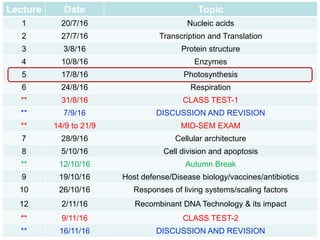
Lecture Date Topic
1 20/7/16 Nucleic acids
2 27/7/16 Transcription and Translation
3 3/8/16 Protein structure
4 10/8/16 Enzymes
5 17/8/16 Photosynthesis
6 24/8/16 Respiration
** 31/8/16 CLASS TEST-1
** 7/9/16 DISCUSSION AND REVISION
** 14/9 to 21/9 MID-SEM EXAM
7 28/9/16 Cellular architecture
8 5/10/16 Cell division and apoptosis
** 12/10/16 Autumn Break
9 19/10/16 Host defense/Disease biology/vaccines/antibiotics
10 26/10/16 Responses of living systems/scaling factors
12 2/11/16 Recombinant DNA Technology & its impact
** 9/11/16 CLASS TEST-2
** 16/11/16 DISCUSSION AND REVISION
Vital metabolism for survival of
life in the earth
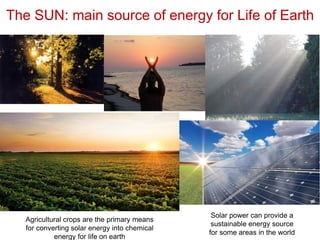
The SUN: main source of energy for Life of Earth
Solar power can provide a
sustainable energy source
for some areas in the world
Agricultural crops are the primary means
for converting solar energy into chemical
energy for life on earth
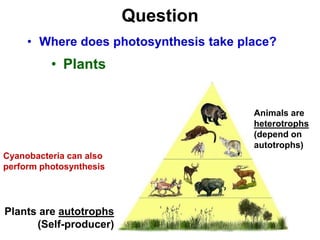
Question
• Where does photosynthesis take place?
• Plants
Plants are autotrophs
(Self-producer)
Animals are
heterotrophs
(depend on
autotrophs)
Cyanobacteria can also
perform photosynthesis
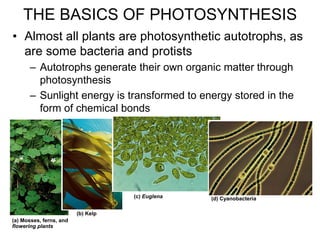
• Almost all plants are photosynthetic autotrophs, as
are some bacteria and protists
– Autotrophs generate their own organic matter through
photosynthesis
– Sunlight energy is transformed to energy stored in the
form of chemical bonds
(a) Mosses, ferns, and
flowering plants
(b) Kelp
(c) Euglena (d) Cyanobacteria
THE BASICS OF PHOTOSYNTHESIS
• The energy from sunlight is used to initiate photooxidation reactions in
light-absorbing pigments that convert light energy into chemical energy.
• The light reactions of photosynthesis require a proton impermeable
membrane and a series of linked redox reactions to generate proton
motive force used for ATP synthesis.
• Photooxidation uses the oxidation of H2O to produce O2 in a process
that provides electrons for photophosphorylation and the reduction of
NADP+ to produce NADPH.
• Chemical energy in the form of ATP and NADPH is used to convert
CO2 to glyceraldehyde-3-Phosphate using enzymes in the Calvin
Cycle pathway. Plants use sunlight for photosynthesis during the day
and undergo aerobic respiration at night.
Key Concepts in Photosynthesis
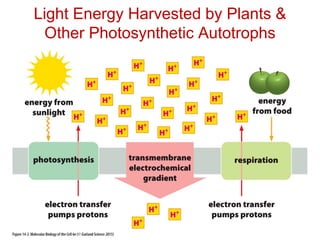
Light Energy Harvested by Plants &
Other Photosynthetic Autotrophs
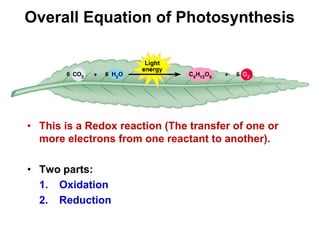
Overall Equation of Photosynthesis
• This is a Redox reaction (The transfer of one or
more electrons from one reactant to another).
• Two parts:
1. Oxidation
2. Reduction
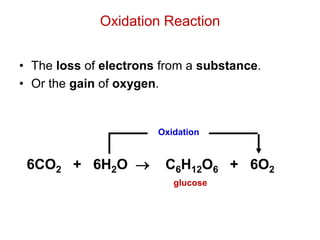
Oxidation Reaction
• The loss of electrons from a substance.
• Or the gain of oxygen.
glucose
6CO2 + 6H2O  C6H12O6 + 6O2
Oxidation
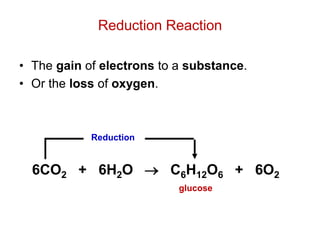
Reduction Reaction
• The gain of electrons to a substance.
• Or the loss of oxygen.
glucose
6CO2 + 6H2O  C6H12O6 + 6O2
Reduction
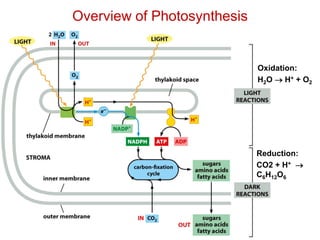
Overview of Photosynthesis
Oxidation:
H2O  H+ + O2
Reduction:
CO2 + H+ 
C6H12O6
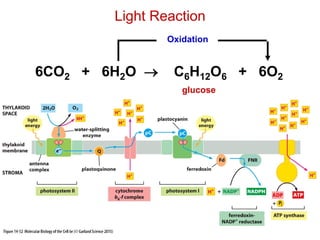
Light Reaction
glucose
6CO2 + 6H2O  C6H12O6 + 6O2
Oxidation
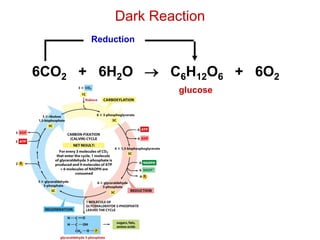
Dark Reaction
glucose
6CO2 + 6H2O  C6H12O6 + 6O2
Reduction
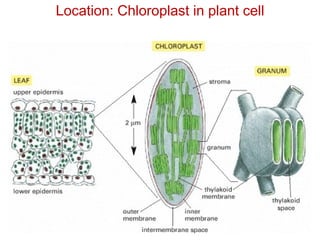
Location: Chloroplast in plant cell
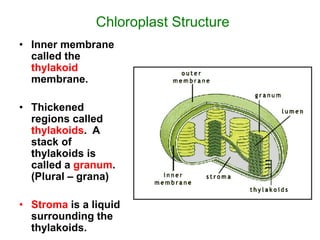
Chloroplast Structure
• Inner membrane
called the
thylakoid
membrane.
• Thickened
regions called
thylakoids. A
stack of
thylakoids is
called a granum.
(Plural – grana)
• Stroma is a liquid
surrounding the
thylakoids.
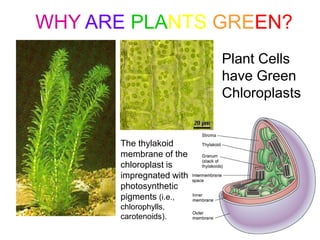
WHY ARE PLANTS GREEN?
Plant Cells
have Green
Chloroplasts
The thylakoid
membrane of the
chloroplast is
impregnated with
photosynthetic
pigments (i.e.,
chlorophylls,
carotenoids).
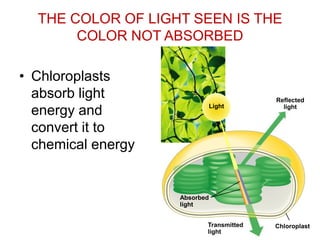
• Chloroplasts
absorb light
energy and
convert it to
chemical energy
Light
Reflected
light
Absorbed
light
Transmitted
light
Chloroplast
THE COLOR OF LIGHT SEEN IS THE
COLOR NOT ABSORBED
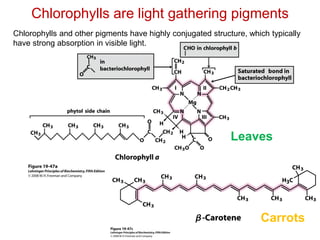
Chlorophylls are light gathering pigments
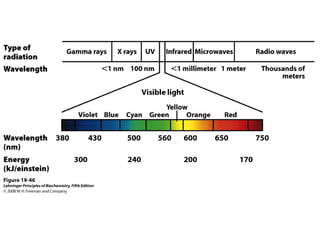
Chlorophylls and other pigments have highly conjugated structure, which typically
have strong absorption in visible light.
Leaves
Carrots
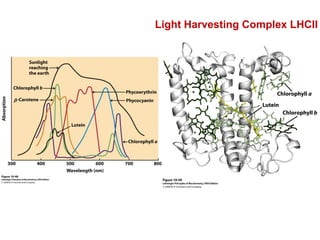
Light Harvesting Complex LHCII
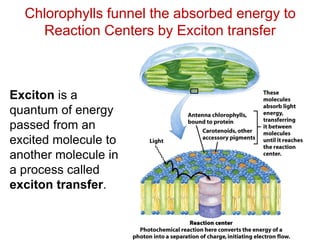
Chlorophylls funnel the absorbed energy to
Reaction Centers by Exciton transfer
Exciton is a
quantum of energy
passed from an
excited molecule to
another molecule in
a process called
exciton transfer.
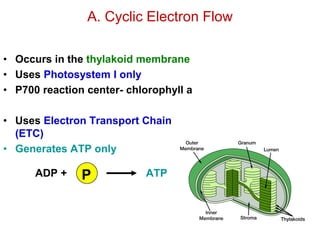
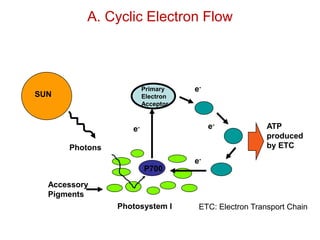
A. Cyclic Electron Flow
• Occurs in the thylakoid membrane
• Uses Photosystem I only
• P700 reaction center- chlorophyll a
• Uses Electron Transport Chain
(ETC)
• Generates ATP only
ADP + ATPP
P700
Primary
Electron
Acceptor
e-
e-
e-
e-
ATP
produced
by ETC
Photosystem I
Accessory
Pigments
SUN
Photons
ETC: Electron Transport Chain
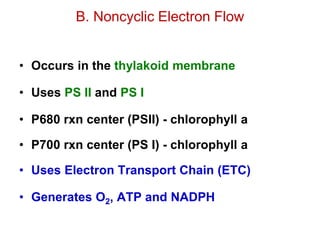
A. Cyclic Electron Flow
• Occurs in the thylakoid membrane
• Uses PS II and PS I
• P680 rxn center (PSII) - chlorophyll a
• P700 rxn center (PS I) - chlorophyll a
• Uses Electron Transport Chain (ETC)
• Generates O2, ATP and NADPH
B. Noncyclic Electron Flow
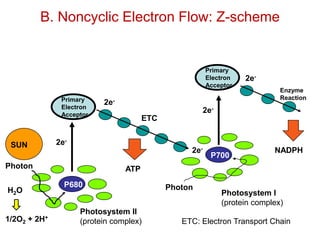
P700
Photosystem I
(protein complex)
P680
Photosystem II
(protein complex)
Primary
Electron
Acceptor
Primary
Electron
Acceptor
ETC
Enzyme
Reaction
H2O
1/2O2 + 2H+
ATP
NADPH
Photon
2e-
2e-
2e-
2e-
2e-
SUN
Photon
B. Noncyclic Electron Flow: Z-scheme
ETC: Electron Transport Chain
• ADP +  ATP
• NADP+ + H  NADPH
• Oxygen comes from the splitting of
H2O, not CO2
H2O  1/2 O2 + 2H+
(Reduced)
P
(Oxidized)
B. Noncyclic Electron Flow
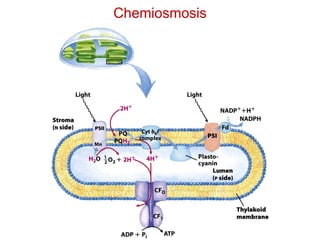
• Powers ATP synthesis.
• Occurs in the thylakoid membranes.
• Uses Electron Transport Chain and ATP
synthase (enzyme) to make ATP.
• Photophosphorylation: addition of phosphate to
ADP to make ATP.
Chemiosmosis
Chemiosmosis
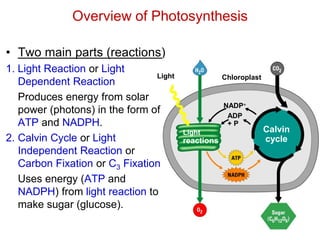
• Two main parts (reactions)
1. Light Reaction or Light
Dependent Reaction
Produces energy from solar
power (photons) in the form of
ATP and NADPH.
2. Calvin Cycle or Light
Independent Reaction or
Carbon Fixation or C3 Fixation
Uses energy (ATP and
NADPH) from light reaction to
make sugar (glucose).
Light Chloroplast
Light
reactions
Calvin
cycle
NADP
ADP
+ P
Overview of Photosynthesis
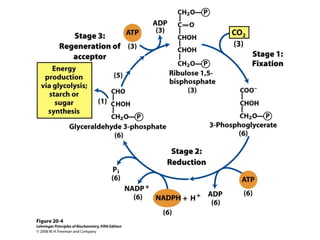
Calvin Cycle
• Carbon Fixation (light independent rxn).
• C3 plants (80% of plants on earth).
• Occurs in the stroma.
• Uses ATP and NADPH from light rxn.
• Uses CO2.
• To produce glucose: it takes 6 turns and
uses 18 ATP and 12 NADPH.
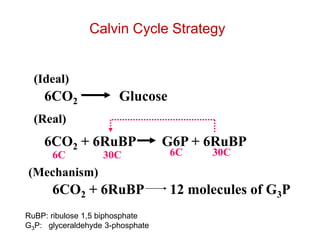
Calvin Cycle Strategy
6CO2 Glucose
(Ideal)
(Real)
6CO2 + 6RuBP G6P + 6RuBP
6C 30C 6C 30C
(Mechanism)
6CO2 + 6RuBP 12 molecules of G3P
RuBP: ribulose 1,5 biphosphate
G3P: glyceraldehyde 3-phosphate
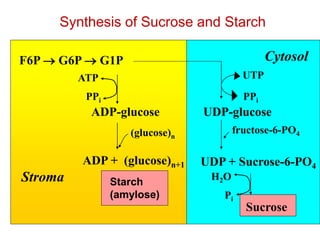
Synthesis of Sucrose and Starch
F6P  G6P  G1P
ADP-glucose
ATP
PPi
(glucose)n
ADP + (glucose)n+1
Starch
(amylose)
UDP-glucose
fructose-6-PO4
UDP + Sucrose-6-PO4
H2O
Pi
UTP
PPi
Stroma
Cytosol
Sucrose
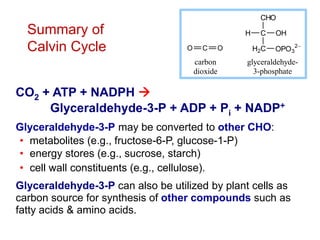
CO2 + ATP + NADPH 
Glyceraldehyde-3-P + ADP + Pi + NADP+
Glyceraldehyde-3-P may be converted to other CHO:
• metabolites (e.g., fructose-6-P, glucose-1-P)
• energy stores (e.g., sucrose, starch)
• cell wall constituents (e.g., cellulose).
Glyceraldehyde-3-P can also be utilized by plant cells as
carbon source for synthesis of other compounds such as
fatty acids & amino acids.
glyceraldehyde-
3-phosphate
OH
H2C
CH
CHO
OPO3
2
OCO
carbon
dioxide
Summary of
Calvin Cycle
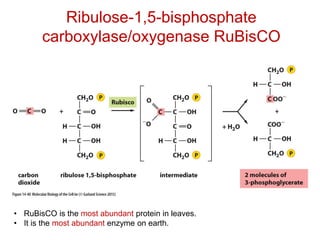
Ribulose-1,5-bisphosphate
carboxylase/oxygenase RuBisCO
• RuBisCO is the most abundant protein in leaves.
• It is the most abundant enzyme on earth.
When O2 reacts with ribulose-1,5-bisphosphate, the
products are 3-phosphoglycerate plus the 2-C
compound 2-phosphoglycolate.
This reaction is the basis for the name RuBP
Carboxylase/Oxygenase (RuBisCO).
OH
H2C
CH
C
OO
OPO3
2

H2C
C
OPO3
2
O
O
3-phospho- phosphoglycolate
glycerate
Photorespiration:
O2 can compete with
CO2 for binding to RuBisCO,
especially when [CO2] is low
& [O2] is high.
Photorespiration is a wasteful process, substantially
reducing efficiency of CO2 fixation, even at normal ambient
CO2
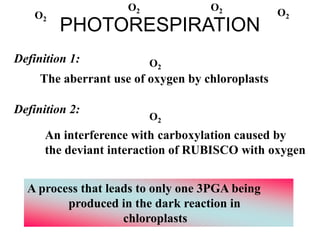
PHOTORESPIRATION
Definition 1:
An interference with carboxylation caused by
the deviant interaction of RUBISCO with oxygen
The aberrant use of oxygen by chloroplasts
A process that leads to only one 3PGA being
produced in the dark reaction in
chloroplasts
Definition 2:
O2
O2
O2 O2
O2
O2
• Carbon dioxide is broken and “fixed” into
glucose or fructose molecules in the CALVIN
CYCLE!!!!
• Glucose subunits can make cellulose or other
polysaccharides, such as fruit sugars.
• The carbon skeleton in glucose also helps to
synthesize other important biochemical
compounds such as, lipids, amino acids, and
nucleic acids.
Overview of the Dark Reactions

Photosynthesis

  • 1.
    Science of Living System SoumyaDe School of Bioscience Email: somde@iitkgp.ac.in Tel: 03222-260514 BS20001
  • 2.
    Lecture Date Topic 120/7/16 Nucleic acids 2 27/7/16 Transcription and Translation 3 3/8/16 Protein structure 4 10/8/16 Enzymes 5 17/8/16 Photosynthesis 6 24/8/16 Respiration ** 31/8/16 CLASS TEST-1 ** 7/9/16 DISCUSSION AND REVISION ** 14/9 to 21/9 MID-SEM EXAM 7 28/9/16 Cellular architecture 8 5/10/16 Cell division and apoptosis ** 12/10/16 Autumn Break 9 19/10/16 Host defense/Disease biology/vaccines/antibiotics 10 26/10/16 Responses of living systems/scaling factors 12 2/11/16 Recombinant DNA Technology & its impact ** 9/11/16 CLASS TEST-2 ** 16/11/16 DISCUSSION AND REVISION
  • 3.
    Vital metabolism forsurvival of life in the earth
  • 4.
    The SUN: mainsource of energy for Life of Earth Solar power can provide a sustainable energy source for some areas in the world Agricultural crops are the primary means for converting solar energy into chemical energy for life on earth
  • 6.
    Question • Where doesphotosynthesis take place? • Plants Plants are autotrophs (Self-producer) Animals are heterotrophs (depend on autotrophs) Cyanobacteria can also perform photosynthesis
  • 7.
    • Almost allplants are photosynthetic autotrophs, as are some bacteria and protists – Autotrophs generate their own organic matter through photosynthesis – Sunlight energy is transformed to energy stored in the form of chemical bonds (a) Mosses, ferns, and flowering plants (b) Kelp (c) Euglena (d) Cyanobacteria THE BASICS OF PHOTOSYNTHESIS
  • 8.
    • The energyfrom sunlight is used to initiate photooxidation reactions in light-absorbing pigments that convert light energy into chemical energy. • The light reactions of photosynthesis require a proton impermeable membrane and a series of linked redox reactions to generate proton motive force used for ATP synthesis. • Photooxidation uses the oxidation of H2O to produce O2 in a process that provides electrons for photophosphorylation and the reduction of NADP+ to produce NADPH. • Chemical energy in the form of ATP and NADPH is used to convert CO2 to glyceraldehyde-3-Phosphate using enzymes in the Calvin Cycle pathway. Plants use sunlight for photosynthesis during the day and undergo aerobic respiration at night. Key Concepts in Photosynthesis
  • 9.
    Light Energy Harvestedby Plants & Other Photosynthetic Autotrophs
  • 10.
    Overall Equation ofPhotosynthesis • This is a Redox reaction (The transfer of one or more electrons from one reactant to another). • Two parts: 1. Oxidation 2. Reduction
  • 11.
    Oxidation Reaction • Theloss of electrons from a substance. • Or the gain of oxygen. glucose 6CO2 + 6H2O  C6H12O6 + 6O2 Oxidation
  • 12.
    Reduction Reaction • Thegain of electrons to a substance. • Or the loss of oxygen. glucose 6CO2 + 6H2O  C6H12O6 + 6O2 Reduction
  • 13.
    Overview of Photosynthesis Oxidation: H2O H+ + O2 Reduction: CO2 + H+  C6H12O6
  • 14.
    Light Reaction glucose 6CO2 +6H2O  C6H12O6 + 6O2 Oxidation
  • 15.
    Dark Reaction glucose 6CO2 +6H2O  C6H12O6 + 6O2 Reduction
  • 16.
  • 17.
    Chloroplast Structure • Innermembrane called the thylakoid membrane. • Thickened regions called thylakoids. A stack of thylakoids is called a granum. (Plural – grana) • Stroma is a liquid surrounding the thylakoids.
  • 18.
    WHY ARE PLANTSGREEN? Plant Cells have Green Chloroplasts The thylakoid membrane of the chloroplast is impregnated with photosynthetic pigments (i.e., chlorophylls, carotenoids).
  • 20.
    • Chloroplasts absorb light energyand convert it to chemical energy Light Reflected light Absorbed light Transmitted light Chloroplast THE COLOR OF LIGHT SEEN IS THE COLOR NOT ABSORBED
  • 21.
    Chlorophylls are lightgathering pigments Chlorophylls and other pigments have highly conjugated structure, which typically have strong absorption in visible light. Leaves Carrots
  • 22.
  • 23.
    Chlorophylls funnel theabsorbed energy to Reaction Centers by Exciton transfer Exciton is a quantum of energy passed from an excited molecule to another molecule in a process called exciton transfer.
  • 24.
    A. Cyclic ElectronFlow • Occurs in the thylakoid membrane • Uses Photosystem I only • P700 reaction center- chlorophyll a • Uses Electron Transport Chain (ETC) • Generates ATP only ADP + ATPP
  • 25.
  • 26.
    • Occurs inthe thylakoid membrane • Uses PS II and PS I • P680 rxn center (PSII) - chlorophyll a • P700 rxn center (PS I) - chlorophyll a • Uses Electron Transport Chain (ETC) • Generates O2, ATP and NADPH B. Noncyclic Electron Flow
  • 27.
    P700 Photosystem I (protein complex) P680 PhotosystemII (protein complex) Primary Electron Acceptor Primary Electron Acceptor ETC Enzyme Reaction H2O 1/2O2 + 2H+ ATP NADPH Photon 2e- 2e- 2e- 2e- 2e- SUN Photon B. Noncyclic Electron Flow: Z-scheme ETC: Electron Transport Chain
  • 28.
    • ADP + ATP • NADP+ + H  NADPH • Oxygen comes from the splitting of H2O, not CO2 H2O  1/2 O2 + 2H+ (Reduced) P (Oxidized) B. Noncyclic Electron Flow
  • 29.
    • Powers ATPsynthesis. • Occurs in the thylakoid membranes. • Uses Electron Transport Chain and ATP synthase (enzyme) to make ATP. • Photophosphorylation: addition of phosphate to ADP to make ATP. Chemiosmosis
  • 30.
  • 31.
    • Two mainparts (reactions) 1. Light Reaction or Light Dependent Reaction Produces energy from solar power (photons) in the form of ATP and NADPH. 2. Calvin Cycle or Light Independent Reaction or Carbon Fixation or C3 Fixation Uses energy (ATP and NADPH) from light reaction to make sugar (glucose). Light Chloroplast Light reactions Calvin cycle NADP ADP + P Overview of Photosynthesis
  • 32.
    Calvin Cycle • CarbonFixation (light independent rxn). • C3 plants (80% of plants on earth). • Occurs in the stroma. • Uses ATP and NADPH from light rxn. • Uses CO2. • To produce glucose: it takes 6 turns and uses 18 ATP and 12 NADPH.
  • 33.
    Calvin Cycle Strategy 6CO2Glucose (Ideal) (Real) 6CO2 + 6RuBP G6P + 6RuBP 6C 30C 6C 30C (Mechanism) 6CO2 + 6RuBP 12 molecules of G3P RuBP: ribulose 1,5 biphosphate G3P: glyceraldehyde 3-phosphate
  • 35.
    Synthesis of Sucroseand Starch F6P  G6P  G1P ADP-glucose ATP PPi (glucose)n ADP + (glucose)n+1 Starch (amylose) UDP-glucose fructose-6-PO4 UDP + Sucrose-6-PO4 H2O Pi UTP PPi Stroma Cytosol Sucrose
  • 36.
    CO2 + ATP+ NADPH  Glyceraldehyde-3-P + ADP + Pi + NADP+ Glyceraldehyde-3-P may be converted to other CHO: • metabolites (e.g., fructose-6-P, glucose-1-P) • energy stores (e.g., sucrose, starch) • cell wall constituents (e.g., cellulose). Glyceraldehyde-3-P can also be utilized by plant cells as carbon source for synthesis of other compounds such as fatty acids & amino acids. glyceraldehyde- 3-phosphate OH H2C CH CHO OPO3 2 OCO carbon dioxide Summary of Calvin Cycle
  • 37.
    Ribulose-1,5-bisphosphate carboxylase/oxygenase RuBisCO • RuBisCOis the most abundant protein in leaves. • It is the most abundant enzyme on earth.
  • 38.
    When O2 reactswith ribulose-1,5-bisphosphate, the products are 3-phosphoglycerate plus the 2-C compound 2-phosphoglycolate. This reaction is the basis for the name RuBP Carboxylase/Oxygenase (RuBisCO). OH H2C CH C OO OPO3 2  H2C C OPO3 2 O O 3-phospho- phosphoglycolate glycerate Photorespiration: O2 can compete with CO2 for binding to RuBisCO, especially when [CO2] is low & [O2] is high. Photorespiration is a wasteful process, substantially reducing efficiency of CO2 fixation, even at normal ambient CO2
  • 39.
    PHOTORESPIRATION Definition 1: An interferencewith carboxylation caused by the deviant interaction of RUBISCO with oxygen The aberrant use of oxygen by chloroplasts A process that leads to only one 3PGA being produced in the dark reaction in chloroplasts Definition 2: O2 O2 O2 O2 O2 O2
  • 40.
    • Carbon dioxideis broken and “fixed” into glucose or fructose molecules in the CALVIN CYCLE!!!! • Glucose subunits can make cellulose or other polysaccharides, such as fruit sugars. • The carbon skeleton in glucose also helps to synthesize other important biochemical compounds such as, lipids, amino acids, and nucleic acids. Overview of the Dark Reactions