OBJECTIVES
:
After performing this experiment, we wil able to:
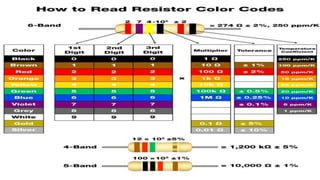
• Determine the listed value of resistor using resistor color code
• Describe the resistor and how to use resistor; and
• Cite the historical about resisitor and give some example
TOPICS:
• What is resistors?
• History concepts about resistor
• Types of resistors
• Why we need to use resistor?
• How to use resistor?
• Disadvantages and advantages
• Understanding about resistor
WHAT IS
RESISTOR?
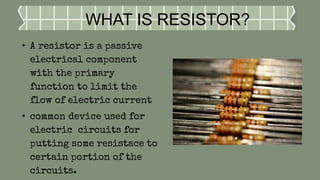
WHAT IS RESISTOR?
• A resistor is a passive
electrical component
with the primary
function to limit the
flow of electric current
• common device used for
electric circuits for
putting some resistace to
certain portion of the
circuits.
SYMBOLS
History concepts about
resistor?
• was invented by German
physicist Georg Simon Ohm
in the 1820s.
• He published his findings on
the relationship between
current, voltage, and
resistance in a paper called
"The Galvanic Circuit
Investigated Mathematically"
in 1827.
Georg Simon Ohm
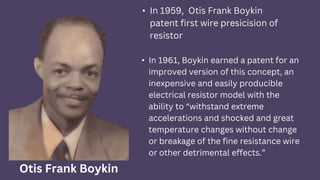
Otis Frank Boykin
• In 1959, Otis Frank Boykin
patent first wire presicision of
resistor
• In 1961, Boykin earned a patent for an
improved version of this concept, an
inexpensive and easily producible
electrical resistor model with the
ability to “withstand extreme
accelerations and shocked and great
temperature changes without change
or breakage of the fine resistance wire
or other detrimental effects.”
TYPES OF RESISTORS
• The Carbon-Composition
• Carbon - Film Resistors
• Metal - Film Resistor
• Wire Wound Resistors
TYPES OF RESISTORS
Carbon - Composing Resistors
• The carbon composition resistor is a type of fixed resistor that
reduces or restricts the electric current flow to a certain level.
• commonly used resistors in the 1960’s and earlier.
COLOR
CODING
• The carbon film resistor is a type of fixed resistor that uses carbon
film to restrict the electric current to certain level. These types of
resistors are widely used in the electronic circuits.
Carbon - Film Resistors
• The resistor which uses metal film to limit the flow of electric
current to certain level is called metal film resistor.
Metal - Film Resistor
• Wire wound resistor is a type of passive component in which
metal wires are used to reduce or restrict the flow of electric
current to a certain level.
Wire Wound Resistors
Disadvantages and advantages
CARBON -
COMPOSITION
ADVANTAGES:
• Carbon-composition resistors are small in size compared with wire-
wound resistors.
• A very wide resistance range is available.
• These are the cheapest resistors.
• These have good RF performance.
CARBON -
COMPOSITION
DISADVANTAGES:
• Carbon-composition resistors have no precision, and have very high
tolerance.
• These resistors get easily heated and crack down on soldering.
• Carbon film resistors are available in all resistor values, from very low
values (< 1Ω) to many MΩ.
• They are available in very miniature size
• They may also be used as resistors in ICs.
• They can replace wire wound resistors in high-voltage applications.
• Carbon-film resistors have good high-frequency properties.
• They cost low.
CARBON - FILM
RESISTOR
ADVANTAGES:
• Carbon film resistors cannot withstand high temperatures.
• They cannot with stand to mechanical shocks.
• They cannot with stand to atmospheric moisture and humidity.
• They are chemically reactive and hence unstable.
CARBON - FILM
RESISTOR
DISADVANTAGES:
• Wire wound resistors can be designed to produce very accurate resistance values, with
very low tolerance (± 0.01%).
• They can with stand large power dissipation.
• They can be used in high-temperature situations.
• They are capable of carrying extremely large currents.
• Wire-wound resistors can with stand mechanical shock and vibration.
• They can be used in high-voltage circuits.
• Wire-wound resistors have very stable resistance values which do not change much with
aging.
Wire Wound Resistors
ADVANTAGES:
• Wire wound resistors are very large in size and weight.
• They are very costly.
• Power type wire wound resistors are not suitable beyond 200 kHz because of
inter winding inductance and the capacitance.
• In many situations, wires can break, leading to the breakdown of the circuit in
which these resistors are used.
Wire Wound Resistors
DISADVANTAGES:
Why we need to use resistor?
• In electronic circuits, resistors are predominantly used to
lower the flow of current, divide voltages, block
transmission signals, and bias active elements.
• to control the flow of current to other components.
How to use resistor?
• A resistor is a two-terminal electrical component that
provides electrical resistance. In electronic circuits,
resistors are predominantly used to lower the flow of
current, divide voltages, block transmission signals, and
bias active elements.
Understanding about resistor
COLOR
CODING
PROBLEM SOLVING
LIMITATIONS AND APPLICATIONS OF RESISTORS
LIMITATIONS OF RESISTORS
• Over heat of resistors
• Resistors are probably the most robust
electronic components, with high reliability
• Resistors affected in noise and inductance
• Wrong values
APPLICATIONS OF RESISTORS
• Resistors are used in high frequency
instrument
• Resistors are used in power control circuit
• Resistors used in amplifiers, oscillators,
telecommunication and digital multimeter
THAT'S ALL THANK YOU

resistor.pptx

  • 2.
    OBJECTIVES : After performing thisexperiment, we wil able to: • Determine the listed value of resistor using resistor color code • Describe the resistor and how to use resistor; and • Cite the historical about resisitor and give some example
  • 3.
    TOPICS: • What isresistors? • History concepts about resistor • Types of resistors • Why we need to use resistor? • How to use resistor? • Disadvantages and advantages • Understanding about resistor
  • 4.
  • 5.
    WHAT IS RESISTOR? •A resistor is a passive electrical component with the primary function to limit the flow of electric current • common device used for electric circuits for putting some resistace to certain portion of the circuits.
  • 6.
  • 7.
  • 8.
    • was inventedby German physicist Georg Simon Ohm in the 1820s. • He published his findings on the relationship between current, voltage, and resistance in a paper called "The Galvanic Circuit Investigated Mathematically" in 1827. Georg Simon Ohm
  • 9.
    Otis Frank Boykin •In 1959, Otis Frank Boykin patent first wire presicision of resistor • In 1961, Boykin earned a patent for an improved version of this concept, an inexpensive and easily producible electrical resistor model with the ability to “withstand extreme accelerations and shocked and great temperature changes without change or breakage of the fine resistance wire or other detrimental effects.”
  • 10.
  • 11.
    • The Carbon-Composition •Carbon - Film Resistors • Metal - Film Resistor • Wire Wound Resistors TYPES OF RESISTORS
  • 12.
    Carbon - ComposingResistors • The carbon composition resistor is a type of fixed resistor that reduces or restricts the electric current flow to a certain level. • commonly used resistors in the 1960’s and earlier.
  • 14.
  • 15.
    • The carbonfilm resistor is a type of fixed resistor that uses carbon film to restrict the electric current to certain level. These types of resistors are widely used in the electronic circuits. Carbon - Film Resistors
  • 17.
    • The resistorwhich uses metal film to limit the flow of electric current to certain level is called metal film resistor. Metal - Film Resistor
  • 19.
    • Wire woundresistor is a type of passive component in which metal wires are used to reduce or restrict the flow of electric current to a certain level. Wire Wound Resistors
  • 21.
  • 22.
    CARBON - COMPOSITION ADVANTAGES: • Carbon-compositionresistors are small in size compared with wire- wound resistors. • A very wide resistance range is available. • These are the cheapest resistors. • These have good RF performance.
  • 23.
    CARBON - COMPOSITION DISADVANTAGES: • Carbon-compositionresistors have no precision, and have very high tolerance. • These resistors get easily heated and crack down on soldering.
  • 24.
    • Carbon filmresistors are available in all resistor values, from very low values (< 1Ω) to many MΩ. • They are available in very miniature size • They may also be used as resistors in ICs. • They can replace wire wound resistors in high-voltage applications. • Carbon-film resistors have good high-frequency properties. • They cost low. CARBON - FILM RESISTOR ADVANTAGES:
  • 25.
    • Carbon filmresistors cannot withstand high temperatures. • They cannot with stand to mechanical shocks. • They cannot with stand to atmospheric moisture and humidity. • They are chemically reactive and hence unstable. CARBON - FILM RESISTOR DISADVANTAGES:
  • 26.
    • Wire woundresistors can be designed to produce very accurate resistance values, with very low tolerance (± 0.01%). • They can with stand large power dissipation. • They can be used in high-temperature situations. • They are capable of carrying extremely large currents. • Wire-wound resistors can with stand mechanical shock and vibration. • They can be used in high-voltage circuits. • Wire-wound resistors have very stable resistance values which do not change much with aging. Wire Wound Resistors ADVANTAGES:
  • 27.
    • Wire woundresistors are very large in size and weight. • They are very costly. • Power type wire wound resistors are not suitable beyond 200 kHz because of inter winding inductance and the capacitance. • In many situations, wires can break, leading to the breakdown of the circuit in which these resistors are used. Wire Wound Resistors DISADVANTAGES:
  • 28.
    Why we needto use resistor?
  • 29.
    • In electroniccircuits, resistors are predominantly used to lower the flow of current, divide voltages, block transmission signals, and bias active elements. • to control the flow of current to other components.
  • 30.
    How to useresistor?
  • 31.
    • A resistoris a two-terminal electrical component that provides electrical resistance. In electronic circuits, resistors are predominantly used to lower the flow of current, divide voltages, block transmission signals, and bias active elements.
  • 32.
  • 33.
  • 38.
  • 42.
  • 43.
    LIMITATIONS OF RESISTORS •Over heat of resistors • Resistors are probably the most robust electronic components, with high reliability • Resistors affected in noise and inductance • Wrong values
  • 44.
    APPLICATIONS OF RESISTORS •Resistors are used in high frequency instrument • Resistors are used in power control circuit • Resistors used in amplifiers, oscillators, telecommunication and digital multimeter
  • 45.