Resistors
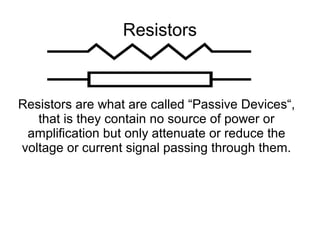
Resistors are what are called “Passive Devices“,
that is they contain no source of power or
amplification but only attenuate or reduce the
voltage or current signal passing through them.
Resistors
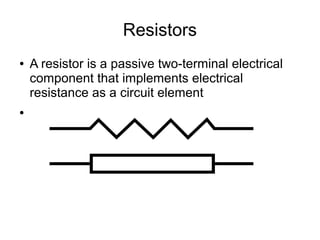
● A resistor is a passive two-terminal electrical
component that implements electrical
resistance as a circuit element
●
● Some of the common characteristics
associated with the resistor are; Temperature
Coefficient, Voltage Coefficient, Noise,
Frequency Response, Power as well as a
resistors Temperature Rating, Physical Size
and Reliability.
● Carbon Composition Resistor – Made of carbon dust or
graphite paste, low wattage values
● Film or Cermet Resistor – Made from conductive metal
oxide paste, very low wattage values
● Wire-wound Resistor – Metallic bodies for heatsink
mounting, very high wattage ratings
● Semiconductor Resistor – High frequency/precision surface
mount thin film technology
Composition Types of Resistor
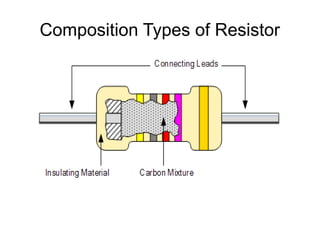
● Carbon Resistors are the most common type of
Composition Resistors
● Their resistive element is a mixture of finely
ground carbon dust or graphite and a non-
conducting ceramic (clay) powder to bind it all
together.
● The ratio of carbon dust to ceramic (conductor
to insulator) determines the overall resistive
value of the mixture
Carbon Composite Resistor
● low to medium type power resistor which has a low
inductance making them ideal for high frequency
applications
● power ratings from 0.125 or 1/4 of a Watt up to 5
Watts.
● due to their manufacturing process carbon type
resistors have very large tolerances
● The tolerance of a resistor is the difference between
the preferred value and its actual manufactured value
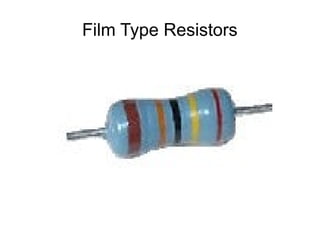
Film Type Resistors
● “Film Resistor” consist of Metal Film, Carbon
Film and Metal Oxide Film resistor types which
are generally made by depositing pure metals,
such as nickel, or an oxide film, such as tin-
oxide, onto an insulating ceramic rod or
substrate.
● The resistive value of the resistor is controlled
by increasing the desired thickness of the
deposited film
● Once deposited, a laser is used to cut a high
precision spiral helix groove type pattern into
this film.
● cutting of the film has the effect of increasing the conductive or resistive path, a bit
like taking a long length of straight wire and forming it into a coil.
● This method of manufacture allows for much closer tolerance resistors (1% or
less) as compared to the simpler carbon composition types.
● Film type resistors also achieve a much higher maximum ohmic value compared
to other types and values in excess of 10MΩ (10 Million Ω´s) are available.
● the carbon film resistor has a higher negative temperature coefficient than carbon
composition.
●
Metal Film Resistors
● much better temperature stability than their
carbon equivalents
● better for high frequency or radio frequency
applications
Metal Oxide Resistors
● higher temperature rating than the equivalent
metal film resistors.
Thick Film Resistor
● manufactured by depositing a much thicker
conductive paste of CERamic and METal,
called Cermet, onto an alumina ceramic
substrate
● used for making small surface mount chip type
resistors
● They have good temperature stability, low
noise, and good voltage ratings
Wirewound Types of Resistor
● made by winding a thin metal alloy wire
(Nichrome) or similar wire onto an insulating
ceramic former in the form of a spiral helix
similar to the film resistor.
● generally only available in very low ohmic high
precision values (from 0.01 to 100kΩ)
● handle much higher electrical currents than
other resistors of the same ohmic value with
power ratings in excess of 300 Watts.
How to read the code
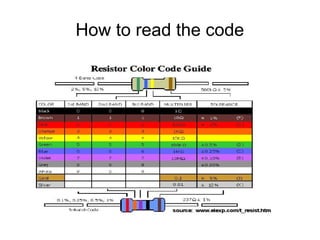
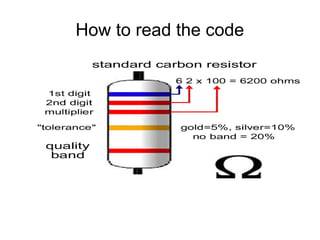
● First find the tolerance band, it will typically be gold ( 5%) and
sometimes silver (10%).
● Starting from the other end, identify the first band - write down the
number associated with that color; in this case Blue is 6.
Now 'read' the next color, here it is red so write down a '2' next to the
six. (you should have '62' so far.)
● Now read the third or 'multiplier' band and write down that number of
zeros.
● In this example it is two so we get '6200' or '6,200'. If the 'multiplier'
band is Black (for zero) don't write any zeros down.
●
●
If the 'multiplier' band is Gold move the decimal point one to the left. If the
'multiplier' band is Silver move the decimal point two places to the left. If the
resistor has one more band past the tolerance band it is a quality band.
●
● Read the number as the '% Failure rate per 1000 hour' This is rated assuming
full wattage being applied to the resistors. (To get better failure rates, resistors
are typically specified to have twice the needed wattage dissipation that the
circuit produces) 1% resistors have three bands to read digits to the left of the
multiplier. They have a different temperature coefficient in order to provide the
1% tolerance.

Resistors

  • 1.
    Resistors Resistors are whatare called “Passive Devices“, that is they contain no source of power or amplification but only attenuate or reduce the voltage or current signal passing through them.
  • 2.
    Resistors ● A resistoris a passive two-terminal electrical component that implements electrical resistance as a circuit element ●
  • 3.
    ● Some ofthe common characteristics associated with the resistor are; Temperature Coefficient, Voltage Coefficient, Noise, Frequency Response, Power as well as a resistors Temperature Rating, Physical Size and Reliability.
  • 4.
    ● Carbon CompositionResistor – Made of carbon dust or graphite paste, low wattage values ● Film or Cermet Resistor – Made from conductive metal oxide paste, very low wattage values ● Wire-wound Resistor – Metallic bodies for heatsink mounting, very high wattage ratings ● Semiconductor Resistor – High frequency/precision surface mount thin film technology
  • 5.
  • 6.
    ● Carbon Resistorsare the most common type of Composition Resistors ● Their resistive element is a mixture of finely ground carbon dust or graphite and a non- conducting ceramic (clay) powder to bind it all together. ● The ratio of carbon dust to ceramic (conductor to insulator) determines the overall resistive value of the mixture
  • 7.
    Carbon Composite Resistor ●low to medium type power resistor which has a low inductance making them ideal for high frequency applications ● power ratings from 0.125 or 1/4 of a Watt up to 5 Watts. ● due to their manufacturing process carbon type resistors have very large tolerances ● The tolerance of a resistor is the difference between the preferred value and its actual manufactured value
  • 8.
  • 9.
    ● “Film Resistor”consist of Metal Film, Carbon Film and Metal Oxide Film resistor types which are generally made by depositing pure metals, such as nickel, or an oxide film, such as tin- oxide, onto an insulating ceramic rod or substrate. ● The resistive value of the resistor is controlled by increasing the desired thickness of the deposited film
  • 10.
    ● Once deposited,a laser is used to cut a high precision spiral helix groove type pattern into this film.
  • 11.
    ● cutting ofthe film has the effect of increasing the conductive or resistive path, a bit like taking a long length of straight wire and forming it into a coil. ● This method of manufacture allows for much closer tolerance resistors (1% or less) as compared to the simpler carbon composition types. ● Film type resistors also achieve a much higher maximum ohmic value compared to other types and values in excess of 10MΩ (10 Million Ω´s) are available. ● the carbon film resistor has a higher negative temperature coefficient than carbon composition. ●
  • 12.
    Metal Film Resistors ●much better temperature stability than their carbon equivalents ● better for high frequency or radio frequency applications
  • 13.
    Metal Oxide Resistors ●higher temperature rating than the equivalent metal film resistors.
  • 14.
    Thick Film Resistor ●manufactured by depositing a much thicker conductive paste of CERamic and METal, called Cermet, onto an alumina ceramic substrate ● used for making small surface mount chip type resistors ● They have good temperature stability, low noise, and good voltage ratings
  • 15.
    Wirewound Types ofResistor ● made by winding a thin metal alloy wire (Nichrome) or similar wire onto an insulating ceramic former in the form of a spiral helix similar to the film resistor. ● generally only available in very low ohmic high precision values (from 0.01 to 100kΩ) ● handle much higher electrical currents than other resistors of the same ohmic value with power ratings in excess of 300 Watts.
  • 16.
    How to readthe code
  • 17.
    How to readthe code
  • 18.
    How to readthe code ● First find the tolerance band, it will typically be gold ( 5%) and sometimes silver (10%). ● Starting from the other end, identify the first band - write down the number associated with that color; in this case Blue is 6. Now 'read' the next color, here it is red so write down a '2' next to the six. (you should have '62' so far.) ● Now read the third or 'multiplier' band and write down that number of zeros. ● In this example it is two so we get '6200' or '6,200'. If the 'multiplier' band is Black (for zero) don't write any zeros down. ●
  • 19.
    ● If the 'multiplier'band is Gold move the decimal point one to the left. If the 'multiplier' band is Silver move the decimal point two places to the left. If the resistor has one more band past the tolerance band it is a quality band. ● ● Read the number as the '% Failure rate per 1000 hour' This is rated assuming full wattage being applied to the resistors. (To get better failure rates, resistors are typically specified to have twice the needed wattage dissipation that the circuit produces) 1% resistors have three bands to read digits to the left of the multiplier. They have a different temperature coefficient in order to provide the 1% tolerance.